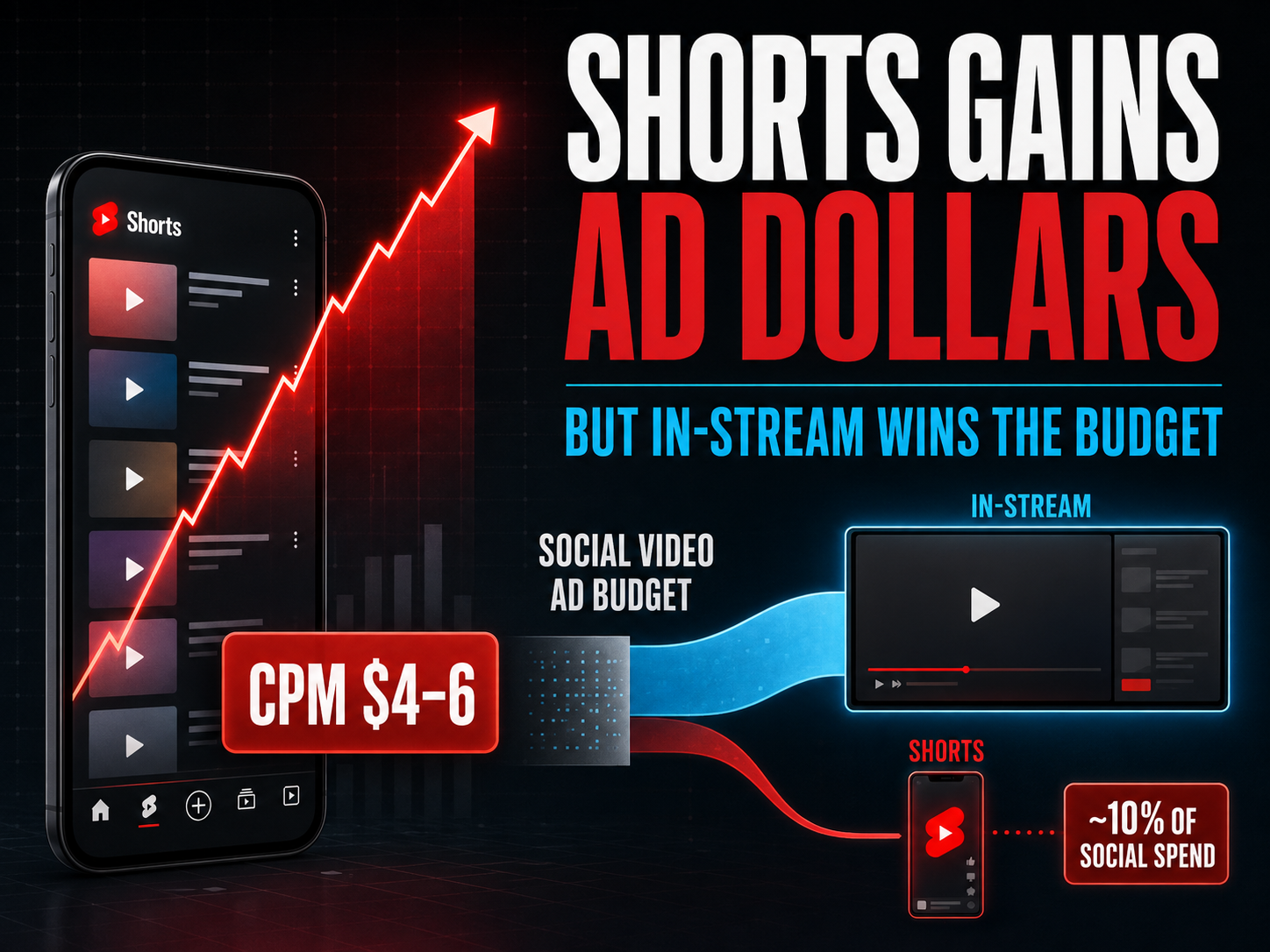
YouTube doubles its Shorts revenue-sharing bar… ad dollars rise while bundled buys steer delivery to in-stream

Feb. 1, 2027, YouTube doubles the entry bar for its Partner Program to 8,000 qualified watch hours or 20 million Shorts views in 90 days. Agency executives say advertiser spending on Shorts is rising, but bundled YouTube buys push delivery toward the far larger in-stream pool

YouTube doubles its Shorts revenue-sharing bar… ad dollars rise while bundled buys steer delivery to in-stream

Shorts CPMs run $4–$6 against $7–$8 for Reels and TikTok… revenue per watch-hour matches long-form, but Shorts holds about 10% of social budgets
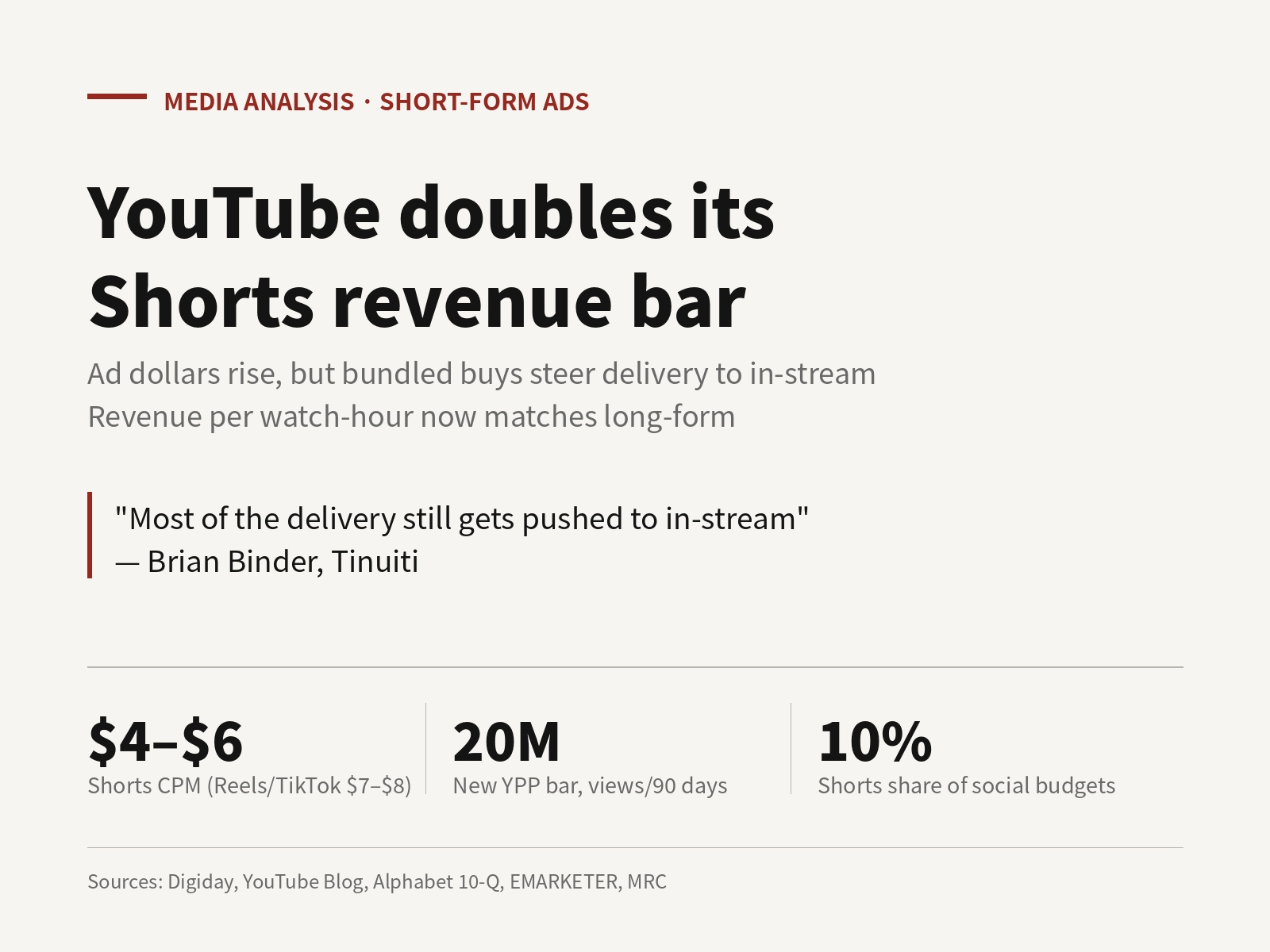
YouTube will require new Partner Program (YPP) applicants to reach 8,000 qualified watch hours over the previous 365 days or 20 million qualified Shorts views over 90 days starting Feb. 1, 2027 — double the current 4,000 hours and 10 million views. Agency executives told Digiday the change does not reflect a shrinking pool of ad dollars aimed at Shorts. The buyers it spoke to said spending on Shorts inventory is going up.

유튜브 숏츠, 수익배분 기준 2배 상향… 광고 집행은 증가, 예산 배분은 인스트림 우위
유튜브, 2027년 2월 1일부터 파트너 프로그램 신규 가입 기준을 시청시간 8000시간 또는 90일 쇼츠 조회 2000만 회로 확대. 광고 대행사들 숏츠 광고 집행액이 늘고 있다고 말하지만, 유튜브 인벤토리를 묶어 사는 번들 구매에서 물량이 많은 인스트림으로 노출이 몰리고 소셜 동영상 예산은 메타 릴스와 틱톡이 선점.

Even so, Shorts accounts for roughly 10% of social video budgets. Most advertisers do not buy Shorts on its own; they buy a bundle of YouTube inventory that includes traditional in-stream, and the sheer volume of in-stream supply absorbs the delivery. The team that owns YouTube buying is frequently the programmatic or search group rather than the social group, and Meta (메타) Reels and TikTok already hold the social video allocations. What lets YouTube raise the bar on the creator side is not ad demand but the economics of revenue per watch-hour.

Shorts CPMs at $4–$6 against $7–$8 for Reels and TikTok… cheaper inventory, slower budget shift

Agency executives put U.S. CPMs at roughly $4 to $6 for Shorts and $7 to $8 for Reels and TikTok. Leah Askew, svp and head of precision media for North America at Digitas, said Shorts spending has grown considerably. Brian Binder, senior director of TV, audio and display at Tinuiti, described the format as one that is only now starting to grow. Skyler McGill, head of programmatic and video at Wpromote, said Shorts has been expanding within both YouTube budgets and video budgets overall.

One agency executive said that when Meta and TikTok take 60% of a buy, Shorts has no path to that level and lands closer to 10%, because it cannot yet scale to the same degree. A YouTube spokesperson did not respond to Digiday's request for comment by press time.


YouTube Shorts

Meta Reels

TikTok

Scale

200 billion daily views; 1 billion-plus hours a day on TV

46% of all time spent on Instagram

$34.8 billion global ad revenue forecast for 2026 (WARC)

CPM (U.S., agency estimates)

$4–$6

$7–$8

$7–$8

Share of ad load on the platform

Loses delivery to in-stream inside bundled buys

53% of Instagram ads in Q4 2025

The default buying unit in social campaigns

Team that buys it

Often programmatic or search

Social

Social

Third-party brand-safety accreditation

MRC accredited (June 2026)

None

None

Creator revenue share

Pooled model, 45% on Shorts

Bonuses and brand deals

Creator rewards

Sources: Digiday (agency CPM estimates), YouTube blog, EMARKETER citing Sensor Tower, WARC, MRC

Bundled buying concentrates delivery… "the algorithm favors in-stream"

Binder said that when inventory is grouped, most delivery still goes to in-stream ads, and the algorithm leans that way because there is so much of that supply. He added that buyers are not avoiding Shorts inventory. McGill said pulling Shorts out as its own line item, rather than leaving it inside a bundled Demand Gen line, tends to drive more scale and better optimization performance.

The buying-unit question is also a measurement question. Inside a bundle, the delivery and performance attributable to Shorts are hard to isolate, and no baseline gets built for comparison against Reels and TikTok. Breaking out the line item is less a decision to spend more than a step toward comparable data.

Revenue per watch-hour now matches long-form… ad frequency is the reason

YouTube CEO Neal Mohan told the MoffettNathanson conference in May 2025 that Shorts had reached parity with core YouTube on revenue per watch-hour in several countries including the U.S., and had passed it in some. He attributed the shift to more ad impression opportunities — Shorts can carry a break every minute or two against every five to 10 minutes on long-form — along with AI-targeted placement and rising usage.

That economics sits behind the current change. Once Shorts viewing stopped diluting YouTube's blended revenue per view, the company gained room to adjust the creator entry bar. YouTube said in its 2026 creator letter that it has paid more than $100 billion through the Partner Program over the past four years.

Pooled allocation puts Shorts RPM at $0.01–$0.07… 10 million views pays in the hundreds

Shorts ad revenue is not earned per video. Revenue from ads running between Shorts in the feed is pooled, then allocated to channels by their share of qualified views within each country, and creators keep 45% of their allocation against 55% on long-form. Industry benchmarks put Shorts RPM at roughly $0.01 to $0.07 per 1,000 views, with high-value categories such as finance and tech reaching the $0.10 range. A channel clearing 10 million views therefore collects a few hundred dollars from the Partner Program.

That math sets the weight of the threshold change. New channels after February 2027 will have to clear a bar twice as high to qualify for ad revenue sharing, and what waits on the other side is not enough to run a channel on. The Shopping bonuses and brand deal incentives YouTube placed below the threshold follow from the same structure.

Google sells Shorts as social inventory… long-form cutdowns fall flat

YouTube and Google (구글) sellers have pitched Shorts to buyers as social video, which follows from its closest comparisons being Reels and TikTok. That pitch carries a creative requirement. Askew said advertisers should not take long-form video into the format, and that treating it as a vertical-video problem is not enough either — social strategy and social assets have to come with it. User-generated content and creator-led assets are replacing cutdowns of TV spots.

Binder said conversations are increasingly about a lift-and-shift approach: taking what a brand already runs on the traditional social side and moving it into Shorts. Because those assets originate with the social team, the approach runs into the organizational question below.

Programmatic or search owns YouTube… social budgets sit behind a wall

Askew said her organization called an all-hands conversation to settle where YouTube buying belongs, and landed on programmatic because of the platform and the skills already built there, with a requirement that the investment group collaborate strategically with social. The lanes, she said, become blurred.

Binder said social teams manage Meta and TikTok while YouTube is sometimes managed by a search or programmatic team, which leaves brands to work out where the platform lives and which baseline its performance should be measured against. With assets coming from one team and the buy executed by another, Shorts budgets belong fully to neither group's KPIs.

Reels takes 53% of Instagram ads… how social budgets got claimed

Sensor Tower data cited by EMARKETER puts Reels at 46% of all time spent on Instagram, with 53% of Instagram ads running on Reels in the fourth quarter of 2025. A Tinuiti report cited in the same article shows Reels' share of Instagram ad impressions rising from 13% to 21% year over year in the second quarter of 2025. TikTok's global ad revenue is forecast at $34.8 billion for 2026.

U.S. digital video ad spend is on track to pass $80 billion in 2026, the same year connected TV upfront commitments exceed primetime linear upfront spending for the first time. YouTube draws from both the social short-form pool and the CTV pool, but different teams control those budgets, which slows Shorts' access to the social side.

Money moves only on outperformance… "it needs to be the best performer"

As buyers start treating Shorts like Reels and TikTok, the condition for moving budget has become outperformance rather than parity. One agency executive said Shorts performance is comparable to TikTok and Reels, but because those platforms operate at higher spend levels, Shorts is expected to deliver stronger efficiency. Without that, the executive said, there is no argument for scaling it fully — it has to be the best performer before dollars are routed its way.

New YPP bar of 8,000 hours or 20 million views… existing partners kept, Shorts share gated at 10 million

YouTube published the Partner Program changes on Aug. 10 (Aug. 11 in the Korean-language edition of its blog), calling them the first major overhaul since 2018 for a program with more than 3 million creators. New applicants must reach 8,000 qualified watch hours over the last 365 days or 20 million qualified Shorts views over the last 90 days, and the update does not affect creators already in YPP. Fan funding and shopping thresholds stay as they are. YouTube says creators can review and sign the new terms in YouTube Studio, effective Feb. 1, 2027; Forbes reported that existing partners must accept them by Jan. 31, 2027.

YPP eligibility for ad and Premium revenue sharing from Feb. 1, 2027. Source: YouTube Official Blog, Aug. 10, 2026

Shorts revenue sharing carries a separate condition. From Feb. 1, 2027, ad and subscription revenue sharing on Shorts applies to creators with at least 10 million qualified Shorts views over the previous 90 days. Channels below the line keep their YPP status and continue earning on long-form, and sharing resumes automatically once they clear 10 million views again. YouTube says creators already earning substantially from Shorts will see little effect. Fan funding and shopping thresholds are unchanged, and YouTube is adding Shopping bonuses, brand deal incentives and earnings boosts for starting and growing trends for channels under the threshold.

The subscription split was also set out: dedicated creator pools are formed from 30% of net Premium revenue and 60% of net Premium Lite revenue, after the costs of operating and promoting the service including payments to music partners. Each pool is distributed by member watch time and views, and creators receive 55% on long-form and 45% on Shorts. Premium Lite is expanding to every country where Premium is offered. Citing 2026 performance, YouTube says partners earn more on average when a viewer subscribes to Premium than when the same viewer watches ads. YouTube said Shorts now draws more than 200 billion daily views and more than a billion hours of daily watch time on TV sets, and that it expects to pay creators more in 2027 than in 2026.

How Premium revenue reaches creators: net revenue into creator pools, then Shorts and Watch Page sub-pools, then a 45% or 55% revenue share. Source: YouTube Official Blog, Aug. 10, 2026

The rules also define which views do not count. Reuploads of other creators' work, unedited movie and TV clips, and artificial traffic are excluded from qualified views, which limits any operation built on bulk clip uploads at both the eligibility stage and the payout stage.

Shorts takes the first MRC brand-safety accreditation in short form… a route in for regulated categories

Buy-side conditions changed once already this year. YouTube secured its sixth consecutive Media Rating Council (MRC) brand-safety accreditation in June and extended the scope to Shorts, the first short-form video service to be covered. The accreditation spans the Maximum, Moderate and Limited inventory suitability tiers and applies to in-stream and Shorts inventory bought through Google Ads and Display & Video 360. TikTok and Reels do not hold an equivalent third-party accreditation.

Social Media Today noted that the accreditation audits documented systems and processes rather than live placements, and that as AI components take on more of the ad-placement process, practice can diverge from the audited parameters. For finance, pharmaceutical and other regulated advertisers that had excluded short form for want of third-party verification, the audit nonetheless supplies a documented basis.

YouTube Q2 ad revenue of $11.06 billion… up 12.6%

Alphabet's (알파벳) quarterly filing puts YouTube ad revenue at $11.055 billion for the second quarter of 2026, against $9.796 billion a year earlier, a gain of 12.6%. Alphabet's total revenue for the quarter was $119.796 billion and Google advertising revenue was $81.629 billion; YouTube ads reached $20.938 billion for the first half. On the earnings call, chief business officer Philipp Schindler said Shorts continues to deliver high-performing opportunities for both social and video buyers.

Alphabet CEO Sundar Pichai said more than 1.7 billion unique viewers watched videos tied to the 2026 FIFA World Cup. YouTube's total revenue passed $60 billion in 2025.

What this means for Korean (한국) broadcasters

Shorts inventory prices below Reels and TikTok, yet in-stream takes the delivery inside a bundled buy. Social budget authority sits outside the team that buys YouTube, and moving money requires outperformance rather than parity. The table below keeps what the U.S. market shows on the left and adds, on the right, what to check when the same conditions apply in Korea.


What the U.S. market shows

What Korean (한국) players should check

Buying structure

Bundled with in-stream, the far larger pool takes the delivery

Whether Shorts is a separate line item, and how performance changes once it is

Creative

Long-form cutdowns and vertical conversions underperform; social assets are required

Capacity to move from clip recycling to a social-asset production process

Organization

Programmatic or search owns YouTube, separating it from social budgets

A single benchmark across teams and a clear owner for the channel

Brand safety

Only YouTube holds MRC accreditation in short form

Basis for regulated categories; the verification bar for selling one's own short-form inventory

Creators

Entry bar doubles in February 2027; Shorts share requires 10 million views per 90 days

Ad-revenue dependence of short-form-only channels and a plan for shopping and brand-deal income

Content policy

Reuploads and unedited clips are excluded from the revenue calculation

Recalculating what bulk uploads of on-air clips actually contribute


Auto-uploaded clips fall outside qualified views… editing is the condition

Broadcaster channels in Korea run Shorts largely by slicing on-air highlights. Under the rules YouTube has set out, reuploads of other creators' work, unedited movie and TV clips, and artificial traffic are excluded from qualified views. A clip cropped to vertical with no captions, commentary or restructuring can accumulate views and still be left out of the revenue calculation.

The first move is shifting channel metrics from raw views to qualified views and retention. Where clip production is outsourced at programme scale, editing guidelines need an explicit restructuring requirement and a managed ceiling on raw-cut clips.

MBC Entertainment (MBC엔터테인먼트), with 9.21 million subscribers and 114,000 uploads, runs a dedicated Shorts tab whose latest entries are preview and teaser clips from the variety programmes currently on air. In that setup — a broadcaster feeding clips against its own transmission schedule — how heavily the clips are edited and how they are distributed across channels bears directly on the revenue-sharing conditions that take effect in February 2027.

The Shorts tab on MBC Entertainment's channel, filled with preview and teaser clips from programmes on air. Source: YouTube channel page

Programme-by-programme channels collide with the 10 million-view condition

From Feb. 1, 2027, only channels with at least 10 million qualified Shorts views over 90 days share in Shorts ad and subscription revenue. Broadcasters that spin up a separate channel per programme have to clear that bar channel by channel, and channels for finished programmes lose the share as views decay. Sharing resumes automatically once views recover, but seasonal programmes will see it switch off and on across hiatus periods.

That forces a choice between consolidating channels by genre or brand and keeping programme channels alive with off-season upload volume. Ownership and settlement terms for channels operated by MCN partners also need resolving before the new terms take effect on Feb. 1, 2027.

Selling your own short-form inventory now invites MRC-level scrutiny

With Shorts the first short-form service to hold MRC brand-safety accreditation, finance and pharmaceutical advertisers that require third-party verification have documentation on YouTube's side only. Broadcasters selling ads against short-form zones inside their own apps, OTT services and FAST channels will face the same question. Suitability tiering, invalid-traffic filtration and impression measurement have to be presentable as documented process before the inventory sells.

Korea has no equivalent accreditation covering short-form inventory. Where a single broadcaster cannot stand up an audit process alone, a shared standard built with media reps, advertiser bodies and measurement vendors is the more practical route.

Short-form sales sit apart from broadcast ad sales

On the buy side, programmatic or search teams tend to hold YouTube while social teams hold Meta and TikTok. On the sell side in Korea, broadcast inventory moves through media reps while short-form is sold by in-house digital teams, so no integrated proposal gets built. Without knowing which of the advertiser's teams controls short-form money, the proposal reaches the wrong desk.

Standing short-form up as its own product line is what produces performance data comparable to Reels, TikTok and Shorts. Bundled into a broadcast package, short-form results are never counted separately, and nothing survives to serve as evidence in the next negotiation.

Recalculating standalone short-form economics… ad frequency is the variable

YouTube says Shorts has reached parity with long-form on revenue per watch-hour, attributing it to break opportunities every minute or two against every five to 10 minutes on long-form. Operators that have treated short form purely as a funnel into long-form and FAST channels can now recalculate the standalone economics of the short-form slot, looking at ad frequency and ad product structure together.

For K-content clips with heavy overseas viewing, allocation follows qualified view share within each country, so the country mix rather than the total view count drives what actually gets paid. Channels with large international audiences should carry country-level view distribution into their performance reporting.

Task

What to check

Standard / deadline

Clip editing

Share of raw vertical cuts without captions, commentary or restructuring; outsourced editing guidelines

Reuploads and unedited clips are excluded from qualified views

Channel structure

90-day qualified views per programme channel, handling of finished programmes, ownership and settlement for MCN-run channels

New terms signed in YouTube Studio; effective Feb. 1, 2027

Selling inventory

Suitability tiering, invalid-traffic filtration and documented measurement for short-form zones in owned apps, OTT and FAST channels

MRC accreditation sets the expected bar

Sales organization

Short-form as its own product line; which advertiser team (programmatic or social) executes the spend

Counted separately from broadcast packages

Revenue model

Ad frequency and ad product structure in the short-form slot; standalone economics apart from funnel value

Watch-hour parity as the premise

Global views

Country-level distribution of qualified views; payout variance for channels with heavy overseas viewing

Allocation pooled by country


Sources

Tim Peterson, "Future of TV Briefing: YouTube Shorts gains ad dollars but needs to crack social budgets," Digiday, Aug. 19, 2026 (https://digiday.com/future-of-tv/future-of-tv-briefing-youtube-shorts-gains-ad-dollars-but-needs-to-crack-social-budgets/)

YouTube Official Blog, "New opportunities to earn and changes to the YouTube Partner Program," Aug. 10, 2026 (https://blog.youtube/news-and-events/youtube-partner-program-updates-2027-new-opportunities-earn/)

YouTube Official Blog (Korean edition), "유튜브 파트너 프로그램의 새로운 수익 창출 기회 및 변경 사항" (New earning opportunities and changes to the YouTube Partner Program), Aug. 11, 2026 (https://blog.youtube/intl/ko-kr/news-and-events/youtube-partner-program-updates-2027-new-opportunities-earn/)

YouTube Help, "YouTube Shorts monetization policies" (https://support.google.com/youtube/answer/12504220)

Tubefilter, "YouTube hopes stricter ad eligibility requirements will make Shorts revenue meaningful for creators," Aug. 10, 2026 (https://www.tubefilter.com/2026/08/10/youtube-partner-program-ad-eligibility-requirements-shorts/)

Forbes, "YouTube Doubles The Monetization Bar For New Creators," Aug. 11, 2026 (https://www.forbes.com/sites/gabrielalinzainescu/2026/08/11/youtube-doubles-the-monetization-bar-for-new-creators/)

Music Ally, "YouTube raises thresholds for creators to start earning revenue," Aug. 11, 2026 (https://musically.com/2026/08/11/youtube-raises-thresholds-for-creators-to-start-earning-revenue/)

Seoul Economic Daily (서울경제), English edition, "YouTube Raises Bar for Ad Revenue, Squeezing Smaller Creators," Aug. 12, 2026 (https://en.sedaily.com/international/2026/08/12/youtube-raises-bar-for-ad-revenue-squeezing-smaller-creators)

Variety, "YouTube CEO Says Revenue From Its TikTok-Like Shorts Videos Is at Parity With Core YouTube in U.S., Other Countries," May 15, 2025 (https://variety.com/2025/digital/news/youtube-shorts-revenue-parity-core-youtube-us-1236399174/)

Google Ads & Commerce Blog, "YouTube earns industry's first MRC accreditation for short-form video," June 3, 2026 (https://blog.google/products/ads-commerce/youtube-mrc-accreditation-shorts/)

Social Media Today, "YouTube Shorts is awarded Media Rating Council accreditation," June 4, 2026 (https://www.socialmediatoday.com/news/youtube-shorts-is-awarded-media-rating-council-accreditation/821955/)

EMARKETER, "FAQ on short-form video advertising: New formats, measurement standards, and creative guidelines," August 2026, citing Sensor Tower and Tinuiti (https://www.emarketer.com/content/faq-on-short-form-video-advertising--new-formats--measurement-standards--creative-guidelines)

Alphabet Inc., Form 10-Q for the quarter ended June 30, 2026, U.S. Securities and Exchange Commission (https://www.sec.gov/Archives/edgar/data/0001652044/000165204426000071/goog-20260630.htm)

Variety, "YouTube Ad Sales Increase 13% in Q2 2026: Alphabet Earnings Results," July 22, 2026 (https://variety.com/2026/digital/news/youtube-q2-2026-ad-sales-alphabet-google-earnings-results-1236818132/)

TheWrap, "Alphabet Second Quarter 2026 Earnings Report," July 2026 (https://www.thewrap.com/industry-news/business/alphabet-earnings-q2-2026/)

TheDesk.net, "YouTube advertising revenue climbs to $11.1 billion during Q2," July 2026 (https://thedesk.net/2026/07/google-alphabet-youtube-q2-2026-earnings-report/)

Shorts RPM and creator earnings estimates: vidIQ, "YouTube Shorts Monetization in 2026" (https://vidiq.com/blog/post/youtube-shorts-monetization/); Satura, "Average YouTube Shorts RPM by Niche: 2026 Guide" (https://saturaai.com/blog/youtube-shorts-rpm-explained-niche-earnings)