
POLICY INTELLIGENCE
Four bipartisan House co-leads are preparing the measure. The industry points to 143,500 jobs a year, but its headline 65% U.S. production share is a modeling assumption, not an independent forecast.
The campaign for a U.S. film and television production incentive has moved from presidential endorsement toward legislation. The Ankler reported that Reps. Laura Friedman (로라 프리드먼) and Linda Sánchez (린다 산체스), both California Democrats, and Republicans Brian Jack (브라이언 잭) of Georgia and Nathaniel Moran (너새니얼 모런) of Texas are preparing a bipartisan House bill. Three sources said it could be introduced as soon as next week. A bill number and final text were not public as of September 20, although some supporters were discussing a path to passage by year-end.
The industry’s working benchmark is a 20% credit on qualifying U.S. labor. A minimum domestic spend of $1 million (about KRW 1.4 billion) has been discussed, along with possible uplifts for productions relocating to the United States and for work in rural communities. Every one of those details remains subject to the statutory text.
The commercial significance lies in the design. The proposed credit is expected to be transferable and stackable with state incentives. That would allow productions with little current tax liability to sell the credit and convert it into financing, changing the effective cost of choosing a U.S. location. The transfer rules, buyer liability and timing of monetization could matter nearly as much as the headline rate.
A federal layer on top of state incentives
Hollywood shifts its ask from tariffs to tax credits
President Donald Trump (도널드 트럼프) twice floated a 100% tariff on foreign-made films in 2025 without imposing one. On August 31, 2026, he instead urged Congress to enact a bipartisan federal production incentive. The Motion Picture Association (미국영화협회·MPA), unions representing actors, writers, directors and crews, suppliers and major studio executives then intensified their push in Washington. The industry’s practical answer to runaway production is now a domestic cost offset rather than a border measure.
Netflix co-CEO Ted Sarandos (테드 서랜도스) and NBCUniversal entertainment and studios chair Donna Langley (도나 랭글리) met with lawmakers, while Disney Entertainment co-chair Alan Bergman (앨런 버그먼) was also reported to be involved. The alignment of studios, platforms, labor and production suppliers makes the campaign look less like a narrow corporate tax request and more like a national industrial-policy effort.
The coalition also broadens the politics. Republican lawmakers from Georgia and Texas—states with established production programs—joined California Democrats, while a new congressional film and television production caucus added members from New York. Production states increasingly share a cross-party economic interest.
The working rate moved from 15% to 20% in three months
A June discussion draft associated with Sen. Adam Schiff centered on a 15% labor credit modeled in part on Canada’s federal system. It also contemplated an uplift for productions relocating to the United States. Following Trump’s endorsement and the entry of Republican House co-leads, the industry benchmark rose to 20%. Jon Voight and some advocates have pushed for a rate closer to 25%, leaving the final number unresolved.
The timing also reflects the expiration of an older federal tool. Internal Revenue Code Section 181, which allowed qualified production costs to be expensed immediately, no longer applies beginning with the 2026 tax year. Whether the new credit moves as a stand-alone bill, through budget reconciliation or inside a year-end tax package will shape both timing and durability.
The 143,500-job estimate comes with assumptions
An Olsberg SPI (올스버그 SPI) study commissioned by the MPA estimates that a 20% federal incentive would add $125.3 billion (about KRW 175.42 trillion) in U.S. production spending from 2027 through 2035. It projects $133.1 billion (about KRW 186.34 trillion) in additional labor income, $249.1 billion (about KRW 348.74 trillion) in gross value added and an annual average of 143,500 full-time-equivalent jobs.
These are modeled activity and employment effects, not a calculation of tax revenue recaptured by the Treasury. The $249.1 billion figure should not be read as government income, and the jobs figure does not mean 143,500 direct hires would appear immediately after enactment.
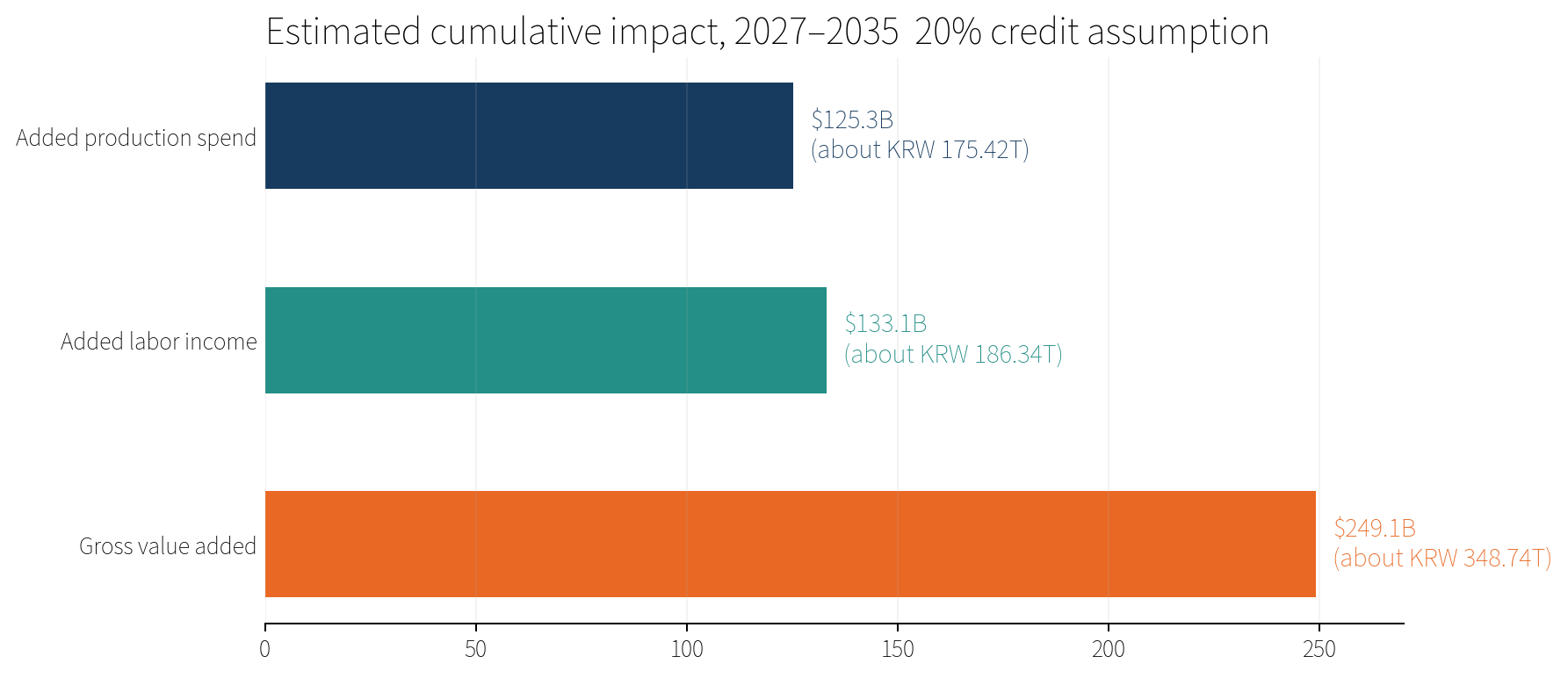
Figure 1. Modeled cumulative impact of a 20% federal incentive, 2027–2035. Source: Olsberg SPI study commissioned by the MPA.
The study’s most consequential input is a 65% U.S. production share. It starts with a 2025 U.S. share of 34% for film and 42% for television. Without the incentive, those shares fall to 25% and 29% by 2035. With the incentive, both are assumed to reach and hold 65%. That 65% is not an independently observed forecast; it is a scenario target linked to a 2015 FilmLA sample of 109 films.
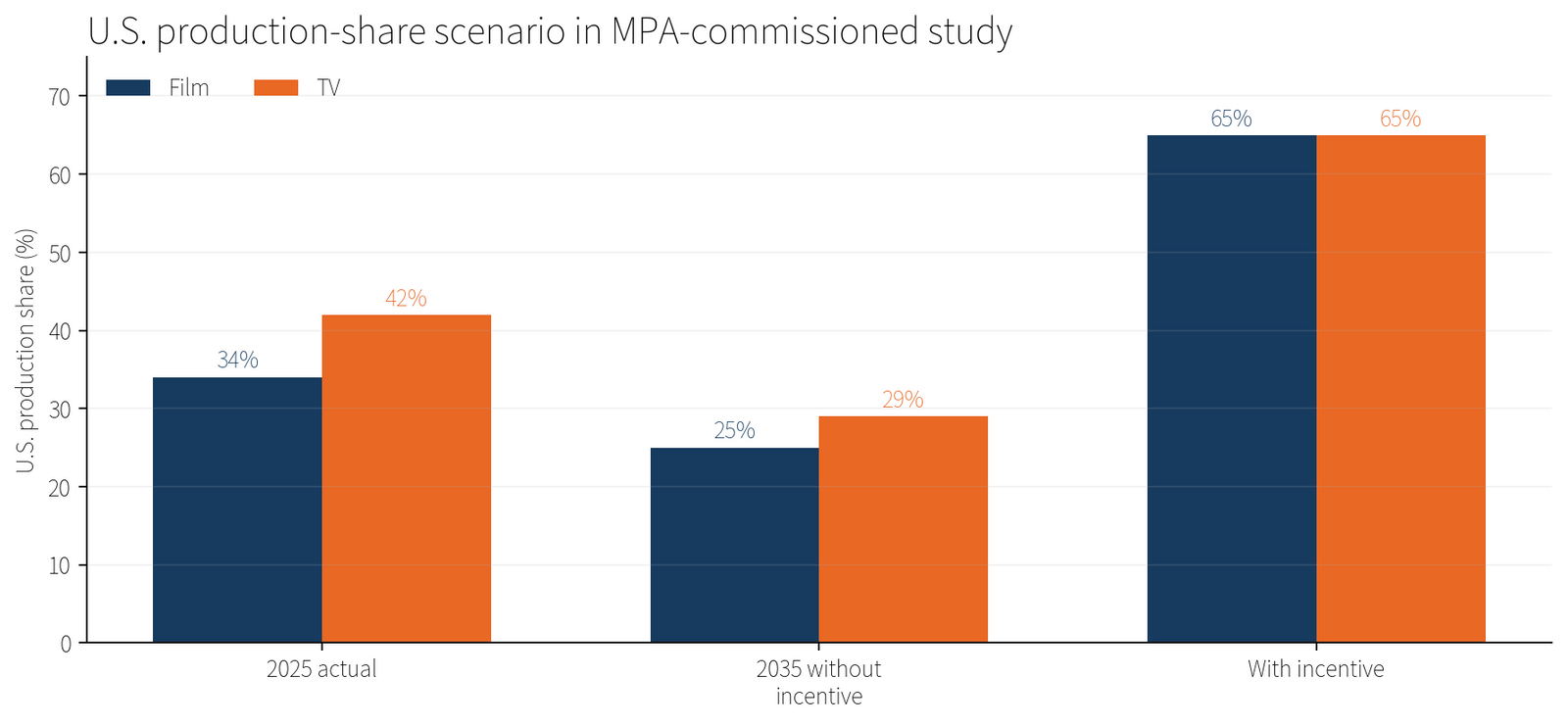
Figure 2. U.S. production-share scenarios. The 65% level is a central modeling assumption, not a guaranteed outcome.
There is a fiscal counterargument. The Mackinac Center for Public Policy has criticized state film incentives, including Georgia’s program of more than $1 billion a year (about KRW 1.4 trillion), citing weak or negative returns in prior cost-benefit studies. The MPA model measures production activity, labor income and employment rather than Treasury revenue recapture, so the two claims address different outcomes.
Los Angeles production losses raise the pressure
FilmLA (필름LA) counted 4,711 regional location shoot days in the second quarter of 2026, down from 5,394 a year earlier and 5,121 in the prior quarter. Activity was 36% below the five-year average. California has expanded its annual incentive budget to $750 million (about KRW 1.05 trillion) and raised its base credit to 35%, yet aggregate local filming has not produced a sustained rebound.
Friedman told a March hearing in Burbank that the region had lost 40% of its production jobs over three years. Soundstage utilization has fallen from the mid-90% range to 62%. As of 2026, 39 states, Washington, D.C. and Puerto Rico operate production incentives, generally worth 15% to 45% of eligible spending.
The pressure extends beyond soundstages. Fewer shoot days translate into weaker demand for set construction, camera and lighting rentals, costumes, transportation, hotels and post-production. That supply-chain effect is why supporters frame the federal credit as a jobs and industrial-capacity policy rather than a subsidy for celebrity-driven content.
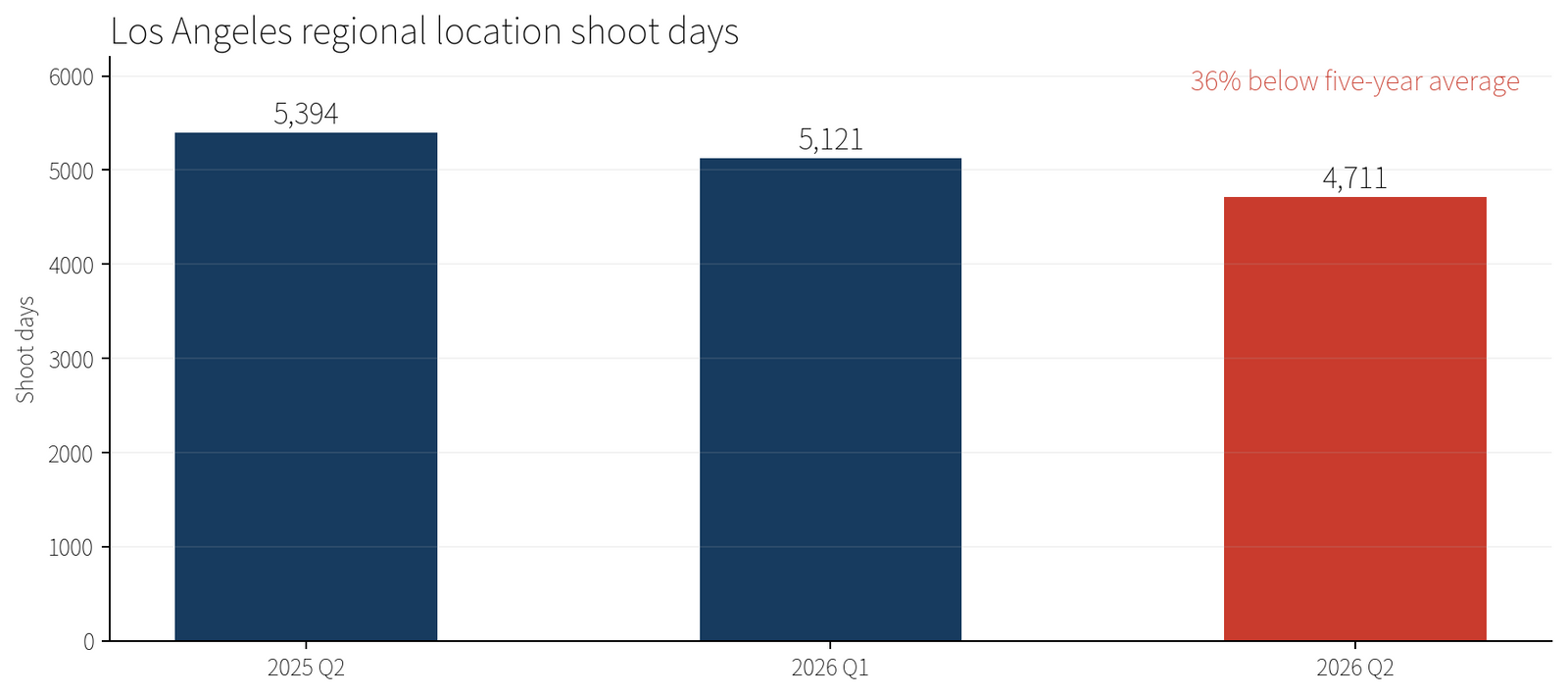
Figure 3. Los Angeles regional location shoot days. Source: coverage of FilmLA’s Q2 2026 report.
The number of national and subnational production-incentive programs worldwide has increased from 86 in 2017 to 121 today. Variety identified Korea alongside Ireland, Australia, South Africa and Eastern Europe as production hubs that expanded during that period. A federal U.S. credit would elevate the competition from state-level recruitment to national industrial policy.
Lower U.S. costs but tougher competition for Korea
Korea currently offers production-cost tax credits of up to 15% for large companies, 20% for mid-sized companies and 30% for small companies, with the program scheduled through the end of 2028. The Korean benefit offsets domestic corporate or individual income tax. A transferable U.S. credit stacked with state programs would work differently and could materially reduce the budget of Korean productions spending on U.S. labor through a local entity.
The defensive risk is equally important. U.S. projects comparing Korea with domestic locations would add the federal credit to their cost models, potentially affecting location work as well as Korean VFX and post-production orders. Korea will need to compete with more than facilities and talent: cash-like location support, streamlined permitting and bundled virtual-production and post-production services become more urgent.
Four details that will determine the bill’s impact
Sources and interpretation
This update reflects public reporting and official materials available as of September 20, 2026. The House proposal remained in preparation; no bill number or final statutory text had been confirmed. MPA study results depend on a 20% credit and a 65% U.S. production-share scenario. Korean-won conversions use a convenience rate of USD 1 = KRW 1,400, rounded for scale; actual market, tax and accounting rates will differ.
The Ankler, Elaine Low, SCOOP: Federal Incentive Bill Could Come Next Week, Sept. 18, 2026. https://theankler.com/scoop-federal-incentive-bill-could-come-next-week/
Variety, MPA Projects Federal Film Incentive Would Double U.S. Production and Create 143,500 Jobs, Sept. 15, 2026. https://variety.com/2026/film/news/mpa-federal-film-incentive-jobs-production-report-1236861764/
The Hollywood Reporter, Nearly $250B Could Come From Federal Film Tax Credit, Study Says, Sept. 15, 2026. https://www.hollywoodreporter.com/business/business-news/nearly-250-b-federal-film-tax-credit-study-1236700785/
The Hollywood Reporter, Netflix, Universal Chiefs Descend on D.C. to Capitalize on Trump Tax Credit Momentum, Sept. 18, 2026. https://www.hollywoodreporter.com/business/business-news/dc-hollywood-trump-tax-credit-momentum-1236704767/
IndieWire, A Federal Tax Incentive for Filming Could Bring in Extra $125 Billion in Production Spend, Sept. 15, 2026. https://www.indiewire.com/news/business/federal-tax-incentive-filming-study-mpa-1235217277/
Deadline, Industry Unites Behind U.S. Production Incentive as New Study Predicts Windfall in Jobs and Spending, Sept. 15, 2026. https://deadline.com/2026/09/entertainment-industry-film-tv-production-incentive-jobs-1237103806/
Reuters, Trump urges Congress to pass tax incentives for entertainment industry, Aug. 31, 2026. https://www.reuters.com/world/trump-urges-congress-pass-tax-incentives-entertainment-industry-2026-08-31/
TheWrap, Can Hollywood Sell Congress, Trump on a Federal Film Tax Credit?, June 23, 2026. https://www.thewrap.com/industry-news/public-policy-legal/can-hollywood-sell-congress-trump-on-a-federal-film-tax-credit/
FilmLA, Q2 2026 regional location-production report and related industry coverage.
Mackinac Center for Public Policy, The False Promise of Film Incentives, April 2026.