
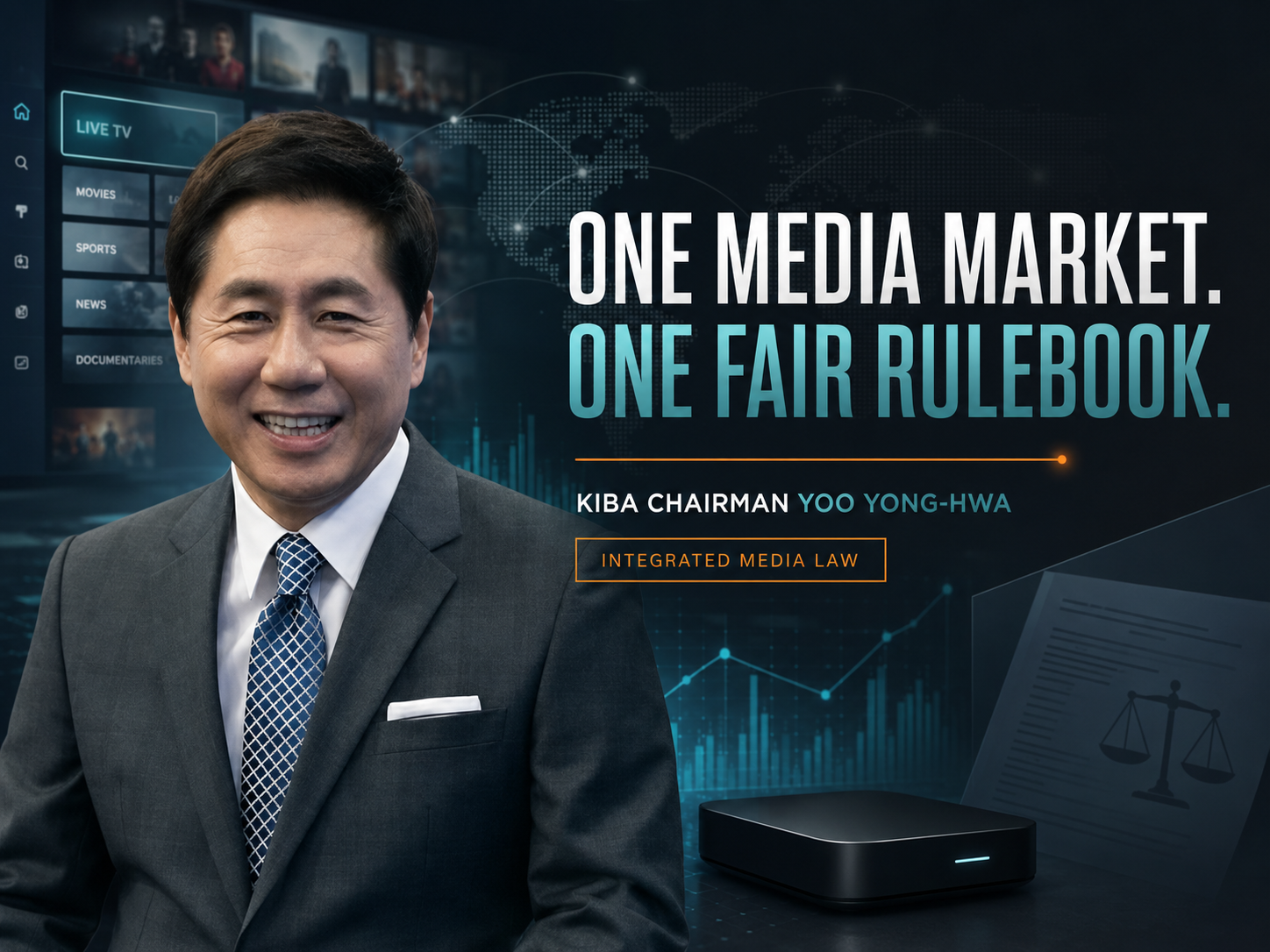
Media Policy | Interview Analysis
Chairman Yoo Yong-hwa: "Same service, same regulation" and minimum regulation are the two principles to carry through… draft legislative proposal in mid-November, digital advertising conference on December 16
Yoo Yong-hwa (유용화), chairman of the Korea IPTV Broadcasting Association (한국IPTV방송협회, KIBA), has set enactment of an integrated media law as the association's first priority. In an interview published by ET News (전자신문) on August 30, Yoo said Korea's media law "still has 'control' as its default" and "has not escaped the framework of the Broadcasting Act, built in the 1980s as an instrument of state control."
The association has formed a research team to produce a draft legislative proposal by mid-November. Elected at the association's general assembly on March 19 and in office since April, Yoo has been meeting operators, lawmakers and ministries to refine the proposal.
Yoo located the cause of the crisis in the legal framework rather than in the management of individual operators. The 1980 Broadcasting Act (방송법) was written as a tool of state control, the 1983 Telecommunications Business Act (전기통신사업법) on national security grounds, and neither the 2008 Internet Multimedia Broadcast Services Act (IPTV법) nor the 2009 Digital Media Content Industry Promotion Act broke with a regulation-first pattern, he said.
In the meantime pay-TV subscriptions reached saturation and viewing moved to mobile and streaming services. IPTV remains bound by rate and terms-of-service regulation and public-interest obligations while global streaming services have reshaped their pricing and business models outside that regime. That asymmetry, in Yoo's account, is why subscriber growth no longer translates into revenue.
EU set horizontal regulation with the 2007 AVMSD… "We just watched"
Yoo held up the European Union's Audiovisual Media Services Directive (AVMSD) as the comparison. The EU adopted the AVMSD in 2007, establishing a horizontal regime built on the principle of same service, same regulation, then revised it in 2018 and had member states transpose the revision by 2020 to fit the digital environment. The 2018 revision requires on-demand catalogues to carry at least 30% European works and brought video-sharing platforms into scope. "We just watched all that time," Yoo said. Netflix and other streaming services entered the market in the interim, and domestic operators, tied to regulation, lost competitiveness without being able to respond, he said. He described the inaction of politicians and ministries with the legal term for neglect, haetae (해태·懈怠).
IPTV at 21.53 million subscribers and a 59.6% share… revenue flat as subscribers rise
The Korea Communications and Media Commission (방송미디어통신위원회, KCMC) reported on May 29 that pay-TV subscriptions stood at 36,150,070 in the second half of 2025. That was 76,030 fewer than the previous half-year, continuing a slow decline that began in the first half of 2024. IPTV accounted for 21,535,256 of those subscriptions, a 59.57% share.
Cable system operators (SOs) had 11,935,236 (33.01%) and satellite 2,679,578 (7.41%). Over the past three years IPTV subscriptions have grown slowly while SO and satellite have shrunk. KT (KT) leads by operator with 9,123,463 subscriptions (25.24%).
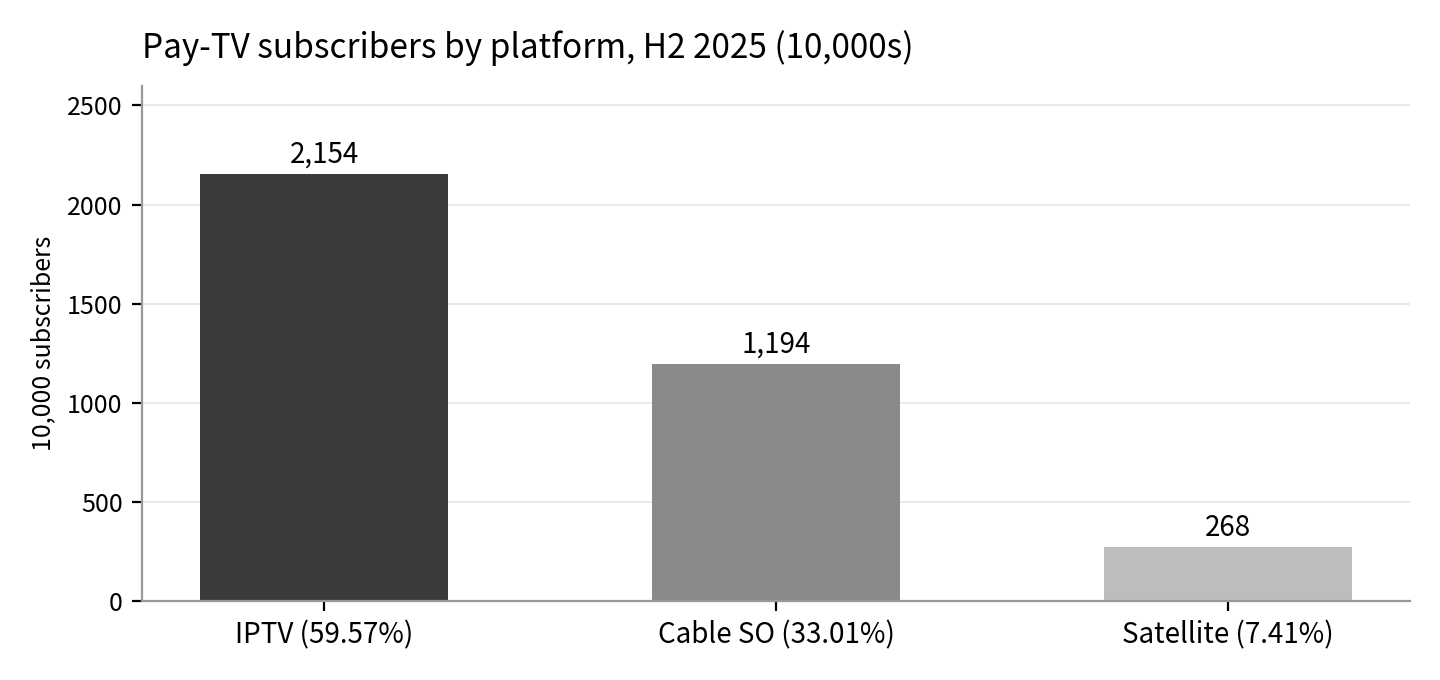
Pay-TV subscribers by platform, second half of 2025. The three IPTV operators are approaching a 60% share. Source: Korea Communications and Media Commission (released May 29)
Yoo does not read those numbers as growth. "If you look only at subscriber numbers or share, it looks like growth, but profitability is under serious pressure," he said. Global streaming services diversify pricing and business models freely, while IPTV, held to rate and service regulation, has limited room to diversify revenue into data-driven businesses. "What is urgent is not adding subscribers but fixing the institutional base so that high-value services can be built," he said.
Terms-of-service rules first in line… "Even one add-on service needs approval first"
Asked which regulation should be addressed first, Yoo named rates and terms of service. The current terms-of-service regime is nominally a notification system but in practice requires acceptance by the regulator, he said. "An operator that wants to launch a single add-on service has to get approval first, so it hesitates and investment is delayed," he said. "At the very least, marketing and sales should be free." Streaming services launch products freely while only domestic broadcasters' commercial activity is blocked, he said, adding that this is a demand shared by every broadcast operator.
The same demand surfaced in a government forum. On August 20 the KCMC held the first meeting of its Pay-TV Revitalization Public-Private Council (유료방송 활성화 민관협의체), with the three IPTV operators KT, SK Broadband (SK브로드밴드) and LG Uplus (LG유플러스), four cable SOs, KT Skylife (KT스카이라이프), six program providers including CJ ENM and SBS Medianet (SBS미디어넷), and the Korea Information Society Development Institute (정보통신정책연구원, KISDI).
The industry's first-listed improvement item was rate and terms-of-service regulation. A common standard and verification system for set-top-box viewing data, and program-fee disputes between platforms and program providers, are also on the council's agenda. The KCMC had said in its second-half work report in July that it would draw up a pay-TV media promotion strategy.
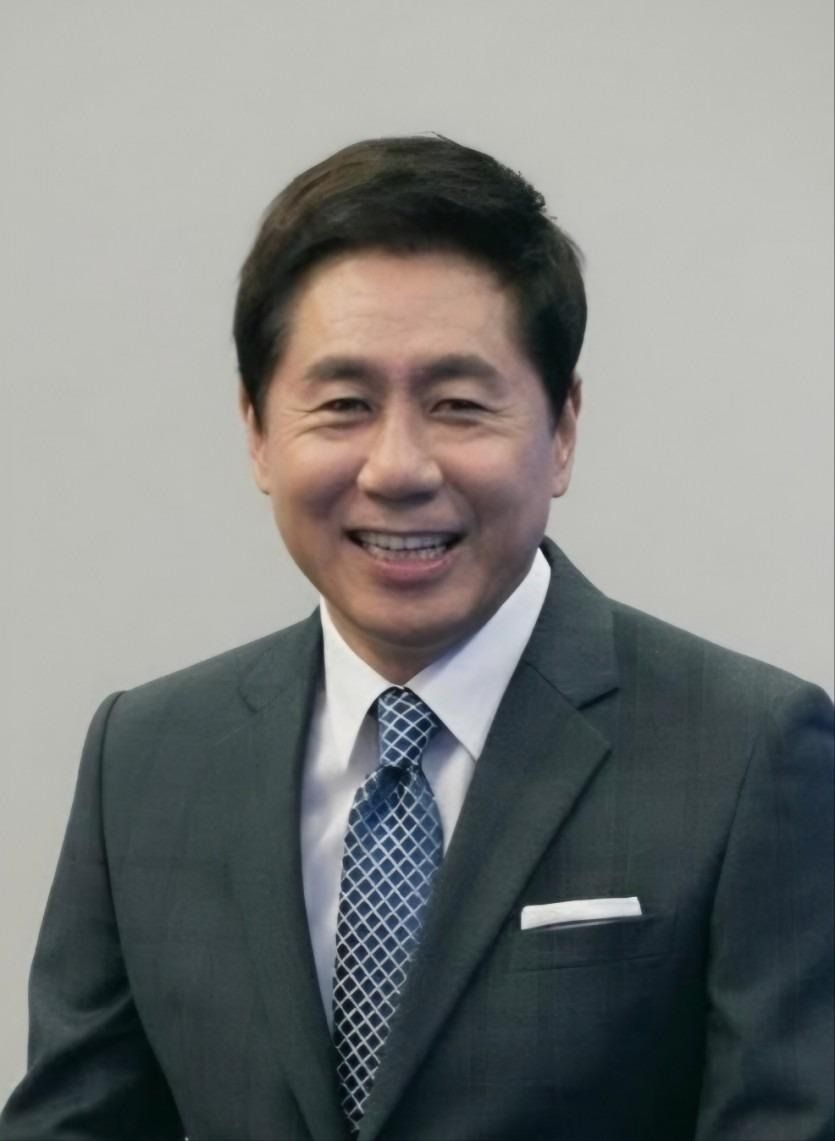
Viewing data from 18 million set-top boxes… "A channel measured at 0% reads 0.8%"
The next growth engine Yoo described is an AI- and data-based media and advertising platform. The plan is to use household-, age- and generation-level viewing data from set-top boxes to deliver personalized addressable advertising. "Content that the existing ratings agencies register at 0% comes out at 0.8% in set-top data," he said. "For small and mid-sized program providers that is not a small number." Used well, the 18 million set-top boxes would affect the entire advertising market, not only the three IPTV operators, he said. The three companies are jointly funding development of an addressable advertising solution, and the association's policy committee is directly involved.
Yoo also raised the flow of government advertising to YouTube. A working domestic personalized digital advertising market is what would make government advertising effective and protect data sovereignty, he said.
Streaming services a "complex partnership"… program fees resolved by "growing the pie"
On whether streaming services are competitors or partners, Yoo said it is not either-or but "a complex partnership in which coexistence has to be found inside fierce competition." IPTV set-top boxes already function as integrated media platforms carrying Netflix, Disney+ and YouTube, he said. For alliances to mean anything, though, the tilted playing field has to be leveled first; once regulatory parity exists, he said, growing a domestic streaming service or entering Southeast Asian markets together becomes possible.
On the program-fee disputes that surfaced first in the cable industry, Yoo saw a structural limit of a zero-sum game over a fixed pie. He called platforms and program providers "a shared-fate community that sustains the ecosystem together" and said the fundamental solution is to grow the whole market through addressable TV advertising and data solutions. With home-shopping channels the association is discussing cooperation such as hot-deal offers and data sharing. Excessive government intervention in the name of policy coordination leaves lasting side effects, he said; adjustment should be left to the parties with the government in a minimal role.
150-day holdback accepted on condition… pay-TV holds 4 of 22 seats on the ministry's council
For pay-TV's role in the K-content ecosystem, Yoo pointed to stable private funding. KT (KT) has placed an independent-film section in its VOD service; SK Broadband sponsors environmental and women's film festivals and screens their titles on VOD during the festivals; LG Uplus offers classical performances and other cultural content free of charge. If the advertising pie grows, he said, there would be room to reinvest in programs like the KBS anthology drama TV Literature Hall (TV문학관) of decades past.
On the film holdback being pursued by the Ministry of Culture, Sports and Tourism (문화체육관광부), Yoo said the association has already told the ministry-led governance body it will accept a 150-day window on condition that promotion measures are drawn up alongside it. The ministry and the Korean Film Council (영화진흥위원회, KOFIC) held the first meeting of their Public-Private Council for Improving Korean Film Distribution (한국 영화 유통구조 개선을 위한 민관협의체) on May 29. The 22-member council comprises four ministry and KOFIC officials, three producers, five distributors, three exhibitors, four pay-TV (TVOD) representatives and three streaming services; Yoo sits on it.
Digital Daily (디지털데일리) reported on August 18 that the council had discussed a baseline of 150 days with title-by-title exceptions, and Asia Today (아시아투데이) reported on August 19 that the agreement was expected to set a 120-to-150-day window. The ministry had said it would announce a result within August, and civic groups including MINBYUN and People's Solidarity for Participatory Democracy called at an August 24 press conference for the plan to be dropped on consumer-choice grounds.
"Same service, same regulation" and minimum regulation… the Assembly bill was introduced in June
Yoo named two points he intends to carry through in the integrated media law. The first is the principle of same service, same regulation: if the substance of providing content is the same, rights and obligations proportionate to influence should apply regardless of the delivery medium. The second is minimum regulation: rather than layering new rules onto existing media, outdated rules should be removed so domestic operators can innovate on their own. The result, he said, "must be a rational and fair integrated law that clearly separates the public sphere from the industrial sphere."
A bill is already before the National Assembly. Rep. Choi Min-hee (최민희) of the Democratic Party introduced the Audiovisual Media Services Act (시청각미디어서비스법) on June 18. The bill came out of an integrated-media-law task force Choi set up under her office while chairing the Science, ICT, Broadcasting and Communications Committee (과학기술정보방송통신위원회) in the first half of the 22nd Assembly; the task force met 16 times. The draft released on January 26 replaces "broadcasting" with "audiovisual media service" as the umbrella concept and splits the field into a public sphere and a market sphere with different regulatory intensity.
Public broadcasters, terrestrial networks and news channels stay in the public sphere under a licensing regime, while streaming services enter the law under a notification regime. Streaming services and YouTube are subject to algorithm-transparency rules, and the bill includes promotion provisions covering overseas expansion and tax relief.
Korea IPTV Broadcasting Association (KIBA) logo. Source: KIBA
The association's calendar is aligned with that legislative debate: a joint seminar with the Korean Association for Broadcasting & Telecommunication Studies (한국방송학회) and three platform associations on September 30, the research draft in mid-November, an integrated-media-law seminar in late November, and a digital advertising conference on IPTV Day, December 16.
Yoo acknowledged that integrated media legislation has been attempted repeatedly and has failed each time, but said he "senses considerable will in the newly constituted committee."
Term goal is passage of the law… Korea-China-Japan exchange as a route to content exports
Yoo named passage of the integrated media law as the single most important task of his term. "Business success depends on social approval and securing the public interest," he said, adding that private interests are protected when a company works for the national public good.
KT, SK Broadband and LG Uplus are each pursuing AI transformation and more advanced personalized services. Over the longer term he outlined a plan for association-level private exchange among Korea, China and Japan as a route to content exports.
Yoo graduated from Korea University (고려대) in history and earned a doctorate in political science at Dongguk University (동국대).
He was a visiting scholar at Johns Hopkins SAIS and Georgetown University, a visiting professor of political science at Dongguk, a policy researcher at the National Assembly, and from 2017 a visiting professor at Hankuk University of Foreign Studies (한국외대).
He hosted current-affairs programs including KTV's Daehan News, National Assembly TV's Political Debate, TBS's Yoo Yong-hwa's Sisigakgak and BBS Buddhist Broadcasting's Morning Journal. He became chairman of the association in April 2026.
Quotation practice: text in double quotation marks is a reported remark; unquoted text summarizes reporting. All remarks by Chairman Yoo are translated from his ET News interview of August 30, 2026 (conducted by Park Ji-sung, head of the telecom and media desk; written by Choi Da-hyun).
Terminology: this article uses "streaming service" throughout in place of "OTT".
Sources
ET News (전자신문), interview with KIBA chairman Yoo Yong-hwa, published August 30, 2026 (print edition August 31, p. 12)
Korea Communications and Media Commission, pay-TV subscriber and market-share release for H2 2025, May 29, 2026 (as reported by ET News, ZDNet Korea and Inews24)
IT Daily (아이티데일리), first meeting of the KCMC Pay-TV Revitalization Public-Private Council, August 20, 2026
ZDNet Korea (지디넷코리아), Rep. Choi Min-hee introduces the Audiovisual Media Services Act, June 18, 2026
Edaily, Aju News, Business Post, Digital Today: National Assembly task-force draft forum, January 26–27, 2026
Ministry of Culture, Sports and Tourism and KOFIC, first meeting of the film distribution council, May 29, 2026 (as reported by Newsis, Newspim and Kyunghyang Shinmun)
Digital Daily, film holdback heading to 150 days, August 18, 2026; Asia Today, holdback voluntary agreement expected at 120–150 days with exceptions, August 19, 2026; Edaily, ministry's end-of-August deadline, August 31, 2026; Korea NGO News, civic-group press conference, August 24, 2026
Korea IPTV Broadcasting Association press release, election of Yoo Yong-hwa as chairman, March 19, 2026
EU Audiovisual Media Services Directive (2010/13/EU, as amended by Directive (EU) 2018/1808)