
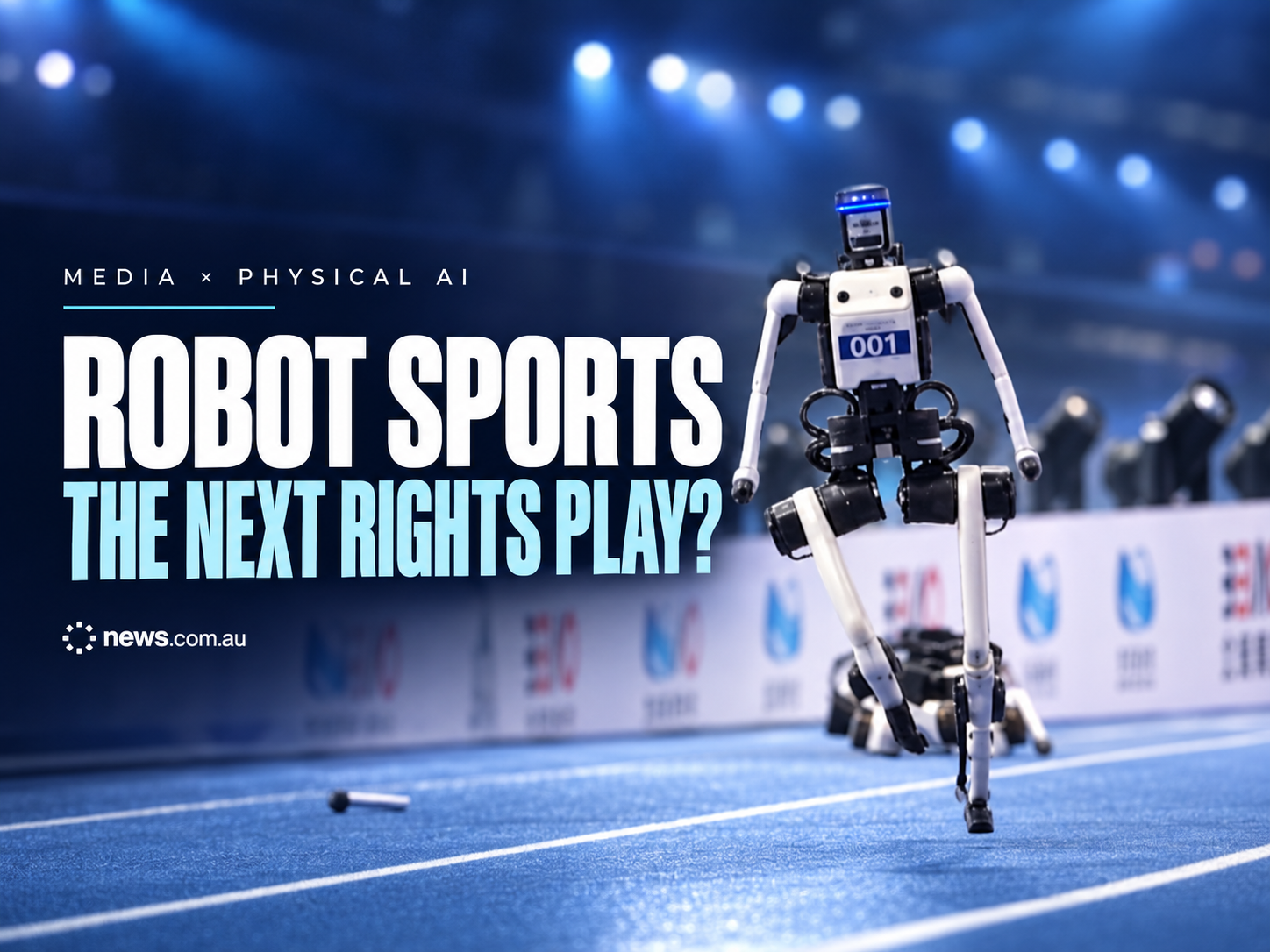
A robot sports league launched in Riyadh and 2,056 robots competed in Beijing — a new variable in a US$67.34bn rights market
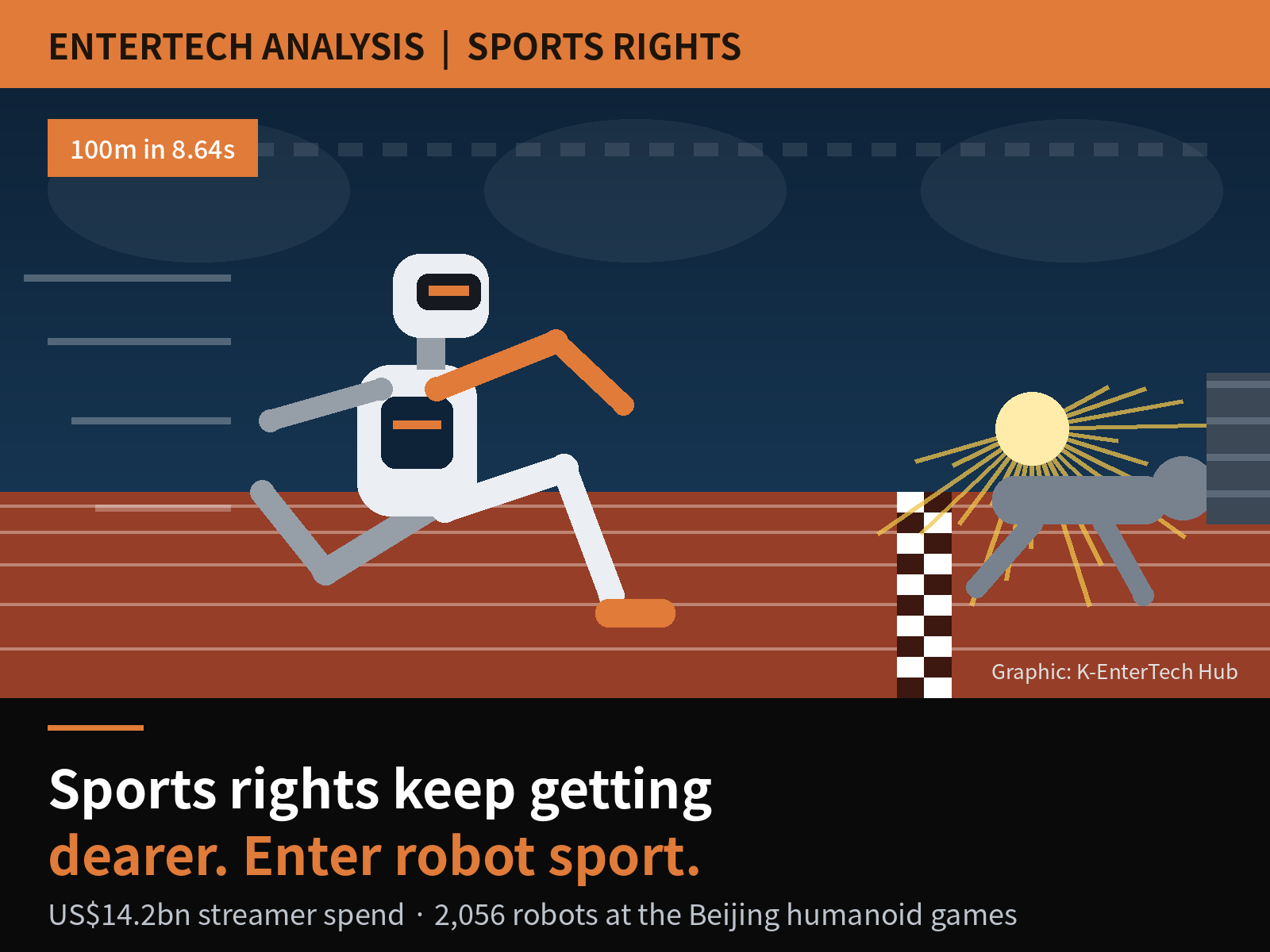
The capital that has been buying sports rights has moved into building leagues out of robots. CyberHero launched in Riyadh, Saudi Arabia, on September 9. Created by the esports company Hero Esports, the league puts machines and software built by people onto the court. Beyond securing games to carry, it is a business that supplies the games.
Hero Esports counts Saudi Arabia's Savvy Games Group and Tencent among its investors. CyberHero's competition machine is EngineAI's T800 humanoid: 1.73m tall, 75-85kg, with 29 articulated joints. Teams are made up of builders who engineer the robot, coders who develop its AI and drivers who make decisions during a match. The first season was announced as an eight-city circuit covering two Middle East stops plus Europe, the Americas and Asia.
Two weeks before the launch, on August 26, the second World Humanoid Robot Games closed in Beijing with 2,056 robots entered. In the 100m final on the closing day, Tiangong Ultra, built by X-Humanoid, recorded 8.64 seconds. On the number alone that is faster than Usain Bolt's human world record of 9.58 seconds. The robots that crossed the line, however, hit the barrier at the end of the track one after another, and one caught fire, bringing staff out with an extinguisher.
Riyadh produced a business plan; Beijing put the capability and the limits of the technology on the same screen. Both put the same question to broadcasters and streaming services. If robot competition can hold an audience, can a platform build a sport it owns the rights to instead of buying them?
In the existing sports market, buyers compete over fandom that is already assembled. The number of matches in a popular league cannot be expanded quickly, and the major rights are tied up in long contracts. More platforms do not mean more games capable of gathering a weekend-evening audience. That is why a scarce right is priced again at every renewal.
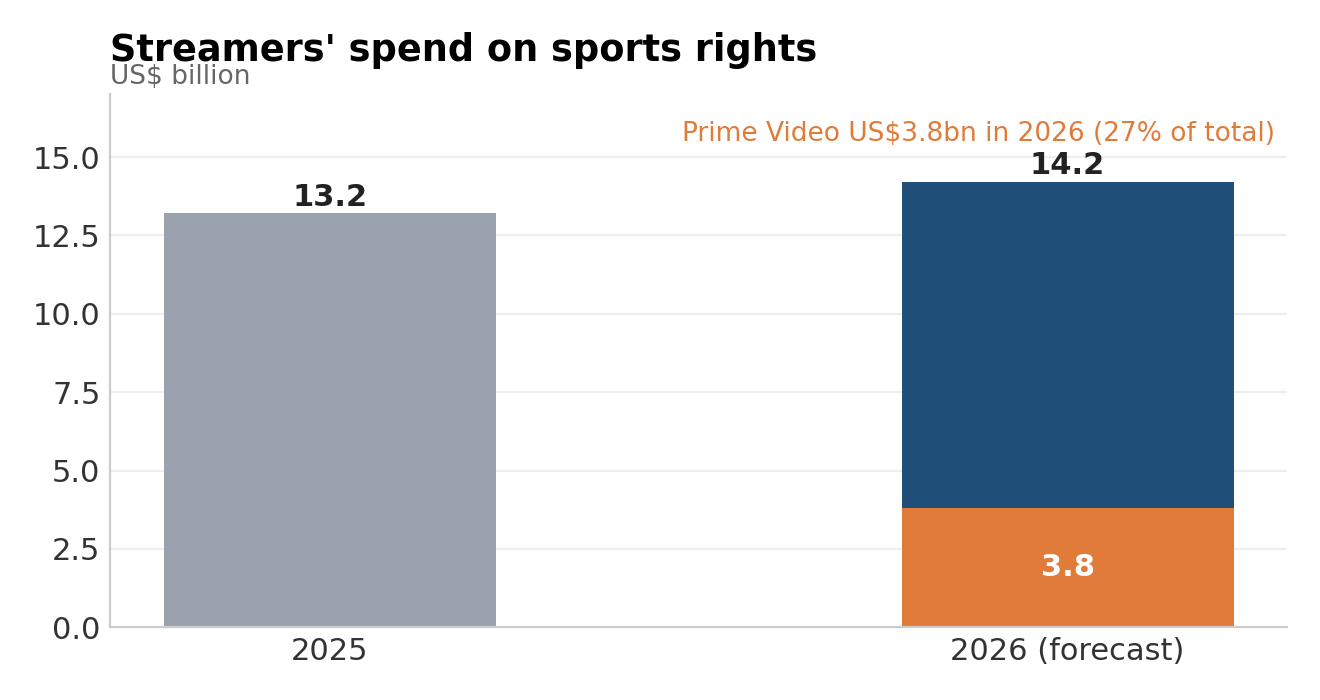
Ampere Analysis puts streamers' spending on sports rights at US$14.2bn (about KRW19.112trn) in 2026. Kagan, part of S&P Global Market Intelligence, counts the whole broadcast and streaming market at US$67.34bn, about KRW90.629trn. North America accounts for US$34.9bn (about KRW46.972trn), roughly 52% of it.
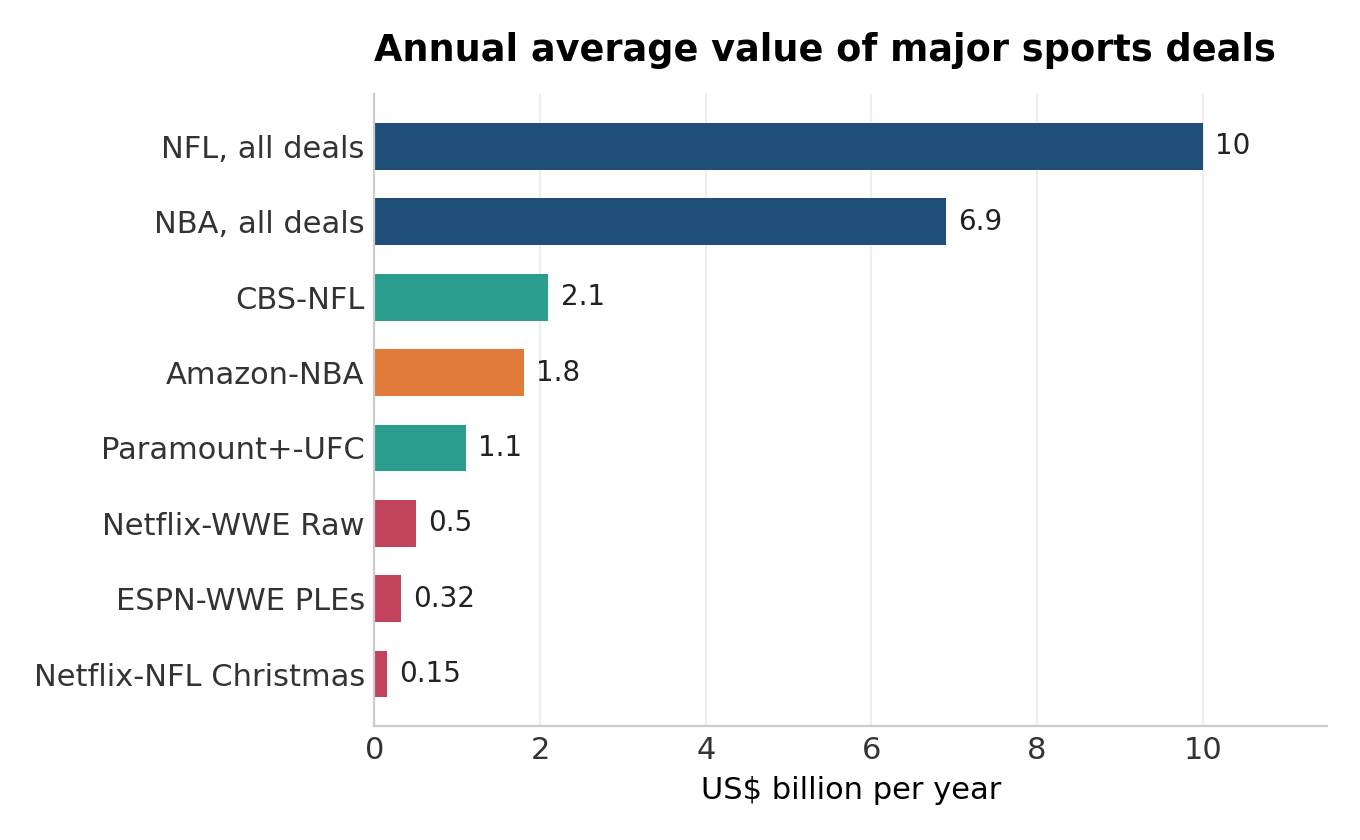
A major league's contract prices decades of viewing habit. The NFL's long-term agreements run to US$110bn (about KRW148.05trn) over 11 years and the NBA's to US$76bn (about KRW102.288trn). Amazon's NBA spending alone is reported at roughly US$1.8bn (about KRW2.423trn) a year. For a platform that is a chance to win subscribers and sell advertising, but keeping the chance means beating rivals at the next renewal too.
The pressure to pay more continues. In remarks reported on September 11, NFL commissioner Roger Goodell raised the possibility of repackaging the current rights bundles. The league is also reported to be seeking a 50% increase from CBS, which pays about US$2.1bn (about KRW2.826trn) a year. A long contract does not fix the cost through a mid-term renegotiation or beyond its expiry.
Korean broadcasters and streaming services know the same burden. Losing a popular sport can cost viewers and subscribers; holding it means absorbing a higher fee. TVING's investment in the KBO and Coupang Play's in the Premier League show both the customer-acquisition effect and the renewal bill that follows. Revenue from carriage does not bring with it the right to run the league or decide next season's supply.
A robot league offers a way to change that structure. Holding the rights to the machines and the AI models, the rules and the characters, and the video archive leaves room to accumulate the value created in production and distribution inside the business. For Korean broadcasters the question worth examining is whether they can develop a format with robot companies and take part in designing those rights from the start.
Being able to manufacture the competitor does not manufacture the fandom. Between Riyadh's circuit schedule and Beijing's crashes sits a business that has not been proven. What a broadcaster has to judge is not a robot's top speed but how many viewers will come back for the next week's match.
2,056 robots, 51 events, 1,301 sessions — and 96% of entries from China
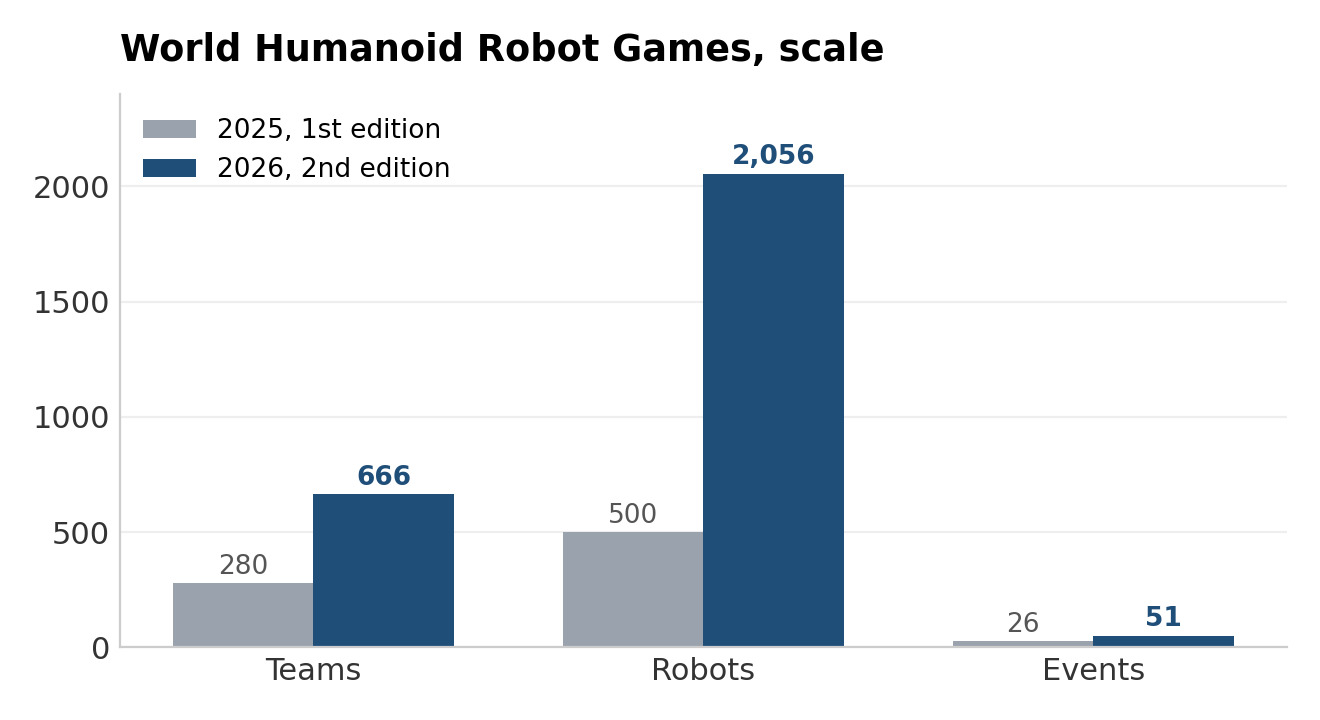
The second edition drew 666 teams from 16 countries fielding 2,056 robots across 51 events and 1,301 sessions. The programme split into 30 competitive events and 21 scenario-based ones, putting track, football, table tennis, boxing, weightlifting and martial arts alongside household-chore tasks. The 2025 inaugural edition had 280 teams, 500 robots and 26 events. The robot count quadrupled in a year, and 96% of entries came from Chinese teams.
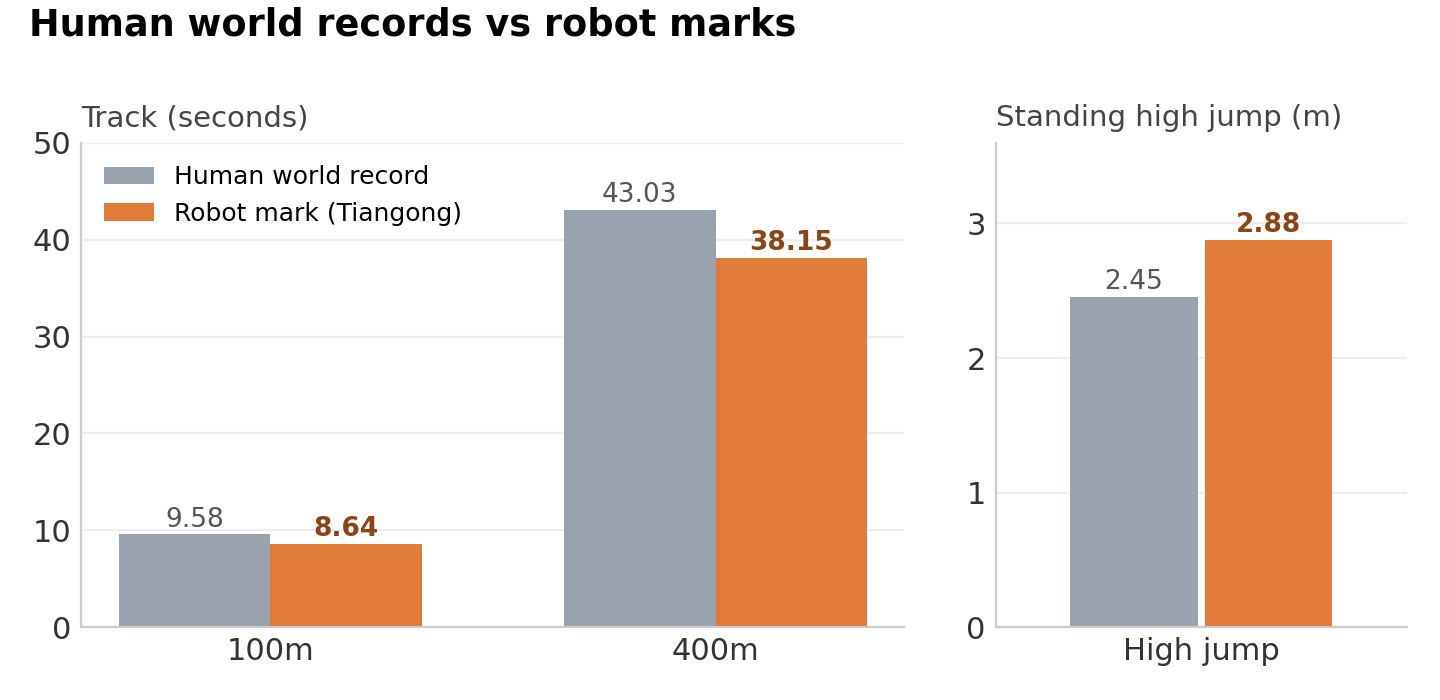
AGIBOT topped the overall standings on its debut with 46 medals — 18 gold, 16 silver and 12 bronze. Tiangong Ultra did not lead the overall table and won the 100m and the standing high jump. On marks alone, the list of events where robots passed human world records grew.
Tiangong machines ran the 400m in 38.15 seconds against the human record of 43.03 seconds and cleared 2.88m in the standing high jump against 2.45m, with a 1,500m mark of 2:21.64. In April, Honor's Lightning completed a half marathon in a net time of 50 minutes 26 seconds.
The other kind of result came from the same event. Four robots entered the weightlifting, where one lost balance holding a 15kg barbell and toppled toward the officials' table. Weightlifting still permits teleoperation. Holding a posture under a variable payload remains a different engineering problem from walking and running. On the track, acceleration passed human marks while deceleration did not, which is why the finishers hit the barrier.
Footage is public. CNET compiled the highlights as "WILDEST Highlights From China's Humanoid Robot Olympics", and news.com.au posted a reel of the falls and collisions as "Biggest fails from the 2026 World Humanoid Robot Games in China". Both carry the record-beating runs and the crashes past the finish line as scenes from the same event. The links are listed under "Video" at the end of this article.
The governing structure already exists. On August 18, 2025, the closing day of the first games, four bodies — the World Robot Cooperation Organization, the Global Digital Economy Cities Alliance, RoboCup Asia-Pacific and the Chinese Institute of Electronics — launched the World Humanoid Robot Games Federation, which set performance and safety standards alongside competition as its stated goals. China Media Group(CMG) carried the domestic feed and CGTN provided the international signal. No U.S. rights deal for the event has been struck.
US$14.2bn on sports rights — Prime Video passes DAZN
In Ampere's February count, 44% of 2026 sports rights spending comes from generalist streaming services rather than sports-first ones. The buyer of sports rights has moved from sports operators to general-purpose platforms.
Prime Video accounts for US$3.8bn (about KRW5.114trn), or 27% of the total, more than US$500m clear of the second-biggest spender and ahead of DAZN, which had led since 2018. Paramount+ joined the top five after Paramount signed a seven-year, US$7.7bn (about KRW10.363trn) UFC deal with TKO Group in August 2025, worth about US$1.1bn (about KRW1.48trn) a year. That contract also ended UFC's pay-per-view sales from 2026.
North America took 48.6% of rights spending in 2025 — 73.8% with Western Europe
By region, North America accounted for 48.6% of sports rights spending in 2025. Western Europe was second at 25.2%, and the two together came to 73.8%. Asia Pacific took 10.9%, Central and South America 6.7%, the Middle East and North Africa 3.6%, Central and Eastern Europe 2.9% and Sub-Saharan Africa 2.0%.
The US$14.2bn of streamer spending and the league contracts cited above move almost entirely between buyers in those first two regions, which is also where the capital to build a robot league and the windows to carry one sit.
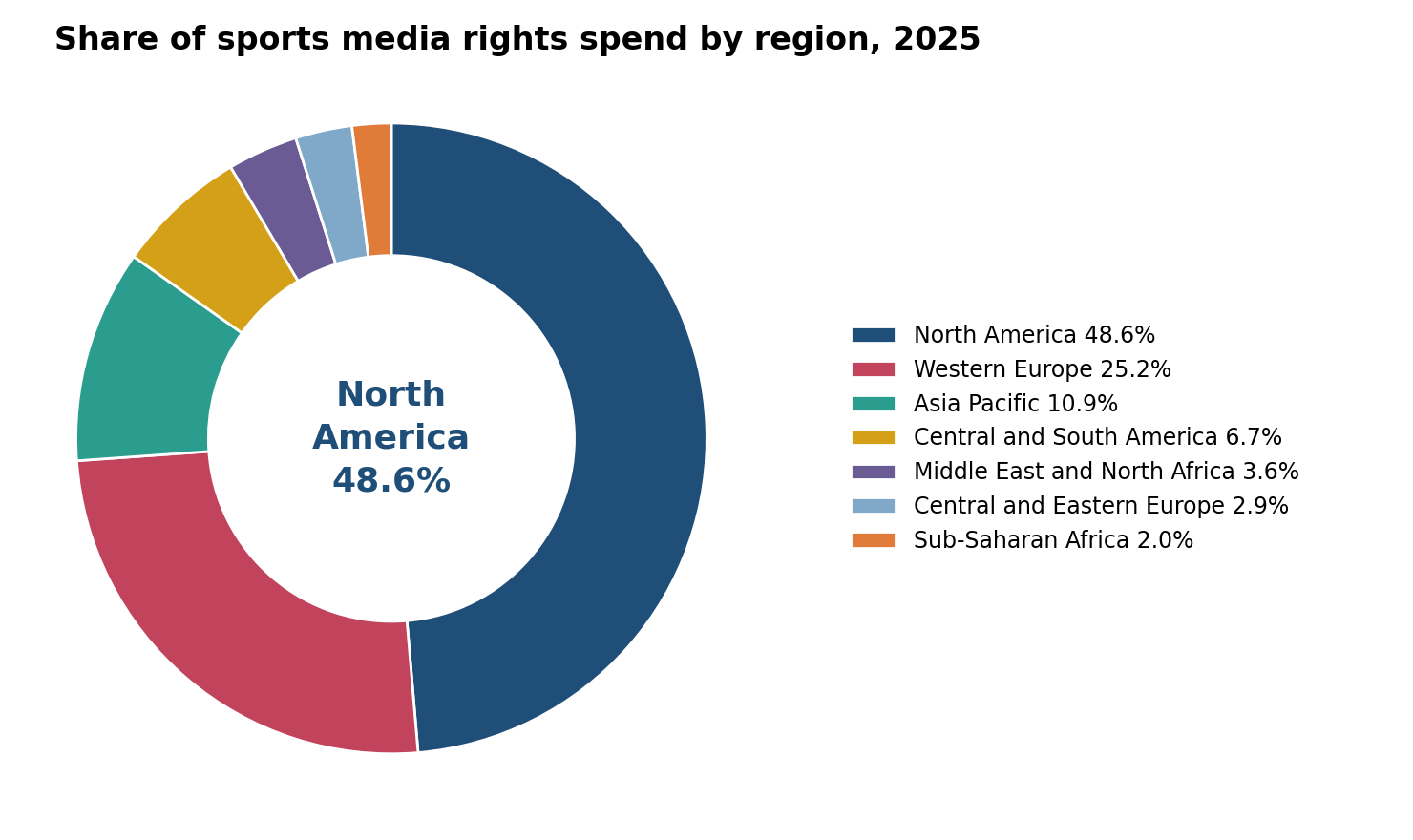
Share of sports media rights spend by region, 2025. Redrawn from a supplied chart. Source: industry tally
For 2026, S&P Global Market Intelligence's April count puts the total at US$67.34bn, with North America at US$34.9bn, or 52%. The U.S. alone accounts for US$32.8bn (about KRW44.146trn), up 11% year on year. The 9.6% rise in the global total was attributed to the 2026 World Cup and Winter Olympics falling in the same year rather than to a fundamental acceleration in demand, which means a year without those events does not repeat the increase — what a buyer pays annually and the simultaneous audience it secures that year do not necessarily move together.
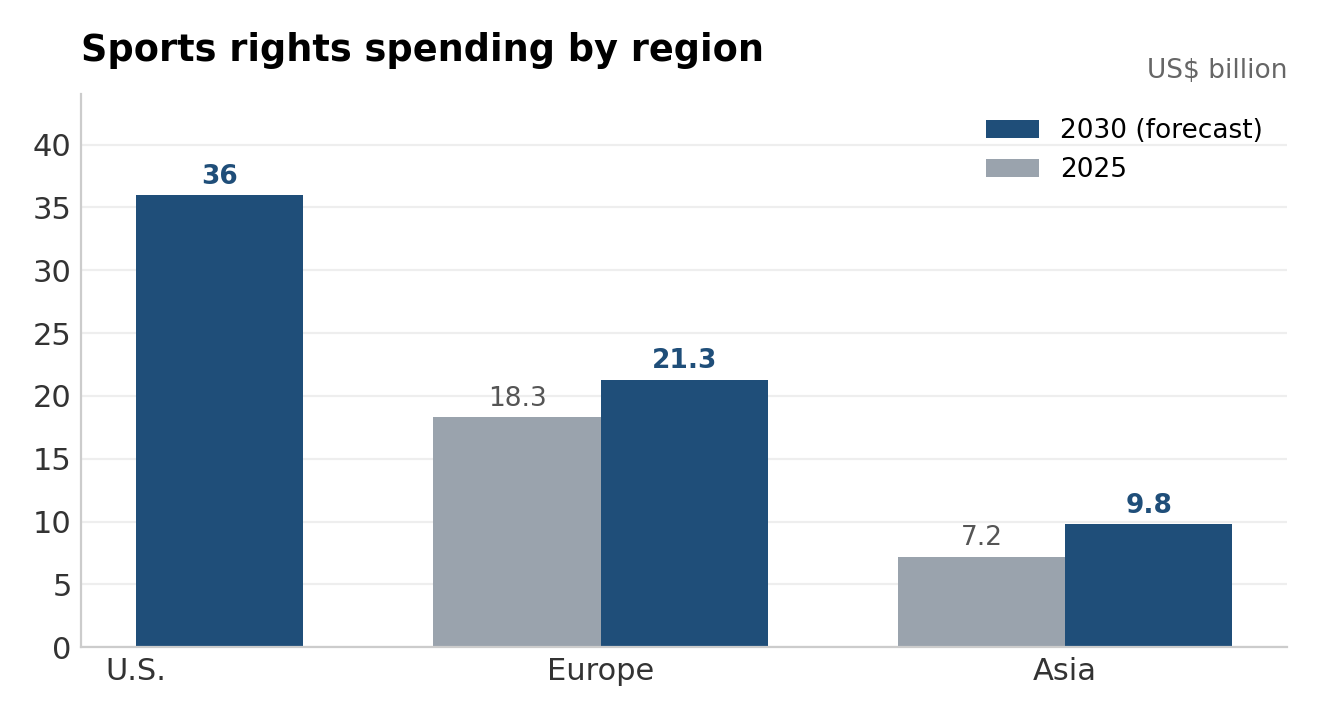
Counting broadcast and streaming together, Ampere expects global rights spending to grow 20% over five years. The U.S. is the largest piece at more than US$36bn (about KRW48.452trn) in 2030, on the strength of new NBA and MLB cycles. Europe rises 17% from US$18.3bn in 2025 to US$21.3bn in 2030, carried by the World Cup and the Winter Olympics, and Asia goes from US$7.2bn to US$9.8bn, with Indian cricket contracts starting in 2027 as the main driver. Dan Harraghy, senior research manager at Ampere, said "sports rights remain a reliable driver of value in media." The forecast carries a rider: if the NFL treats its current deals as underpriced and renegotiates, the U.S. figure goes higher.
NFL repackaging under review — supply is 32 teams and fewer than 2,000 players
The NFL's 11-year agreements took effect with the 2023 season. SNL Kagan puts the total the league receives through 2032 at US$110bn, more than double the previous cycle. Netflix pays about US$150m (about KRW202bn) a year for two Christmas Day games and YouTube holds exclusive Sunday Ticket rights, while ESPN has announced plans to acquire NFL Network and RedZone. Goodell's repackaging remark sits against the fact that this structure opens at once at the 2029 opt-out. The league still carries 87% of its inventory without a paywall.
Supply, unlike price, is fixed. The NFL has 32 teams and fewer than 2,000 players; the NBA has 30 teams and roughly 600. There is no way to make another Patrick Mahomes, because a player has to be born, found and trained over years. Human sport also runs on a production rule that the performers cannot die, which sets the ceiling on how much risk a format can carry.
Annual average value of major sports deals. Source: SNL Kagan, company statements, press reports
YouTube's first exclusive NFL game drew 17.3m globally — given away free
YouTube streamed the NFL's Week 1 game in Brazil in September 2025 exclusively and free to a worldwide audience. It averaged 17.3m viewers globally, 1.1m of them outside the U.S. Executives at FOX and ESPN disputed how Nielsen arrived at the number. A rights holder can put a game outside its paywall to buy reach instead of putting it inside a subscription. A company that owns the league makes that call in its own window, without a negotiation.
A US$4.7bn Sunday Ticket verdict overturned, and a matching-clause suit over the NBA
The structure of rights deals has also gone to court. In June 2024 a federal jury in Los Angeles found the NFL's method of selling Sunday Ticket violated antitrust law and returned a US$4.7bn (about KRW6.326trn) damages verdict; on August 1 Judge Philip Gutierrez threw the verdict out and ruled for the NFL, faulting the methodology of the plaintiffs' expert testimony. The plaintiffs appealed. What was at issue was not the price but the practice of the league bundling its games and selling them through a single window.
In the NBA's case the fight was over a matching clause. Warner Bros. Discovery sued the league on July 26, 2024, saying it had exercised its right to match the package awarded to Amazon; the NBA argued TBS could not meet Amazon's terms and had altered eight of them. The two settled that November, with Inside the NBA produced by TNT Sports and airing on ESPN/ABC and Warner Bros. Discovery taking NBA rights in markets outside the U.S., including the Nordics and Latin America. Both disputes arose because the league holds the selling structure and the contract terms; a company that owns its league has no counterparty for that kind of fight.
62.8m for the World Cup final, 6.7m peak for LoL Worlds — the viewing that prices rights
What holds up the price of sports rights is the power to gather an audience at a set time. Live carries a value that is hard to recover once the result is known, which is what separates it from on-demand programming. A broadcaster sells the advertising in that window; a streaming service tries to convert the viewer who signed on for the match into a subscriber.
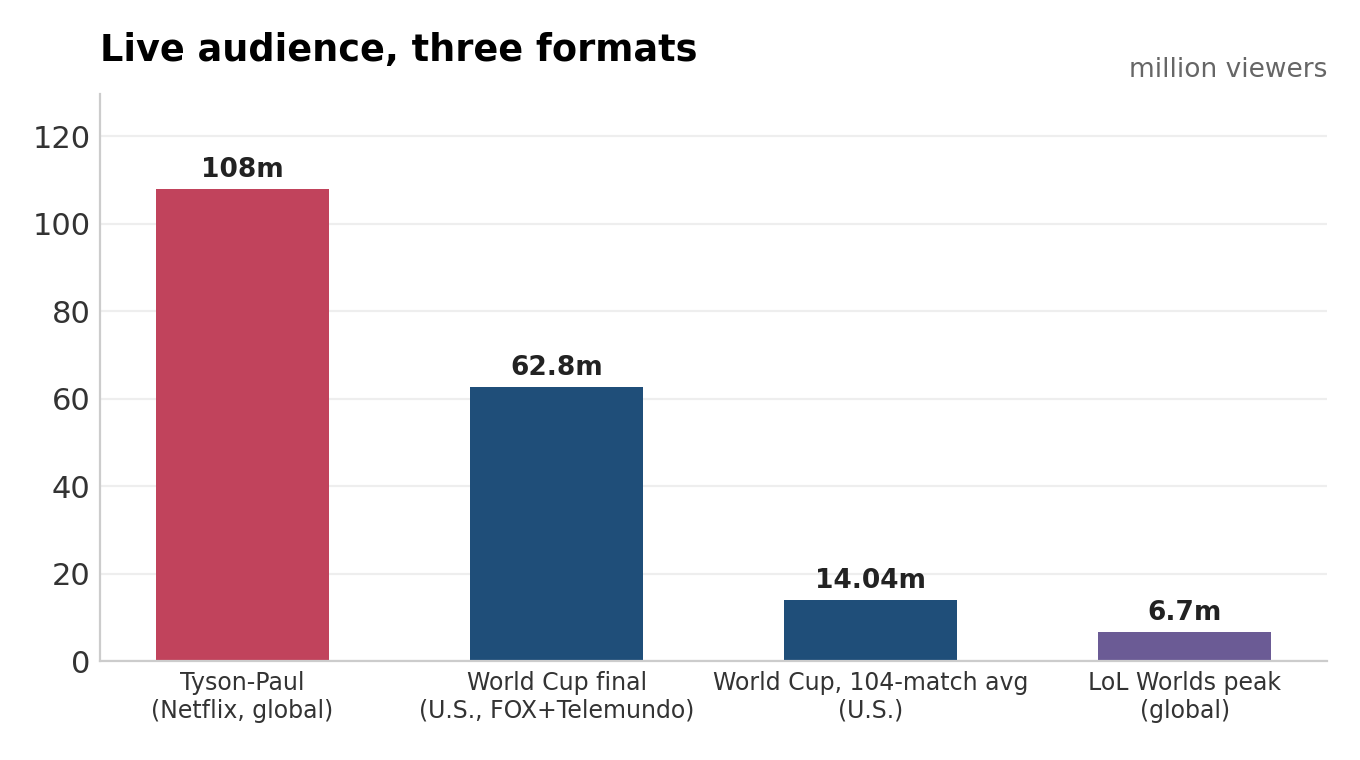
This year's World Cup showed that concentration. The July 19 final between Spain and Argentina averaged 62.8m viewers across FOX and Telemundo in the U.S., and 66.4m counting the match window alone — well above the previous U.S. soccer record of 26.7m for the 2015 women's World Cup final.
With 48 teams competing, the tournament's 104 matches averaged 14.04m viewers: 7.74m on FOX, FS1 and Tubi and 6.3m on Telemundo, Peacock and Universo. Against 2022, FOX was up 116% and Telemundo and Peacock up 143%. For a rights holder, gathering an audience across the whole tournament matters as much as the final itself.
Consumption continued outside the broadcast. Viewing across Telemundo platforms came to 77.2bn minutes and FIFA's official YouTube channel logged 4bn views. Replays and highlights are consumed around the live event. Viewer counts, cumulative hours and video views are different measures, however, and cannot be added together.
Esports, which began in games, has also produced large simultaneous audiences. The 2025 League of Legends World Championship peaked at about 6.7m concurrent viewers during the fifth game of the final between T1 and KT Rolster. Even in a competition built by the company that made the game, rivalry between teams and players can accumulate into sports programming an audience turns up for on schedule.
Dividing that figure against the World Cup final's 62.8m to compare market size does not work. The World Cup number is a U.S. average audience; the Worlds number is a peak concurrent audience on the platforms measured. The territory, the platform coverage and the choice between average and peak all differ. Nor do two numbers settle the ceiling on esports fandom.
What a robot league can take from this is the process by which an audience assembles. A new machine can win attention once. A league's value forms when that attention turns into support for teams and competitors and repeats as viewing of the next match. That is also when a broadcaster has grounds to price the rights.
A US$75m prize pool at the Esports World Cup — sovereign capital in a built league
The 2026 Esports World Cup runs in Riyadh, Saudi Arabia, from July 6 to August 23 with a US$75m (about KRW100.9bn) prize pool. US$30m (about KRW40.4bn) goes to the Club Championship, with US$7m (about KRW9.4bn) to the winning club, and the game championships together exceed US$39m (about KRW52.5bn). Twenty-four titles across 25 tournaments draw about 2,000 players and roughly 200 clubs from more than 100 countries. The 2025 edition reached 750m viewers worldwide and 350m hours watched, peaking at 7.98m concurrent viewers during the League of Legends competition, with more than 3m people attending in person.
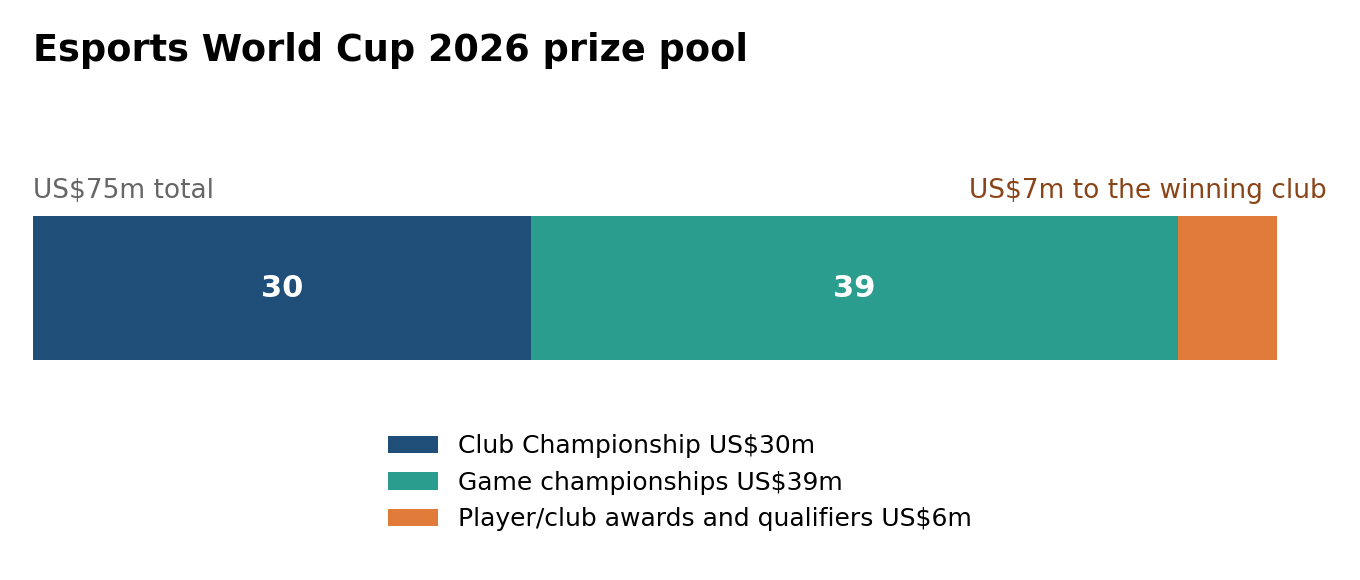
How the 2026 Esports World Cup prize pool is allocated. Source: Esports World Cup Foundation
The Esports World Cup Foundation(EWCF), which runs the event, also came in as founding partner for the first Olympic Esports Games, which the International Olympic Committee will hold in Riyadh in 2027. Separate from the capital that buys rights to existing sports, another pool builds new competitions and funds the purses. The capital a robot league would need is being raised along the same route.
19,000 humanoids shipped in H1 — 65% for entertainment, education and research
The point where robots meet entertainment is already in the shipment data rather than in a plan. Morgan Stanley counted about 19,000 humanoid units shipped worldwide in the first half of 2026, up 272% year on year, of which roughly 65% went to entertainment, education, research and data collection. Productive uses in factories and warehouses account for the rest. Buyers are still purchasing demonstrations and training data rather than labour, which is part of why robot competition was built as competition first.
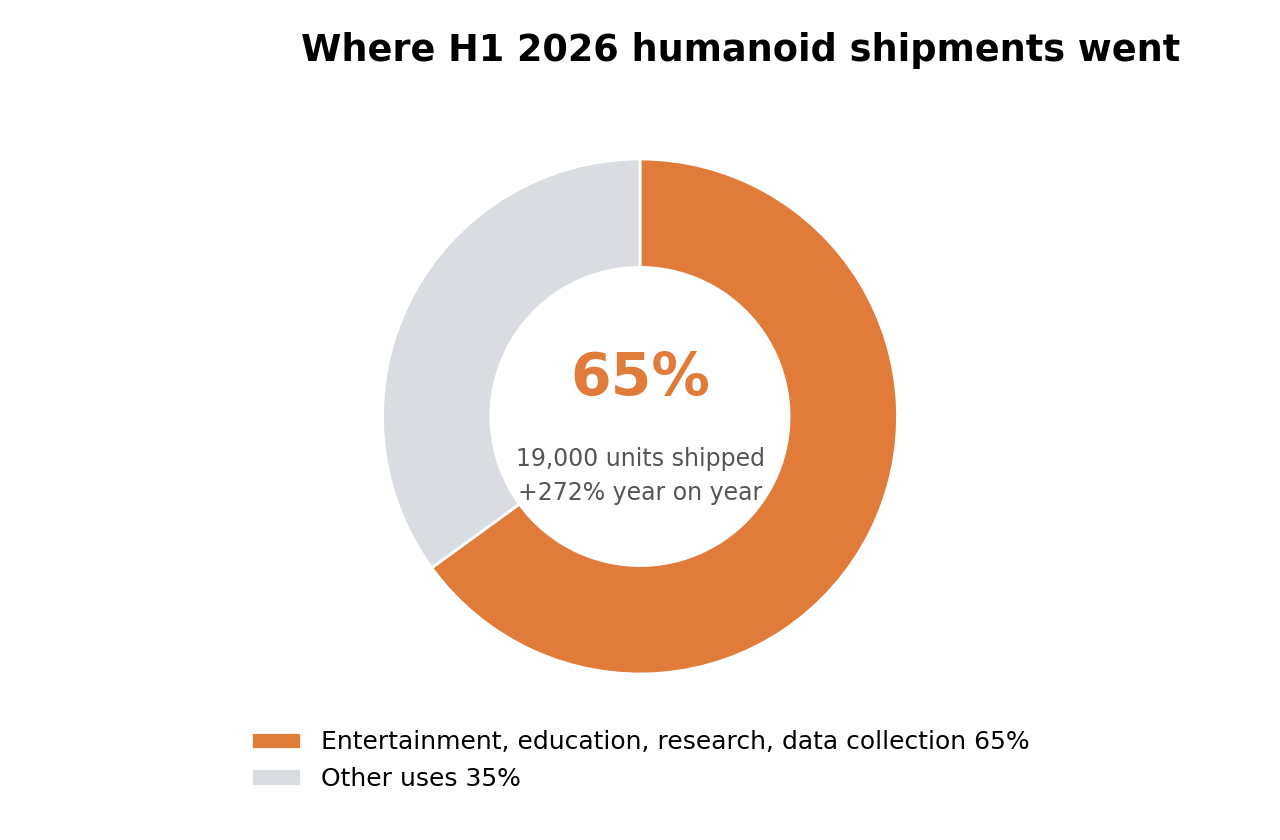
Use mix of humanoid shipments worldwide, first half of 2026. Source: Morgan Stanley
The China shipment forecast moved up within six months. On June 24, Morgan Stanley raised its 2026 estimate for Chinese humanoid shipments to 50,000 units from 28,000 in January, and its 2030 estimate to 446,000 from 262,000, citing competition among domestic developers and policy support. Full-sized machines are expected to go from 30% of shipments in 2026 to 70% by 2028, and Xpeng has said it plans mass production by the end of 2026.
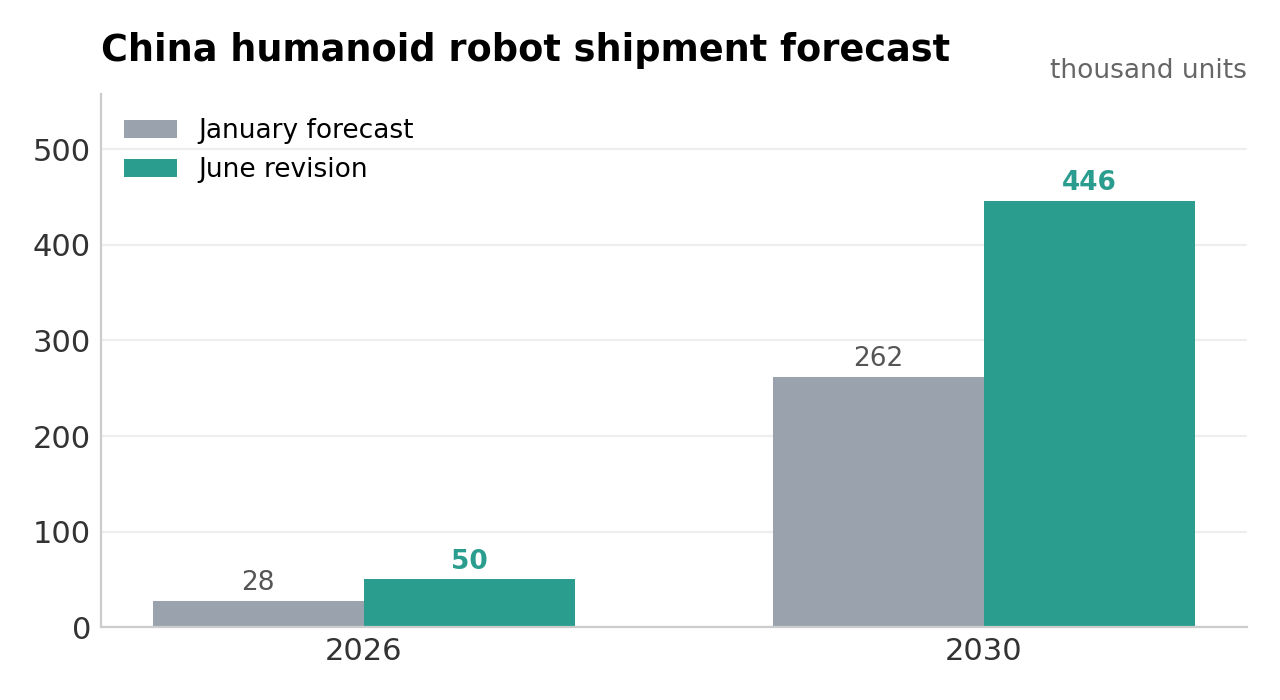
January estimates against the June revision for Chinese humanoid shipments. Source: Morgan Stanley
Unitree closes 460% above its IPO price — "two to three years, or five to 10"
Capital for the machine side opened in the same window. Unitree listed in Shanghai on August 19 at an offer price of RMB150.80, raising US$905m (about KRW1.218trn), and closed its first day 460% above the offer. The following day it closed at RMB687, down 18.7%, still about 86% above the RMB370 target Nomura set when it initiated coverage.
Speaking at the World Robot Conference in Beijing the day after the listing, founder Wang Xingxing said the industry's turning point could "arrive in two to three years if things move fast, or five to 10 years if they move slowly." He defined that point as a robot entering an unfamiliar home and completing about 80% of tasks from voice or text instruction alone. At the same event in 2025 he had put it inside five years.
Robot football already runs as a league — RoboCup 2026 drew 364 teams to Incheon
The format exists beyond one-off games. RoBoLeague, a three-a-side autonomous humanoid football league, launched in Beijing in June 2025, with robots devising game strategy without human input. RoboCup 2026 ran in Incheon, Korea, from June 30 to July 6, drawing 364 teams from 45 countries and about 3,000 participants; the THU Huoshen team from Tsinghua University won the humanoid football title for a second year, using the commercial Booster T1 platform so it could concentrate on perception, locomotion and team strategy software. RoboCup's standing goal is a fully autonomous humanoid side capable of beating the World Cup champions by 2050.
In May 2025, Unitree's G1 robots fought a kickboxing tournament that CMG carried live. Billed as the first humanoid combat event, it ran on teleoperation, with the robots following human operators' movements. With no rights market for robot sport yet, a broadcaster built and aired the format itself.
CyberHero opens on an eight-city circuit — an esports company owning the league
Hero Esports, which built CyberHero, grew by running esports competitions; Savvy Games Group, one of its backers, sits under Saudi Arabia's sovereign wealth fund, and Tencent is a games and content operator. The rules, the machine specification and the team structure were designed by the operator rather than bought from an existing sport. Danny Tang, co-founder and chief executive of Hero Esports, said at the launch that "CyberHero was born from a bold idea about the future of competition: that robots can test their limits and improve through competition data."
The opening event was staged closer to an entertainment show than a sports broadcast. Middle East digital personalities AboFlah and Bashar Arabi acted as team managers and the electronic producer Tokyo Machine performed. Splitting teams into builders, coders and drivers turns the engineering and the code into content alongside the result. The eight-city circuit covers two Middle East stops plus Europe, the Americas and Asia.
Riyadh has a sovereign fund, Asan has a province — league-building moved to city level
Savvy Games Group sits under the Saudi sovereign wealth fund, and the Esports World Cup and the 2027 Olympic Esports Games are both held in Riyadh. Broadcasters and streaming services buy rights to existing sports; the parties building new ones include sovereign funds and local governments.
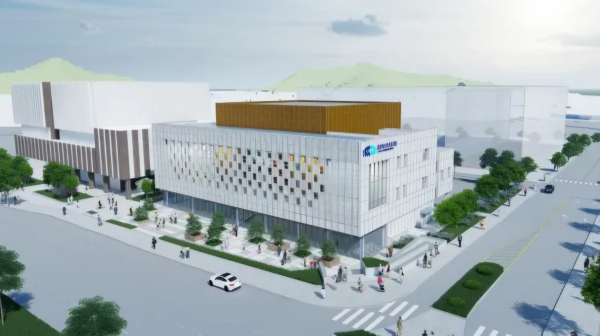
In Korea that position is held by provincial government. Chungcheongnam-do(충청남도) is building a permanent esports arena near KTX Cheonan-Asan station in Baebang-eup, Asan(아산시), at a cost of KRW29.51bn (about US$21.93m), targeting completion in March 2026. The three-storey building with one basement level covers 3,849 square metres on a 5,400 square metre site, with a 429-seat main arena, a 74-seat secondary arena, a learning studio, player rooms and a broadcast control room.
The Chungnam Information and Culture Industry Promotion Agency will run it, with its own tournaments, bids for international events, an esports academy and concerts and exhibitions in the plan. Governor Kim Tae-heum(김태흠) said the arena would make Asan and Chungnam a hub for esports.
Asan already hosts events. Eternal Return Super Week, part of the 2026 Korea Esports League(KEL), runs at the Yi Sun-sin Gymnasium in Asan on September 19 and 20 from 10am to 8pm with free admission.
The Ministry of Culture, Sports and Tourism(문화체육관광부), the Korea e-Sports Association(KeSPA), Nimble Neuron(님블뉴런) and the Chungnam Content Agency(충남콘텐츠진흥원) organise it, with Chungcheongnam-do, Asan and SK Telecom among the sponsors. The programme includes concerts by Ryu Su-jeong(류수정) and Skocism(스코시즘), a VR and sim-racing experience zone and a flea market with merchandise and food trucks. Attaching performances and hands-on zones to the matches is how CyberHero staged its opening event in Riyadh.

Eternal Return Super Week of the 2026 Korea Esports League runs at the Yi Sun-sin Gymnasium in Asan on September 19-20, free to attend. Source: event poster
An arena that houses the court, the control room and the operating staff in one building covers what robot competition needs as well. CyberHero's T800 stands 1.73m and weighs 75-85kg, inside the stage dimensions built for people. One of the eight circuit stops is in Asia. With a permanent arena, robot makers and event operations all present in Korea, no domestic robot league deal has been signed.
One company holding the machines, the models, the league and the archive
Amazon's spending on NBA rights is reported at about US$1.8bn a year. What that money buys is the right to carry set games for the term of the contract. It does not buy the league, so when the term ends the negotiation starts again.
A company that develops a robot league itself can design a different structure: the machines and the AI models controlling them, league operations, the format, the characters, the video archive and the distribution platform inside one company. Secure those rights and the core assets of producing and distributing the competition accumulate. That is what separates it from renting rights whose price and availability change at every renewal.
Big Tech already holds parts of what such a business would need. Amazon has Prime Video alongside AWS, Twitch, gaming and robotics. Google holds YouTube with cloud, AI and robotics capability; Apple has a sports business and a hardware ecosystem; Microsoft runs Xbox alongside cloud and AI. None of that means any of them will enter robot sport, but the conditions for combining technology development with content distribution are in place.
Amazon shows the overlap. In July 2025 the company said it had deployed one million warehouse robots and released DeepFleet, a generative AI model that coordinates the fleet's movement. Amazon says the model raises fleet travel efficiency by 10% and that 75% of its global deliveries are assisted in some way by a robot. Investment in securing sports content and investment in developing and operating robots sit inside the same company. Turning logistics automation into spectator sport, however, would require separate machine development and competition design.
Rule-making differs too. Human sport sets its rules around an athlete's physical capacity and safety. Robot sport can design collisions, obstacles and other elements more widely, taking the machine's performance and the possibility of repair or replacement into account. How it looks on camera and how easily a viewer can follow the contest can also be primary criteria in the early design.
Being able to replace a machine does not remove risk or cost. Collisions and falls raise questions of audience and crew safety, battery fires and facility damage. The more often machines break, the higher the production and operating burden. The viability of a robot league rests less on how much spectacle it can stage than on whether it can manage safety and cost while building rules and characters that make a viewer wait for the next match.
What a robot league has to clear — fandom is harder than the engineering
The barrier for robot sport is converting curiosity into repeat viewing. The pull of sport comes from the uncertainty of the result together with what the athlete carries: the strain, the injury and recovery, the limits that arrive with age. In a competition where the machine can be repaired or replaced, what fills that narrative is the open question.
Simone Biles withdrawing at the Tokyo Olympics, and Tiger Woods returning to Augusta after repeated back surgeries, show that an athlete's own experience can draw as much attention as the result. The Mike Tyson-Jake Paul fight, which Netflix said reached 108m live viewers worldwide, carried age, reputation and comeback alongside the contest. Physical risk alone does not explain those audiences, but an athlete's history and limits are plainly part of what is being watched.
Precedents for a purpose-built league cut both ways. Esports proved that fandom and a sponsorship market can form outside established sport. An early Overwatch League franchise slot cost about US$20m (about KRW26.9bn). A high entry price did not make the business durable: the league closed out its existing structure after the 2023 season, and the termination payments Activision Blizzard faced were put at around US$120m (about KRW161.5bn). Converting early investment and attention into a long-term viewing and revenue base was a separate task.
BattleBots is the longer precedent. Since starting in 2000 it has moved between networks through cancellations and revivals while keeping a committed audience — evidence that robot combat can be repeat-consumed content. That survival has not translated into the audience scale or rights value of a major professional sport.
WWE shows the role of character and story in long-run performance. The Hulk Hogan-André the Giant match at WrestleMania III in 1987 carried months of accumulated conflict and expectation as well as a test of strength. The audience watched one match to confirm the story so far and to wait for the next one.
That structure has been priced in large carriage deals. Netflix announced a long-term deal for WWE's Raw in January 2024, reported at US$5bn (about KRW6.73trn) over 10 years, and from 2026 ESPN streams WWE's major events for US$1.6bn (about KRW2.153trn) over five years. A viewing base that consumes characters and narrative continuously, beyond individual results, was valued as an asset.
The same question faces robot sport. Building a machine that runs faster and strikes harder does not guarantee a return visit. It needs an identity the audience recognises as the same competitor after the machine is swapped and the software changed, rivalry between teams, and records and stories that accumulate. Beyond whether a robot can compete, whether it can become something an audience supports for years is what decides the league's durability.
Stunt budgets and digital doubles — the production-side calculation
On set, a robot's value turns into a more concrete cost question. High-risk action absorbs wires and rigging, stunt crews, insurance, digital doubles and visual effects — spending that keeps performers safe while making the shot look real.
If a robot could run up a wall, drop 12m and go straight into the next take, the method could change, because part of what is built with digital doubles and post could be shot in front of the camera. That remains a hypothesis. The durability to take the impact, the repeatability of the movement and on-set safety all have to be established, and total cost including the machine and its repairs has to beat the current approach.
What a production needs to verify is repeat performance rather than one success: landing on the same mark, reproducing the same movement, holding the schedule. If a machine has to be replaced after every shot, the visual effects budget simply moves to robot repairs.
The frequent falls and collisions at the Beijing games show the gap. For an audience they are a spectacle; for a production they are a variable to control. For robots to become performers on set, they have to go from machines that do something startling to production assets that deliver the same performance on the next take.
Machines already make the calls — every pitch in KBO, two challenges in MLB
In baseball, machines already take part in the core judgement of the game. KBO League has used an automated ball-strike system(ABS) to call strikes and balls since 2024, with the system performing the judgement a human umpire used to make.
Major League Baseball drew the boundary differently. The ABS it adopted for 2026, after its competition committee approved it in September 2025, keeps the umpire's original call and re-checks it through the system when a player challenges. Each team gets two challenges, and a successful one is not deducted.
Only the pitcher, catcher or batter may ask, by tapping the cap or helmet. Commissioner Rob Manfred said players' preference for the challenge format over full automation influenced the decision. Across 288 spring training games there were 4.1 challenges per game and 52.2% of calls were overturned. Alongside the technology's accuracy, who may call on the system, when and how has itself become part of the rules.
The two choices show the same technology producing different viewing experiences. KBO applied consistency across every pitch; MLB kept the player's judgement and the moment of review inside the game. The scope of automation is not settled by the technology alone: player acceptance and the flow of the game work on it too.
A robot league puts the question one step further along. Automating the calls leaves the competitor the audience supports unchanged. Replace the competitor with a machine and the object of that support has to be built from scratch. Accurate calls can be engineered with sensors and rules; a reason to wait for the next match has to be demonstrated separately.
TVING's KRW450bn KBO deal and Coupang Play's KRW70bn a year — the renewal bill after a hit
In the Korean streaming market too, the more a sport pulls in subscribers, the higher the rights price climbs. A platform wins users with a popular competition and then has to absorb a fee that reflects that success at the next renewal.
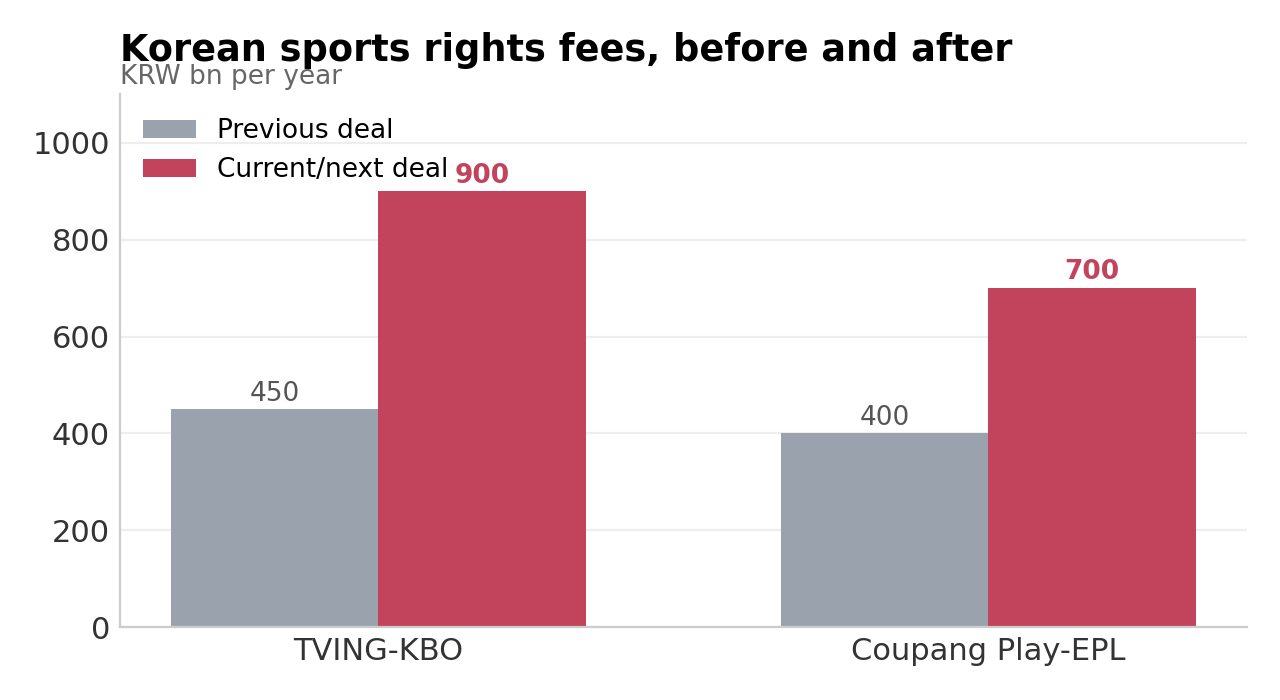
CJ ENM disclosed on August 6 that it would sign a contract securing online and mobile carriage rights and video business rights to the KBO League from 2027 through 2031. It did not disclose the value. Industry estimates put it above KRW90bn (about US$66.9m) a year and above KRW450bn (about US$334m) in total. Against the previous deal — KRW135bn in total and KRW45bn a year from 2024 to 2026 — the annual burden at least doubles.
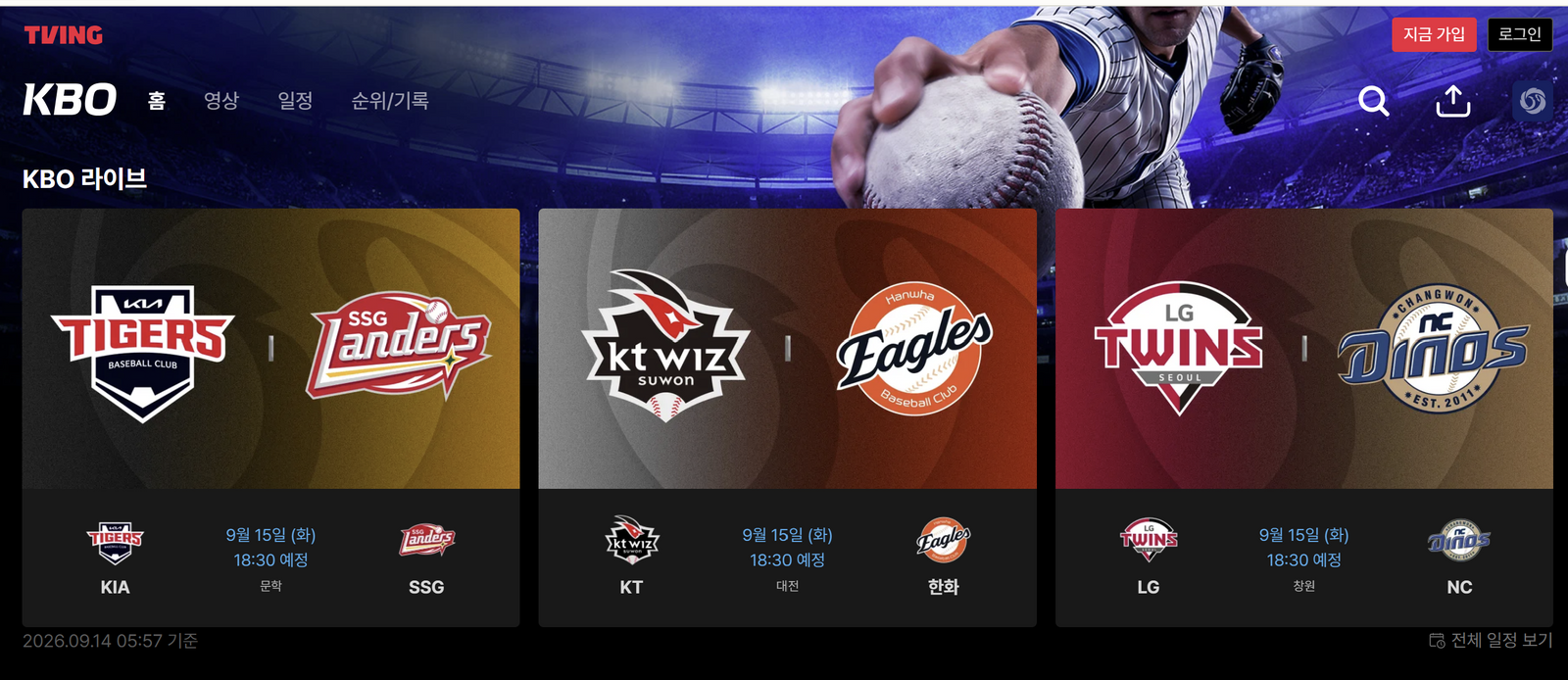
TVING posted revenue of KRW140.7bn (about US$104.6m) and operating profit of KRW6bn in the second quarter of 2026, its first quarterly profit since the company was established. Baseball coverage was credited with helping subscriber growth and the improvement in results, but the new contract assumes a higher cost. A profit earned under the old fee does not guarantee the economics of the next one.
At KRW90bn a year, the service has to recover KRW45bn more annually than under the previous deal, on top of production and service operating costs. Subscriber growth alone is not enough. How long the users who came for baseball keep subscribing, and how much additional revenue they generate through advertising and other content, decides whether the renewal pays.
Football followed the same path. Coupang Play's exclusive Korean rights to the English Premier League, secured for six seasons from 2025-26, were reported at around KRW70bn (about US$52m) a year, well above the roughly KRW40bn (about US$29.7m) estimated for the earlier SPOTV(스포티비) deal. Neither figure was confirmed by the parties.
A long rights term lets a platform run its schedule and acquisition strategy with some stability. It also leaves the contracted spending in place if the audience falls short. A star's transfer or retirement, and shifts in domestic interest, are variables the platform carries.
A separate sports tier is one way to recover the cost. When Coupang Play introduced its Sports Pass at KRW9,900 a month, adding it to the KRW7,890 Wow membership came to KRW17,790. For an existing Wow member, though, the incremental cost of watching sport is KRW9,900, and the combined figure also covers shopping and delivery benefits. It is worth separating the additional spend needed to watch sport rather than comparing the total with a video subscription.
The subscriber relationships and advertising base a platform accumulates through a contract remain as assets. Control of the league, the clubs and the schedule does not. Lose the rights at renewal and the subscribers who followed that competition can move with them. The stronger a sport's hold on subscriptions, the harder it becomes for a platform to let the rights go.
An EPL exclusive, paid KBO online — and a carriage bill through committee on September 9
Rights competition is also changing how viewers reach a game. The team stays the same, but a change of rights holder means choosing an app and a tariff again. For a fan who follows several sports, rights spread across services can mean multiple subscriptions.
Coupang Play's EPL exclusive and TVING's paid KBO streaming show that shift. It is hard, though, to describe either as free television moving wholesale behind a paywall. The EPL was carried on SPOTV's paid service before Coupang Play, and the KBO's online and mobile rights are separate from its television rights. What TVING's paid service changed was mainly the online route.
The complaints about production quality in TVING's first year of KBO coverage in 2024 should also be separated from the access question. Once a service charges, it is judged not only on whether the game is available but on the accuracy of the graphics and captions, the stability of the stream and the convenience of replays. An exclusive wins users and, at the same time, concentrates the complaints of fans with no alternative on that one platform.
For events of national interest such as the Olympics and the World Cup, the legislative answer moved forward. On September 9 the National Assembly's legislation and judiciary committee passed an amendment to the Broadcasting Act requiring national terrestrial broadcasters to carry major events live. The committee added a clause applying the obligation only to rights contracts signed after the law takes effect, reducing the retroactivity objection. Committee passage is one stage; a plenary vote, promulgation and entry into force remain.
That debate is about access to events of national interest, not about turning every EPL or KBO match free. The issue is how to make major events available to everyone while deciding which operator bears the cost, and on what terms.
The People Power Party opposed the bill, arguing that a carriage obligation weakens broadcasters' bargaining position and increases their financial burden: a buyer who must carry the event cannot easily walk away from a high price. In a September 10 column for Sports Khan(스포츠경향), Kim Se-hoon(김세훈) also questioned delivering universal access through a terrestrial carriage obligation, noting that the aim of widening access and the instrument of assigning carriage duty to particular broadcasters do not necessarily produce the same result.
A carriage duty on its own does not settle price or cost-sharing. Resale terms between the rights holder and the terrestrial broadcasters, a mediation route if talks fail, and who bears costs not recovered through advertising all have to be set alongside it. Without those mechanisms, an obligation meant to guarantee access can turn into a cost dispute between broadcasters.
A streaming service has to recover the price of an exclusive through subscriptions and advertising; a terrestrial broadcaster has to provide wide access while carrying the cost. The problem in front of Korean sports media does not end with who wins the rights. Who finally pays the price written in the contract is what remains.
Riot owns its league — room to connect Korean robotics with broadcast production
A league operator stands in a different place. Riot Games(라이엇 게임즈) sells LCK rights while holding both the game IP and the league operation. Naver Chzzk(네이버 치지직) and SOOP took the LCK rights for five years from 2026 through 2030, at a figure the industry estimates in the tens of billions of won a year. The platform secures viewers for the term; Riot returns to the next negotiation as the seller. Control of the rules, the characters and the competition is what that rests on.
In robot sport, who holds the rights to the format and the footage matters as much as who builds the machine. Robot makers, AI developers, event operators and broadcasters may all take part, and their respective rights do not sort themselves out. Ownership of the format, the split of production costs, and terms for carriage, international sales and archive use have to be set in the early contracts.
Korea has both robot developers and broadcasters with sports production experience. On July 16, Hyundai Motor Group moved Boston Dynamics to a structure wholly held by group affiliates and chairman Chung Euisun, and Atlas is scheduled to go into parts sorting at Metaplant America in 2028. The Ministry of Planning and Budget(기획예산처) said on August 27 that KRW2.3trn (about US$1.709bn) will go into humanoids through 2030. Robot competitions held in Korea can be a starting point for collaboration. Owning industrial robots, however, is not the same as having competition machines: durability for repeated shooting, the safety of the audience and crew, and rules a viewer can follow all need separate verification.
Korean broadcasters: when to secure the rights to a new sport
For Korean broadcasters, rising rights fees are the heavier burden. On figures reported by Hankyung on April 10, KBS posted a KRW99.6bn (about US$74.1m) loss, MBC a KRW27.6bn (about US$20.5m) loss and SBS a KRW13.2bn (about US$9.8m) profit. Terrestrial advertising revenue fell 51.1% from KRW1.898trn in 2014 to KRW927.3bn in 2024, and KOBACO projects terrestrial TV advertising falling from about KRW1.376trn in 2022 to about KRW827.1bn in 2026. Securing rights still leaves production, staffing and on-site transmission costs to carry. Lose a popular sport and viewers leave; hold it and costs rise.
Robot sport will not relieve that burden now. Its audience and economics are unproven, and whether the machines can support stable broadcast production has to be checked. But while a league is being built is when a broadcaster can negotiate the competition format, the production terms and the division of rights. The range open to negotiation is different from bidding for a finished league.
The starting point worth examining is co-producing small events with a robot company or an event operator: whether viewers follow the rules, whether they support a particular team or machine, and whether they come back for the next match. A broadcaster brings cameras, commentary, editing and scheduling, and what it takes in return belongs in the contract — joint ownership of the format, production rights to later events, international sales rights, archive use. Filming a robot company's demonstration on its behalf does not turn into a rights business.
Terrestrial free reach can itself be a negotiating asset for an early league. A sport without fans needs exposure more than a rights fee, which is the same kind of trade YouTube made when it gave away one NFL game and assembled 17.3m viewers globally. The broadcaster provides production and exposure and secures a share of the upside if the league grows. That is also the reason to connect Korean robotics with Korean broadcast production.
A league launched in Riyadh, and in Beijing robots ran and fell. Neither has proved durable commercial appeal. The Broadcasting Act amendment attached the carriage obligation to the Olympics and the World Cup first, and a sport with no established price sits outside it. What Korean broadcasters can do now is test the possibility at a production cost they can absorb and keep the rights, rather than bet heavily on predicting the next popular sport. Once an audience gathers, the price of the rights changes too. Whether to queue up as a buyer then, or to join now as a production partner, is the decision in front of them.
Video
· CNET, "WILDEST Highlights From China's Humanoid Robot Olympics" — https://www.youtube.com/watch?v=Jjrqx1PAG70
· news.com.au, "Biggest fails from the 2026 World Humanoid Robot Games in China" — https://www.youtube.com/watch?v=XgnBN8BLc-o
Sources
· PR Newswire, "World's First Robot Sports League Launched in Riyadh, Plans to Hit 8 Cities Worldwide" (CyberHero, Hero Esports, EngineAI T800), Sept 9, 2026 — https://www.prnewswire.com/news-releases/worlds-first-robot-sports-league-launched-in-riyadh-plans-to-hit-8-cities-worldwide-302874350.html
· Global Times, "Tiangong Ultra resets 100m mark at 8.64s as humanoid robot games close in Beijing", Aug 27, 2026 — https://www.globaltimes.cn/page/202608/1369085.shtml
· CGTN, "Tiangong Ultra sets 100m record as World Humanoid Robot Games close", Aug 27, 2026 — https://news.cgtn.com/news/2026-08-27/Tiangong-Ultra-sets-100m-record-as-World-Humanoid-Robot-Games-close-1PWx9LjZDC8/p.html
· Tech Times, "Tiangong Ultra Ends Robot Games at 8.64s While AGIBOT Tops Overall Medal Table", Aug 27, 2026 — https://www.techtimes.com/articles/325749/20260827/
· Al Jazeera, "Chinese robot Tiangong clocks sub-9-second 100 metres in Beijing", Aug 25, 2026 — https://www.aljazeera.com/sports/2026/8/25/chinese-robot-tiangong-clocks-sub-9-second-100-metres-in-beijing
· China Daily, "Federation for humanoid robot sports launches at World Humanoid Robot Games", Aug 18, 2025 — https://global.chinadaily.com.cn/a/202508/18/WS68a2b643a310b236346f2298.html
· South China Morning Post, "Ready, set, fight: Unitree's humanoid robots test skills in unique kickboxing competition", May 26, 2025 — https://www.scmp.com/tech/tech-trends/article/3311831/
· TechNode, "Unitree G1 Robots battle in world's first humanoid robot combat tournament", May 27, 2025 — https://technode.com/2025/05/27/
· GovTech, "China Launches Three-on-Three Humanoid Robot Soccer League" (RoBoLeague), July 2025 — https://www.govtech.com/products/china-launches-three-on-three-humanoid-robot-soccer-league
· Interesting Engineering, "China wins RoboCup 2026 as humanoid AI soccer reaches new heights" (RoboCup 2026, Incheon), July 2026 — https://interestingengineering.com/ai-robotics/china-humanoid-robots-robocup-socce
· SportsPro, "Streamers to spend 'US$14.2bn' on sports rights in 2026" (Ampere Analysis), Feb 2026 — https://www.sportspro.com/news/broadcast-ott/sports-rights-streaming-spend-2026-amazon-prime-video-dazn-peacock-february-2026/
· TheWrap, "Streamers Will Spend $14.2 Billion on Sports Rights in 2026, New Projections Show", Feb 2026 — https://www.thewrap.com/culture-lifestyle/sports/streaming-service-sports-rights-spend-ampere-analysis-forecast/
· C21Media, "Worldwide spend on media sports rights to hit $78bn by 2030, claims Ampere Analysis" — https://www.c21media.net/news/worldwide-spend-on-media-sports-rights-to-hit-78bn-by-2030-claims-ampere-analysis/
· SportsPro, "Global sports media rights spend to surpass US$78bn in 2030" (Ampere Analysis), Nov 2025 — https://www.sportspro.com/news/sports-media-rights-global-spending-ampere-analysis-november-2025/
· S&P Global Market Intelligence (Kagan), "Global sports rights climb to over $67 billion in 2026", Apr 8, 2026 — https://www.spglobal.com/market-intelligence/en/news-insights/research/2026/04/global-sports-rights-climb-to-ove-67-billion-in-2026
· Insider Sport, "Global sports media rights hit $67bn amid US dominance" (reporting S&P Global's count: US$67.34bn in 2026, North America US$34.9bn or 52%, U.S. US$32.8bn up 11%), Apr 10, 2026 — https://insidersport.com/2026/04/10/sports-rights-surge-masks-media-power/
· The 2025 regional share chart (North America 48.6%, Western Europe 25.2%, Asia Pacific 10.9%, Central and South America 6.7%, MENA 3.6%, CEE 2.9%, Sub-Saharan Africa 2.0%) was redrawn from an industry tally supplied for this article.
· SportsPro, "NFL commissioner Goodell says league could restructure media deals to attract streamers", Sept 11, 2026 — https://www.sportspro.com/news/broadcast-ott/nfl-us-tv-rights-streaming-fox-nbc-espn-netflix-september-2026/
· The Desk, "SNL Kagan: NFL to get $110 billion from TV deals through 2032", Aug 2025 — https://thedesk.net/2025/08/snl-kagan-tv-rights-study-football-nfl/
· CBS Sports, "NBA signs new TV deal: Details on 11-year, $76 billion deal with ESPN, NBC, Amazon", July 2024 — https://www.cbssports.com/nba/news/nba-signs-new-tv-deal-details-on-11-year-76-billion-deal-with-espn-nbc-amazon-as-tnt-gets-left-out/
· CNBC, "Paramount buys UFC rights in $7.7 billion, 7-year deal in first major move post-Skydance merger", Aug 11, 2025 — https://www.cnbc.com/2025/08/11/paramount-buys-ufc-rights-skydance-merger.html
· CBS News, "Judge overturns $4.7 billion verdict in 'Sunday Ticket' case against NFL", Aug 1, 2024 — https://www.cbsnews.com/news/nfl-sunday-ticket-lawsuit-judge-overturns-verdict/
· NFL.com, "Federal judge overturns $4.7B verdict in 'Sunday Ticket' lawsuit, rules for NFL", Aug 2024 — https://www.nfl.com/news/federal-judge-overturns-4-7b-verdict-in-sunday-ticket-lawsuit-rules-for-nfl
· Sportico, "NBA, TBS and WBD Settle Lawsuit and Form New Partnership", Nov 2024 — https://www.sportico.com/law/analysis/2024/nba-tbs-warner-bros-discovery-settlement-1234810750/
· CNBC, "NBA, Warner Bros. Discovery agree to settle lawsuit over live game rights", Nov 18, 2024 — https://www.cnbc.com/2024/11/18/nba-warner-bros-discovery-settle-lawsuit-over-live-game-rights.html
· The Hollywood Reporter, "The 2026 World Cup by the Record-Breaking TV Numbers", July 2026 — https://www.hollywoodreporter.com/tv/tv-news/2026-world-cup-most-watched-matches-1236653951/
· NBCUniversal, "FIFA World Cup 2026 Propels Telemundo and Peacock to Record Viewership", July 2026 — https://www.nbcuniversal.com/article/fifa-world-cup-2026-propels-telemundo-and-peacock-record-viewership
· Esports Charts, "T1 Makes History: Worlds 2025 Peaks at 6.7M Viewers", Nov 2025 — https://escharts.com/news/t1-makes-history-winning-worlds-2025-event-reached-over-67m-peak-viewers
· PR Newswire, "$75 Million Prize Pool, Full Game Lineup and Schedule Announced for Esports World Cup 2026" (Esports World Cup Foundation), 2026 — https://www.prnewswire.com/news-releases/75-million-prize-pool-full-game-lineup-and-schedule-announced-for-esports-world-cup-2026-302665501.html
· SportsPro, "Olympic Esports Games delayed until 2027 as Saudi Arabia's EWCF comes in as founding partner", Feb 2025 — https://www.sportspro.com/news/olympic-esports-games-2027-ioc-saudi-arabia-february-2025/
· Variety, "YouTube's First Exclusive NFL Game Averages More Than 17 Million Global Viewers", Sept 2025 — https://variety.com/2025/tv/news/youtube-nfl-game-ratings-17-million-viewers-1236511738/
· Deadline, "YouTube Says Its Live NFL Game Drew 17.3M Global Viewers, Including 1.1M Outside U.S.", Sept 2025 — https://deadline.com/2025/09/youtube-nfl-game-17-million-global-viewers-1236512076/
· Hankook Ilbo(한국일보), "MLB adopts the automated ball-strike system for 2026 on a challenge basis", Sept 24, 2025 — https://www.hankookilbo.com/News/Read/A2025092411130003040
· Sports Video Group, "Netflix Pins Exclusive Rights to WWE Raw in 10-Year, $5B Deal", Jan 2024 — https://www.sportsvideo.org/2024/01/23/
· Yahoo Sports, "ESPN lands $1.6 billion deal to stream WWE's major events starting in 2026", Aug 2025 — https://sports.yahoo.com/wrestling/article/espn-lands-16-billion-deal-to-stream-wwes-major-events-starting-in-2026-161436540.html
· Netflix, "Jake Paul vs Mike Tyson: Over 108 Million Live Global Viewers", Nov 2024 — http://about.netflix.com/en/news/jake-paul-vs-mike-tyson-over-108-million-live-global-viewers
· Digiday, "How the world's most ambitious esports league shrank to nothing: An oral history of the Overwatch League" — https://digiday.com/media/how-the-worlds-most-ambitious-esports-league-shrank-to-nothing-an-oral-history-of-the-overwatch-league/
· Windows Central, "Microsoft may lose $120 million as Overwatch League shutdown is confirmed" — https://www.windowscentral.com/gaming/microsoft-may-lose-dollar120-million-due-to-the-overwatch-league-shutdown
· South China Morning Post, "Morgan Stanley raises China humanoid robot shipment forecast to 50,000 units", June 24, 2026 — https://www.scmp.com/tech/article/3358210/morgan-stanley-raises-china-humanoid-robot-shipment-forecast-50000-units
· Implicator.ai, "Unitree founder says humanoid robots' ChatGPT moment is up to 10 years away" (Wang Xingxing's remarks, Unitree's listing, Morgan Stanley H1 shipment count), Aug 20, 2026 — https://www.implicator.ai/unitree-founder-says-humanoid-robots-chatgpt-moment-is-up-to-10-years-away/
· CNBC, "Humanoid robots' 'ChatGPT moment' could be 10 years away, Unitree founder says", Aug 20, 2026 — https://www.cnbc.com/2026/08/20/unitree-humanoid-robots-chatgpt-moment.html
· TechCrunch, "Amazon deploys its 1 millionth robot, releases generative AI model" (DeepFleet), July 1, 2025 — https://techcrunch.com/2025/07/01/amazon-deploys-its-1-millionth-robot-releases-generative-ai-model/
· Electronic Times(전자신문), on the Chungnam permanent esports arena in Asan (KRW29.51bn, completion target March 2026), Dec 13, 2024 — https://www.etnews.com/20241213000053
· Kukmin Ilbo(국민일보), on the legislation committee passing the terrestrial-carriage bill on September 9, 2026 — https://www.kmib.co.kr/article/view.asp?arcid=9000010518
· Business Post(비즈니스포스트), on the bill clearing the legislation committee over opposition objections, Sept 2026 — https://www.businesspost.co.kr/BP?command=article_view&num=446831
· Sports Khan(스포츠경향), Kim Se-hoon's column on the bill's effect on rights bargaining and the KOBACO advertising outlook, Sept 10, 2026 — https://sports.khan.co.kr/article/202609101116003/
· Hankyung(한국경제), on terrestrial broadcasters' results and the ad-revenue trend, Apr 10, 2026 — https://www.hankyung.com/article/2026041026437
· Prism(프리즘), on the progress of the Broadcasting Act amendment, June 14, 2026 — https://v.daum.net/v/20260614125502134
· Hankyung(한국경제), "Coupang Play takes exclusive Korean EPL rights from 2025-26", Mar 24, 2025 — https://www.hankyung.com/article/202503244214i
· Media Today(미디어오늘), on the criticism of TVING's KBO coverage from the first preseason game, Mar 2024 — https://www.mediatoday.co.kr/news/articleView.html?idxno=316513
· Seoul Finance(서울파이낸스), on TVING's KBO coverage complaints, 2024 — https://www.seoulfn.com/news/articleView.html?idxno=512921
· Korean press reports on CJ ENM's Aug 6, 2026 disclosure, "TVING re-signs KBO rights for five years", Aug 7, 2026 — https://v.daum.net/v/20260807120307591
· Hankyung Business(한경비즈니스), "SPOTV switches off, Coupang switches on: the sports rights war", July 2025 — https://magazine.hankyung.com/business/article/202507035005b
· Kukmin Ilbo(국민일보), "LCK wins rights fees in the tens of billions of won a year", Jan 21, 2026 — https://www.kmib.co.kr/article/view.asp?arcid=1768812995
· Newspim(뉴스핌), "Hyundai Motor takes 100% of Boston Dynamics, accelerating Atlas commercialisation", July 16, 2026 — https://www.newspim.com/news/view/20260716000872
· Herald Business(헤럴드경제), "KRW2.3trn for humanoids and KRW2.8trn for physical AI" (Ministry of Planning and Budget), Aug 27, 2026 — https://biz.heraldcorp.com/article/10854151
· The Ankler, Erik Barmack, "Yes, Robots Are Coming for Sports", Sept 8, 2026 — https://theankler.com/yes-robots-are-coming-for-sports/