

Competition for current reporting brings usage-based fees and revenue sharing into publisher negotiations
Licensing expands alongside litigation, with South Korea testing whether existing news contracts cover AI training
Google and Meta are expanding their news partnerships, bringing more competition to an AI licensing market led by OpenAI and giving publishers more potential buyers for their reporting. Demand for current information is also changing how those deals work: alongside payments for access over a fixed term, publishers are negotiating fees tied to usage and shares of revenue generated by AI answers.
OpenAI had at least 24 content-company agreements in Axios's tally as of Sep 14, 2026, followed by Google with 20, Meta with 14, Perplexity with 12, Microsoft with 11 and Snowflake with 10. Some agreements cover multiple publications, so the totals do not rank the volume of content each company can use. They do show how the field of buyers now spans search, social media and enterprise data services.
The larger market has yet to produce a common price for journalism. Training a model on an archive, retrieving a current article and supplying information to a business customer involve different permissions and commercial terms. Publishers are negotiating those uses while challenging others in court. In South Korea, broadcasters and Naver are disputing an earlier question: whether a news-supply agreement signed before the generative-AI boom already granted training rights.
Current reporting becomes a product in its own right
The Washington Post's April 2025 agreement with OpenAI shows why access to news has value beyond a training archive. The announcement covered summaries, quotations and links in ChatGPT answers; it did not announce training rights. The service would draw on reporting to answer questions about events as they unfolded.
Google's Dec 10, 2025 announcement described paid arrangements for expanded display rights and API delivery. Its new AI pilot would test article overviews and audio briefings in Google News, with attribution and article links. Google also named Yonhap and AP as real-time information partners for Gemini and announced plans to highlight subscribers' publication links. The announcement did not disclose deal-specific training rights or prices.
For publishers, those features connect licensing to audience acquisition. If readers stop at an AI summary, fewer may reach the original article and encounter a subscription offer. Payment and the treatment of links therefore belong in the same commercial discussion. A Google spokesperson told Axios that more than 200 publishers worldwide were participating in the pilot; its expansion alone does not establish how much traffic or subscription revenue it produces.
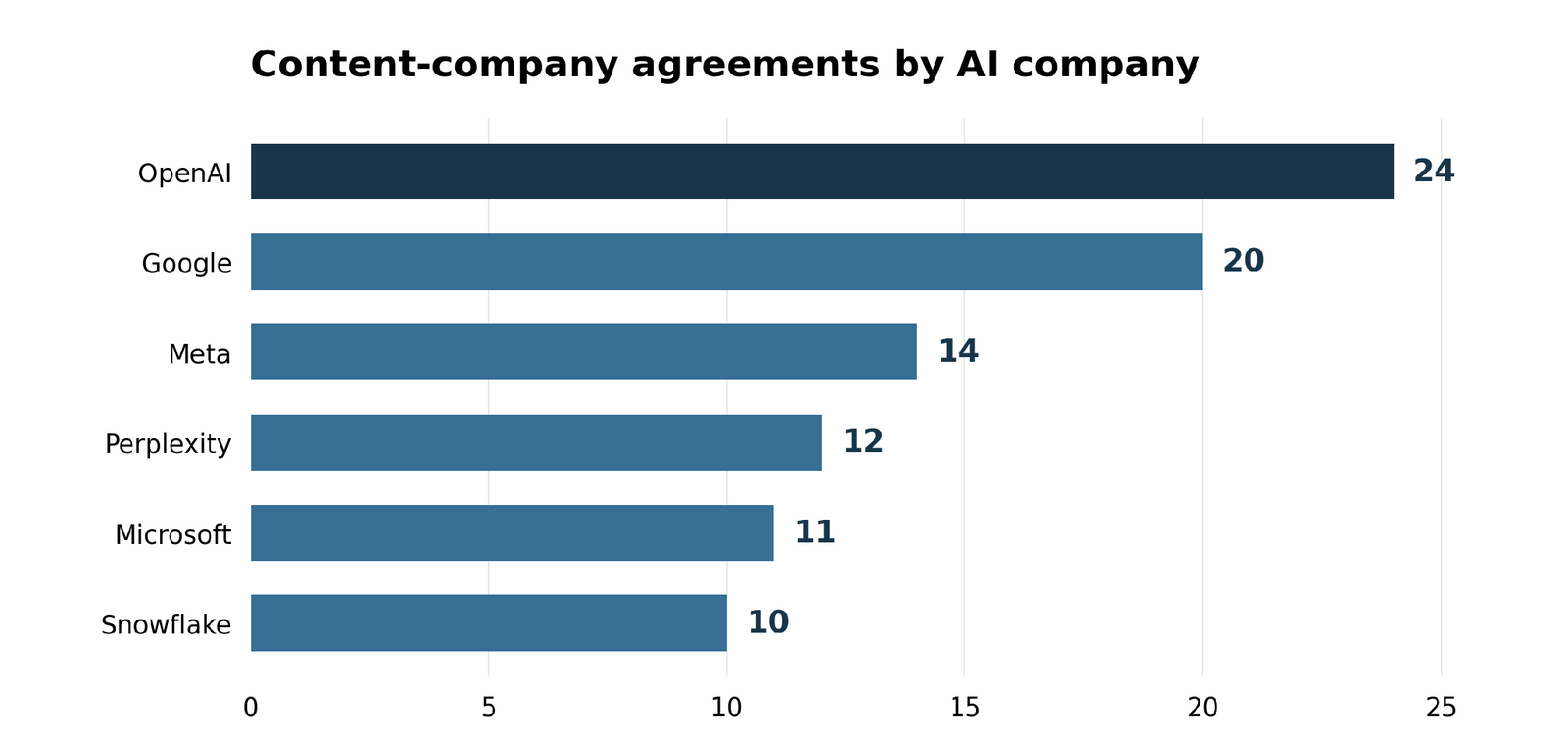
Figure 1. Agreement count, not number of outlets or contract value. Source: Axios, as of Sep 14, 2026.
The demand reaches into subscription products. Microsoft's Jul 3, 2026 agreement with Australia's Nine Entertainment gives Copilot access to paywalled newspaper reporting for real-time answers. OpenAI signed its first Canadian content deal in September with local-news operator Village Media. Licensing is extending beyond major U.S. publishers into local reporting and the Asia-Pacific market. Nine's agreement was Microsoft's first news deal in Asia-Pacific.
Publishers including the Post, the Guardian and the Atlantic already work with several AI companies. Nonexclusive agreements leave room to sell access to another buyer. Whether that income can offset lost search traffic or subscriptions is harder to establish: many companies disclose neither the value of their contracts nor the basis for payment.
Google separates news presentation from contributions to AI answers
Google's News AI pilot builds on its publisher relationships. In the announcement on Dec 10, 2025, Search product vice president Robby Stein and global news partnerships vice president Jaffer Zaidi named Der Spiegel, El País, Folha de S.Paulo, Infobae, Kompas, The Guardian, The Times of India, The Washington Examiner and The Washington Post as initial participants. Real-time information partners for Gemini included Brazil's Estadão and Indonesia's Antara alongside AP and Yonhap.
Google describes the pilot as a commercial partnership paying for enhanced content rights and specialized delivery. Press Gazette reported that cash was understood to be involved, although Google did not call these licensing agreements. The commercial question is which uses the payment covers. Rights for presentation and delivery in the news pilot should not be assumed to grant unrestricted permission to train models on a publisher's content.
Google's public-policy statement on Jun 18, 2026 put Extended News Previews at more than 5,500 European publications, News Showcase at more than 2,800 partners in 33 countries, and the News AI pilot at more than 200 publications. These are separate programs with different purposes and potentially overlapping participants. Their totals cannot be added together to produce a count of AI licensing partners.
Google's programs for paying news and web publishers
Sources: Google Public Policy, Google's official blog and Digiday. Different scopes and possible overlap preclude adding these totals.
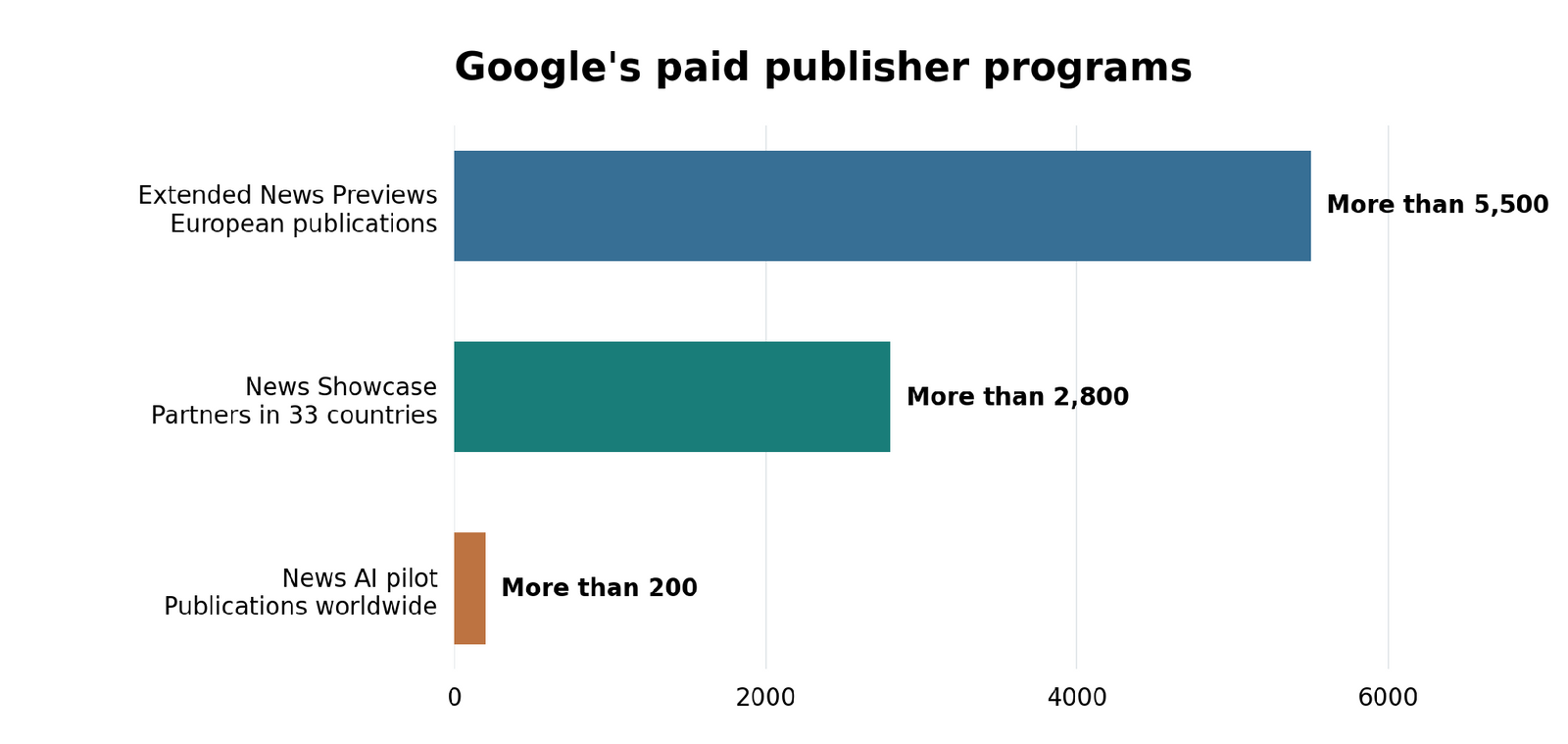
Disclosed scale of separate Google programs. Participants may overlap; totals must not be added. Source: Google Public Policy.
A separate AI contribution pilot extends beyond news websites. Digiday reported on Sep 14, 2026 that Google had approached at least dozens of publishers, with smaller and midsize businesses showing particular interest. A Search Console widget displays monthly earnings. Payment depends on Google's assessment of a source's meaningful contribution to an answer, rather than simply the number of uses. A definitive participant count was unavailable.
Seeing a payout is not the same as being able to verify it. Digiday found monthly amounts and some history but no detailed explanation of the calculation. Google described an early learning exercise. For publishers, the arrangement offers direct income while leaving a central commercial question unresolved: what evidence connects the material supplied to the amount received? That is also a question Korean broadcasters will need their reporting and settlement terms to answer.
Publishers negotiate how each use will be paid for
News Corp, owner of the Wall Street Journal and other titles, offers some of the clearest reported benchmarks. According to Journal reporting compiled by Press Gazette, its March agreement with Meta is worth up to $50 million a year, approximately KRW 69.2 billion, for at least three years. Its May 2024 OpenAI deal was reported to exceed $250 million, about KRW 345.8 billion, over five years.
Amazon reportedly pays the New York Times $20 million to $25 million annually, or approximately KRW 27.7 billion to KRW 34.6 billion. OpenAI's agreement with People Inc., formerly Dotdash Meredith, has been reported at more than $16 million a year, about KRW 22.1 billion. Different durations, rights and noncash benefits make these imperfect comparisons. The disclosed figures also provide little indication of what publishers outside that leading group can earn.
Table 1. Selected reported deal values
Source: individual media reports compiled by Press Gazette. Rights and consideration differ by agreement.
Other arrangements attach payment more closely to consumption. Britain's Reach agreed in March to supply articles for Amazon's Nova models and Alexa, with compensation tied to usage. Microsoft's Publisher Content Marketplace, which includes People, supports payment for individual uses. In such contracts, the definition of a billable use and the records available to verify it become part of the price negotiation.
ProRata calculates how much each publisher contributes to an AI answer and distributes 50% of the revenue from that answer to participating publishers. Press Gazette counted 140 partnerships covering 1,635 outlets, up from roughly 500 outlets announced in June 2025. A publisher's return depends on the contribution assigned to its work and the revenue available for distribution. ProRata led the tracker by the number of participating outlets.
That is a different proposition from OpenAI's. Varun Shetty, its vice president of media partnerships, said at the WAN-IFRA congress in Marseille on Jun 2, 2026 that the company had no plans to share ChatGPT advertising revenue with publishers. Press Gazette reported that the position also covered publisher content appearing alongside ads. Perplexity introduced advertising revenue sharing in late 2024 but subsequently dropped advertising, citing user trust. A change in an AI company's business model can therefore change the income a publisher expects from it.
Snowflake is connecting publishers to another class of buyer. Its Cortex Knowledge Extensions let businesses purchase reporting for their own AI tools. Seventeen outlets were participating, including AP, People, the USA Today Network and the Washington Post. Digiday reported financial-institution contracts ranging from $100,000 to less than $1 million, approximately KRW 138 million to under KRW 1.383 billion. Enterprise information demand provides a potential source of revenue alongside consumer chatbots.
Table 2. How payment reaches the publisher
Classification based on reported arrangements. A contract may combine more than one approach.
Anthropic exposes the limits of the licensing model
One major company has taken a different path. Adweek reported on Aug 26, 2026 that Anthropic had neither signed a content-licensing agreement with a digital publisher nor been sued by one. While rivals paid for publisher partnerships and defended news-related claims, Anthropic remained less collaborative without drawing the same litigation from digital media companies.
Reporter Mark Stenberg, drawing on interviews with four digital-media executives and an industry legal expert, attributed the discrepancy to favorable timing and branding. That was an industry explanation, not a legal finding. Anthropic had agreed to a $1.5 billion settlement, approximately KRW 2.075 trillion, in a book authors' class action, and Reddit sued it over access to its content in June 2025. The exception described by Adweek concerned digital news publishers.
Adweek's reporting also described why conversations had not produced deals. People interviewed said Anthropic regarded the collection and use of news as fair use and appeared more willing to buy distinctive, hard-to-obtain datasets than general news. Product partnerships vice president Tom Turvey, who joined in February 2024, served as a contact for publishers. Three executives described courteous discussions that did not lead to contracts. These were accounts of negotiations, not a court finding that the company's use of news was lawful.
An Anthropic spokesperson told Adweek that Claude was trained on public data, internally generated data and data obtained through selected partnerships. Those partnerships focused on improving products for enterprise and developer customers; the counterparties were not disclosed. Citing Axios's reporting on Mar 18, 2026, Adweek said Anthropic's share of spending by companies buying AI tools for the first time rose from about 50% in January to 73% in March. The measure concerns that purchasing cohort, not the entire enterprise AI market.
The cost of litigation helps explain publishers' choices. Adweek put the Times' spending on its OpenAI lawsuit at close to $30 million, approximately KRW 41.5 billion, based on quarterly disclosures. Interviewees argued that OpenAI's earlier arrival attracted the first wave of cases and that, with similar questions already before the courts, a further suit against Anthropic could offer limited value for the expense. Favorable branding and timing were industry explanations, not evidence that Anthropic was free of legal exposure.
The report also cited Elon Musk's xAI as having neither deals nor litigation with digital news publishers. That qualification matters: it does not exclude claims by book publishers or other rights holders. Adweek gave contemporaneous valuations of $965 billion, about KRW 1,335 trillion, for Anthropic and $852 billion, about KRW 1,179 trillion, for OpenAI as both moved toward public markets. Growth in a buyer's valuation does not itself establish an obligation or commercial willingness to license news.
Outside digital news, the disputes were already substantial. Adweek reported that Anthropic paid $1.5 billion, approximately KRW 2.075 trillion, in July to resolve the authors' class action. Reddit's June 2025 lawsuit alleged more than 100,000 visits after requests to stop. The Axios diagram places Anthropic in an area dominated by publishing, music and video, alongside companies including Suno, Udio, Midjourney, MiniMax, Stability, Runway, ElevenLabs, Vermillio and Klay. The layout is not a legal classification, but it illustrates how much of this market lies outside news licensing.
Anthropic's position makes it difficult to treat news licensing as a standard cost across the AI industry. Publishers are setting prices with some companies and suing others, while leaving at least one major player outside both groups. The market is being shaped by individual negotiations and publishers' choices about litigation, without a common compensation rule.
More deals have not ended the disputes
The same publisher can be a supplier to one platform and a plaintiff against another. The Times licenses Amazon while suing OpenAI, Microsoft and Perplexity. News Corp has agreements with OpenAI and Meta but has sued Perplexity and Brave. The source of the content, its permitted uses and the compensation differ by company; one agreement does not authorize another platform's access.
Negotiations and litigation have intersected in different ways. Brazil's Folha de S.Paulo sued OpenAI in August 2025, then signed a deal and withdrew the case nine months later. Argentina's Editorial Perfil sued OpenAI and Microsoft on Aug 26, 2026 after what it described as more than a year of unsuccessful efforts to secure commercial discussions. CNN sued Perplexity in late May after licensing talks broke down over terms the previous year.
The disputes have also spread to more companies. In Axios's analysis, cases targeting OpenAI and Microsoft accounted for about 36% of AI copyright suits filed before 2025 and 16% of those filed from 2025 onward. The change reflects a broader field of defendants across publishing, music and video, rather than an absolute decline in cases against the two companies. Adobe was also among the companies facing claims.
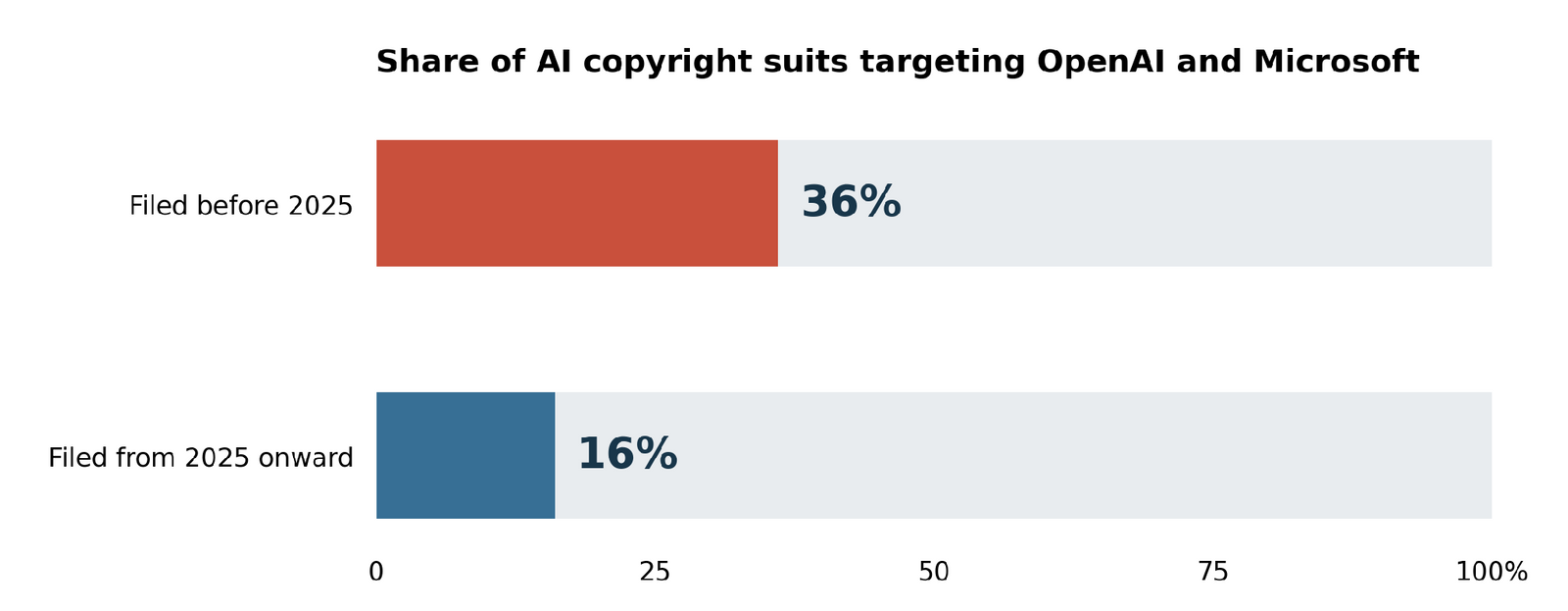
Figure 2. Share within each filing-period group; this does not show a decline in absolute case counts. Source: Axios analysis.
Outside news, disputes concern rights in both training material and generated output. Academic and book publishers have challenged the use of their work to train Meta's Llama and Google's Gemini. Disney, NBCUniversal and Warner Bros. Discovery have pursued image and video generators including Midjourney and MiniMax.
Publishing and video disputes broaden while music settlements reshape services
Book publishers have sought to strengthen both the plaintiff group and the evidence of harm. On May 5, 2026, Elsevier, Cengage, Hachette Book Group, Macmillan and McGraw Hill, together with author Scott Turow, sued Meta and chief executive Mark Zuckerberg in the Southern District of New York. They alleged unauthorized use of millions of literary, educational and scholarly works to develop Llama. The Next Web interpreted the case as bringing forward plaintiffs better placed to demonstrate the market harm that had been insufficiently established in Kadrey.
Hachette, Cengage, Elsevier and Turow also sued Google in the same district on Jul 10, 2026, alleging that material obtained through sources including Google Books was used to train Gemini. The Chicken Soup for the Soul publisher took a different route, suing Anthropic, Google, OpenAI, Meta, Apple, Nvidia, Perplexity and xAI together on Mar 17, 2026. The court required separate cases against the defendants, leaving Meta in the original action. The publisher, which had opted out of the Anthropic settlement, refiled against Anthropic in May.
For video creators, the means of access has become a separate issue. Ted Entertainment, operator of the h3h3 YouTube channel, and other creators brought class actions against Meta and ByteDance on Dec 23, 2025, followed by Snap in January. Bloomberg Law reported claims focused on alleged circumvention of access controls under the Digital Millennium Copyright Act. It identified the copyright-registration status of the videos as a reason for that approach to pleading.
Hollywood studios have challenged the reproduction of protected characters and works in generated material. Disney and NBCUniversal sued Midjourney in June 2025, and Warner Bros. Discovery followed that September. All three sued China's MiniMax in the Central District of California on Sep 16, 2025. These disputes involve different questions from a newspaper's claim about the copying of reporting for training, even when they appear in the same map of AI litigation.
Music settlements have also led to new production partnerships. Universal Music Group settled with Udio on Oct 29, 2025 and agreed licenses covering recordings and music publishing. It was the first settlement after the three major music groups sued Suno and Udio in 2024. UMG announced a music-tool development partnership with Stability AI the next day. Warner Music reached agreements with Udio and Stability on Nov 19, 2025; the following day, UMG, Sony Music and Warner Music all signed licensing agreements with Klay Vision.
Warner's Suno settlement included conditions on retiring unlicensed models within a year, restricting downloads to paid accounts and using participating artists' names and voices with consent. K-EnterTech Hub reported on Sep 9, 2026 that Suno had introduced v6, trained on licensed recordings. The arrangement concerns the model and the permissions available to users as well as the money paid for source material.
Rights-management technology is another part of the market. The Association of American Publishers announced a May partnership to use Vermillio's TraceID to detect and remove AI infringements, including replicated audiobooks. Vermillio had raised a $16 million Series A round, about KRW 22.1 billion, co-led by Sony Music in March 2025. Permission to use originals and monitoring of generated material are developing alongside each other.
AI disputes and agreements beyond news
Sources: Hachette, Bloomberg Law, AP, Axios, AAP and reporting cited in the text. Allegations are not final findings of liability.
For news publishers, court decisions remain a major variable in negotiations. Earlier U.S. rulings turned on how works were acquired and the evidence of harm to their markets. In Bartz v. Anthropic, the court treated model training as fair use but did not extend that finding to building a central library from pirated books. In Kadrey v. Meta, weaknesses in the plaintiffs' evidence and arguments about market harm helped determine Meta's victory. In Thomson Reuters v. Ross Intelligence, the court rejected fair use for Westlaw editorial content used to develop a competing legal-research service.
The decisions do not establish that every use of copyrighted material to train AI is lawful or that every such use infringes. Bartz separated the transformative training question from the acquisition and retention of copies. Kadrey turned in part on the evidence of market harm offered by those plaintiffs. Ross concerned editorial legal material used for a competing, non-generative legal-research product. In the Times litigation, the alleged substitution of journalism is itself contested.
What three earlier rulings did and did not decide
Sources: case reporting and litigation materials discussed in the text. The comparison does not imply a universal exemption for AI training.
Those questions now run through the Times litigation against OpenAI and Microsoft, which entered the summary-judgment phase in September. The parties have asked the court to resolve claims on the record before a possible trial. They dispute the basis on which the works were obtained and whether AI services substitute for the publishers' products.
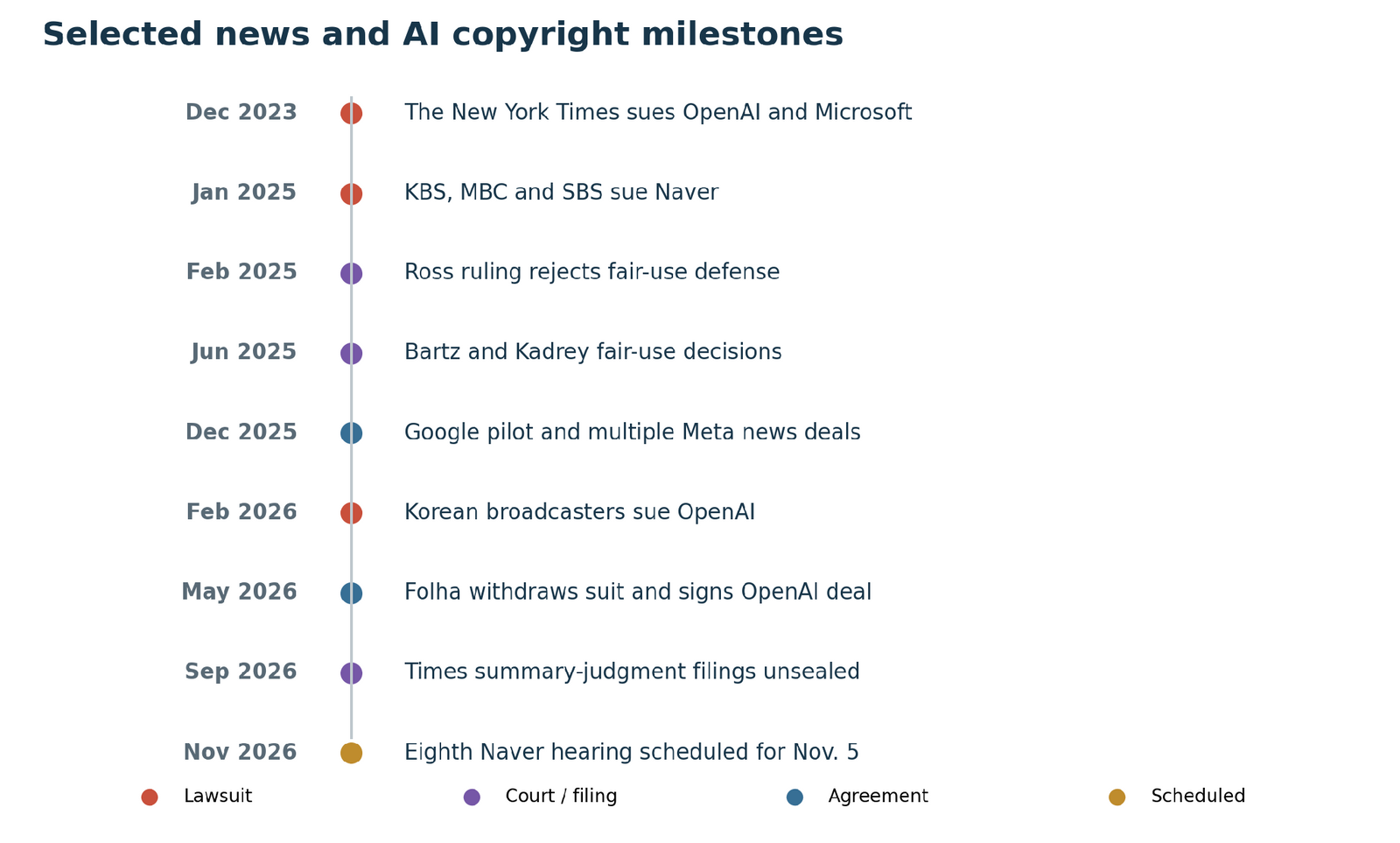
Figure 3. Selected milestones. The November 2026 hearing is scheduled, not completed. Sources: Axios, Press Gazette and the Journalists Association of Korea newspaper.
Plaintiffs' briefs unsealed on Sep 17, 2026 quoted internal company documents. TechCrunch reported that Microsoft applied-sciences director Brent Hecht described collection of copyrighted works for AI training in a January 2023 memo as “the largest theft of labor in human history.” The Times alleged that OpenAI's mid-training datasets contained more than 91,692 copies of works from the Times, the Daily News and the Center for Investigative Reporting. It also cited more than two million nytimes.com documents in a Common Crawl-derived dataset.
Those quotations and allegations were presented in the plaintiffs' briefs, with much of the underlying evidence still unavailable publicly. OpenAI argues that training on public works is consistent with existing law and that reported facts themselves are not protected by copyright. It has submitted research disputing that ChatGPT commercially substitutes for Times products. Microsoft makes a similar argument about Copilot.
Local publishers have joined the challenge. The Seattle Times and Newsday sued the two companies on Sep 7, 2026, although both had hired AI fellows in 2024 through a Lenfest Institute program supported by the defendants. More than 30 U.S. local-newspaper publishers representing roughly 400 titles filed against the same companies on Jun 26, 2026. Cooperation on newsroom uses of AI had not settled the separate question of permission to train on reporting.
The demands in local-news cases are substantial. Reporting compiled by Press Gazette put the damages sought by nine MediaNews Group newspapers in a November 2025 action at more than $10 billion, approximately KRW 13.833 trillion. That is a claim, not an award. The publication's tracker listed roughly a dozen publisher cases against OpenAI and around six against Perplexity.
News Corp sued Brave on Jul 22, 2026. On Jul 31, 2026, a federal court largely rejected Perplexity's effort to dismiss Reddit's case. Allowing claims to proceed is not a final finding of infringement. The separate tracker ChatGPT Is Eating the World counted 106 AI copyright suits on May 7, 2026. That total spans sectors and a different reporting date; it is neither a September count nor a total limited to news publishers.
South Korea tests what an earlier news deal allowed
South Korea's broadcasters are confronting that distinction through an existing contract. KBS, MBC and SBS dispute whether news-content partnership terms agreed with Naver in 2020 authorized training of HyperCLOVA X. At issue is whether arrangements for supplying news to a portal also covered a later use in generative AI.
Naver says its contracts authorized the use and argues, alternatively, that news training qualifies as fair use. The broadcasters say the earlier terms granted no such permission. The Journalists Association of Korea's newspaper reported that the court had questioned whether Naver adequately explained the possibility of training use. The Seoul Central District Court held its seventh hearing on Sep 8, 2026 and scheduled the next for Nov 5, 2026 at 11:10 a.m. No judgment date has been fixed.
At the seventh hearing, both sides supported moving toward the close of arguments at the next hearing or the one after it. The broadcasters sought a prohibition on training as well as damages. The Journalists Association of Korea newspaper suggested a first-instance decision could come around the end of the year or early in the next, but the court had not set a judgment date. Naver emphasized the existing contractual relationship as a distinction from overseas disputes about unauthorized scraping, putting the wording of the terms and the explanations given at signing at the center of the case.
The broadcasters' claims include copyright infringement, misuse of data, appropriation of commercial achievements and civil tort liability. They initially sought KRW 200 million each, approximately $144,600, while indicating that they intended to raise the amount. They submitted a list of about 97,000 works in January and alleged that five million to six million works were affected. Following a court suggestion, they excluded reporting that merely conveyed facts. Naver has also argued that such factual reporting falls outside copyright protection.
The three broadcasters separately sued OpenAI in Seoul on Feb 23, 2026. The Korea Broadcasters Association alleged that OpenAI had refused negotiations with them while signing paid licenses with overseas publishers. That case concerns use by a company without a contractual relationship; the Naver case concerns the reach of one already in place.
Commercial partnerships are developing alongside the litigation. Yonhap's role as a supplier to Gemini is one example. An August 2025 discussion reported by the Journalists Association of Korea also cited agreements between the Chosun Ilbo and Upstage and between Naver and KBS. Public details do not establish equivalent training rights or payment terms across those arrangements. A partnership announcement alone does not settle permissions for training, answer display and onward supply.
The differences have prompted calls for common terms. At a National Assembly seminar on Jul 22, 2026, Korea AI Association vice president Kim Kyung-tae argued that publishers should develop a shared standard for news use. Aju Business Daily cited Britain's SPUR initiative, involving the BBC and the Guardian, as an example. Consistent definitions could make it easier to compare permissions and payment terms across individual deals.
Government policy remains contested. After the Presidential Council on National AI Strategy recommended legal changes in December to reduce uncertainty around training, the Korean Association of Newspapers objected in January to a use-first, compensate-later approach. It called for withdrawal of a proposed training exemption, mandatory transparency about training data and a framework for paying for news.
The newspaper association submitted its response on Jan 2, 2026. The government's recommendation concerned amendments to copyright and AI framework legislation under the draft national AI action plan. The Korea Broadcasters Association framed the separate OpenAI lawsuit as an issue of data sovereignty. In the publisher roundtable reported in August 2025, a participant warned that isolated negotiations could repeat the earlier transfer of distribution power to portals. With financial terms of domestic partnerships largely undisclosed, an announcement alone offers little basis for comparing compensation.
The U.S. timetable also needs qualification. Axios's September account anticipated a decision in the coming months on a possible 2027 trial. It did not set a judgment date in 2027. A first-instance Korean decision could arrive before the U.S. case reaches trial, but the order is not fixed. Both proceedings could influence how the parties describe permitted uses and market effects in their next negotiations.
The Times summary-judgment decision in the United States and the interpretation of Naver's terms in Korea could influence the next round of negotiations. The Naver case has particular implications for publishers that supplied reporting under similar arrangements. Yonhap is already supplying current information to Gemini while broadcasters contest the boundary between news distribution and AI training. For Korean publishers, the scope of permission in the next contract will matter alongside the reporting they have to sell.
Korean TV need news products they can price and verify
For Korean broadcasters, the litigation leaves a commercial task unfinished: deciding what to sell to AI companies and on what terms. A ruling on whether an existing distribution agreement covered model training would not establish a price for future supply. The overseas cases show why publishers can pursue claims over past use while negotiating a different relationship for the next contract.
That negotiation starts with a clear account of the material a broadcaster can supply. Training on an archive, retrieving breaking news and displaying summaries in an answer are distinct uses. Written reporting, footage and audio also need an inventory of available rights, including material obtained from outside producers or other sources. Defining the term of access and any permission to supply content onward would make the scope of an offer clearer to both sides.
The commercial proposition extends beyond the size of the archive. Original local reporting, footage from the scene and verified records of people and events could support AI services answering questions about Korea. Turning those assets into a dependable product would require timestamps, source information and a way to deliver corrections and follow-up reporting. Yonhap's real-time supply arrangement illustrates the value of keeping answers current as well as supplying material for training.
Payment terms need equally careful definition. Broadcasters could consider a minimum guarantee with usage payments, but the model would be difficult to value without agreement on what counts as a billable use. Retrieval, display in an answer and onward supply to an enterprise customer are different points at which a charge might apply. Contracts would also need reporting that lets the broadcaster check the resulting payment. Promised links should be assessed against the visits and subscription conversions they actually generate.
There is room for common technical and reporting standards across broadcasters. Shared definitions of training and retrieval, attribution requirements, usage reports and correction procedures could make offers easier to compare while leaving each company to negotiate its own scope and price. An exclusive arrangement would require a separate assessment of the business it could foreclose with other AI buyers.
Anthropic's position shows the limits of assuming that exposure to litigation will bring every AI company to the negotiating table. Korean broadcasters need both a basis for asserting their rights and a news product that a buyer has a reason to pay for. Their next negotiations will test whether the credibility and timeliness of their reporting can be translated into defined permissions, verifiable use and recurring income.
Terms Korean broadcasters can carry into AI negotiations
K-EnterTech Hub analysis based on reported arrangements. Proposed negotiating items are not an existing standard contract or a claim that these terms have been adopted in Korea.
The network of AI and media agreements
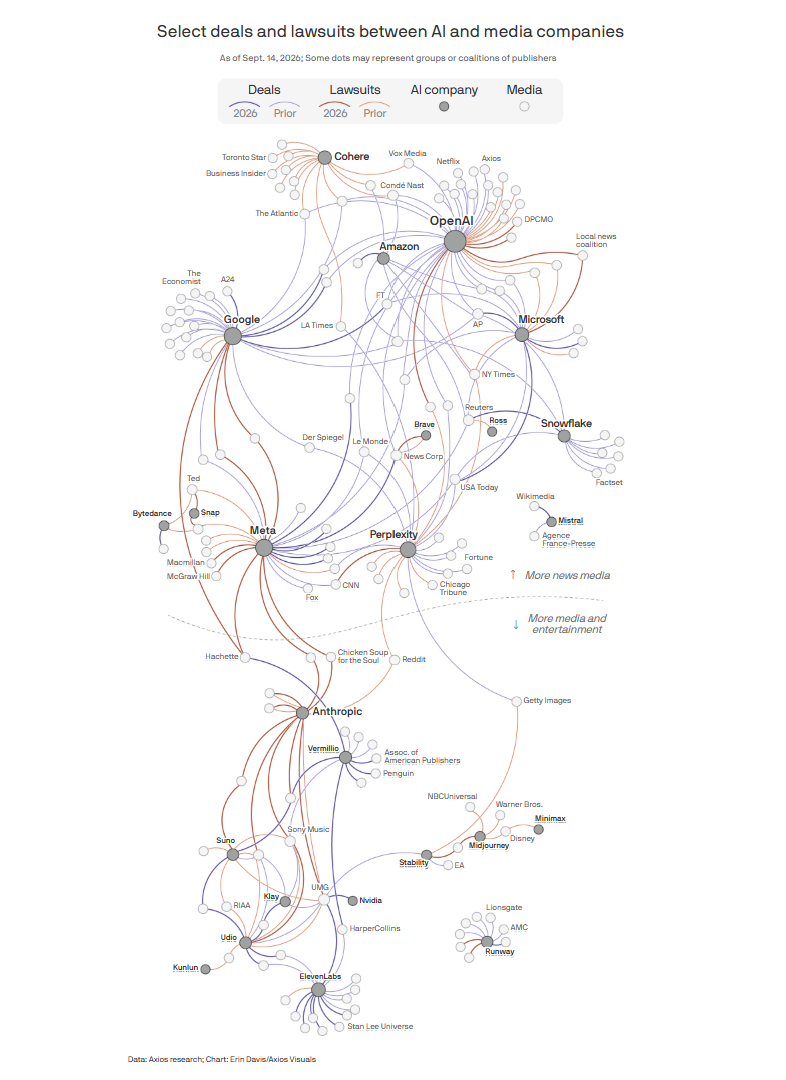
Original Axios graphic as of September 14, 2026. Purple links indicate agreements and red links lawsuits; darker links are from 2026 and lighter links are earlier. Some nodes represent publisher groups or coalitions. Data: Axios research. Chart: Erin Davis / Axios Visuals.
Sources and data notes
Agreement counts follow Axios's tally as of September 14, 2026. Contract values are reported figures, with attribution in the text. Currency conversions use KRW 1,383.3 per U.S. dollar, the September 18 Seoul daytime close, and are rounded. References follow.
1. Axios — New entrants tangle AI media deal web (2026-09-19)
2. Press Gazette — Who is suing AI and who is signing (2026-09-17)
3. Axios — Historic NYT v. OpenAI copyright battle heats up (2026-09-08)
4. TechCrunch — Microsoft internal documents cited in unredacted filings (2026-09-17)
5. Journalists Association of Korea — Broadcasters v. Naver approaches end of hearings (2026-09-09)
6. Press Gazette — OpenAI not planning to share advertising revenue with publishers (2026-06-02)
7. Digiday — Timeline of major publisher and AI deals in 2025 (2026-01-01)
9. The Next Web — Five major publishers are suing Meta over Llama (2026-05)
10. TheWrap — Hachette and Scott Turow sue Google over AI training (2026-07)
11. Al Jazeera — Authors and publishers sue Google (2026-07-15)
12. Bloomberg Law — Chicken Soup publisher adds to AI copyright suits (2026-03-19)
13. ChatGPT Is Eating the World — Chicken Soup refiles and tracked suits reach 106 (2026-05-07)
14. Bloomberg Law — Meta and ByteDance face YouTuber scraping suits (2025-12-23)
15. MediaPost — Judge sides against Snap in scraping battle
16. Axios — Disney, NBCU and WBD sue MiniMax (2025-09-16)
17. AP via WSLS — Universal Music and Udio settle and plan music platform (2025-10-30)
18. AP via News4JAX — Music companies sign AI licensing deals (2025-11-20)
19. Association of American Publishers — Partnership with Vermillio on AI infringement (2026-05)
20. Axios — Sony Music backs Vermillio (2025-03-03)
21. The Washington Post — Microsoft executive memo in AI court records (2026-09-17)
22. The Hollywood Reporter — OpenAI and Microsoft copyright litigation (2026-09)
23. Futurism — Microsoft memo and Times litigation (2026-09)
24. LLM Pulse — AI content licensing deal tracker (2026-08-17)
25. Tow Center at Columbia Journalism Review — AI deals and lawsuits tracker
26. Journalists Association of Korea — Publisher roundtable on AI negotiations (2025-08-13)
27. Edaily — Naver and broadcasters dispute protection of factual news (2026-04-09)
28. Asia Economy — Korean broadcasters sue OpenAI (2026-02-25)
29. MBC — Broadcasters bring action against OpenAI (2026-02-23)
30. Financial News via Nate — Newspaper association opposes use-first compensation (2026-01-06)
31. Aju Business Daily — News rights and AI policy seminar (2026-07-22)
32. Money Today — USD KRW daytime close at 1383.3 (2026-09-18)
K-EnterTech Hub · Reporting and analysis by Jung Han.
Additional source · Adweek — Anthropic and digital-publisher licensing
Additional source · Google — Supporting the web with new features and partnerships
Google Public Policy | Paid programs and the information ecosystem | Jun 18, 2026
Digiday | Google pay-per-value pilot and payout transparency | Sep 14, 2026
9to5Google | AI contribution pilot payments to websites | Sep 17, 2026
Media Copilot | AI overviews and audio in Google News
K-EnterTech Hub | Reporting on AI music training and Suno v6 | Sep 9, 2026
Source scope
Reporting dates differ across the deal and litigation sources. Contract values and company valuations refer to the reporting period, not a common current market price. Detailed Adweek negotiation accounts and K-EnterTech Hub's Suno v6 item follow the quotations and summaries in the supplied manuscript; Adweek's full online text could not be re-accessed for this update. The U.S. timetable refers to an expected decision in the coming months on a possible 2027 trial. Korean judgment timing is also a reported expectation, not a scheduled decision.