
NBCUniversal moves its streaming service Peacock inside YouTube Premium — starting in the U.S. in early 2027, in a multi-year pact that also spans YouTube TV carriage, live sports production and ad tech
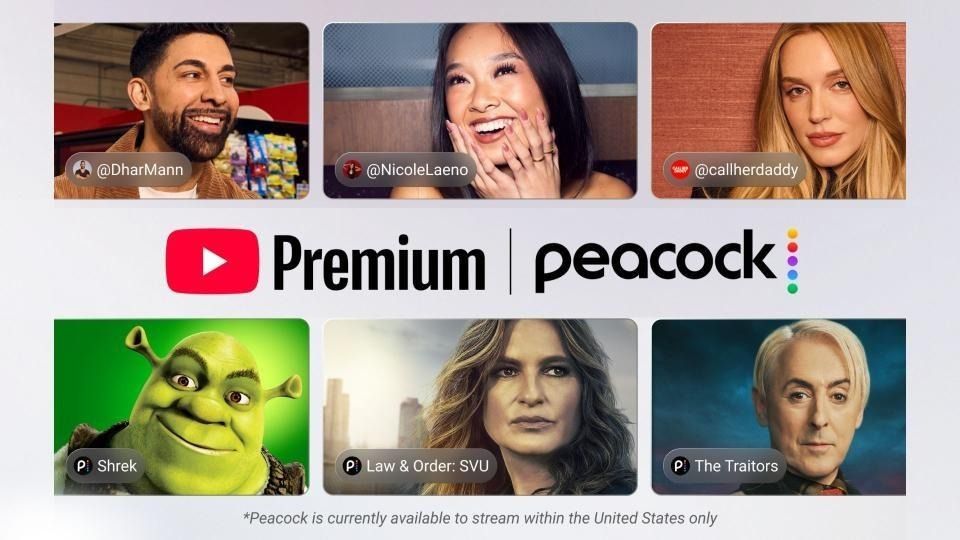
Promotional art for the YouTube Premium and Peacock tie-up, with a footnote that Peacock currently streams in the U.S. only. (Image: NBCUniversal / YouTube)
NBCUniversal is moving Peacock inside YouTube’s paid subscription product. Beginning in early 2027, YouTube Premium subscribers in the U.S. will get Peacock Premium content without a price increase, accessed within the YouTube experience itself.

As direct-to-consumer growth has slowed for media companies running their own apps, the gateway to viewing time has shifted to YouTube — and legacy players are now renting distribution from the platform they had defined as a competitor. YouTube held 13.4% of total U.S. TV watch-time in April 2026, retaining the top spot on Nielsen’s Media Distributor Gauge, while streaming overall reached 47.6%. Peacock registered 1.7% in the same count. With the single largest holder of viewing time turning into a distribution window, the reach a premium content company can achieve through its own app alone has narrowed accordingly.
The companies announced the multi-year global strategic partnership on July 27. NBCUniversal described it as the largest wholesale distribution partnership Peacock has struck to date, saying the bundle will make Peacock one of the most broadly distributed premium streaming services in the U.S. The deal spans subscription bundling, channel-store retail, virtual MVPD carriage, international service distribution, live sports production and rights, advertising technology collaboration, and distribution of YouTube products on Comcast platforms.
Bundle, Add-On and Carriage in One Deal
The centerpiece is the subscription bundle. From early 2027, ad-supported Peacock Premium will be carried in a new YouTube Premium bundle in the U.S., and YouTube said the U.S. price of YouTube Premium will not change when Peacock arrives. The price of the new bundle itself has not been announced, and financial terms of the deal were not disclosed. Sold separately, ad-supported Peacock Premium runs $10.99 a month, while YouTube Premium — ad-free viewing plus background play, offline downloads and YouTube Music — is $15.99. The design is integrated rather than a handoff to a separate app: subscribers reach Peacock content inside YouTube.
The content named in the joint announcement leans heavily on live sports: the NFL, Olympics, NBA, MLB, WNBA, Premier League, Big Ten and Notre Dame football, Big 12, Big East and Big Ten college basketball, the Kentucky Derby and golf. Series include Love Island USA, The Real Housewives franchise, Law & Order: SVU, Saturday Night Live, The Traitors, All Her Fault and The Office. Universal theatrical films, the Shrek series among them, come with it.
Apart from the bundle, ad-supported Peacock Premium ($10.99 a month) will also be sold as a standalone add-on through YouTube Primetime Channels later this summer; Peacock Premium Plus, the limited-ads tier at $16.99 a month, went into that store first, on June 29; NBCUniversal described that launch as one component of a larger agreement with Google covering YouTube TV, Peacock, YouTube and Universal, announced in late 2025. Internationally, NBCUniversal’s Universal+ and Hayu expand distribution through YouTube Premium in select markets.
The conversion mechanic built for that June launch previews what this deal is really about. Peacock subscribers can watch Telemundo programming and every FIFA World Cup 2026 match in Spanish directly on YouTube, and select World Cup matches carry a free 10-minute look-in on the Telemundo Deportes YouTube channel — show the run of play, then ask viewers to subscribe to keep watching. Using YouTube’s free reach as the front door to a paid conversion is the same structure, now scaled up to the level of the subscription product itself.
The traditional pay-TV layer is included as well. NBCUniversal extended its multiyear carriage agreement with YouTube TV — described in the announcement as the largest and fastest-growing pay TV provider in the U.S. — keeping its entertainment, sports and news channels on the service; the two last renewed that pact in October 2025. The traffic runs the other way too: YouTube, YouTube TV and YouTube Premium expand distribution and packaging on Comcast’s Xfinity and Xumo platforms.
Why YouTube Premium and Not YouTube TV
The two companies collided head-on last fall. NBCUniversal warned viewers its channels could go dark on YouTube TV if the sides could not agree on new distribution terms. NBCUniversal wanted Peacock carried as part of the YouTube TV linear channel deal; YouTube did not want Peacock baked into its live TV bundle. An agreement kept the channels up. NBCUniversal went on to announce a long-term deal with Google covering YouTube TV, Peacock, YouTube and Universal in late 2025, and described the June channel-store launch as part of it. Axios characterized the earlier accord as a short-term patch to avert a blackout, with the formalized long-term agreement arriving only now.
This agreement sits at the midpoint of that standoff. NBCUniversal got a stronger distribution path for Peacock, but through YouTube Premium rather than YouTube TV. YouTube filled out its subscription offering with premium content without having to raise YouTube TV prices. The separation holds: YouTube TV remains the cable-replacement product, YouTube Premium the ad-free, offline-downloads product.
Three Layers: Premium, Primetime Channels and YouTube TV

The YouTube Primetime Channels shelf, where individual streaming services are merchandised as separate subscriptions.
Peacock sits in three different places inside the same YouTube. The newly announced YouTube Premium bundle is wholesale: Peacock content is folded into a subscription YouTube sells, users reach it without a separate transaction, and YouTube does the billing. Primetime Channels is a channel store, where users pick and pay for individual services — Peacock Premium at $10.99 and Peacock Premium Plus at $16.99 keep their list prices, and each service is merchandised under its own name and logo. YouTube TV is the cable-replacement product built from linear channels, which is where NBCUniversal’s carriage sits.
The three layers skim off different kinds of buyers. Viewers content to watch free with ads stay on YouTube proper; those who want one specific service buy it through Primetime Channels; those who find picking individual subscriptions tedious take the Premium bundle; those replacing cable take YouTube TV. Wherever the payment happens, the billing relationship and the viewing data stay with YouTube.
Layer on the FreeWheel ad tech integration and the NBC Sports live production partnership, and distribution, ad sales and production all converge toward one company. A content supply agreement ends when it expires; ad servers wired into demand pipes and an established production partnership do not unwind as easily. That is why this deal does not read as a single bundle.
Sports Production and Ad Tech
The deal goes beyond content distribution. A selection of NBCUniversal live sporting events will stream on the NBC Sports YouTube channel. Which events and when was not disclosed; the companies characterized it only as a sample of games for YouTube users. NBC Sports will also serve as production partner for select premiere live sporting events on YouTube — a structure in which a broadcaster supplies live production capability to a platform rather than simply selling it rights.
On the advertising side, the two are deepening ad tech collaboration including through FreeWheel, with execution details still undisclosed.
YouTube 13.4% vs. Peacock 1.7%

Nielsen The Gauge, April 2026 (Total Day, Persons 2+). YouTube alone accounts for 13.4% of the 47.6% streaming share. (Source: Nielsen The Gauge)
Nielsen’s April 2026 Gauge put YouTube at 13.4% of total U.S. TV watch-time. Peacock came in at 1.7% in the same measurement. Netflix followed at 7.8%, Disney at 5.0% (Disney+, ESPN+ and Hulu SVOD combined), Prime Video at 4.2%, The Roku Channel at 3.0%, Tubi at 2.3%, Paramount at 2.1% (Paramount+ and Pluto) and Warner Bros. Discovery at 1.5%. YouTube by itself exceeds the 12.8% held by Netflix and Disney together.
Across the full picture, streaming stood at 47.6%, cable at 21.6%, broadcast at 19.9% and other at 11.0%. YouTube accounts for roughly 28% of all streaming watch-time, and its solo total equals about two-thirds of all U.S. broadcast viewing. A market that premium content companies divide among originals costing billions to produce is topped, under a single brand, by user-uploaded video and creator channels.
The subscriber bases differ in scale as well. Peacock counted 48 million paid subscribers at the end of June, adding 2 million net in the quarter, and the service — launched in July 2020 — turned its first quarterly profit in Q2 2026. Google does not break out YouTube Premium subscriber numbers; its paid base including YouTube Music has been reported at more than 125 million. U.S. members are the ones getting Peacock; those outside the U.S. reach NBCUniversal content through Universal+ and Hayu. Peacock itself still streams only within the United States.
That gap explains the deal terms. The reach Peacock gains by appearing before YouTube Premium subscribers and the retention YouTube gains by adding Peacock are not comparable in scale. Financial terms were not disclosed, but holding the existing YouTube Premium price steady suggests the wholesale rate flowing to NBCUniversal was not set high. These are the terms a distributor with 1.7% of watch-time gets across the table from a platform holding 13.4%.
Sixteen Bundles — More Than Any Other Service

Axios research, as of June 13, 2026. Counts only bundles offering at least six months free or discounted. (Data: Axios research; Chart: Danielle Alberti/Axios)
By Axios’ count, 65 bundles are on sale across 12 major U.S. streaming services. Peacock leads with 16, followed by Starz at 15, HBO Max at 14, ESPN at 13, Hulu at 12, and Disney+ and Netflix at 10 each. Apple TV has 6, ViX 5, Paramount+ 4, Discovery+ 3 and Amazon Prime Video 2. A service sitting at 1.7% of watch-time ranks first in bundle count.
Nine of Peacock’s 16 come from within parent Comcast’s Xfinity packages. Its Apple TV pairing sells standalone and through Prime Video: Apple TV at $12.99 plus ad-supported Peacock Premium at $10.99 totals $23.98 separately, against $14.99 bundled — a discount of more than 37%. Most bundles run through telecom carriers and aggregators; all 10 of Netflix’s go through intermediaries such as Xfinity StreamSaver, T-Mobile, Verizon and Frontier.
Antenna data cited by The New York Times puts bundles at 28% of all new streaming subscriptions, double their 2024 share. With the market at saturation, organic subscriber growth has become difficult, and bundles pull in price-sensitive consumers while holding down churn. Antenna also found the Disney+, Hulu and HBO Max package well ahead of each standalone service on three-month retention of new sign-ups.
Matt Schnaars, NBCUniversal’s president of platform distribution and partnerships, has described Peacock’s move from an initial direct-selling focus toward selective bundle partnerships and channel stores. He points to platforms that aggregate and ingest apps as the source of the next stage of growth, while stressing that the approach is selective and consumer-oriented rather than indiscriminate. The YouTube Premium tie-up is the next step in that strategy: a direct streamer-to-platform pairing with no carrier or aggregator in between.

The Movies & TV storefront on Google TV and YouTube: titles from individual streaming services are programmed into the platform’s shelf and lead to a sign-up button.
What Schnaars means by platforms that aggregate and ingest apps looks like this screen. The Movies and TV storefront on Google TV and YouTube puts Free, Live and Purchased tabs side by side, while the top banner pairs a title from an individual streaming service with a sign-up button. Ad-supported free content, live channels, transactional purchases and subscription services all compete on the same shelf.
The service brand shrinks to a provider label beneath the title. Viewers choose what to watch rather than which app to open, and the order of those choices is set by the platform’s programming and recommendations. This shelf is where Peacock lands as it moves inside YouTube Premium. The layout makes the trade visible: reach in exchange for control of the discovery path.
Subscription Pressure and Perceived Value
The choice of YouTube Premium as the bundling vehicle rests on consumer research. Hub Entertainment Research found YouTube Premium ranked second for excellent value, which Hub attributed to the breadth of what ad-free services deliver across video and music. Respondents using only free YouTube sat at the bottom of the same list. Peacock placed lower, behind Netflix but ahead of Disney’s Hulu.
As consumers weigh price more heavily, layering premium content onto a base of users who already pay a subscription — and who rate that spending as worthwhile — sharply lowers acquisition cost. Rather than spending marketing dollars to drive app installs, NBCUniversal is stepping into a billing relationship that already exists.
Aligned With a Fandom Strategy
NBCUniversal has already signaled its intent to draw in the communities and fandoms that form on social and mobile video platforms, through unscripted franchises and short-form formats such as mobile microdramas built on Bravo IP and personalities. Placing YouTube’s creator ecosystem next to NBCUniversal’s premium series, films and live sports on one screen extends that direction.
Matt Strauss, chairman of NBCUniversal’s Media Group, said the agreement moves Peacock into its next phase of growth and, combined with the YouTube TV extension, widens the paths by which audiences reach the company’s content. YouTube CEO Neal Mohan framed it as pairing the platform’s creators, artists and cultural moments with Peacock’s live sports, Universal films and original series.
The platform side framed it around subscription growth. Mary Ellen Coe, YouTube’s chief business officer, described the deal as a way to grow the subscription business alongside partners, giving members premium content while connecting them to the creator ecosystem available only on YouTube. Mike Cavanagh, co-CEO of Comcast, cast it as part of a strategy of partnering with industry leaders to drive sustained growth at NBCUniversal.
Comcast plans to complete the spin-off of NBCUniversal, together with the U.K.’s Sky, by the middle of 2027. Mike Cavanagh, currently Comcast co-CEO, is set to lead the stand-alone NBCUniversal, and framed the deal as an extension of a strategy of partnering with industry leaders to drive sustained growth. A streaming business that will have to stand on its own has secured a major distribution window in advance.
What This Means for Korean Players
Bundles now account for 28% of new U.S. streaming subscriptions, and premium content companies are accepting terms under which they no longer hold the customer relationship directly. Distribution deals Disney and Warner Bros. Discovery struck with Charter and Verizon run in the same direction. Korean companies have largely treated YouTube as a promotional channel or a clip outlet. NBCUniversal treats it as a sales and billing channel for a subscription product. Given how heavily Korean OTT services depend on telecom bundle placement, the candidate pool for bundling partners should widen to include the paid subscription tiers of global platforms.
Overseas expansion routes need rethinking as well. Standing up an owned app in North America or Europe delivers poor returns against marketing spend. The way Universal+ and Hayu extend international reach through YouTube Premium is a more workable model for smaller operators. Korean OTT services and broadcasters expanding abroad should weigh entering platforms that already hold local billing relationships before going it alone.
NBC Sports taking on production partner duties for YouTube live events means production capacity itself becomes tradable, separate from rights sales. The live production and large-event operations expertise accumulated by Korean broadcasters is an exportable asset as global platforms push further into live.
Ad technology collaboration through FreeWheel means content supply and advertising inventory sales land on the same negotiating table. When Korean players negotiate with FAST channels or overseas platforms, leverage comes from designing the ad sales structure and data integration terms alongside the content rate — not from the rate alone.
The separation and the distribution deal are proceeding on the same timeline. Companies restructuring their business tend to lock in a distribution base before independence. With media restructuring under discussion in Korea as well, corporate reorganization and distribution partnerships should not be handled as separate agendas.
Sources
NBCUniversal–YouTube joint announcement, July 27, 2026 https://www.nbcuniversal.com/article/nbcuniversal-and-youtube-announce-global-strategic-partnership-expanding-reach-peacock-and
YouTube Official Blog https://blog.youtube/news-and-events/peacock-premium-partnership-youtube-premium-subscription/
Todd Spangler, Variety, July 27, 2026 https://variety.com/2026/tv/news/peacock-youtube-premium-bundle-1236821758/
Bevin Fletcher, StreamTV Insider, July 27, 2026
Peacock press release, June 29, 2026 — Peacock Premium Plus on YouTube Primetime Channels https://www.peacocktv.com/blog/peacock-premium-plus-on-youtube-primetime-channels
NBCUniversal–Google long-term agreement, late 2025 https://www.nbcuniversal.com/article/nbcuniversal-and-google-reach-long-term-agreement-across-youtube-tv-peacock-youtube-universal
Sara Fischer, Axios, July 27, 2026 — NBCU–YouTube distribution deal
Kerry Flynn, Axios, June 13, 2026 — U.S. streaming bundle tally https://www.axios.com/media-trends-membership/2026/06/13/streaming-bundles-disney-hbo-max-netflix
Axios, Sept. 26, 2025 — NBC / YouTube TV blackout warning https://www.axios.com/2025/09/26/nbc-youtube-tv-blackout-warning
CNBC, July 27, 2026 https://www.cnbc.com/2026/07/27/nbcuniversal-youtube-peacock-premium-subscribers.html
Deadline, July 27, 2026 https://deadline.com/2026/07/nbcuniversal-peacock-youtube-premium-bundle-1237004321/
Nielsen, The Gauge and Media Distributor Gauge, April 2026 https://www.nielsen.com/thegauge
Hub Entertainment Research, streaming service value survey, 2026