

K-EnterTech Hub
ANALYSIS
TollBit counts 116 AI scrapes per 1,000 human requests for B2B content in Q2; DoubleVerify tallies 3.2 billion ad requests to AI slop pages through September

Graphic: K-EnterTech Hub
Summary
AI bots favor expert, human-written content as ad money flows to AI slop. B2B content drew 116 AI scrapes per 1,000 human requests in Q2, 5.8x national news (TollBit). Ad requests to slop pages topped 3.2B in Jan.–Sept. (DoubleVerify). Korea's Naver AI suit resumes Nov. 5.
Expert content that people labor over is being harvested as raw material for AI answers, while cheap, low-quality content churned out by AI is pulling in advertising. AI's appetite for content keeps growing even as AI slop sites multiply in the ad market. How to pay those who make content, and how to guarantee inventory quality to those who buy ads, has become the media industry's pressing question.
AI bots are reading B2B and professional content far more heavily than people are. In the second quarter of 2026, B2B/professional sites logged 116 AI scrapes for every 1,000 human requests, according to TollBit, a marketplace that charges AI companies for access to publisher content. Parenting (92) and health and wellness (87) came next. National news (20) and local news (22) ranked last among 13 categories.
Over the same period, low-quality AI-generated sites — known as AI slop — expanded quickly in the ad market. The number of AI slop domains rose more than fivefold year over year in Q2 and traffic to them quadrupled, Axios reported on Oct. 17, citing ad verification firm DoubleVerify. Monthly ad requests to AI slop pages climbed 354%, from 184 million in January to 834 million in September, for a nine-month total above 3.2 billion.
Axios set the two datasets side by side in its media trends materials under the headings "Human intelligence is scarce" and "AI slop hijacks GEO." Generative engine optimization, or GEO, is the practice of shaping content so that AI answer engines such as ChatGPT cite it. SEO's incentive problems have been exacerbated in the answer-engine era, Axios wrote, as brands and publishers compete to influence what chatbots recommend.
In South Korea, the same tension is being argued in court. The eighth hearing in the copyright suit brought by broadcasters KBS, MBC and SBS against Naver (네이버) over AI training is set for Nov. 5 at the Seoul Central District Court (서울중앙지방법원), with both sides contesting whether training on news qualifies as fair use.
B2B at 116, national news at 20: bots go where high-intent answers live
Axios attributed the pattern to the nature of the queries: B2B content answers high-intent questions asked just before a work or purchase decision, and niche content holds more evergreen value for bots. The measure is a ratio against human demand, so the low figures for news also reflect how many people still visit news sites directly.
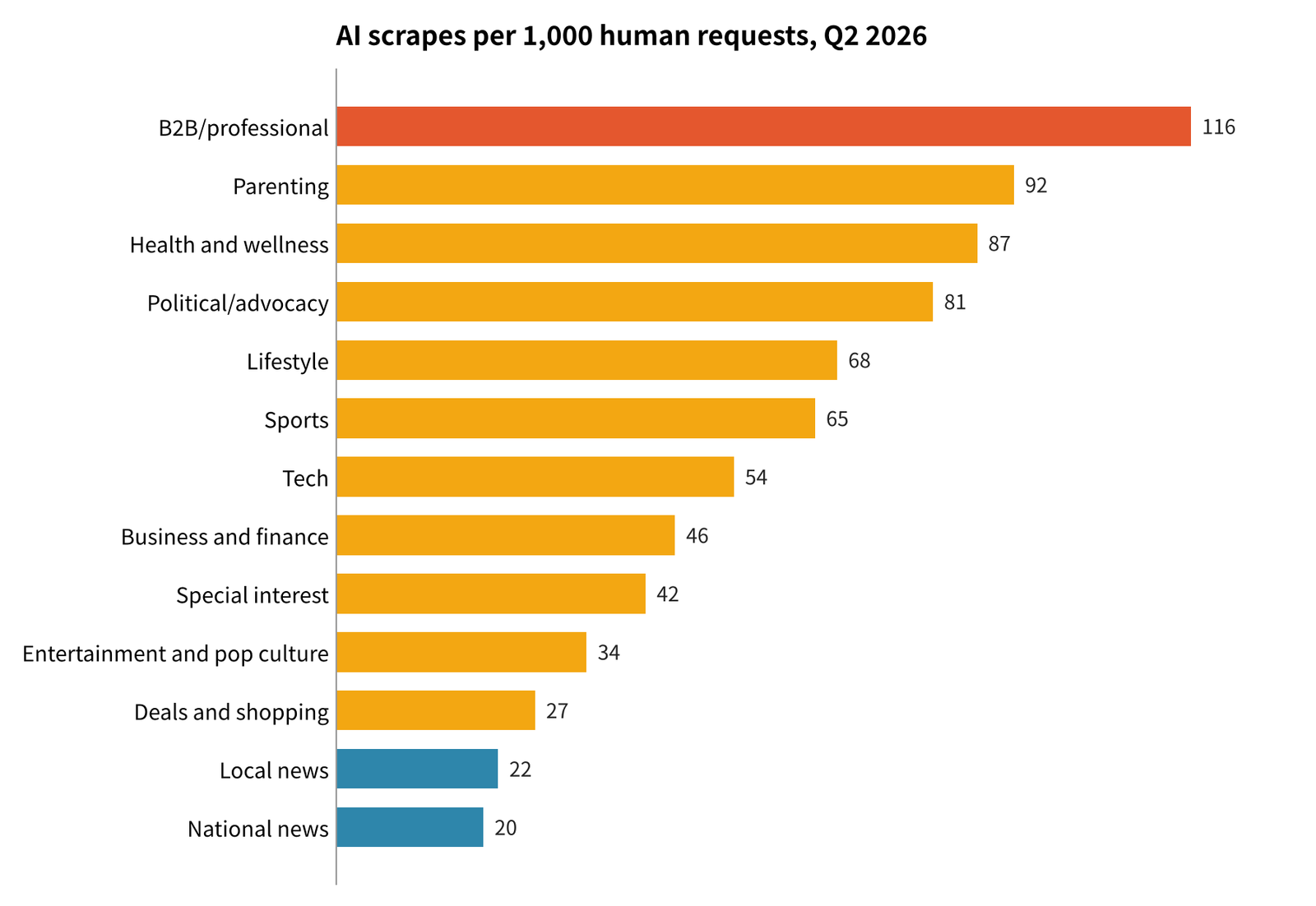
The gap between bots and people has widened quickly. TollBit's report on the second half of 2025 found one AI bot visit for every 31 human visits in Q4, up from one in 200 in Q1 2025, Digiday reported. Thirty percent of AI scrapes in Q4 ignored explicit robots.txt instructions. AI apps sent publishers only about 0.12% of their referral traffic, against roughly 80% from Google.
TollBit's first-half 2026 figures cover more than 987 billion site visits. The company detected over 22 billion AI bot scrapes in the period, more than 1.9 billion of which bypassed or ignored publishers' robots.txt instructions. TollBit subtitled the report "The Bad Bots."
Slop sites up fivefold in a year; September ad requests hit 834 million
Growth in slop ad requests accelerated in the second half. After dipping from 296 million in April to 258 million in May, monthly requests rose to 359 million in July, 528 million in August and 834 million in September. August and September alone accounted for 42% of the roughly 3.25 billion requests logged over nine months.
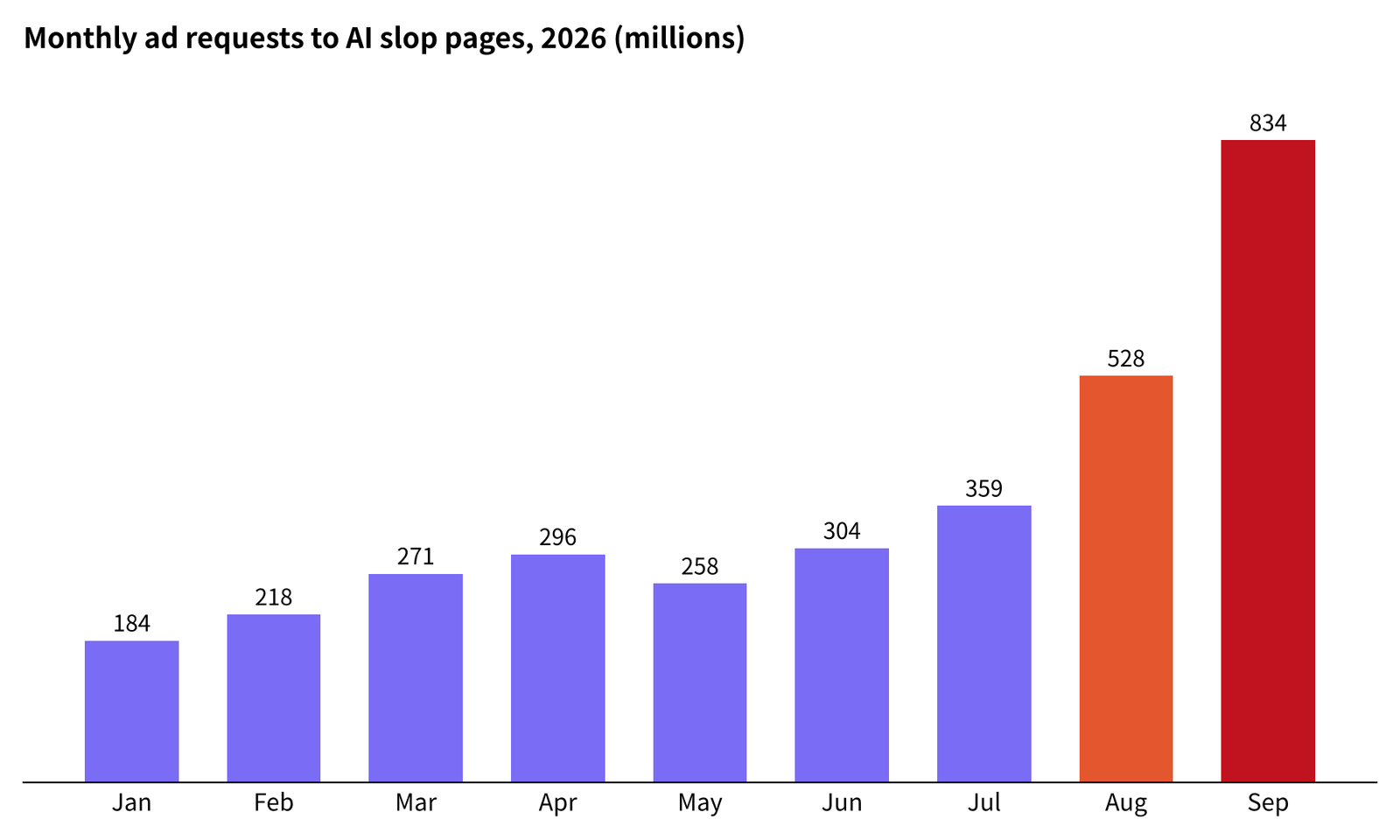
Cost explains the boom. In March, the DV Fraud Lab exposed a network it named AutoBait: more than 200 domains run by a single operation, each posing as an independent lifestyle blog while sharing the same AI-generated articles and images. The operators left their content-generation prompts exposed in the sites' JavaScript. The researchers estimated that a full article costs less than $2.25 (about 3,000 won) to produce, Mediaweek reported. DoubleVerify said it identified thousands of AI slop sites in multiple languages in the first few weeks of 2026 alone.
DoubleVerify detected more than half a billion AI slop impressions in the first half of 2026, ExchangeWire reported on Sept. 14. In EMEA, travel was the top category for slop, with significant volume in sports and technology as well. The company has extended its AI SlopStopper avoidance tool from the open web to social video, starting with YouTube.
Lawsuits widen from articles to metadata as Gracenote sues OpenAI
Axios noted that the legal fight between content owners and AI companies now reaches metadata. Gracenote, owned by Nielsen, sued OpenAI for copyright infringement in March, alleging that OpenAI not only used its metadata without permission but also copied the relational framework that connects it. No major media copyright suit had previously centered on the proprietary structure behind a dataset, Axios reported on March 10.
Publisher suits against AI answer services keep coming. Penske Media sued Google over AI Overviews in September 2025, and The New York Times and the Chicago Tribune sued Perplexity in December 2025. In Japan, the Yomiuri Shimbun sued Perplexity in August 2025, alleging it took 119,467 articles without permission and seeking about ¥2.17 billion; the Asahi Shimbun and Nikkei filed their own suits later that month.
Blocking is spreading, too. An Axios analysis of 102 top U.S. publisher domains, shared by media reporter Sara Fischer on Oct. 19, found that 42% block AI training crawlers outright but just 25% block AI search crawlers. Some 46% block Anthropic's ClaudeBot entirely, compared with 38% for OpenAI's GPTBot — most publishers shut off training while leaving the path to AI citations open.
Korea's broadcasters vs. Naver: eighth hearing Nov. 5, ruling possible by early 2027
KBS, MBC and SBS filed suit on Jan. 13, 2025, alleging Naver used their news without permission to train its HyperCLOVA (하이퍼클로바) and HyperCLOVA X models. Each broadcaster seeks 200 million won (about $149,000) in damages, plus an injunction against AI training, and plans to raise the amount later. Ahead of the third hearing, the plaintiffs submitted a list of some 97,000 allegedly infringed works.
At the sixth hearing on Aug. 18, the court said Naver likely had not explained the possibility of generative AI use when it revised its news partnership terms in 2020, and told the parties to argue on that premise. Naver is relying on its contractual license and fair use. The seventh hearing on Sept. 8 lasted about 10 minutes, and both sides proposed closing arguments at the next or following session. The Journalists Association of Korea's weekly (한국기자협회보) expects a first-instance ruling in late 2026 or early 2027. The three broadcasters also sued OpenAI in February over both training and outputs.
Korean law does not yet address the dispute. The Framework Act on AI (AI 기본법), in force since January, requires only that AI-based services and AI-generated outputs be disclosed; it contains no provisions on training data or copyright. A bill introduced in June 2025 that would require AI developers to disclose training-data information has stalled in the National Assembly.
The TollBit data gives Korean broadcasters and media companies reason to widen what they put on the table. Korea's litigation centers on news articles, but bot demand runs highest in B2B, parenting and health — information that directly answers a question. Broadcasters' medical and business programming, documentary and factual archives, and script and subtitle data fall in that range. On the ad side, Korean advertisers buy the same open-market programmatic inventory as global brands. DoubleVerify told Digiday that working directly with publishers through private marketplaces and programmatic guaranteed deals mitigates slop and spoofing risk — a case for Korean broadcasters' and publishers' digital sales teams to sell verified human traffic as a condition of the deal.
What AI can't replace: firsthand reporting, perspective and trust
Publisher data shows which content AI substitutes easily and which it doesn't. Tech outlet Digital Trends logged 4.1 million bot scrapes in a single week on TollBit's monitoring, while AI chatbots sent back just under 4,200 visitors. The hardest-hit pieces were evergreen how-tos, such as a guide to taking screenshots on Windows, and spec-heavy product reviews — answers AI can assemble on the spot. "Information that is data-centric or spec-centric" is where publishers are hurt most, Dan Gaul, who helped launch the site in 2006, told The Media Copilot. Features, commentary and creative work faced less substitution, and Digital Trends is shifting from traffic optimization to building community.
What AI cannot generate is information that has not yet been recorded anywhere. Field reporting and interviews, proprietary data and facts drawn from industry relationships can be quoted by AI answers but not produced by them. In TollBit's data, bots crowded into B2B and niche categories. What Gracenote went to court to protect was not article text but a metadata structure built over years.
Trust is not replaceable either. Some 48% of UK consumers told DoubleVerify that seeing a brand advertised next to low-quality AI-generated content would hurt their view of the brand, and 30% said the effect would be very negative, Advanced Television reported on Sept. 14. Inventory whose authorship can be verified carries value for advertisers.
For Korean broadcasters and media companies, that means regional reporting networks, specialist reporters and producers, decades of broadcast archives, and relationships with talent and fans. As Axios put it in its slide title, human intelligence is becoming scarce, and in the AI era the price of content is being set less by volume than by firsthand information and trust.
Outlook: a first Korean ruling, and a shift from blocking to charging
The first-instance ruling in the broadcasters' case against Naver will be Korea's first judicial word on how far AI developers may use news data for training, and on what terms. Whether the court decides on contract interpretation alone or goes on to rule on fair use will shape how newspapers and online outlets negotiate next. The suit against OpenAI, which also targets outputs, raises broader questions.
Abroad, the emphasis is moving from blocking to billing. TollBit routes AI bots to a paywall that charges per page, and redirected more than 2.6 billion bot requests there in the first half of 2026 alone. Ad verification firms are pushing slop-avoidance tools onto social and video platforms. With bots taking more expert, human-made content and ad dollars leaking further into AI-made pages, content owners are likely to negotiate on three fronts at once: paid access, licensing and verified ad inventory.