
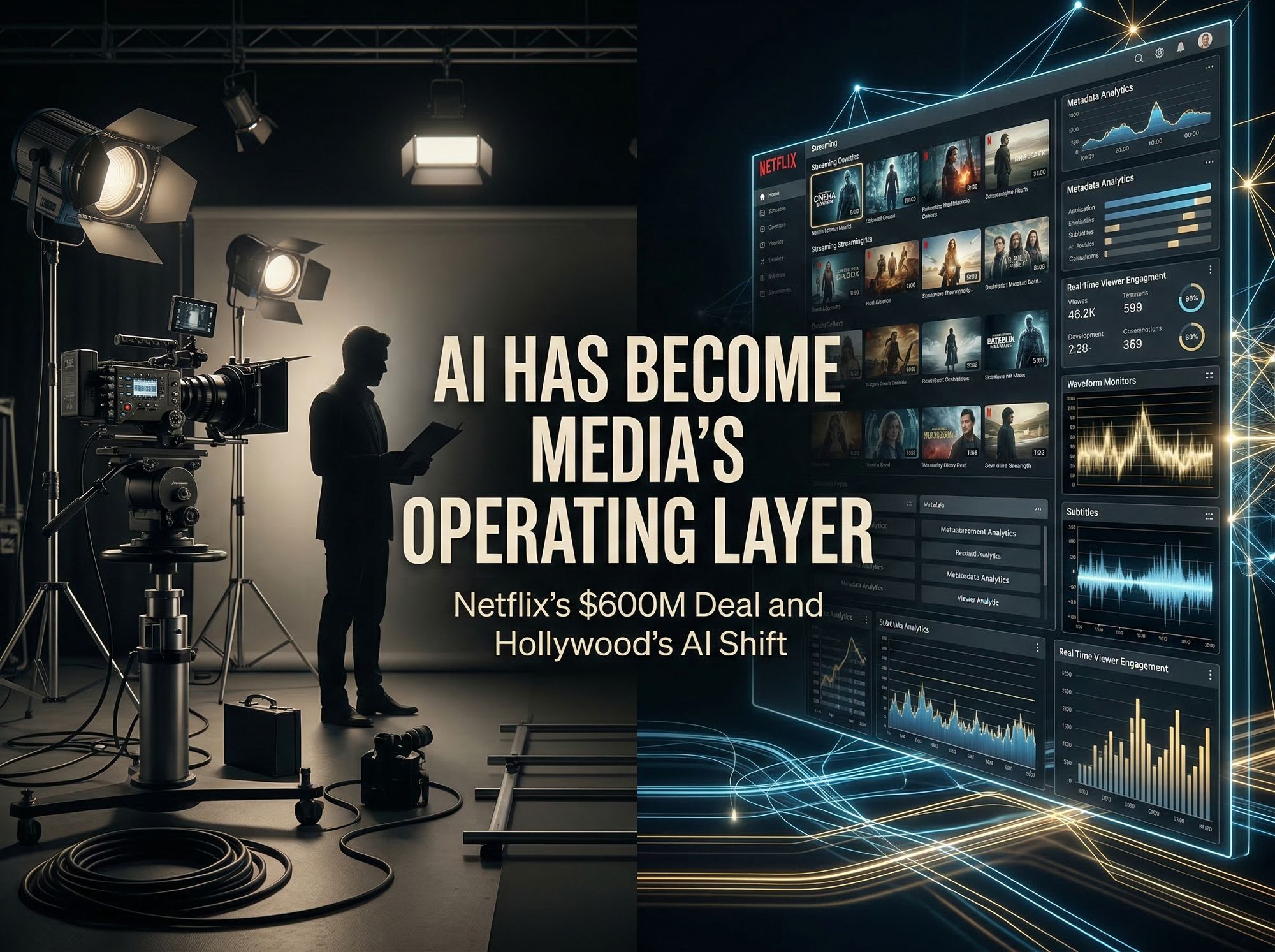
AI Has Become Media's Operating Layer
Netflix's $600M Deal, Hollywood's Performative Resistance, and a Structural Shift That Cannot Be Undone
AI is no longer a toolbox. It is already the infrastructure of the media industry — its operating layer. Functions once scattered across the workflow — metadata tagging, QC automation, transcript generation, recommendation engines — are now integrated into a single intelligent system. That layer routes content, enforces compliance, and drives the day-to-day operations of every workflow from the newsroom to ad insertion.
 Jung Han
What pushed this transition was not technology itself, but scale. As global distribution exploded into multi-region, multi-platform, multi-accessibility demands, manual version management and monitoring hit a physical wall. No human team can monitor thousands of simultaneous feeds, process dubbing and subtitles in dozens of languages by hand, or predict and respond to millions of concurrent viewers surging around a major live event. Without automation, the economics of scale became impossible — and that automation has now evolved into agentic systems capable of understanding context, setting objectives, and executing multi-step processes independently.