
At AI Content Festival 2026, Ko, Kim Nan-do and TikTok Korea’s Shiqi Wu examine human judgment, IP partnerships and the connection between content and commerce
Samseog Ko said AI is reshaping content value chains and revenue models at a November 12 discussion in Seoul. Kim Nan-do emphasized creators’ judgment and original stories, while Ko called for an ecosystem in which creators, companies, platforms and consumers grow together.
Samseog Ko says the next competitive advantage in the content business will come from connecting technology with people. As AI production tools become widely available, creators’ judgment and consumer trust become more valuable, while revenue expands beyond rights and advertising into IP partnerships, brands and commerce. A November 12 discussion at AI Content Festival 2026 in Seoul focused on that commercial question: who can turn AI-enabled content into a sustainable business?
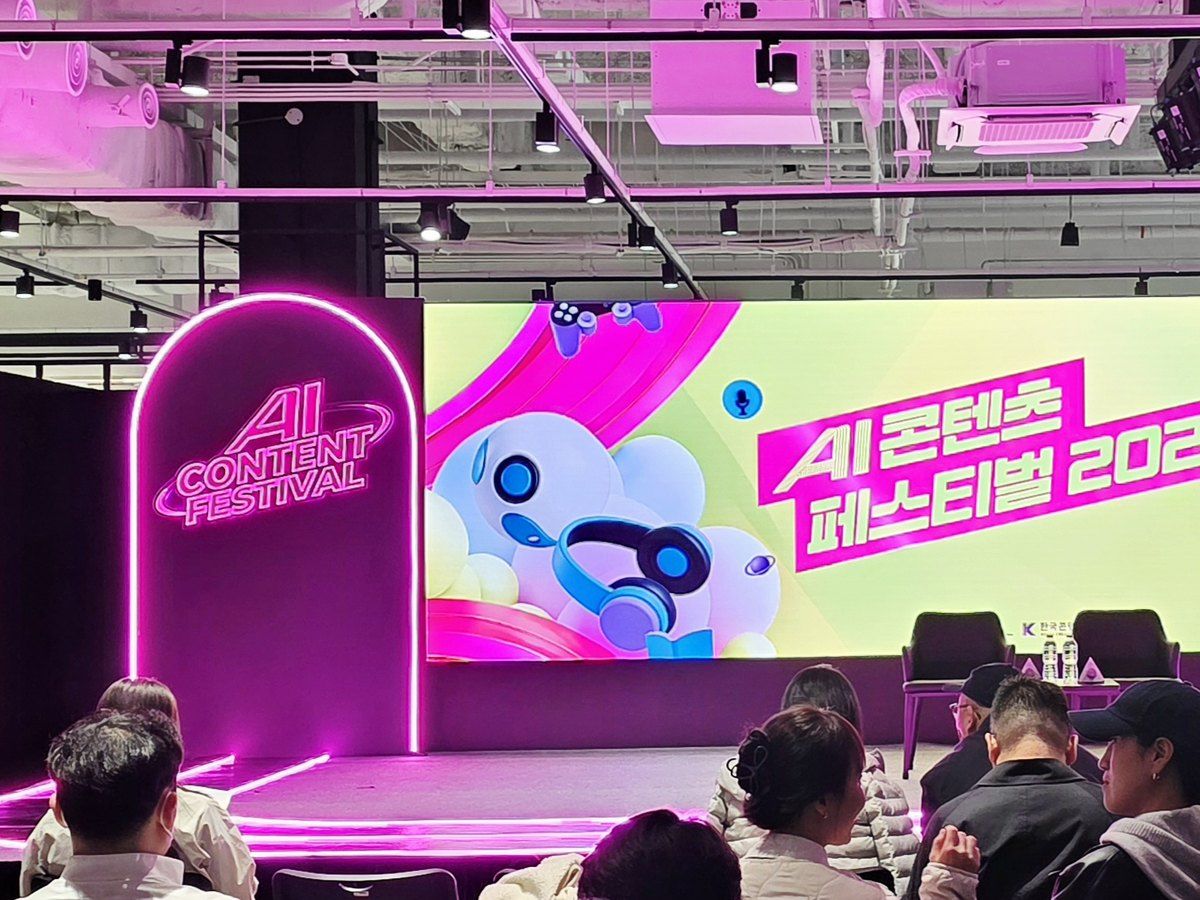
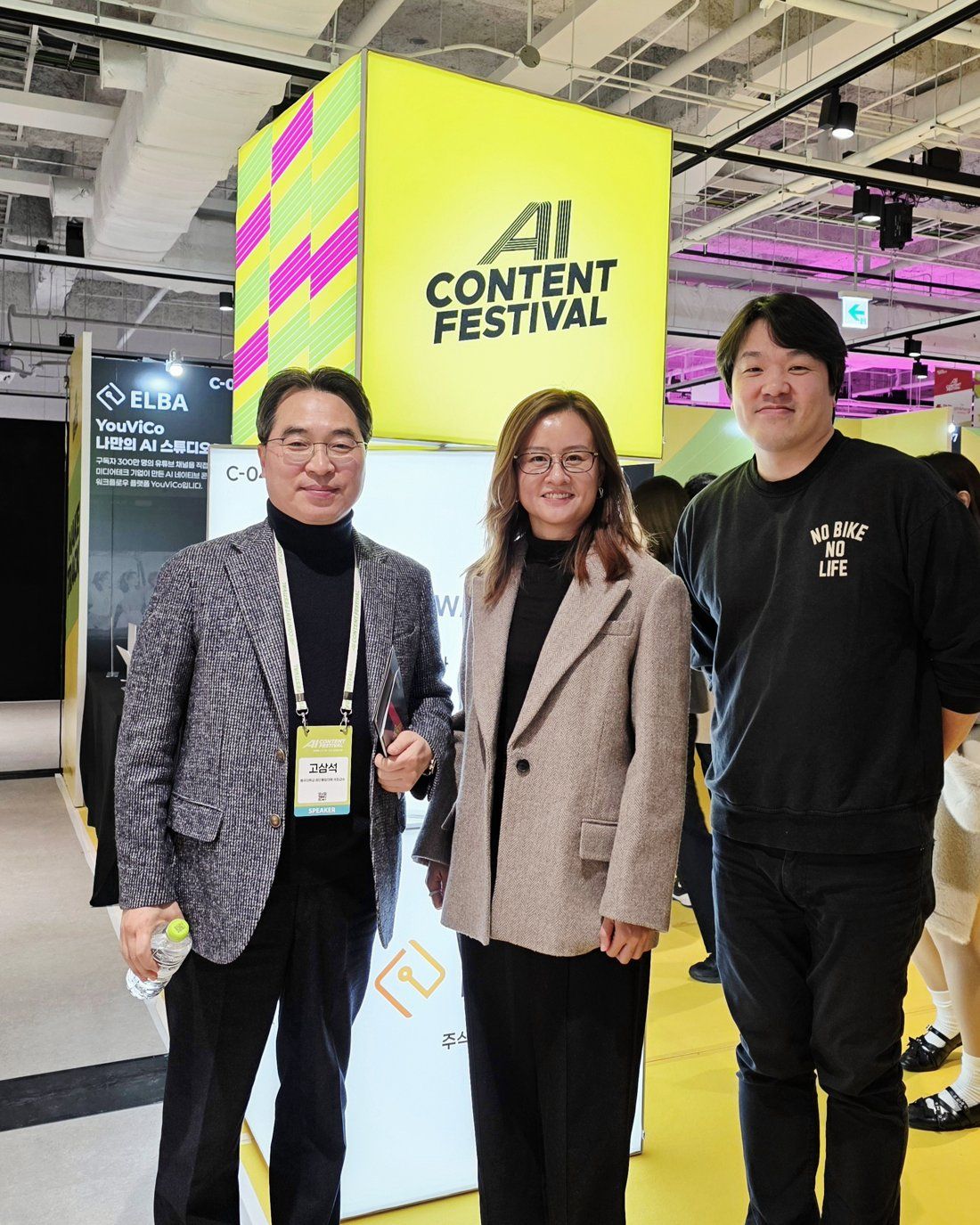
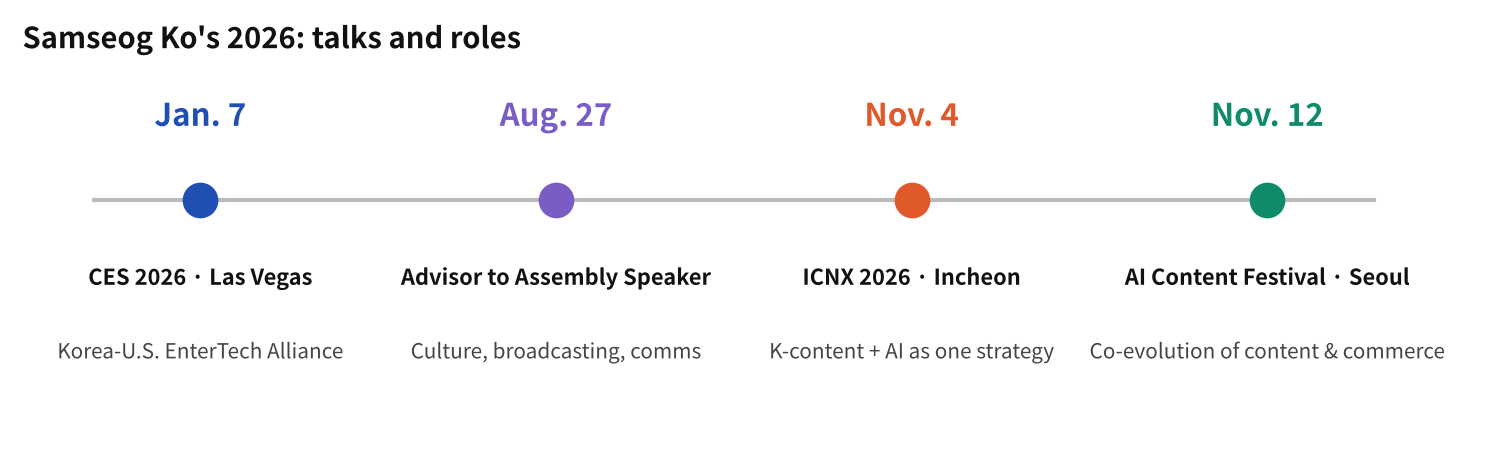
Samseog Ko (고삼석), Distinguished Professor at Dongguk University (동국대학교), moderated a special talk titled "AI Changes the Business Game" at AI Content Festival 2026 (AI 콘텐츠 페스티벌 2026) at COEX (코엑스) in Seoul on Nov. 12. The panel included Kim Nan-do (김난도), professor emeritus at Seoul National University (서울대학교), and Shiqi Wu (시치 우), general manager of Global Business Solutions at TikTok Korea (틱톡코리아).
"We are entering a period of transformation in which AI is reorganizing the content industry's value chain, its competitive order and the business model itself," Ko said. "We need to ask where the real value of content will be created, and who will win the new market."
The discussion focused less on the performance of AI production tools than on planning, distribution and revenue. The central issue was how creators’ decisions, platform recommendations and brand partnerships work together in a viable business.
The numbers behind that shift are growing. TikTok and consulting firm Kearney estimate that K-culture spending driven by TikTok will reach 13.92 trillion won ($10.4 billion) by 2030, and the U.S. live shopping market is projected to hit $680 billion the same year. The panelists described content revenue moving away from broadcast rights, licensing and ads toward IP and commerce, where discovery and purchase happen on the same screen.
The Ministry of Culture, Sports and Tourism (문화체육관광부) and the Korea Creative Content Agency (KOCCA, 한국콘텐츠진흥원) are running the festival Nov. 12–14 at COEX The Platz. This year's edition adds a business program to broker investment and partnerships between companies, and extends the lecture and talk schedule from two days to three. The opening day's sessions focused on how AI is changing consumption, creation, distribution and revenue models.
Individual creators reach global audiences; consumers move from trends to purchases
Ko opened by saying that individuals can now use AI to make content and reach consumers worldwide. Consumers, he said, no longer stop at watching. They create trends and carry them through to purchases and business.
He asked Kim about changes in consumer behavior and content revenue in the AI era, and asked Wu about platform innovation and new business opportunities.
"AI has become like air"; revenue widens from rights and ads to IP and commerce
Kim said AI is becoming an everyday utility, like the internet and the smartphone — "AI that has become like air." Content used to earn money mainly from broadcast rights, licensing and advertising, he said. Now content works as the search bar and shop window of global consumption, and revenue is expanding into IP and brand collaborations and into the combination of content and commerce.
The source of competitive advantage is shifting too. "When anyone can make content with AI, a creator's own eye for quality, their 'human edge' and their own story matter more than production skill or capital," Kim said.
Axios made a similar point in its 2026 Media Trends Executive Annual Report, published in October: "Models commoditize. Taste doesn't." The report named taste and trust as the new moat for media companies. It counted 22 mentions of "taste" in the second-quarter 2026 earnings calls of Pinterest, Spotify and Etsy, up from two in the first quarter of 2024. Citing eMarketer, it said 45.5% of U.S. influencer marketing spend this year is expected to go to creators with fewer than 20,000 followers.
As access to production tools broadens, selecting a story and understanding its audience become more valuable. Brands’ interest in creators with trusted specialist communities fits that shift. Kim’s argument about judgment and a human edge therefore concerns more than artistic quality: it also describes an asset that helps audiences decide what deserves their attention.
Kim's view tracks with Trend Korea 2026 (트렌드 코리아 2026), the annual consumer-trend book he leads, published last September. Its keywords for 2026 include "human-in-the-loop," the idea that people must step into AI workflows as directors, checkers and finishers, and "zero click," in which algorithmic recommendations cut out the search step.
TikTok averages 93 minutes a day; K-culture spending via TikTok projected at 13.92 trillion won by 2030
At TikTok Summit Korea 2026, held Oct. 20 at the Grand InterContinental Seoul Parnas, Wu gave the keynote on a platform strategy that turns user attention and engagement into purchases and business results. About 500 people from Korean brands and agencies attended. Sensor Tower presented data showing TikTok's global average daily use at 93 minutes, the longest among the major ad platforms it surveyed. TikTok Korea also introduced TikTok Symphony, its AI ad-creative tool, and Seedance 2.5, a video-generation model.
At the discussion, Ko put AI-driven recommendations, creator collaboration, content-linked commerce and K-brands’ overseas expansion on the agenda. The focus was the role platforms and businesses can play between a consumer discovering a new interest through content and deciding to spend money on it.
A survey of consumers who encountered K-culture on TikTok offers evidence of that path from discovery to purchasing. TikTok and consulting firm Kearney’s August 26 report, K-Culture on TikTok, surveyed 3,300 people aged 16–49 across 10 countries, including the United States, Britain, Japan and Brazil. Among respondents, 88.7% said TikTok helped them discover K-culture, 61.4% reported a greater likelihood of purchasing, and 55.7% said they had made related purchases after watching.
The report estimates that K-culture consumption driven by TikTok will grow about 29%, from 10.75 trillion won (approximately $8.0 billion) in 2026 to 13.92 trillion won (approximately $10.4 billion) in 2030. K-beauty accounts for the largest projected direct economic effect by category in 2030, at 3.27 trillion won (approximately $2.4 billion).
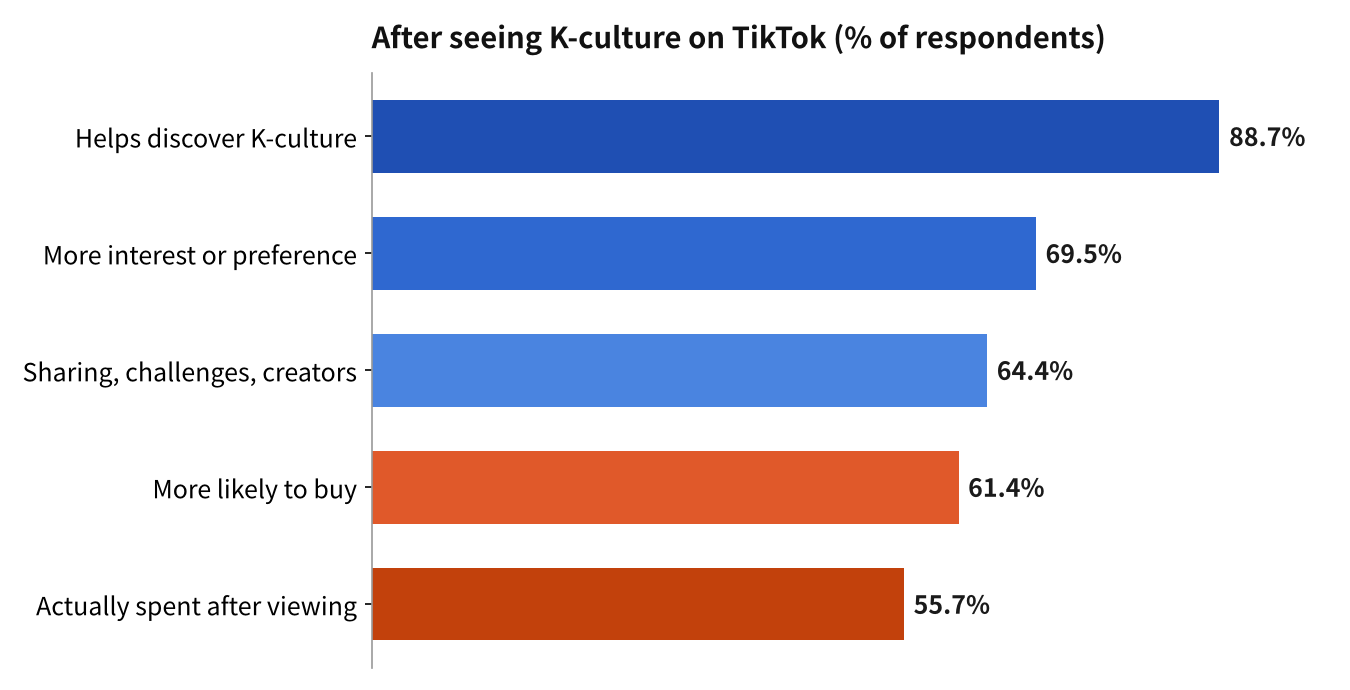
The finding relevant to the discussion is that interest in Korean content appears alongside spending on related products, including beauty. It gives producers a reason to examine businesses beyond selling a title, and brands a reason to consider content as a route to overseas customers. These are survey findings and estimates from platform-sponsored research, however, rather than measured sales gains attributable to any individual piece of content.
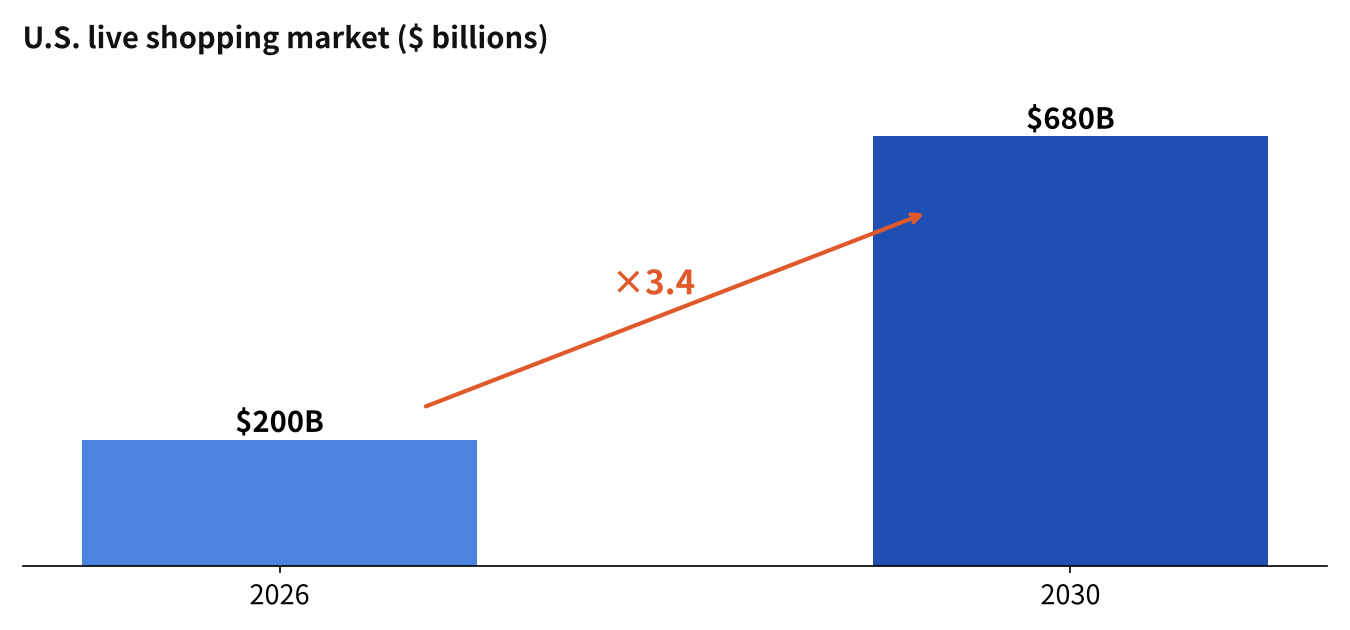
In the U.S., ARK Investment Management projects live shopping will more than triple, from $200 billion this year to $680 billion by 2030, according to figures cited in the Axios report. The same report notes that TikTok Shop sales from live shopping grew more than 80% in 2025, and cites WPP Media's forecast that global commerce advertising will reach $199.6 billion this year.
In April, TikTok said it would invest more than $50 million in Korea's content ecosystem this year, including bigger creator rewards and expanded sports, news and entertainment partnerships.
From production support to joint business
Eight days before the Seoul talk, Ko gave the keynote at ICNX 2026, the Incheon Advanced Media Global Conference, on Nov. 4 at Songdo Convensia, under the title "Why K-Content and AI Must Be a Single National Strategy." The entertainment tech event was run by Incheon Metropolitan City (인천광역시) and Incheon Technopark (ITP, 인천테크노파크). "It is hard to imagine a future for content without AI, or global competitiveness for an AI industry without content," Ko said. "K-content promotion and AI industry development should be pursued not as two separate policies but as one national strategy."
Ko said the U.S. is focused on combining AI technology with content IP, China on industrializing AI content at scale, and the U.K. on AI-driven creative technology. Korea, he argued, should build a distinct entertainment tech ecosystem on the originality of K-culture and its global fandom. He said the government's Korea AI Action Plan should widen its focus beyond applying AI to content production and distribution, toward new industries, ecosystem building and global expansion. He also proposed moving past content exports to an open global ecosystem in which Korean creators and companies co-plan and co-produce with foreign partners and share the results — an extension of the co-evolution strategy in his book Next Hallyu (넥스트 한류), published last year.
Public policy and business execution meet here. Lower production costs will not necessarily improve Korean companies’ bargaining position if IP and customer relationships accumulate only with overseas platforms. Co-development and co-production need commercial terms that also secure rights and a share of subsequent revenue.
Conditions for content and technology partnerships
At a CES-related forum in January, Ko proposed cooperation among Korean and U.S. streaming and AI companies, producers and startups. The festival discussion brought that proposal to the practical questions of recommendations, brand partnerships and consumer purchasing.
A partnership needs a defined production scope, terms for IP use and a way to share the proceeds. Adding participants alone does not establish a sustainable business ecosystem.
Public support and commercial partnerships serve different purposes. Businesses still need to agree with overseas partners on what they will produce together and which rights and revenues each will retain.
What remains after the views?
For Korean producers, the next operating task is to turn production savings into stronger IP and audience relationships. Overseas distribution, brand partnerships and merchandising should be considered during development, with clear roles and rights. Views should be separated from purchases and repeat purchases. The commercial test is whether a successful title leaves recurring value with the company and its creators.
Co-evolution depends on rights and revenue sharing
Closing the session, Ko said competitiveness in the AI-era content industry will come from delivering new value grounded in human creativity, a discerning eye and consumer trust. Companies, he said, must respond quickly to a market where discovery, consumption, participation and purchase are linked. For sustainable growth, he called for a "co-evolution" (공진화) ecosystem in which technology and people, creators and companies, and platforms and consumers develop together.
Low-quality AI output is also spreading through the ad market. Ad-verification firm DoubleVerify counted 3.2 billion ad requests tied to low-quality AI-generated content, known as "AI slop," through September this year, up 354%. YouTube, TikTok and Meta are introducing AI-disclosure rules, but standards differ by platform.
"If AI is changing the game in the content business, the winners on the new board will be the people and companies who best connect technology and people, content and consumers, and innovation and markets," Ko said.
Collaboration should be assessed through creator compensation and audience trust as well as production efficiency. If contributions and responsibilities remain unclear, even a successful title may fail to generate a lasting business.
A joint business among content, technology and brand partners requires agreement on contributions and rights. Producers need terms for IP use and downstream revenue; creators need compensation and participation conditions; platforms and brands need responsibilities for distribution and sales. The test is what remains after the collaboration: IP, customer relationships and recurring revenue.
The festival runs through Nov. 14. On Nov. 12–13, the COEX Startup Branch hosts one-on-one meetings with Korean and international investors and demand-led pitches from companies including Kidari Studio (키다리스튜디오) and MBC C&I. On Nov. 13, CJ 4DPLEX (CJ포디플렉스) presents its ScreenX production process and AI use cases. On Nov. 14, science communicator Gwedo (궤도) and Pyo Chang-won (표창원) of the Crime Science Research Institute give talks for the general public.
Sources: November 12, 2026 event press release; CES and ICNX presentations and linked reporting; TikTok/Kearney research; Axios Media Trends Executive Annual Report 2026, pages 10, 11, 40, 41 and 86. Forecasts are distinguished from results. Consumption, advertising and transaction estimates have different scopes and are not added together. Business implications are K-EnterTech Hub analysis.