

Only private AI company in the sixth session of the SHIF conference; the Ministry of Digital Technologies says the Karakalpakstan incentives can apply nationwide, with health insurance due in force on October 1
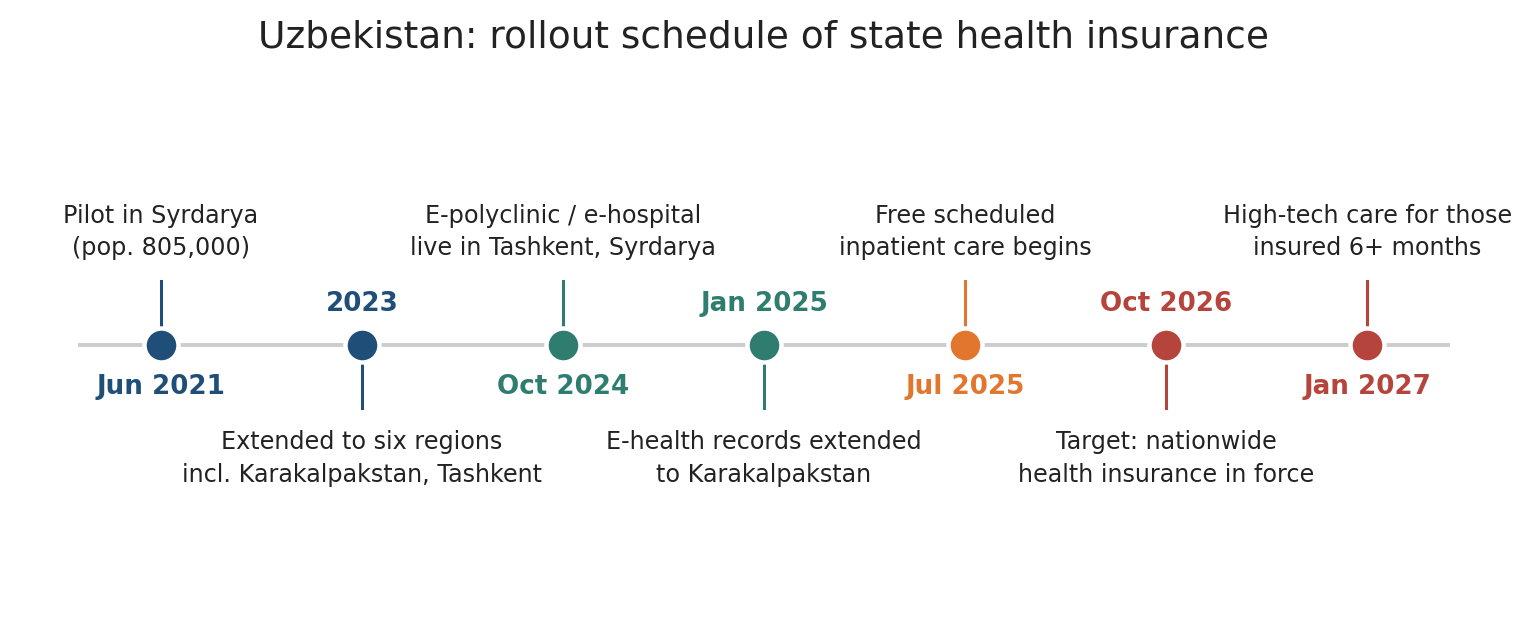
Uzbekistan has fixed October 1, 2026 as the date for nationwide health insurance, five years after the Syrdarya pilot. Source=P4H Network, Rödl & Partner
Acryl (아크릴), a Korean supplier of AI transformation (AX) infrastructure, spoke at the International Conference on State Health Insurance held in Tashkent on September 10-11 at the invitation of Uzbekistan's State Health Insurance Fund (SHIF).
Chief executive Jin Park(박외진) presented on September 11 in the sixth session, 'Digitalization of Health Financing and Strategic Purchasing,' under the title 'Sovereign Healthcare AX.' Acryl said on September 14 that it had also met separately with Uzbekistan's Ministry of Digital Technologies (MDT) during the same period to discuss building an AI data center.
The reason the Uzbek government put a foreign AI company at a health insurance table is a statutory deadline. Uzbekistan piloted state health insurance in June 2021 in the Syrdarya region, population 805,000, extended it in 2023 to Karakalpakstan, Tashkent and Samarkand among others, and fixed the nationwide schedule by Presidential Resolution PP-311 of September 5, 2024. Full rollout is targeted for October 1, 2026, and high-tech medical services become available on January 1, 2027 to taxpayers who have contributed for six months or more. Less than three weeks separated the Tashkent conference from that rollout date.
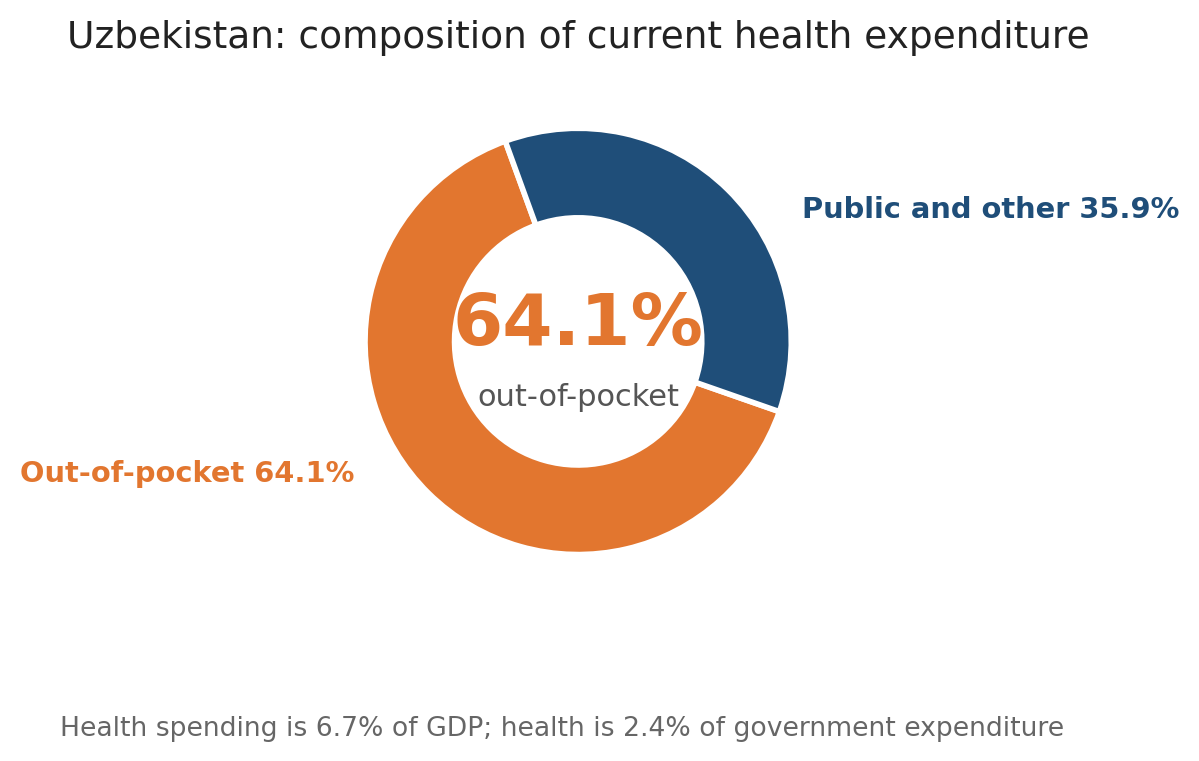
In figures compiled by the P4H Network, current health expenditure in Uzbekistan is 6.7 percent of gross domestic product, and out-of-pocket payments made by patients at the point of care account for 64.1 percent of that total. Health accounts for 2.4 percent of general government expenditure. The rollout schedule has moved; this financing structure has not.
With out-of-pocket spending close to two-thirds, shifting payment onto insurance funds requires counting who spent what and how much, claim by claim, and then setting prices and payment methods on that record — the work that goes by the name strategic purchasing. That was the title of the conference's sixth session.
Acryl was the only private AI company in the session. It shared the panel with the Asian Development Bank (ADB), India's National Health Authority (NHA), the Uzbek state IT enterprise UZINFOCOM and the International Labour Organization (ILO).
Subtitling his talk 'From GPU Infrastructure to Foundation Models and AI Operations,' Park set out a structure in which a state keeps both the processing of its health data and the authority to train models inside its own borders, and then joined a panel discussion on digital infrastructure for strategic purchasing.
The conference was co-hosted by Uzbekistan's Ministry of Health and SHIF, with the World Health Organization (WHO), the World Bank, ADB, ILO and health insurance bodies from several countries attending.
Two years of e-polyclinic and e-hospital… claims data starts to accumulate
SHIF brought the 'Electronic polyclinic' and 'Electronic hospital' systems into service in Tashkent city and the Syrdarya region on October 1, 2024, and extended them to Karakalpakstan on January 1, 2025. The two systems handle outpatient and inpatient processes inside the 'Electronic Health' framework that ties state medical databases together.
A Ministry of Health review of progress chaired by Eldor Odilov, director of the project office at the Center for Health Projects, drew deputy ministers Olim Omonov and Farrukh Sharipov along with UZINFOCOM staff. As claims and prescriptions moved from paper to screen, the data needed for automated adjudication, payment and anomaly detection came into existence. The opening for AI came from these systems, laid before the law caught up, and left the question of who would run the models and where.
Only private AI firm in the session… seated alongside India's NHA
The invitation came from SHIF, which Acryl says signalled an interest in joint initiatives and technical cooperation from the invitation stage onward. India's NHA was in the same session because there is a precedent to compare against. India built a national digital health architecture first, binding claims, medical records and identity into one system, and the layer Uzbekistan is now assembling is the same one. Uzbekistan, however, fixed its nationwide deadline before fitting the systems to it, which opens a short window for outside suppliers.
$24m GPU cluster, $45m more for compute… the Uzbek AI budget
Uzbekistan approved its Strategy for the Development of Artificial Intelligence Technologies until 2030 by Presidential Decree RP-358 on October 14, 2024, setting a $1.5 billion AI market as the 2030 target. The government has already built a GPU cluster worth $24 million and allocated a further $45 million to expand computing equipment.
Between 2027 and 2031 it plans a $200 million research and development center with six laboratories, a computing center holding 200 GPUs, a startup campus and a commercialization hub.
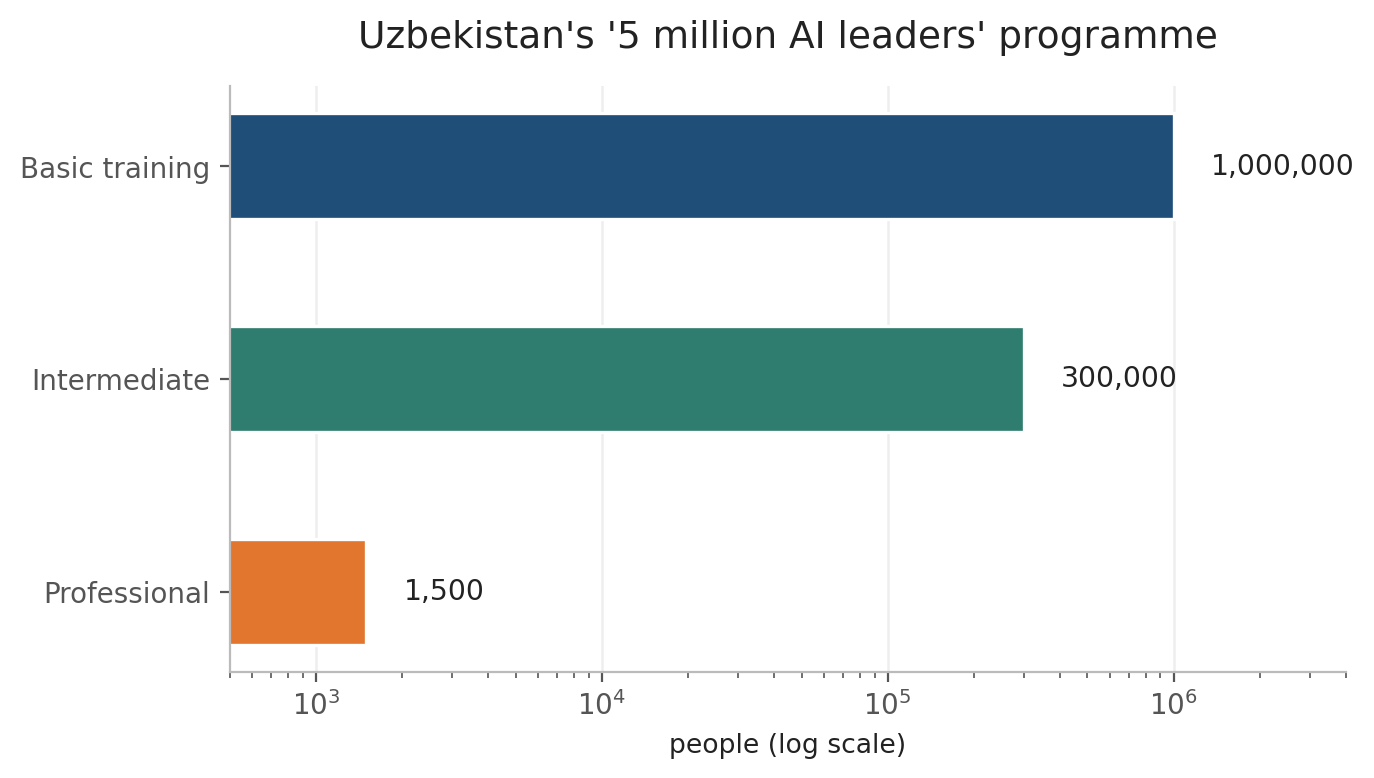
On the skills side, the 'five million AI leaders' programme has put one million people through basic training and more than 300,000 through intermediate courses, and has produced 1,500 professional specialists. Government briefings also cite a copper processing plant that cut energy use by 10 percent and raised productivity by 10 percent after applying AI.
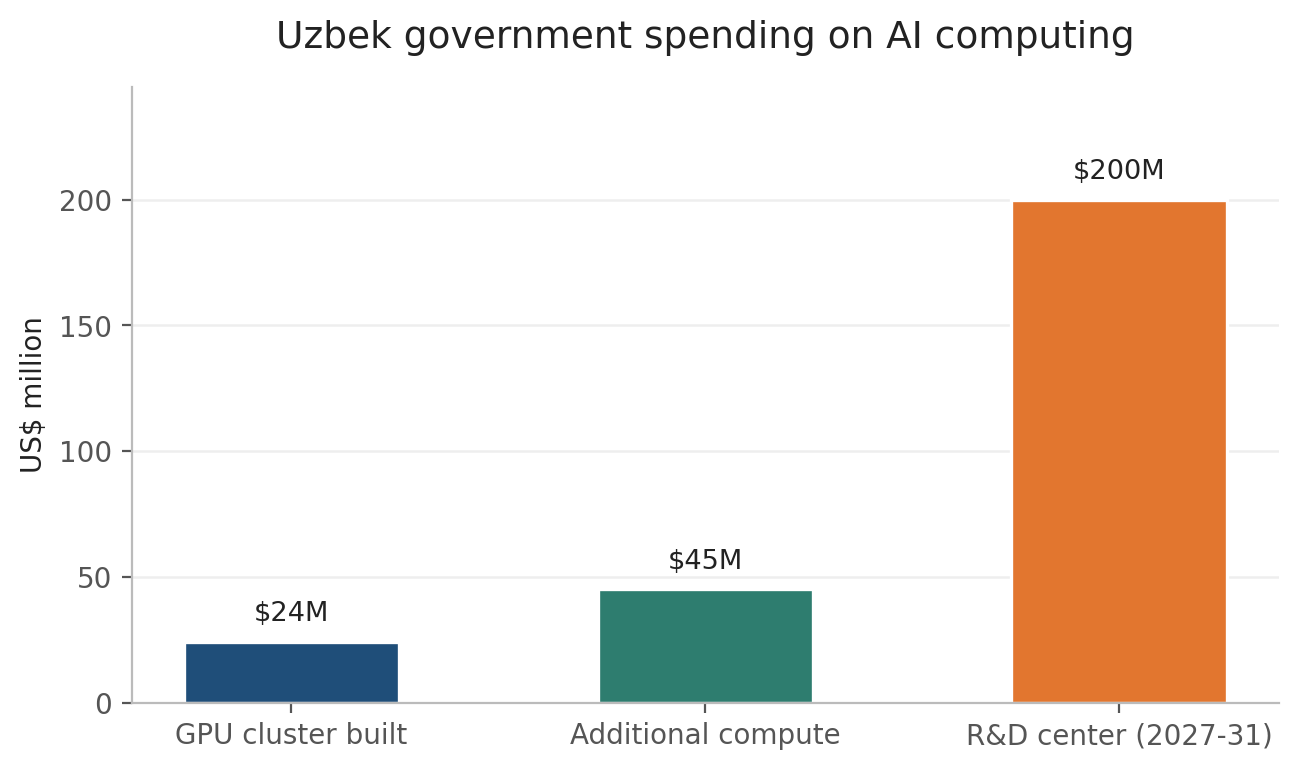
Uzbek government spending on AI computing, by stage. Source=Ministry of Digital Technologies, Frank.uz reporting
Uzbekistan's IT and AI ecosystem. Source=Ministry of Digital Technologies briefings, Frank.uz reporting
Power at $0.05 per kWh, tax relief to 2040… the terms the MDT put forward
What Acryl took away from the MDT meeting was a package of data-center and AI investment incentives centred on Karakalpakstan. Uzbekistan opened a special IT zone dedicated to AI and data centers there in November 2025, applying the benefits to projects above $100 million through 2040.
Customs duties and value-added tax are waived on imported servers, GPUs and cooling systems not produced domestically; IT park residents are exempt from profit, property and land tax; and foreign shareholders pay a zero percent dividend tax rate. Electricity is supplied at a fixed $0.05 per kilowatt-hour excluding VAT, on condition that consumption is cut 20 percent during peak hours and that battery storage equal to 30-35 percent of capacity is installed. The MDT told Acryl the same incentives can be applied anywhere in Uzbekistan depending on how a project is structured.
AI and data-center investment incentives in the Karakalpakstan special IT zone. Source=UzDaily, Fergana Agency
Digital Technologies Minister Sherzod Shermatov met NVIDIA's vice president for global AI infrastructure, Nicolo Caprese, and executives of Firebird on April 29, 2026 to discuss an AI data center starting at 125 megawatts and expandable to 250 megawatts. The Karakalpakstan incentives and workforce training programmes were on the agenda of that meeting.
From the Fourth Hospital HIS in 2023 to UZINFOCOM… three years on the ground
The basis for the invitation is work Acryl has already completed in the country. It built the hospital information system (HIS) for the 200-bed Fourth Hospital in 2023, and in October 2024 formed a consortium with Kangwon National University Hospital (강원대학교병원) to carry out a survey of the maternal and child health medical IT environment in Karakalpakstan and to draw up improvement measures.
It signed a memorandum of understanding with SHIF in March 2025, and in November that year entered a strategic partnership with UZINFOCOM, the state IT enterprise under the Ministry of Digital Development, covering joint development and operation of healthcare AI technology, platforms and infrastructure.
In a Korea Economic Daily (한국경제) report of November 28, 2025, Acryl said the partnership would "accelerate the construction of AI infrastructure in Uzbekistan's healthcare sector," citing synergies with the maternal health project and the Fourth Hospital build as the basis for expanding across Central Asia.
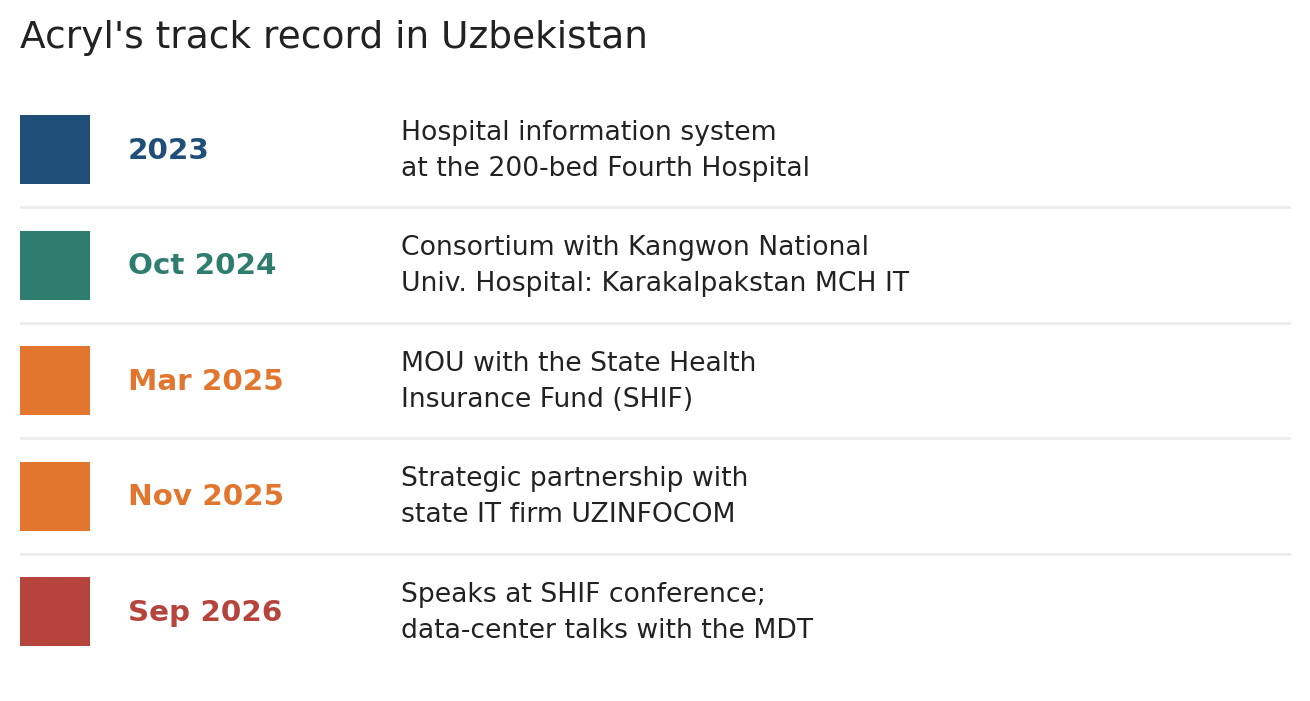
Acryl's project history in Uzbekistan. Source=company materials and reporting by Korea Economic Daily and TheBio
1,272 GPUs, training time cut 96 percent… the validation figures behind the pitch
Sovereign healthcare AX, as Acryl framed it, has three layers: GPU infrastructure, foundation models and AI operations. What the company put forward at the infrastructure layer were validation figures for GPUBASE, its GPU operations software. Acryl says it measured performance across 1,272 accelerators of seven heterogeneous types on the three major clouds — Microsoft Azure, Amazon Web Services and Google Cloud — cutting training time by up to 96 percent and raising GPU utilization above 90 percent.
Where a government purchases GPUs outright and keeps them inside its borders, the hardware is paid for at once and effective utilization afterwards drives the cost of the programme. That is why buyers look at operating metrics before equipment lists, and why Acryl put its validation figures at the front of the presentation. At the model and operations layers, the products Acryl mapped across are ALLM.H (아름.H), a medical-specialized AI, and NADIA-ANE (나디아-앤), an AI-based electronic medical record platform.
KOSDAQ-listed in December 2025, about 100 staff… two business lines, models and infrastructure
Acryl started in affective computing and natural language processing and now runs two business lines: industry-specific AI models and AX infrastructure. It listed on Korea's KOSDAQ market in December 2025 and employs about 100 people. The lead product on the infrastructure side is GPUBASE, its GPU operations software, which is aimed at reducing the compute that sits idle on GPUs a customer has already bought. On the model side sit ALLM.H (아름.H), a medical-specialized AI, NADIA-ANE (나디아-앤), an AI-based electronic medical record platform, and JONATHAN, an integrated AI platform.
Its largest domestic supply record is GPUBASE in Hancom's (한글과컴퓨터) MDC build, with contracts totalling 5.5 billion won. On the research side, in June 2026 it was named lead institution for an Institute of Information and Communications Technology Planning and Evaluation (IITP) national project on Ethernet-based GPU cluster network fabric systems and optimization technology, worth 6.7 billion won in total including 5.5 billion won in government funding and running to December 2028 with Yonsei University (연세대학교), Sungkyunkwan University (성균관대학교) and Ajou University (아주대학교).
It signed cooperation agreements with MangoBoost in May 2026 and Megazone Cloud in July 2026, and supports Korean-made neural processing units (NPUs) from Rebellions (리벨리온) and FuriosaAI (퓨리오사AI). In healthcare it is working with Samsung Medical Center (삼성서울병원), Seoul National University Bundang Hospital (분당서울대학교병원) and Seoul National University Hospital (서울대학교병원) while extending into bio foundation models.
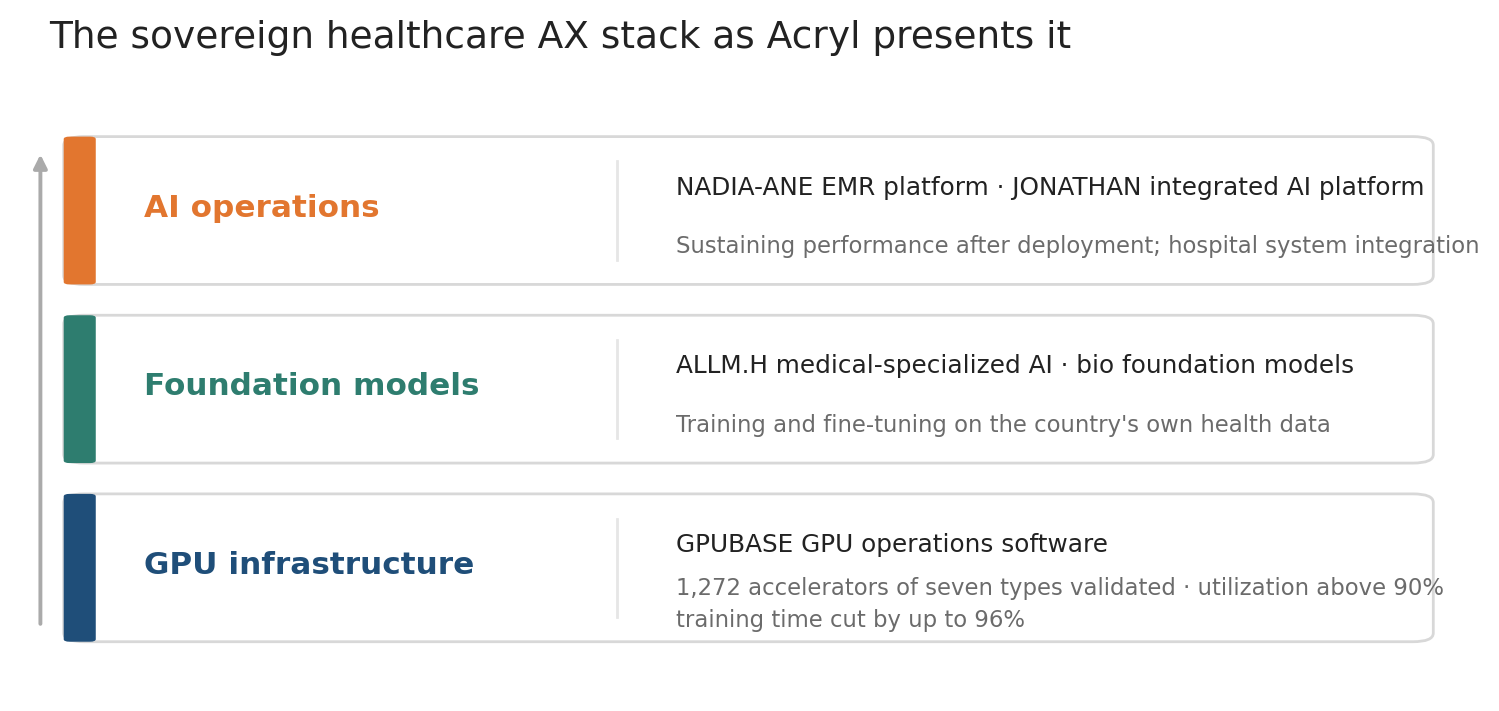
The three layers Acryl presented in Uzbekistan. Source=company presentation materials
Acryl company profile. Source=company materials and public reporting
A $24.8 billion sovereign AI market… and the procurement shape it implies
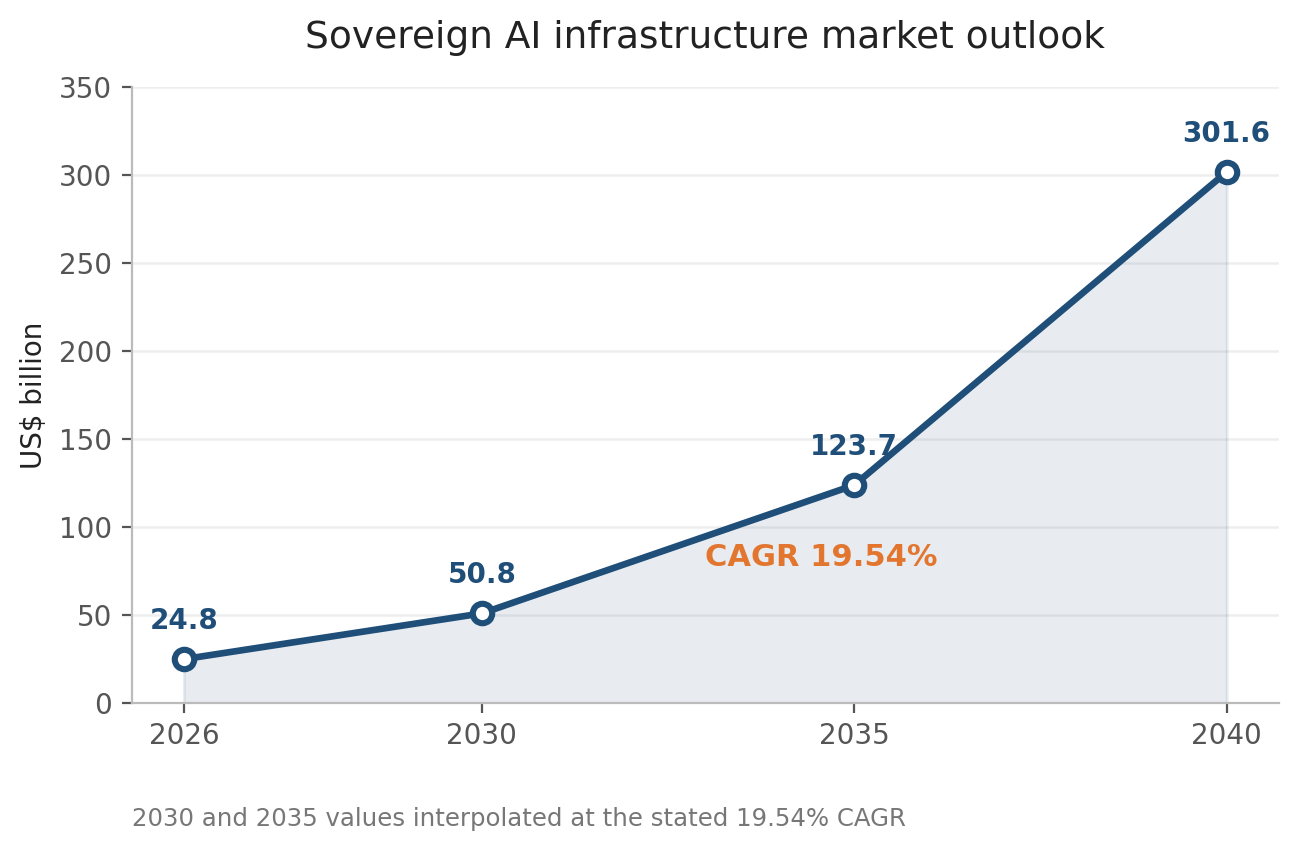
A Research and Markets report dated August 10, 2026 puts the sovereign AI infrastructure market at $24.8 billion in 2026, rising to $301.6 billion by 2040 at a compound annual growth rate of 19.54 percent. Hardware accounts for more than 45 percent of 2026 revenue and GPU-accelerated computing for about 30 percent; North America holds more than 35 percent of the market, while Asia-Pacific grows at 23.1 percent a year.
When infrastructure, models and operations are tendered separately, responsibility splits once performance falls short, so buyers tend to prefer a single contractor accountable for all three layers. That is why 'full stack' sits in the title of Acryl's presentation. What the company holds in Uzbekistan so far is an invited presentation and a set of discussions; the scope of any business will be settled in follow-up talks with government bodies and related institutions there.
Korea-Central Asia summit on September 16… overlapping with the government channel
Five days after Acryl's Tashkent schedule ended, Seoul hosted the first Korea-Central Asia Summit on September 16. In a written briefing on September 11, the presidential office said President Lee Jae-myung (이재명) would chair a multilateral summit that afternoon with the leaders of Kazakhstan, Kyrgyzstan, Tajikistan, Turkmenistan and Uzbekistan.
The leaders of Uzbekistan, Turkmenistan and Kazakhstan came as state guests; those of Tajikistan and Kyrgyzstan on official visits. Bilateral summits ran from September 14 to 16, and a business summit with some 500 participants was held the same day.
The government said the 'Seoul Declaration,' setting out a medium- to long-term vision, would cover diversification of critical mineral and energy supply chains along with cooperation in future industries including AI and digital technology.
Acryl said it expects this policy direction to work in favour of expanding its business in Uzbekistan. In the distributed materials, Park said: "Artificial intelligence is harder to operate reliably and to keep improving in real industrial and public settings than it is to build," adding that "Acryl has the structure to actually deliver national-scale healthcare AX, on the strength of full-stack capability spanning GPU infrastructure, foundation models and AI operations."
He also said the company would "combine Korea's experience in digitalizing health insurance with Acryl's AI technology to establish itself as the healthcare AX partner for Uzbekistan and Central Asia."
Sources
· Acryl press release, 'Acryl presents full-stack healthcare AX at international conference,' September 14, 2026
· Rapportian, September 14, 2026 — https://www.rapportian.com/news/articleView.html?idxno=240301
· Korea Economic Daily, 'Acryl breaks into Uzbek state enterprise with AI infrastructure exports,' November 28, 2025 — https://www.hankyung.com/article/202511281562i
· P4H Network, Uzbekistan country health financing profile — https://p4h.world/en/countries/uzbekistan
· P4H Network, 'State Health Insurance Fund of Uzbekistan has announced piloting state health insurance for the first time in the nation' — https://p4h.world/en/news/state-health-insurance-fund-of-uzbekistan-has-announced-piloting-state-health-insurance-for-the-first-time-in-the-nation/
· P4H Network, 'Uzbekistan's State health insurance fund accelerates the launch of the Electronic polyclinic and Electronic hospital information systems' — https://p4h.world/en/news/uzbekistans-state-health-insurance-fund-accelerates-the-launch-of-the-electronic-polyclinic-and-electronic-hospital-information-systems/
· Rödl & Partner, 'Uzbekistan: Introduction of state health insurance' — https://www.roedl.com/en/insights/uzbekistan-introduction-state-health-insurance/
· UzDaily, 'Uzbekistan Introduces Tax Incentives for AI and Data Center Projects' — https://www.uzdaily.uz/en/uzbekistan-introduces-tax-incentives-for-ai-and-data-center-projects/
· Fergana Agency, 'Residents of a Special IT Zone in Karakalpakstan to Be Exempt from Taxes and Customs Duties' — https://en.fergana.agency/news/142161/
· Yuz.uz, 'Uzbekistan discussed building an AI data center with up to 250 MW capacity with NVIDIA,' April 29, 2026 — https://yuz.uz/en/news/142968
· Frank.uz, 'Uzbekistan will allocate another $45 million for AI infrastructure development' — https://frank.uz/en/news-en/uzbekistan-will-allocate-another-45-million-for-ai-infrastructure-development/
· Lex.uz, Presidential Decree RP-358, 'On the approval of the Strategy for the Development of Artificial Intelligence Technologies until 2030,' October 14, 2024 — https://lex.uz/en/docs/7159258
· Research and Markets, 'Sovereign AI Infrastructure Market Till 2040,' August 10, 2026 — https://finance.yahoo.com/technology/ai/articles/sovereign-ai-infrastructure-market-till-080500128.html
· Presidential office written briefing by spokesperson Kang Yu-jung, September 11, 2026, via News Seoul — https://newsseoul.co.kr/news/view/1065603612623204
· TheBio, 'Acryl signs MOU with UZINFOCOM' — https://www.thebionews.net/news/articleView.html?idxno=20294