
Three national R&D programs in brain tumor, pancreatic and lung cancer… pilots with Seoul National University Hospital, SNU Bundang Hospital and Korea University Anam Hospital
Acryl (아크릴), a Korean AI company listed on the KOSDAQ market, said on September 4 that it has joined three national research programs covering brain tumor, pancreatic and lung cancer. Its hospital partners are Seoul National University Hospital (서울대학교병원), Seoul National University Bundang Hospital (분당서울대학교병원) and Korea University Anam Hospital (고려대학교 안암병원).
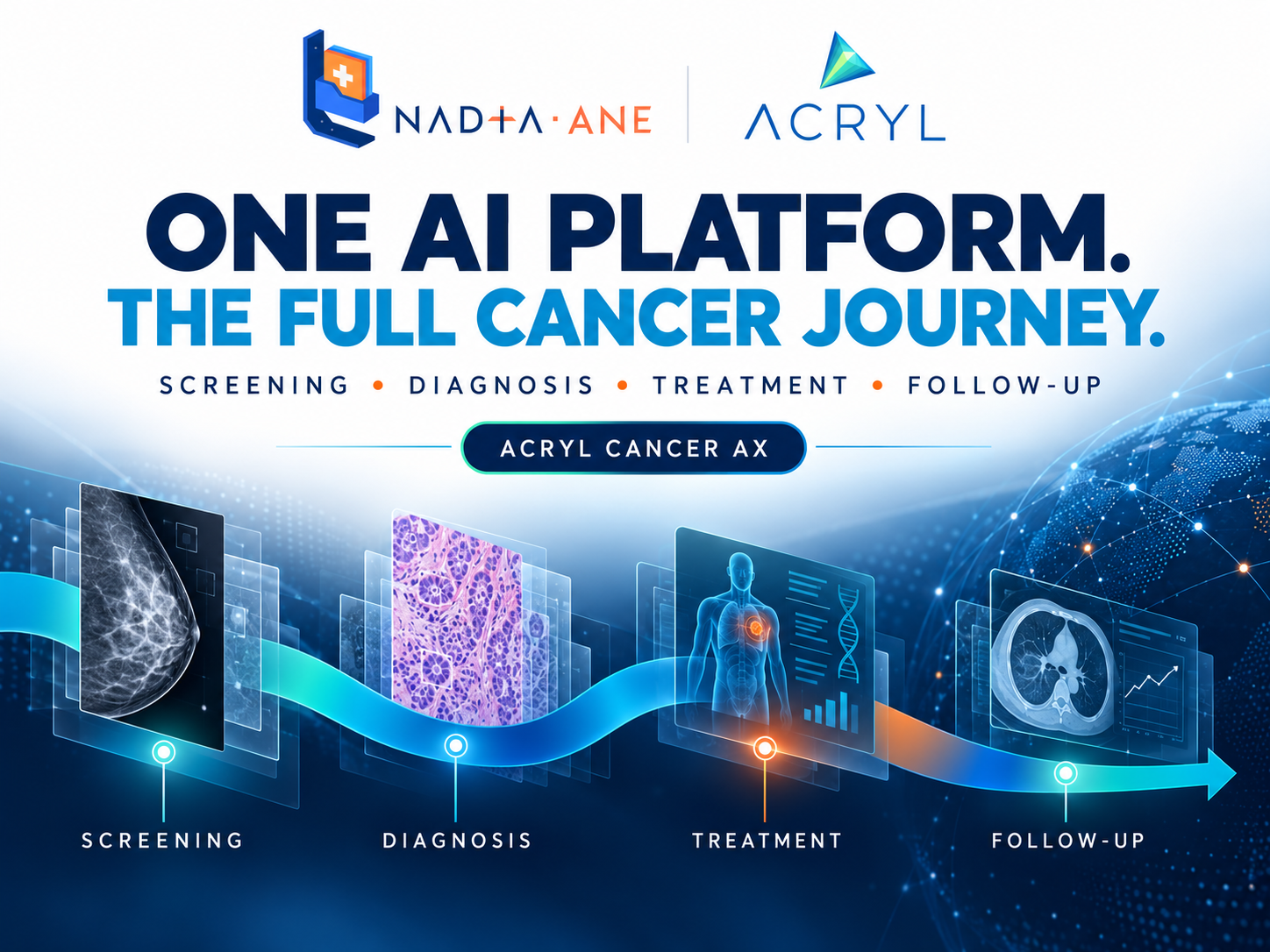
The three programs cover different cancers and are funded by different ministries. Acryl says it will combine what they produce into a single Cancer AX Platform (암질환 AX 플랫폼). AX stands for AI transformation — rebuilding how work is done around AI rather than adding a tool to it.
One patient's records sit in several separate systems inside a hospital. CT and MRI scans go to the picture archiving system (PACS), tissue results to the pathology system, gene test results somewhere else again, and the doctor's own notes to the electronic medical record (EMR). Screening reports and the scans taken later to check for recurrence end up in different places too. Most medical AI built so far looks at only one of those. Acryl joins the scattered records in one layer first, then puts cancer-specific AI on top of it.
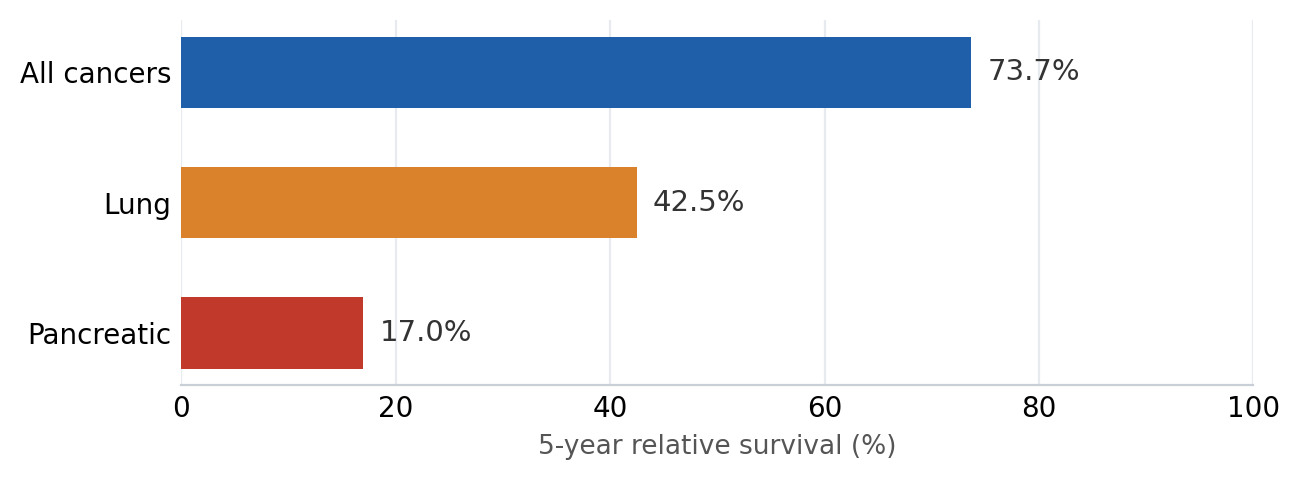
In the 2023 national cancer registry statistics released by the Korea Central Cancer Registry (중앙암등록본부) in January, 288,613 people in Korea were newly diagnosed with cancer that year and 2,732,906 were living with a diagnosis or had been treated for one. Among patients diagnosed in the most recent five-year window, 73.7% were still alive five years later. For lung cancer the figure was 42.5% and for pancreatic cancer 17.0% — two of the three cancers Acryl has taken on first.
Brain tumor: a $5.6 million state program… tissue images, genes and brain waves trained in one model
With Korea University Anam Hospital, Acryl has taken on the Bio Multimodal Foundation Model program of the Ministry of Science and ICT (과학기술정보통신부). It is worth 7.6 billion won ($5.6 million) and runs from June 2026 to December 2030. Multimodal means handling data of different kinds — images, text, numbers — together; a foundation model is one large model trained once and then reused for many purposes.
Five kinds of data go into a single model: pathology images, gene activity, protein information and electroencephalogram readings among them. The model estimates how long a patient is likely to survive and how likely the disease is to return after surgery. Acryl provides the training infrastructure, the alignment training that makes one model read those different data types together, and the evaluation that checks how the finished model performs inside a hospital. It also contributes federated learning, which trains at each hospital separately and pools only the results, so patient records never leave the building. (TheBioNews, June 9)
Pancreatic cancer: the $11.5 million OnKoTECT consortium… clearance comes before clinical use
Pancreatic cancer is handled in the OnKoTECT (온코텍트) consortium led by SNU Bundang Hospital, under the digital healthcare track of the Bio Industry Technology Development program of the Ministry of Trade, Industry and Energy (산업통상자원부). It is worth 15.5 billion won ($11.5 million) and runs four years and six months, from August 2026 to December 2030. Kim Jae-yong (김재용), director of the hospital's Biomedical Research Institute, leads it, and the consortium covers pancreatic and lung cancer together.
Participating hospitals are Samsung Medical Center (삼성서울병원), the National Cancer Center (국립암센터), Chonnam National University Hwasun Hospital (화순전남대병원), Eunpyeong St. Mary's Hospital (은평성모병원) and Pusan National University Hospital (부산대병원); the companies are A&T Solution (에이앤티솔루션), Acryl and Hecto (헥토). Six categories of data are used, including imaging, genomics and pathology.
Acryl's share is software that screens for pancreatic cancer early and software that predicts whether it will return after surgery. Both are being built as software as a medical device (SaMD) — the program itself is the regulated device, so it must clear review by the Ministry of Food and Drug Safety before it can be used in care. Acryl is pursuing that clearance alongside development. (Incheon Ilbo, September 1)
Lung cancer: supporting the tumor board… operated on in Seoul, followed up in Gangwon
With Seoul National University Hospital, Acryl is building an AI service for managing lung cancer patients. It analyses diagnostic findings, test values and treatment records together to support the doctor's judgement. Acryl calls it agentic AI: an AI that does not merely answer a question but gathers what it needs, organises it and carries the next step through.
Its first use is the multidisciplinary tumor board. In lung cancer, surgeons, medical oncologists and radiation oncologists meet to agree a treatment direction; the AI assembles and organises the material that meeting needs. After treatment ends, it tracks the patient's symptoms, recovery and recurrence risk.
The pilot runs in follow-up care. A patient diagnosed and operated on at Seoul National University Hospital receives later follow-up at a regional hospital such as Kangwon National University Hospital (강원대학교병원), which removes the trip to Seoul for each check-up. Acryl calls this a region-complete cancer care model. The program's name and budget have not been disclosed.
The three national cancer programs Acryl has joined. Source: institutional announcements and Acryl
NADIA-ANE joins the data, ALLM.H reads it… the hospital's own EMR stays in place
The bottom layer is NADIA-ANE (나디아앤), a medical data platform Acryl launched on May 12. It converts each hospital's own database structure into a standard form. What matters to the hospital is that its existing electronic medical record does not have to be replaced: the old system stays, and a layer that AI can read is added on top, so the cost and risk of a system replacement are avoided.
Above it sits ALLM.H (아름.H), a language model specialised for medicine. A clinician can ask, in plain Korean, for the patients who met a given condition over the past three years, and the model turns that into a database query and returns the answer. Acryl reports that on EHRSQL 2024, which measures exactly that conversion, it was right on the first attempt 89.08% of the time. It also says the product set a record on evaluations using MIMIC-IV, the intensive-care database published by the Massachusetts Institute of Technology (MIT), and that it is being connected to the clinical data warehouse of a large Korean university hospital.
Cancer-specific models and AI agents sit on those two layers. Screening for cancer risk, early diagnosis, evidence for the treatment decision, and recurrence and recovery tracking afterwards all run on one platform. Acryl calls it AI-Native Cancer Care.
A perfect score on 435 physician licensing questions… ALLM.H2 FRANK at 99.0% on KorMedMCQA
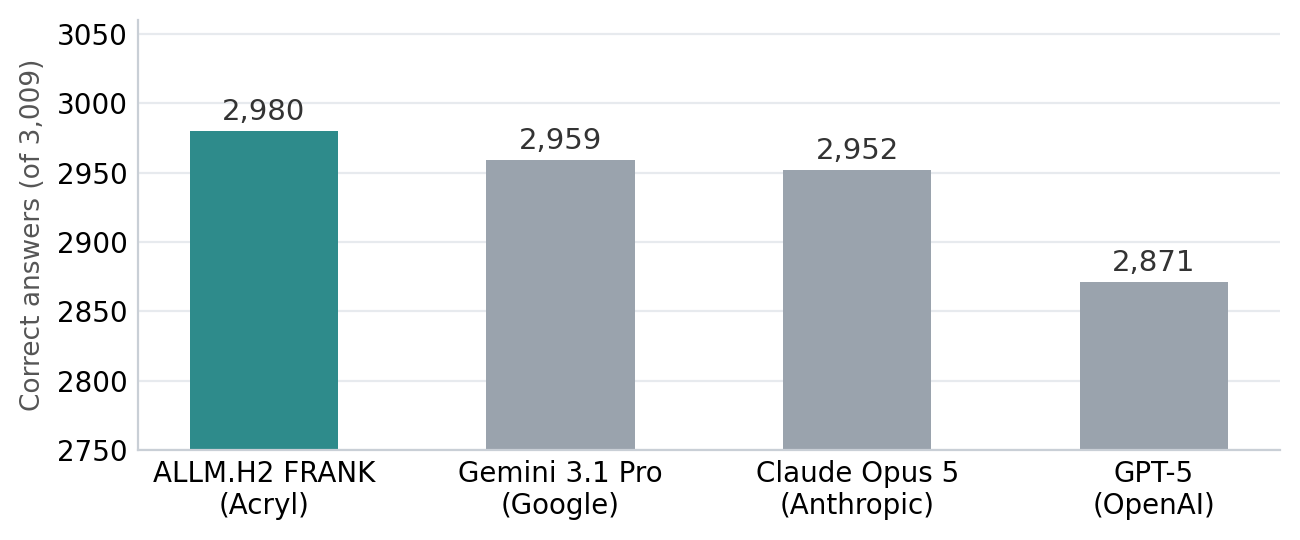
On September 1 Acryl published test results for ALLM.H2 FRANK (아름.H2 프랭크), a medical model with 31 billion parameters. Parameters are the values a model adjusts as it learns; more of them generally means a wider range of information the model can hold.
The test is KorMedMCQA, built from Korea's national licensing examinations for doctors, dentists, pharmacists and nurses. Acryl says the model answered 2,980 of 3,009 questions correctly, or 99.0%, and got all 435 physician-examination questions right. On the same test Google's Gemini 3.1 Pro answered 2,959, Anthropic's Claude Opus 5 answered 2,952 and OpenAI's GPT-5 answered 2,871. The figures are Acryl's own measurements; the earlier ALLM.H scored 96.78% on the physician section. (Asia Economy, September 1; Docdocdoc, September 2)
More cancers and the national screening program… and drug development on the pharma side
Acryl says it will widen the platform to cancers beyond brain tumor, pancreatic and lung, and extend it into screening and health management services tied to Korea's national cancer screening program, under which the government provides tests for stomach, colorectal, liver, breast, cervical and lung cancer to people in set age groups.
It is also moving into pharmaceuticals and biotech, applying what it builds in hospitals to drug development: finding biomarkers that indicate which patients a drug is likely to work for, selecting participants for clinical trials, analysing response after dosing, and analysing real-world data gathered in ordinary care.
Korea's first AX infrastructure company… founded in 2011 on emotion recognition, listed on KOSDAQ last December
Acryl, founded in 2011, is Korea's first AX infrastructure company. It began with emotion recognition — reading human feeling from data — and natural language processing. The business now runs on three lines: Jonathan (조나단), a platform that lets companies build, deploy and operate AI models; NADIA (나디아), the version built for healthcare; and GPUBASE, which keeps GPUs working rather than idle. Acryl sells not only the models but the infrastructure that runs them.

The company listed on KOSDAQ, Korea's growth-company market, in December 2025, offering 1.8 million new shares in an indicative band of 17,500–19,500 won with Shinhan Securities as lead manager. Revenue grew from 9.2 billion won in 2022 to 13.4 billion won ($9.9 million) in 2023. It counts about 80 customers — LG Electronics, Samsung E&A, Samsung Medical Center, Severance Hospital and Seegene among them — across more than 170 projects. In healthcare, four of its medical-device software products already have clearance and three more are in development or clinical stages. (Money Today, December 1, 2025)
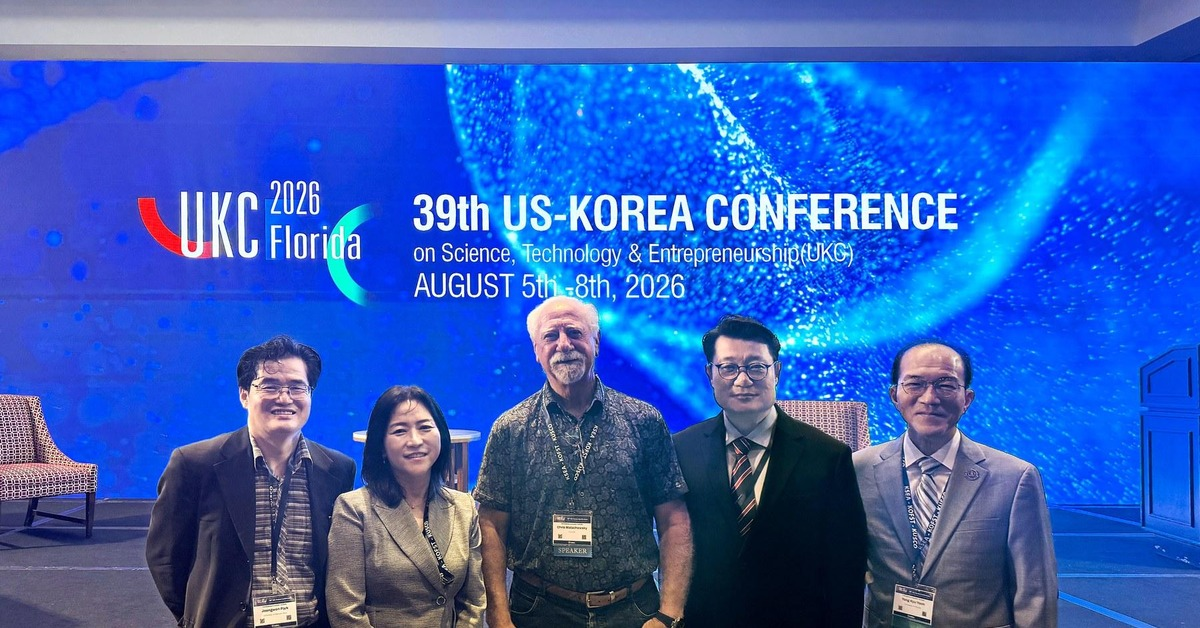
It is also working on North America. In August it presented on GPU operating efficiency at the US-Korea Conference on Science, Technology and Entrepreneurship (UKC 2026) in Orlando, Florida, and met NVIDIA co-founder Chris Malachowsky there.
Four-digit lead count in three days at KHF 2026… data control for large hospitals, decision support for small ones
Acryl said it logged a four-digit number of enquiries over three days at the Korea International Healthcare and Health Tech Fair (KHF 2026, 국제 병원 및 헬스테크 박람회), held recently at COEX in Seoul. Dozens of institutions asked for meetings and demonstrations after the show. Those run from September.
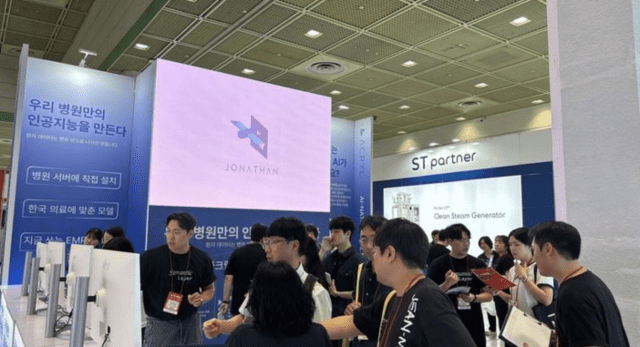
Tertiary and university hospitals asked about keeping patient data inside the hospital under their own control, and about building the whole stack in house. Small, local and long-term care hospitals asked about Dr.Gull (닥터갈), a conversational AI that helps with clinical judgement — Acryl's account of the visits.
Both groups asked the same underlying question: whether they could search their own records in plain Korean, inside the hospital network, without replacing the EMR they already use. The booth wall carried the same message: “Build your own hospital's AI” and “Installed on the hospital's own servers.”
Acryl exhibited in three spaces — the joint pavilion of the National IT Industry Promotion Agency (NIPA), the Yonsei University Health System booth and the Dr. Answer hall — and showed Dr. Answer 3.0 (닥터앤서 3.0) services for skin disease and prostatic hyperplasia.
Jin Park said the show “confirmed strong market demand for a medical AI structure in which the hospital itself holds control of the data, the models and the operations.” (Docdocdoc, September 2)
Jin Park (박외진), chief executive of Acryl, said: “The businesses we have secured recently target three different diseases — brain tumor, pancreatic cancer and lung cancer — but the ultimate goal is one. What distinguishes Acryl is that we do not stop at building individual AI models; we build a Cancer AX Platform that connects the patient's whole journey, from screening through diagnosis, treatment and prognosis management, with AI.” (Yakup, September 4)
The pancreatic cancer software has to pass medical-device review before it can be used in care. The lung cancer service has to produce results in the pilot linking a large Seoul hospital with regional ones. Both the brain tumor and pancreatic cancer programs run to December 2030.
Note: Won amounts are converted at 1,350 won to the dollar (Seoul closing rate of 1,350.4 won on September 4, 2026).
Note: Text in quotation marks is as reported; unquoted attributions summarise reported material. Program budgets and terms follow the announcing institutions.
Sources
· Yakup, “Acryl launches Cancer AX on the back of national cancer AI programs,” September 4, 2026
· AI Times, Jang Se-min, “Acryl to build an AI cancer diagnosis, treatment and prognosis system with Korean hospitals,” September 4, 2026
· Etoday, “Acryl wins brain tumor, pancreatic and lung cancer national R&D projects,” September 4, 2026
· TheBioNews, “Acryl joins a 7.6 billion won Ministry of Science and ICT program for brain disease AI,” June 9, 2026
· Incheon Ilbo, “SNU Bundang Hospital leads a 15.5 billion won national project on pancreatic and lung cancer AI,” September 1, 2026
· TheBioNews, “Acryl launches NADIA-ANE, an AI-native EMR platform,” May 12, 2026
· Docdocdoc (청년의사), Yoo Ji-young, “Acryl's AI full stack draws hospitals looking to add AI without replacing the EMR,” September 2, 2026
· Asia Economy, “Acryl's 31-billion-parameter model outscores Google, Anthropic and OpenAI,” September 1, 2026
· Money Today, “Acryl accelerates in the AI infrastructure market with Jonathan and NADIA [IPO focus],” December 1, 2025
· Korea Central Cancer Registry, “2023 national cancer registry statistics,” January 20, 2026
· Asia Economy, “Won closes 8.9 won stronger at 1,350.4 per dollar,” September 4, 2026