

NAB pursues a standalone Senate vote or a ride on a year-end package; House passed the bill in September and 60-plus senators cosponsor it
The AM Radio for Every Vehicle Act, which passed the House, would require AM in every new U.S. car at no extra charge to keep an emergency-alert channel in vehicles. NAB wants a Senate vote before Jan. 3. Hyundai and Kia already comply.
The National Association of Broadcasters is making a final push to pass the AM Radio for Every Vehicle Act during the lame-duck session of Congress.
"Our immediate priority is getting the AM Radio for Every Vehicle Act across the finish line before the end of this year," Shawn Donilon, NAB's executive vice president of government relations, said on the Nov. 11 episode of NAB's Airtime podcast. Inside Radio reported the remarks on Monday. NAB sees two routes: a Senate vote on the bill the House already passed, or attaching the language to a larger package moving through Congress before adjournment.
The House approved the bill by voice vote on Sept. 15. More than 60 senators are cosponsors, enough to break a filibuster. What remains is floor time in the Senate. The 119th Congress ends on Jan. 3, 2027; if the Senate does not act by then, the bill dies and must be reintroduced.
The politics shift in January, after Democrats won both chambers in the Nov. 3 midterms. "With the midterms behind us, we're focused on working with lawmakers on both sides of the aisle to ensure local stations can keep serving their communities," Donilon said.
The bill would make AM radio standard equipment in every new passenger vehicle sold in the U.S. The Department of Transportation would write the rule within a year of enactment, and automakers would have up to two more years to comply. AM must come in the base price, with no extra fee or subscription. The push began after some automakers dropped AM from electric vehicles, raising concern that drivers would lose a source of emergency information.
In Korea, MBC and SBS shut down their Seoul AM signals in 2022, and support for disaster-broadcast reception centers on facilities such as tunnel repeaters. Hyundai and Kia have kept AM in the cars they sell in the U.S.
What the bill does: AM as standard at no extra charge, a DOT rule within a year; $50 to $70 per EV to comply
If the bill passes, automakers must make AM reception standard equipment in all new passenger vehicles made or sold in the U.S., with civil penalties for violations. The Department of Transportation would have one year after enactment to issue an AM rule. The requirement would generally take effect no more than two years after the rule is issued, with more time for smaller manufacturers.
AM must be included in the base price, with no separate fee or subscription. Until the rule takes effect, automakers selling cars without AM must disclose that to buyers. The Government Accountability Office would study AM against other emergency communications technologies, and the FCC would review the mandate at least every five years.
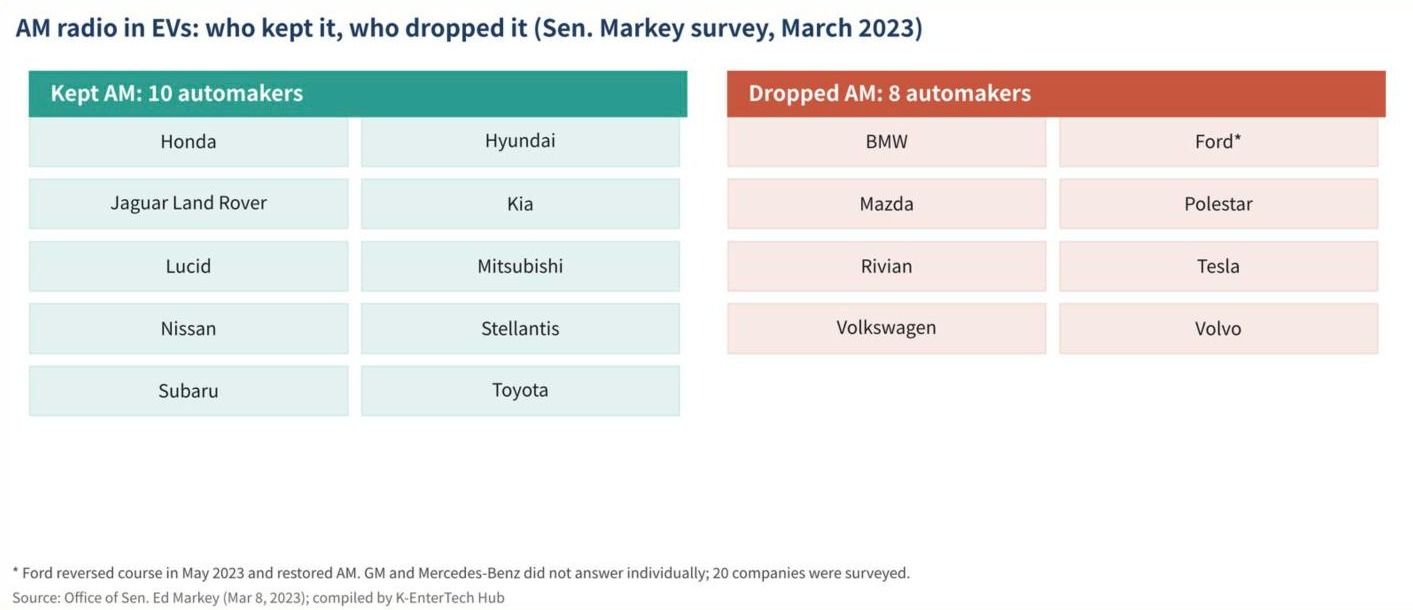
The fight began in 2023, when some automakers pulled AM from electric vehicles, saying motors and high-voltage wiring create interference in the AM band. A March 2023 survey of 20 automakers by Sen. Ed Markey's office found that eight had removed AM from EVs: BMW, Ford, Mazda, Polestar, Rivian, Tesla, Volkswagen and Volvo. Ten, including Hyundai and Kia, had kept it. Ford reversed itself that May and restored AM through a software update.
Adding AM will raise costs. Data automakers gave the Center for Automotive Research put electromagnetic shielding of high-voltage cables at $35 to $50 a vehicle and filtering hardware at $15 to $20, for a total of $50 to $70 per EV. The Congressional Budget Office estimated the House bill would cost manufacturers several million dollars a year. The FCC lists 4,310 licensed AM stations as of March 31, 2026, and more than 50 million Americans listen to AM each month.
House passed it by voice vote in September; 60 Senate cosponsors and a committee win in February 2025
The bill was first introduced in May 2023. In December 2024 it had majority support in both chambers but was left out of the continuing resolution, the last major bill of the 118th Congress. It returned in January 2025 as S. 315, led by Sens. Ted Cruz (R-Texas) and Ed Markey (D-Mass.), and as H.R. 979, led by Reps. Gus Bilirakis (R-Fla.) and Frank Pallone (D-N.J.).
The Senate Commerce Committee approved it on Feb. 5, 2025, with Sen. Gary Peters (D-Mich.) the lone no. On April 1 that year NAB said Senate cosponsors had passed the filibuster-proof mark of 60. The House Energy and Commerce Committee advanced the bill 50-1 in September 2025, and after Majority Leader Steve Scalise scheduled a standalone vote, the full House passed it on Sept. 15, 2026. PBS reported the vote was unanimous.
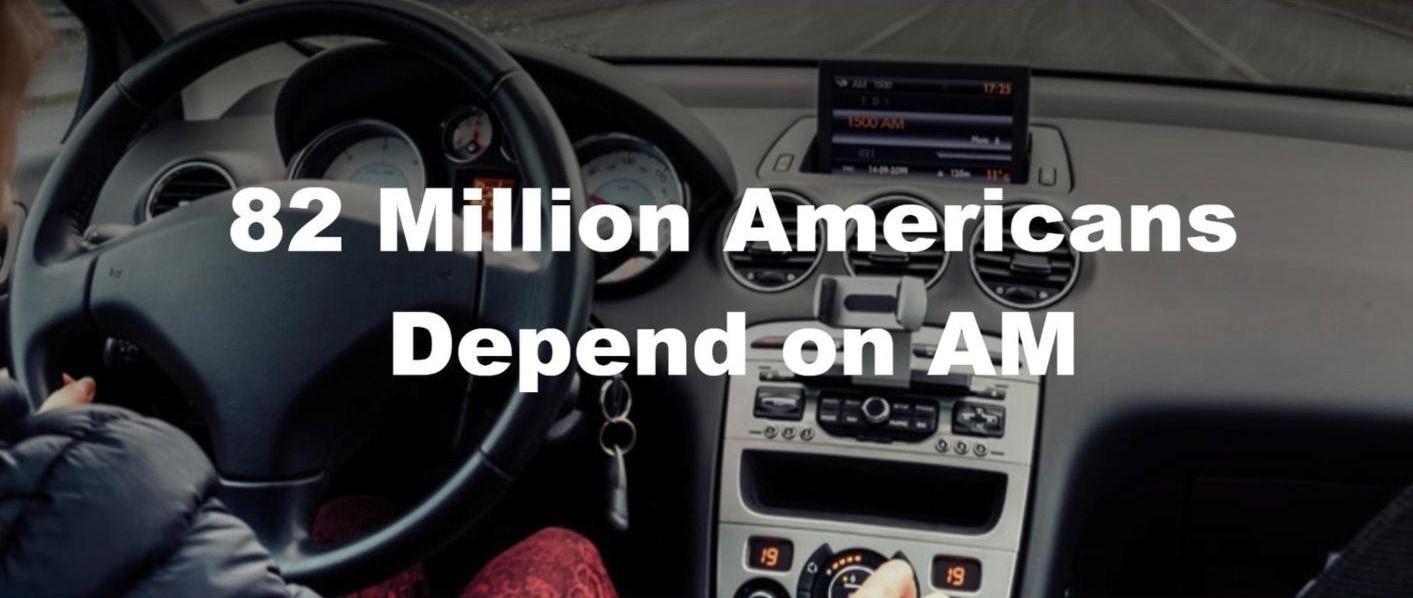
NAB is asking member stations to keep running its "Depend on AM" spots and to push listeners to call their representatives. Nearly one million AM listeners have contacted their members of Congress in support. The campaign's 82 million figure rests on a Nielsen survey for fall 2022 that broadcasters say showed 82 million Americans listening to AM each month.