
MEDIAGPT | AD TECH
Ads Agent replaces the Ad Console and the DSP interface; a beta across 20 marketplaces and 21 languages opens programmatic buying to small sellers
Amazon has rebuilt the software advertisers use to buy and manage its ads around AI agents. At its annual unBoxed advertising event in San Francisco on Tuesday, Amazon Ads unveiled Amazon Ads Agent, a platform that replaces Amazon Ad Console, the company’s longstanding interface for buying and managing campaigns. It also takes over from the Amazon DSP interface, MediaPost reported.
The name is not new. Amazon introduced Ads Agent at unBoxed 2025 last November as a chat-based assistant that built Amazon DSP campaign structures, recommended audience segments and keywords from thousands of options, and wrote SQL queries in Amazon Marketing Cloud from plain-language prompts, with every campaign held for advertiser approval before launch. A year later, that agent runs the whole platform.
Kelly MacLean, a vice president at Amazon Ads, told ADWEEK the change is not a rebrand; the agents are built into the platform and into the workflows advertisers use. “It’s about how the context and the intelligence is integrated across all of these different campaign types and the advertiser journey—no matter what page they’ve been on before or after,” she said.
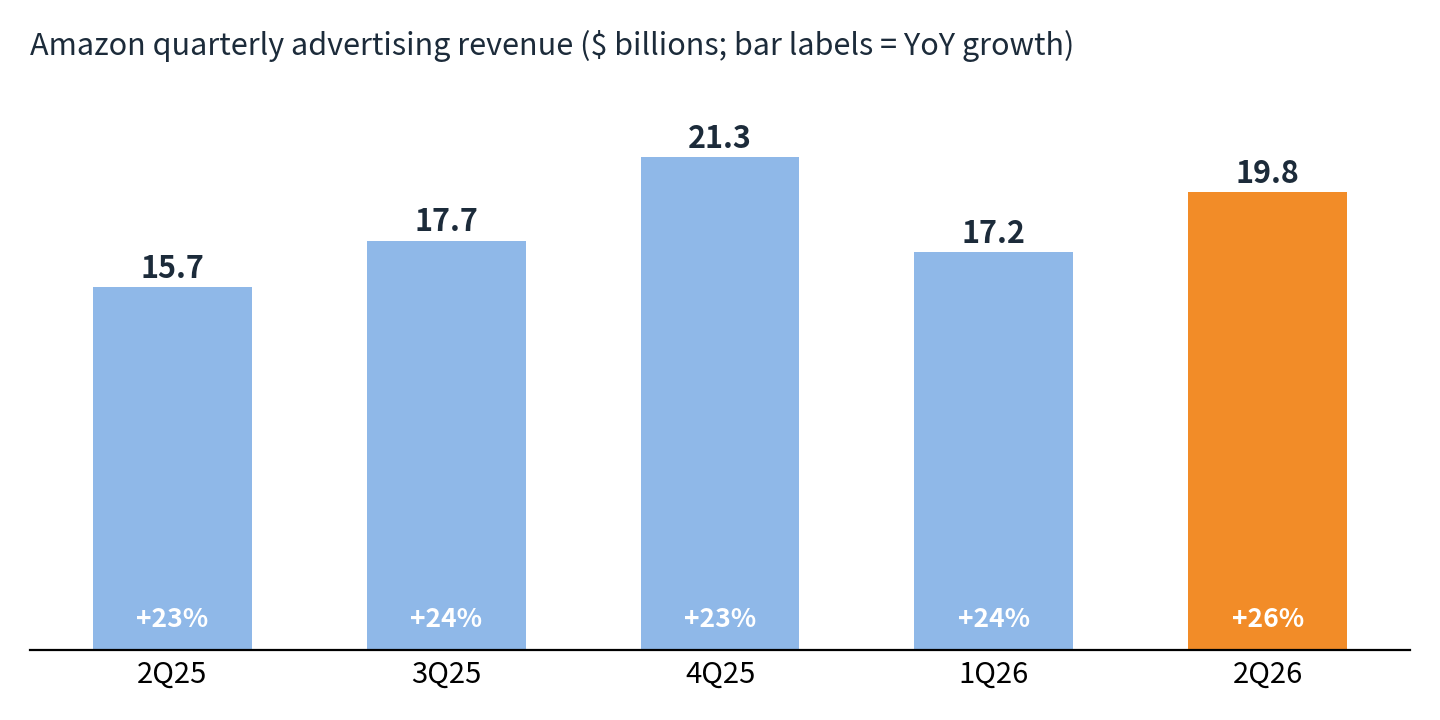
The rollout to beta advertisers begins in the next few months across 20 marketplaces and 21 languages. It changes how money enters a business that brought in $19.8 billion in the second quarter, up 26% from a year earlier, and about $76 billion over the past four quarters. It also arrives a month after the Federal Trade Commission and 22 states sued Amazon, alleging hidden surcharges in its ad auctions.
One interface, three campaign types
Advertisers in Amazon Ads Agent choose among three campaign types: Sponsored ads for search, and two new ones, DVA+ and full-funnel campaigns. Both new types can be handed entirely to Amazon’s AI or run manually.
The consolidation targets a sprawl of formats. Amazon sells search, display, streaming, video and audio inventory, and advertisers have typically planned each separately. The new platform merges that planning and searches for audiences across Amazon’s ecosystem. Amazon also rolled out a generative AI creative agent, expanded natural-language features and updates to Amazon Marketing Cloud, according to Marketing Dive’s account of the event.
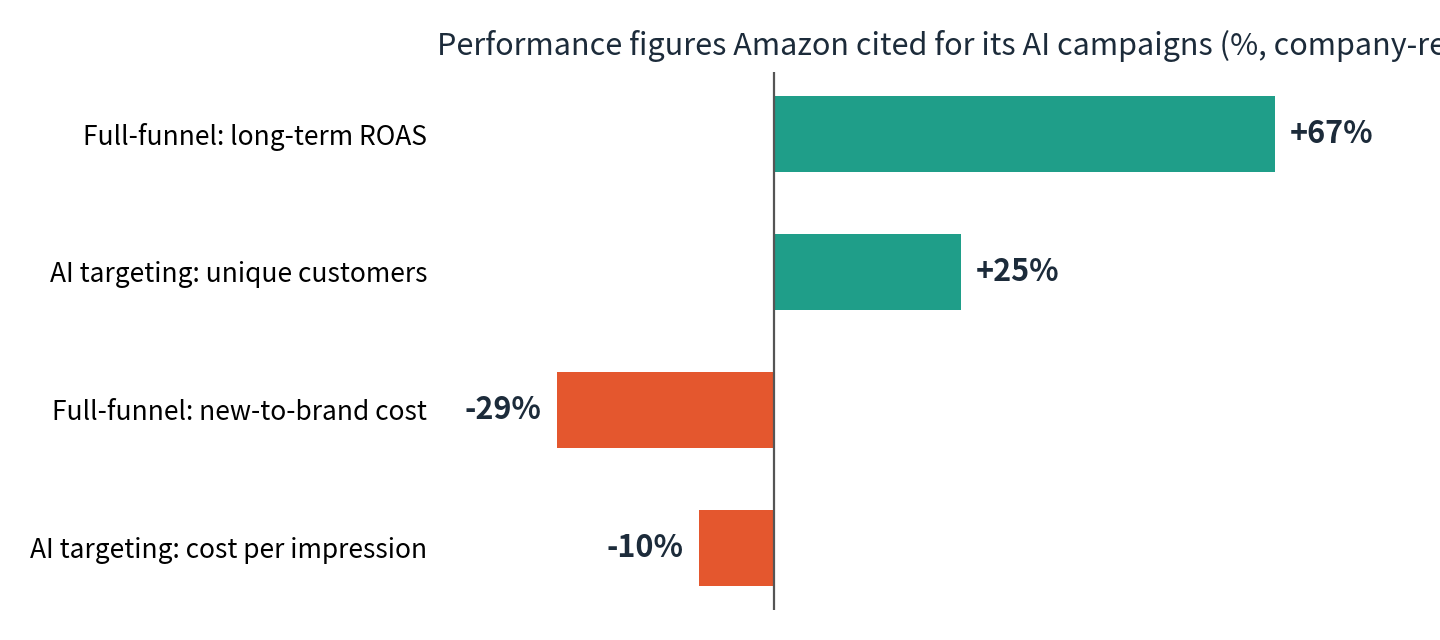
MacLean told ADWEEK that advertisers who apply Amazon’s AI targeting recommendations increase their unique customer count by an average of 25%, and that their cost per impression falls by more than 10% on average.
DVA+ folds display, audio and video into one buy
DVA+ covers display, video, audio and programmatic formats, absorbing what had been Sponsored Display, Sponsored TV and programmatic buying, Digiday reported. Advertisers used to manage those campaigns, their workflows and optimization on their own. Now they pick a goal, upload creative or generate it with Amazon’s tools, set a budget, and let the AI run the ads.
Targeting comes from Brand+, which draws on Amazon’s authenticated graph, and delivery is optimized by Performance+. “The feedback we’ve heard over the last few years is: how do you simplify your DSP?” MacLean said. “We wanted to go even further so that it was dead simple for marketers to set a budget, set an objective, and run.”
An advanced-settings toggle restores manual control over supply partners, frequency caps and bidding—what MacLean called “that traditional DSP-like experience that advertisers already know and trust.” In an interview with Digiday, she described the overall approach as “human-led, AI supported.”
Small and midsize brands, which make up the bulk of Amazon’s advertisers, are the main target. “DVA+ opens up a new realm of DSP technology that never really existed for small and medium-sized businesses to leverage the power of Amazon signal on Amazon and across the open internet,” MacLean said.
Full-funnel campaigns pass 1,000; Amazon cites 67% lift in long-term ROAS
Full-funnel campaigns are aimed at core sellers that mostly buy conversion-focused search ads, with the goal of moving them into awareness formats such as streaming. The campaign bundles sponsored ads, display, video and audio. Advertisers choose a budget, creative and the products to promote; the AI does the rest. Amazon has long sought brand budgets from these sellers beyond their shopper-marketing spend.
Amit Bhattacharyya, Amazon Ads’ vice president of full-funnel ad products, AI and modeling, said smaller advertisers had been trying to link lower- and upper-funnel campaigns themselves. “They would try to figure out segments and targeting, but of course, it’s not easy for them,” he told ADWEEK. “So we said, ‘why not help them build something that’s very simple and yet quite powerful for their outcomes.’”
Amazon says full-funnel campaigns raise long-term return on ad spend by 67% and cut the cost of acquiring new-to-brand customers by 29%. More than 1,000 have run, and the product is open to all U.S. advertisers, with a minimum daily budget of $100. One featured advertiser, Canine Naturals, drew 41% of its sales from new-to-brand shoppers over 206 days. “I don’t have to do anything, just give it all the assets and it’ll figure it out,” Brenda Quintana, its digital marketing manager, said on stage.
DVA+ and full-funnel campaigns can run side by side in one account, with Amazon deduplicating reach so each finds different audiences. “There are shoppers in your audience who are not yet in market,” Bhattacharyya said.
Ad revenue hits $19.8 billion, fastest growth in six quarters
Amazon’s advertising revenue reached $19.8 billion in the second quarter, reported July 30, up 26% year over year—the fastest rate in six quarters of disclosed data, PPC Land calculated. The line has grown from $15.7 billion a year earlier through $17.7 billion in the third quarter of 2025, $21.3 billion in the holiday quarter and $17.2 billion in the first quarter of 2026. “Sponsored Products continues to be our largest offering and a key driver of growth,” CEO Andy Jassy said. This year’s Prime Day (June 23–26) fell in the second quarter, which flatters the year-over-year comparison.
Amazon also used the earnings release to promote its agent: Ads Agent users saw 8% lower cost per impression and 6% lower cost per acquisition, and the tool expanded to 11 more countries this year.
Rivals launch agentic buying, but spend is still small
Agentic buying has become a feature race across ad tech, though the dollars involved are hard to gauge. Scope3, which renamed itself Apostra last week, has managed $1.2 million in media spend over the past three months, ADWEEK reported. PubMatic, Magnite, The Trade Desk and Kargo have all released agentic buying features. In IAB Europe research cited by Digiday, 58% of advertising executives expect agentic buying to reach scale within a year.
Amazon differs from independent ad-tech firms in that it owns the search results, product pages, streaming and audio inventory and the signed-in shopping data its agent works with. Agencies are adjusting. “Our strategists spend less time on execution mechanics and more time on insights,” Jason O’Toole, executive vice president and head of commerce and retail media at Dentsu, told Marketing Dive.
FTC suit over auction surcharges sharpens transparency questions
On Aug. 31, the FTC and attorneys general from 22 states, including Maryland, sued Amazon in the U.S. District Court for the Western District of Washington. The complaint, as summarized by the Maryland attorney general’s office, alleges that Amazon charged Sponsored Products advertisers more than the winning bid close to 80% of the time, quietly turning its stated second-price auction into a first-price one, and extracted tens of billions of dollars from about one million brands and more than 500,000 small and midsize businesses. Amazon disputes the allegations, Digiday noted.
As agents take over targeting and bidding, advertisers see less of how decisions are made. Market observers are raising concerns about the transparency of automated decisions, advertiser control and auction mechanics inside a consolidated buying system, Digiday reported. “We are figuring out how to give them more transparency on the audience side,” Bhattacharyya told the publication.
K-beauty sales double on Amazon U.S.; Korean sellers’ ad playbook shifts
On Amazon U.S., Korean sellers’ growth is led by beauty. Shin Hwa-sook (신화숙), head of Amazon Global Selling Korea (아마존 글로벌셀링 코리아), told the Korean trade outlet Cosmorning (코스모닝) that K-beauty sales on Amazon U.S. doubled year over year during the March Big Spring Sale. The outlet described K-beauty as the fastest-growing category on the U.S. store.
With the Seoul Business Agency (서울경제진흥원), Amazon Global Selling Korea runs the Amazon Accelerator 2026 for beauty start-ups, giving 20 selected brands 5 million won (about $3,700) in advertising plus seeding with 300 influencers. On May 13 it held Amazon AI Day 2026 at COEX (코엑스) in Seoul, covering AI for market research, content production, logistics and IP protection.
The sellers Amazon is courting with full-funnel campaigns—small merchants that mostly buy conversion-driven search ads—include Korean beauty brands in the U.S. store. Because the product is open to all U.S. advertisers, those brands can now buy streaming and audio alongside search in a single campaign. Under the model MacLean described, what advertisers supply comes down to a goal, a budget and creative, and Amazon’s tools can generate images and TV-ready video.
Korean platforms are moving too, at a different layer. Naver (네이버) began evaluating search ads in December 2025 through ADVoost (애드부스트), an AI system that scores ads on search intent, landing-page content and creative fit rather than keyword matching alone, the Seoul agency InterAd (인터애드) explained. In Naver’s second-quarter results, ad revenue rose 7.5%, and the company said AI accounted for more than 60% of that growth; its new AI Briefing ads posted click-conversion rates 30% higher and purchase-conversion rates three times higher than standard search ads. Naver has put AI into how ads are ranked and served; Amazon has handed the buying interface itself to an agent.
Korean broadcast ad spending set to fall 14% in two years as budgets follow purchase data
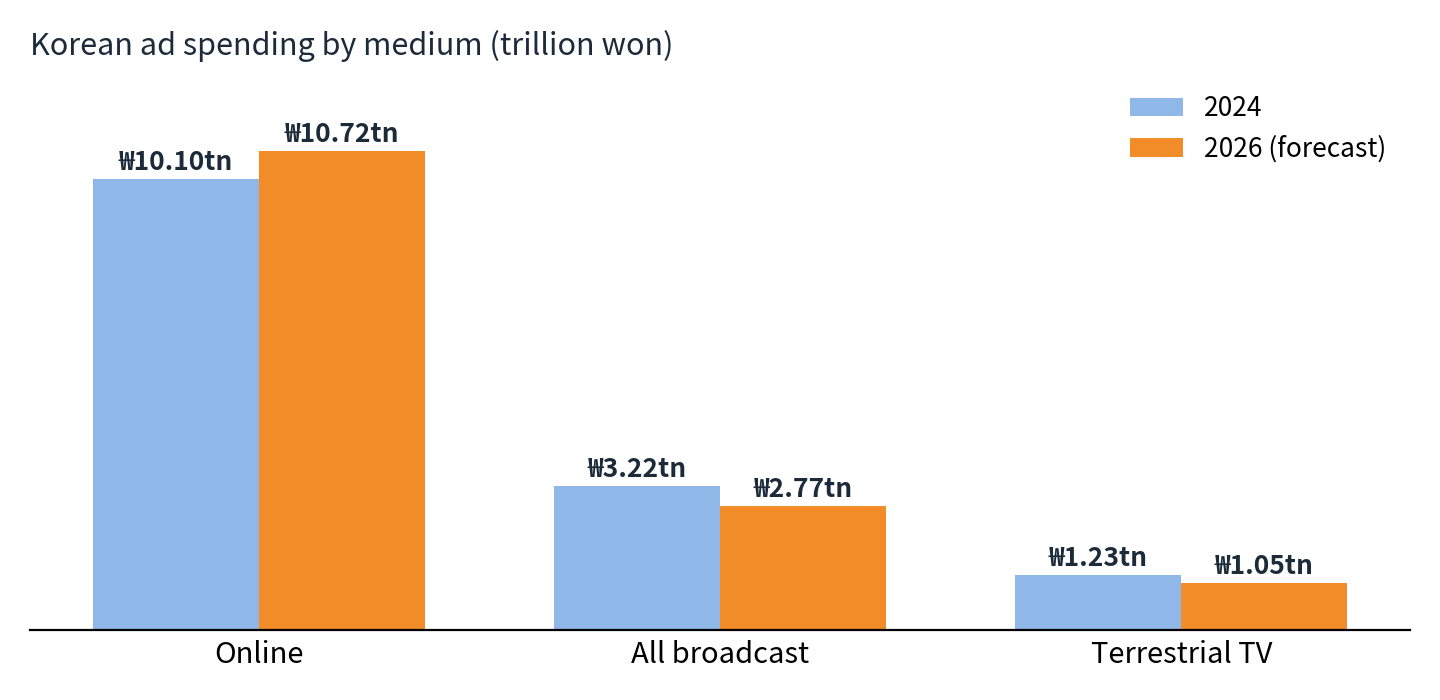
Korea’s total advertising spending reached 17.13 trillion won ($12.6 billion) in 2024, according to the 2025 Broadcasting and Communications Advertising Expenditure Survey released Jan. 8 by the Korea Communications and Media Commission (방송미디어통신위원회) and the Korea Broadcast Advertising Corporation, or KOBACO (한국방송광고진흥공사). Online took 10.1 trillion won, or 59%. Broadcast fell 5% to 3.22 trillion won, an 18.8% share, and terrestrial TV dropped 7.2% to 1.23 trillion won. The agencies forecast broadcast spending of 2.77 trillion won this year and terrestrial TV of 1.05 trillion won, the Journalists Association of Korea (한국기자협회) reported—declines of 13.8% and 14.8% from 2024.
Amazon’s overhaul points the way that money is moving. Full-funnel campaigns put streaming and video in the same campaign as search and report results in sales terms such as new-to-brand and long-term sales, so advertisers can judge video budgets on the same revenue yardstick as search. Korean terrestrial and cable ads are sold through KOBACO and private media reps on ratings and reach. Broadcasters do not hold viewers’ purchase data, which makes it hard for them to prove sales impact on the same terms.
Korean commerce companies with that data are adding video inventory. Coupang (쿠팡) has put ads into Coupang Play (쿠팡플레이) content for its Wow members and into some sports broadcasts, and in July introduced a Premium Pass that removes ads for 3,900 won (about $2.90) a month on the web. Bloter (블로터) reported on July 7 that the industry sees Coupang following Amazon’s playbook with a time lag. Kurly (컬리) is folding ads built on search, cart and purchase data into a single ad system, and its non-product revenue rose 60.3% to 335 billion won in the first half, Supple (서플) reported.
For broadcasters, the lesson lies in how ads are sold. Amazon’s DVA+ lets the agent buy supply from open-internet partners as well as Amazon’s own properties, and sell-side platforms such as PubMatic and Magnite have released agent-to-agent trading tools. For broadcasters’ digital, CTV and FAST inventory to be picked up by such agents, programmatic integration and outcome data are prerequisites; data partnerships with commerce and retail-media companies to measure sales results serve the same end. Korean content companies running channels in the U.S. CTV and FAST market, where ad sales run largely through DSPs, may also feel the change.
Outlook: beta markets and the lawsuit come next
ADWEEK’s report did not list the 20 beta marketplaces. For Korean sellers active in Amazon’s Japanese or European stores as well as the U.S., timing will depend on that list. Agency contracts may shift too: if bid and targeting work moves to the agent, agency roles are likely to tilt toward insight and creative, as O’Toole described.
Amazon also said Branded Conversations, which puts brands into shopping conversations, will become generally available in the U.S. in January 2027, and that its AMC SQL generator will reach general availability in 2027, according to a rundown of the announcements by Pacvue, an Amazon ad-management software firm. The sequence moves agents from the buying screen into the shopping conversation itself. For Korean broadcasters and media reps, the parallel task is to make their broadcast and digital inventory readable and buyable by agents, and to secure the data that proves sales results.
Apostra has handled $1.2 million in three months; Amazon books nearly $20 billion in ad revenue a quarter. How fast agentic buying becomes standard will likely turn on the results Amazon’s beta advertisers see and on what the FTC case reveals about how its auctions and billing work.
Note: Quotation marks indicate reported remarks; unquoted attributions summarize reporting. MacLean and Bhattacharyya remarks are from ADWEEK’s Sept. 29 interview unless another outlet is named. Underlined text links to the original source.
Performance figures (25% unique customers, 10% CPM, 67% long-term ROAS, 29% new-to-brand cost, etc.) are Amazon’s own.