

An AI Set Beside Sony's Wall, Prompts Given Away Free — a 95-Minute Feature for $500,000, 15 People, 14 Days

Promise has begun hybrid feature production near Sony Pictures' Culver City lot, at an estimated 20% to 50% below conventional cost, while Netflix disclosed generative AI use on roughly 300 titles this year.

An AI Set Beside Sony's Wall, Prompts Given Away Free — a 95-Minute Feature for $500,000, 15 People, 14 Days

Hybrid production estimated 20-50% cheaper; Netflix used generative AI on about 300 titles; Higgsfield's valuation reached $5.4 billion in eight months

Promise, a generative AI studio, has begun shooting the horror feature 'Touch Grass.' The set sits within walking distance of Sony Pictures' Culver City lot.

The Guardian reported from the set on Aug. 16. A corner of the office was hung with white sheets; as actor Tori Thomas ran a chase scene, a field of grass generated by Seedance 2.5 — the video model from China's ByteDance — was composited behind her in real time.

The director's monitor showed actor and background together as the take ran, with seedheads moving where she appeared to brush past. On the next take the field became an underground cavern.
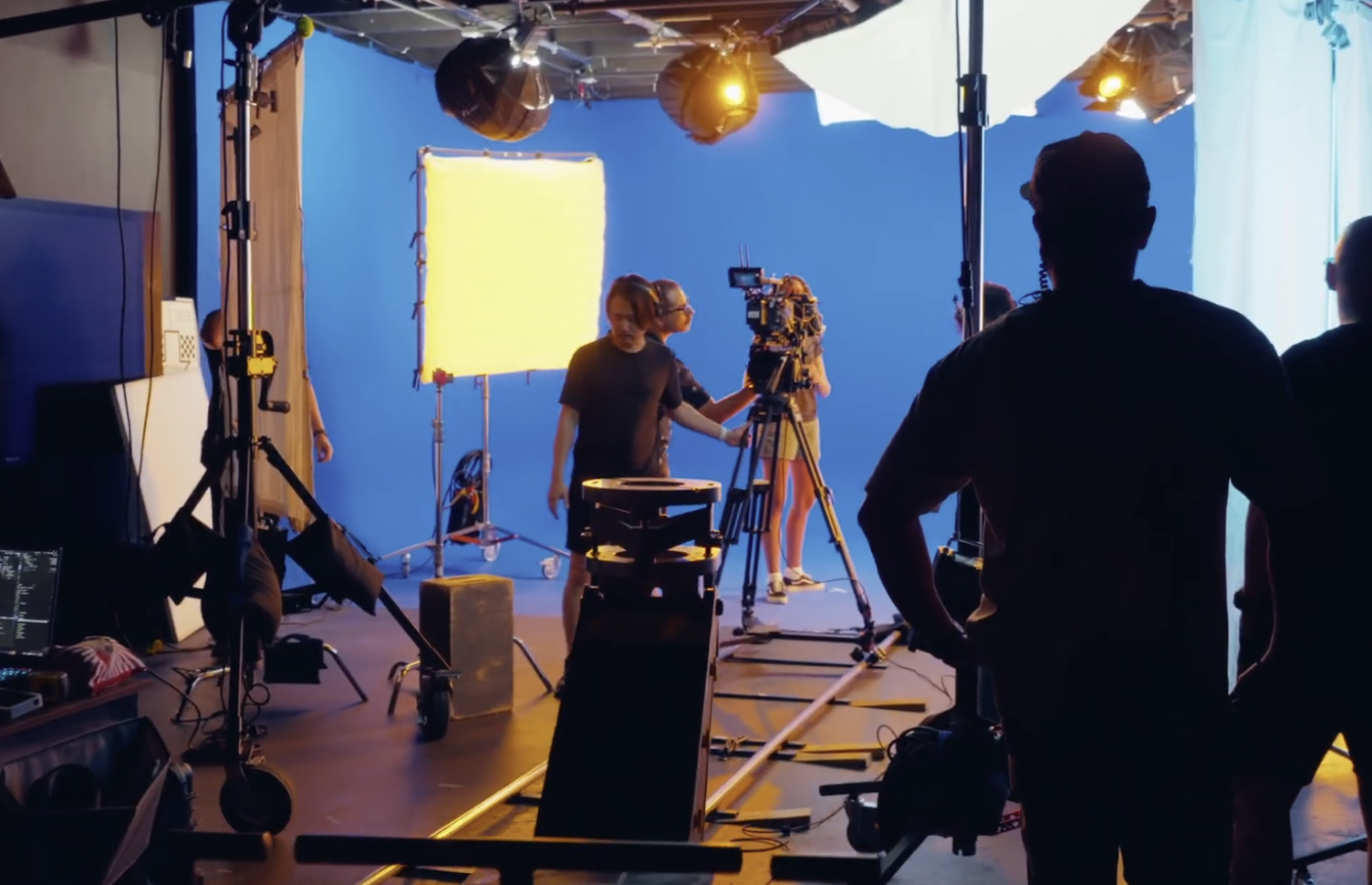
On a Promise hybrid shoot: live-action capture against blue screen, with backgrounds filled in afterward by generative models. Photo: Promise

George Strompolos, CEO of Promise, told The Guardian that hybrid production — human actors combined with AI — runs 20% to 50% cheaper than conventional filmmaking. "We're at the beginning of an era of independent, highly empowered small studios," he said, adding that it would bring more creative risk-taking.

The same month in San Francisco, the AI startup Higgsfield AI published in full the prompts behind its 95-minute feature 'Hell Grind' and opened Higgsfield Academy, a free certification track. TheWrap reported it on Aug. 17. The company closed a $400 million Series B (about 556 billion won) the same day.

Andreessen Horowitz and Google sit behind Promise; DST Global and Goldman Sachs behind Higgsfield. Capital arrived at the production company and the tool vendor in the same window.

A horror feature in the low millions — shooting across practical locations and virtual production

'Touch Grass' carries a budget in the low millions of dollars. Dave Clark, Promise's chief creative officer, directs. According to Deadline's August report, Chris White, executive producer on A24's 'Backrooms,' and Bloody Disgusting founder Brad Miska produce. Miska produces on behalf of Be Afraid Media, the horror company behind Dread Central, and co-developed the found-footage franchise 'V/H/S.'

The protagonist designs AI personalities for a secretive tech company. She finds a hidden layer beneath the internet called The Feed, and learns that copies of people are being assembled from their deepest desires. The premise comes out of the Dead Internet Theory — the claim that the internet is already filled with bots and synthetic identities.

In materials issued to Deadline, Promise said the film will shoot across practical locations and virtual production environments, combining live-action performance, practical effects and conventional visual effects with generative AI while keeping the actors' performances at the center.

Seedance 2.5, the model used on set, went live on ByteDance's own apps — Jimeng (即梦) and Dreamina — on July 31, with a developer API opening in early August. Specifications posted to the company's official blog that day list single-pass generation of up to 30 seconds of video with audio, and up to 50 reference assets at once: 30 images, 10 video clips and 10 audio files.

Joel Hynek, who won an Academy Award for visual effects on 'Predator,' worked on the shoot. "When we went from optical to digital, we thought we'd gone to heaven," he told The Guardian. "It's like that again."

'Hardcore 94' pilot in production — a character model trained on original art, placed on Unreal Engine coordinates

Promise is also making 'Hardcore 94,' a four-part adult animated series. Ivan Rome wrote the script from Clark's original idea, and Clark co-directs with MetaPuppet. Aliens land on Compton, California, in 1994.

A scene from 'Hardcore 94.' Animated characters and a near-photoreal interior occupy the same frame. Photo: Promise

Animated characters move through near-photoreal environments. Clark told Forbes in a July 24 interview that off-the-shelf models do not hold that combination together. In the same interview he described training a character-specific model on original artwork drawn by a Promise artist, then separating characters and backgrounds into layers. Some shots were built by positioning a camera and characters inside a 3D space in Unreal Engine and feeding those coordinates back into the image tool. "You can't do that with off-the-shelf models," Clark said.

Promise logs prompts, settings and approvals in MUSE, its studio operating software, and screens separately for intellectual-property conflicts with Copyright Guardian. Forbes reported the purpose as producing output a studio can own, insure, edit and release. The company supplies visual effects to traditional studios through The Generation Company, a production-services arm, and runs training for creators in more than 170 countries through Curious Refuge, an AI film school. Its backers include Peter Chernin's The North Road Company and Andreessen Horowitz, along with Google and Michael Ovitz's Crossbeam.

Brad Pitt, acknowledging the scale of the pushback, said AI used as a tool "is going to help these mid-budget films get made." The Guardian carried the remark; the range he named was $40 million to $90 million (about 56 billion to 125 billion won).

Producers outside the studio system have emerged as well. Kavan 'the Kid' Cardoza, 37, who founded Phantom X, works from the spare bedroom of his home in Playa Vista, Los Angeles. 'Chronicles of Bone,' the fantasy series he released online last autumn, has drawn 28 million YouTube views, and he has signed with the image platform Magnific AI. Recalling studio meetings that specified how many jump scares a horror film required, he told The Guardian: "That's not creativity — that's manufacture."

Netflix: generative AI on about 300 titles — Obsidian estimates 30-40% in cost savings

Netflix told shareholders on July 16, in its second-quarter 2026 letter, that generative AI had been used on roughly 300 titles this year, spanning concept and pre-visualization through post-production and release. The letter cited the Indian series 'Glory,' the Brazilian miniseries 'Brasil 70: A Saga do Tri' and the U.S. docuseries 'The American Experiment.'

Co-CEO Ted Sarandos said on the earnings call the same day that 'The American Experiment' contains 17 minutes of AI-enhanced footage, produced twice as fast and at half the cost of other available methods. Quarterly revenue was $12.56 billion (about 17.5 trillion won), up 13% year over year. In March, Netflix acquired InterPositive, the AI company co-founded by Ben Affleck, for $600 million (about 830 billion won).

Imagine Entertainment, run by Ron Howard and Brian Grazer, houses an AI studio, Obsidian, at its Beverly Hills headquarters. Howard is directing 'The Code,' an animated documentary drawn from artwork made by American prisoners of war in Vietnamese captivity. Obsidian executive producer D. Ryan Reeb told The Guardian the technology cuts 30% to 40% off cost. He said he had met with dozens of production companies and expected all of them to adopt it. Asked whether AI use in Hollywood resembles plastic surgery — everyone does it, nobody discusses it — he answered: "It's 100% like that."

Higgsfield publishes the 'Hell Grind' prompts in full — certification free

Higgsfield Academy lets users open the instructions behind each scene and modify them directly. Completing the track earns a certification. According to TheWrap, it converts guidance the company had been delivering through YouTube videos and one-on-one enterprise support into a formal curriculum.

The Higgsfield Academy landing page, leading with a free start button and workflow categories. Photo: Higgsfield

The published prompts are dense. A single shot carries separate instructions for characters, environments, camera movement, lighting, action and continuity, and references assets already built inside Cinema Studio, the company's platform. "You can cut and paste a prompt right out of our system and play it somewhere else," co-founder and CEO Mahi de Silva told TheWrap, "but you're likely not to get the visual coherence."

In the same interview, de Silva recalled how early generative AI vendors approached studios with a demo, a limited-time exclusive and a $100 million commitment (about 139 billion won). Those companies, in his assessment, overpromised and underdelivered. The company's position is that a filmmaker who understands cameras, lenses, lighting and set design can apply that knowledge directly to generative tools.

15 people, 14 days — $400,000 of a $500,000 budget went to compute

'Hell Grind' is a 95-minute action fantasy shown in Cannes in May. Kazakh filmmaker Aitore Zholdaskali directed, with a co-writing credit for Adilkhan Yerzhanov, twice selected for official Cannes programs. Four street thieves botch a heist and open a door to an underworld.

A crew of 15 in directing, cinematography and editing finished it in 14 days. The budget came in under $500,000 (about 700 million won); according to reporting by The Wall Street Journal and Variety on June 10, roughly $400,000 of that was compute. Screen Daily reported on May 19 that the first 25-minute segment required 16,181 generations to yield 253 final shots — a 64-to-1 ratio. The company estimated a comparable conventional production at $50 million (about 70 billion won).

The screening record was corrected afterward. The Wall Street Journal reported the film as a Festival de Cannes debut; asked by Futurism on May 22, the festival said it was not part of the official program. CineD's May 28 account places a private industry preview on the Vieux Port on May 16 and a screening at Cinéma Olympia, a commercial theater, on May 21 — both on the fringe of the Marché du Film.

The second feature, 'The Cully Hill Boys,' is a different case. It is a comedic action film using the likenesses of two-time UFC champion Israel Adesanya, MMA veteran Quinton 'Rampage' Jackson and livestream creator N3on. Setting a visual-effects-heavy science fiction film beside a comedy built on real likenesses gives learners two deliberately opposite examples.

"The skin is too smooth, the lighting is too perfect" — spotting AI slop is the first lesson

Adil Alimzhanov, Higgsfield's content lead, told TheWrap that the first thing new users need to learn is how to recognize when a generated result is off. "The skin is too smooth, the lighting is too perfect," he said, citing plastic texture and the uncanny-valley effect that comes from excessive symmetry as markers of AI slop.

Higgsfield builds a more naturalistic look into the generation process so those markers appear less often. Alimzhanov said a prompt as plain as a girl standing in a park returns a deliberate camera angle, film grain, skin texture and lighting without further specification. The course still shows learners large volumes of imagery and asks them to identify what is wrong in each. His reason sits with the audience: viewers may not name a specific flaw, but they sense that something is off, and at that moment they leave the story.

A $400 million Series B on Aug. 17 — a $5.4 billion valuation, quadrupled in eight months

De Silva does not call Higgsfield a studio. "We are not in the content creation business," he told TheWrap. "We're in the tools distribution business." Signaling any intent to compete with studios, he said, would work against the company. The two features were made as teaching material rather than product. He declined to characterize the Hollywood customer base in detail, saying only that Higgsfield has supported filmmakers on reshoots and visual effects.

DST Global and Goldman Sachs Alternatives led the Series B. TechCrunch reported on Aug. 17 that the valuation reached $5.4 billion (about 7.5 trillion won), four times the $1.3 billion (about 1.8 trillion won) mark set at January's Series A extension. Axios Pro Rata listed Tribe Capital, Smash Capital, Fifth Wall, Intel Capital, Liberty Global Tech Ventures, Mirae Asset Capital (미래에셋캐피탈) and NTT Docomo Ventures among participants.

Figures disclosed with the round were $700 million in annualized revenue (about 973 billion won), 30 million users across 200 countries, and business with 390 of the Fortune 500. TheWrap's reporting a day earlier cited a $500 million annual run rate, 31 million monthly visits, 26 million users and more than 170,000 corporate accounts. The research firm Sacra, as of June 30, estimated annualized revenue at $200 million at the end of 2025, $400 million in May 2026 and $500 million in June.

Seedance as the common model on both sets — Disney's cease-and-desist in February

'Hell Grind' was built with a mix of Seedance and Higgsfield's own tools; on 'Touch Grass,' Seedance 2.5 handled real-time compositing. The production company and the tool company stand on the same family of models.

Cardoza told The Guardian that Chinese models lead on both image and video generation, and assumed they were trained on data U.S. models cannot use because of intellectual-property constraints. On Washington's consideration of restrictions for Chinese open-source models, he said: "I'll move to China. I'm not even lying."

The Walt Disney Company sent ByteDance a cease-and-desist letter on Feb. 13, alleging its works were used in training. Seedance 2.0, released in February, had its global rollout halted after clips reproducing real actors and film scenes spread online. The disputes remain unresolved.

SAG-AFTRA ratifies limits on synthetic performers — Nolan on a technology so completely rejected

Christopher Nolan has said he has never seen a technology advance so rapidly and be so completely rejected by the public; The Guardian quoted the remark again in this reporting. Guillermo del Toro has also criticized generative technology. The AI resurrection of the late actor Val Kilmer for the independent film 'As Deep as the Grave' and the arrival of the AI performer Tilly Norwood sharpened the backlash. Emily Blunt asked: "Please stop taking away our human connection."

SAG-AFTRA members ratified a new TV/Theatrical Agreement in June. The union's published AI bargaining and policy timeline shows terms further restricting the use of synthetic performers, added on top of existing digital-replica provisions. National executive director Duncan Crabtree-Ireland raised compensation for synthetic characters resembling no living performer as a bargaining issue in a March 28 interview with Fortune. In June, more than 16,000 people signed an open letter urging passage of the NO FAKES Act, which would establish a federal right in one's voice and likeness.

Representative Laura Friedman, a Democrat whose district covers Hollywood, said last month: "We can't wait until we see tens of thousands of American workers displaced." The Guardian carried the remark. Producer and AI adviser Joanna Popper, in the same article, described the upside as letting anyone with storytelling ability make what they want, while naming her concern as five tech companies absorbing the industry's financial gain.

Private capital across both layers in the U.S. — in Korea, 8 billion won from KOFIC and 19.8 billion from KOCCA

In the U.S., venture firms, media holding companies and platform companies are investing directly in new studios, creating production entities. On the tooling side, Higgsfield opens prompts and instruction for free and recovers through paid platform use, while Promise runs a 170-country training network through Curious Refuge. Conditions for synthetic performers and digital replicas are set by collective agreements, with federal legislation debated behind them.

Korea funds this from the state. As CNN reported in May, the government tripled its AI budget for 2026, and part of the Korean Film Council's (영화진흥위원회) 8 billion won (about $5.4 million) emergency fund was earmarked for productions using advanced technologies including AI. The Korea Creative Content Agency (한국콘텐츠진흥원, KOCCA) is putting 19.8 billion won (about $13.3 million) into AI production. CJ ENM (씨제이이엔엠) launched an AI Content Alliance in February with academia and small and mid-sized studios; according to Kukmin Ilbo (국민일보) on April 30, it completed 'Apartment,' a feature shot against green screen with all backgrounds and visual effects generated using Google's Imagen, Nano Banana and Veo, for 500 million won (about $360,000), released on TVING (티빙).

Training is procured by the state as well. KOCCA's January workforce roadmap commits 43 billion won (about $31 million) to train some 3,400 people, with a new flagship program — the AI-Specialized Content Academy — funded at 7.9 billion won (about $5.7 million) for 900 entry-level and 100 experienced professionals. Electronic Times (전자신문) reported on March 11 that a 4.5 billion won (about $3.2 million) creator-training program opened across nine consortia at roughly 500 million won each. The production academy KOCCA runs with Netflix has graduated about 2,300 people since 2024.

The Institute of Information & Communications Technology Planning & Evaluation (정보통신기획평가원, IITP) raised a different point in an August report on the industrialization of AI video. Automation from planning through editing and localization has raised productivity, it found, but the savings are translating less into producer margin than into content oversupply and a transfer of profit to distribution platforms.

What this means for Korean operators — the model is the same; pipeline, records and contracts differ

Seedance 2.5 is open via API. Korean producers use the same model on the same terms as Promise and Higgsfield. CJ ENM finishing 'Apartment' for 500 million won and Higgsfield making 'Hell Grind' for $500,000 sit on the same technical layer.

The 'Hardcore 94' method is not a call to an off-the-shelf model. It is a character-specific model trained on original artwork, characters and backgrounds separated into layers, and Unreal Engine coordinates fed back into the image tool. 'Touch Grass' likewise moves between practical locations and virtual production. De Silva's point — that opening the prompts does not reproduce the results elsewhere — says the same thing from the tooling side. What a Korean producer needs to hold is not a model license but that combination and the internal tooling that makes it repeatable.

Higgsfield opened its prompts to expand its own user base. If a Korean academy adopts one commercial platform's workflow as its curriculum, its 900 graduates become that platform's base of users. That argues for separating a tool-neutral foundation track from platform-specific modules — and for stating in the training contract whether prompts and assets created by trainees belong to the operating institution, the participating company or the trainee.

On 'Hell Grind,' $400,000 of a $500,000 budget was compute. The cost center in AI video has moved from labor to processing. KOCCA recognizing AI tool subscriptions as a leasing expense fits that direction, but the credit allocation itself needs recalculating if feature-scale exercises are intended.

'Hell Grind' was not an official Cannes selection, yet was reported as one for some time, corrected only after the festival responded. Korean cases of recording attendance at events adjacent to an overseas market as an official invitation have recurred. Where that distinction blurs in grant reporting and investor materials, the cost of verification moves downstream.

What this means for Korean broadcasters — four things the commissioning party has to settle first

Broadcasters sit differently in this shift than producers do. They commission outside production, contract directly with performers and writers, and hold archives that could be used for training. The problems Promise and Higgsfield have worked through arrive in Korean broadcasting with the counterparties reversed.

Allocation of savings comes first. In the transfer of profit IITP described, broadcasters are on the receiving side. When an outside producer cuts 20% to 50% off a budget using AI, where that share goes is determined by the standard contract the broadcaster uses. Left on a cost-based settlement structure, the producer's incentive to invest in the technology disappears — and so does the production capacity the broadcaster was trying to secure.

Performer clauses were drafted first in SAG-AFTRA's collective agreement. In Korea the counterparties are performer organizations including the Korean Broadcasting Performers' Rights Association (한국방송실연자권리협회, KoBPRA), and the party across the table is the broadcaster.

Writing the scope of use, compensation basis and post-hoc deletion rights for synthetic performers and digital replicas into standard contracts needs to be finished before co-productions begin. Once a U.S. co-production is under way, the counterparty's standard applies wholesale, and Korean performers fall outside its coverage.

Clearing archive training rights is third. What Promise did with original artwork for a character model, a broadcaster could attempt with its own footage library. Broadcast archives, however, carry overlapping performer, writer, music and appearance contracts, and older agreements contain no clause covering use in training. Holding the asset and being able to train on it are separate questions; without the rights work, the archive does not open.

Generation records and disclosure standards are fourth. Promise logs prompts and approvals in MUSE and screens conflicts with Copyright Guardian; Netflix put its usage count in a shareholder letter. Korean broadcasting has neither a review standard for disclosing generative AI use nor internal process-record rules — least of all in news and current affairs. License renewal review, viewer complaints and copyright disputes converge at this point, and setting an internal standard costs less than waiting for a regulatory one.

Whether broadcasters enter the tooling and training layer remains open. Higgsfield opens training for free and recovers through platform use; Promise runs a 170-country training network through Curious Refuge. In Korea, KOCCA is spending 43 billion won on workforce development, and Netflix already co-runs an academy with KOCCA that has graduated 2,300 people. For a broadcaster that wants its talent pipeline shaped to its own workflow, the timing of entry into that layer is already set.

The remaining gap is a few contract clauses — allocation, not unit cost

The technology gap closed at the API. Korean producers pay the same price for Seedance 2.5. CJ ENM finished a feature for 500 million won; Higgsfield made 95 minutes for $500,000. Unit production cost is not where the distance will open.

It opens across three documents: the standard-contract clause deciding who keeps the savings, the performer-contract language covering synthetic performers and digital replicas, and the process-record rule that preserves training-data provenance and generation history. All three are already being drafted in the U.S. Promise keeps records in MUSE and Copyright Guardian, SAG-AFTRA wrote synthetic-performer terms into its June agreement, and the NO FAKES Act sits before Congress.

In Korea, revision of the standard contract has not begun, and broadcast review carries no standard for disclosing generative AI use. Promise's 'Touch Grass' and the 'Hardcore 94' pilot, along with Higgsfield's next feature, all arrive within the year. Whether those documents exist by the time that output reaches Korean streamers and broadcasters as deliverables is the variable that remains.


Sources

· The Guardian, "'I see the incredible promise': on set of an AI film shoot as new studios embrace controversial tech," Robert Booth, Aug. 16, 2026 — set report from Promise. Remarks by Strompolos, Hynek, Cardoza, Reeb and Popper, and quotations of Pitt, Nolan, Blunt and Friedman, are as carried in this article.

· TheWrap, "The Company Behind AI Film 'Hell Grind' Wants to Teach You How to Make AI Movies for Free," Tess Patton, Aug. 17, 2026 — Academy launch; de Silva and Alimzhanov remarks; $500M run rate, 31 million monthly visits, 26 million users, 170,000+ corporate accounts.

· Deadline, "Promise AI Developing Horror Feature 'Touch Grass'," Aug. 2026 — logline and production team; practical locations and virtual production; Miska's credits.

· Forbes, "Dave Clark's AI Studio Promise Aims For Films Hollywood Can Release," Maureen Kerr, July 24, 2026 — Clark's remarks and the 'Hardcore 94' method; the purpose of MUSE and Copyright Guardian.

· Promise, company site and official accounts — The Generation Company; Curious Refuge (170+ countries); backers; production stills.

· The Hollywood Reporter, Oct. 2025 — launch of The Generation Company; investment from Google, The North Road Company and Crossbeam.

· TechCrunch, "Higgsfield raises $400M Series B, quadrupling its valuation in 8 months to $5.4B," Aug. 17, 2026 — round size, valuation, $700M annualized revenue, 30 million users in 200 countries, 390 of the Fortune 500.

· Axios Pro Rata; Eastern Herald, Aug. 18, 2026 — lead investors and full participant list.

· Sacra, Higgsfield company page, June 30, 2026 — annualized revenue trajectory; $80M Series A extension at a $1.3B valuation.

· Screen Daily, May 19, 2026 — sub-$500,000 budget; 16,181 generations for 253 final shots across the first 25 minutes.

· The Wall Street Journal; Variety, June 10, 2026 — roughly $400,000 of the budget in compute; use of third-party models including Seedance.

· Futurism, May 22, 2026 — Festival de Cannes spokesperson confirming the film was not in the official program.

· CineD, "Hell Grind: The 95-Minute AI Feature Cannes 2026 Says It Never Screened," May 28, 2026 — May 16 Vieux Port preview, May 21 Cinéma Olympia screening, director and co-writer credits.

· ByteDance Seed official blog, July 31, 2026 — Seedance 2.5 specifications (single-pass 30-second generation, up to 50 multimodal references).

· Wikipedia, 'Seedance 2.0'; TechTimes, June 24, 2026 — the Feb. 13, 2026 cease-and-desist letters and the paused global rollout.

· Netflix Q2 2026 shareholder letter and earnings call, July 16, 2026; Variety, July 16, 2026; Cartoon Brew and BigGo Finance, July 17, 2026 — roughly 300 titles, Sarandos remarks, $12.56 billion revenue, InterPositive acquisition.

· SAG-AFTRA, 'AI Bargaining and Policy Work Timeline' — June 2026 ratification of the TV/Theatrical Agreement; NO FAKES Act open letter with 16,000+ signatures.

· Fortune, Mar. 28, 2026 — remarks by national executive director Duncan Crabtree-Ireland.

· Variety, Apr. 20, 2026; NBC News, Mar. 19, 2026 — Val Kilmer generative AI performance; Tilly Norwood controversy.

· CNN, "South Korea's movie industry is embracing AI," May 2026 — tripled government AI budget; Korean Film Council 8 billion won; KOCCA 19.8 billion won; CJ ENM AI Content Alliance.

· Kukmin Ilbo (국민일보), Apr. 30, 2026 — CJ ENM's 'Apartment,' 500 million won, released on TVING.

· Youth Daily (청년일보), Jan. 12, 2026; HelloT (헬로티), Jan. 15, 2026 — KOCCA 2026 workforce roadmap, 43 billion won for 3,400 trainees; AI-Specialized Content Academy at 7.9 billion won.

· Electronic Times (전자신문), Mar. 11, 2026 — AI-Specialized Content Creator program, 4.5 billion won, nine consortia, 900 trainees.

· Bizinfo (기업마당), 2026 program notice — eligible cost categories including AI tool subscriptions under leasing.

· Weekly Hankook (주간한국), May 21, 2026 — KOCCA–Netflix Production Academy, about 2,300 graduates over two years.

· IITP (정보통신기획평가원), 'Industrialization of AI Video and the Restructuring of the Media Industry,' Aug. 2026 — transfer of savings to platforms.

Note: Quotation marks indicate remarks as reported by the cited outlet; unquoted description summarizes that outlet's reporting. Won figures are converted at the Aug. 21, 2026 Seoul close of about 1,390 won to the dollar and rounded.