
Bartlett plans up to $400 million. What decides these deals is not the percentage but the scope of the work and the terms of the exit.
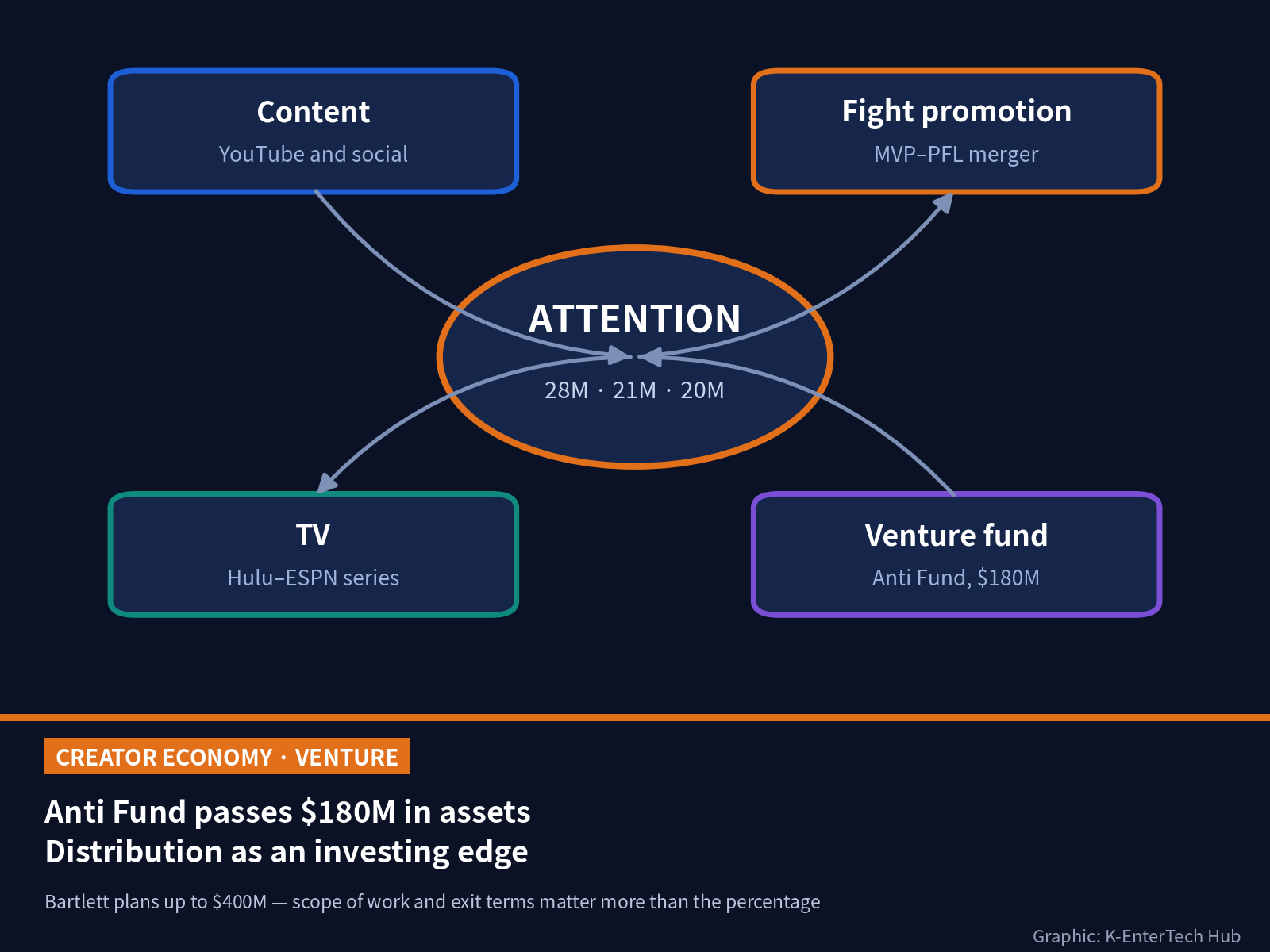
A YouTuber’s influence is being put to work as an investing edge. Anti Fund, the firm Jake Paul co-founded, closed its growth-stage vehicle, Growth I, in June at $100 million, above target. Assets under management across the firm now exceed $180 million. The portfolio includes OpenAI, SpaceX and Anduril.
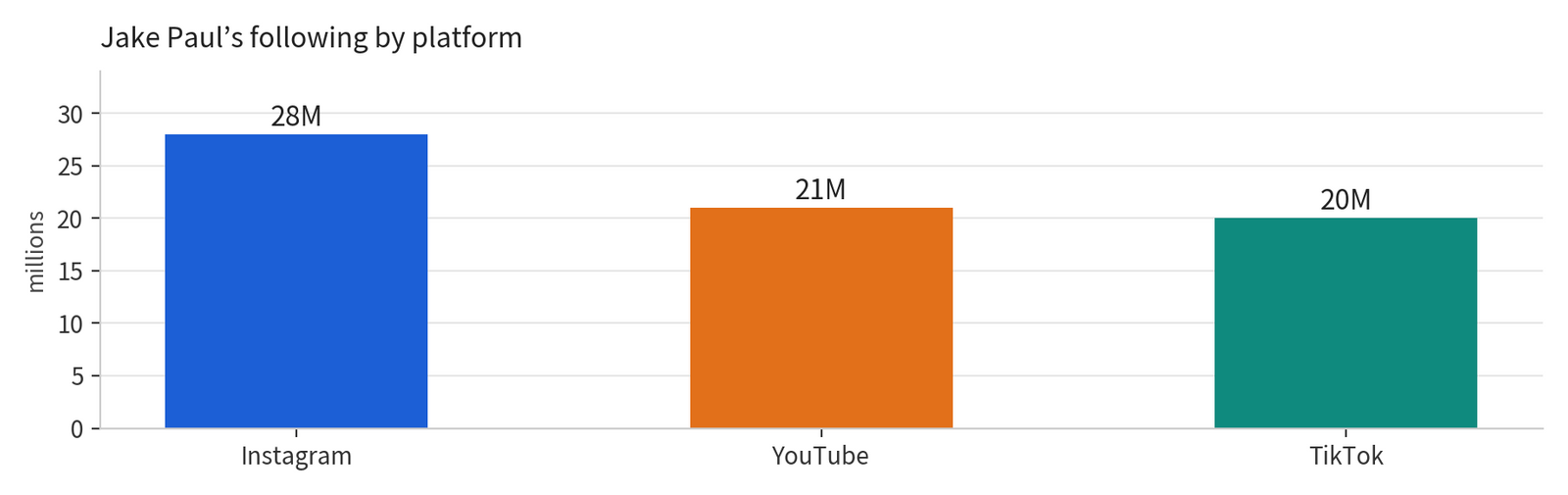
What Anti Fund offers is not only capital. Paul is a creator and professional boxer with 28 million followers on Instagram, 21 million on YouTube and 20 million on TikTok. Through Most Valuable Promotions (MVP), the boxing promotion he co-founded, he also builds and sells fight cards. The firm’s strategy is to route the public attention gathered through content and sport toward the products and services of the companies it backs.
The line on the firm’s home page compresses the idea: “Capital is a commodity. Attention is not.” Money alone is hard to differentiate; the ability to reach consumers and get a response from them is treated as a separate competitive asset.
Paul made the same argument in an interview for Natalie Jarvey’s Ankler newsletter, ‘Like & Subscribe,’ saying that owning attention and owning distribution is the core of the business. The offer to founders is money plus a route to customers. It is a way of competing for allocations in sought-after rounds on something other than price.
The shift is not confined to fund management. Digiday reported on Sept. 24 on deals in which creators take startup equity in exchange for strategic advice and content production. A guide from the investment platform Cherub puts seed-stage stakes at 0.1% to 3%, depending on the role. Podcaster and entrepreneur Steven Bartlett has also announced plans to invest up to $400 million in creator businesses alongside Authentic Brands Group.
Three models sit side by side and are not the same thing: Anti Fund raises outside capital and invests it, creators take equity as payment for services, and Bartlett is funding creator-led businesses. What they share is a view of the creator as a partner in a company’s growth rather than a face in an advertisement. The pay for influence is moving from a one-off fee toward equity and a share of longer-term business results.
From six-second clips to fight promotion, and then a fund
Paul, born in 1997, made his name in 2013 on Vine, the six-second video app, then moved to YouTube. He appeared on the Disney Channel sitcom ‘Bizaardvark’ and left during a period of controversy that included a noise dispute with neighbours. Having built recognition through short video and television, he expanded into sport.
He turned professional as a boxer in 2020 and drew attention fighting retired MMA fighters, a basketball player and others. In 2021 he co-founded MVP with Nakisa Bidarian and began managing fighters and promoting cards himself. A creator who had gathered an audience through content turned the box office of his own fights into a business. The nearest Korean analogue would be a major YouTuber founding a boxing promotion and headlining its cards.


Anti Fund also launched in 2021. With the entrepreneur Geoff Woo, Paul set out to back founders and companies the market has not yet fully priced. The name ‘Anti’ signals looking for opportunity outside established investing convention.
Woo, a Stanford-trained engineer, founded the location-sharing app Glassmap and sold it to Groupon in 2013. The two combine the work of judging technology and business with the work of putting products in front of the public. Woo leads investment decisions and fund operations; Paul works on raising capital, sourcing deals and promoting portfolio companies.
This is not the celebrity angel buying startup shares with personal money. Anti Fund raises outside capital, invests it as a fund and has to return the proceeds to its limited partners. Logan Paul, Jake’s older brother, joined as a general partner in December 2025. Creator recognition may open the door to deals, but the firm will be judged the way any other manager is: on realised returns.
Sources: Anti Fund announcements; reporting by The Ankler, Bloomberg and SportsPro
Institutional money and investment staff: how Anti Fund is run
Anti Fund splits its vehicles by company stage. Venture I, for early-stage companies, closed at $30 million in December 2025. Growth I, aimed at companies already scaling, closed above target at $100 million in June. Firm-wide assets under management now exceed $180 million.
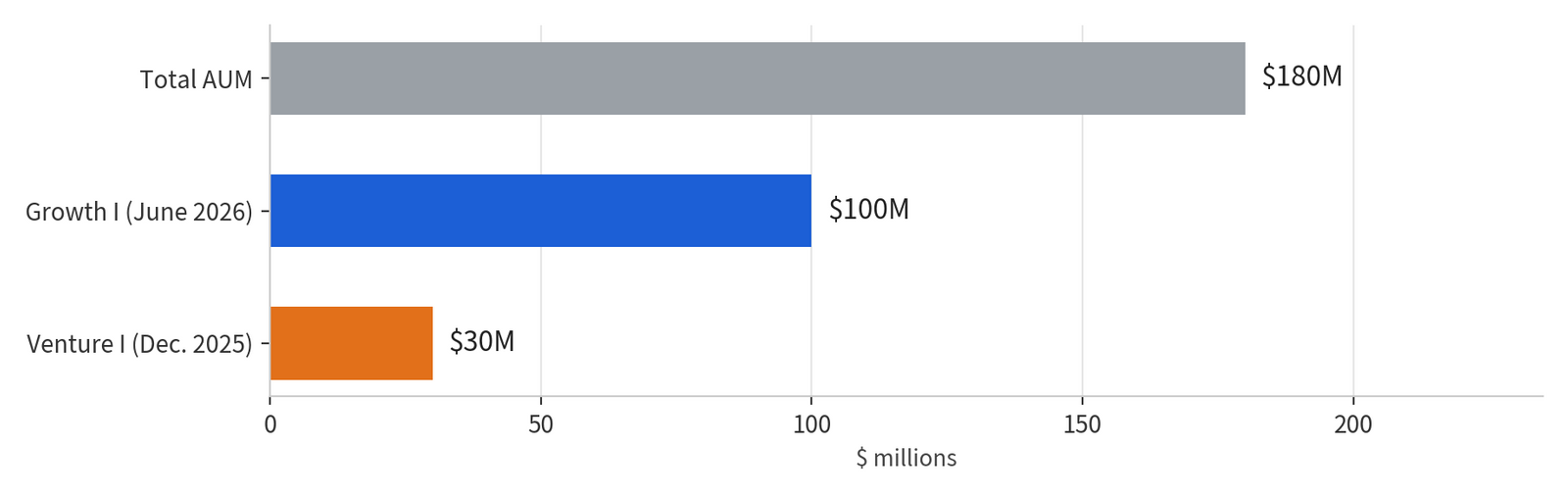
Anti Fund by vehicle and total assets under management. Source: Anti Fund announcement, June 18, 2026
Its remit runs from pre-seed and seed through growth and pre-IPO rounds. Individual investments range from $250,000 to $30 million, and the firm will lead a round or join one. Early on it backs technology and founders; at growth stage it concentrates capital in companies that have already established a market position.
The limited partner list points the same way. According to the June announcement, Aquarian Holdings is a core investor in both Venture I and Growth I. Daniel Michalow, formerly of the hedge fund D.E. Shaw, and Asher Genoot, chief executive of the bitcoin miner Hut 8, are also on the list. The firm leads with creator recognition but has widened its funding base to institutions and professional investors.
The investment team includes people with finance and investing backgrounds. Five are listed on the firm’s site. Co-founders Geoff Woo and Jake Paul are managing partners overseeing the firm; Logan Paul is listed as a general partner.
Sources: Anti Fund website and announcement (June 18, 2026); Net Influencer
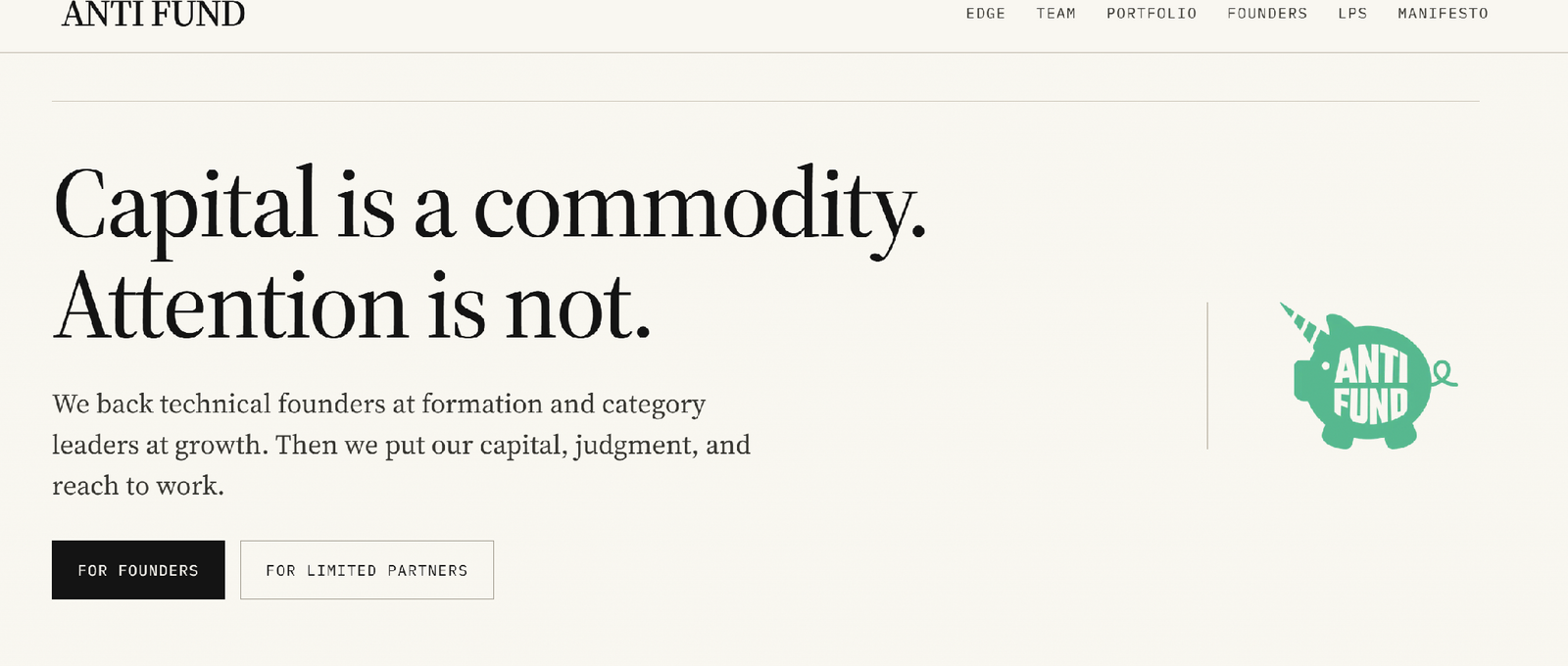
Anti Fund’s home page. Under the line “Capital is a commodity. Attention is not,” the firm says it backs technical founders at formation and category leaders at growth, then puts its capital, judgment and reach to work. Source: antifund.com
Steve Han, a partner, previously worked at March Capital and Deutsche Bank. Laura Brady, who leads capital formation, is also chief executive of the family office that manages Jake Paul’s personal assets. Raising money from limited partners is a dedicated role here, separate from evaluating and managing investments.
What the firm is trying to combine is the capital and operating discipline of a professional manager with a creator’s access to a mass audience. Institutional money and investment staff are what separate it from a personal celebrity investment. Whether that combination produces returns is a separate question, still to be tested.
From OpenAI to consumer brands: technology bets alongside creator businesses
More than 40 companies are listed on Anti Fund’s site. They fall into three areas: AI, infrastructure and defence; software and finance; and consumer goods and brands. The firm was founded by a creator, but its investments do not stop at content and consumer products.
The first group is technology and industrial infrastructure. OpenAI, the defence technology company Anduril and the space company SpaceX appear alongside the robotics AI company Physical Intelligence and the AI coding company Cognition. Also included are the autonomous surface vessel maker Saronic, the AI chip designer Etched, the fusion energy company Helion and the tunnelling company The Boring Company.
The second group is software and financial services: Ramp, which provides corporate cards and expense management; Polymarket, where users trade on the outcome of events; and the voice AI company ElevenLabs. The range runs from business tools to financial platforms to content production technology.
The third group is consumer goods and consumer-facing services. The sleep technology company Eight Sleep, the drinks brands Olipop and Happy Dad, the creator subscription platform Passes, Kings League — the football league founded by Gerard Piqué — and Betr, which Paul co-founded, sit here. The area covers subscriptions and sports and entertainment businesses as well as product sales.
Source: Anti Fund portfolio page. The acquisitions and listings are as published by the firm; none of them establishes that Anti Fund sold its stake or realised cash.
The firm names AI, robotics, defence, energy, semiconductors, manufacturing and next-generation industrial infrastructure as its core areas, with software and consumer technology taken selectively. A list of company names, though, does not show how the capital is distributed across those areas.
Of the three, consumer goods and services are where Paul’s channels can be applied most directly to marketing and customer acquisition. A creator who introduces a product or turns using it into content can move viewers toward a purchase or a sign-up. Defence, energy and industrial infrastructure are different: results there depend on technology, execution and contracts with corporate and government buyers, not on public recognition.
Anti Fund’s portfolio holds both. It invests in consumer businesses where creator influence can be applied while extending into industries that require specialist technical and commercial judgment. Assessing its record therefore means separating what Paul’s promotion contributed to customer acquisition from what a company’s own technology and business produced.
Capital plus promotion: what the Sora case shows about the creator’s role
Anti Fund’s claimed differentiator is that it can keep working on customer acquisition and marketing after the investment closes — not only providing money but applying a creator’s content and public profile to a company’s growth. OpenAI’s video generation service, Sora 2, is the example it points to.
Paul invested in OpenAI through Anti Fund and passed feedback to the product team before Sora 2 launched. He allowed videos to be made using his name and likeness, and by his own account clips featuring him passed a billion cumulative views in six days (Jake Paul’s public post).
Woo told The Ankler that buying that exposure as advertising would have cost roughly $50 million. That figure is an estimate of promotional value, not advertising revenue and not an investment return. Nor does it mean Anti Fund took OpenAI equity in place of an advertising fee. The accurate reading is of an investor who then helped push adoption of the product.
Exposure at that scale does not guarantee that a service keeps growing. OpenAI announced in March that it would shut the Sora app down (CNN). Generating early attention and retaining users at a profit are different capabilities.
Manufacturing attention can also produce legal exposure. Betr, the betting app Paul co-founded, ran a spot parodying the HBO series ‘Entourage’ with the original cast members Jeremy Piven and Adrian Grenier, and received a cease-and-desist letter from HBO. Betr told Variety, in effect, that HBO does not own the two actors.
The episode shows that applying a creator’s promotional capability still requires checking rights in the underlying content and brands. A famous face and online traction can raise advertising effectiveness; they do not resolve the question of using someone else’s intellectual property.
Boxing, MMA and television: meeting audiences beyond the follower count
Paul’s influence does not rest on personal social accounts alone. Through the sports businesses he runs and the television programmes he appears in, he reaches new audiences and widens the points of contact where fighters and content can be introduced. That base is the other half of the promotional capability Anti Fund advertises.
MVP, which Paul co-founded with Nakisa Bidarian in 2021, announced in late July that it was merging with the MMA promoter PFL (Professional Fighters League). The plan is to expand into a business spanning boxing and mixed martial arts and to launch under the MVP MMA name in 2027 with a new US broadcast partner (ESPN).
The merger brings the combined roster to roughly 400 fighters, and PFL holds 34 broadcast agreements in overseas markets (SportsPro). That extends Paul’s reach beyond his own channels into the sports broadcasting market. A broadcast agreement, however, is a deal to distribute sports content; it is not a right for Paul or Anti Fund to use a broadcaster’s schedule or advertising inventory at will.
The leadership has since changed. John Martin, who had been running the merged company, announced his resignation on Sept. 22 and named MVP co-founder Bidarian as the person to lead the next phase (MMA Fighting). The investor list includes 885 Capital of the United Arab Emirates and Knighthead Capital Management of the United States.
A television production is also in the works. Deadline reported on Sept. 10 that Hulu and ESPN had jointly approved a fight competition series in which the Paul brothers coach the contestants. It is the first series the two platforms have greenlit together; Wheelhouse and MVP are producing, and filming is due to begin next year (Deadline).
Contestants are divided into two teams coached by Jake and Logan Paul. They train together and are eliminated through matchups, across MMA, boxing, wrestling, jiu-jitsu and other disciplines. Paul intends to use the show as a channel for finding new fighters to compete under MVP.
If that works as intended, fighters who build recognition on television compete in the sports events, and the fights and the content around them draw further viewers. It is a strategy for carrying the popularity of a personal channel into sports and broadcast businesses.
The strength Anti Fund can offer founders comes out of these activities. But Paul’s sports business and television appearances do not by themselves guarantee promotional opportunities or revenue for a portfolio company. What matters is less how many distribution channels he is connected to than whether those points of contact can be converted into customers and sustained business results for the companies he backs.
0.1% to 0.3% for advice, up to 3% for long-term work: a reference range emerges
Alongside Paul’s approach of raising and deploying a fund, another arrangement has appeared: taking shares in exchange for advising a startup or producing content for it. Digiday reported on Sept. 24 on a creator equity guide produced by the investment platform Cherub.
Cherub, which has been matching founders with creators, convened 100 creators interested in startup investing at a private event this month. The guide sets out, for seed-stage companies, how much equity can be allocated according to a creator’s role and the scope of their involvement. It reads as a reference point for negotiation rather than a fixed industry rate card.
Source: Cherub guide, as reported by Digiday, Sept. 24, 2026
The allocation rises as the creator moves from advising to producing content and running the brand. Compensation is set not by follower count but by what work is actually taken on, and for how long.
Cases are accumulating. Driptail, a social fashion app, brought creators in as equity investors and saw its user base grow 60-fold between March and July this year. That figure alone does not establish that creator involvement was the sole cause. The influencer Alix Earle also took a strategic equity stake in the beverage brand Poppi in 2024.
Kate McAndrew of the venture firm Baukunst told Digiday that what matters in these deals is consumer insight and marketing strategy rather than exposure alone — creators advising companies on which customers to sell to and how, not merely publicising a product. Ross Yellowlees, co-founder of the creator marketing agency JERi, said in the same piece that creators should be seen as businesses rather than content producers.
Alongside creators investing in companies, capital is also moving the other way, into creators’ own businesses — investment aimed at converting personal recognition into consumer brands and product sales.
According to Variety and TheWrap, Steven Bartlett has launched OBSN with Authentic Brands Group, owner of more than 50 brands including Reebok and Eddie Bauer. The two plan to invest up to $400 million in creator-led businesses over the coming years. That is a forward investment target rather than a fund already raised, and should be distinguished from Anti Fund’s assets under management.
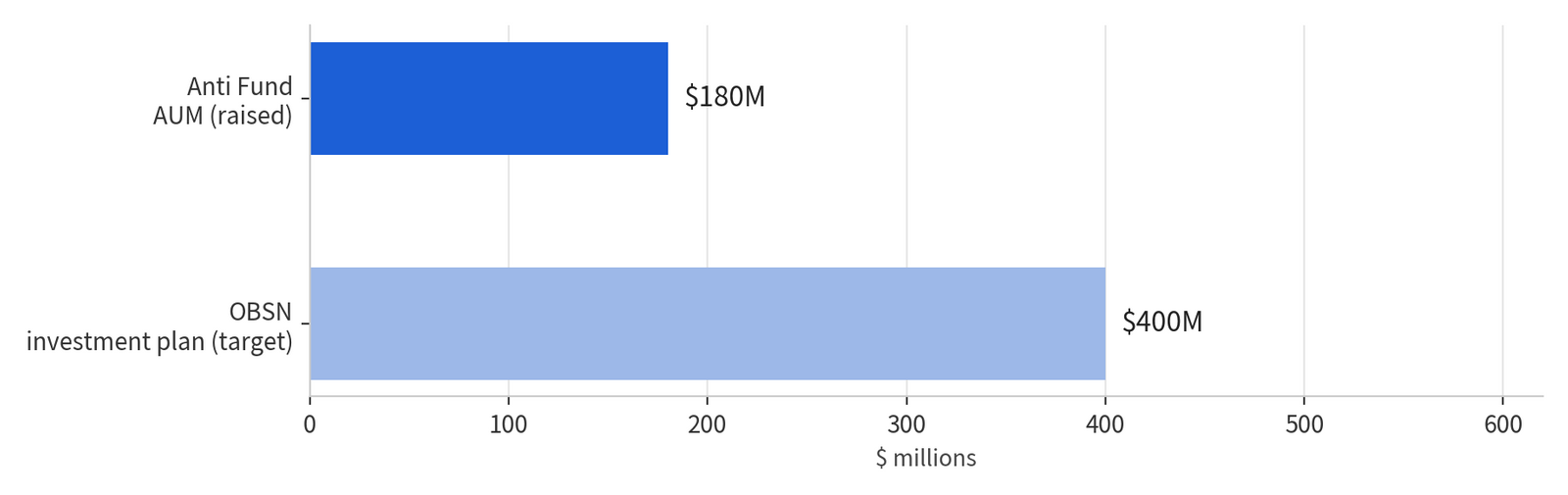
Two figures of different kinds. Anti Fund’s is capital already raised and under management; OBSN’s is a multi-year investment target. Sources: Anti Fund announcement; Variety and TheWrap
Forbes noted in a June article that creators are moving into roles such as a brand’s chief creator officer, leading content and consumer communication strategy, or angel investor funding early-stage companies. The relationship is widening from appearing in an advertisement for a fee to participating in how a business is run and grown, with equity as the share of that outcome.
Korea is moving to performance-based pay; the equity terms come next
In the Korean creator market, too, brand collaborations are shifting from one-off advertising toward longer partnerships. PortOne’s ‘Influencer Economy Report 2026,’ published in September, describes that change together with the spread of compensation tied to results such as sales. What companies expect of creators is widening from introducing a product to driving the purchase.
Performance-based pay and equity participation are not the same thing. Sales commissions and revenue shares pay out against results that have already occurred; equity is a contract that takes on both a company’s growth potential and its risk of failure. Accepting less cash now in exchange for a share of future enterprise value means the investment terms matter as much as the term of the collaboration and the scope of the work.
Abroad, the frameworks for designing these deals are emerging. Cherub has published its allocation guide by role; Anti Fund has grown into a firm managing outside capital; Bartlett and Authentic Brands’ OBSN intends to put capital and brand operating capability into creator-led businesses. Equity for services, investment through a fund and funding creator businesses are different models, but they point the same way: tying creator influence to company growth.
What Korea needs first is contract terms that reflect those differences. Compensation should vary with how many pieces of content are produced and how far the creator participates in brand strategy and product development. Vesting, under which rights are earned over a period of service; lock-ups, during which shares cannot be sold; and the treatment of equity on early termination all have to be set out. Where a creator is signed to an agency, the contract has to say whether the shares are held by the creator or the agency, and what happens to those rights when the exclusive contract ends.
Disclosure matters where investing and promoting overlap. A creator introducing a product from a company they hold shares in should make that relationship visible to consumers. For the company it is a marketing collaboration; for the creator it is a transaction with their own assets at stake.
Outlook: business results over view counts, distributions over fund size
Anti Fund’s task now is to show that creator influence converts into investment returns. The firm lists acquisitions and listings among its portfolio companies as exits. But an acquisition price or a listing valuation is not the firm’s return. Judging performance requires knowing the cost basis, the ownership level, whether the stake was actually sold and how much was distributed to limited partners.
The $100 million Growth I, closed in June, should be read the same way. Holding shares in well-known companies and making money on them are separate facts. Nor can the timing of distributions be inferred from a fund’s vintage year alone: it depends on how the holdings grow, on listing and sale conditions, and on the actual terms of each investment.
Three measures are worth following. Investment performance means not only the marked value of the holdings but the cash received on a sale and the amount distributed to limited partners. The creator’s contribution to portfolio companies shows up in how far content exposure carried through to new customers, purchases and repeat purchases. The durability of the influence will be visible in MVP–PFL’s broadcast agreements and in the ratings and renewal of the Hulu–ESPN series. None of those results is the same thing as a fund’s return.
Creator recognition can help introduce a product and gather early customers. Without a competitive product and a working revenue model, though, attention does not settle into enterprise value. The fact that a creator is both investor and promoter does not remove that business risk.
For Korean companies and creators, the lesson is about terms rather than scale. Rather than chasing the size of foreign funds, the first question is how contribution and risk are to be divided. Whether a 50 million won fee or 0.5% of equity is the better deal cannot be settled by the percentage alone. Enterprise value, the rights attached to the shares, dilution from later rounds, the conditions under which the rights vest and the realistic prospect of a sale all have to be weighed. Splitting the package between cash and equity — production costs now, a share of growth later — is also an option.
Creator equity is not a way of doing away with advertising fees. It is a means for a company to secure a creator’s content and customer understanding as a long-term capability, and for the creator to retain part of the growth they helped create. The task in the Korean market is not to put a price on fandom but to work out how to measure what that fandom produced and divide it fairly. With those terms in place, creator influence can become a durable business asset rather than one-off advertising income.
Note: Anti Fund’s portfolio and exit lists follow the firm’s published materials. Where the entry date, ownership level and realised proceeds of an individual deal are not disclosed, acquisition prices and listing valuations have not been read as fund returns. OBSN’s $400 million is a forward investment plan, different in kind from Anti Fund’s assets under management. The comparison between a 50 million won fee and 0.5% equity is an illustration of contract terms, not a market rate for any specific deal. Won conversions in the Korean edition use 1,356.18 won to the dollar (Sept. 24, 2026). Quotations are as reported, with the outlet and timing given at each.
Sources
· Anti Fund official site (team, portfolio, exits, investment criteria). https://antifund.com/
· The Ankler, Natalie Jarvey, ‘Like & Subscribe’, “Jake Paul Takes Me Inside His $180M Venture Fund” (Sept. 23, 2026). https://likeandsubscribenews.substack.com/p/jake-paul-takes-me-inside-his-180m
· Anti Fund, “Anti Fund Closes Oversubscribed $100 Million Growth Fund; Firm AUM Tops $180 Million” (June 18, 2026). https://finance.yahoo.com/small-business/articles/anti-fund-closes-oversubscribed-100-140000618.html
· Net Influencer, on Anti Fund’s AUM and limited partners (June 2026). https://www.netinfluencer.com/jake-logan-pauls-anti-fund-tops-180m-aum-with-oversubscribed-growth-vehicle/
· Digiday, “From brand deals to equity deals: creators want a stake, not just a fee” (Sept. 24, 2026). https://digiday.com/media/from-brand-deals-to-equity-deals-creators-want-a-stake-not-just-a-fee/
· Variety, “Steven Bartlett Partners With Authentic Brands to Launch OBSN” (Sept. 2026). https://variety.com/2026/digital/news/steven-bartlett-obsn-steven-com-authentic-brands-creators-1236860849/
· TheWrap, “Podcaster Steven Bartlett Wants to Invest $400 Million in Creator Businesses” (Sept. 2026). https://www.thewrap.com/industry-news/tech/creatorverse-steven-bartlett-invest-400-million/
· Forbes, “The Rise Of The Chief Creator Officer And The Creator Angel Investor” (June 1, 2026). https://www.forbes.com/sites/karineldor/2026/06/01/the-rise-of-the-chief-creator-officer-and-the-creator-angel-investor/
· Inc., “Creators Don’t Just Want Brand Deals Anymore. They Want Equity”. https://www.inc.com/michael-kaye/creators-dont-just-want-brand-deals-anymore-they-want-equity/91403534
· ESPN, “Jake Paul’s MVP, PFL team up in ‘landmark’ combat sports merger” (July 2026). https://www.espn.com/mma/story/_/id/49488415/jake-paul-mvp-pfl-team-landmark-combat-sports-merger
· PFL, “Most Valuable Promotions and Professional Fighters League Merge to Create a New Global Combat Sports Platform Powerhouse” (July 30, 2026). https://pflmma.com/news/most-valuable-promotions-and-professional-fighters-league-merge-to-create-a-new-global-combat-sports-platform-powerhouse
· SportsPro, “PFL’s merger with Jake Paul’s MVP is latest convergence of boxing and MMA but can it take on UFC?” (Aug. 2026). https://www.sportspro.com/opinions/finance-investment/pfls-merger-with-jake-pauls-mvp/
· MMA Fighting, on John Martin’s resignation and succession (Sept. 22, 2026). https://www.mmafighting.com/
· Deadline, “Jake & Logan Paul Land Fight Competition Series At Hulu & ESPN” (Sept. 10, 2026). https://deadline.com/2026/09/jake-logan-paul-land-fight-competition-series-hulu-espn-1237072912/
· POST Wrestling, “ESPN & Hulu to launch combat sports reality competition hosted by Jake & Logan Paul” (Sept. 10, 2026). https://www.postwrestling.com/2026/09/10/report-espn-hulu-to-launch-combat-sports-reality-competition-hosted-by-jake-logan-paul/
· CNN, on OpenAI’s decision to shut down the Sora app (March 2026). https://www.cnn.com/
· Bloomberg, “Jake Paul’s Betr Startup Raises Funds at $375 Million Valuation” (March 6, 2024). https://www.bloomberg.com/news/articles/2024-03-06/jake-paul-s-betr-sportsbook-startup-raises-funds-at-375-million-valuation
· Variety, on Betr’s HBO cease-and-desist (Sept. 2026). https://variety.com/2026/tv/news/jake-paul-betting-app-hbo-entourage-cease-and-desist-1236872384/
· StartupN, “PortOne publishes ‘Influencer Economy Report 2026’” (Sept. 2026). https://www.startupn.kr/news/articleView.html?idxno=59936