
POLICY | BROADCASTING & MEDIA
Seoul forum calls for direct access to mediation for viewers and service users
Independent producers seek explicit safeguards on payment and contractual rights
Overlapping jurisdictions and deals with global streamers remain unresolved
Viewers should be able to seek mediation directly over broadcast billing and refund disputes, while independent producers need explicit legal protection against unfair commissioning practices, speakers at a policy forum in Seoul argued. The proposals would broaden the focus of South Korea’s Broadcasting Act beyond disputes between businesses and independent-production quotas to strengthen consumer redress and fairness in production contracts.
The Korea Communications and Media Commission (KMCC) and the Digital Future Research Institute held the forum at HJBC in central Seoul on September 29. Speakers proposed opening broadcast dispute mediation to viewers and service users, and expressly prohibiting unfair practices in transactions with independent producers.
Participants supported the broad objectives but differed over overlapping regulatory mandates, enforcement and how to address production deals with global streaming platforms. The proposals were presented for discussion and are not adopted government policy. (Forum coverage; official recording)
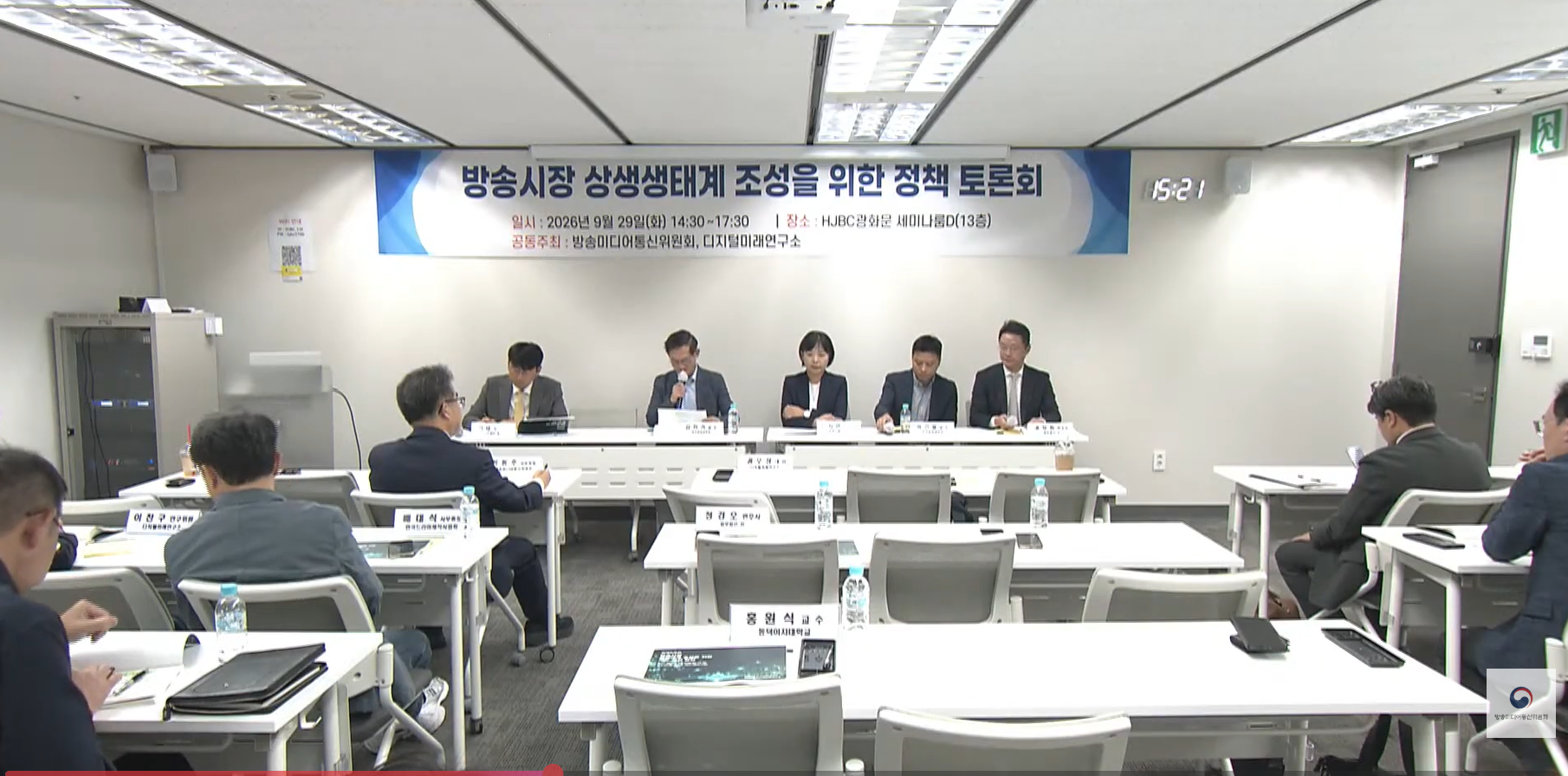
Broadcasting and telecommunications increasingly overlap in the services consumers buy, but the mechanisms for resolving their complaints remain separate. Applications for telecommunications dispute mediation rose 38.5% to 2,123 in 2025, according to the KMCC casebook cited by NoCut News. Consumers can apply directly to that system.
Broadcast dispute mediation, by contrast, is open only to categories of businesses specified in law, leaving viewers unable to use it directly for pay-TV billing, video-on-demand refunds or cancellation disputes.
On the production side, weaker commissioning demand is compounding the damage caused by disputed payments and cancellations. For a small producer, a late payment or a unilateral scheduling decision can jeopardize the next project as well as the current one. The argument at the forum was that a quota requiring broadcasters to carry independently produced programs does not, on its own, ensure fair payment or a workable division of rights.
Osang Kweon, head of the Digital Future Research Institute, connected the two agendas in his opening remarks: prompt redress for users and fair terms that allow creators to share in the returns from their work. “These two issues are critical to trust and sustainable growth in the broadcasting industry,” he said.
As the boundary between broadcasting and telecommunications blurs for users, he argued, the test is whether laws and institutions solve the problems encountered in practice.
Kweon described fair production conditions as the foundation for diverse, high-quality content and said the institute would connect industry experience with research to support effective reform. His framing places consumer protection and producer economics within the same chain—from the financing of a programme to the experience of its audience.
The proposals were illustrative legislative options presented by the speakers, rather than an enacted reform or a settled government bill. The regulator, known as the KMCC, said it would consider the discussion in policy development. The unresolved questions concern jurisdiction, enforcement capacity and the reach of any broadcasting rules into contracts with global streaming services.
In his welcome remarks, KMCC Secretary-General Dong-joo Park cautioned: “Without viewers’ trust and a healthy creative environment, the success of K-content will be difficult to sustain.” The point was a domestic condition for international success: confidence in the service and workable conditions for the people making the programmes.
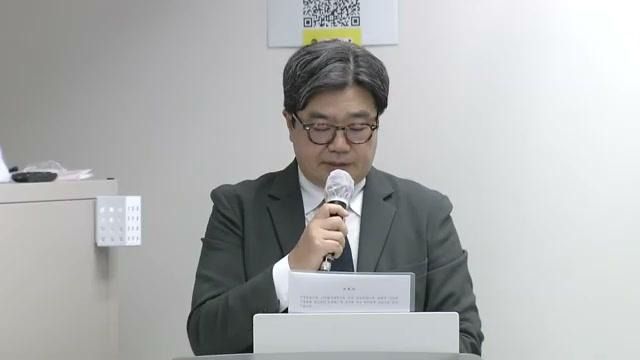
The welcome address linked the sustainability of Korean content to audience trust and a healthy creative environment. Source: KMCC broadcast. Source
In the first session, Kim Tae-ju, a lawyer at Lee & Ko, proposed adding “viewers and users” to those eligible to request mediation under Article 35-3 of the Broadcasting Act. In the second, Lee Chan-gu, a research fellow at the Digital Future Research Institute, proposed specifying prohibited practices in independent-production transactions under Article 85-2. KMCC Secretary-General Park Dong-ju said the commission would ensure that the views and proposals raised at the forum were reflected in policymaking.
A guide to the Korean policy terms
Terminology follows the Korean article and the forum presentations. English descriptions of Korean bodies and procedures are explanatory.
IPTV dominance exposes the gap between two systems
Telecommunications mediation applications increased from 1,259 in 2023 to 1,533 in 2024 and 2,123 in 2025, a rise of about 69% over two years. Contract-related cases accounted for 1,122 applications, or 52.9% of the 2025 total. The KMCC casebook included a consumer whose internet charges continued to be automatically debited from 2011 to 2025 after a move to an area without the provider’s network. (Dailian; NoCut News)
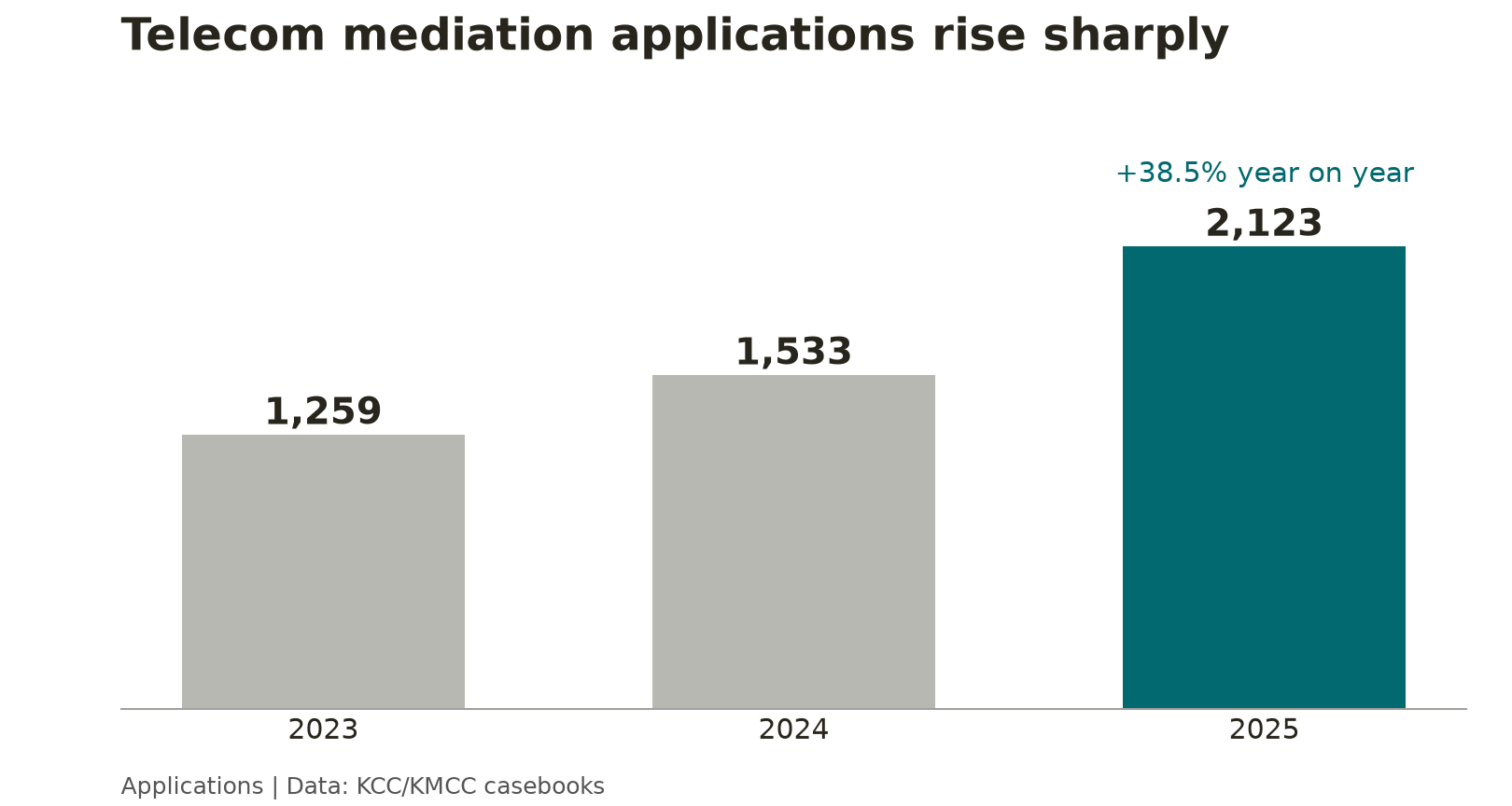
Telecommunications dispute mediation applications rose from 1,259 in 2023 to 2,123 in 2025. Unlike this process, broadcast dispute mediation does not currently accept direct applications from viewers. Data: KCC/KMCC casebooks, as cited in the linked reporting.
The jurisdictional overlap reflects the structure of Korea’s pay-TV market. The KMCC reported approximately 36.15 million pay-TV subscriptions in the second half of 2025, including 21.53 million IPTV subscriptions, or 59.6% of the total. Cable accounted for approximately 11.93 million and satellite for 2.68 million. The component figures are rounded and do not sum exactly to the reported total. (Digital Daily)
The three IPTV operators, KT, SK Broadband and LG Uplus, frequently sell television alongside broadband and mobile services. As panelists explained, this can bring a dispute originating in television use, such as a VOD charge, into telecommunications mediation. The consumer has bought a combined service, even though the regulatory system treats its components separately.
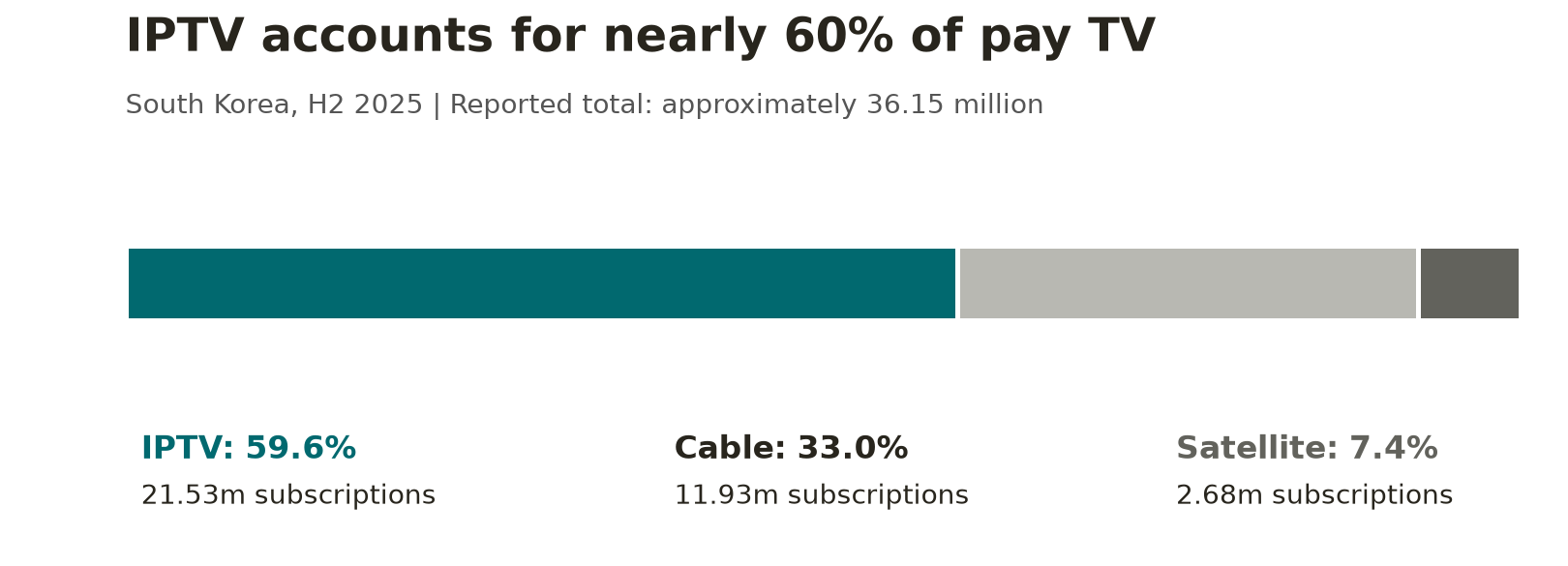
IPTV accounted for 59.6% of Korea’s pay-TV subscriptions in the second half of 2025. Figures are rounded. Data: KMCC, May 29, 2026.
The issue also sits within the KMCC’s broader remit. Legislation passed on September 27, 2025 reorganized the former Korea Communications Commission’s functions and added broadcasting-promotion responsibilities previously held by the Ministry of Science and ICT. The resulting agency combines broadcasting regulation with industry-promotion functions. (Digital Daily)
Opening a business-only process to viewers
The existing broadcast mediation process covers business disputes involving channel supply, transmission facilities, broadcasting areas, broadcasting rights and joint ventures. After reviewing documents and hearing the parties, the committee is generally required to prepare a proposal within 60 days. It may extend that period once by 30 days. A settlement is reached if all parties accept within 15 days of notification, giving it the same legal effect as a judicial settlement.
Kim identified specialist industry knowledge, defined processing deadlines and the legal effect of an accepted settlement as the system’s strengths. Disputes over channel scheduling or supply payments require an understanding of broadcasting transactions, he said. “Rather than abolishing the existing system, we should expand its functions to reflect the changing broadcasting environment.”
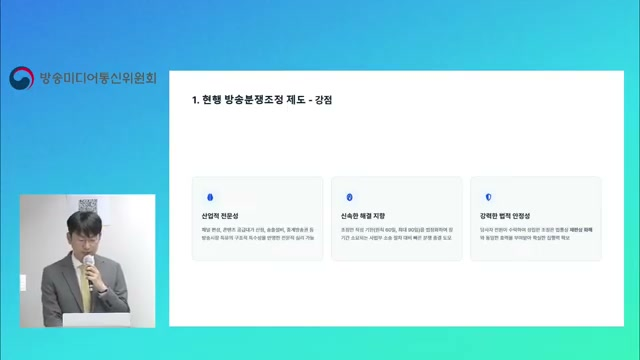
Kim Tae-ju of Lee & Ko explains the existing system’s strengths: industry expertise, timely resolution and legal certainty. Image: KMCC YouTube broadcast.
The limitation is who can use it. A viewer’s interests may be considered when a business dispute threatens to take a channel off air, but that is different from allowing the viewer to seek mediation over a personal billing or refund problem. The Viewers’ Rights Protection Committee receives complaints, yet its conclusions lack binding force. Kim proposed that it focus on recurring complaints and policy improvements, while referring individual cases requiring redress to the broadcast mediation committee.
Requiring every party’s acceptance can also weaken the process. A rejection or failure to respond prevents a settlement. Kim said that creates “an incentive for the party with greater bargaining power to use the prolonged process itself as a negotiating tool.” His presentation also identified the absence of a general legal basis for the regulator to initiate mediation on its own when a channel blackout is threatened.
One front door for complaints
Poor IPTV picture quality, bundled-service cancellation charges, channel changes and VOD refunds all arise within what a customer experiences as one service. The institutions handling them, however, are divided between broadcasting and telecommunications. Kim said unclear jurisdiction can lead to referrals, rejected applications and duplicated investigations. Consumers should not have to decide which legal category their complaint belongs to before seeking help.
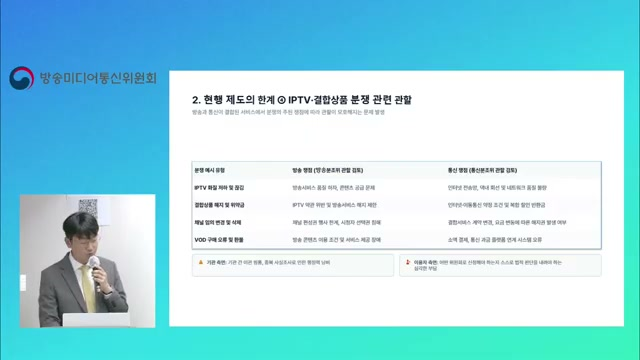
Kim explains how IPTV and bundled-service disputes can overlap the broadcasting and telecommunications systems. Image: KMCC YouTube broadcast.
Telecommunications mediation offers a comparison. Users can apply directly, and the committee can issue its own proposed decision when the parties do not agree. According to Kim’s presentation, parties have 14 days to accept or object; no response is treated as non-acceptance. “Despite what the term may suggest, it is not a compulsory decision that becomes final simply because there is no response,” he said. Rather, the mechanism gives negotiations a reference point.
Broadcast and telecom mediation: current arrangements and proposals
Sources: the statutes and Kim’s presentation as summarized in the Korean article; KCC’s January 20, 2022 appointment announcement; KMCC’s 2025 telecom mediation casebook. The 2022 membership figure is historical.
Kim’s medium- to long-term solution is a single intake portal or telephone number. Users would file a complaint without first classifying it as broadcasting, telecom or a bundled-service issue. The receiving body would then assign it according to its substance.
Policy complaints would go to the Viewers’ Rights Protection Committee, broadcasting disputes to the broadcast mediation committee and telecom disputes to the telecom mediation committee. Where the issues overlap, a designated lead institution would coordinate a joint investigation and present the consumer with one proposed resolution.
More access requires more capacity
Expanding eligibility alone would not equip the system to handle additional cases. Kim’s draft provisions would allow up to 30 committee members and the appointment of consumer-dispute specialists. He also proposed a dedicated consumer subcommittee, a permanent secretariat and simplified procedures for minor cases.
Under another proposed provision, a referral from the Viewers’ Rights Protection Committee would count as a mediation application from the point of referral. “If we expand the pool of applicants without restructuring the organizational infrastructure, cases could pile up and the quality of mediation could suffer,” Kim said.
He outlined four additional measures for consideration: regulator-initiated mediation where harm is serious or a blackout is threatened; emergency interim measures to maintain channel supply while mediation proceeds; deemed acceptance if no rejection is submitted within 15 days; and a limited power for the committee to propose a decision after negotiations fail.
These were alternatives for further examination, not a call to introduce all four at once. Deemed acceptance, in particular, would require reliable proof that the proposal had been properly delivered and explained to the parties.
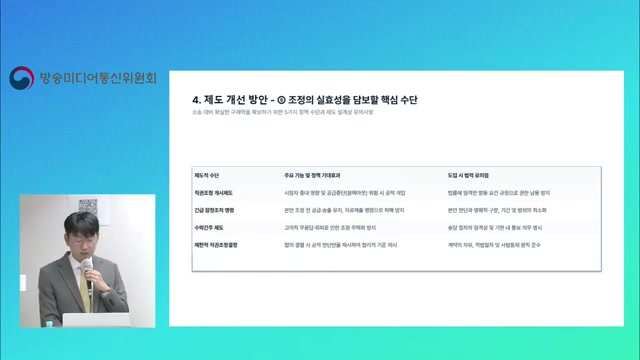
Four possible measures to improve the effectiveness of mediation, with safeguards to consider before adoption. Image: KMCC YouTube broadcast.
Kim proposed a phased sequence: bring consumer disputes into the system and improve intake and referral first; establish the necessary bodies and simplified procedures next; consider intervention powers and interim measures later. He left provisions assigning jurisdiction over bundled services out of the illustrative draft, saying they required more discussion because broadcasting and telecom issues were intertwined.
Jurisdiction and copyright complicate the reform
Panelists broadly supported better access but warned that jurisdiction needed to be settled first. Kwon Chang-beom, a lawyer at IN, noted that Article 35-3 already lists telecom providers in item 8. Adding users in item 9 could therefore overlap with disputes already handled by the telecom mediation committee.
With IPTV VOD auto-payment complaints already entering that system, he suggested specifying the types of dispute covered by broadcast mediation in the statute, supplemented by a provision for other relevant cases. He also urged caution over intervention powers, which could affect the bargaining positions of producers and platforms differently.
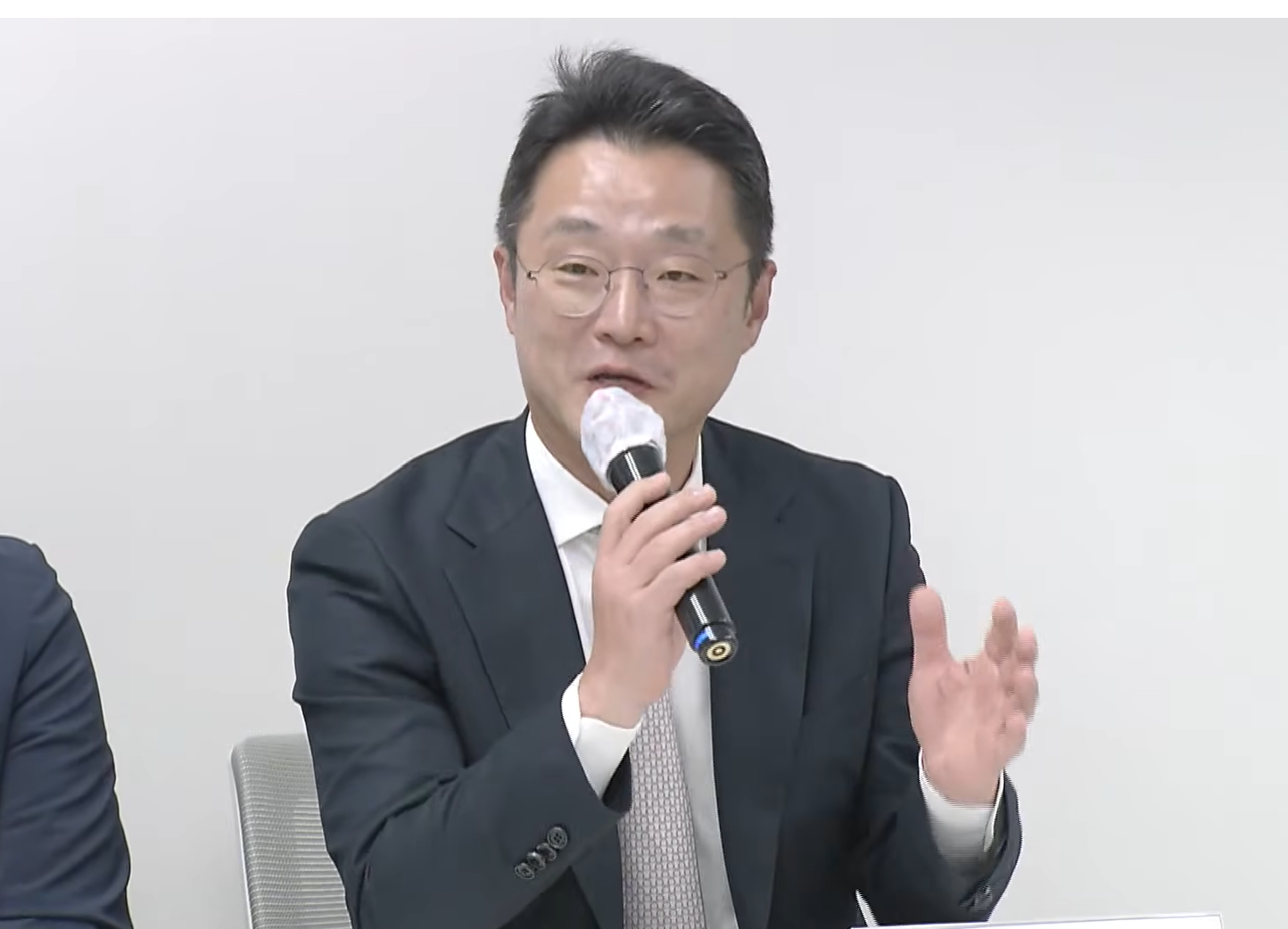
Park Geon-cheol, a business administration professor at Tech University of Korea, said policymakers also needed to define the users they intended to protect. Should the scope stop at broadcast viewers and pay-TV subscribers, or extend to streaming subscribers and individual media creators? He called for a consistent redress framework that also considered the Ministry of Culture, Sports and Tourism’s content-dispute process and cooperation with the Personal Information Protection Commission. He cited the June TVING data breach as an example of a problem that cannot be resolved simply by separating broadcasting from telecommunications.
Jeong Ji-yeon, secretary-general of the Consumers Union of Korea, said consumer groups often found it difficult to make that distinction in bundled-service complaints. “What matters more than having 100 consumers suffer the same harm and go through mediation 100 times is preventing the 101st consumer from suffering that harm,” she said. Individual settlements should feed into better contract terms and business practices, rather than end with the case. She also warned that “viewing rights must not become a bargaining tool” in negotiations between businesses.
Retransmission-fee disputes raised a separate question. A Korea Cable Television & Telecommunications Association representative in the audience pointed to the Broadcasting Act’s proviso directing copyright-related disputes to the Copyright Act. If a terrestrial broadcaster characterizes retransmission payments as copyright royalties, the parties may first dispute whether broadcast mediation has jurisdiction at all.
Kim replied that consumers cannot reasonably be expected to distinguish among broadcasting, telecom and copyright questions. A unified intake system that could also consider copyright issues was worth exploring, he said, while acknowledging that the different authorities would need to coordinate before such a system could be implemented.
Unpaid fees and disputed rights expose gaps in production deals
The second session examined how far legislation should reach into independent-production transactions. Lee Chan-gu opened with the dispute surrounding the EBS animation Brave Fire Engine Ray, produced under a 2015 agreement involving four companies, including original publisher Yeondoo Sesang.
According to Media Today’s report on the judgment, the Goyang Branch of the Uijeongbu District Court ordered EBS on April 21 to pay approximately KRW 2.5 million in outstanding settlement payments to Yeondoo Sesang. The publisher alleged that a work supported by KRW 1.4 billion in government funding had been identified as a Chinese work during distribution in China. EBS responded that responsibility lay with the overseas distributor.
Lee also described concerns about management of the work’s rights following a report to the Board of Audit and Inspection, and the publisher’s allegation of retaliation. The payment judgment should be distinguished from the parties’ separate claims about attribution and retaliation.
Drawing on disputes reported since 2020, Lee grouped unfair practices into nine categories. They included shifting production costs and additional expenses onto suppliers, unilaterally cancelling or changing scheduling, demanding transfers of intellectual property and altering or cancelling contracts without agreement.
Examples in his presentation included approximately KRW 600 million in disputed unpaid additional service fees between MBC Art and a set-construction contractor; a JTBC entertainment-program scheduling cancellation; a dispute between JTBC and Studio C1 over a proposal and original source material; and allegations of unpaid appearance fees and prize money on an MBN entertainment program. The transactions extend beyond a broadcaster and a production company. Affiliates, service providers, staffing businesses and subcontractors can also be involved, allowing losses to spread through several tiers.
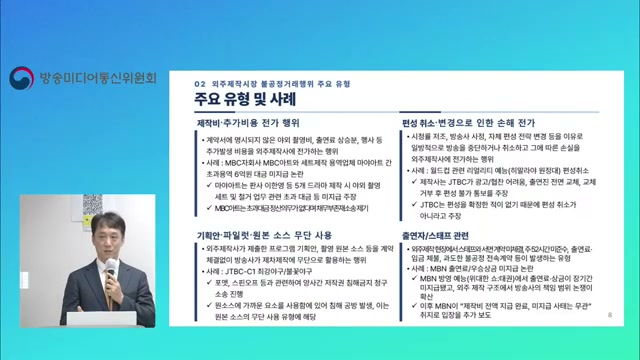
Lee emphasized the difficulty small producers face in sustaining lengthy litigation. “When a dispute occurs, there is no practical way to resolve it, so most turn to the media. If they go to court, small producers lose the capacity to make their next program,” he said.
Fewer productions, changing buyers
Korean drama production fell from 141 titles in 2022 to around 100 in 2024, according to Korea Drama Production Association figures. The KMCC’s 2025 Broadcasting Market Competition Assessment, released on May 15, 2026, also showed pressure on external production.
Broadcasters’ total direct production expenditure, including in-house production, external production and acquisitions, increased 2.3% to KRW 2.9709 trillion in 2024. The external-production component, however, declined 2.2% to KRW 987.8 billion. An increase in total spending does not necessarily mean more commissions or revenue for independent producers.
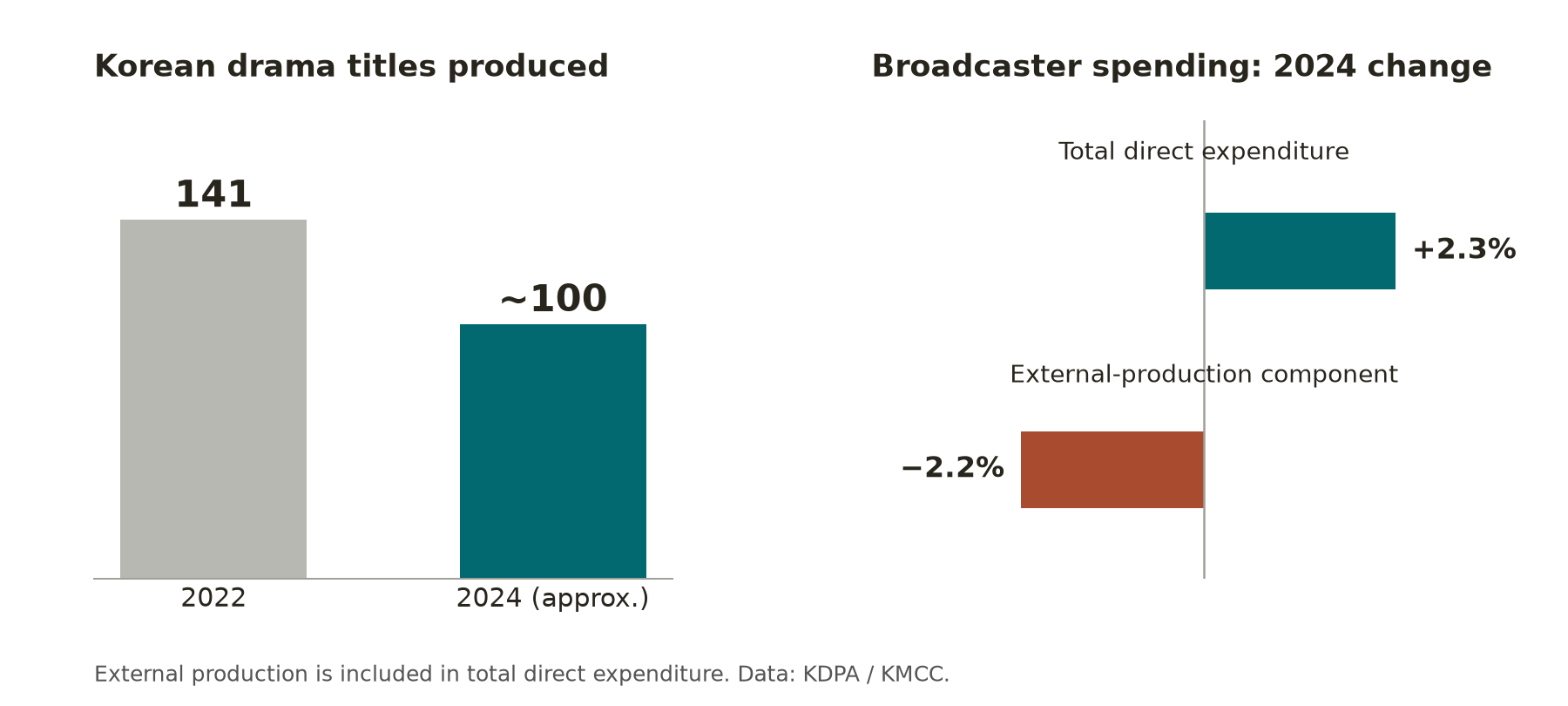
Korean drama output declined between 2022 and 2024. Broadcasters’ overall direct production expenditure increased in 2024, but the external-production component fell. The two expenditure measures are not separate, additive categories. Data: Korea Drama Production Association and KMCC.
The same assessment reported that Netflix supplied 30 Korean originals in 2024. Korean content accounted for 8.8% of Netflix’s global viewing hours, second to US content. The KMCC said it would strengthen monitoring of the potential adverse effects of Netflix’s growing influence on the production sector. That is why a discussion of fair production deals cannot stop at Korean broadcasters. (Digital Daily)
The UK approach starts with the contract
Lee cited the UK and France as international examples. Section 285 of the UK Communications Act 2003 requires the public-service channels within its scope to establish commissioning codes for independent productions. Under Ofcom’s guidance, the framework seeks clarity on the categories of rights being acquired, the payment for each category, and the duration and exclusivity of those rights.
The provision does not automatically assign every secondary right to the producer. Its significance is the requirement to make the transaction explicit: which rights the broadcaster is buying, on what terms, and what remains available for negotiation and exploitation. Lee also identified France’s regulatory enforcement mechanisms, including urgent corrective orders and financial measures to compel compliance, as worth examining.
Recent UK revenue figures show why the ability to earn from rights beyond an initial commission matters. According to Pact’s 2026 TV Production Census, released on September 9, UK independent television-sector revenue increased 4.1% to GBP 3.81 billion in 2025. Domestic TV revenue fell 4.7% to GBP 1.99 billion, while international TV revenue increased 15.8% to GBP 1.57 billion.
Secondary-rights revenue, including repeat fees and international sales of finished programs, rose 12.7% to GBP 575 million. International business and rights exploitation helped offset domestic weakness. International TV revenue and secondary-rights revenue overlap in part, however, and should not be added together as if they were separate segments.
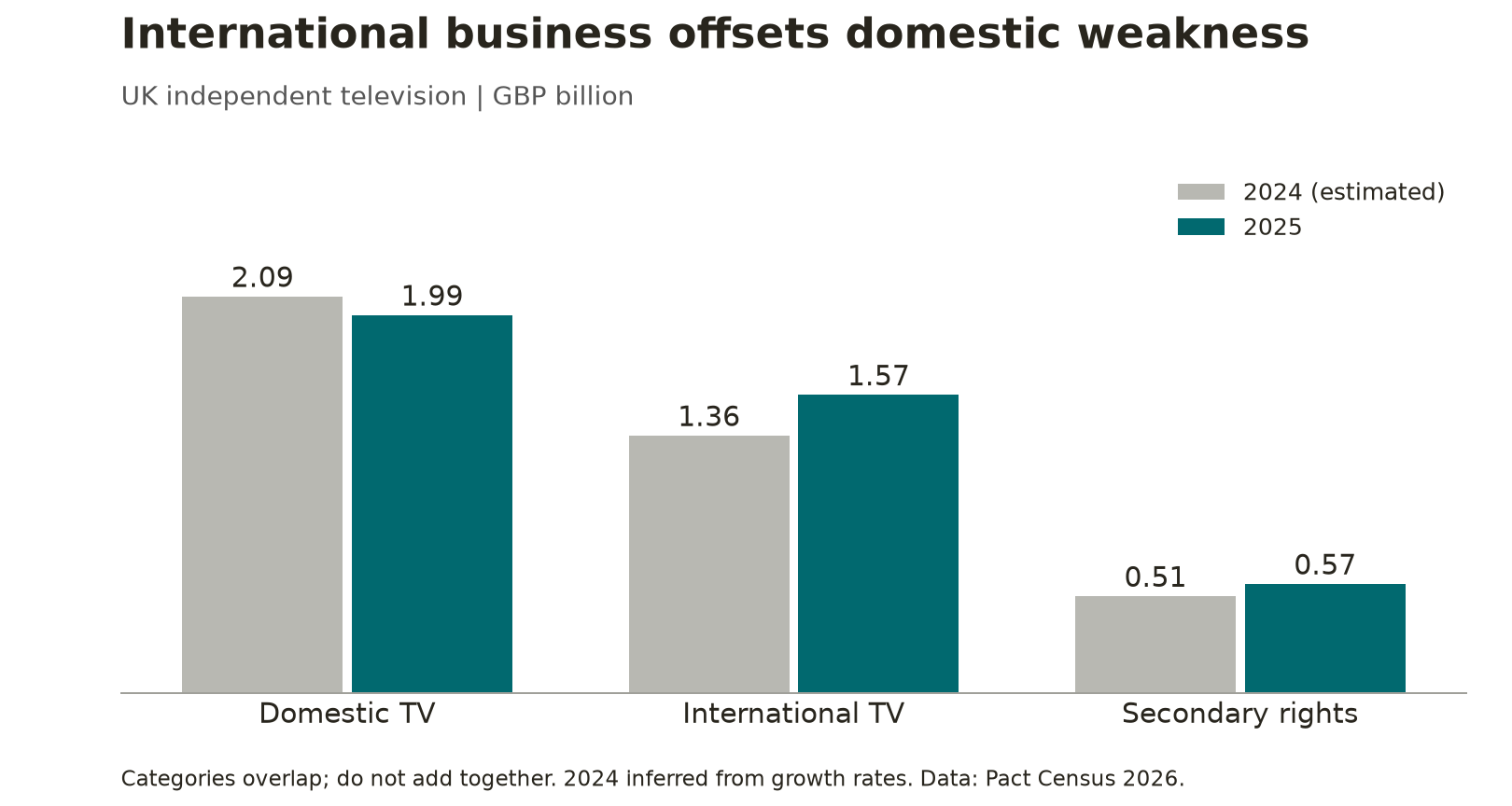
UK independent television revenues: domestic TV revenue declined, while international TV and secondary-rights revenues rose. Figures in GBP billion; 2024 values are estimated from reported growth rates. International TV and secondary-rights revenues overlap. Data: Pact Census 2026.
How production transactions are regulated
Comparison follows Lee’s presentation and section 285 of the UK Communications Act. It is not a comprehensive account of each country’s production or copyright law.
In Korea, responsibility is divided among the KMCC, the culture ministry and the Fair Trade Commission. Lee argued that broadcasting and IPTV legislation lacks sufficiently specific rules on unfair independent-production transactions, while the culture ministry’s laws often rely on broad provisions that are difficult to enforce. He also said competition and subcontracting rules do not adequately reflect the characteristics of media transactions and are oriented toward remedies after harm occurs.
Lee compared the 13 prohibited practices in cultural-industry fair-distribution bills introduced since 2019, but which lapsed at the end of parliamentary terms, with his nine categories of production disputes. In his assessment, the proposed provisions covered only three of those categories.
Korea’s mandatory external-production share increased from 3% in 1991 to 31% in 2001, according to KOCCA’s analysis of the policy. Lee’s proposal would complement that emphasis on securing a volume of airtime with rules addressing the terms of the underlying transactions.
Four routes to a statutory prohibition
Lee presented four legislative options. The first would add a broad prohibition to Article 85-2, with detail left to the enforcement decree. The second would insert a new Article 72-2 after the independent-production quota provision, again leaving the specific categories to the decree. The third would use the same new article but specify the prohibited conduct in the statute.
The fourth would place detailed independent-production prohibitions in Article 85-2(2), alongside the existing prohibited-practices framework. Lee favored this route, citing consistency within the law and a more coherent basis for corrective orders and administrative financial penalties.
The four options discussed
Source: Lee’s presentation and panel comments in the Korean article. Support for an option did not mean agreement on all its details.
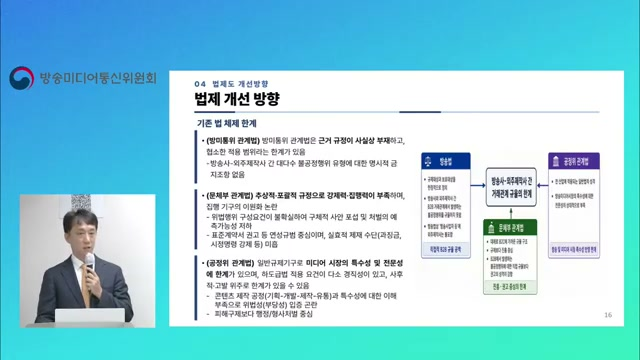
Lee compares gaps in the laws administered by the KMCC, the culture ministry and the Fair Trade Commission. Image: KMCC YouTube broadcast.
For Lee, the issue extends beyond protecting individual companies to preserving the industry’s production base. “If we cannot support the healthy growth of the independent-production sector, which is a source of creativity and diversity, there can be no ‘sustainable’ in the sustainable growth of K-content,” he said.
Agreement on the objective, disagreement on enforcement
The discussion leaned toward explicit prohibitions, but the scope and means of enforcement remained contested. Hong Won-sik of Dongduk Women’s University said lawmakers should first establish whether new provisions were necessary given the Fair Trade Commission’s existing powers and the KMCC’s guidelines for relevant renewal reviews.
He questioned whether the regulator would have the expertise to determine violations and whether subsequent administrative litigation would simply extend the dispute. Requiring a broadcaster to prove that a transaction was fair could also operate as a form of prior regulation, he warned. Hong said options 2 or 4 could be considered, provided the law narrowly identified conduct that genuinely required prohibition and attached appropriate enforcement measures.
Jeong Kyung-oh, a lawyer at LIN, focused on the protection gap in deals with global streaming platforms. Services such as Netflix fall into the value-added telecommunications category, he explained, making the Broadcasting Act’s prohibitions difficult to apply directly to their transactions with Korean producers. User-protection provisions in telecommunications law are also designed primarily around end consumers rather than production companies.
Jeong argued that the Fair Trade Commission process might not adequately address producers’ losses either. He called for an initial prohibition in the Broadcasting Act without waiting for a broader audiovisual media services law covering broadcasting, telecom and streaming. He backed option 4 while proposing that detailed requirements be set out in the enforcement decree.
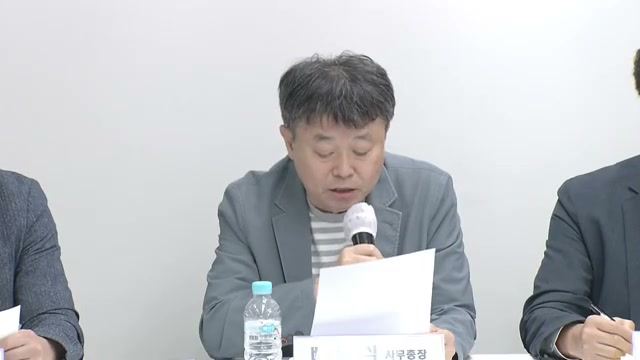
Bae Dae-sik, secretary-general of the Korea Drama Production Association, took a different view on how much detail should be left to secondary legislation. Broad language such as “unfair contracts” or “appropriate allocation of revenue and rights” would not change production practices, he argued. Leaving the essential requirements to a decree could weaken the rules.
He called for parties to define the scope of rights, payment, duration and exclusivity at the contract stage, and to negotiate broadcasting, streaming, overseas distribution and remake rights separately. In drama, he said, the practice of insisting on ownership of all IP was changing, but unfair practices remained in non-drama production. He also warned that the culture ministry’s work on a streaming standard contract should not produce rules followed by Korean companies while leaving global platforms outside them.
There was pushback against an approach aimed only at broadcasters. A KMCC official in the audience relayed broadcasters’ argument that large production companies can sometimes hold the stronger bargaining position. The official suggested placing key requirements in the statute and leaving the remainder to the decree. Lee responded that a small number of large producers should not delay safeguards needed by the many smaller businesses in the sector.
What would change for the industry
If the proposals become law, pay-TV operators will need to review terms governing billing, refunds and cancellation, as well as their complaint-handling procedures. The three IPTV operators, given their market share, would have particular reason to ensure that customers with bundled-service disputes receive a consistent response. Which committee handles which cases, however, remains a legislative question.
If mediation outcomes are used to identify recurring harm and improve contractual terms, the effect could extend beyond individual complaints to everyday business practices. That would meet the consumer groups’ call for prevention as well as compensation.
Viewer protection could also become a more prominent constraint in retransmission-fee negotiations between terrestrial broadcasters and pay-TV operators. The longer-term proposals for regulator-initiated mediation and interim measures would provide a basis for intervention when negotiations threaten to interrupt channel supply. These remain proposals, not current powers. Implementation would require clear conditions for intervention, procedural safeguards and a resolution of the relationship with copyright disputes.
For producers and broadcasters, the crucial questions are which conduct the law prohibits and which remedies follow a violation. Explicit production-related prohibitions could strengthen the basis for corrective orders and administrative financial penalties, but would not turn every contractual disagreement into a regulatory offense. The elements of a violation, the burden of proof and the relationship with competition law would still need to be defined.
Nor would an amendment to the Broadcasting Act’s independent-production provisions, on its own, cover deals with global streamers. Work on standard contracts that specify rights, prices and permitted uses would need to proceed alongside debate over a legal framework that also encompasses streaming services.
The test is whether redress and contracts improve
The forum moved beyond general calls to protect viewers and producers by identifying provisions that could be changed. Illustrative drafting, however, does not amount to an agreed legislative program. Consumer disputes need a clear allocation of jurisdiction and workable procedures; production transactions need a defined scope of prohibited conduct and credible enforcement.
Option 4 attracted support from several participants, but further negotiation is needed over the division between statute and decree and how the rules should reflect differences in bargaining power. Lee said he would refine the proposals after further input from the working group and experts. Extending effective protection to transactions with global streaming platforms also remains unfinished business.
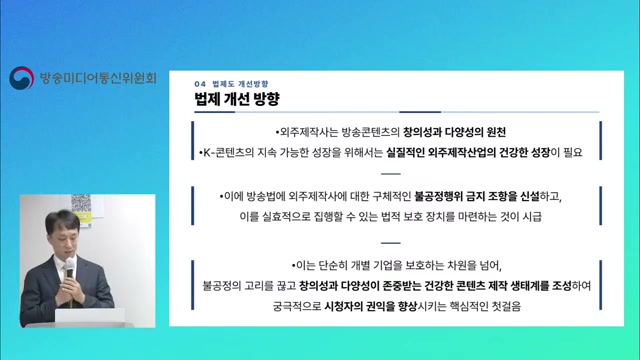
Lee closes his presentation by describing independent producers as a source of creativity and diversity in broadcast content. Image: KMCC YouTube broadcast.
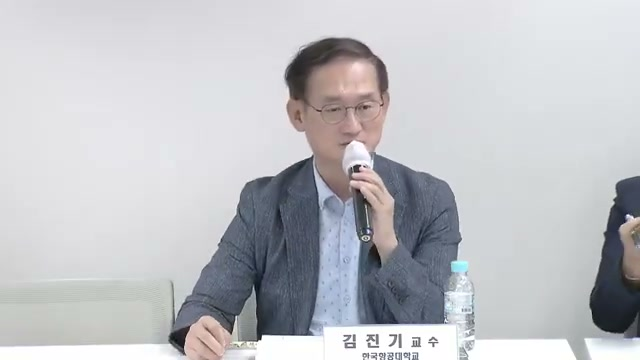
Moderator Kim Jin-ki of Korea Aerospace University compared the need to preserve content-production capabilities with the importance of maintaining a manufacturing base. “A shared-growth ecosystem is not a system that one party creates for another. It is an environment in which no one can operate alone and everyone needs someone else,” he said, calling for a reassessment of industry policy.
Ultimately, reform will be judged not by the number of new provisions but by whether viewers obtain timely redress and producers receive fair payment that enables them to make their next program.
Editorial and source notes
This English edition follows the revised Korean article dated September 30, 2026. Quotations are English translations of Korean remarks recorded in that article; they are not statements originally delivered in English. Speaker proposals are distinguished from adopted government policy. Original event screenshots retain their Korean slide text, while captions, comparison tables and data charts are presented in English.
Park Geon-cheol’s affiliation follows his introduction at the event and the Tech University of Korea faculty listing, rather than the different affiliation in the Dailian report. Monetary amounts retain their original currencies; no dollar conversions have been added. Statistics preserve their original reporting periods.