
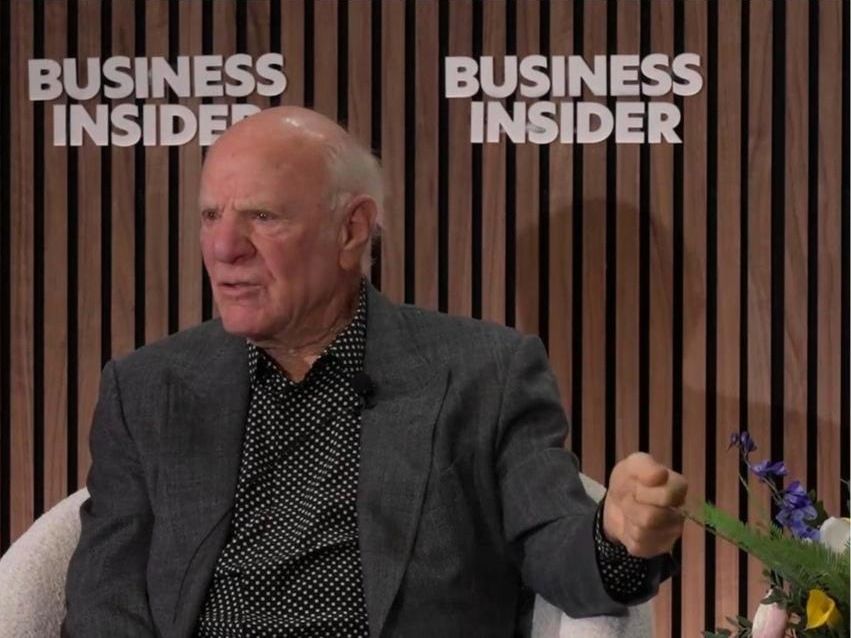
The 84-year-old former Paramount and Fox chief says "Netflix won" a month after the $110 billion Skydance deal closed; YouTube's 15.8% share of U.S. TV viewing is twice Netflix's 7.7%
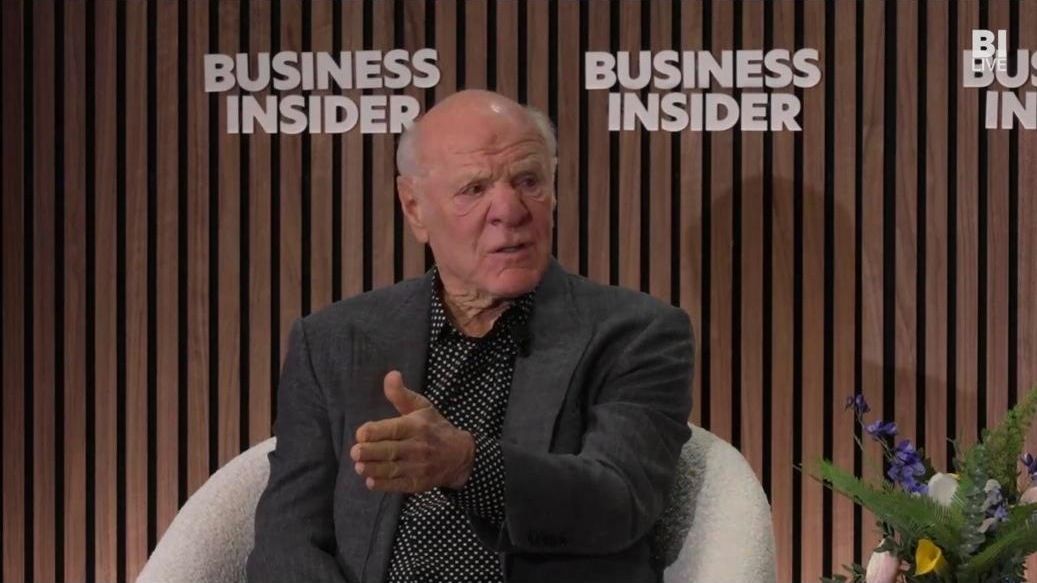
“Netflix won. But not everyone needs to copy Netflix.”
Barry Diller, chairman of People Inc., has dismissed the logic behind Hollywood's latest round of consolidation. "Netflix won," he said. The next big winner, in his view, is YouTube.
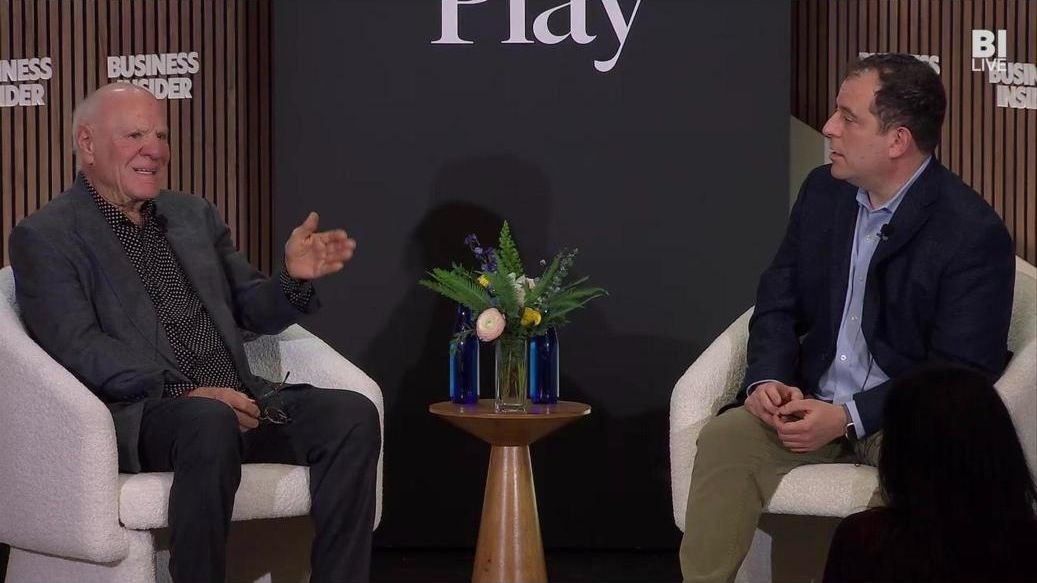
Diller made the remarks to Business Insider chief correspondent Peter Kafka at the publication's The Long Play event in late October, in a conversation BI published on November 5. His case against bulking up rests on a single judgment: paid streaming has already been decided. "Scale is not the answer to really much of anything," he said. "So I don't really believe in consolidation."
The comments landed weeks after the biggest deal in Hollywood history closed. Paramount Skydance completed its takeover of Warner Bros. Discovery on October 6 in a transaction worth about $110 billion including debt, and renamed the combined company Skydance. Netflix had signed a deal in December 2025 to buy Warner Bros.' studio and streaming businesses, but lost out when Paramount offered $31 a share in cash for the entire company.
Diller ran Paramount Pictures from 1974 to 1984, then spent more than eight years at 20th Century Fox, where he launched the Fox broadcast network with Rupert Murdoch. After Hollywood he built IAC into a home for Expedia, Match Group and Ticketmaster. "20th Century Fox is gone," he said, adding that he suspects Paramount will eventually be gone too.
Disney-Fox, Discovery-WarnerMedia, Skydance-Warner: every deal sold as a Netflix defense
Executives outside Netflix have used the same rationale for years. Disney bought most of 21st Century Fox for $71.3 billion in 2019; Discovery merged with WarnerMedia in 2022; the Ellisons bought Paramount through Skydance in 2025 and then added Warner Bros. Discovery.
When Kafka noted that everyone says they need to get bigger to take on Netflix, Diller replied: "Netflix won." Rivals, he said, "are simply never going to beat Netflix, ever, unless they do something weird." That does not rule out good businesses. "It does not mean you can't have wonderful, profitable businesses," he said. "And frankly, the more, the better."
For Skydance the work now is on costs. The combined company is expected to generate close to $70 billion in annual revenue and is looking to cut more than $6 billion in costs, The Hollywood Reporter India reported. AFP reported that Skydance planned to raise about $52 billion in new debt for the deal, on top of the more than $32 billion Warner Bros. Discovery already carried.
Fox announced on June 15 that it will acquire Roku, the connected-TV platform reaching more than 100 million households, at an enterprise value of $22 billion, with closing expected in the first half of 2027. In its 2026 Media Trends annual report, released October 20, Axios classed the deal as a strategic shift beyond content into distribution and hardware.
Netflix posts a 34.6% operating margin and guides to $51.1 billion in 2026 revenue
Netflix's third-quarter revenue rose 12% to $12.87 billion. Operating income climbed 37% to $4.5 billion, lifting the operating margin to 34.6% from 28.2% a year earlier. In its October 20 shareholder letter, the company forecast full-year 2026 revenue of $51.1 billion and said subscription revenue growth had beaten its expectations.
Advertising is moving more slowly. Netflix cut its 2026 ad revenue outlook to about $2.7 billion from roughly $3 billion and pushed the launch of its ad tier in 15 new countries into 2027. Its fourth-quarter margin guidance includes a hit of about 120 basis points tied to recently announced job cuts.
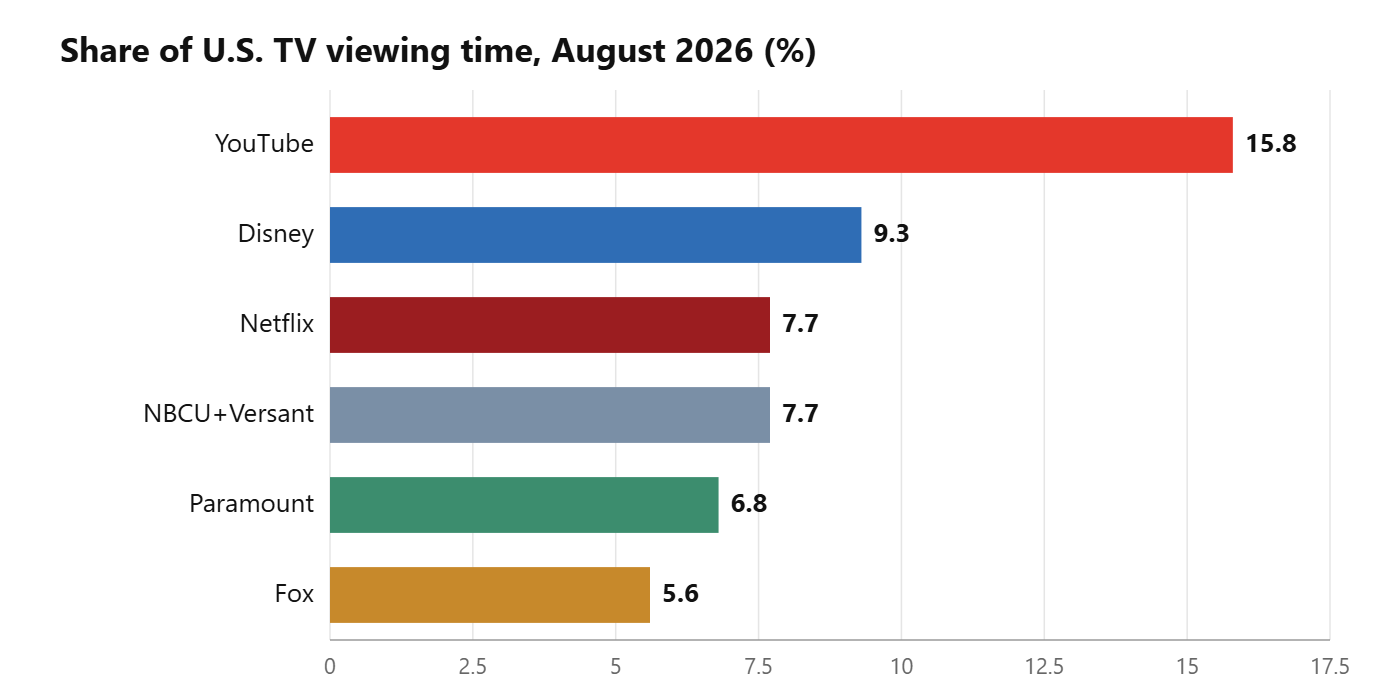
YouTube takes a record 15.8% of U.S. TV time, twice Netflix's share
The winner Diller sees coming is a platform, not a studio. "You can press a button and publish to the world, whatever it is," he said. "If you want to talk about declaring the next 'big winner' — it's absolutely YouTube." He put TikTok in the same category, citing thousands of people creating and publishing. "The established major companies are contracting," he said. "The platforms are expanding."
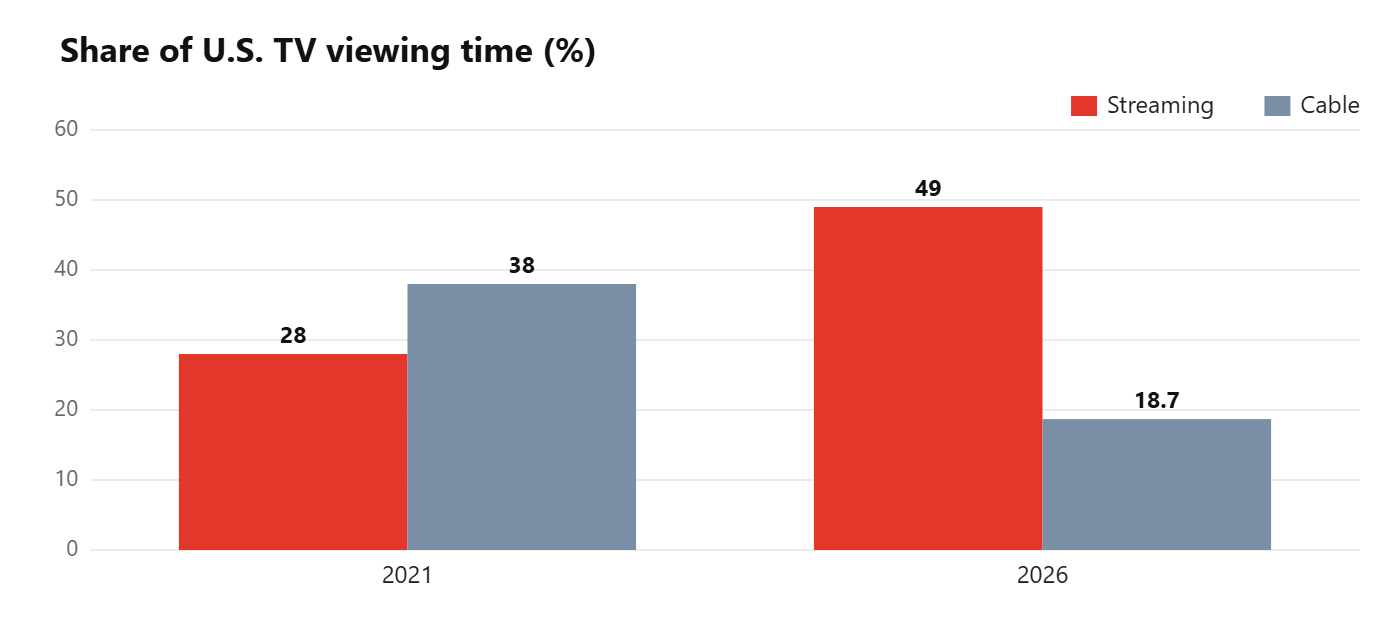
In Nielsen's August edition of The Gauge, released October 22, YouTube took 15.8% of all U.S. TV viewing, a platform record. Its viewing rose 6% in a month when total TV usage fell 4.4% as the World Cup ended and schools reopened. In the Media Distributor Gauge, Disney held 9.3%, Netflix 7.7% and Paramount 6.8%. Streaming accounted for 49.6% of TV time.
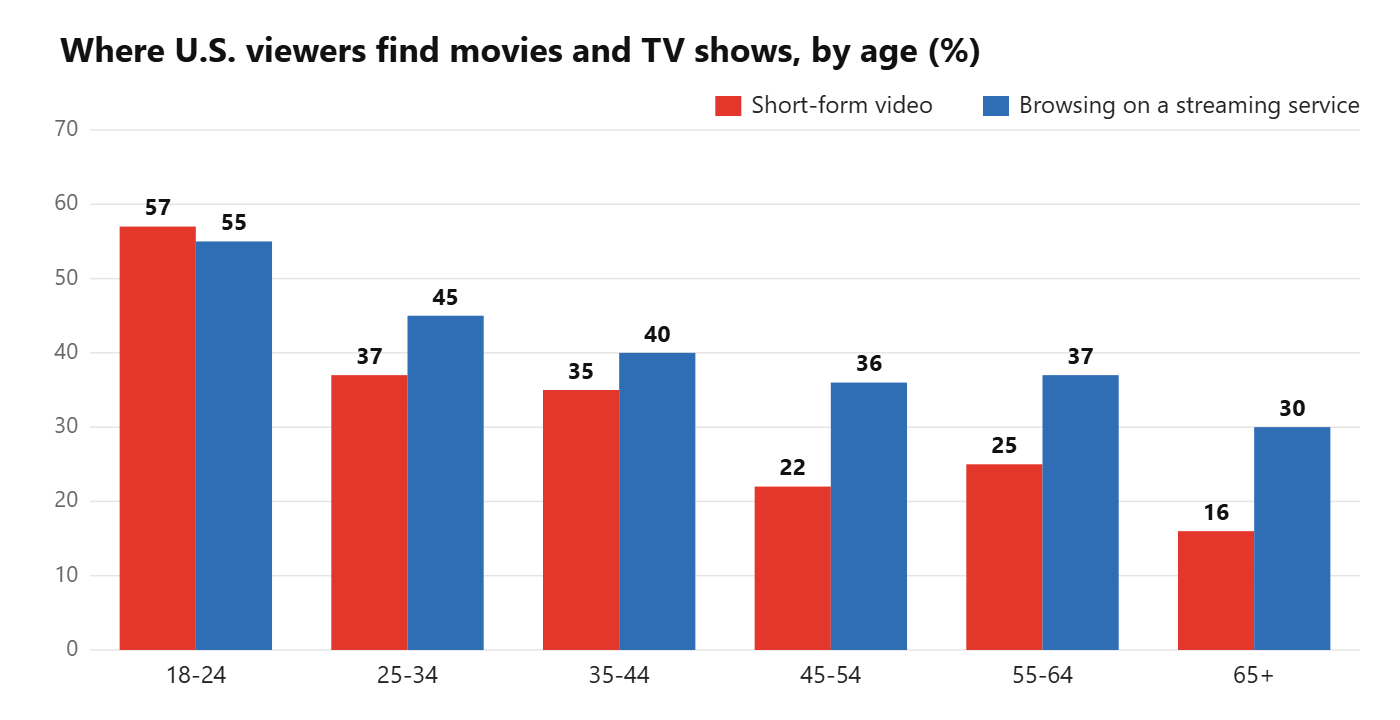
Short-form platforms are now pressing on traditional media too. In Luminate's October special report on social media and entertainment discovery, 57% of U.S. viewers aged 18 to 24 said they find movies and TV shows on short-form platforms such as TikTok, Instagram Reels and YouTube Shorts, ahead of browsing on a streaming service (55%) and more than three times the rate for those 65 and older (16%). Short-form video accounts for 26% of weekly media time for 18-to-24-year-olds, versus 12% for those 55 and over.
Streaming services have responded by going all in on short-form. Disney+ launched its vertical feed, Verts, in March. Netflix followed with Clips in April, Prime Video with Clips in May, HBO Max with HBO Max Shorts in July and Peacock with its Vertical Feed in August. Luminate notes that each service gave in-app discovery as the goal. In August Disney struck a deal with TikTok letting creators feature Marvel, Pixar and Star Wars characters.
| Service | Feed | Launch | Content |
|---|---|---|---|
| Disney+ | Verts | Mar 2026 | Scenes and moments from the library |
| Netflix | Clips | Apr 2026 | Clips from series, films and specials |
| Paramount+ | N/A | Apr 2026 | Sports highlights, CBS News, trailers |
| Prime Video | Clips | May 2026 | NBA highlights, movie and show clips |
| HBO Max | HBO Max Shorts | Jul 2026 | Trailers, clips, bonus content |
| Peacock | Vertical Feed | Aug 2026 | Library clips, microdramas |
| Tubi | Scenes | Nov 2024 | Movie and show clips |
Short-form vertical feeds in U.S. streaming apps. Source: Luminate, as of September 2026
Citing Nielsen, the Axios report notes that streaming's share of U.S. TV viewing has risen 21 points since 2021 to 49%, while cable's share has fallen from 38% to 18.7%.
From six majors to four groups: "The quality has not really been good"
Diller recalled the era of six major studios as "a very healthy environment to make good stuff." With 20th Century Fox folded into Disney and Warner Bros. into Skydance, Hollywood's majors are now four groups: Disney, Skydance, Universal and Sony Pictures.
On volume, he expects studios to "make as many things as the market demands." On quality he was less sanguine. Television was extraordinary for 10 to 15 years before the post-COVID flood, he said, but "the quality that has come out, for whatever reasons, in the last couple of years has not really been good." "There was a bubble that deflated," he added. "When was the last great defining show that you've seen?"
The Axios report says U.S. networks produced nearly 5,000 fewer TV episodes in 2024 than in 2022, and Hollywood employment fell to 185,200, the lowest since 2020. Studios are cutting scripted spending and shifting investment toward live sports.
A 26%-to-51% MGM bid, abandoned: "It begins and ends with instinct"
The conversation opened with MGM Resorts International. In June People offered $48.30 a share to take the casino operator private, a deal worth about $18 billion including debt, and it withdrew the bid on September 23. Diller said he saw an opportune moment to take People's 26% stake to 51% but had never done a private-equity-style deal. Investors did not want the structure he had in mind, and he grew uncomfortable with taking on more debt and asking third parties for money, so he walked away.
MGM then proposed buying People. Diller said MGM did not want to become a magazine publisher; it wanted to repatriate the quarter of its equity People owns. He turned down the proposal, which arrived within about a week. People keeps its 26% and can buy up to 29%.
His attachment to MGM is a hedge against AI. Businesses such as Expedia face disintermediation, he said, making it hard to underwrite the next three to seven years. "No disintermediation is coming between a person who wants to go to a place and that place," he said, calling the resorts "forever assets." About 40% of every dollar that goes through Las Vegas passes through one of MGM's 11 properties there, he said, and gaming is only about a third of the business.
On decisions, he said: "Like most things, at least for me, it kind of begins and ends with instinct." After the decks and the bankers, instinct decides. He said he is ready to change his mind at any point based on events, and called that ability a strength.
Demand is growing for markets that AI cannot replace. The Axios report says live revenue has nearly doubled since 2021 to $149 billion, with PwC projecting $174 billion by 2030, and calls live experiences an AI-resistant growth bet. Disney already draws 38% of its revenue from its Experiences segment.
Lost 60% of Google traffic, grew for 11 straight quarters: People's 'inversion'
People, then Dotdash, bought Meredith for $2.7 billion in 2021, when magazines were in steep decline. Diller said the titles printed about 325 million copies a year but had no "digital heart," and moving them online took two and a half to three years. Since then People has lost about 60% of its Google traffic to search changes and AI, but three years ago it began shifting distribution to TikTok, Instagram and YouTube, and it has now grown for 11 consecutive quarters.
Diller stressed the value of brands. Legacy digital businesses without strong brands will disappear, he said; People has 10 to 15 strong ones. Headcount is the same as three years ago, but about a third of the staff has turned over into new roles. Wall Street, he said, values People at its MGM stake and its publishing at zero, and the company may buy back stock after its earnings report.
The new revenue idea is what he calls inversion.
Publishers have long licensed their brands to third parties for 1% or 2%; Diller asked why People should not take the other 99%. Southern Living, a magazine with 2 million subscribers, is now making and distributing its own canned sweet tea, an idea that came from its editors. A good idea can be promoted through the magazines and billions of digital impressions at almost no cost, he said.
People has 21 such projects. He recalled asking why Travel + Leisure never made something like The White Lotus, and why Food & Wine never built a brand like Casamigos.
On streaming he admitted a mistake. Vimeo moved into consumer streaming with its own content early in the streaming wars and retreated within months; Diller called the retreat a big mistake and said simply, "I was wrong." He added that he was the first to say publicly, five to seven years ago, that Netflix had won the streaming war.
On AI agents he sees two worlds coexisting: a horizontal one in which a few large language model platforms handle everything, and a vertical one in which specialist brands earn more trust. Citing Expedia's roughly $145 billion in annual sales, he said LLMs do everything well but can do nothing when something goes wrong. Survival, in his view, requires a strong service brand and technology a company owns itself.
Netflix hits 15.16 million monthly users in Korea as TVING-Wavve merger waits on KT
Ten years after Netflix entered Korea, the country's media landscape has changed dramatically. Netflix reached a record 15.16 million monthly active users in Korea in December 2025, according to WiseApp·Retail (와이즈앱·리테일), and posted the fastest year-on-year growth (15%) among the country's streaming services, the Herald Economy (헤럴드경제) reported.
The market is answering by consolidating, and a government once wary of concentration now appears willing to allow alliances given Netflix's momentum. Korea's Fair Trade Commission (공정거래위원회) conditionally approved the combination of TVING (티빙) and Wavve (웨이브) on June 10, 2025, requiring both to keep current pricing through December 31, 2026. The legal merger is stuck on the consent of KT Studio Genie (KT스튜디오지니), TVING's second-largest shareholder with 13.54%. KT CEO Park Yun-young (박윤영) said on July 23 that KT had not yet received a formal request to join the merger, MTN reported. The move may already be late.
TVING turned profitable on its own. Second-quarter revenue reached 140.7 billion won ($104 million) and operating profit 6 billion won ($4.4 million). The company credited Korea Baseball Organization (KBO) games and originals including Yumi's Cells 3 (유미의 세포들3) for net subscriber gains, a result that can be read as the kind of profitable business Diller says remains possible without beating Netflix.
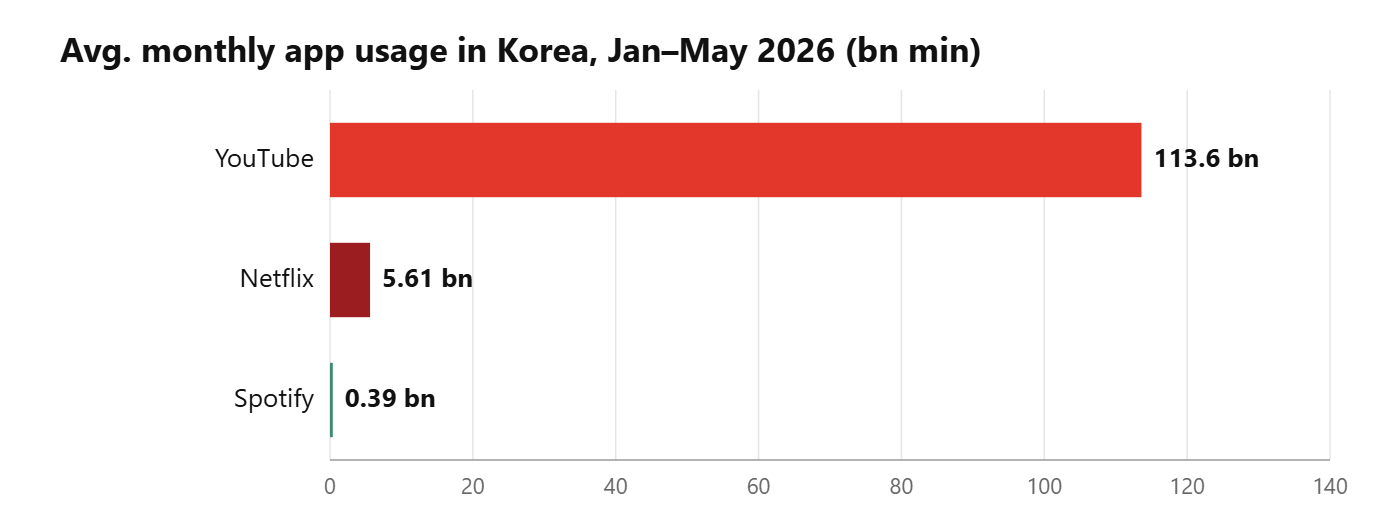
Once other content formats are counted, YouTube cannot be ignored. WiseApp·Retail found that YouTube averaged 113.6 billion minutes of monthly use in January–May 2026, about 20 times Netflix's 5.61 billion, the Korea Economic Daily (한국경제) reported.
Why settle for 1% or 2%? What Diller's remarks mean for Korean broadcasters
Diller's measure of the right size is enough scale to get product out and distribute it, and no more. Wavve's shareholders are SK Square (SK스퀘어) and the three terrestrial networks, KBS, MBC and SBS; a merger with TVING would put CJ ENM's and the networks' programming on one service. By Diller's yardstick, the merged company should be judged on profits like those TVING posted in the second quarter, not on its subscriber gap with Netflix.
People lost 60% of its Google traffic and kept growing by moving distribution to TikTok, Instagram and YouTube. Korean broadcasters rely heavily on rights sales to global streaming services and on clip distribution through YouTube. With Korean video time concentrated on YouTube, spreading distribution across several channels so that one platform's policy change cannot sink revenue is the approach People chose.
Short-form discovery bears directly on broadcasters' clip strategies. In Luminate's survey 57% of U.S. 18-to-24-year-olds found titles on short-form video, and U.S. streaming services added vertical clip feeds one after another this year. Clips broadcasters post to YouTube and TikTok should be designed around how many viewers they convert to the full program and to the broadcaster's own service, not around views.
Inversion raises the question of rights. Korean industry figures have long noted that many dramas supplied as Netflix originals are paid at cost plus a margin while the intellectual property passes to the streamer. Diller's question about settling for 1% or 2% points broadcasters toward extending program brands into products, formats, concerts and travel themselves. Their schedules and YouTube channels serve as the in-house promotion that People's magazine pages provide.
Diller calls Las Vegas resorts forever assets because no intermediary can come between people and a place they want to visit. Location tourism, concerts and fan events built on Korean content happen off the screen, where AI is hard-pressed to substitute. Moving broadcast IP into places and experiences can serve as a hedge for the AI era.
As AI search spreads, the trust that vertical brands command grows in value. News, current affairs and documentary, where broadcasters have built expertise, can stand apart from generic AI answers. Diller counts his ability to change his mind quickly as a strength and calls the Vimeo retreat a mistake. Talks on the TVING-Wavve merger are now in their fourth calendar year without a conclusion.
Skydance cuts, Netflix's ad rollout and the end of Korea's price freeze set the 2027 agenda
Skydance now holds Paramount Pictures and Warner Bros. Pictures, HBO Max and Paramount+, CBS and CNN under one roof. Where the reported $6 billion-plus in savings falls, across production slates and channels, bears directly on what Diller called the "engines of quality production."
Netflix begins expanding its ad tier to new countries in March 2027. Nielsen is applying a one-time methodology adjustment to The Gauge from the September 2026 interval and will publish September and October together, showing whether YouTube's run of records holds under the new baseline. In Korea, the TVING-Wavve price freeze expires at the end of 2026, making the merger and a combined pricing plan the first variable for the domestic market next year.
Diller, 84, says he has no plans to retire. Even as he acknowledged the platforms' rise, he said: "I'd like these engines of quality production — I want them to thrive."
From the William Morris mailroom to Paramount, Fox and IAC
Diller was born in San Francisco in 1942. He started in the mailroom of the William Morris talent agency, moved to ABC and launched its Movie of the Week at 27. He became chief executive of Paramount Pictures at 32, and the studio released Saturday Night Fever, Grease and Raiders of the Lost Ark before he left in 1984. At 20th Century Fox he launched the Fox network at 44, home to The Simpsons and Cops.
His internet career began in 1995 with the purchase of Silver King Communications, a group of local stations. The company became HSN, then USA Networks, then IAC in 2003, where Diller built and spun off Expedia, Ticketmaster, Vimeo and Match Group. In April 2026 IAC renamed itself People Inc. to reflect its focus on publishing and its MGM stake. Diller also chairs Expedia Group.
He has funded public projects including Little Island and the High Line on Manhattan's West Side, and published a memoir, Who Knew, in May 2025. "I have a motor inside me," he said at the event, adding that he will keep working as long as he can be engaged and useful. Asked about legacy, he said the word looks backward and bores him. On technology, he said he comes from entertainment and learns from the specialists around him.
CES 2027 Entertainment Tech Summit at UNLV, Jan. 7 at 5 p.m., with Dreamscape Learn
During CES 2027, K-EnterTech Hub (K엔터테크허브) will hold the Entertainment Tech Summit with UNLV's Dreamscape Learn center at the University of Nevada, Las Vegas, at 5 p.m. on January 7, 2027. Distribution after studio consolidation, discovery through short-form video and place-based experiences are on the agenda. Dreamscape Learn is a virtual reality-based immersive learning program, and Korean participants will tour the facility.
With smartcms, K-EnterTech Hub also runs the CES 2027 Entertainment Tech Insight Tour, which covers the show floor from a content and entertainment perspective. Tour and summit participants receive an analysis of CES entertainment-tech sessions.