

WPP chief executive Cindy Rose will use the CES 2027 C Space keynote on Jan. 6 at ARIA to argue for data independence and trust. Generative AI search advertising is forecast to pass $100 billion by 2030, and AI-referred shopping traffic overtook ordinary traffic on conversion in September. For the second year running, an agency holding company chief takes that stage, in an industry whose ranking changed with the Omnicom-IPG merger.
C Space keynote at CES 2027

The Consumer Technology Association (CTA), which produces CES, announced the keynote at a media event in New York on Nov. 17. The talk is set for Jan. 6, 2027, at 11 a.m. in the Mariposa Ballroom at ARIA in Las Vegas.
According to CTA, Rose will argue that brands now have to be chosen by the algorithms that pick recommendations as well as by people, which makes trust, transparency and open standards imperatives. With generative AI search advertising forecast to pass $100 billion by 2030, the question on stage is how advertisers use AI while holding on to their own data.
“I personally believe there has never been a more exciting time to be in this industry,” Rose said. “Access to AI capability alone is no longer the differentiator; the ability to put AI to work to deliver growth and innovation for clients and build competitive advantage through unique marketing intelligence is the differentiator,” Rose said. “Trust is not just a slogan or a soft value; it has become a commercial operating model.” She added that CES is the right stage to examine how the world’s leading brands can harness enterprise AI at scale “while protecting the data independence and brand differentiation that ultimately determine who wins.”
“AI creates new opportunities across advertising, helping brands become more efficient, creative and connected to consumers,” said Kinsey Fabrizio, president and chief executive of CTA. “That transformation is driving growth across industries and will be on display at CES.”
WPP is in the middle of its own transition. Omnicom completed its acquisition of Interpublic in November 2025, and the title of largest advertising group went with it. Rose, who took over in September 2025, has committed to £500 million in annual savings and a return to organic growth during 2027.
Beyond the keynote, CTA said conference programming will carry more conversations on AI agents, brand marketing, creator marketing and customer engagement.
GenAI search advertising is forecast to pass $100 billion by 2030
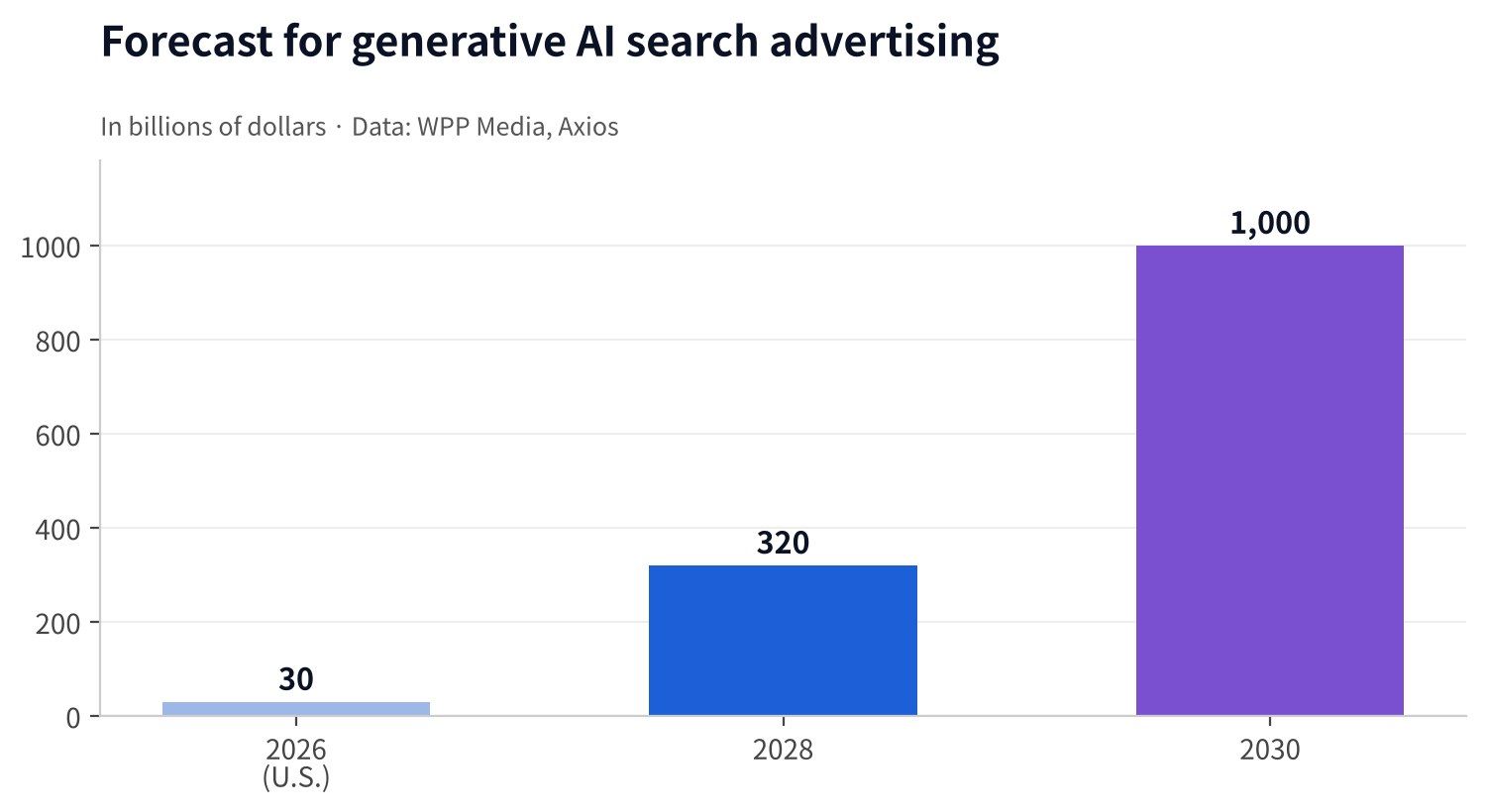
Axios’s 2026 Media Trends Executive Annual Report puts generative AI search advertising at $32 billion in 2028 and above $100 billion by 2030, from roughly $3 billion in 2026, about 60% of it in the United States. The forecast comes from WPP Media, WPP’s own media arm.
OpenAI expects to make $2.5 billion from advertising this year and $100 billion by 2030. eMarketer projects AI search will move from 0.7% of U.S. search ad revenue in 2025 to 13.6% in 2029. The same report notes that AI search ad formats are not settled yet and that last-click attribution — giving credit to the final ad a shopper clicks — is breaking down.
AI-referred traffic passed ordinary traffic on conversion in September
Adobe data shows the purchase conversion rate for AI-referred traffic overtook non-AI traffic for the first time in September 2026. Indexed to the non-AI rate of October 2024, AI referrals ran 595% higher while the non-AI rate fell 9%. Shopify data shows more than half of AI-referred sessions start straight on a product page, against 20% for organic search.
The race to set the rules of AI shopping has started as well. Google is working with Shopify and online retailers on a Universal Commerce Protocol; OpenAI and Stripe built an Agentic Commerce Protocol; Microsoft piloted a premium content marketplace for publishers. Commerce advertising is expected to reach $199.6 billion globally in 2026, roughly 97% of it retail media.
| Metric | Figure | Source |
|---|---|---|
| GenAI search advertising | $32B in 2028 → more than $100B by 2030 | WPP Media |
| AI share of U.S. search ads | 0.7% in 2025 → 13.6% in 2029 | eMarketer |
| AI-referred conversion | Passed non-AI traffic in Sept. 2026 (+595% indexed) | Adobe |
| AI-referred sessions | More than half start on a product page (20% organic) | Shopify |
| Commerce advertising | $199.6B globally in 2026; 97% retail media | WPP Media |
| Ad requests to AI slop | 3.2B from Jan. to Sept. 2026, up 354% | DoubleVerify |
3.2 billion ad requests landed on AI slop, which is why trust is an operating model
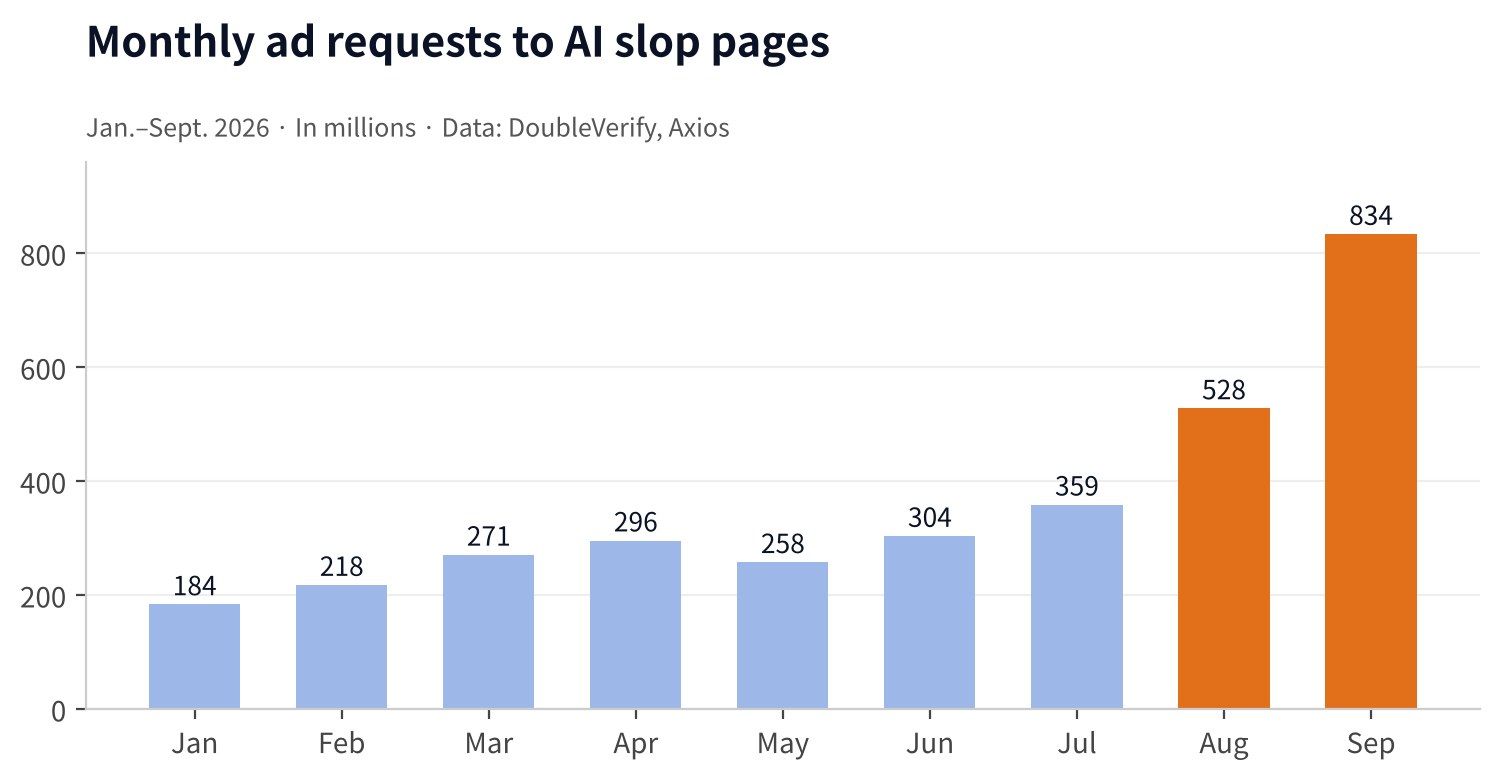
Behind Rose’s line about trust as a commercial operating model is the quality of the pages ads land on. DoubleVerify counted ad requests to mass-produced low-quality AI pages — AI slop — rising from 184 million in January 2026 to 834 million in September, 3.2 billion for the year through September, up 354%. Over the same stretch the number of AI slop sites grew fivefold and their traffic quadrupled.
Pressure on the content side has grown too. Tollbit counts 116 AI crawler visits per 1,000 human requests for B2B and professional content, against 34 for entertainment and pop culture and 20 for national news. Cloudflare introduced one-click AI bot blocking in 2024, moved to default blocking for new sites and pay-per-crawl in 2025, and is shifting toward licensing in 2026.
What WPP is: the holding company Sorrell built, now second to Omnicom

WPP is a London-based advertising and marketing holding company. It began in 1971 as Wire and Plastic Products, a maker of wire shopping baskets. Martin Sorrell bought a controlling stake in 1985, turned it into a marketing services group and grew it by acquisition: J. Walter Thompson, the Ogilvy Group and, in 2000, Young & Rubicam for $5.7 billion. Sorrell left in April 2018 after 33 years.
The group today holds Ogilvy, Grey and VML in advertising, AKQA in digital, Burson in public relations, Landor in brand consulting and Hogarth in content production. Media sits with WPP Media, renamed from GroupM in 2025, which contains EssenceMediacom, Mindshare and Wavemaker. WPP employs 104,083 people as of 2026 and operates in more than 100 countries.
WPP was long called the world’s largest advertising group. On Nov. 26, 2025, Omnicom completed its acquisition of Interpublic and the combined company took that position. Former chief executive Mark Read announced in June 2025 that he would step down; Rose was named in July and started on Sept. 1.
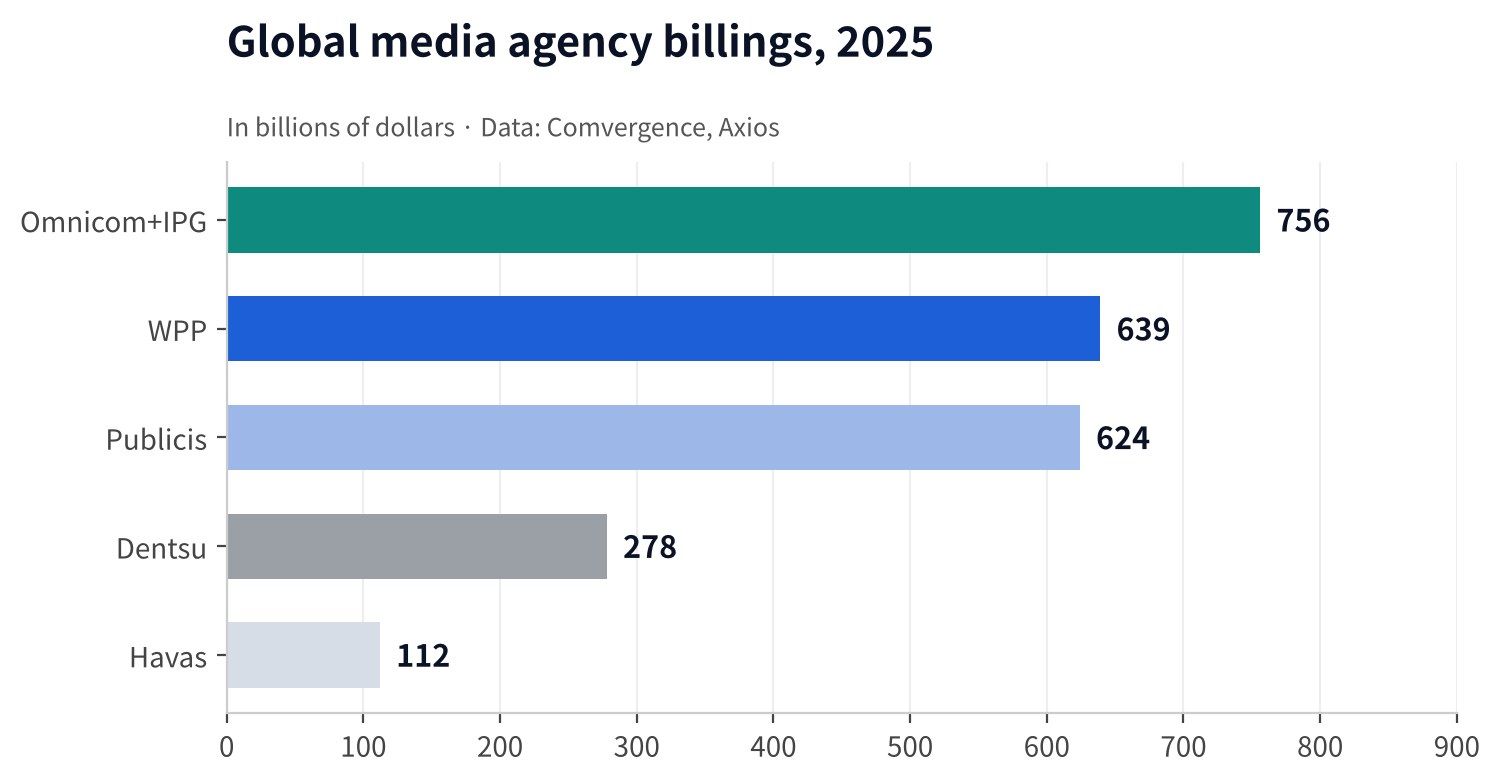
Comvergence put 2025 global media agency billings — the media spending agencies place on behalf of advertisers — at $75.6 billion for Omnicom and IPG combined, $63.9 billion for WPP, $62.4 billion for Publicis, $27.8 billion for Dentsu and $11.2 billion for Havas. The top three hold 84% of the five groups’ combined $240.9 billion. On new business won against accounts lost in 2025, Publicis gained the most and WPP Media lost the most.
Rose came to WPP by way of Disney and Microsoft
Rose joined WPP’s board as a non-executive director in 2019 and became chief executive in September 2025. She was previously chief operating officer for Microsoft Global Enterprise, president of Microsoft Western Europe and chief executive of Microsoft UK. Earlier she ran Vodafone’s UK consumer division, served as executive director of digital entertainment at Virgin Media and spent 15 years at The Walt Disney Company.
Her restructuring plan, Elevate28, folds the group into four divisions — WPP Media, WPP Creative, WPP Production and WPP Enterprise Solutions — and places Ogilvy, VML and AKQA under WPP Creative. It targets £500 million (about 887.3 billion won) in annual savings by 2028 against roughly £400 million (about 709.8 billion won) in transformation costs over two years, with a return to organic growth targeted during 2027.
The numbers have not turned yet. In the third-quarter trading update published on Oct. 29, revenue less pass-through costs — outside costs billed straight through to clients — fell 2.1% on a like-for-like basis. Media rose 0.3%, back in positive territory, while creative fell 5.1% and production rose 2.5%. Asia-Pacific was down 4.3% and North America 1.8%. WPP shares fell 62% during 2025 and the company dropped out of the FTSE 100 after almost 30 years; its market value went from about £24 billion in 2017 to £3.1 billion in 2025.
| Segment | Q3 2026, like-for-like year over year |
|---|---|
| Group (revenue less pass-through costs) | -2.1% |
| Media | +0.3% (back to growth) |
| Creative | -5.1% |
| Production | +2.5% |
| Asia-Pacific | -4.3% |
| North America | -1.8% |
C Space is the marketing, content and entertainment campus, open Jan. 5–7
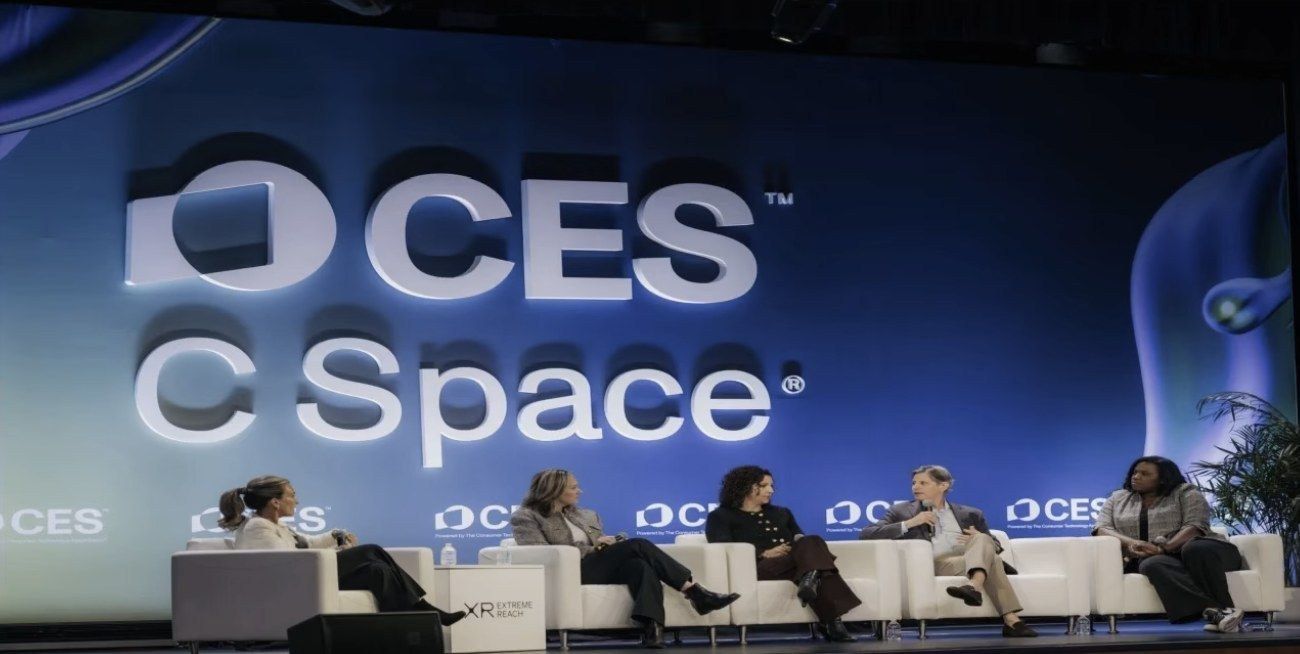
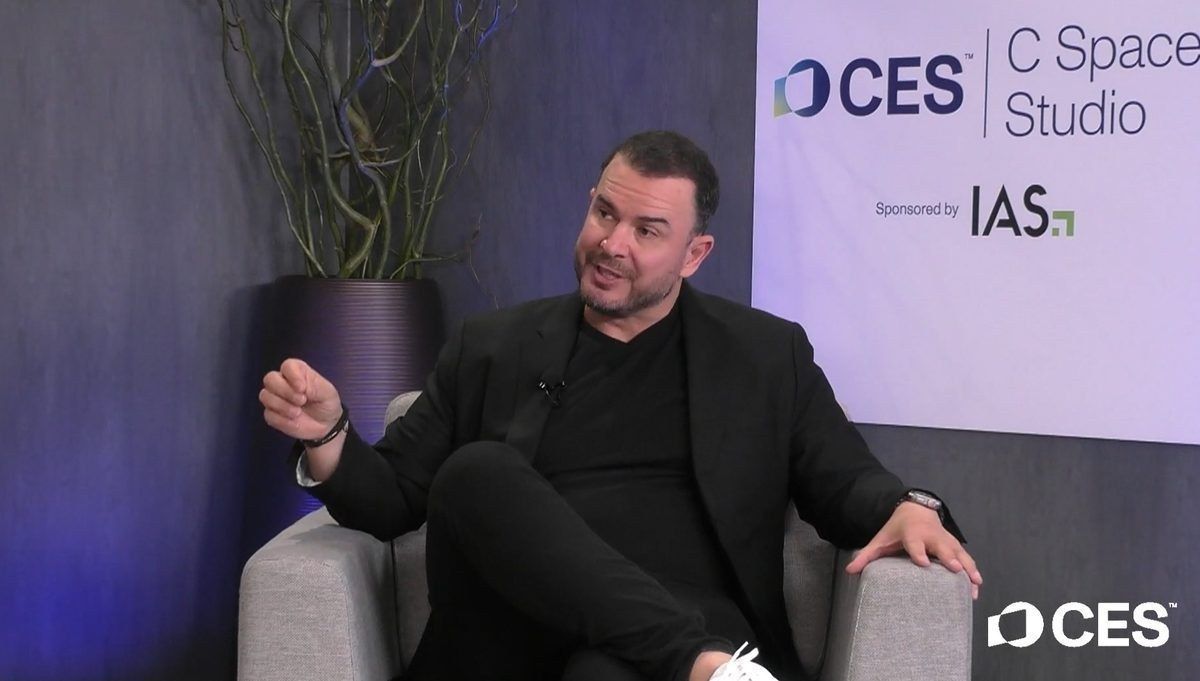
C Space is where the marketing, advertising, content and entertainment industries gather inside CES, bringing together global brands, media platforms, agencies, creators and technology companies. ARIA, Vdara, The Cosmopolitan and Park MGM make up the campus. CTA lists its hours as Jan. 5 from 9 a.m. to 6 p.m. for conference programming only, then Jan. 6 and 7 from 9 a.m. to 6 p.m., different from the show floor. At CES 2026, more than 19,000 attendees listed marketing, entertainment, content or advertising among their business interests, and 68% of them were senior-level executives.
On the morning of Jan. 7 at ARIA Joshua 8, the 3CV track covers machine customers — AI agents that search and buy on a shopper’s behalf. At the Creator Space in LVCC Central Hall, sessions on creator ad tech and AI, brand partnerships and the trust economy run across all three show days.
On Jan. 5, at the same hotel, Digital Hollywood holds its 28th pre-opening conference on Hollywood IP, the creator economy, microdramas and vertical networks, and the official CES content creator track runs the same day at ARIA’s Mariposa 5. How brands spend on content, and how creators and platforms prove the results, runs into the same data-and-verification question.
The studio inside C Space is presented by Skydance. Brands at the CES 2026 studio included Disney, Fox, NBCUniversal, Warner Bros. Discovery, Tubi, SiriusXM and Vox Media on the media side; Microsoft Ads, LinkedIn, Reddit, Roblox, Vizio and Viant on the platform and ad tech side; and Walmart Connect, Target, Marriott Media, Mars and Intuit SMB Media Labs in retail and brand media. WPP and Havas represented the agency groups, alongside SAG-AFTRA, AARP and The Ad Council. The CES 2027 studio schedule has not been published yet.
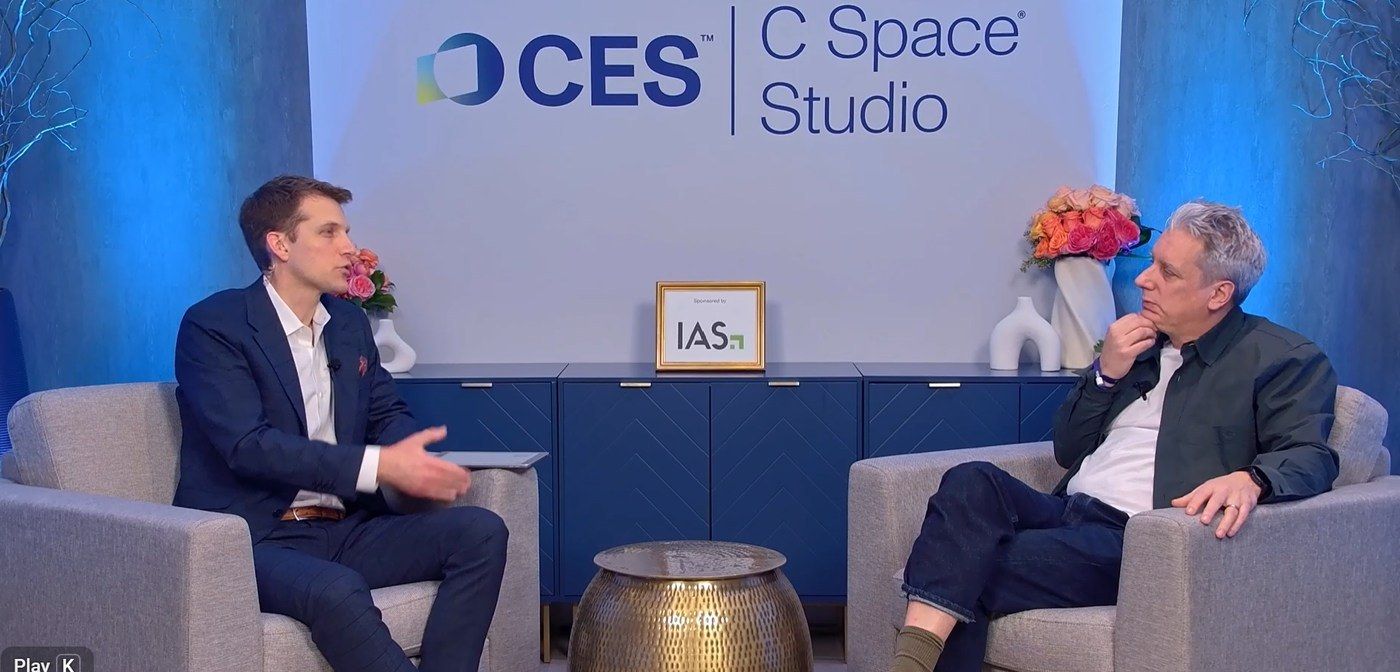
WPP also ran a session at the CES 2026 C Space Studio. Under the title “Building an AI-First Marketing Future without Losing the Human Edge,” Richard Hartell, chief business officer for the U.S. at WPP Media, discussed what happens when discovery and decision-making move into AI interfaces, the trust questions that follow, and how fast generative AI is advancing, arguing that human judgment remains essential as automation scales. It sits on the same line as the subject Rose takes to the 2027 stage.
Two straight years of an agency holding company chief, from creativity to trust
The same slot last year went to Yannick Bolloré, chairman and chief executive of Havas and chairman of Vivendi’s supervisory board. That CES 2026 C Space keynote ran at 11 a.m. on Jan. 6 in the Mariposa Ballroom at ARIA, on combining advanced AI with human understanding to turn data into meaning. Gary Shapiro, CTA’s chief executive, called Bolloré “a visionary leader who understands the power of blending tech with human insight.” A year later, in the same hour on the same stage, the subject has moved from creativity to data independence and trust.
WPP is a regular at C Space. It appears on the list of brands at the CES 2026 C Space Studio, one of only two agency groups there alongside Havas. The forecasts for generative AI search advertising and commerce advertising in the Axios report are WPP Media’s numbers.
Rose’s record lines up with the question CES is asking this year. She supplied enterprise AI at Microsoft; she now has to deploy it and prove it in client results. That matches CTA’s framing of CES 2027 around revenue from AI rather than adoption of it. With the ranking changed by the Omnicom-Interpublic merger and WPP Media the weakest on net new business, the keynote doubles as a test of how an advertising holding company survives the AI era.
CES 2027 is framed around AI that pays, in three tracks
Brian Comiskey, CTA’s vice president of innovation and trends, said at the CES Asia Unveiled Seoul session of the Korea Electronics Show (KES) 2026 at COEX on Oct. 13 that CES 2027 will focus on revenue rather than adoption. “The AI industry will move through adoption and maturity toward creating real impact,” he said. “What matters for companies is what results AI delivers for revenue growth and operating efficiency.”
CTA groups the show into three tracks: foundation (AI, semiconductors, energy), transformation (robots, autonomous vehicles, smart homes) and exploration (quantum computing, space). Agentic AI moves from pilots into daily operations, and vertical AI built for specific industries reshapes the software market, in CTA’s reading. In a CTA survey across seven markets, workplace AI use in South Korea (한국) reached 70%, tied with the United States for the highest rate, and Korean users reported saving about 8.2 hours a week.
Korean agencies are making the same turn, from agency to agentic
Cheil Worldwide (제일기획) opened its Cheil Tech Showcase 2026 at its Hannam-dong headquarters in Seoul on May 27 under the theme “from agency to agentic,” showing 17 AI solutions. President Kim Jong-hyun (김종현) said the company would combine its consumer data and insight with AI to create new business opportunities for clients. The tools included VariAid, which generates banners from a single PSD file, the Cheil Media Data Bank for digital media buying, and Wonderland, an XR live-broadcast setup run from a phone. In a Samsung Electronics Germany case, a store-visit optimization tool roughly doubled annual visits per merchandiser and cut working hours by 66%.
What comes next
CES 2027 runs Jan. 6–9 in Las Vegas. Other keynotes include Antonio Filosa, chief executive of Stellantis (Jan. 6, 8:30 a.m., Palazzo Ballroom at The Venetian), Tekedra Mawakana, co-chief executive of Waymo (Jan. 6, 1 p.m., Palazzo Ballroom), and Yuanqing Yang, chairman and chief executive of Lenovo (Jan. 6, 5 p.m., Sphere). CTA, which owns and produces CES, describes itself as North America’s largest technology trade association, with members supporting more than 17 million American jobs.
The question Rose is bringing to the stage applies to the Korean market as well. When AI agents search and buy for consumers, ad budgets move from the search box to the AI recommendation layer, and click-based measurement has to be rebuilt. Korean agencies, broadcasters and platforms have to decide where their first-party customer and viewing data sits, which AI is allowed to train on it, and who verifies the results. Without data independence, both brand differentiation and a medium’s bargaining power can pass to the AI platforms.
CES 2027 Entertainment Tech Program — K-EnterTech Hub × smartcms

K-EnterTech Hub and smartcms run a CES 2027 program for entertainment tech, media, content and AI companies, and the C Space campus described above is part of the Jan. 7 route. The Jan. 5 day covers Digital Hollywood’s morning sessions plus Sphere, AREA15 and Allegiant Stadium; Jan. 7 runs from the Creator Space and C Space to a planned immersive-venue visit and the EnterTech Summit.
The EnterTech Summit begins at 5 p.m. on Jan. 7 under the theme “changing business models: from scale to scarcity,” with sessions on Hollywood in the AI era, content format shifts and CES 2027 entertainment tech trends, followed by pitches from Korean companies, a K-culture showcase and networking. Attendance is free with advance registration.
The program has seven tiers — report, tour, business matching, summit pitching, summit exhibition, full participation package and full service — starting at 500,000 won, excluding VAT, with early pricing through Dec. 15. Details and registration are on the CES 2027 program page; inquiries go to Nam Hyun-jung, chief executive of smartcms (emilia@smartcms.co.kr).