
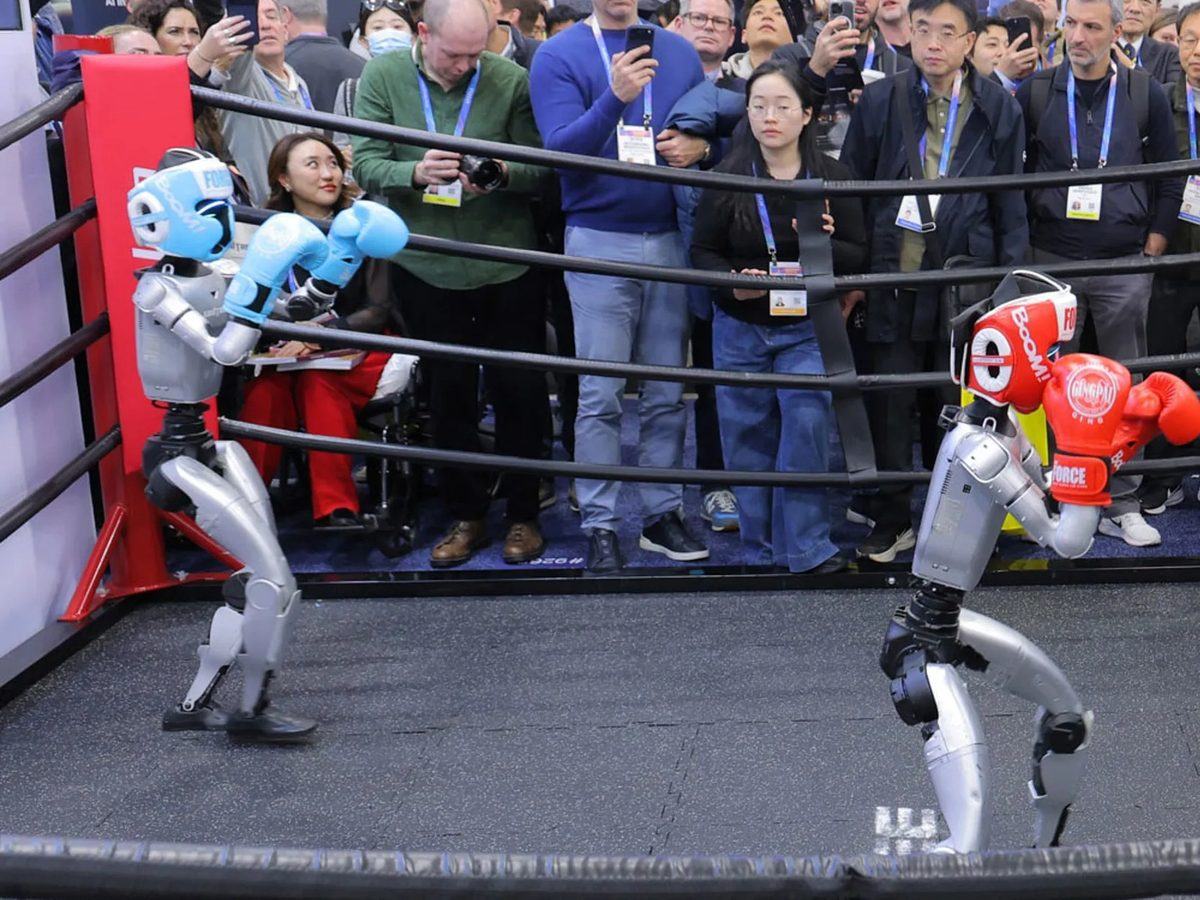
Korea took 23 of 38 Best of Innovation honors; beyond Samsung, LG and Hyundai Mobis, 19 went to startups and mid-size firms. China won humanoids, the U.S. AI chips
Korean products took 23 of the 38 Best of Innovation honors in the first round of the CES 2027 Innovation Awards, already topping last year's final 15. Only four went to Samsung, LG and Hyundai Mobis; the other 19 went to startups, universities and mid-size firms.
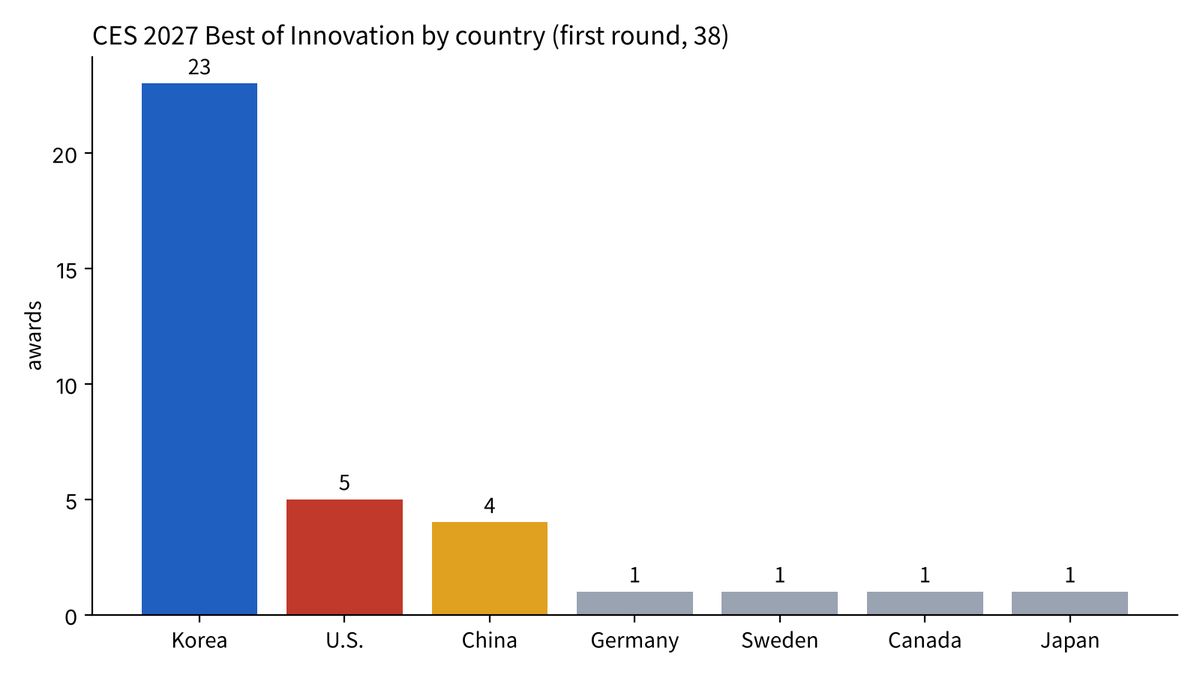
Korean products won 23 of the 38 Best of Innovation honors — the top award in each category — in the CES 2027 Innovation Awards announced by the Consumer Technology Association on Nov. 9, a 61% share. The U.S. won five and China four, with one each for Germany, Sweden, Canada and Japan, according to a tally by Korea's Electronic Times.
Entries hit a record of about 4,000, up 10% from a year earlier. Korea won 15 of 43 top honors in last year's final list and has already passed that number in this first round. CTA will publish the full list on Jan. 4, and CES 2027 runs Jan. 6–9 in Las Vegas.
The mix of winners has shifted. Only four of Korea's 23 top honors went to large conglomerates — Samsung Electronics, LG Electronics and Hyundai Mobis. The other 19 went to mid-size companies such as Kolmar Korea and Graphene Square, university spinouts and startups.
Two for Samsung foldables, a fifth straight for LG OLED, and in-car entertainment for Hyundai Mobis
Samsung won two mobile Best of Innovation awards for the Galaxy Z Fold8 and Z Fold8 Ultra. Three memory products — LPDDR5X SOCAMM2, server DDR5 RDIMM and UFS 5.0 — were also honored, and Samsung SDI won for a prismatic battery for data-center uninterruptible power supplies, The Korea Economic Daily reported.
LG Electronics won eight awards. Its transparent, wireless Signature OLED T6, developed with Christie's, took Best of Innovation in Art Tech, the fifth straight year for LG OLED TVs. With an LG Innotek lighting module and an LG Display face display for humanoid robots, the LG group won 11.
Hyundai Mobis won Best of Innovation in In-Vehicle Entertainment for the M-Moving Display, a flexible screen that travels across a curved cockpit and appears only when needed, which it calls the world's first space-adaptive display platform.
Motion capture for VTubers and haptics from game audio
Entertainment tech featured too. Soulart's Soulart Station, a markerless motion tracker that combines 3D spatial sensing with on-device AI for VR gamers, VTubers and indie creators, took Best of Innovation in XR & Spatial Computing — a category where Qualcomm also won. WIZCORE won Best of Innovation in Art Tech for TWArch Master.
Haptics maker bHaptics won an AI honor for an on-device engine that classifies game audio — gunshots, explosions, impacts — in real time and turns it into vibrations on its TactSuit vest, filtering out music and working with more than 100 PC games without integration files, Inven Global reported.
Both cybersecurity top awards go to Korea; beauty, food and energy too
Two Korean firms shared Best of Innovation in Cybersecurity: ANAM145, a Korea University spinout, for SignTrail, which verifies a transaction request's execution environment before signing to stop theft disguised as normal transfers, and Union Biometrics for UBio-X LiveGuard. ANAM145 built its tool after studying North Korea-linked heists such as the roughly $1.5 billion Bybit theft in 2025.
Kolmar Korea won Beauty Tech's top award for a second year with ChromaFlow, which turns a lip shade seen in an influencer video into a physical product in under a minute. Graphene Square won in Food Tech for a graphene induction hybrid cooker, Uniplatec in Energy Transition for an air-cleaning smart window film, and Shuols won two for AI footwear in Accessibility & Longevity and Fashion Tech.
Humanoids to China's Galbot, AI chips to Nvidia
Robotics and AI silicon went elsewhere. China's Galbot won Robotics with its ET1 humanoid, in a category where entries rose 74%. Nvidia won in Computer Hardware & Gaming for its Vera CPU and DLSS 5. Other Chinese winners included Anker headphones and Morpho's desktop UV printer.
Ceragem's nine, three from Cheonan-Asan, five from Hanseo University
Counting regular honorees, the list grows. Ceragem won nine awards for eight products, its fourth straight year and 30 in total. Three firms from the Cheonan-Asan Innopolis — The Keeper (AX-Guard EV fire detection), Lee Mobility (EV Dr fire-suppression robot) and Vision Innovation — won, giving the district honorees three years running. Student startups at Hanseo University won five, including a Best of Innovation for the Leadway dynamic evacuation-guidance system.
Full list on Jan. 4
This is the first round; CTA will release the full list on Jan. 4. Korea leads the U.S. and China by a wide margin in top honors, but the top awards in robotics — where entries rose 74% — and AI chips went to China and the U.S. Many of the regional and university winners will exhibit in provincial and university pavilions. Turning the awards into buyer contracts on the show floor is the next step.
K-EnterTech Hub at CES 2027
With smartcms, K-EnterTech Hub runs the CES 2027 Entertainment Tech Insight Tour, the only CES tour dedicated to entertainment tech. The full-service program covers round-trip flights and hotels, Digital Hollywood on Jan. 5, Variety's Entertainment Summit and other C Space sessions, show tours, networking, our Jan. 7 Entertainment Tech Summit at UNLV, visits to LA studios, the Lucas Museum and Dataland, and the CES 2027 Entertainment Tech Report, for 15 million won per person.
Sign up at the kentertechhub.com shop. Contact: Nam Hyun-jung, CEO of smartcms (emilia@smartcms.co.kr)