
ANALYSIS | MEDIA & AI
Terms and training rights of the multiyear deal stay undisclosed; Google’s News AI pilot passes 400 publications as Google Search referrals to publishers fell 34% in a year
CNN has signed a multiyear agreement with Google. Google gets additional rights to use CNN content in generative AI features still in the experimental stage, and CNN gets paid for that use. CNN announced the deal on Oct. 15. It did not disclose the financial terms, the products involved or whether AI training rights are included, TheWrap reported on Oct. 15.
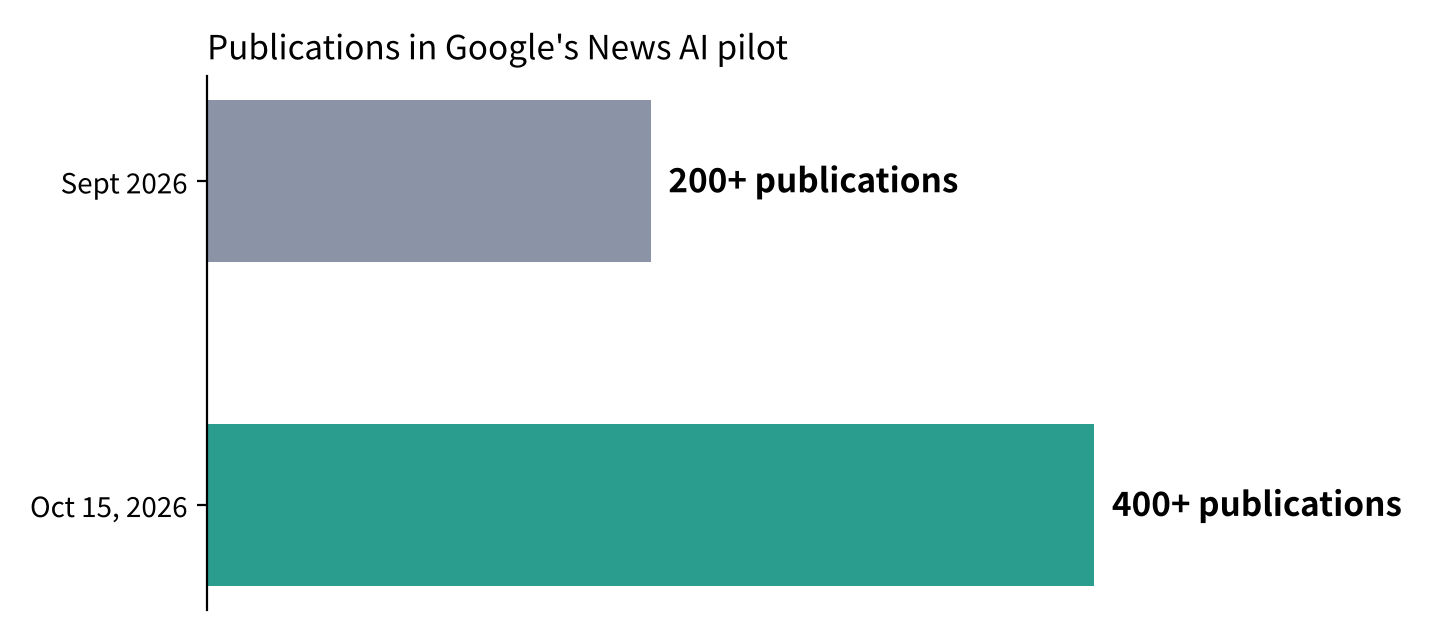
Google said the same day, in an official blog post, that more than 400 publications worldwide now take part in its “News AI pilot,” which pays publishers to use their articles in developing AI features. CNN joined alongside The Financial Times, Axios and Forbes. A program that began in December 2025 with The Washington Post, The Guardian and others reached that scale in 10 months.
Google began paying separately for news because clicks to publishers’ sites fell once AI started answering first on the search results page. Pageviews reaching publishers through Google Search fell 34% in the year from December 2024, according to the analytics firm Chartbeat.
Publishers took that decline to court. But on Sept. 30 a U.S. federal judge dismissed Penske Media’s antitrust suit. The court found that an “expectation” that traffic would come back in return for making content available did not amount to a deal with Google, and that AI summaries are not a product separate from search. The judge acknowledged the harm to publishers but said the remedy lies with Congress. With antitrust law now a hard route to recovering lost traffic, licensing deals are multiplying. Google said more than 400 publications now take part in its AI news program, which pays for content use.
CNN has used both lawsuits and contracts. It signed an AI licensing deal with Meta in December 2025 and, after talks broke down, sued Perplexity for copyright infringement in May. The Google agreement came nine days after Paramount completed its acquisition of Warner Bros. Discovery and CNN became part of the new company, Skydance.
Google’s News AI pilot passes 400 titles as CNN, FT, Axios and Forbes sign on
Google said on Oct. 15 that its News AI pilot now includes more than 400 publications worldwide. The newest partners include global outlets such as CNN, The Financial Times, Axios and Forbes. U.S. local outlets joined as well: The Post and Courier in Charleston, South Carolina; Oil City News in Casper, Wyoming; Shaw Media, a newspaper chain in Illinois and Iowa; and the nonprofit newsroom The Texas Tribune.
Google describes the pilot as a “licensing program”: it receives enhanced content from participating publishers to build new AI features and pays for the delivery and use of that content. That wording is new. At launch in December 2025, Google used the term “commercial partnership.” The early agreements centered on extended display rights and content-delivery methods such as APIs, leading Britain’s Press Gazette to say they were “not licensing deals.” The launch partners included Der Spiegel, El País, The Guardian, The Times of India and The Washington Post.
The content feeds two features. One is an in-depth article overview on a publisher’s Google News page, giving readers context before they click. The other is a customizable audio briefing on topics the listener chooses. Nieman Lab on Oct. 15 showed a “story preview” on The Washington Post’s page; the overview carried a notice that it was written by AI and may contain mistakes. The audio briefing is an AI podcast stitching together the day’s headlines. Users can choose topics such as “World,” “Gaming” and “Sports,” and links to the stories mentioned are attached.
Google did not disclose terms. A Google spokesperson said, however, that the pilot is not a “pay-per-value” arrangement, in which money depends on how much content contributes to an AI answer. Pay-per-value is the model of a separate program being tested for AI Overviews, AI Mode and Gemini. Publishers in that program see monthly earnings in an “AI contribution” panel in Search Console. Because the basis for the figures is unknown, one executive called it a “black box.” Some described the early payments as “pennies” next to advertising revenue. There is also concern that recurring payments would let Google argue it already pays for AI use, weakening publishers’ leverage in larger licensing talks.
Participation roughly doubled in about a month. The figure Google gave, as The Media Copilot reported in summarizing Digiday’s September coverage, was about 200. Separately, Google licenses content from more than 2,800 publications in 33 countries through News Showcase.
Large deals followed in the same week. Britain’s Reach signed an agreement with Google covering its entire U.K. and Ireland portfolio, including the Mirror, the Express, the Daily Star and the Manchester Evening News. The CNN agreement is CNN’s first partnership since Paramount Skydance completed its takeover of Warner Bros. Discovery.
Google is also mindful of the industry’s complaints about lost traffic. It said it would make links in AI search results more prominent and place them higher, and expand link carousels worldwide. Last month Chartbeat counted a 40% year-over-year drop in traffic flowing from Google to publishers.
There is a Korean connection, too. When Google announced the pilot in December 2025, it said it was working with Yonhap News Agency, the AP, Estadão and Antara to provide real-time information in the Gemini app. With the pilot now reaching local outlets, Korean publishers need to work out how to negotiate News Showcase agreements and AI licensing separately.
No price, no product list, no word on training rights; Google says it is not a contribution-based deal
Much is missing from CNN’s announcement. CNN did not say which Google products will use its reporting or whether AI training rights are part of the deal. NewscastStudio noted on Oct. 15 that it was also unclear whether video archives, broadcast transcripts and live coverage are covered. Unlike newspapers built on text, CNN is a broadcaster, which makes this the variable that determines the deal’s value.
“With this partnership we’re unlocking new pathways for audiences to access CNN’s unparalleled journalism while being compensated for the delivery and use of our unique intellectual property in connection with AI products,” Sam Felix, CNN’s senior vice president of strategic partnerships and business development, said in a statement. In the same statement, quoted by Reuters on Oct. 15, he added that Google’s generative AI has changed how people discover information and that CNN will now use those tools to explore new ways to reach audiences. CNN said the deal fits its strategy of protecting its intellectual property while pursuing commercial AI partnerships, and that it has several agreements in place and talks under way with other companies.
Google declined to discuss terms. But Brianna Puccini Duff, a Google spokesperson, told Nieman Lab that the News AI pilot is not a “pay-per-value” arrangement. Publishers are not paid according to how much an article contributes to an AI answer; they are paid for supplying content that goes into experimental features.
Google Search pageviews down 34%; small publishers down 60% over two years
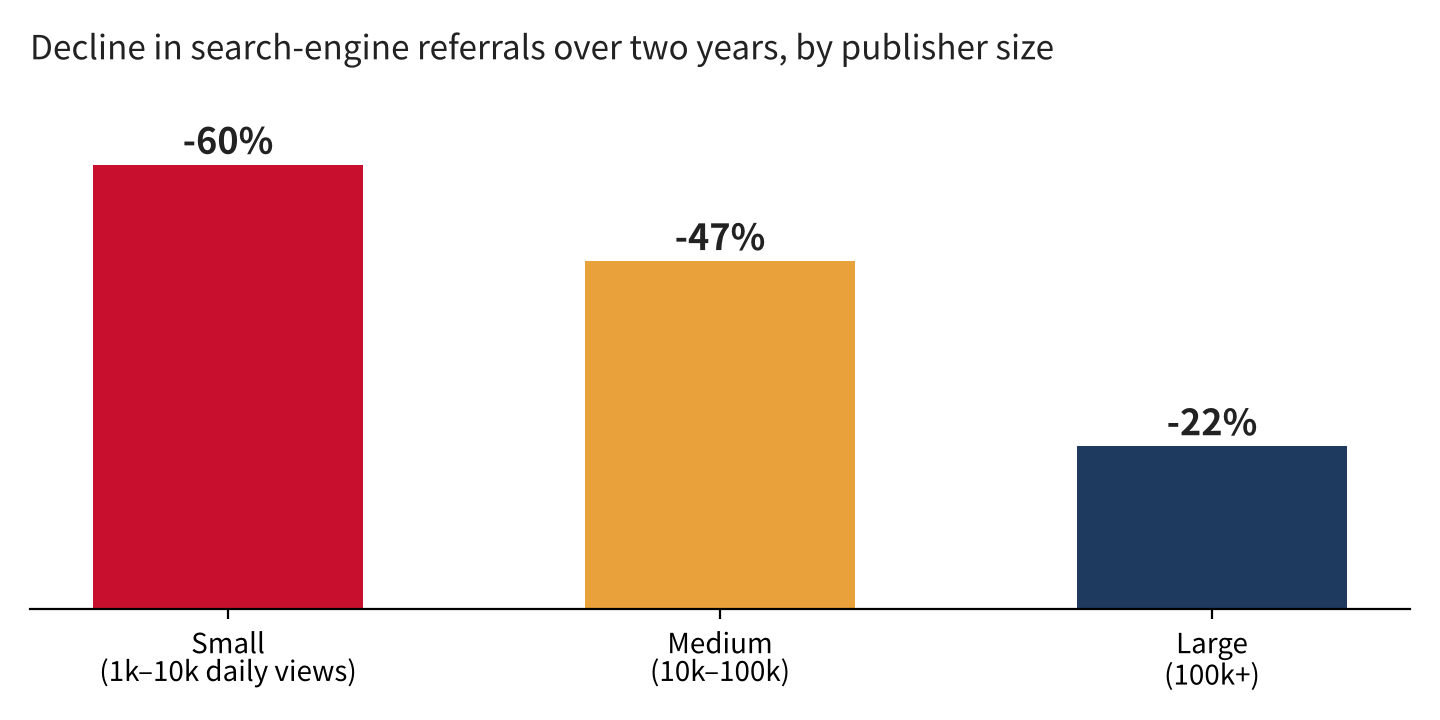
Chartbeat data first reported by Axios on March 17 show pageviews via Google Search fell 34% and those via Google Discover 15% from December 2024 to December 2025. Over two years, search-engine referrals fell 60% for small publishers (1,000 to 10,000 daily pageviews), 47% for mid-sized publishers and 22% for large publishers with more than 100,000. Referrals from ChatGPT rose 200% but remained under 1% of total traffic.
Total pageviews fell only 6%. Direct visits, internal traffic from other pages on the same site, and email, apps and messaging partly filled the gap. According to Nieman Lab on March 18, internal traffic rose from about 38% of news and media site pageviews in 2024 to about 41% after November 2025. Axios cited brand recognition and direct subscription products as the reasons large publishers fell less.
The decline accelerated in the second year. According to Search Engine Journal, which analyzed Chartbeat’s 2026 Publisher Playbook, Google Search referrals fell 40.2% year over year from July 2025 to July 2026, and Discover’s decline widened from 6.6% in the first year to 34.3% in the second. Google Search’s share of total pageviews dropped from 9% to 5%. CNN shifted weight toward direct subscription when it launched All Access on Oct. 28, 2025, at $6.99 (about 9,300 won) a month or $69.99 (about 93,000 won) a year.
A separate pilot pays by contribution to AI answers, and some fear it weakens leverage
Apart from fixed licenses, Google is also testing payment by contribution. According to Digiday, Google opened an “AI contribution” panel in Search Console and pays when it judges that a publisher’s content “significantly” contributed to answers in Gemini, AI Overviews or AI Mode. Participants can leave at any time. Google has approached at least dozens of sites, and interest has been stronger among small and mid-sized publishers and sites outside news than among large outlets.
AdExchanger reported on Sept. 15 that the panel shows monthly AI earnings but does not explain how they are calculated. One publishing executive told Digiday that once recurring payments begin, Google could cite them as proof it is “already compensating” publishers, weakening leverage for larger licenses. David Buttle, founder of the publisher AI coalition Spur, saw the payments less as a meaningful exchange than as a strategic hedge for Google. The structure splits large outlets into fixed licenses and smaller ones into contribution payments, and CNN landed in the first group.
The structure of news-for-AI deals: fixed licenses for large outlets, contribution pay for smaller ones, lawsuits for those outside
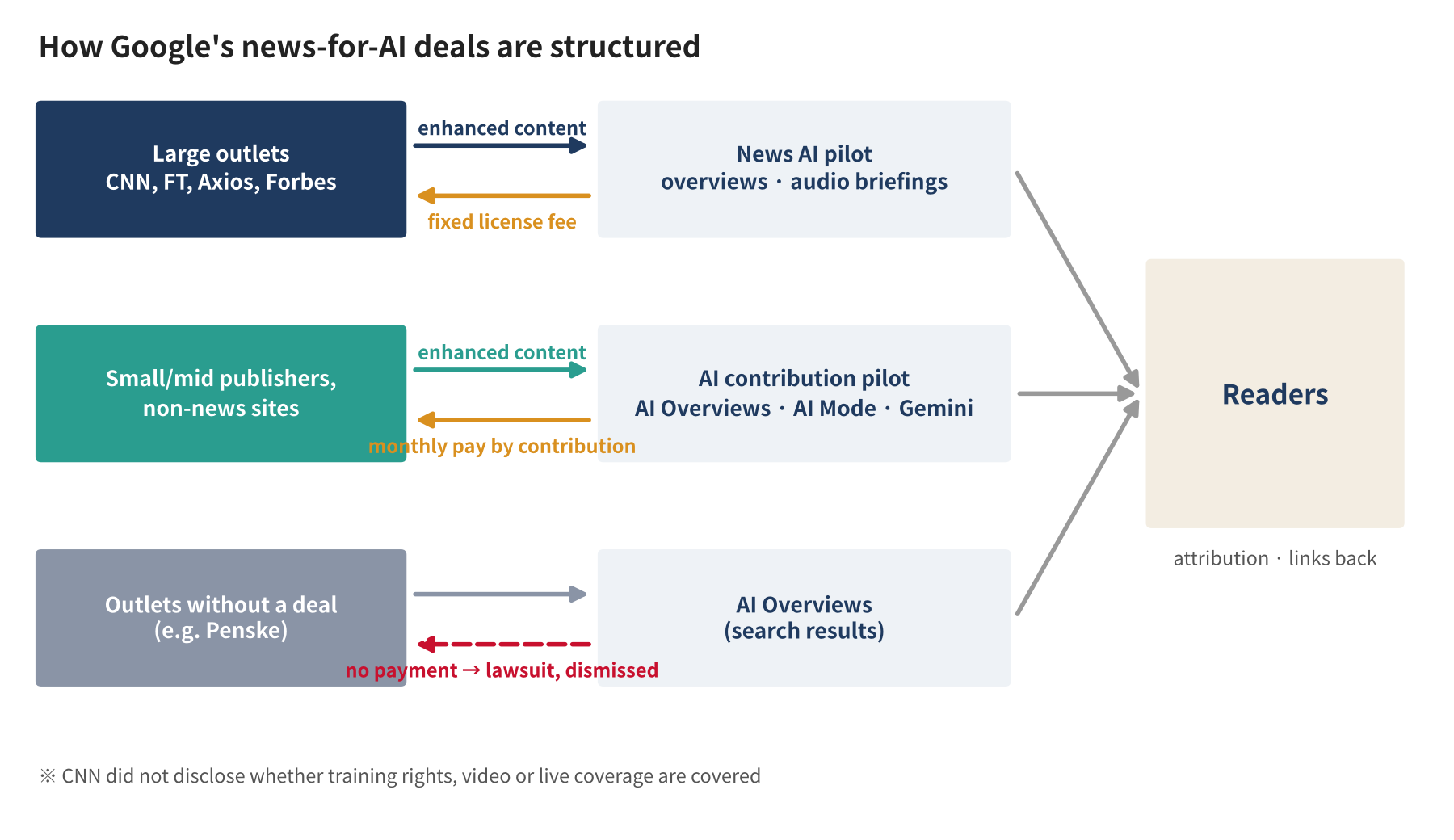
Google’s use of news in AI falls into three layers. The first is fixed licensing with large outlets. When outlets such as CNN, the FT and Axios hand over enhanced content, Google uses it in Google News article overviews and audio briefings and pays a flat fee for supply. The second is the AI contribution pilot in Search Console. When content from smaller publishers and non-news sites is used in AI Overviews, AI Mode or Gemini answers, Google judges its contribution and pays monthly. The third is publishers without a deal. Their stories are also summarized in AI Overviews on the search page, without separate payment, and some, like Penske, have sued and lost.
All three layers show readers attribution and links to the original. What differs is the basis for payment. The fixed license is based on “which feature the content is supplied to,” the contribution model on “how much an answer used it.” Penske argued in its complaint that publishers outside any deal cannot refuse AI Overviews if they want to stay visible in search. CNN’s deal belongs to the first layer, but because training rights and the inclusion of video and live coverage were not disclosed, it is not yet clear how much of CNN’s output even that layer covers.
CNN’s own structure has changed, too. Since Oct. 6, CNN has been part of Skydance along with CBS News. The text and video archives of two major U.S. news organizations now sit in the same company, and, as Thompson’s memo said, how they will be offered to AI companies has not been decided. The volume of content held by a single seller that AI companies must deal with has grown accordingly.
“An expectation is not an agreement”: judge dismisses Penske and Chegg antitrust suits
U.S. District Judge Amit Mehta in Washington, D.C., in a 41-page opinion dated Sept. 30, dismissed the antitrust suits that Penske Media and the education company Chegg brought against Google’s AI Overviews. Penske, which owns Rolling Stone, Billboard, Variety and The Hollywood Reporter, argued in September 2025 that Google used its search dominance to force publishers to let their articles be reused in AI Overviews, with loss of search visibility as the price of refusing.
The judge found no basis for concluding that an agreement existed in which Google promised search traffic in exchange for access to content. He also rejected the tying claim on the ground that AI Overviews is not a product separate from search, Forbes reported on Oct. 1. TheWrap reported that the dismissal allows the case to be refiled. When it sued, Penske said about 20% of Google results linking to its sites carried AI Overviews and that its affiliate revenue had fallen more than a third from its peak by the end of 2024, it said.
Sue Perplexity, license to Meta and Google: CNN’s two-track approach
CNN sued Perplexity for copyright and trademark infringement in the Southern District of New York on May 28. CNN alleged that Perplexity scraped more than 17,000 articles, videos and images without permission and bypassed measures to block crawlers. The two companies negotiated a license in 2025 but failed to agree. Advanced Television on May 29 described it as the first suit by a TV broadcaster against an AI company. “You can’t copyright facts,” Perplexity chief communications officer Jesse Dwyer told NPR.
On the other side are contracts. Meta signed AI agreements on Dec. 5, 2025 with CNN, Fox News, USA Today, Le Monde and others, so that its Meta AI chatbot attaches links to originals in real-time news answers, Reuters reported. Terms were not disclosed. The one deal with a known price is Meta’s three-year agreement with News Corp, which according to The Wall Street Journal is worth up to $50 million (about 66.6 billion won) a year and covers both chatbot answers and model training.
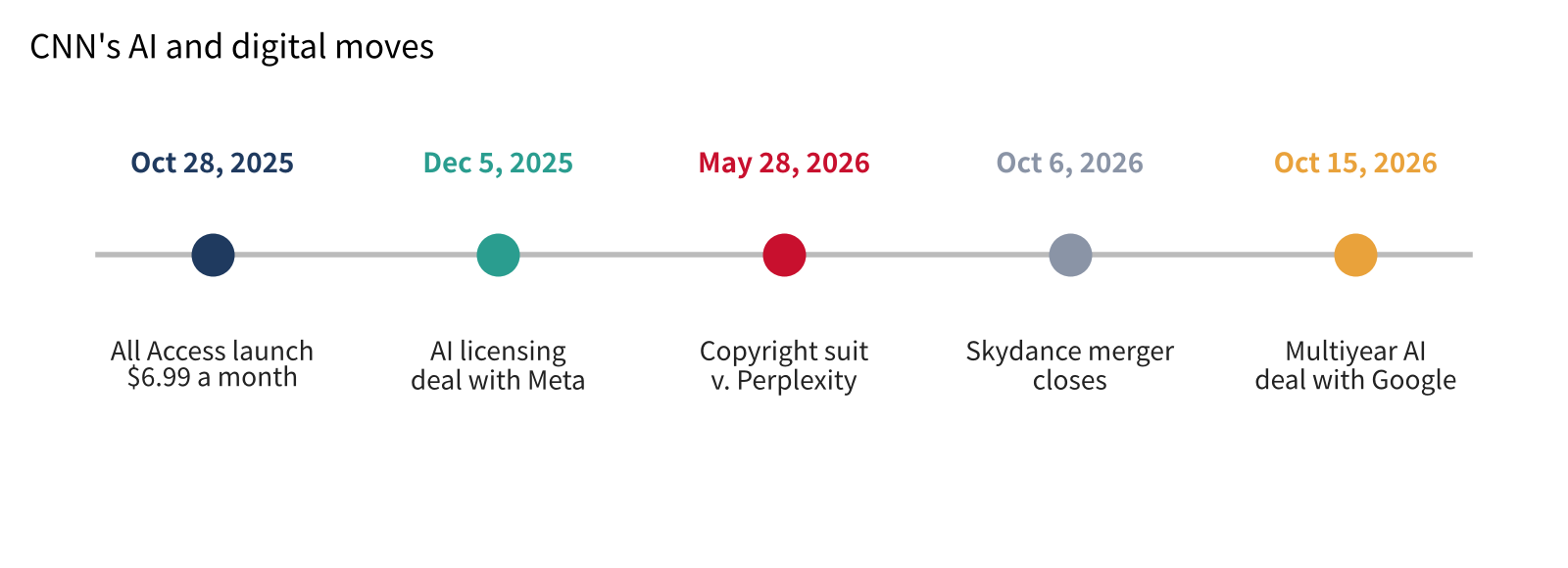
CNN’s parent changed as well. Paramount completed its $110 billion (about 146.5 trillion won) acquisition of Warner Bros. Discovery on Oct. 6 and renamed the company Skydance.
CNN and CBS News are now in one company, and in a settlement with state attorneys general it agreed to set up an independent editorial board overseeing both news organizations. CNN chief executive Mark Thompson said in a staff memo on Oct. 5 that the details of how CNN will operate within the new company had not been settled, Al Jazeera reported. Reuters reported on Oct. 15 that the Google deal was the first partnership announced since the merger.
How AI use of news content is paid for, compared. Sources: Google, Digiday, Reuters, Journalists Association of Korea and others
Korea’s TV and Naver one year and nine months into AI training litigation: a fight over contract terms
In Korea, payment for AI use of news is still being handled in court rather than by contract. On Jan. 14, 2025, the three terrestrial broadcasters KBS, MBC and SBS (지상파 3사) sued Naver (네이버) in the Seoul Central District Court (서울중앙지방법원), alleging it used their broadcast news without permission to train its generative AI HyperCLOVA X (하이퍼클로바X); citing copyright infringement and unfair-competition law, they sought damages and a ban on training. It was the first suit by Korean news organizations against a Big Tech company over unauthorized use of news data. Each broadcaster demanded 200 million won (about $150,000).
At the fourth hearing on April 9, Naver argued that the fact-reporting portions of news may not be protected by copyright and that its news partnership terms give it the right to use articles for AI training. The broadcasters countered by citing Naver CEO Choi Soo-yeon (최수연), who at the HyperCLOVA X launch on Aug. 24, 2023 introduced news as the highest-quality data needed for AI training. The Korea Broadcasters Association (한국방송협회) said that as Naver justified unauthorized use, other AI companies were putting licensing talks on hold.
At the fifth hearing on June 11, the Seoul Central District Court’s 63rd Civil Division (제63민사부), presided over by Judge Lee Kyu-young (이규영), decided to examine Naver officials as witnesses to establish how a 2018 Clova speaker addendum and the 2020 news partnership terms were concluded. The broadcasters have also sued OpenAI, but as of June not even a first hearing had been scheduled.
Newspapers are taking a fair-trade approach. The Korea Newspaper Association (한국신문협회) said in February 2025 that it would report Naver’s use of news for training to the Fair Trade Commission (공정거래위원회); Naver says it has not used news without publishers’ consent since revising its terms in June 2023. Individual agreements have also appeared. In April 2025 Naver signed an AI agreement with Brilliant Korea, the holding company of Money Today (머니투데이). “No money changes hands,” Money Today CEO Kang Ho-byung (강호병) said, explaining that articles are supplied in place of development costs. At a National Assembly (국회) seminar on July 22, a proposal was made to create a public-media-led “News Suppliers Association (뉴스공급자협회)” with use-based pricing for training, citation, display and reprocessing.
What it means for Korean broadcasters
What carries a price in the Google–CNN deal is not a bulk set of training data but content that goes into specific features: article overviews and audio briefings. In contrast, the dispute between Korea’s three terrestrial broadcasters and Naver remains stuck on whether past training was covered by the 2020 news partnership terms. Abroad, the market has moved on to pricing each future feature; in Korea, it is still arguing over the legality of past use. When Korean broadcasters come to the table, they first need a price list by use that sets separate prices for training, summary display, audio reprocessing, video clips and live pictures. The use-based pricing proposed at the July 22 National Assembly seminar points the same way.
Broadcast content carries more layers of rights than text articles. A single terrestrial news item contains the reporter’s package, the anchor’s voice, footage, captions and a script, mixed with rights belonging to interviewees and third-party video. Because Google’s audio briefing overlaps with formats broadcasters already make, such as radio news and headline briefings, broadcasters holding audio assets have more to negotiate with than newspapers. By the same token, sorting out which assets they hold and with what rights status becomes a precondition for any deal before offering them to AI. CNN’s silence on whether video and live coverage are included can be read as a sign that the market has not yet set a price for this part.
They also need to decide how to negotiate. Google chose individual licenses for large outlets and contribution payments for smaller ones, and an industry executive quoted by Digiday worried that small recurring payments could lower leverage for larger deals. In Korea, too, Naver signed an individual agreement in April 2025 with Money Today’s holding company, trading articles for technology with no money involved.
If regional terrestrial and smaller broadcasters negotiate one by one, the same pattern could repeat. The Korea Broadcasters Association already sent a letter in December 2023, on behalf of its 39 terrestrial member stations, to Naver, Kakao, Google Korea and Microsoft Korea demanding separate compensation talks. Whether this joint channel can expand from litigation to price negotiation will determine regional broadcasters’ leverage.
The CNN case also shows that lawsuits and contracts go together. When licensing talks with Perplexity broke down in 2025, CNN sued in May, while signing with Meta and Google over the same period. The Penske ruling confirmed that the argument “we were not guaranteed search traffic” is hard to win compensation with in court. Korean broadcasters, too, would be more in line with the case law if they built their contract logic on payment for use of content rather than lost traffic. With the three broadcasters having sued OpenAI as well as Naver, the next variable is how much weight these cases carry in negotiations with other AI companies.
They also need evidence. Publishers abroad use quantified data on search-traffic changes, such as Chartbeat’s, as negotiating material: Google Search referrals down 34% in a year, small publishers down 60% over two years. If Korean broadcasters track their own news traffic via portals, search and YouTube, and how often AI services cite their content, they will have a starting point for price negotiations. None of the new partners Google named on Oct. 15 is Korean.
Changes in the revenue structure must also be weighed. According to Korea Broadcast Advertising Corp. (KOBACO, 한국방송광고진흥공사) figures cited in a Sept. 10 column in Sports Kyunghyang (스포츠경향), terrestrial TV advertising spending is falling from 1.3762 trillion won (about $1.034 billion) in 2022 to 827.1 billion won (about $621 million, forecast) in 2026.
CNN is growing its $6.99-a-month All Access subscription and AI licensing together as advertising and pay-TV carriage fees shrink. For Korean broadcasters, too, AI fees are a candidate to offset falling advertising, but contract prices are unlikely to form until the lawsuits over the legality of training conclude. Trying feature-specific pilot deals first, separate from the litigation, to establish prices is a sequence worth considering.
Outlook: leverage comes from the right to opt out; the next issue is the form of consent
The variable that will set the price of the next deal is whether publishers can opt out of AI features. After Britain’s Competition and Markets Authority (CMA) made it a requirement, Google on Aug. 31 extended the generative AI search opt-out in Search Console to every site worldwide. Turning it on leaves regular search rankings untouched and removes a site only from the AI features of AI Overviews, AI Mode and Discover. The structure Penske described in its complaint, in which staying in search meant accepting AI Overviews, has changed at least in form. The cost of leaving is clear, too. Sites that opt out receive no traffic or impressions from these features, and AI training use is managed separately from this setting. For outlets negotiating fixed licenses, this switch becomes a card that forces both sides to weigh what each would lose if the publisher walked away.
Meta is going the other way. Meta’s new commercial terms, which take effect Oct. 30, state that content from websites linked to business accounts may be collected and used to “train” Meta products. There is no way to reject this clause alone before it takes effect; continuing to use the account counts as consent. Meta says sites can keep managing access through robots.txt, but legal experts said the terms give Meta room to argue that they take precedence over those blocking instructions. While Google widens the “right to opt out,” Meta is widening “consent by terms of service.” The courts opened another door. On Sept. 29 the U.S. Court of Appeals for the Third Circuit upheld a trial court’s finding, in Thomson Reuters’ suit against the legal AI company Ross Intelligence, that unauthorized copying for AI training was not fair use. It is the first time a U.S. appeals court has ruled on fair use in AI training. The court found that a licensing market for AI training data, including case-law headnotes, is forming quickly. Because the case involved a search tool rather than generative AI, it is hard to transfer directly to chatbot litigation. Still, one day before Penske’s antitrust suit was dismissed, publishers gained a precedent to lean on on the copyright side.
The Korean litigation turns on the same point. What Naver cites as the basis for its AI training rights is the 2020 news partnership terms. The question of whether a platform’s terms of use can amount to consent to AI use has the same structure as the U.S. debate over Meta’s terms.
That means Korean broadcasters should not be seen simply as a step behind their counterparts abroad. Rather than waiting for the outcome of the lawsuits, the immediate task for broadcasters is to review the terms they have already agreed to and the refusal tools they can use now. The list includes Meta’s new business-account terms, the AI clauses in portal and video-platform partnership terms, Google Search Console’s generative AI opt-out and the scope of their robots.txt blocking. The price of the next deal will be set as much by what a broadcaster has consented to and where it can opt out as by the quality of its content.
English — Image caption / photo credit
Photos: Ken Lund, “CNN Center, Atlanta, Georgia” (2011), CC BY-SA 2.0; The Pancake of Heaven!, “Googleplex HQ” (2016), CC BY-SA 4.0, via Wikimedia Commons. Original photographs were cropped, combined and overlaid with text. The edited thumbnail is licensed under CC BY-SA 4.0. Archive photographs used for illustration; they do not depict the agreement’s signing.
Originals: CNN photo · Google photo

