

Digital Future Institute forum at the National Assembly… Committee chair Song Gi-heon pledges a content-promotion law; AI production grants of ₩19.8 billion sit beside ₩3.1 trillion for physical AI
At a Nov. 17 forum at the National Assembly, speakers said AI cuts costs but shifts the bottleneck to review and rights, while TV ad revenue fell from ₩3.15 trillion to ₩2.01 trillion in four years. Committee chair Song Gi-heon pledged a content-promotion law and broad budget support.
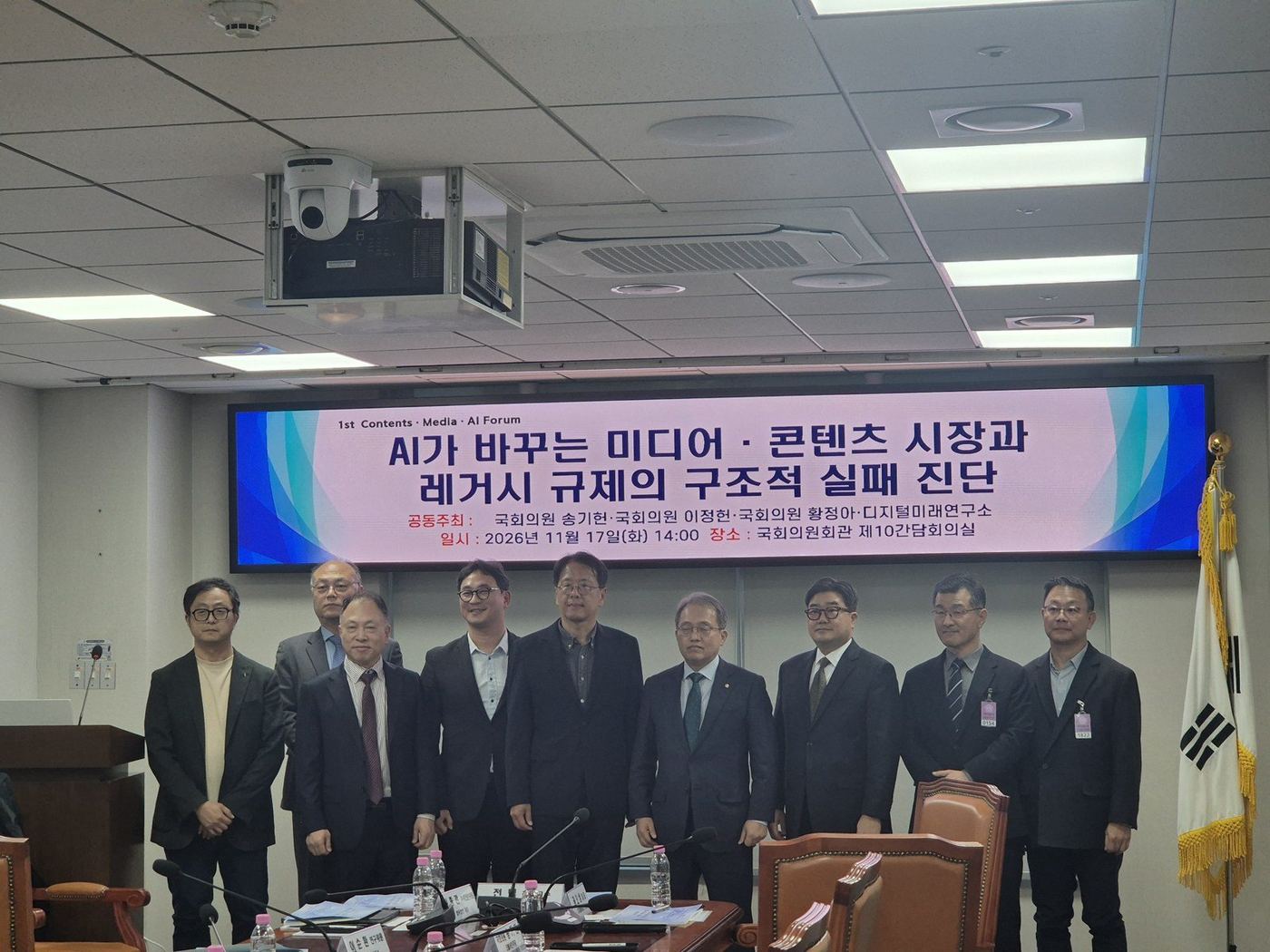
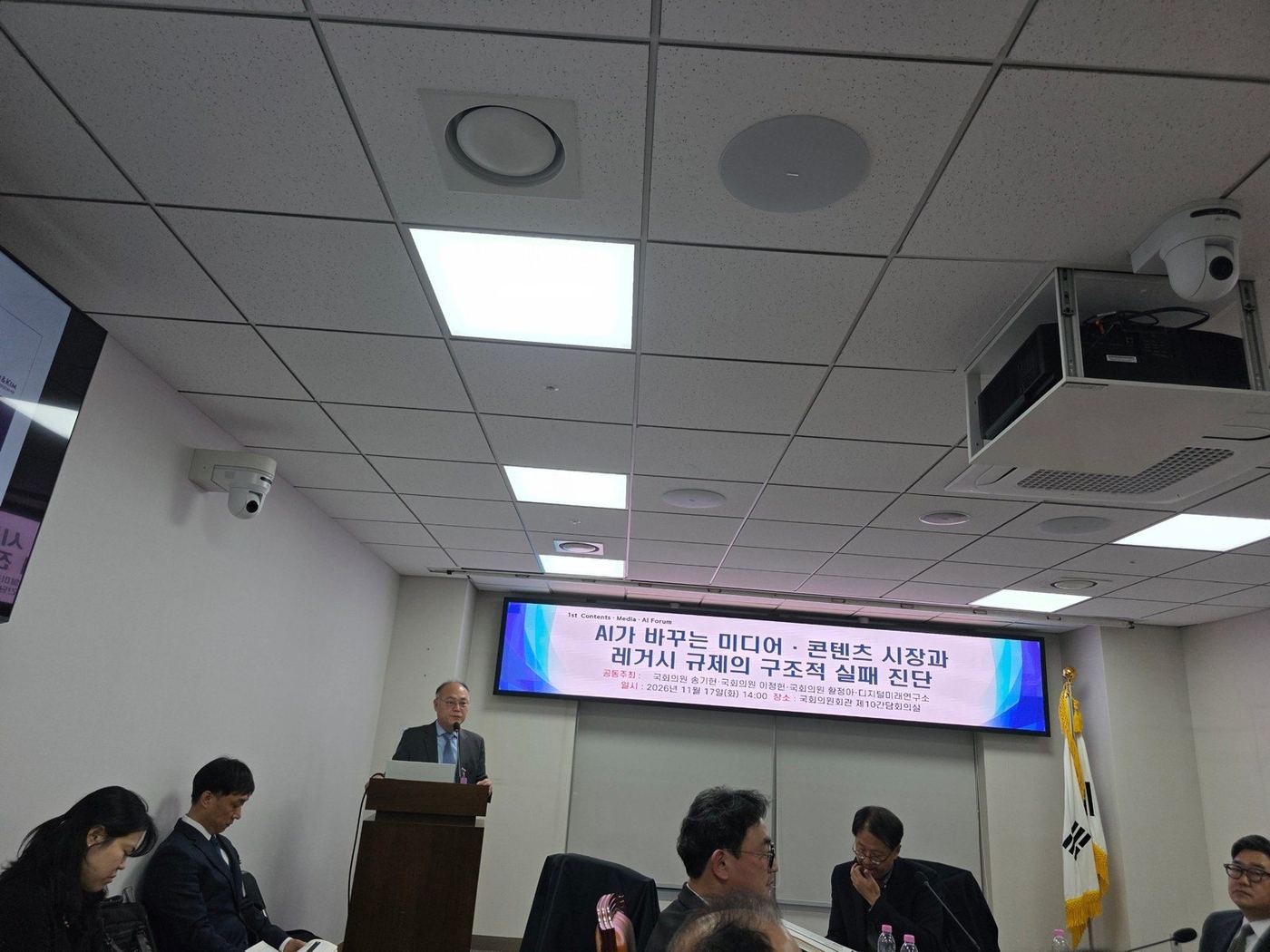
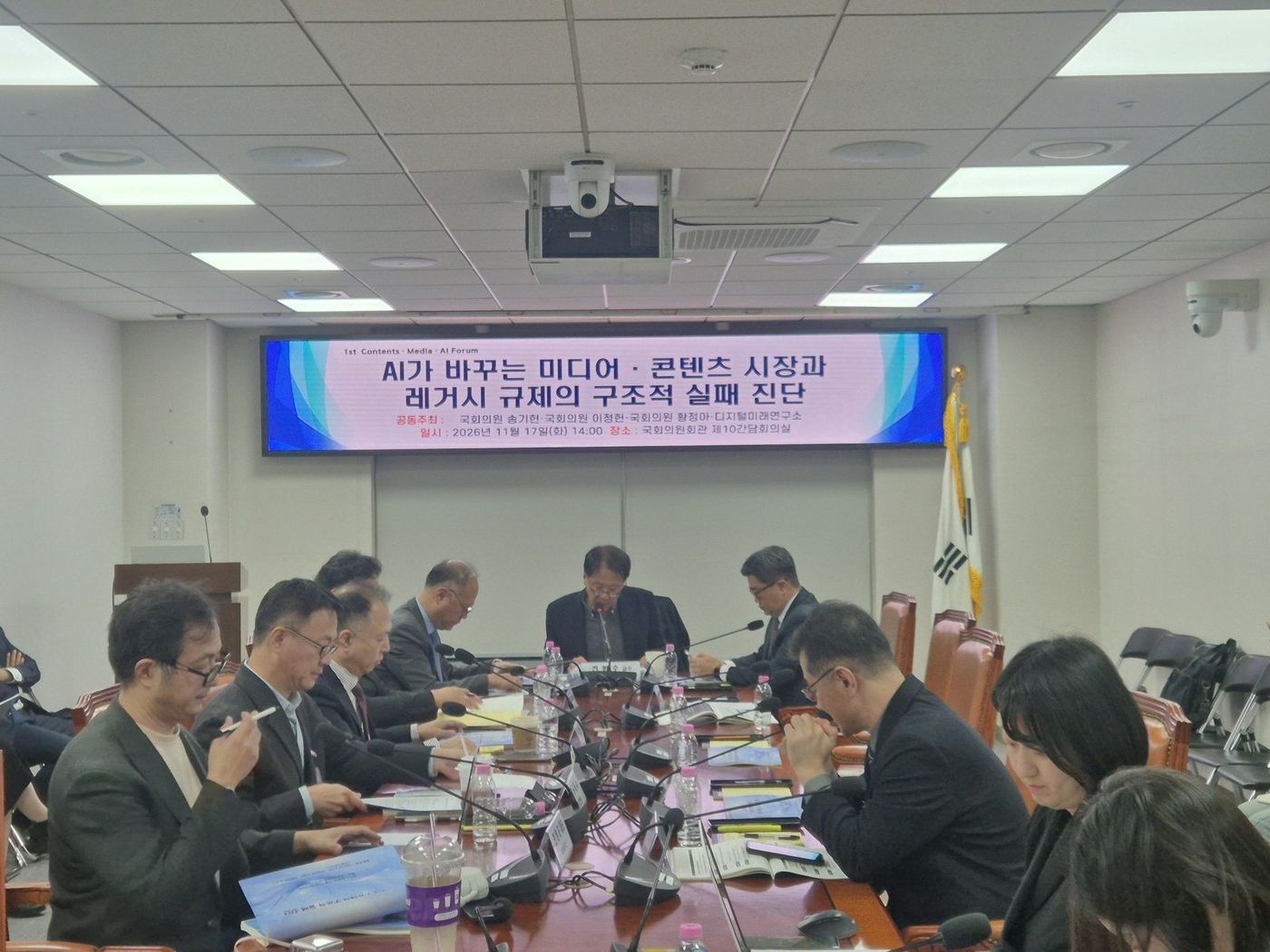
How AI is reshaping the media and content market, and how legacy regulation has failed to keep up, set the agenda at the first Contents·Media·AI Forum at the National Assembly on Nov. 17. The forum met in Conference Room 10 of the Assembly Members' Office Building in Seoul. The Digital Future Institute (디지털미래연구소) co-hosted it with Song Gi-heon (송기헌), chair of the Assembly's Science, ICT, Broadcasting and Communications Committee, and Democratic Party lawmakers Lee Jeong-heon (이정헌) and Hwang Jung-a (황정아).
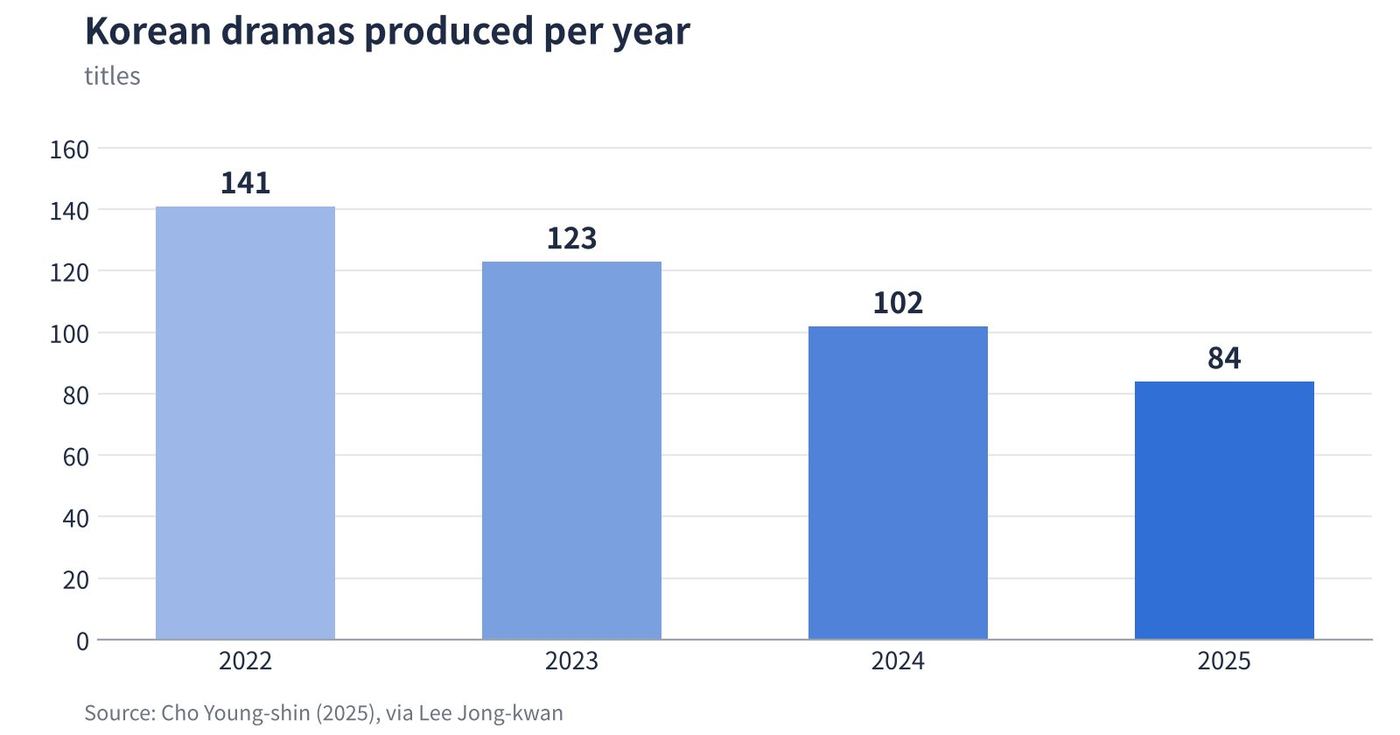
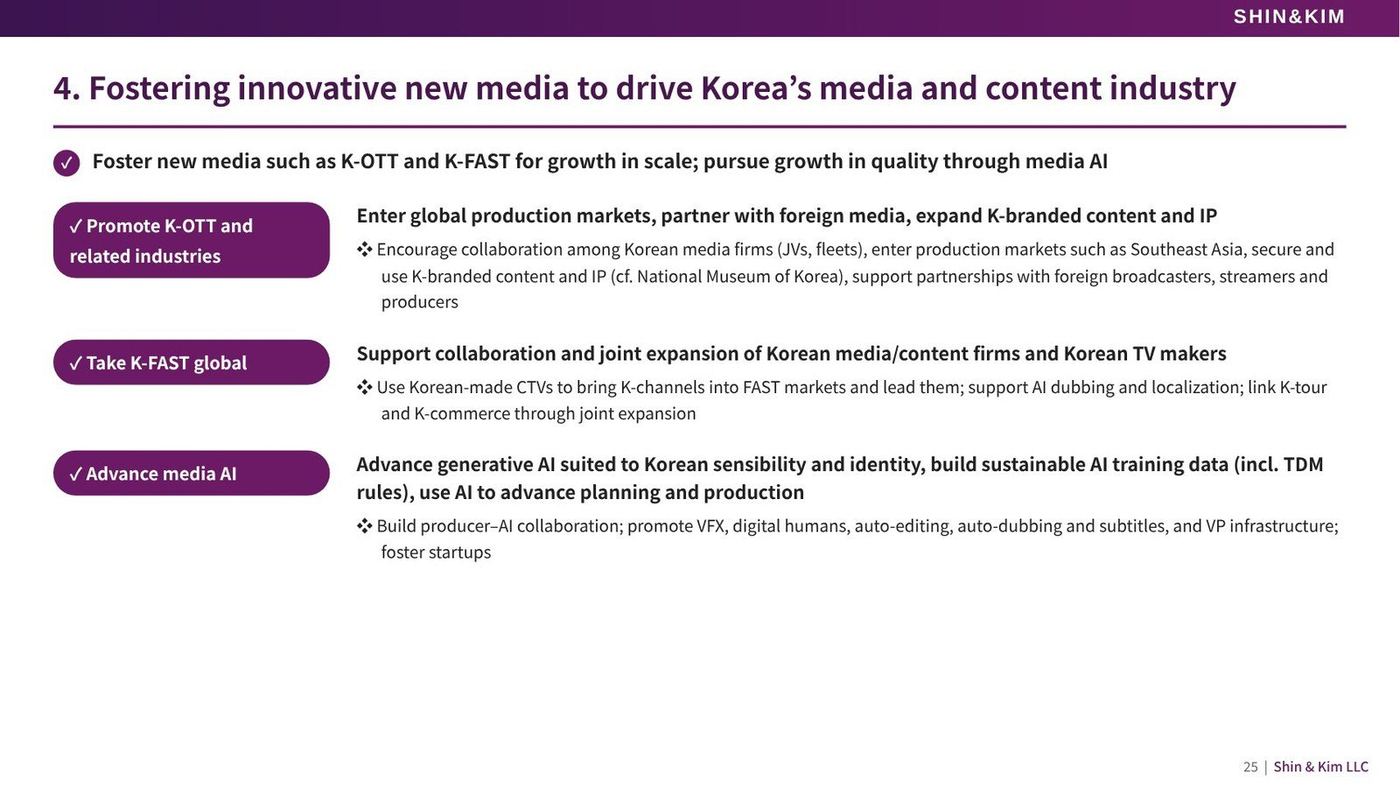
Two presentations examined AI production and broadcast funding. Lee Sun-hwan (이순환), a research fellow at the institute, presented an analysis of AI-driven content production and said AI has cut production costs and time but left the costs of choosing, editing, checking and clearing rights after generation largely untouched. Lee Jong-kwan (이종관), a senior adviser at law firm Shin & Kim (법무법인 세종), presented a diagnosis of the competitiveness crisis in Korea's content industry. He noted that broadcasting revenue has fallen three years in a row and Korean drama output dropped from 141 titles in 2022 to 84 in 2025. He urged lawmakers to rebuild media law around industrial policy rather than regulation.
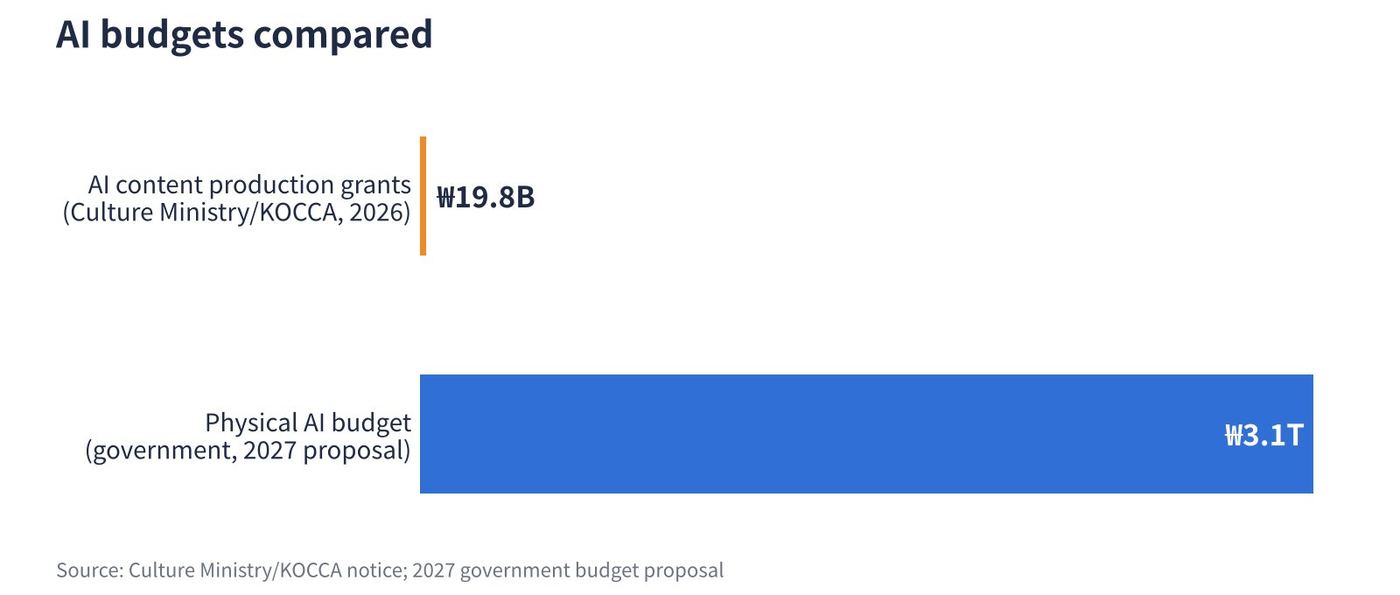
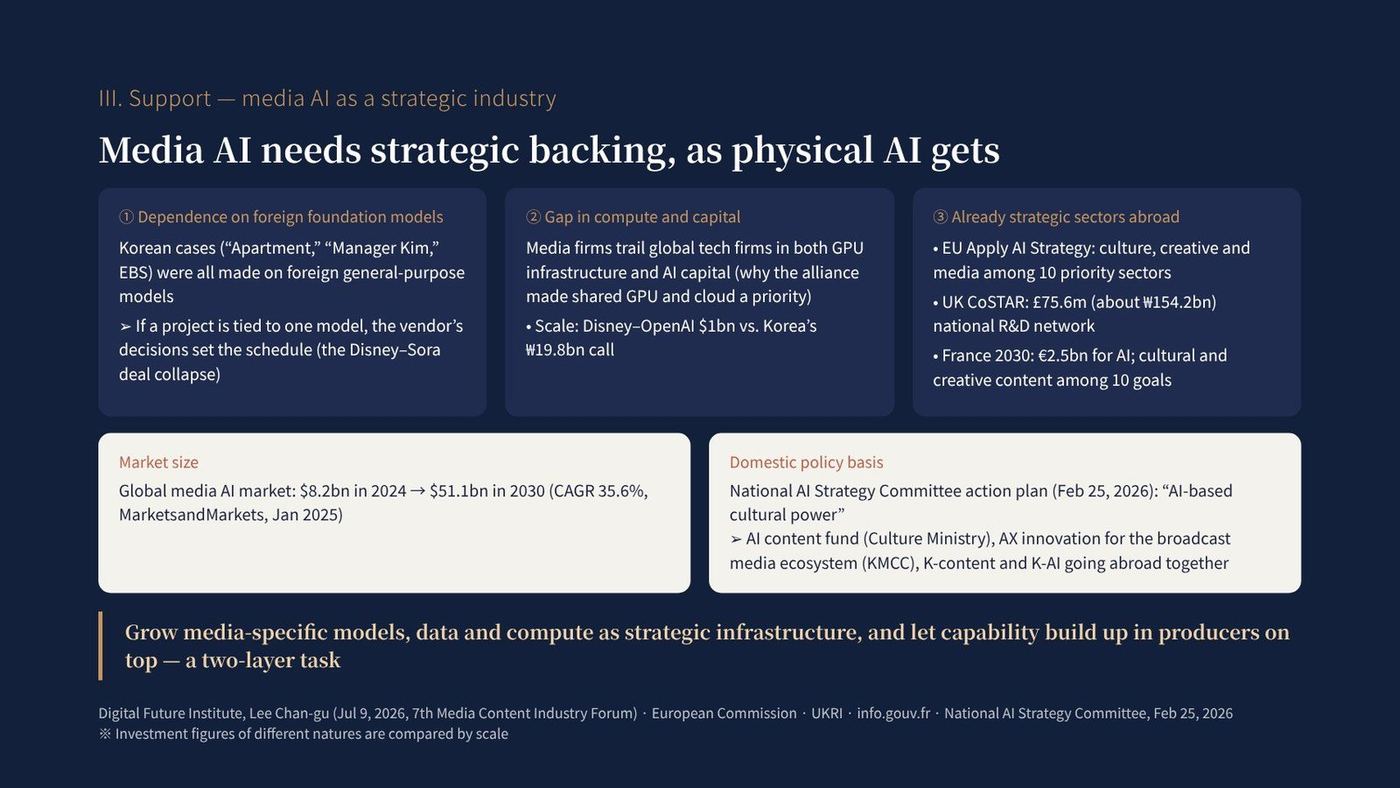
The forum also compared budgets. The Ministry of Culture, Sports and Tourism and the Korea Creative Content Agency (KOCCA, 한국콘텐츠진흥원) set aside ₩19.8 billion ($14.8 million) for AI content production in 2026. The government's 2027 budget proposal allocates ₩3.1 trillion ($2.32 billion) to physical AI. "Media AI is not being supported with the same strategic approach as physical AI," Lee Sun-hwan said.
Song, who stayed through the panel, said legislation to promote the content industry should come quickly and that budgets should support the industry broadly rather than through narrowly earmarked programs. Jeon Beom-su (전범수) of Hanyang University chaired the panel. The panelists were Kwak Gyu-tae (곽규태) of Soonchunhyang University, Seon Ho (선호), a director at CJ ENM, Im Jeong-su (임정수) of Seoul Women's University and Jung Han (한정훈), CEO of K-EnterTech Hub.
2,000 shots generated, about 300 delivered… The bottleneck moves to selection and review
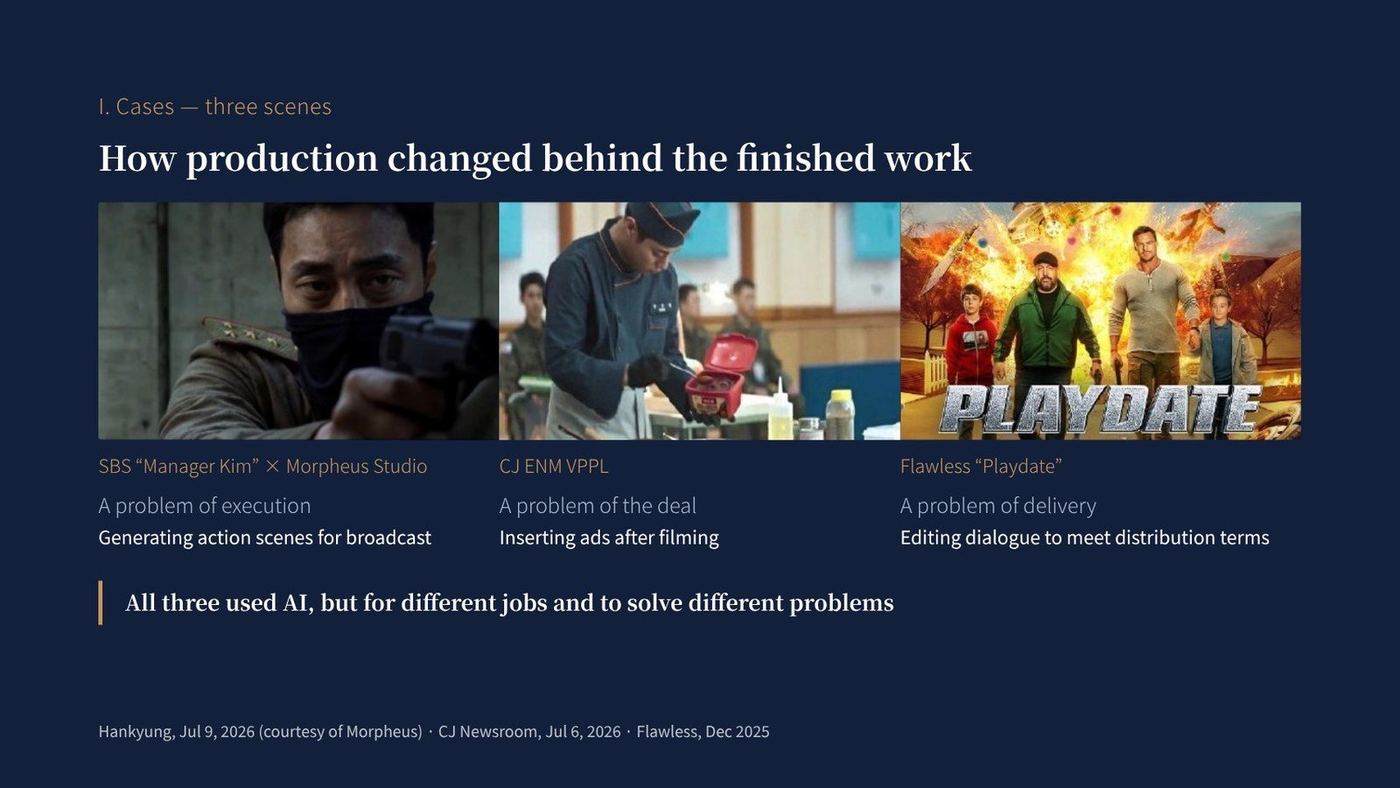
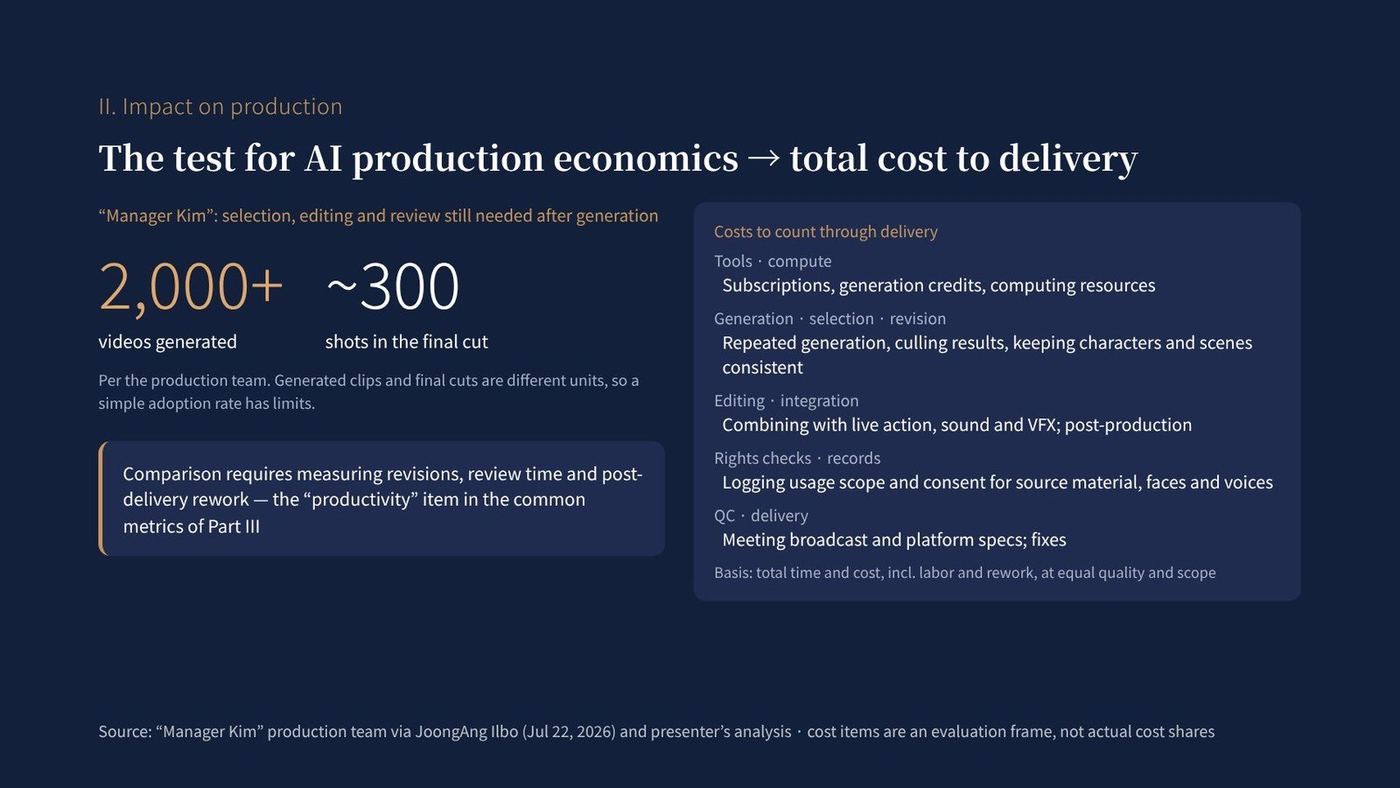
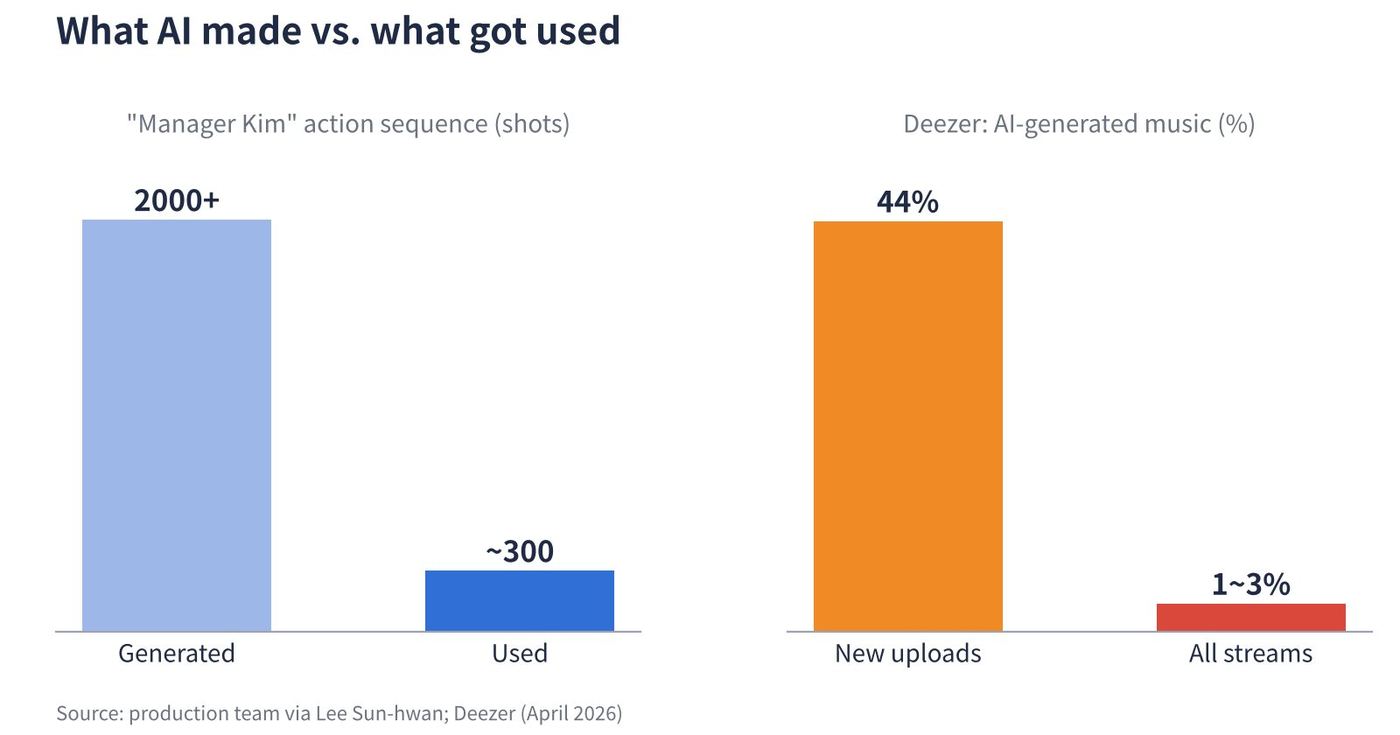
SBS's Friday-Saturday drama "Manager Kim" (김부장) made a roughly three-minute action sequence from the lead character's past with AI. AI video company Morpheus Studio (모피어스 스튜디오) did the work, and SBS production arm Studio S told Korea JoongAng Daily the sequence cut production costs by more than 60%. The team generated more than 2,000 shots and used about 300 in the final cut, according to its account as cited by Lee Sun-hwan. The first draft took two months.
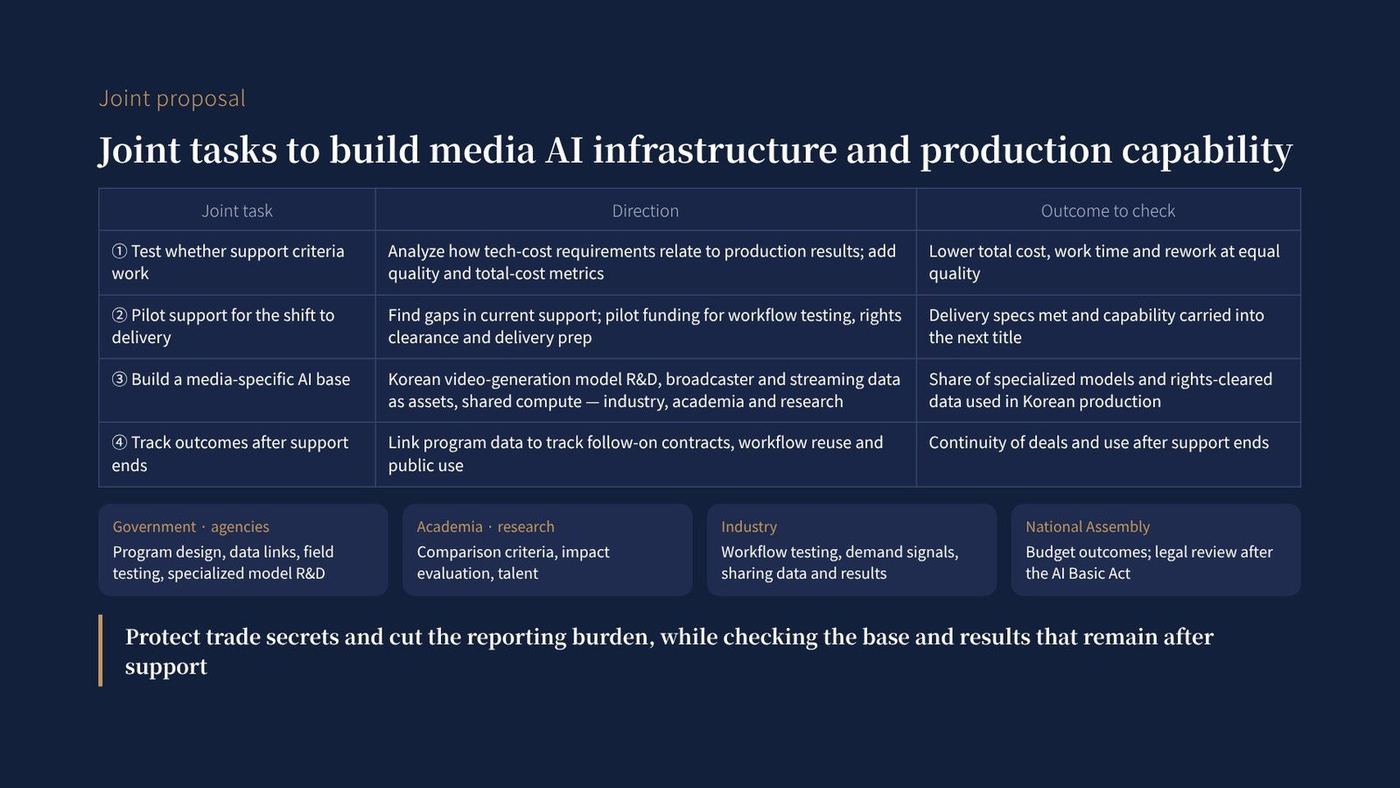
"Even with AI, review to pick out the right shots is essential," Lee said. AI has sped up mock-ups and previsualization, some VFX, and first drafts of subtitles, translation and dubbing. The new bottleneck is deciding which of the flood of generated material to use, how to fix it and under what rights. He compared it to reporting: "Organizing material quickly is a different thing from checking it and publishing a story under your own name."
AI's economics should be measured as "the total cost through delivery," Lee said, not by the price of a tool subscription. Delivery is not sending a file. It means meeting a broadcaster's or platform's specs on picture, loudness, paperwork and quality control so the work can actually air. "Cutting production costs is not the goal," he said. What should stay with the producer after support ends is the ability to make the next project: documented methods, revision records, staff skilled in AI and material with cleared rights.
EBS's "AI Short Theater" (EBS AI 단편극장), released in June 2025, was the first AI series a Korean broadcaster made entirely in-house, yet one usable image could take 200 to 300 regenerations. CJ ENM used Google's Imagen, Nano Banana and Veo to make "Apartment" (아파트). It also introduced virtual product placement (VPPL): actors are filmed holding an unbranded jar of gochujang, and the brand is added in post-production. Advertisers can now decide after the shoot, but Lee said approval rights, revenue splits and the scope of reuse for actors and source works must be settled by contract first. CJ ENM's AI Content Alliance, launched in February, brings together 13 AI production companies and five educational institutions.
Four to five months of work in two weeks… 44% of uploads, 1–3% of listening
The team behind Amazon's "House of David" took previsualization footage that would normally be thrown away, upscaled it with AI and used it in the finished show. Creator Jon Erwin told Variety the Goliath origin sequence took a couple of weeks, against perhaps four or five months by traditional methods. Netflix has many titles that use generative AI, but its guidelines define AI as a support tool and require approval where an actor's likeness or third-party rights are involved. Lee said the level of AI use varies by platform. AI company Flawless changed actors' lip movements and dialogue in the film "Playdate" to remove profanity and lower its rating without reshoots.
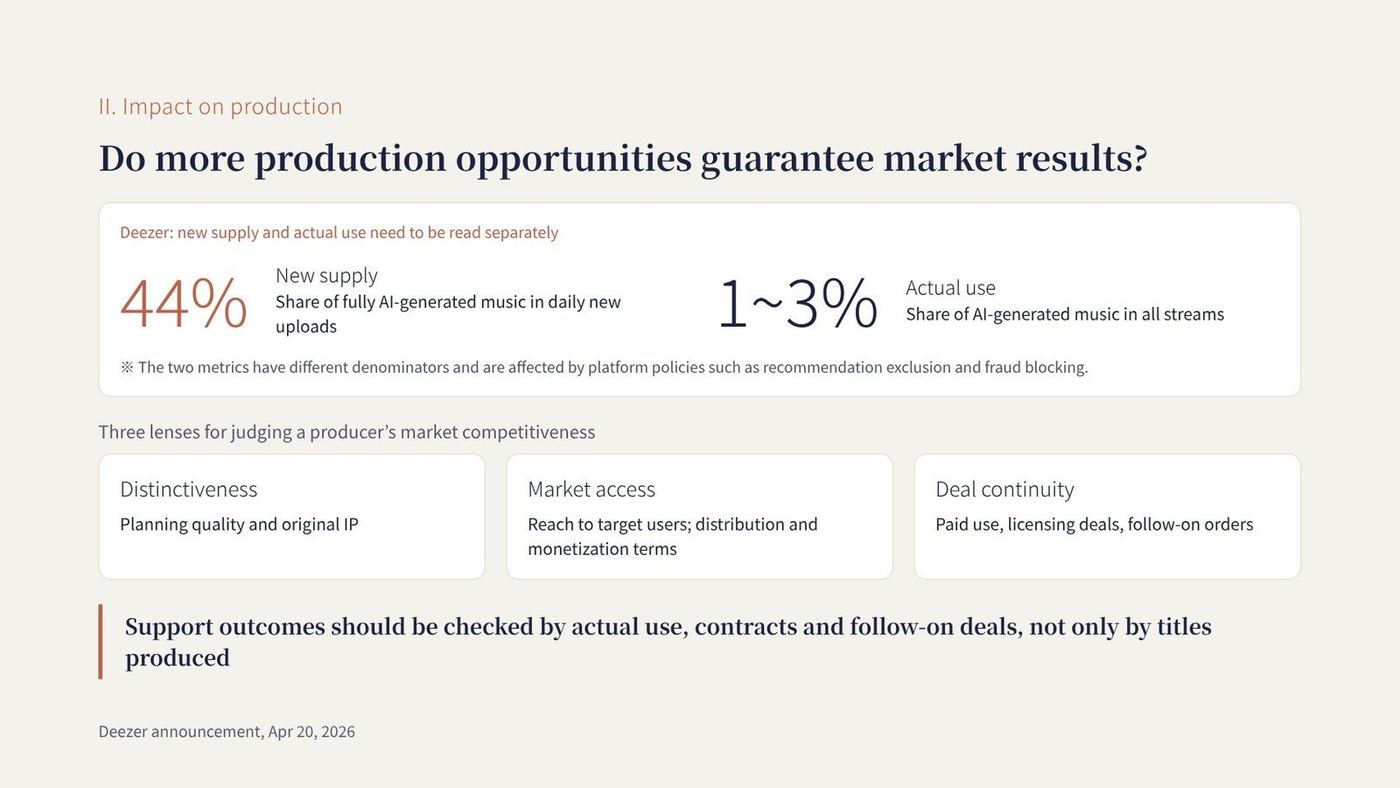
Music streaming service Deezer said on April 20 that about 75,000 fully AI-generated tracks, or 44% of daily uploads, arrive on its platform each day. AI music accounted for only 1% to 3% of total streams, and Deezer keeps it out of algorithmic recommendations. In China's micro-drama market, more than 95% of the 128,000 new titles in the first quarter of 2026 were made with AI, but only 0.48% of 220,000 titles passed 100 million views. "Who actually watched matters far more than how many more titles were made," Lee said, urging grant programs to track signed contracts and follow-on orders.
Audience acceptance varied. AI has spread fastest in work viewers do not see, such as dubbing: more than 6 million people were watching at least 10 minutes a day of YouTube's auto-dubbed content as of December 2025. When a Polish radio station replaced its hosts with AI, the backlash forced the AI hosts off the air within a week. Prediction-market platform Kalshi's AI ad during the NBA Finals passed 3 million views in a week, while Coca-Cola's AI Christmas ad drew "soulless" reactions for a second straight year. Disney's planned $1 billion investment in OpenAI fell apart after OpenAI announced in March that it was shutting down its Sora video app. "When a project is tied to a specific model, the vendor's decisions become the production schedule," Lee said.
₩19.8 billion for AI production, ₩3.1 trillion for physical AI… "The media AI bill hasn't arrived"
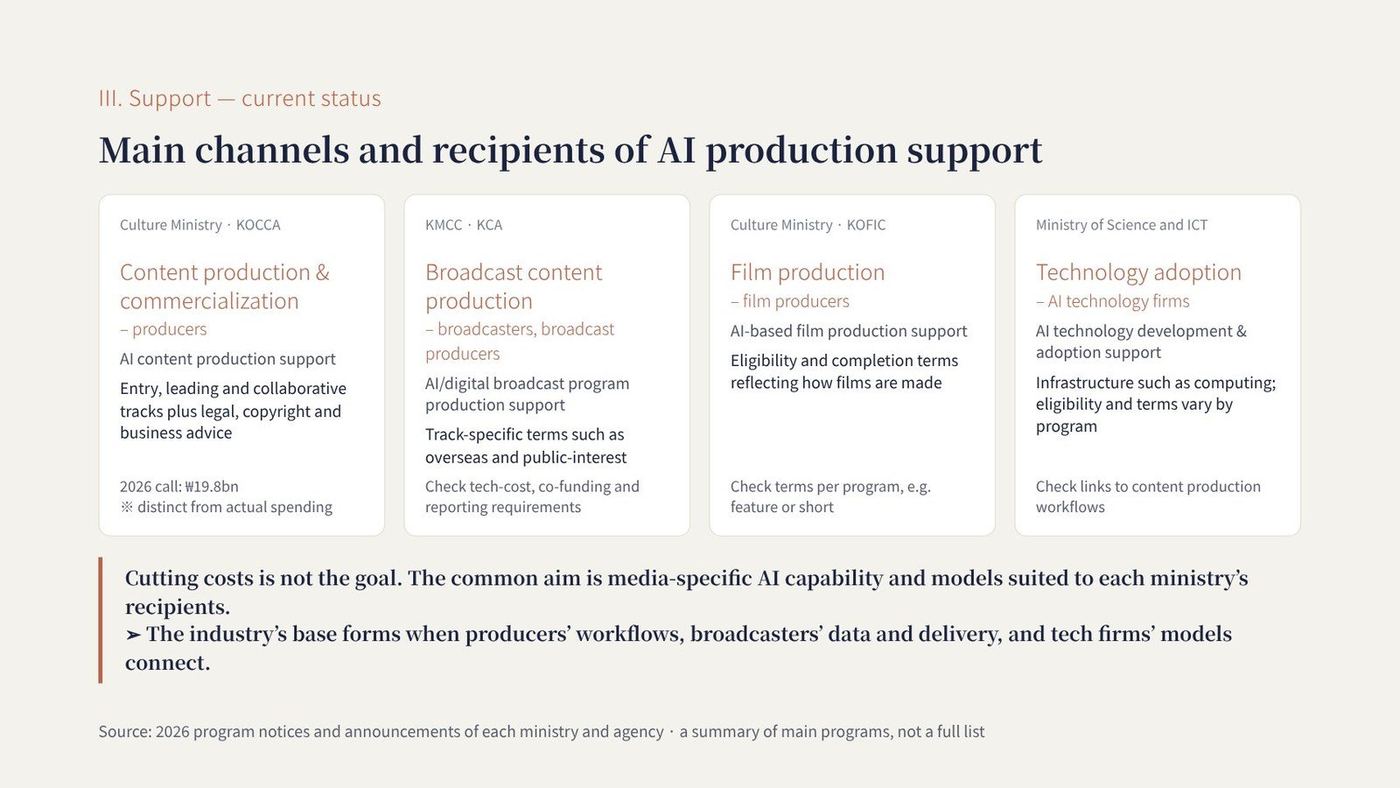
Korea's AI production support is split across four channels: KOCCA's AI content production grants under the culture ministry; broadcast program grants from the Korea Communications and Media Commission (KMCC, 방송미디어통신위원회) and the Korea Communications Agency (KCA, 한국방송통신전파진흥원); the Korean Film Council's (KOFIC, 영화진흥위원회) AI film grants; and the Ministry of Science and ICT's AI adoption programs. Their legal bases differ, too, split between the Content Industry Promotion Act and the AI Basic Act. Lee said it remains unclear whether the science ministry's technology pilots carry through to real productions.
The KMCC's overseas and public-interest tracks require at least 20% of each grant to be spent on AI and digital technology. Lee said there is no way to reward a producer who achieves the same quality with less technology spending, and urged a rule change so efficiency is not penalized. He called for pilots of new production processes, rights clearance and delivery readiness, market entry and follow-on use, and shared infrastructure such as media-specific models, data and GPUs. Britain has put about ₩154.2 billion ($115.2 million) into a national collaborative R&D network, he noted.
The legal framework is still incomplete. The culture ministry's AI Content Promotion Act was supposed to take concrete shape this year but has not appeared, Lee said. Producers need to know what support they can get, what data they can use, what they must label and whose approval they need before they can use AI with confidence. He added that "Apartment," "Manager Kim" and the EBS series were all built on foreign general-purpose models.
TV ad revenue down from ₩3.15 trillion to ₩2.01 trillion… "Rich outside, poor at home"
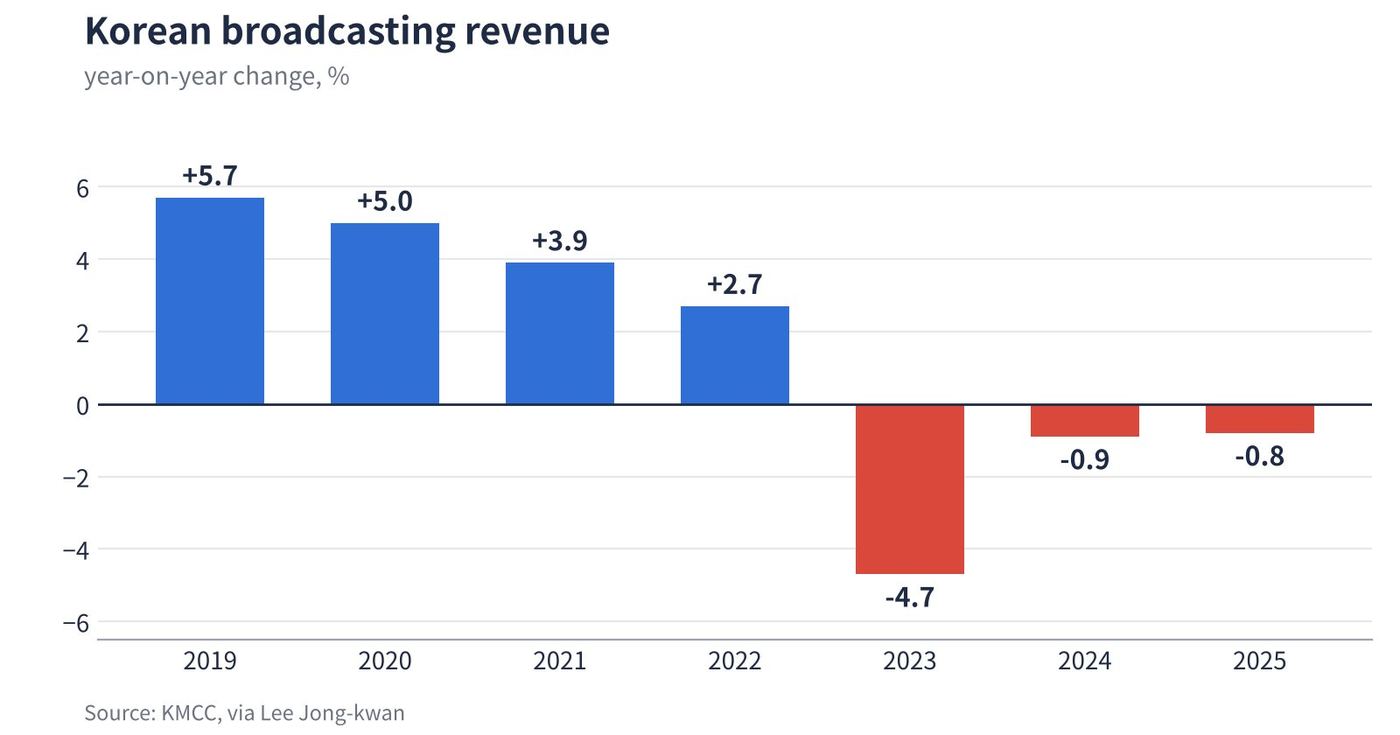
Lee Jong-kwan summed up Korea's media market as "rich outside, poor at home," with money no longer flowing into media. Korean content is popular abroad while the domestic market shrinks. Broadcasting revenue fell 4.7% in 2023, 0.9% in 2024 and 0.8% in 2025, to ₩18.65 trillion ($13.94 billion). Broadcast advertising fell from ₩3.15 trillion in 2021 to ₩2.01 trillion in 2025, while digital advertising grew from about ₩8 trillion to ₩10.7 trillion. In the 2025 financial results for broadcasters released by the KMCC in June, broadcast ad revenue was down 12.3% from a year earlier. Pay-TV subscriptions fell for the first time in 2024 and declined faster in 2025, to 36.23 million.
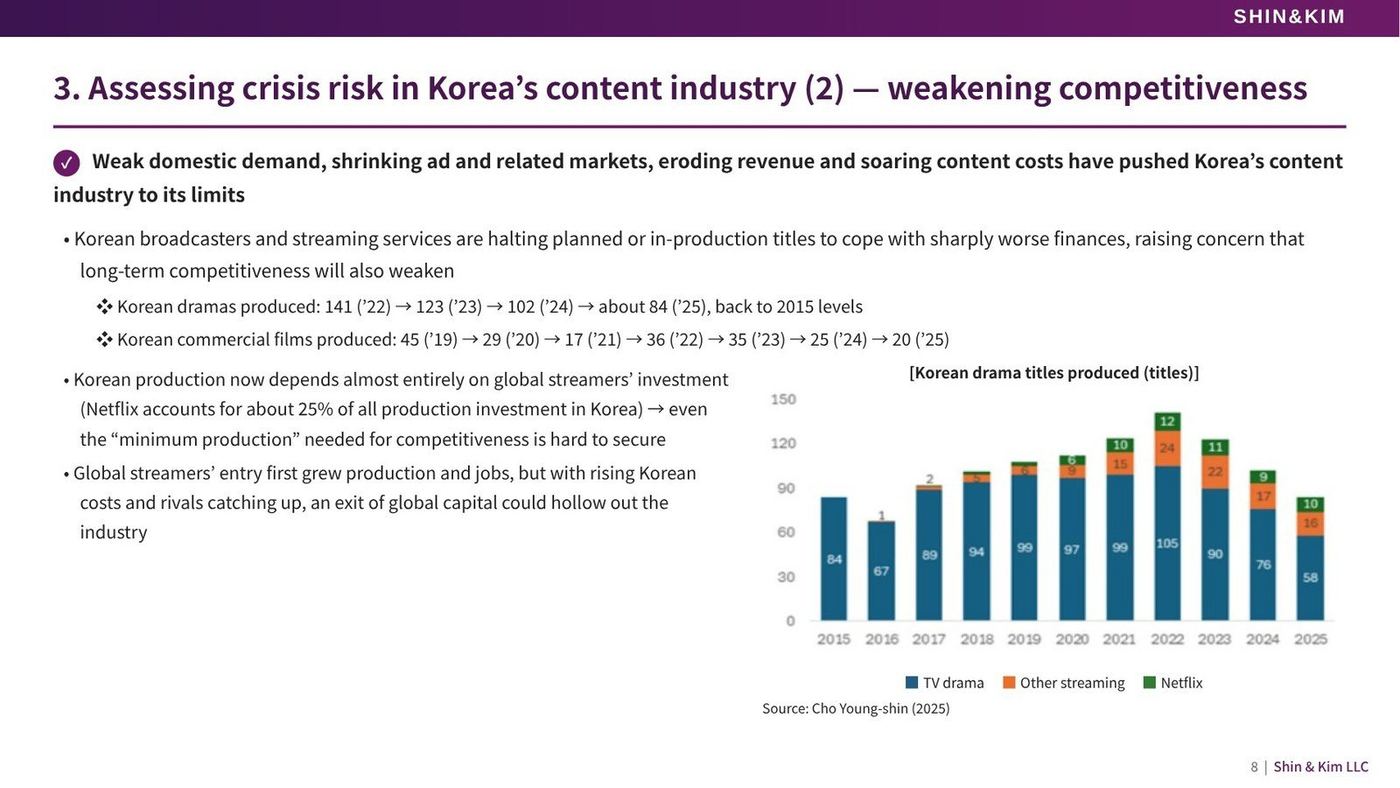
Broadcasting revenue equals about 0.70% of GDP, Lee Jong-kwan said, "smaller than Korea's fried-chicken market." When cable gave way to IPTV, Korean companies replaced Korean companies and the money stayed at home. Now Korean companies are being replaced by foreign ones, and broadcast revenue is flowing out of the country, he said. Netflix accounts for about 25% of all production investment in Korea, but that spending does little to build secondary and tertiary markets at home.
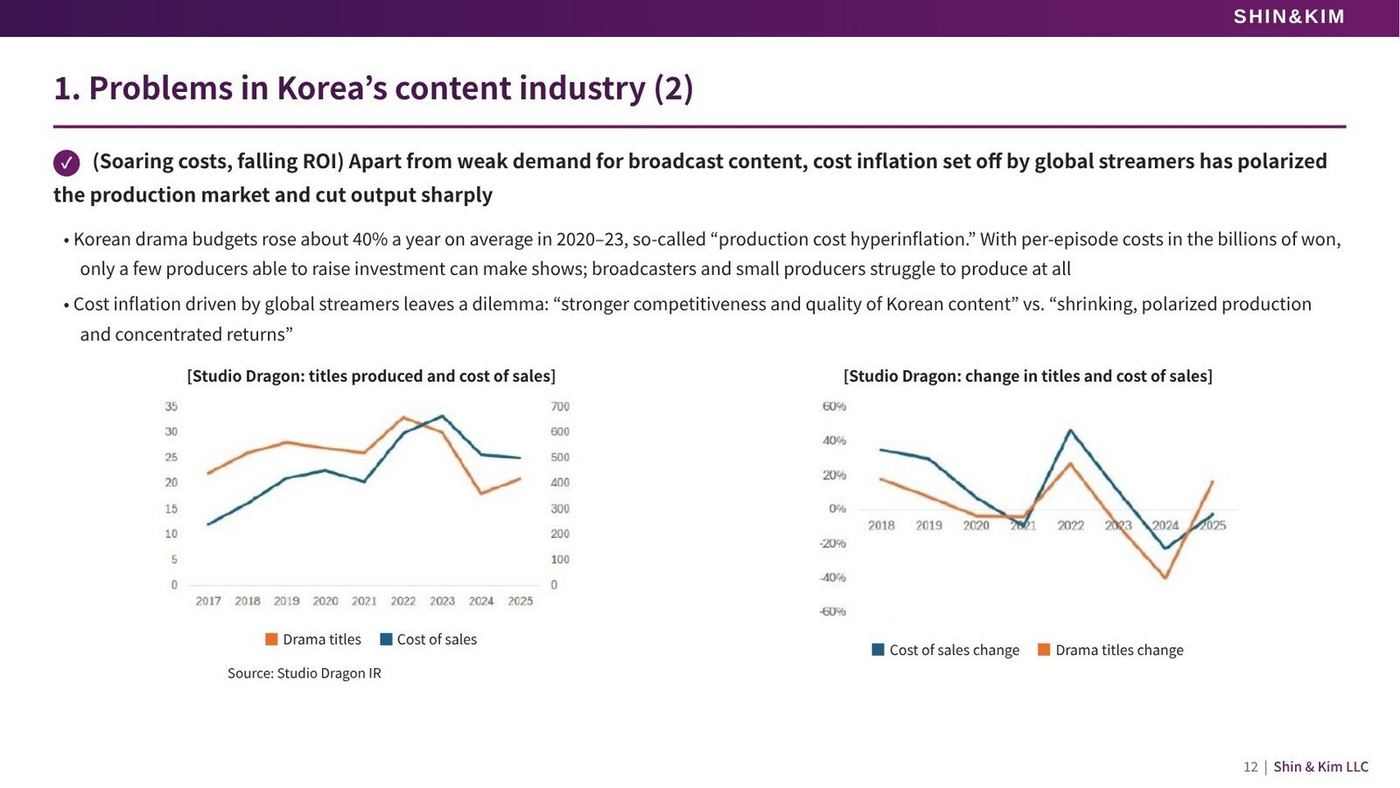
Korean drama output fell from 141 titles in 2022 to 84 in 2025, back to 2015 levels, and commercial film production went from 45 titles in 2019 to 20 in 2025. Lee called the roughly 40% annual rise in drama budgets from 2020 to 2023 "hyperinflation." Borrowing a phrase from Cho Young-shin (조영신), he described the drama market as one of "guaranteed losses," where a show starts in the red the moment production begins. Thinly capitalized producers have little choice but turnkey deals that pay a fixed fee plus margin in exchange for the IP, and Korean studios are turning into subcontractors for global streaming services, he said.
A media-content development act and refundable tax credits… K-FAST on the agenda
Lee Jong-kwan named distribution as Korea's weak point. Psy's "Gangnam Style" was a hit that "just happened" through YouTube, he said, and most Korean content successes since have relied on global streaming services for distribution. Producers need several buyers, a "multi-homing" structure, to gain bargaining power, which means considering a global distribution platform or a public distribution agency. He also criticized a market that still holds 17 pay-TV operators and more than 200 channel providers including dormant ones, and content standards such as "wholesome family" values that are out of step with today's dramas.
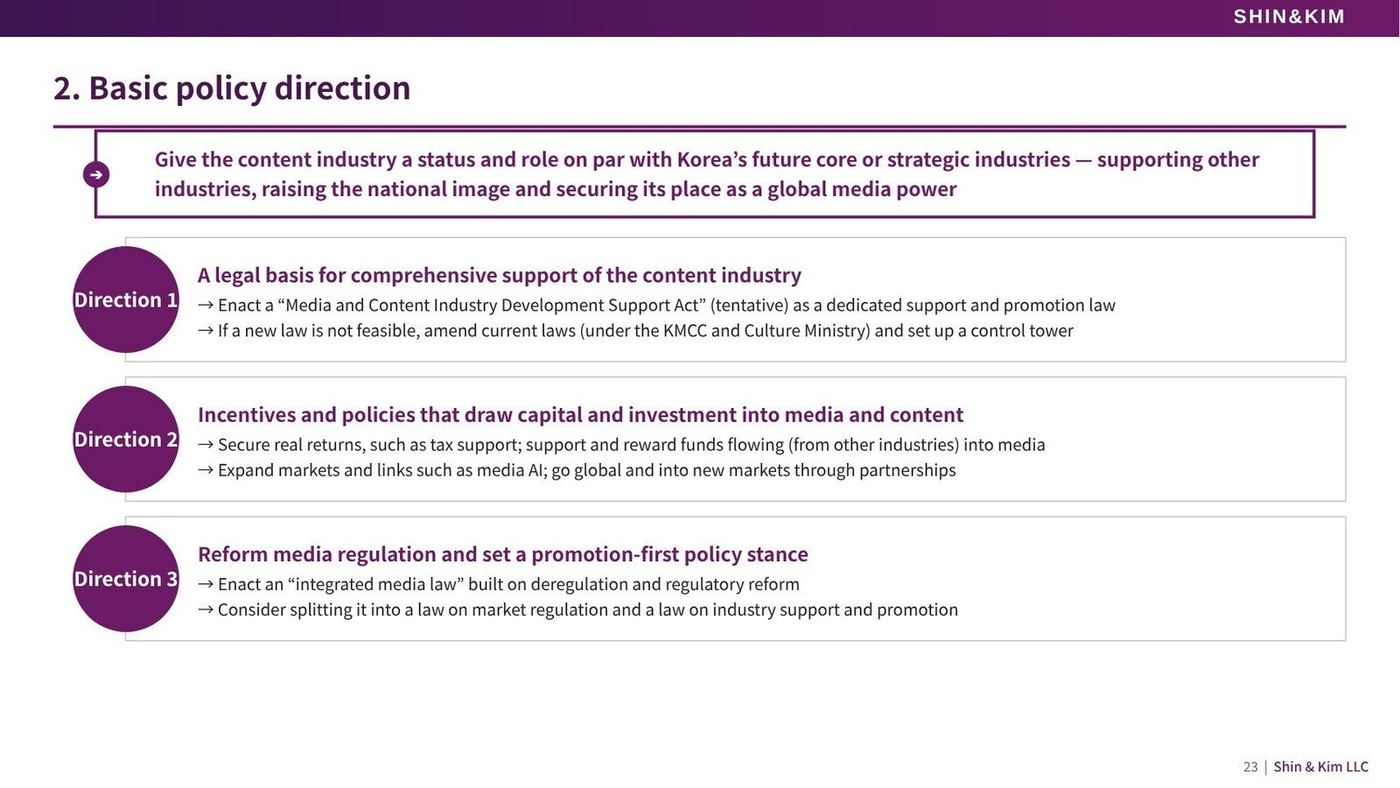
Content deserves status close to a national strategic industry, he said, noting an export multiplier of about 2.02 that lifts exports in beauty, tourism and other sectors. He set out three directions: a dedicated Act on Supporting the Development of the Media and Content Industry (working title), tax incentives to draw outside capital into media, and an integrated media law built around deregulation. The integrated media bill now under discussion unifies regulation, not industry promotion, he said.
He proposed funding at the planning and development stage so producers can build IP, tax credits for beauty, fashion and IT companies that invest in content for global audiences, and California-style refundable tax credits so loss-making and small producers actually benefit. His list of new media to foster included K-OTT and the global expansion of K-FAST (free ad-supported streaming TV), with Korean channels reaching FAST platforms through Korean-made connected TVs and support for AI dubbing and localization. He also called for sweeping deregulation of legacy broadcasting, generative AI that reflects Korean sensibilities, and training data built partly through updated text and data mining (TDM) rules.
Panel… "Build know-how, not AI usage ratios" and "focus on vertical AI"
Kwak Gyu-tae said support should be more generous during the AI transition so companies can build skills through learning by doing. He called for AI content labeling that does not disrupt viewing, domestic and international quality standards, and early guidance on the AI Basic Act's gray areas. "For an ecosystem to work, all of its members have to do well," Kwak said, urging policy to grow mid-sized producers too and to add content to the law on national high-tech strategic industries or pass a separate special act.
Seon Ho said competitive gaps can widen quickly because AI models improve as their user bases grow, and Korea must not repeat the experience of domestic streaming services that never closed the gap with global platforms. K-webtoons succeeded because platforms gave new artists a way in, and AI creators need a domestic platform too. But content falls under the culture ministry and platforms under the science ministry, which muddles funding. He urged a focus on vertical areas such as Korean-language dialogue and emotional expression, which Chinese and U.S. video models still handle awkwardly, and cautioned against copying Europe's rules wholesale.
"Obligations and rights go together," Im Jeong-su said. Falling ad revenue also means falling influence, so rules written when broadcasting was dominant should be reset along with broadcasters' duties and rights. Ad deregulation and tax breaks alone will not bring back the industry's heyday, she said; support should give broadcasters time and direction to change. Creation can no longer be assumed to be a uniquely human domain, Im said, urging Korea to check whether its content know-how can lead AI-driven planning and creation and to build AI capable of creative work over the long term.
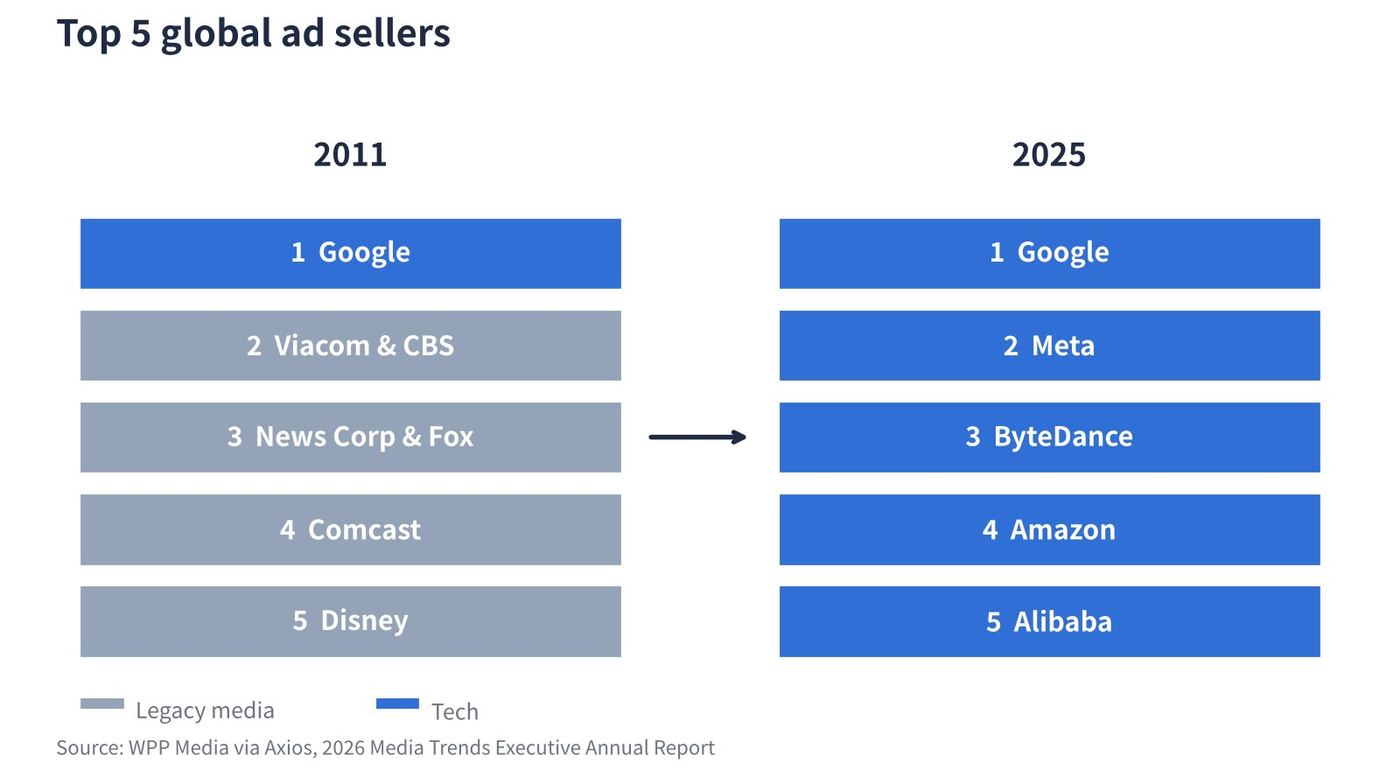
Jung Han, who handled broadcast policy and license renewals at JTBC, named AI and the market dominance of Big Tech entertainment companies as the main causes of the industry's troubles. Since 2019, when Disney+ and Apple TV+ launched, control of distribution has moved to Big Tech, and control of production is following. Citing Axios research, he said Google and Amazon dominate most of the revenue streams that media companies rely on.
Axios's 2026 Media Trends Executive Annual Report, released Oct. 20, tracks the same shift. In 2011 the world's top five ad sellers, by WPP Media's count, were Google, Viacom and CBS, News Corp and Fox, Comcast and Disney; in 2025 they were Google, Meta, ByteDance, Amazon and Alibaba. Netflix, Apple and Amazon have won 32 Oscars since 2017, the Emmys move to Prime Video in 2027 and the Oscars to YouTube in 2029. Streaming's share of U.S. TV viewing has risen 21 points since 2021 to 49%, according to Nielsen.
Han added detail on "Manager Kim." The cave fight scene set on Geoje Island was made almost entirely with AI apart from lead actor So Ji-sub (소지섭), rendered in black and white to keep characters consistent, and cost more than ₩100 million, he said. Korean debate focuses on what share of a show used AI and how many credits were spent, he said, so teams have learned to save credits without building real production know-how. Specialist AI archive and dubbing firms have turned into generalist "AX companies" that take any job, and some broadcasters now make AI TV ads for ₩300,000. He called for ways to value these business models.
Han urged regulators to separate content production and distribution from journalism rather than tightening rules on companies simply because they are large or own news outlets. Korean content backed by public money should keep at least a minimum of viewing-data rights in deals with global platforms and FAST operators, he said. He also urged investment in live and in-person experiences that Big Tech does not dominate, and a government support system linking content with tourism and regional economies through screen tourism, modeled on British and U.S. film offices that also run tourism programs.
The live business Han pointed to is growing, according to the same report. Live entertainment revenue nearly doubled since 2021 to $149 billion, and PwC projects $174 billion by 2030; Axios describes live experiences as an AI-resistant growth bet. Disney now earns 38% of its revenue from experiences such as theme parks.
Committee chair Song: "A content-promotion law soon, and budgets without earmarks"
"The longer regulatory lag lasts, with rules failing to keep up with technology, the shorter our industry's golden time becomes," Song said in his opening remarks. He named negative-list regulation, wider use of regulatory sandboxes and an overhaul of legacy rules as steps the government and the Assembly can take now, and pledged follow-up legislation for the AI Basic Act (인공지능기본법), in force this year.
Closing the panel, Song agreed that Korea lacks a national system to support the content industry comprehensively. Content spans the science and culture ministries, so even the Assembly splits it between two committees, and the government has not resolved the overlap, he said. Everyone credits K-pop and Korean content with lifting the country, yet the government has mostly looked on and said "they are growing well on their own," Song said. He said a content-promotion law should come quickly and that budgets should be bold and comprehensive rather than tied to earmarks, and he promised to consult the panelists again during drafting.
Lee Jeong-heon called for fixing the different rules for broadcasting and online platforms and helping domestic producers secure IP; he has sponsored an amendment to the Framework Act on the Promotion of Cultural Industries (문화산업진흥 기본법) to support small content companies. Hwang Jung-a pledged reforms that protect creators' rights and user trust while leaving room for new experiments.
"Broadcasters barely use spectrum"… Britain's ITV sells to Sky; "We are out of time"
Kwon O-sang (권오상), head of the Digital Future Institute, said broadcast regulation began with spectrum, yet broadcasters now barely use it. "If you don't use spectrum, the first reason for regulation, what are you regulating?" he asked, calling it a mistake to regulate new media using a failed legacy framework as the template.
Lee Jong-kwan said national strategic-industry laws offer seven kinds of support, from R&D, tax and fiscal aid to workforce, land and facilities, research cooperation and technology protection, and he hoped media would get at least one. The media market peaked during the pandemic and has shrunk quickly since 2022, he said: "We really are out of time." Lee Sun-hwan said industry and academia have called for freer, lighter rules since he began studying streaming at the institute in 2018, yet little has changed.
Moderator Jeon pointed to Britain. ITV, the country's largest commercial broadcaster, cut programming budgets as ad revenue fell, and Comcast-owned Sky agreed to buy ITV's broadcasting and streaming business for £1.6 billion, a deal now under regulatory review. ITV said its third-quarter ad revenue fell 8%. Even a country like Britain is being absorbed into the global value chain, Jeon said, and Korea should watch closely.
The next milestones are close. The AI Basic Act's training-data provision takes effect in April 2027, and Lee Sun-hwan proposed turning broadcaster and streaming-service data into assets "based on contribution and compensation, not unconditional opening." On Nov. 20 at 2 p.m., Rep. Lee Ju-hee (이주희) of the Democratic Party hosts a policy forum on the global competitiveness of K-FAST in Conference Room 4 of the Members' Office Building, covering K-FAST expansion and overseas distribution of Korean content through Korean smart TV platforms. Jung Han will present on global FAST market trends and a K-FAST expansion strategy.