
Midterm political spend reaches a record $11.4 billion; CTV jumps 122% to $2.4 billion and passes cable for the first time
Connected TV has overtaken cable in U.S. midterm political advertising for the first time. Political advertisers had spent or booked $11.4 billion as of Nov. 2, the eve of Election Day, up 28% from the 2022 midterms.
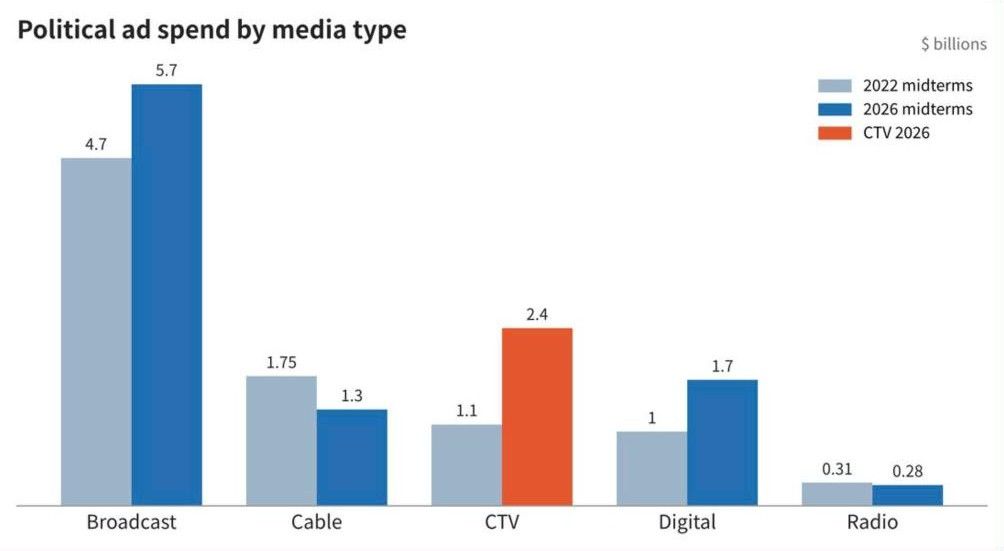
CTV spend reached $2.4 billion, up 122% from roughly $1.1 billion four years ago, according to AdImpact figures shared with ADWEEK. Cable fell 26% to less than $1.3 billion over the same period. In 2022, cable outspent CTV by about 1.6 to 1. This year CTV is close to double cable.
The cycle has also passed the $11.2 billion spent in the 2024 presidential cycle, the first time a midterm has outspent the previous presidential race, 9News reported citing AdImpact. Of the $2.5 billion in growth over 2022, 53% went to CTV.
Broadcast still took the largest share, rising 21% to $5.7 billion. The losses landed on cable, whose reach is tied to shrinking pay-TV households, as campaigns moved money to a channel that lets them pick voters by ZIP code and household.
CTV share rises to 21% from 12%; linear TV slips to 62%
CTV took 21% of total political spend, up from 12% in 2022. Linear TV, including broadcast, cable and satellite, fell to 62% from 73%. Digital rose 63% to nearly $1.7 billion, close to 15% of the total. Radio dropped almost 12%, from $314 million to $277 million.
Cable's decline follows its audience. Brian Wieser, CEO of Madison and Wall, told ADWEEK that less than half the population can now watch cable while more than half can reach CTV, including FAST (free ad-supported streaming TV) channels. Wieser earlier estimated that U.S. pay-TV subscriptions covered 66.7 million of nearly 133 million households, putting penetration right at 50% in the fourth quarter of 2025.
ZIP- and household-level targeting, once limited to local cable slots
Targeting explains much of the shift. Ari Paparo, an ad tech veteran and founder of Marketecture Media, told ADWEEK that fine targeting by ZIP code or household on linear TV was limited to local cable avails. On CTV, it is standard, which suits campaigns and advocacy groups chasing narrow audiences in specific districts. Paparo said CTV offers "more flexibility and less waste."
AdImpact raised its forecasts during the cycle. It projected $10.8 billion in total and $2.5 billion for CTV in September 2025, then lifted the total to $11.6 billion in its June 2026 update. Its CTV projection stood at $2.7 billion, or 23% of the total, CNBC reported on Oct. 21.
Netflix and Prime Video stay out; budgets flow to FAST, YouTube and Hulu
The CTV money is not spread evenly. Netflix lists political, election and advocacy ads as prohibited in its ad policy, and Amazon Prime Video does not accept political ads. Budgets went instead to Hulu, YouTube, Roku, FAST services such as Pluto TV and Tubi, and local broadcast apps.
Unlike broadcasters, streaming services are not bound by Federal Communications Commission political-ad rules, so they set their own policies. Buyers are pushing to open the biggest platforms: one buyer told Campaigns & Elections that getting Prime Video to reverse its policy is a top priority this year.
Detroit nearly doubles to $310 million; Texas Senate tops $560 million
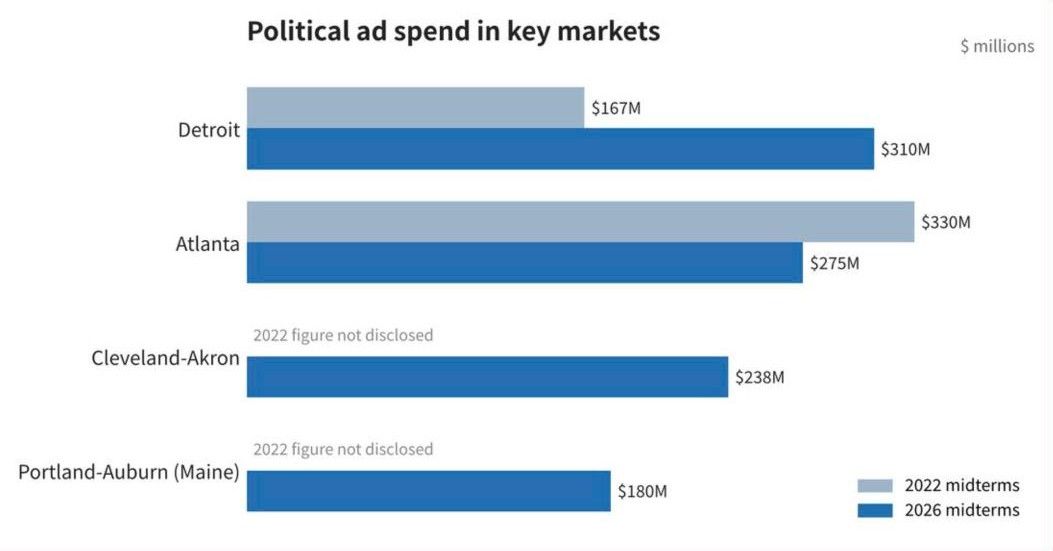
The map shifted too. Spend in Detroit nearly doubled to $310 million from $167 million as Michigan's Senate and governor races heated up. In Maine, where five-term Republican Sen. Susan Collins faces Democrat Troy Jackson, the Portland-Auburn market drew $180 million. Ohio's Senate special election and governor's race pushed Cleveland-Akron past $238 million.
The Texas Senate race between Democrat James Talarico and Republican Ken Paxton passed $560 million in spending and reservations, a record for a nonpresidential race. Atlanta went the other way, falling to $275 million from $330 million in 2022, when Raphael Warnock and Herschel Walker fought a Senate runoff. Georgia this year has both a governor's race and Sen. Jon Ossoff's re-election.
Ohio's $750 million: an ad that hit social media first, then TV and streaming
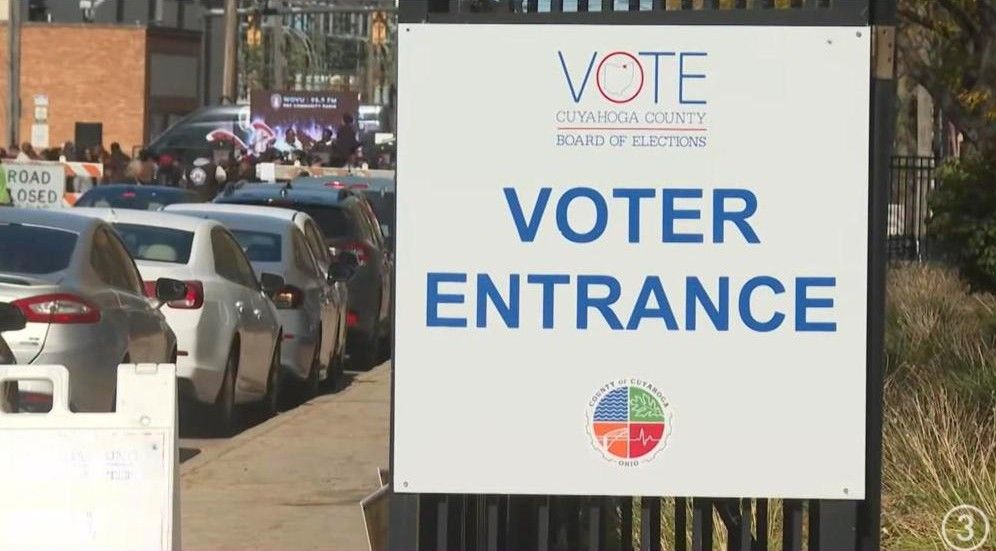
Ohio, home of the Cleveland-Akron market, has both a Senate race and a governor's race on the ballot. In July, AdImpact projected $750 million in Ohio election ad spending, 70% above its initial forecast and the biggest increase of any state, Axios reported on July 29. The Senate race between Democrat Sherrod Brown, a former senator, and Republican Sen. Jon Husted had drawn $422.6 million in candidate and outside-group spending, the Ohio Capital Journal reported on Oct. 20. In the governor's race between Democrat Amy Acton and Republican Vivek Ramaswamy, Republican-aligned groups had spent or reserved more than $100 million and Democratic groups about $40 million.
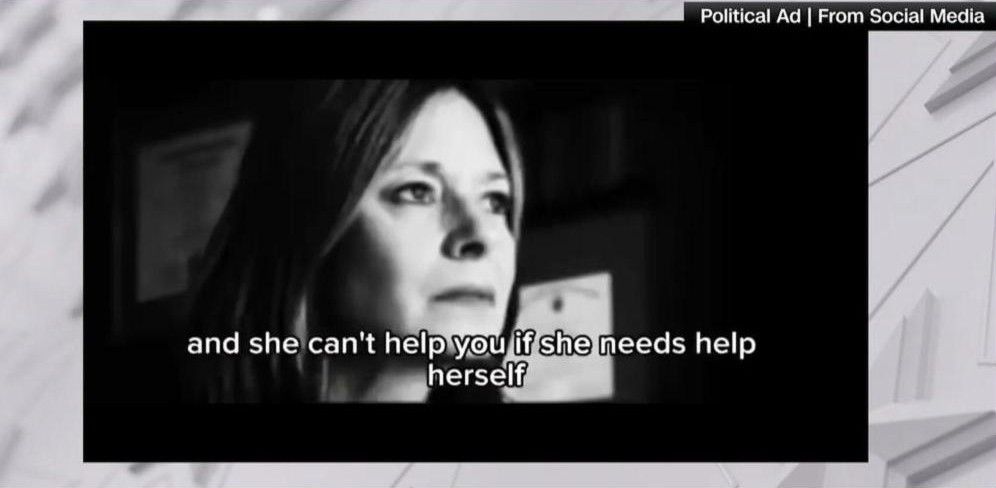
The channels also blur. In October, a one-minute ad that Ramaswamy's campaign later confirmed producing spread on social media first, via a political blogger's post, without the "paid for" tag legally required to air on television. The ad features Acton's estranged birth mother, and Acton condemned it. The campaign said it would air the spot on TV and stream it online, backed by $4 million, the Associated Press reported on Oct. 20.
Korea fixes election media by law; a YouTube ad draws a complaint
In South Korea, campaigns cannot move money the way U.S. advertisers do. Article 70 of the Public Official Election Act (공직선거법) limits a provincial governor or big-city mayor candidate to five TV and five radio spots on local broadcast facilities. Paid online election ads may run only on the websites of registered internet news outlets; paid social media ads are not allowed.
That boundary was tested after the June 3 local elections. On July 21, the Daejeon chapter of the People Power Party (국민의힘) filed a complaint against Daejeon Mayor Heo Tae-jeong (허태정) and five district heads over a one-minute joint campaign ad posted on a news outlet's YouTube channel on May 21, the first day of official campaigning, arguing that paid ads on a third-party platform may fall outside what the law allows. On July 30, Democratic Party (더불어민주당) lawmaker Lee Kang-il (이강일) introduced an amendment that would extend paid election ads to social media platforms designated by the National Election Commission, allowing targeting by region, age and interest.
$2.4 billion in U.S. political CTV, about the size of Korea's TV ad market
The scale gap is wide. Korea's total broadcast ad spend was 3.22 trillion won (about $2.4 billion) in 2024, according to the 2025 broadcasting and communications ad spend survey released Jan. 8 by the Korea Communications and Media Commission (방송미디어통신위원회) and KOBACO (한국방송광고진흥공사). A single U.S. midterm cycle's political CTV spend roughly equals a year of Korean broadcast advertising. The survey estimated Korean broadcast ad spend fell 13.8% to 2.77 trillion won (about $2.1 billion) in 2025, and terrestrial broadcasters' ad revenue to 1.05 trillion won from 1.23 trillion won.
In the same survey, 153 Korean advertisers named targeting accuracy (53.4%) as the top reason for buying streaming ads, the same reason U.S. campaigns gave for moving to CTV. With TV spot counts and online outlets fixed by law, Korean campaigns have little room to act on that demand. If the media scope widens as Lee's bill proposes, new election budgets are likely to move first toward digital platforms that already sell targeted inventory.
For Korean broadcasters, the U.S. case shows where the money went when Netflix and Prime Video stayed out: local broadcast apps and FAST services such as Pluto TV and Tubi. Whether terrestrial broadcasters' free live apps and FAST channels can sell ads by region and household will decide their share if election ad rules change. Companies supplying K-content channels to U.S. FAST platforms also see election-season demand, but political ads are sold and allocated by the platforms, so a channel's share depends on its revenue-sharing terms.
Totals include reservations; AdImpact expects $11.6 billion; next test is 2028
AdImpact's tally combines ads already aired with reservations for the remaining days. The firm has projected a final $11.6 billion for the cycle; actual spend will be settled after polls close on Nov. 3.
The 2028 presidential cycle is the next test. As long as Netflix and Prime Video keep their policies, political CTV money will stay concentrated in FAST, YouTube, Hulu and local broadcast apps. Comcast Advertising told ADWEEK it cannot estimate CTV's 2028 share given ongoing consolidation and new media. In Korea, the pending amendments will set the scope of election advertising before the April 2028 general election.