
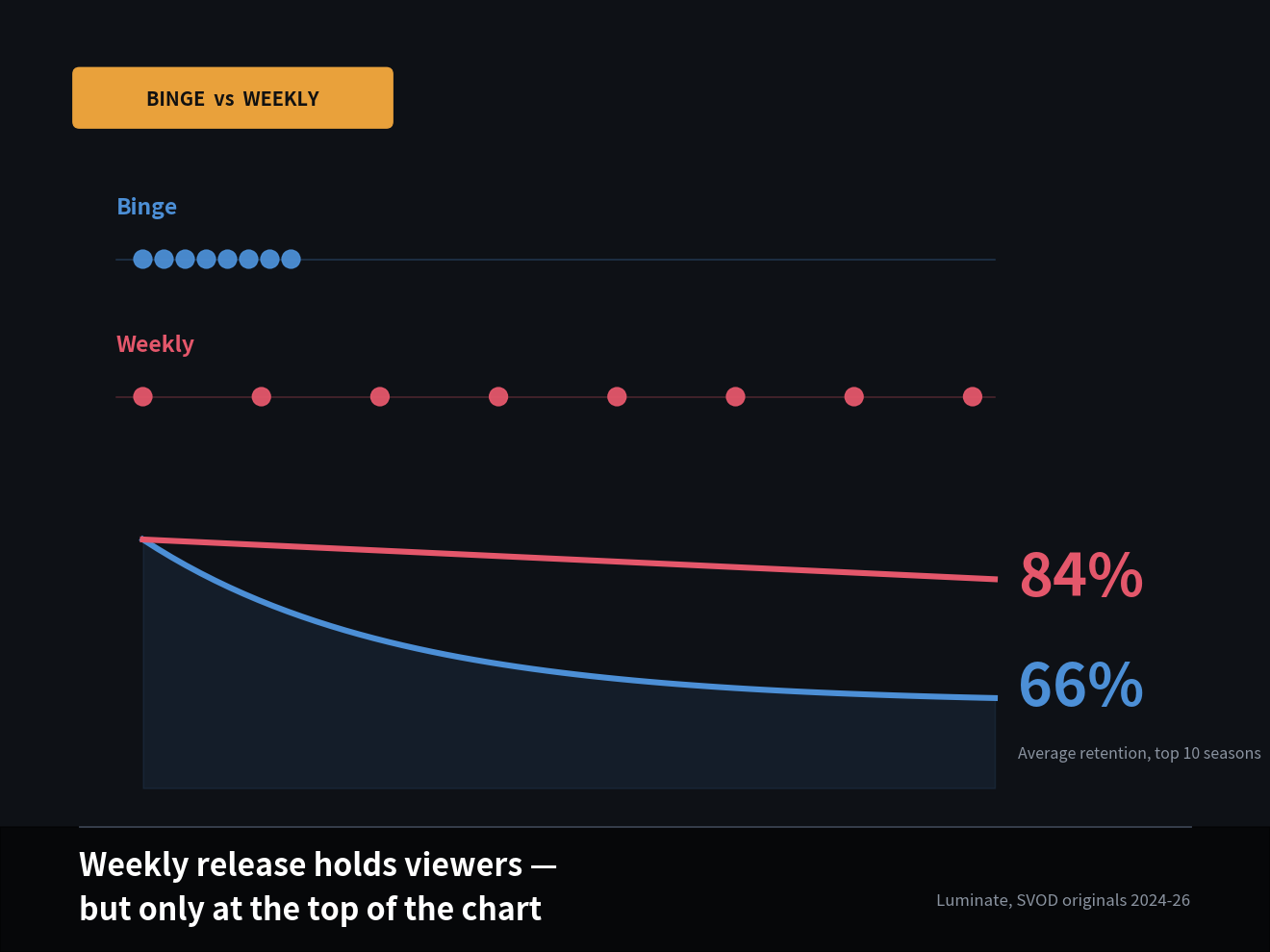
Luminate data on 2024-26 SVOD originals: retention averages 54% binge, 50% weekly and 47% split season overall; among the ten most-watched seasons it is 84% weekly, 66% binge and 59% split
Luminate Film & TV measured retention for original seasons premiering on the major U.S. streaming services between 2024 and 2026, sorted by release cadence. Retention is season finale views divided by season premiere views over a title's first 120 days. The overall averages are 54% for binge, 50% for weekly and 47% for split season. The spread is no more than seven points.
Narrow the field to the ten most-watched seasons by minutes streamed in each cadence and the numbers move. Weekly reaches 84%, binge 66%, split season 59% — an 18-point gap between weekly and binge. Excluding Netflix (넷플릭스) from the full sample reorders the averages entirely: binge 50%, weekly 49%, split season 52%.
Release cadence became an industry question because of subscriber turnover. Antenna put the weighted average monthly churn rate for U.S. premium SVOD at 4.6% in 2025, with 31% of the year's gross additions landing in the fourth quarter. Gross additions grew 7%, four points slower than in 2024. When sign-ups cluster around a handful of moments and titles, how many weeks a single season occupies translates directly into how long a subscription lasts.
Among the top weekly titles, the debut seasons of Landman and Dutton Ranch grew their audiences over the course of the season. Luminate reported that no binge title did the same. Split seasons lost ground where viewers who binged the first batch did not return for the second.
Averages cluster near 50%; excluding Netflix, split season leads
Luminate's sample covers Apple TV, Disney+, HBO Max, Hulu, Netflix, Paramount+, Peacock and Prime Video.
Source: Luminate Film & TV, SVOD original seasons, 2024-26
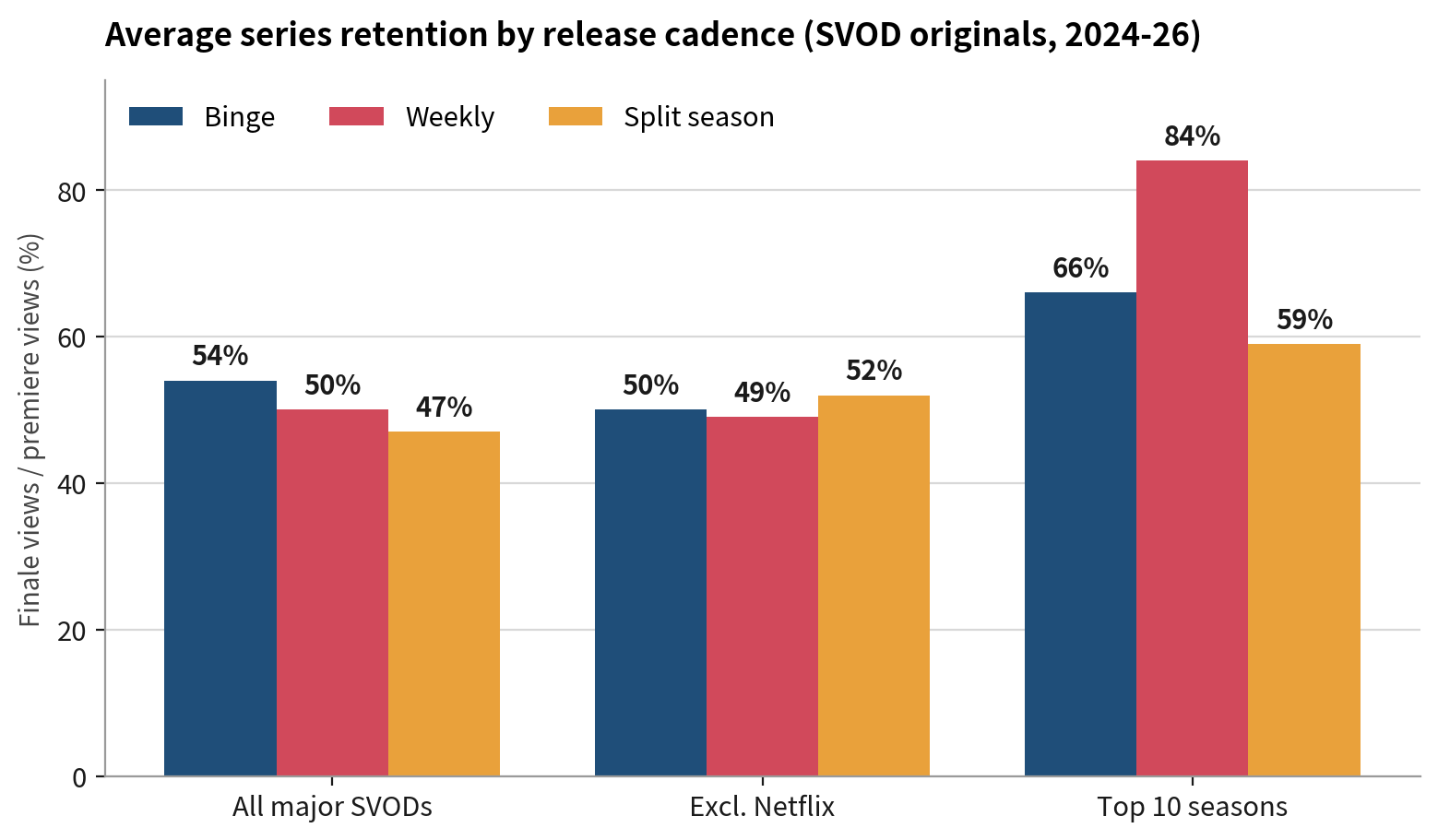
Average series retention by release cadence. Source: Luminate Film & TV
Split season's ranking flips depending on whether Netflix is in the sample. Netflix released more than 80% of its original seasons all at once between 2024 and H1 2026, and accounted for more than 70% of all U.S. binge-released streaming seasons in that window. It also used split releases, as with Stranger Things (스트레인저 씽스) season five. Remove Netflix and split season averages 52%, the highest of the three.
Weekly hits 84% at the top; Landman and Dutton Ranch grew mid-season
Landman premiered on Paramount+ on November 17, 2024 and closed on January 12, 2025, one episode a week. It logged 9.9 billion minutes in Q4 2024, first among scripted dramas and roughly 4 billion minutes ahead of The Night Agent. It held the top scripted spot again in Q1 2025, meaning viewing continued well after the finale. Across all seasons in calendar 2025, Luminate put Landman at an estimated 75 million views against Stranger Things' 65 million.
Dutton Ranch launched with two episodes on May 15, 2026, then one every Friday. It drew 12.9 million global views in its first week, the biggest original series debut in Paramount+ history. The series aired day-and-date on the Paramount Network cable channel, where the premiere reached 1.9 million viewers. Nielsen (닐슨) ranked it the top streaming series for the week of May 11. Social video views reached 99 million in the first three days.
Both titles come from Taylor Sheridan's production slate. Paramount+ carries a far smaller subscriber base than Netflix, yet Sheridan series held five of the top 20 seasons in Q1 2025.
Split season tops out at 59%; the return rate decides it
Netflix split Stranger Things season five into three drops — four episodes over Thanksgiving week, three at Christmas and the finale on December 31. Viewing fell sharply after each batch and rebounded at the next, and the season stayed in the weekly top 10 throughout. Estimated views over six weeks came to 21.4 million, below season four's 26 million. Season five ran about three hours shorter, and a simultaneous theatrical run absorbed part of the streaming audience.
Only two 2025 originals drew more minutes than Stranger Things season five: The Pitt season one and Love Island USA season seven, the latter with roughly four times the runtime.
At 59%, split season's top-10 retention sits below binge's 66%. When viewers who consumed the first batch do not come back for the second, finale views cannot match premiere views. Luminate flagged this as the cadence's main exposure.
Weekly reaches 61% outside Netflix; binge share down a third year
Apple TV, Disney+, HBO Max, Hulu, Paramount+, Peacock and Prime Video; Netflix excluded. Source: Luminate
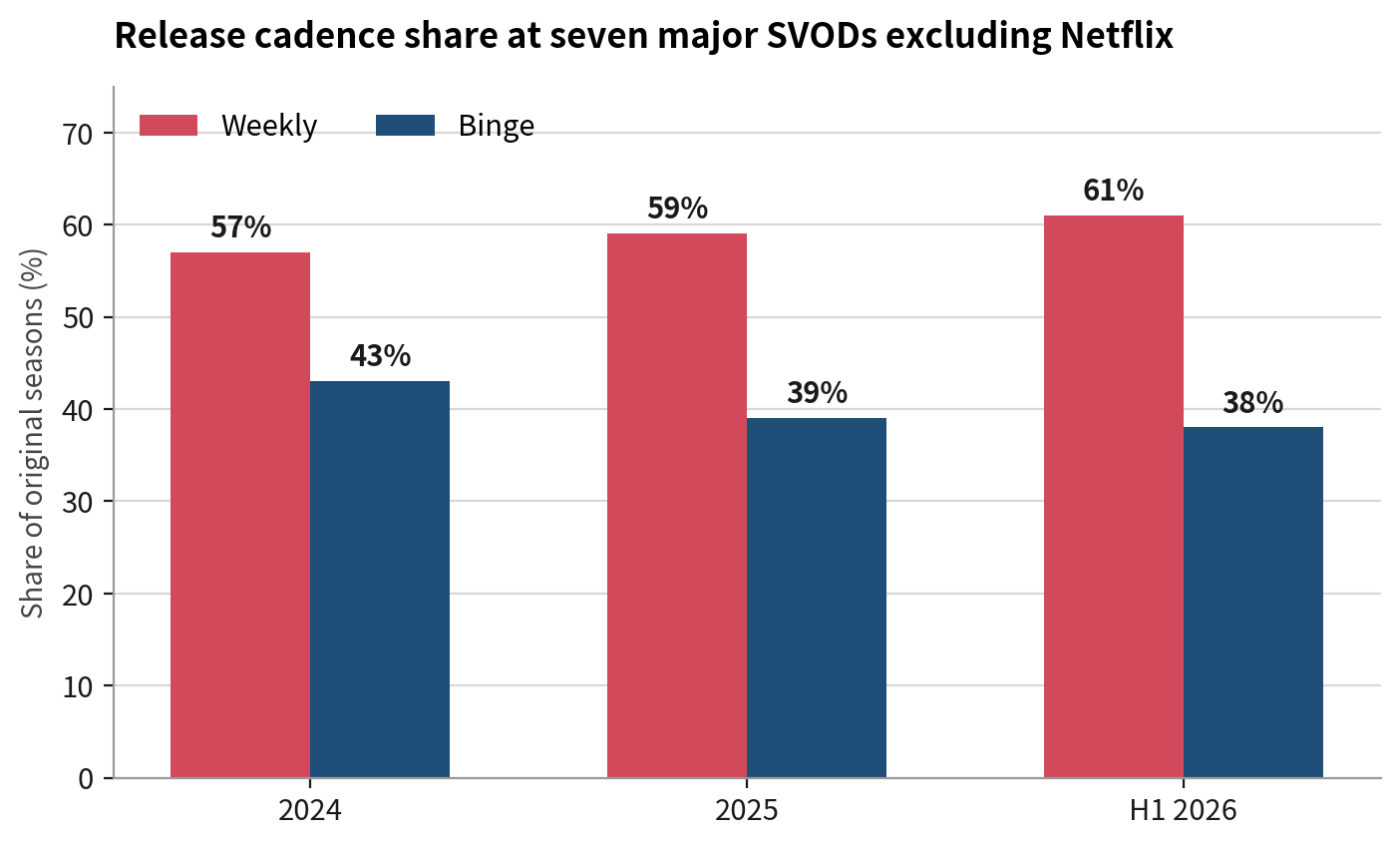
Binge still accounted for 38% of premieres at those seven services in H1 2026, including Hulu's The Bear and Peacock's The 'Burbs.
Prime Video's pattern summarizes the shift. About 75% of its 2025 freshman series dropped all at once, while every title entering a third season moved to weekly. Reacher and The Summer I Turned Pretty both binged season one in 2022 and switched to weekly afterward; the new series Countdown went weekly from the start. Debut seasons test demand quickly, and survivors move to a cadence that stretches subscription time.
Luminate used a different retention definition for that Prime Video analysis: minutes watched in the final seven days of a 12-week window divided by minutes watched in the first seven days. On that basis the binged first seasons of Reacher and The Summer I Turned Pretty landed in the low single digits, while their weekly third seasons held far more viewing over time. Reacher season three ran lower than other weekly titles because it compressed eight episodes into six weeks.
Andor loses 20% from episode 3 to 4; Ahsoka loses 31%
Disney+ released Andor season two in blocks of three episodes a week for four weeks starting April 22. Andor season one opened with three episodes then went weekly; Ahsoka and Star Wars: Skeleton Crew opened with two. Drop-off from episode three to four was 20% for Andor and 31% for Ahsoka.
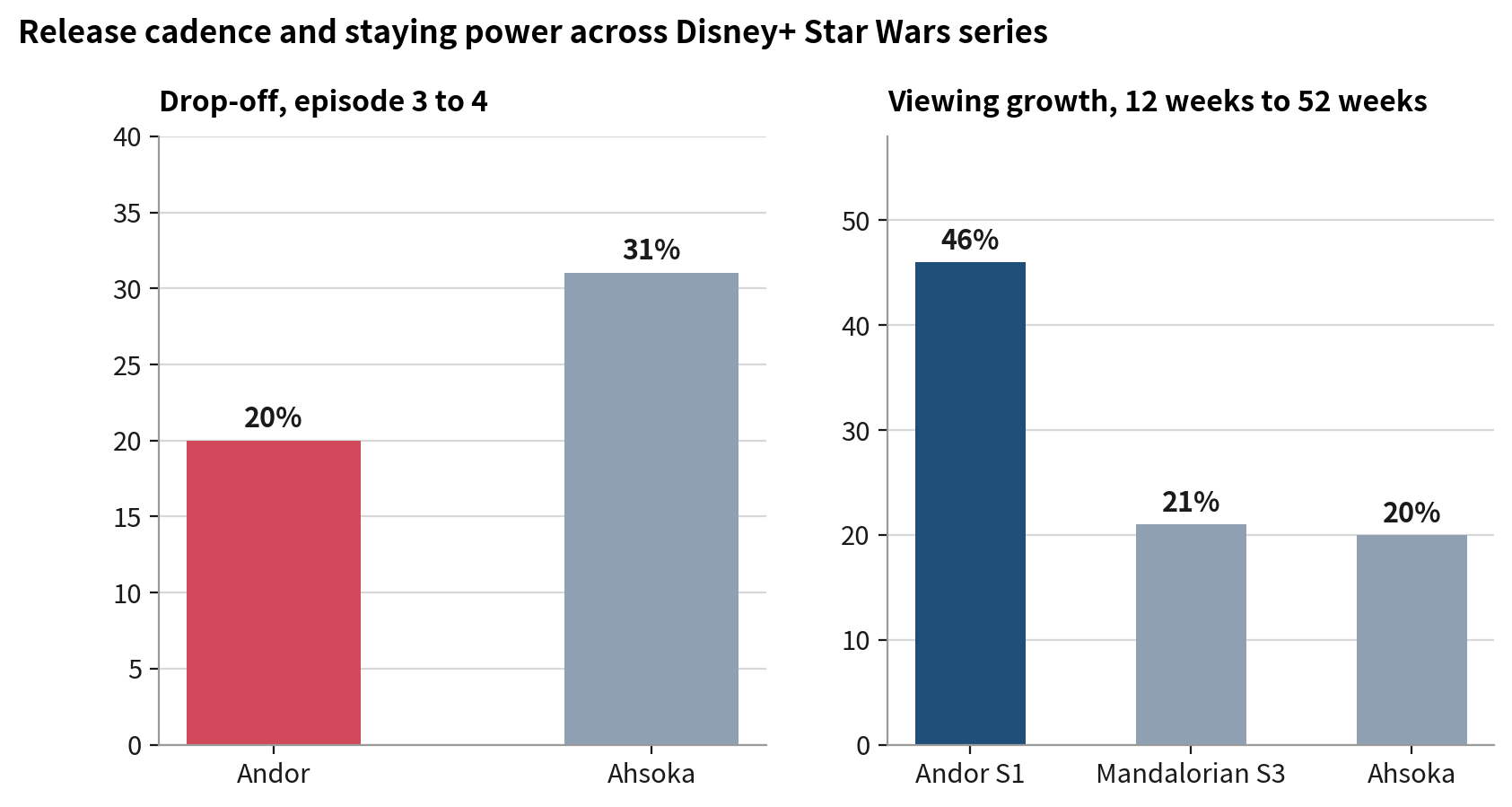
The long-run gap is wider. Andor season one grew 46% comparing its first 12 weeks with a full 52 weeks, against 20% for Ahsoka and 21% for The Mandalorian season three. The season two finale drew 171 million minutes on its release day. Luminate puts Andor's budget at $290 million per season (about 390 billion won).
Annual cadence carries across seasons; The Pitt up 172%
Separately from release cadence, the gap between seasons sorted the results. Titles that returned within a year grew; those that waited longer than 18 months generally declined.
Sources: Luminate; Señal News
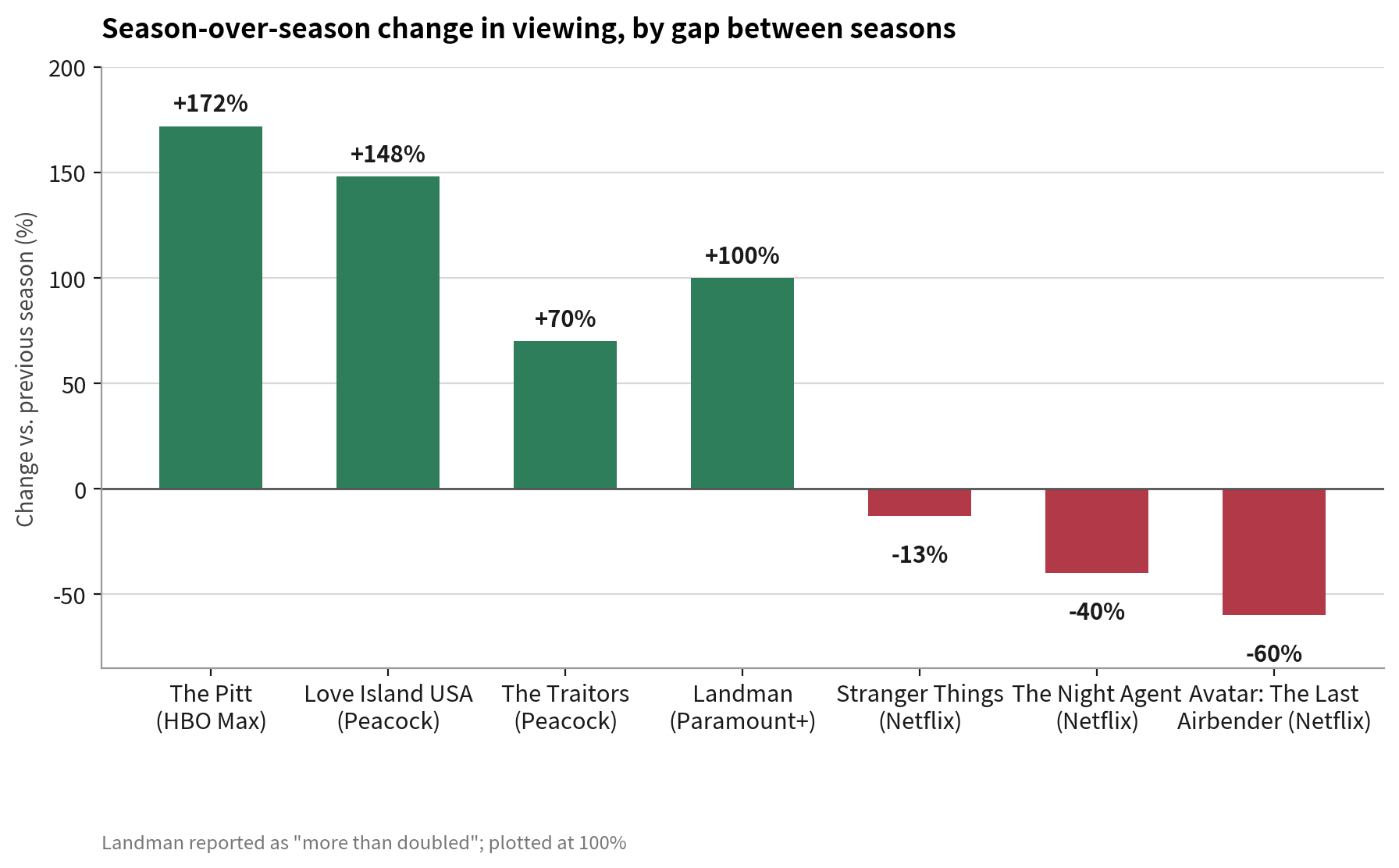
Severance nearly tripled despite a three-year gap, which trade coverage attributed to marketing and word of mouth. The Night Agent fell about 40% into season three on a short gap, so cadence alone does not reverse a decline already under way.
U.S. TV premieres down 15% in H1 2026; library supplies 60% of viewing
The cadence debate is happening as the volume of new programming shrinks. U.S. TV premieres fell 15% year over year in H1 2026 and SVOD series volume fell 12%. U.S.-produced TV premieres dropped from 930 in 2022 to 517 in H1 2026. The major services carry roughly 19,000 library titles against about 7,000 originals, and viewers estimate that nearly 60% of their at-home viewing is content more than a year old.
Netflix held 57% of original-content viewing time among the major SVODs, down year over year. HBO Max's The Pitt led all original SVOD series in H1 2026, while the CBS broadcast titles Marshals and Tracker drew more minutes than The Pitt season two.
TVING posts 6 billion won operating profit; baseball supplies the weekly rhythm in Korea
TVING (티빙) reported second-quarter 2026 revenue of 140.7 billion won (about $104.6 million) and operating profit of 6 billion won (about $4.46 million). Revenue rose 41% from 99.5 billion won a year earlier, and the company swung from a 24 billion won operating loss. Monthly active users reached 9.7 million and advertising revenue grew 52%. Management credited KBO baseball coverage and original hits. Merger talks with wavve (웨이브) are set for the second half.
KBO coverage is the longest weekly schedule any Korean streaming service holds. Viewing recurs at fixed times through the regular season and subscriptions run with it — the same distribution of viewing Luminate found in the top weekly titles, although a sports calendar sets the rhythm rather than an episode count.
On the drama side, Korean services already release two episodes a week as standard practice, often alongside a linear broadcast schedule, so the weekly rhythm is not new. Netflix's Korean originals default to full drops or split parts. The Luminate figures argue against treating that choice as a slate-wide question: the average spread across cadences was four to seven points, and the 18-point gap appeared only among the ten most-watched seasons. The return on changing cadence concentrates in the biggest titles.
The gap between seasons is harder for Korean operators to control. The finding that titles returning after more than 18 months generally decline bears directly on production scheduling at the commissioning stage. The Traitors, back every January, and Landman, back within a year, are the cases where viewing grew.
Methodology
· Sample: 2024-26 original seasons on Apple TV, Disney+, HBO Max, Hulu, Netflix, Paramount+, Peacock and Prime Video
· Retention: season finale views divided by season premiere views over a series' first 120 days of release
· Top 10: the ten most-streamed seasons by minutes within each cadence
· The Prime Video analysis uses a different definition — minutes in the final seven days of a 12-week window divided by minutes in the first seven days
· Exchange rate: $1 = 1,345.10 won (Sept. 8, 2026 base rate)
· Quotation rule: material in quotation marks is as reported; unquoted material summarizes reporting
Sources
· Luminate Film & TV, “Binge vs. Weekly? Amazon Release Strategy Belies the Binary Debate”, luminatedata.com/blog/binge-vs-weekly-amazon-release-strategy-belies-the-binary-debate
· Luminate Film & TV, “The Binge Release Is Alive and Well, and Not Just on Netflix”, luminatedata.com/blog/the-binge-release-is-alive-and-well-and-not-just-on-netflix
· Luminate Film & TV, “Stranger Things Viewership Is Huge — But Beware the Decay Curve”, luminatedata.com/blog/stranger-things-viewership-is-huge-but-beware-the-decay-curve
· Luminate Film & TV, “Andor Release Strategy Defies Disney+ ‘Star Wars’ Woes”, luminatedata.com/blog/andor-release-strategy-defies-disney-star-wars-woes
· Luminate Film & TV, “Landman: The 2024 Streaming Hit So Huge It’s Dominating 2025”, luminatedata.com/blog/landman-the-2024-streaming-hit-so-huge-its-dominating-2025
· Luminate, “2026 Midyear Report: Trends in Music, Television & Film”, luminatedata.com/blog/luminate-2026-midyear-report-trends-in-music-television-film
· Señal News, “USA: annual release schedules are the new key driver for franchise growth”, senalnews.com/en/data/usa-annual-release-schedules-are-the-new-key-driver-for-franchise-growth
· Paramount Press Express, “Dutton Ranch Is the Biggest Original Series Debut in Paramount+ History”, May 2026, paramountpressexpress.com
· Variety, “‘Dutton Ranch’ Scores Biggest Paramount+ Series Launch Ever”, May 2026, variety.com/2026/tv/news/dutton-ranch-ratings-12-9-million-views-paramount-1236759018
· Antenna, “Q1’26 State of Subscriptions Report: Premium SVOD 2025 Year in Review”, antenna.live/insights
· Digital Daily (디지털데일리), “TVING swings to a 6 billion won operating profit in Q2; wavve merger talks in H2”, Aug. 6, 2026, ddaily.co.kr
· ZDNet Korea, “TVING posts first quarterly profit; merger talks with KT and wavve under way”, Aug. 6, 2026, zdnet.co.kr
Charts from the source report were redrawn for this article. Accessed Sept. 8, 2026.