
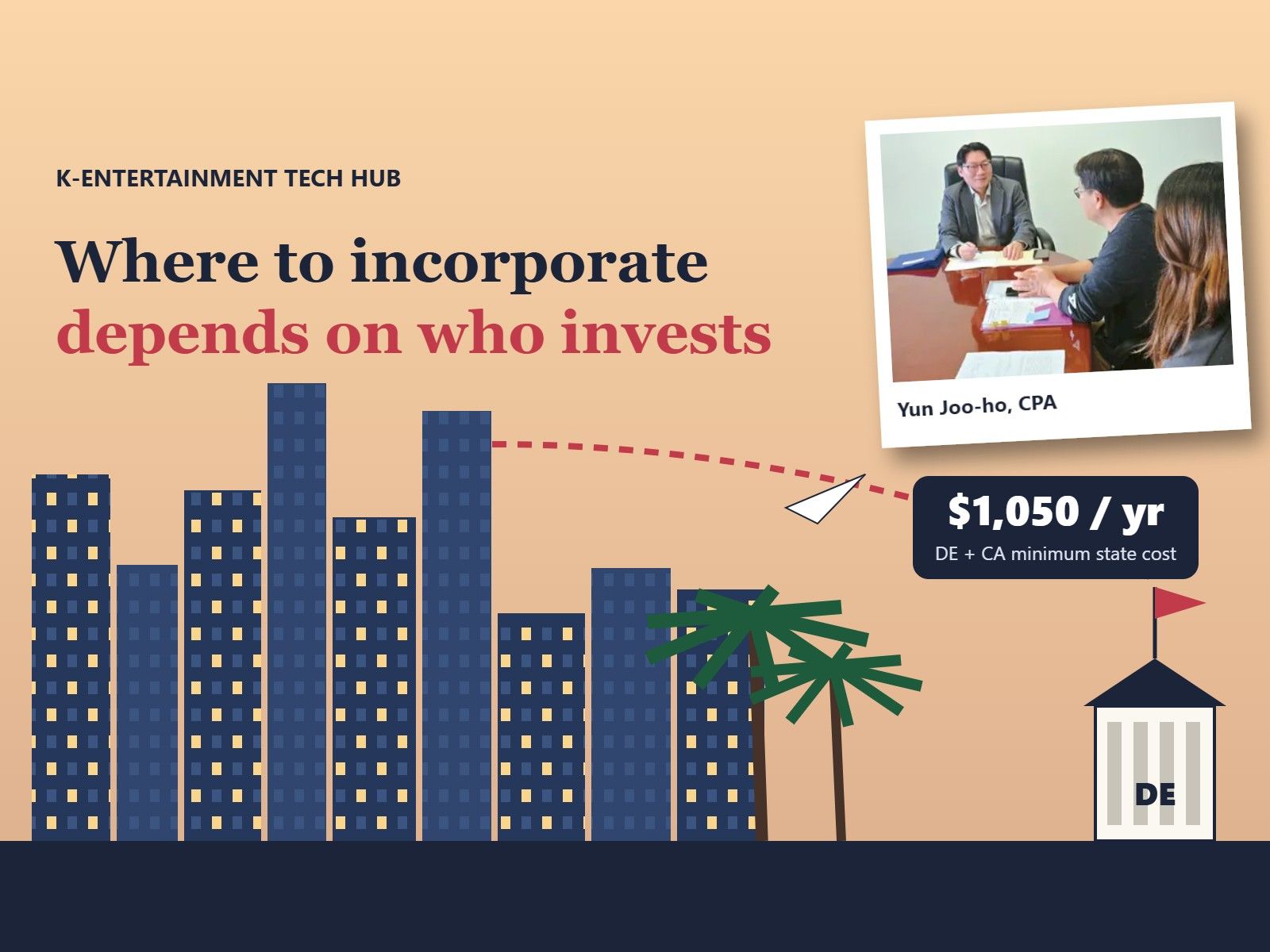
In brief A Korean company's U.S. state of incorporation should follow its funding plan. CPA Yun Joo-ho says wholly owned subsidiaries without U.S. fundraising plans can skip Delaware. A Delaware firm in California registers twice and pays an $800 minimum tax, lifting yearly state costs from $225 to $1,050.
Korean entertainment, K-beauty and tech companies setting up in the United States do not need to default to Delaware, a Los Angeles accountant says. In a tax column for Korea Daily (미주중앙일보) published Oct. 21, CPA Yun Joo-ho (윤주호) wrote that a local subsidiary wholly owned by a Korean parent, or a company with no plan to raise outside money in the U.S., has little reason to pick Delaware.
His reasoning rests on double registration. A Delaware corporation that actually does business in California must register again in California as a "foreign corporation". It keeps a registered agent in both states and pays filing fees and annual taxes in both.
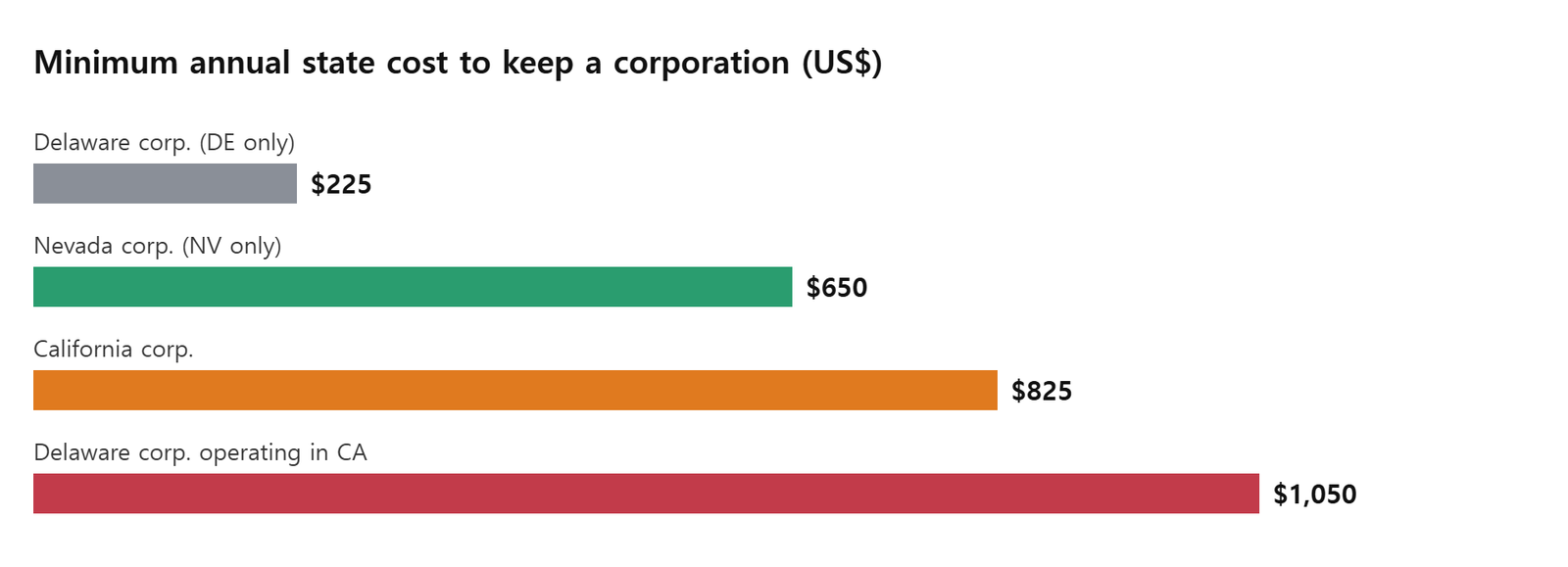
California's Franchise Tax Board charges an $800 minimum franchise tax (about ₩1.07 million) to every corporation incorporated, registered or doing business in the state. Add that and California's $25 Statement of Information fee to Delaware's $225 annual minimum, and state charges alone reach $1,050 a year (about ₩1.4 million), before agent fees and income tax.
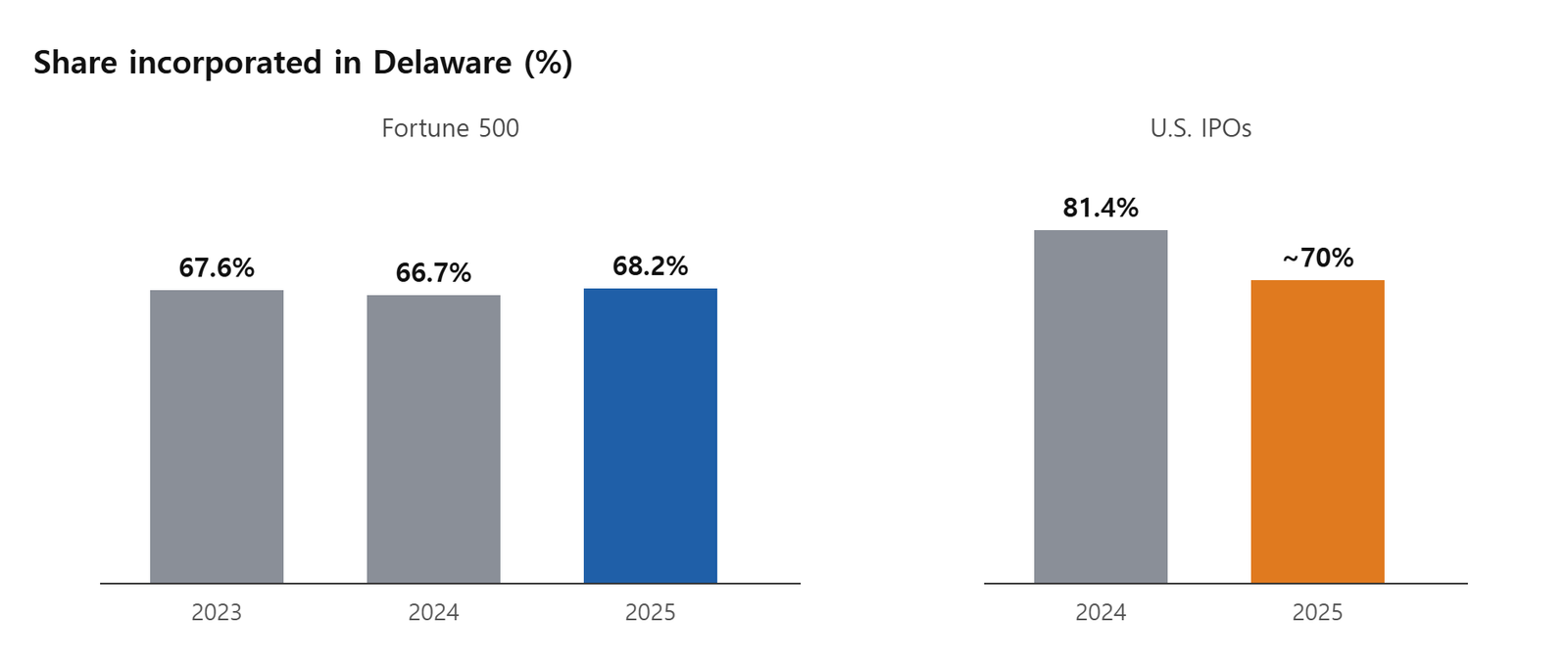
Delaware's appeal sits with investors. According to the Delaware Division of Corporations' 2025 annual report, nearly 70% of U.S. initial public offerings in 2025 chose Delaware as their legal home. That is down from 81.4% in 2024, even as new Delaware formations rose more than 15% to 334,461.

Delaware's IPO share falls to about 70% from 81.4% in a year
The 66.7% Fortune 500 share and 81.4% IPO share cited in Yun's column come from the Division's 2024 report. The 2025 report puts the Fortune 500 share at 68.2% and the IPO share at nearly 70%. More than 2.28 million entities are registered in Delaware.
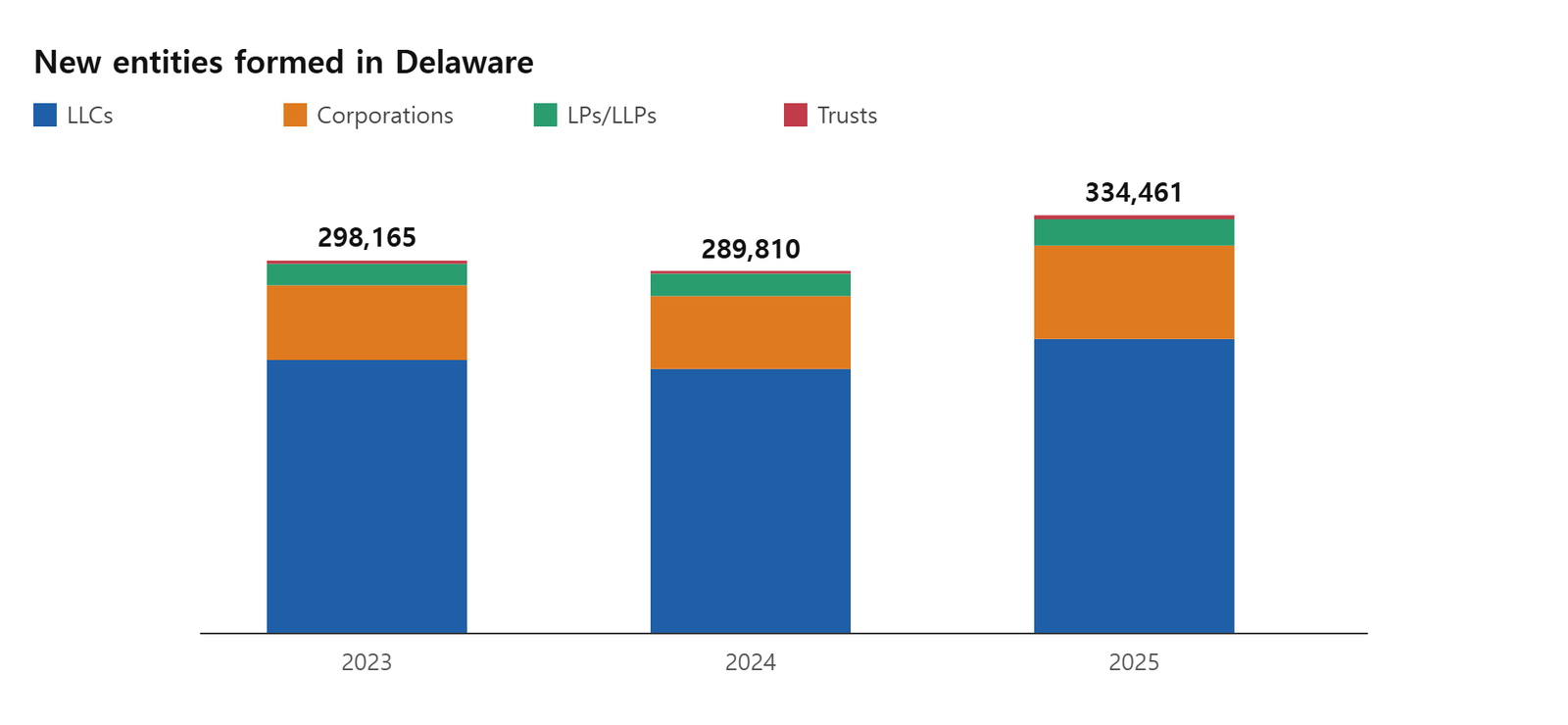
Formations are growing. Delaware recorded 334,461 new entities in 2025, up 15.4% from 289,810 in 2024. New corporations rose 28.1% to 74,716 from 58,313. Of the state's $2.05 billion in fiscal 2025 general fund revenue from the Division (about ₩2.74 trillion), $1.85 billion came from business entity taxes.
Investors favour Delaware for its courts. The Court of Chancery hears corporate disputes, and its decisions go straight to the Delaware Supreme Court on appeal. Yun pointed to one-page, same-day filing and judges who specialise in corporate law as the state's main advantages.
Doing business in California means registering there, and the $800 minimum tax applies wherever you incorporate
Each U.S. state has its own corporate law, so a company formed in another state is a foreign corporation. To operate in California, a Delaware corporation files a Statement and Designation by Foreign Corporation with the Secretary of State, at $100 for a stock corporation. Yun noted that companies can cut costs by using their own office or their accountant's office as the California agent address.
California tax does not care where the company was formed. The FTB levies the $800 minimum on any corporation incorporated, registered or doing business in the state, including foreign companies that never registered. California-sourced income is taxed at 8.84%. Corporations newly formed or qualified on or after Jan. 1, 2020, are exempt from the minimum tax in their first taxable year.
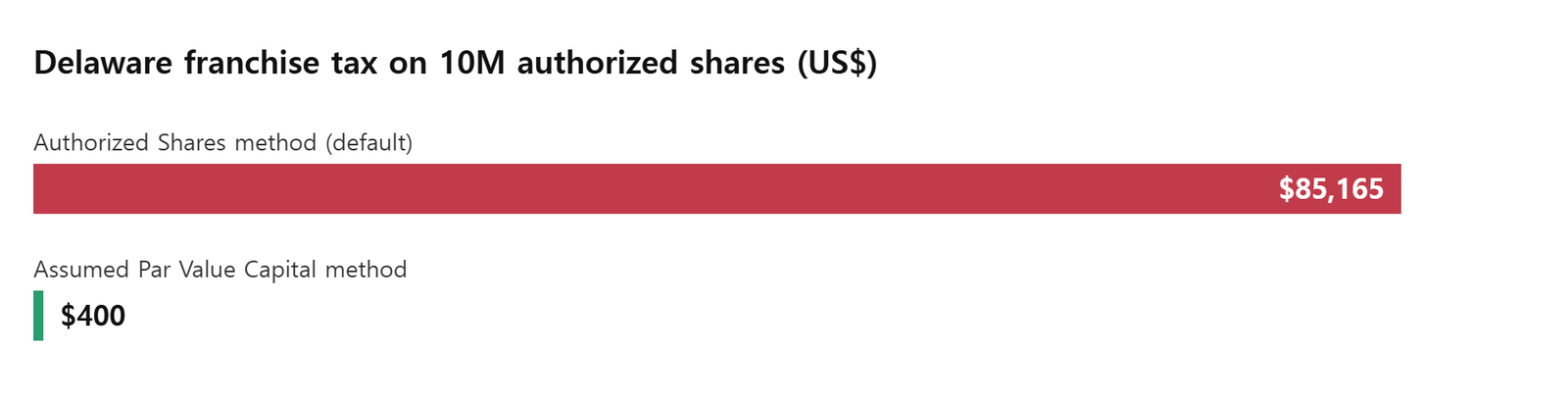
Ten million authorized shares can draw an $85,165 bill; the other method cuts it to $400
Yun warned that in Delaware share counts drive the tax bill, so companies should set authorized shares with care. Delaware's franchise tax defaults to the Authorized Shares method: $175 for 5,000 shares or fewer, $250 for 5,001 to 10,000, plus $85 for each additional 10,000 shares, capped at $200,000.
Startups often authorize millions of shares to leave room for equity grants. Under the default method, 10 million authorized shares produce a bill of $85,165 (about ₩114 million). Reporting issued shares and gross assets on the annual report lets a company use the Assumed Par Value Capital method; with 8 million shares issued and $200,000 in gross assets, the tax falls to the $400 minimum.
The annual report and franchise tax are due every March 1. The report fee is $50, and late filers pay a $200 penalty plus 1.5% monthly interest. California's tax does not change with authorized shares, issued shares or asset size.
Wholly owned Korean subsidiaries can incorporate in California; 25% foreign ownership triggers Form 5472
Yun's two cases for skipping Delaware are a subsidiary wholly owned by a Korean parent and a company with no plan for outside U.S. investment. An entertainment company running production, distribution or marketing from Los Angeles, or a K-beauty brand selling mainly through California stores, can incorporate in California from the start if it fits those conditions, and handle registration and filings in one state.
Some duties apply wherever a company incorporates. A U.S. corporation that is at least 25% foreign-owned must file Form 5472 with its federal return to report related-party transactions, and missing it carries a $25,000 penalty (about ₩33 million). A subsidiary wholly owned by a Korean parent is covered whether it is a Delaware or a California corporation.
Startups chasing U.S. venture capital make a different calculation, often through a "flip" that puts a Delaware parent above the Korean company. At a legal-support seminar for companies going abroad held Jan. 22 by Korea Growth Investment Corp. (한국성장금융), one attendee asked whether Delaware offered real advantages or just more to manage, Hankyung (한국경제) reported.
A flip alone does not bring investors. Kim Na-yul (김나율), CEO of AI model-compression startup CLIKA (클리카), which moved its headquarters to San Francisco in 2025, said at a Startup Alliance (스타트업얼라이언스) seminar on April 9 that she "thought flipping to the U.S. would naturally bring investment," Unicorn Factory (유니콘팩토리) reported. For U.S. investors, she added, the legal and administrative cost of backing a third-country company is a hurdle.
Public companies head to Texas and Nevada; Delaware answers with SB 21
Among listed companies, the move out of Delaware known as "DExit" continues. It began in 2024, when Elon Musk moved Tesla to Texas after a Delaware court voided his $56 billion pay package. ExxonMobil announced plans to redomicile to Texas in March 2026.
Law firm Foley & Lardner counted about 49 Delaware public companies that put reincorporation proposals to shareholders between January 2024 and March 2026, most of them founder-led or founder-controlled technology companies. Bloomberg Law reported on Sept. 9 that nearly half of companies leaving Delaware this year chose Texas, up from one in six two years ago. Nevada still leads in total reincorporations.
Nevada has no corporate income tax or franchise tax; its baseline upkeep is a $150 annual list fee plus a $500 business licence renewal, or $650 a year. A Nevada corporation operating in California still registers there and pays the $800 minimum.
Delaware enacted SB 21 in March 2025, tightening the definition of a controlling stockholder and narrowing stockholders' books-and-records demands. The Delaware Supreme Court upheld the law on Feb. 27, 2026, in Rutledge v. Clearway Energy Group.
Outlook: Delaware's next deadline is March 1, 2027, and the funding route should come first
Delaware's new formations and Fortune 500 share both rose last year, while public-company departures are concentrated among founder-controlled tech firms. For a Korean company setting up in the U.S., the question is who it will sell equity to. If it plans to raise U.S. venture money or list in the U.S., it should budget for Delaware incorporation plus California registration, and schedule the shareholder consents and Korean foreign-exchange filings a flip requires.
A wholly owned subsidiary doing business in California can, as Yun advises, keep costs down by incorporating in California. The same logic applies to companies running shows or exhibitions in Nevada, such as in Las Vegas: the state where the business operates sets the baseline. A company can move its legal home later if its funding plans change, but that means shareholder approval and filings in both states.
The calendar is fixed. Delaware corporations must file their annual report and franchise tax by March 1, 2027. New California corporations start paying the $800 minimum once their first-year exemption ends. Form 5472 comes with the federal return every year, whatever the state of incorporation.
Exchange rate: $1 = ₩1,334.3 (Seoul FX market close, Oct. 30, 2026, per Seoul Finance).
State costs cover filing fees and minimum taxes only; registered-agent fees, legal and accounting fees, and income tax are excluded. The franchise tax example applies assumed figures to the Delaware Division of Corporations' formulas. This article is general information, not tax or legal advice.
Text in quotation marks is reported speech; unquoted passages summarise reporting and source documents.
Sources
- Yun Joo-ho (윤주호), "[Tax Basics] Incorporating in Delaware," Korea Daily (미주중앙일보), Oct. 21, 2026
- Delaware Division of Corporations, 2025 Annual Report
- Delaware Division of Corporations, 2024 Annual Report
- Delaware Inc., 2025 Delaware Annual Report summary
- Wolters Kluwer, Delaware franchise report and tax requirement
- Orrick, Delaware annual franchise tax FAQ
- Mosey, Delaware Franchise Tax & Annual Report guide, 2025.12.4
- California Franchise Tax Board, Corporations
- California SOS, Statement and Designation by Foreign Corporation
- Terms.law, Foreign corporations doing business in California, 2025.11.13
- Wolters Kluwer BizFilings, Nevada incorporation requirements
- IRS, About Form 5472
- Hankyung (한국경제), Korea Growth Investment Corp. seminar report, Jan. 26, 2026
- Unicorn Factory (유니콘팩토리), Startup Alliance seminar report, Apr. 9, 2026
- Bloomberg Law, Texas Sees Growing Benefit From Corporate Push to Ditch Delaware, 2026.9.9
- Foley & Lardner, DExit One Year Later, 2026.5.27
- Husch Blackwell, DEXIT: Is Delaware Losing Its Corporate Crown?
- Cravath/Legal 500, DExit in Review, 2026