
Adobe becomes Disney's 'Official AI Innovation Partner' in a multiyear pact spanning Imagineering, StudioLAB and ESPN Edge — Disney's first major AI tie-up since its OpenAI deal fell through eight months ago
Disney named Adobe its Official AI Innovation Partner in a multiyear alliance unveiled Nov. 9 at Adobe MAX. Adobe will give Disney early access to Firefly, Photoshop and Premiere and build Disney-only AI models via Firefly Foundry. StudioLAB and ESPN Edge projects are underway.
The Walt Disney Company has named Adobe its Official AI Innovation Partner, the two companies announced Monday, unveiling a multiyear strategic alliance that covers generative AI and other emerging technologies. Neither company disclosed the length or value of the deal.
The announcement was timed to Adobe MAX 2026, Adobe's annual creativity conference, which runs Nov. 10–12 at the Miami Beach Convention Center in Florida.
Under the agreement, Adobe will give Disney's creative teams early access to its newest AI, creative and media technology, including the Firefly generative AI app, the Firefly Foundry custom-model service, Premiere and Photoshop. Adobe will also assign dedicated engineering and research staff to Disney's production pipeline.
The pact is Disney's first major alliance with an AI company since its OpenAI arrangement collapsed. In December 2025, Disney agreed to invest $1 billion in OpenAI and license more than 200 characters to the Sora video app for three years; the investment never closed after OpenAI shut Sora down in March 2026. The Adobe deal works the other way around: rather than lending characters to a consumer app, Disney will use models trained only on its own IP inside its own production.
Disney-only models trained on characters, worlds and art styles
Firefly Foundry sits at the center of the alliance. Adobe introduced the service at Adobe MAX in October 2025; it layers a client's IP catalog on top of Firefly models that were trained only on licensed data. Disney will use it to build models that learn its own "world knowledge" — character attributes, environments and visual styles — with the aim of producing commercially safe, production-ready output. Disney describes the models as "human-centered and artist-led."
"Disney has always embraced innovation, and this alliance with Adobe builds on a longstanding relationship between two companies that share a deep commitment to creativity," said Becca Vodnoy, Disney's senior vice president of corporate alliances. The combination of Disney's storytellers and brands with Adobe's technology, she said, gives the company's creative teams "new ways to explore and develop their ideas."
Hannah Elsakr, Adobe's vice president of GenAI New Business Ventures, called the deal "the next chapter" of a decades-long relationship in which the two companies will build a creative foundation that "thoughtfully deploys AI as an accelerant for artistic vision, creativity and guest engagement." Elsakr launched Adobe's enterprise Firefly business, including Firefly Foundry.
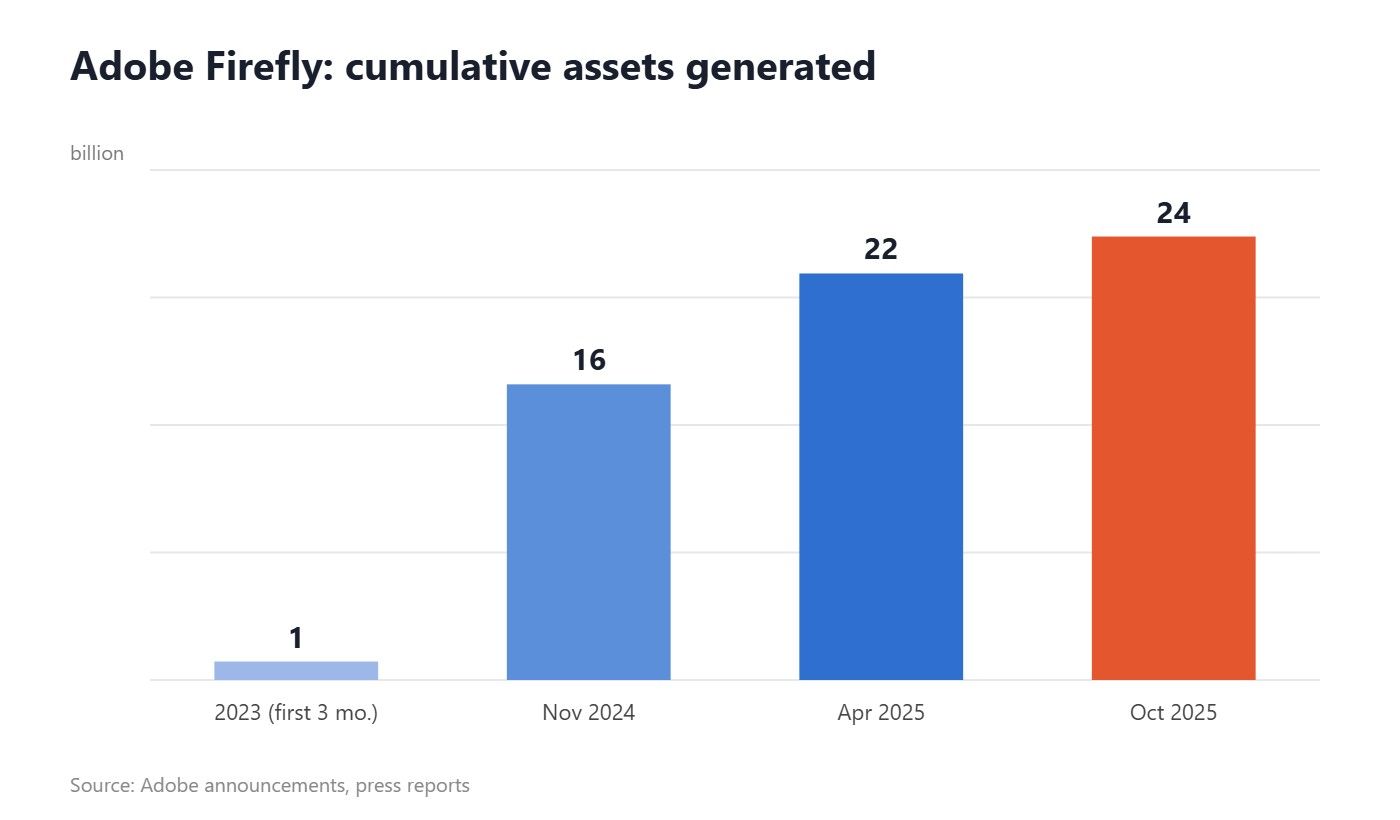
Firefly users had generated more than 24 billion assets as of Adobe MAX in October 2025, up from 16 billion in November 2024. On its June earnings call, Adobe said Firefly's ending annual recurring revenue was approaching $300 million at the close of its fiscal second quarter, up about 50% from the prior quarter. Foundry, which builds private models for enterprise clients, extends that business into corporate IP.
Imagineering trains on 70 years of designs: 'months of work into days and weeks'
Walt Disney Imagineering Research & Development is already using Firefly Foundry in its theme park pipeline; Adobe and Imagineering first disclosed that collaboration on June 16. Imagineering, founded by Walt Disney in 1952, customized the model with more than 70 years of its own concept art and technical designs.
Three workflows came first: a sketch-to-image model that turns hand-drawn concepts into fully rendered 2D concept art; a custom image model that generates franchise-accurate assets for properties including Mickey & Friends, Frozen, Moana, Lilo & Stitch and Cars; and a 3D modeling capability that turns 2D renderings into prototypes so teams can estimate materials and coordinate with engineers earlier.
"The impetus for the use of Adobe Foundry was because we were looking for a way to speed up our process," Kyle Laughlin, senior vice president of Walt Disney Imagineering R&D, said in a June 18 interview on Disney's corporate site. "What's most exciting is that it allows months of work to be compressed into days and weeks." Laughlin called Disney "a talent-driven company" and stressed that people remain at the center of the creative process.
Disney's revenue mix helps explain why AI work started with theme park design. Axios's annual Media Trends 2026 report, released Oct. 20, puts 38% of Disney's revenue in Experiences, the segment covering parks, cruises and consumer products. The report describes a new phase in which streaming is no longer the main moneymaker but a tool for growing advertising, commerce and experiences.
StudioLAB and ESPN Edge projects underway; joint marketing across parks and cruises
The alliance extends into film and sports. Adobe joins StudioLAB, the Walt Disney Studios' innovation hub where creative and technical staff prototype ideas and turn experiments into proven tools, as a StudioLAB Innovation Partner, working with Disney creatives and technologists on internal production workflows.
At the ESPN Edge Innovation Center, ESPN and Adobe will look at how AI can deepen fan engagement, shape how ESPN delivers content and bring its archive to life. Adobe said co-innovation projects with both StudioLAB and ESPN Edge have already started.
The deal also has a marketing side. Adobe will tell innovation stories with Walt Disney World Resort, Disneyland Resort, Disney Cruise Line, ESPN Edge and StudioLAB through global marketing activations, industry events and customer storytelling, and will raise its presence across Disney's media platforms. The pact follows Adobe's Sept. 28 agreement to become the NHL's Official Creative, Marketing and AI Partner.
Disney+ Verts and a TikTok deal; 57% of U.S. 18-to-24s find shows on short-form video
Disney+ launched Verts, a vertical short-form feed in its app, in March. It surfaces scenes from films and series in the Disney+ library, and viewers can jump from the feed to the full title or add it to a watchlist. In August, Disney struck a deal with TikTok that lets creators feature Marvel, Pixar and Star Wars characters in videos hosted on both TikTok and Verts.
Nearly every major U.S. streaming service has added a similar feed over the past year. Netflix and Paramount+ launched theirs in April, Amazon Prime Video in May, HBO Max in July and Peacock in August; Tubi got there first, in November 2024. In its October report Social Media & Entertainment Discovery, written by media analyst Audrey Schomer, entertainment data company Luminate noted that each service has stated the same goal: improving content discovery inside its own app.
| Service | Feed | Launch | Content |
|---|---|---|---|
| Tubi | Scenes | Nov 2024 | Clips from movies and shows |
| Disney+ | Verts | Mar 2026 | Library scenes; creator/fandom content under consideration |
| Netflix | Clips | Apr 2026 | Series, film and special clips; podcasts and live to follow |
| Paramount+ | — | Apr 2026 | Sports highlights, CBS News, UFC, trailers |
| Prime Video | Clips | May 2026 | NBA highlights, movie and show clips |
| HBO Max | HBO Max Shorts | Jul 2026 | Trailers, clips, bonus content |
| Peacock | Vertical Feed | Aug 2026 | Library clips; microdrama hub |
Vertical short-form feeds on major U.S. streaming services. Source: Luminate (as of September 2026)
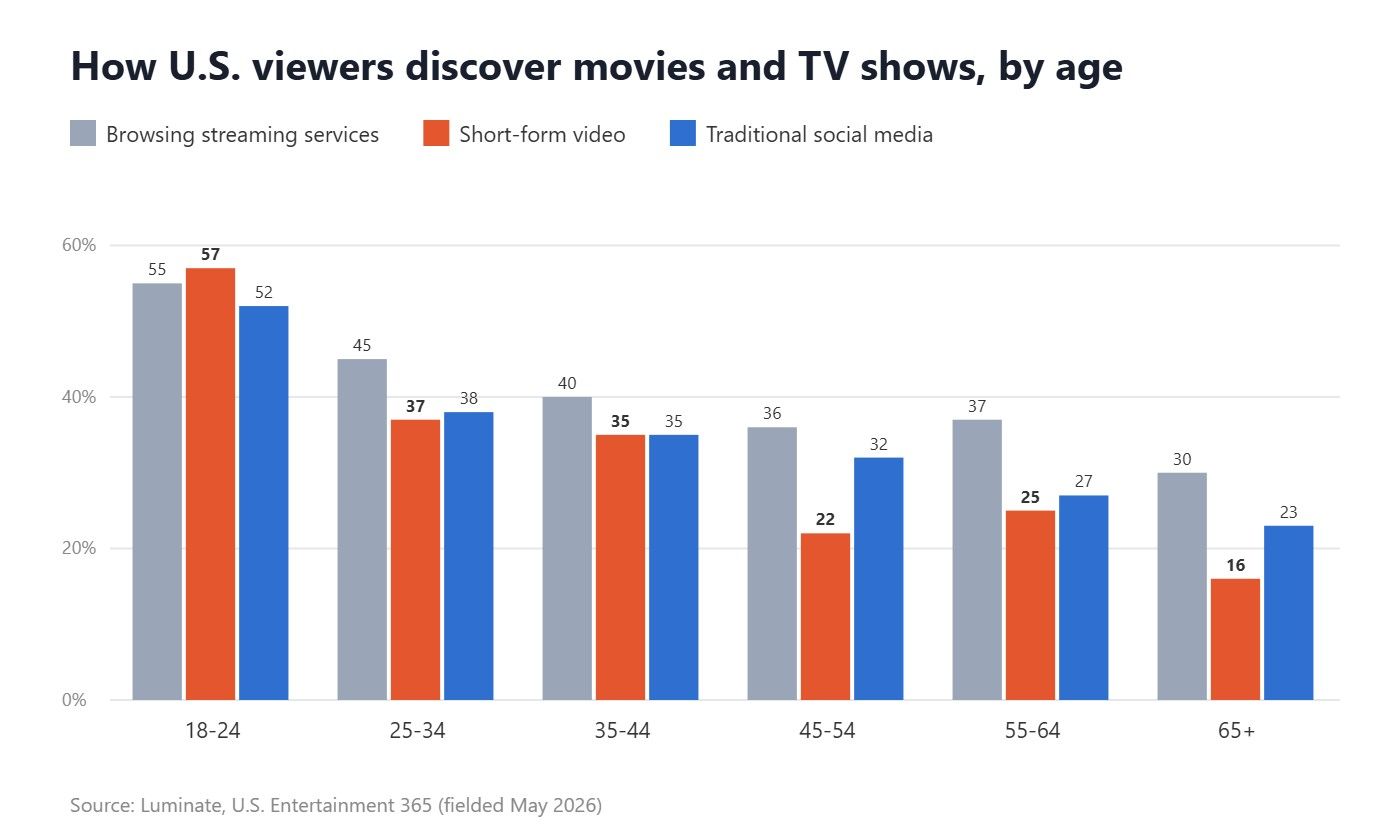
In the same report, 57% of U.S. viewers ages 18 to 24 said they find movies and shows on short-form video platforms — more than the 55% who browse streaming services, and the only age group for which short-form video ranks first. Among those 65 and older, the figure was 16%. Short-form video accounts for 26% of weekly media time for 18-to-24-year-olds, more than double the 12% for people 55 and over. Frequent moviegoers — those who saw three or more films in a theater in the past three months — discover movies on short-form video at 42%, nine points above all movie viewers (33%). The survey covered 2,000 U.S. respondents ages 13 and up in May.
The ESPN–Adobe agenda of content delivery and archive use sits on the same trend. Streaming services need a steady supply of short clips recut from existing films, series and sports footage to keep those vertical feeds full. Mobile video is scaling. MicrOs, the short-form offering on TelevisaUnivision's ViX, topped 1 billion views, with viewership up 48% quarter over quarter, and Peacock and Fox are investing in mobile-first scripted series and microdramas, Axios reported.
Lawsuits, a failed investment and a new CTO: Disney's 18 months in AI
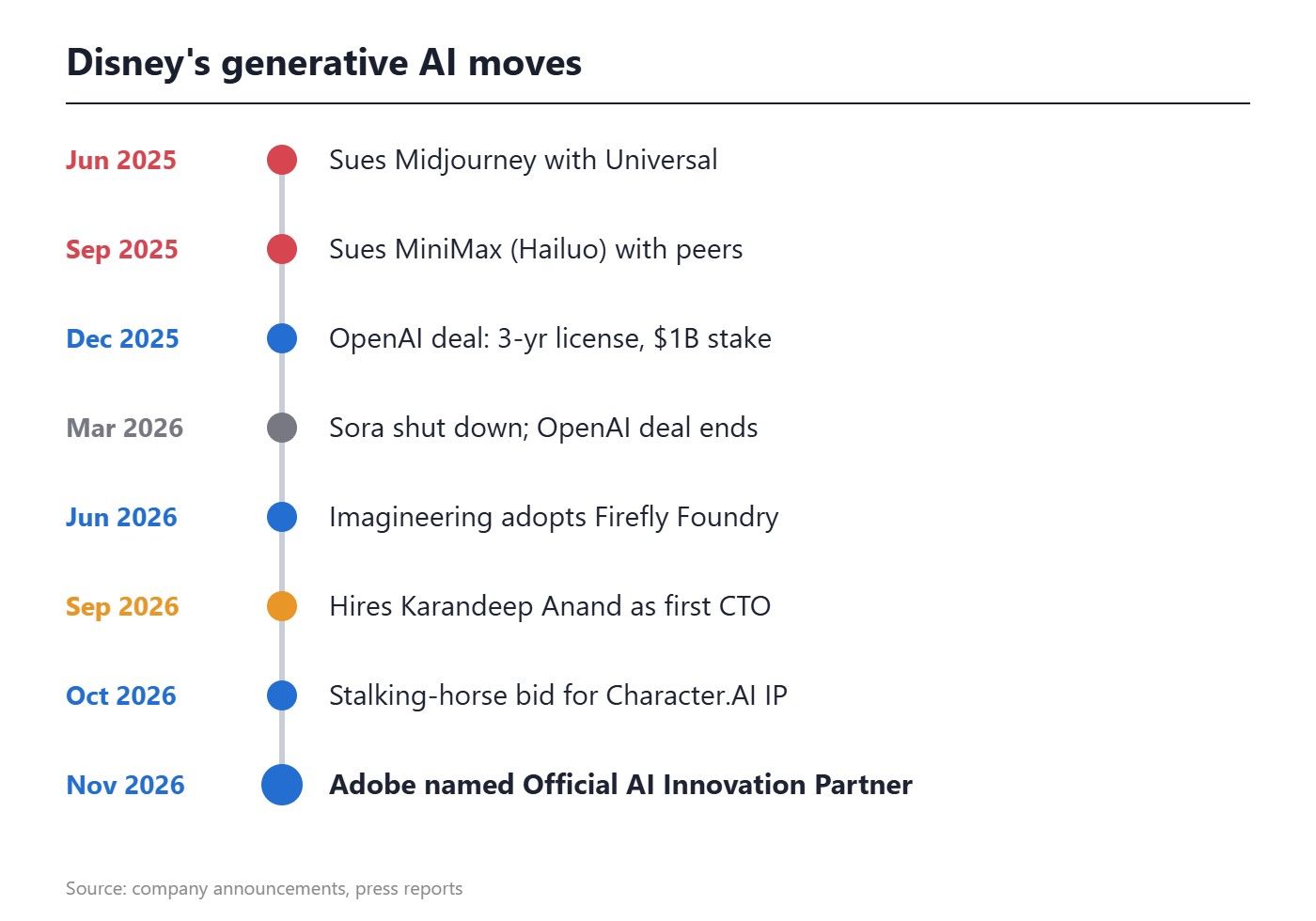
Disney has pursued AI companies in court while courting others as partners. It sued Midjourney with Universal in June 2025, and in September 2025 joined Universal and Warner Bros. Discovery in suing China's MiniMax over its Hailuo video service. The OpenAI deal announced that December unraveled within three months.
On Sept. 18 this year, Disney hired Karandeep Anand, then chief executive of Character.AI, as its first company-wide chief technology officer. Anand started Oct. 2 reporting directly to CEO Josh D'Amaro and oversees data and AI platforms, product and engineering. Announcing the hire, D'Amaro set out three priorities: "great storytelling as our North Star, technology in service of creativity, and operating as One Disney."
Character.AI filed for Chapter 11 protection in Delaware on Oct. 12, with Disney affiliate Disney Worldwide Services acting as stalking-horse bidder: $20 million for a non-exclusive, perpetual license to certain Character.AI intellectual property. The sale is expected to wrap up in late November or early December.
Korea's broadcasters sue Naver and OpenAI while signing AI pacts; CJ ENM makes its own AI content
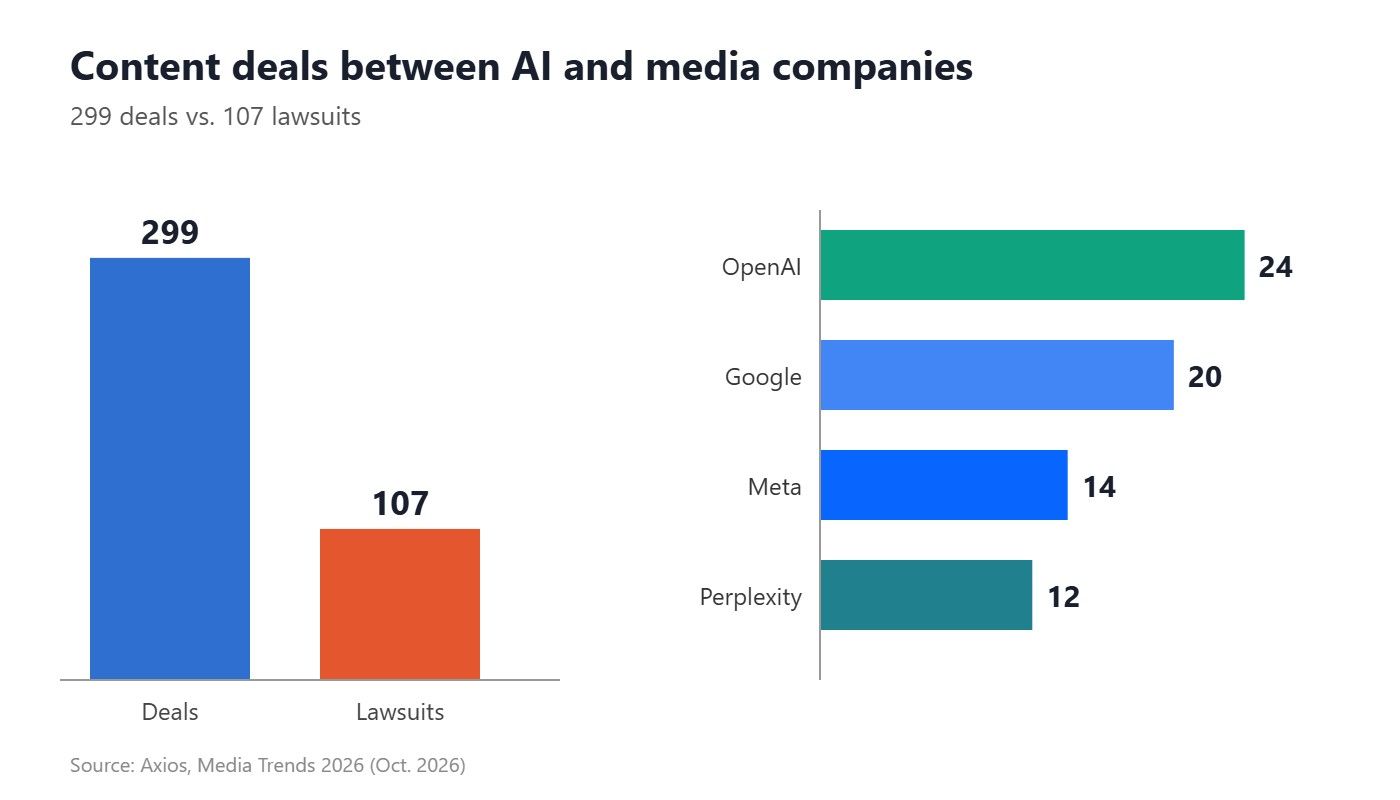
In the U.S., AI deals now outnumber AI lawsuits. Axios counted at least 299 content deals between AI companies and media companies, against 107 lawsuits. OpenAI has 24 such deals, Google 20, Meta 14 and Perplexity 12. News leads on licensing, while music and books remain more litigation-heavy, and payment is shifting from training licenses toward usage-based compensation. More than 40% of top publishers block AI training crawlers, while 25% block AI search crawlers.
Korean broadcasters are fighting AI companies in court and partnering with them at the same time. On Jan. 13, 2025, terrestrial networks KBS, MBC and SBS (지상파 3사) sued Naver (네이버) in Seoul Central District Court, alleging it used their news without permission to train its HyperCLOVA X model, and sought damages and a training ban. On Feb. 23, 2026, the three filed suit against OpenAI as well. The Naver case held its fourth hearing on April 9.
The partnerships have continued. KBS signed an AI agreement with Naver in July 2025 and SBS followed on March 17, 2026; MBC joined the NC AI consortium in the government's sovereign foundation-model project. In 2025, SBS became the first terrestrial broadcaster to set out pricing for AI training on its content, offering flat-fee, usage-based and revenue-share options. Korea's Ministry of Culture, Sports and Tourism (문화체육관광부) and Korea Copyright Commission (한국저작권위원회) issued fair-use guidance on AI training in February 2026.
"We can work with any AI company, but we can cooperate only if they recognize us as much as we recognize them," Kwon Seok-won (권석원), head of MBC's AI strategy team, told the Journalists Association of Korea's newspaper (기자협회보) in a March 26 article, referring to Naver. He urged the government to back an industry coalition to build a sovereign AI model specialized in K-content.
CJ ENM is using AI in its own productions. Its AI feature film The House (아파트), made with Google Cloud, rendered every background with AI and cut live-action shooting with actors to four days. Its AI animated series Cat Biggie (캣 비기), released in 2025, was completed by six creators in five months: 30 two-minute episodes. "AI may open opportunities for IP-owning studios to make high-quality content on their own within limited budgets," Baek Hyun-jung (백현정), CJ ENM's chief AI officer, said in a Google Cloud case study.
| Disney | KBS · MBC · SBS | CJ ENM | |
|---|---|---|---|
| Lawsuits vs. AI firms | Midjourney (Jun 2025), MiniMax (Sep 2025) | Naver (Jan 2025), OpenAI (Feb 2026) | — |
| AI partnerships | OpenAI (Dec 2025, collapsed), Adobe (Nov 2026) | KBS/SBS–Naver MOUs; MBC–NC AI consortium | Google Cloud |
| How IP is used | Private models trained on own IP (Firefly Foundry) | Training-fee pricing (SBS) | In-house AI films and animation |
How Disney and Korean media companies are handling generative AI. Source: company announcements, press reports
Next: film and series production — and for Korea, archives as production assets
Adobe said more activations will roll out over the life of the deal, with the work showcased at Adobe Summit, Adobe MAX and other industry events. The use cases disclosed so far sit at the early, concept stage of theme park design. The next tests are whether the StudioLAB work reaches film and series production, and what product emerges from ESPN's archive.
The Disney–Adobe model is not about licensing IP to a general-purpose model in exchange for a fee. A technology company builds a private model for the IP owner, and the output stays inside the owner's own production pipeline. Korean broadcasters' response to AI has so far centered on training fees and lawsuits. Networks holding decades of drama, entertainment and news archives also have the option of using those archives to train models of their own — the direction MBC's call for a K-content sovereign model points toward. With 57% of U.S. 18-to-24-year-olds finding shows on short-form video, per Luminate, those archives can serve both as training data for AI production and as raw material for short-form clips. The usage-based and revenue-share options in SBS's pricing scheme point the same way U.S. deals are moving.
The gains are not yet proven in numbers, even at Disney. Imagineering's "months into days and weeks" describes theme park concept work. Applying such models to drama and variety shows, where performers' likeness and neighboring rights are involved, would require clearing those rights first. Even in its OpenAI deal, Disney excluded talent likenesses and voices from the license.