

Nearly 35% in Gracenote's six-market survey say subscription clutter has them watching more FAST; picking a show takes 12 minutes / Netflix originals lose about 2.8% of U.S. viewing as Korean broadcasters gain an opening, but new-channel funding totals ₩920 million
Viewers worn out by searching are turning to FAST. Nearly 35% in a Gracenote survey said they watch more of it, while Netflix originals lost about 2.8% of U.S. viewing. FAST puts K-content in front of new overseas viewers, but rights, revenue reporting and promotion still need funding.

Streaming viewers can't find anything to watch. Picking a show now takes them 12 minutes on average, according to "2026 State of Play," a survey of 3,000 streaming users in Brazil, France, Germany, Mexico, the U.K. and the U.S. by Gracenote, Nielsen's content data unit. Nearly 35% said subscriptions have become so complicated that they now spend more time on FAST, the free ad-supported streaming TV channels.
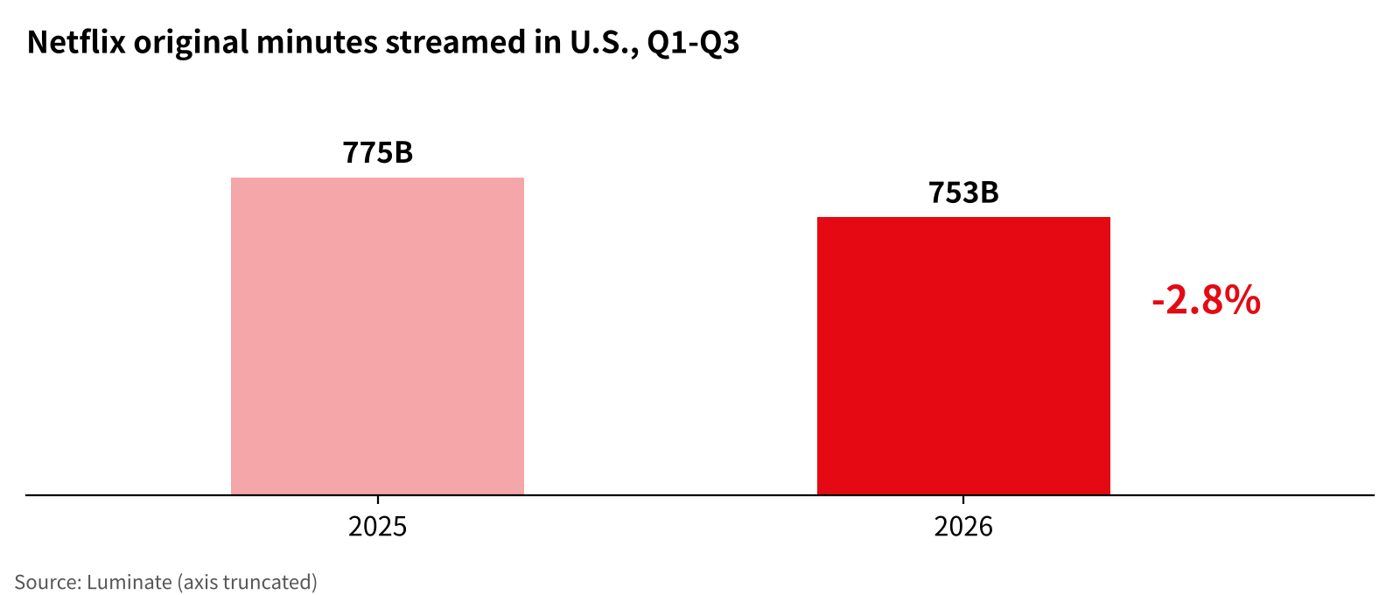
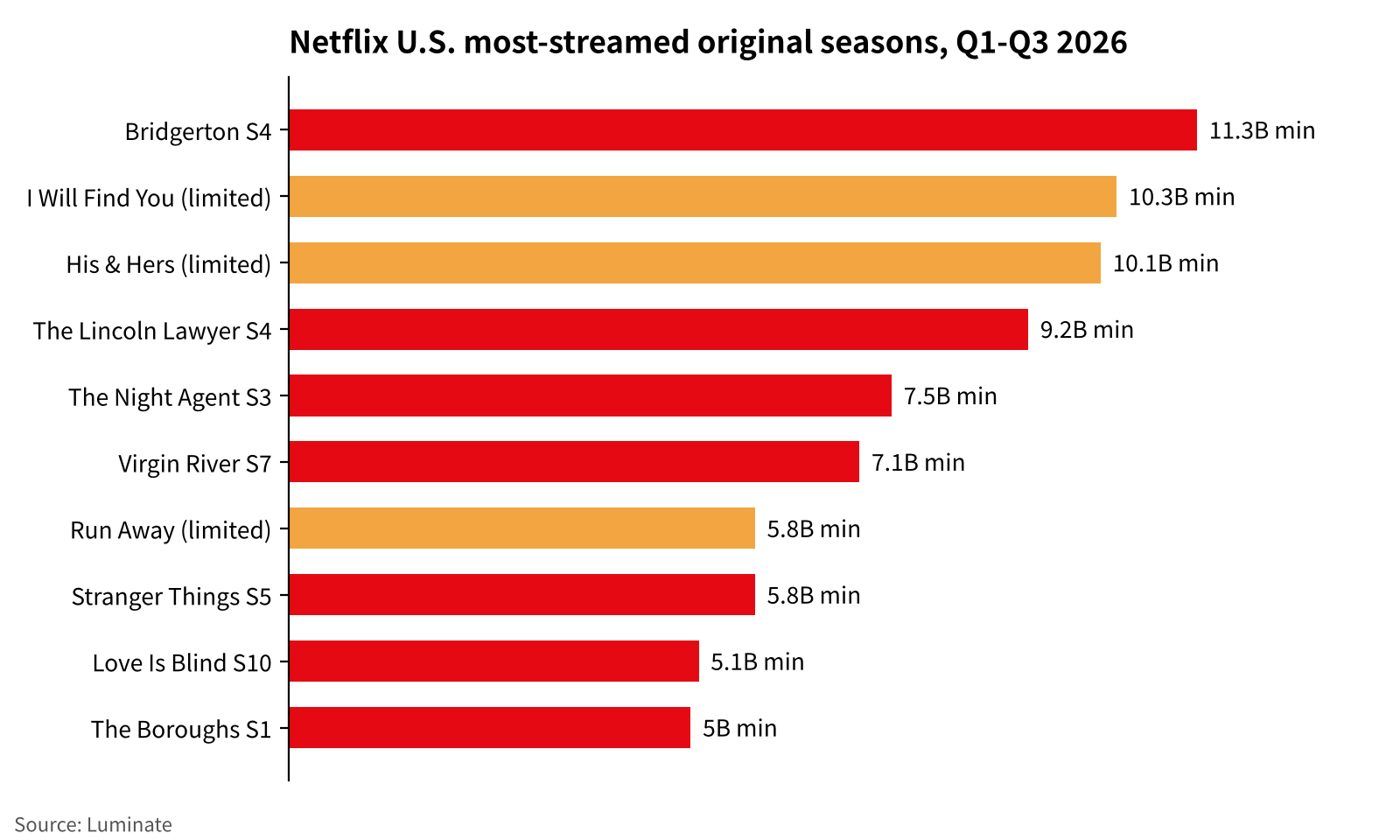
Channels that don't ask viewers to choose are drawing them in. Global FAST viewing hours rose 55% year on year in the second quarter, according to media cloud company Amagi. Netflix, the subscription leader, stalled over the same stretch: U.S. viewing of its originals fell about 2.8% to 753 billion minutes in the first three quarters, Luminate data show, and no Korean title made its top 10 seasons.
For K-content, which leads Netflix's non-English slate, that is a threat. It may also be an opening. A FAST channel can put K-dramas, K-pop stages and Korean news in front of viewers who would never have searched for them. At a FAST roundtable K-EnterTech Hub hosted at MIPCOM in October, European and American executives laid out a path: win first-time viewers through FAST, then add local-language versions and move into telco and pay-TV lineups. Twenty AI-dubbed K-FAST channels backed by the Ministry of Science and ICT (과학기술정보통신부) have drawn about 100 million cumulative viewers in 22 countries, and KT Studio Genie (KT스튜디오지니) says its FAST revenue in the first quarter alone beat all of last year.
Taking that opening will take work from Korean broadcasters: clearing overseas rights, checking ad revenue statements and marketing channels abroad. Conditions are tough. The government's K-FAST program began with ₩8 billion from a 2025 supplementary budget, but its 2026 funding for new channels covers only four channels and ₩920 million, about $690,000. Industry executives want support extended from channel launches to rights clearance, localization, promotion and data. Helping develop AI-driven revenue models for FAST is another job for government.
12 minutes to choose, 51.6% ready to cancel … subscribers who can't find a show
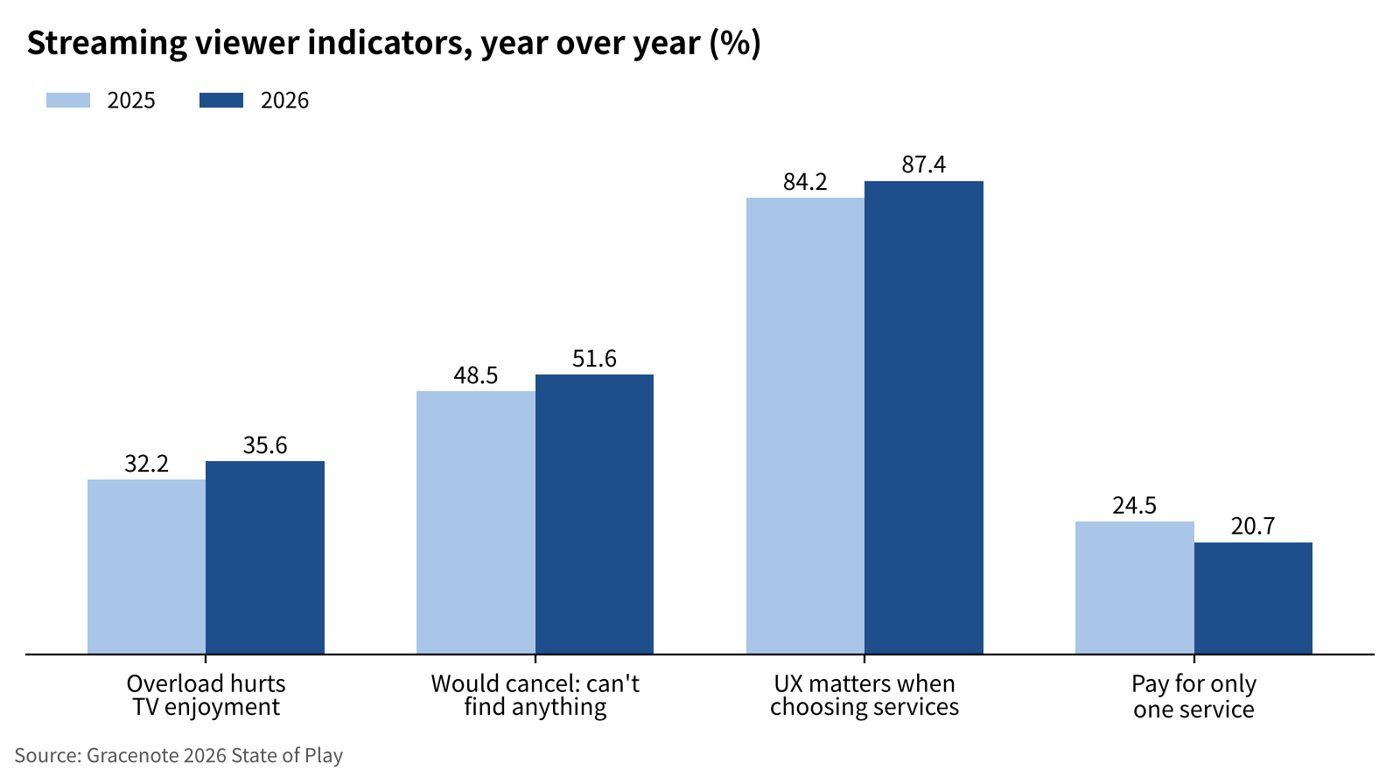
Gracenote polled 500 adults in each market online from Aug. 11 to 19. Thirty percent kept four or more paid subscriptions. Fifty-one percent said more content and services had made it harder to find something to watch. The share who would cancel if they couldn't find something rose from 48.5% to 51.6%. That is stated intent, not churn, but it suggests a bigger library alone no longer holds subscribers.
Many viewers simply go back to what they know. In the survey, 46.8% said they tend to rewatch shows rather than look for new ones. The report notes that Bluey, Grey's Anatomy, NCIS and The Big Bang Theory have appeared in Nielsen's annual top 10 every year from 2023 to 2025. On FAST, where familiar shows run in sequence, a broadcaster's back catalog becomes a product again.

Sports fans struggle more. Nearly 52% said they often don't know which channel or service carries the game they want. Free distribution, meanwhile, has grown. Samsung TV Plus said on Jan. 21 it had passed 100 million monthly active users worldwide, and LG Channels said on July 14 it supplies more than 5,000 channels in 37 countries. Those are platform totals, not revenue for any single channel.
Advertising money has moved toward FAST too, more slowly than forecast but in the same direction. In Amagi's July Airtime Report, FAST ad impressions rose 53% between April 1 and June 15, and advertising made up 51.1% and 50.5% of North American streaming revenue in the first and second quarters, ahead of subscriptions. Fox agreed on June 15 to buy Roku at an enterprise value of about $22 billion. Nielsen's July Gauge put Tubi and The Roku Channel at a combined 4.9% of U.S. TV viewing.
Netflix originals at 753 billion minutes, down about 2.8% … no Korean title in the top 10 seasons
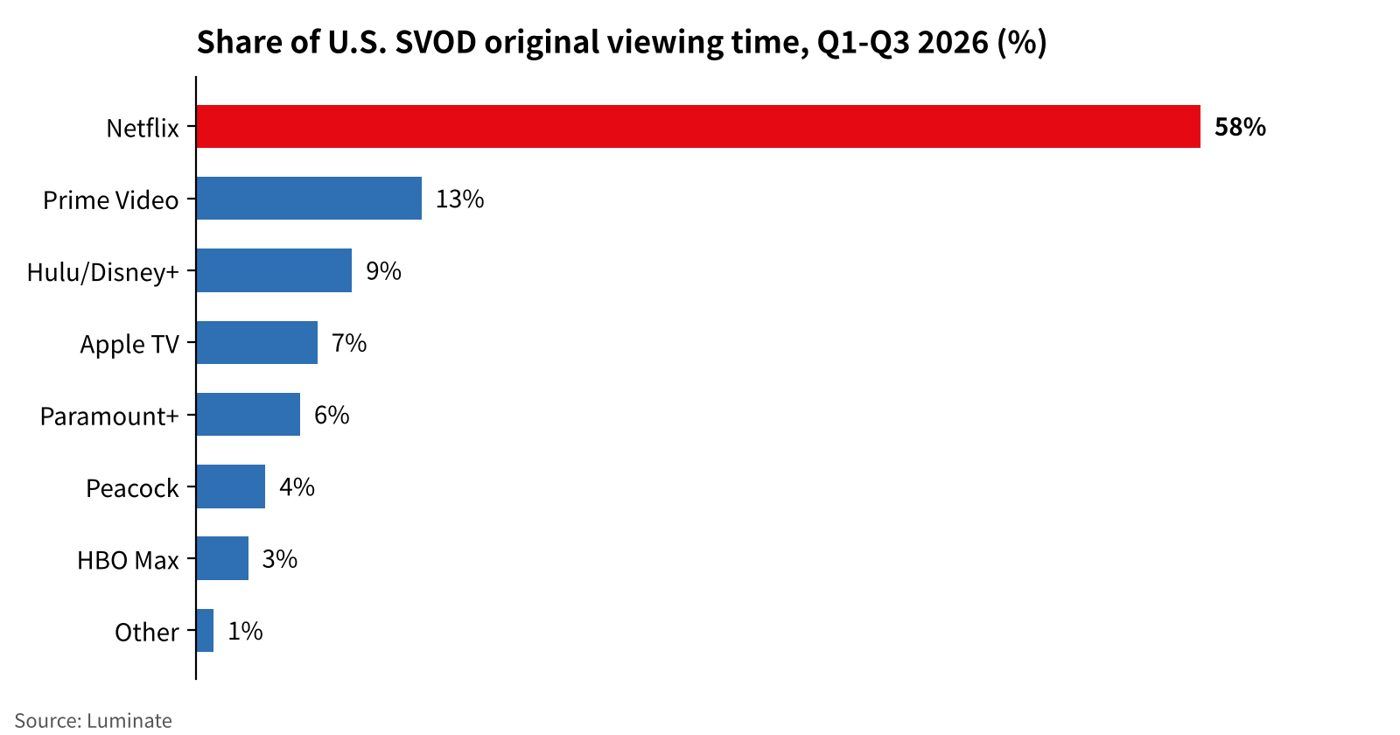
Netflix, the biggest overseas outlet for Korean content, still dominates. In Luminate's Streaming Viewership data, it took 58% of U.S. subscription-service original viewing in the first three quarters of 2026, far ahead of Amazon Prime Video at 13%. But total minutes fell from 775 billion to 753 billion as hits elsewhere, such as HBO Max's The Pitt, took a share.
The base of hits has also narrowed. Through the third quarter last year, 23 of Netflix's top 25 series had passed 5 billion minutes. This year only 13 did. Bridgerton season 4 led the season ranking at 11.3 billion minutes, followed by the limited series I Will Find You at 10.3 billion. No Korean title made the top 10.
Luminate media analyst Tyler Aquilina traced Netflix's content reshuffle to its failure to produce a new long-running hit on the scale of Wednesday or Adolescence. On Oct. 15 Netflix said chief content officer Bela Bajaria would leave and that Peter Rice, former chairman of Walt Disney Television, would succeed her from Oct. 26. The same week it cut about 1,000 jobs, roughly 6% of staff.
Co-CEO Ted Sarandos wrote in a memo that there was room to raise the slate, particularly in the U.S. and Canada. Netflix's total viewing grew 2% in the first half. For Korea's media and entertainment industry, which showed the world what K-content could do through Netflix, that shift could spell trouble.
Global demand for Korean content remains strong. Omdia and Digital i said on June 17 that Korean productions logged 12.1 billion hours on Netflix between April 2025 and March 2026, second only to U.S. productions and 44% more than Japan's. Parrot Analytics estimated on Aug. 30 that 82% of Korean content's global streaming subscription revenue from 2020 to 2025 came from abroad.
The problem is that the demand runs through one outlet. As Netflix leans toward U.S. and Canadian originals, terms for buying and financing Korean shows may change. Korean broadcasters and producers need a route for their catalogs that doesn't hinge on one buyer's choices. FAST sends not one or two hits but whole libraries of drama, variety and news to platforms in many countries at once, around the clock. For content to be discovered by viewers abroad, it needs a window like FAST.
7.8% prefer FAST, 40% use it in Brazil … where Korean culture is popular
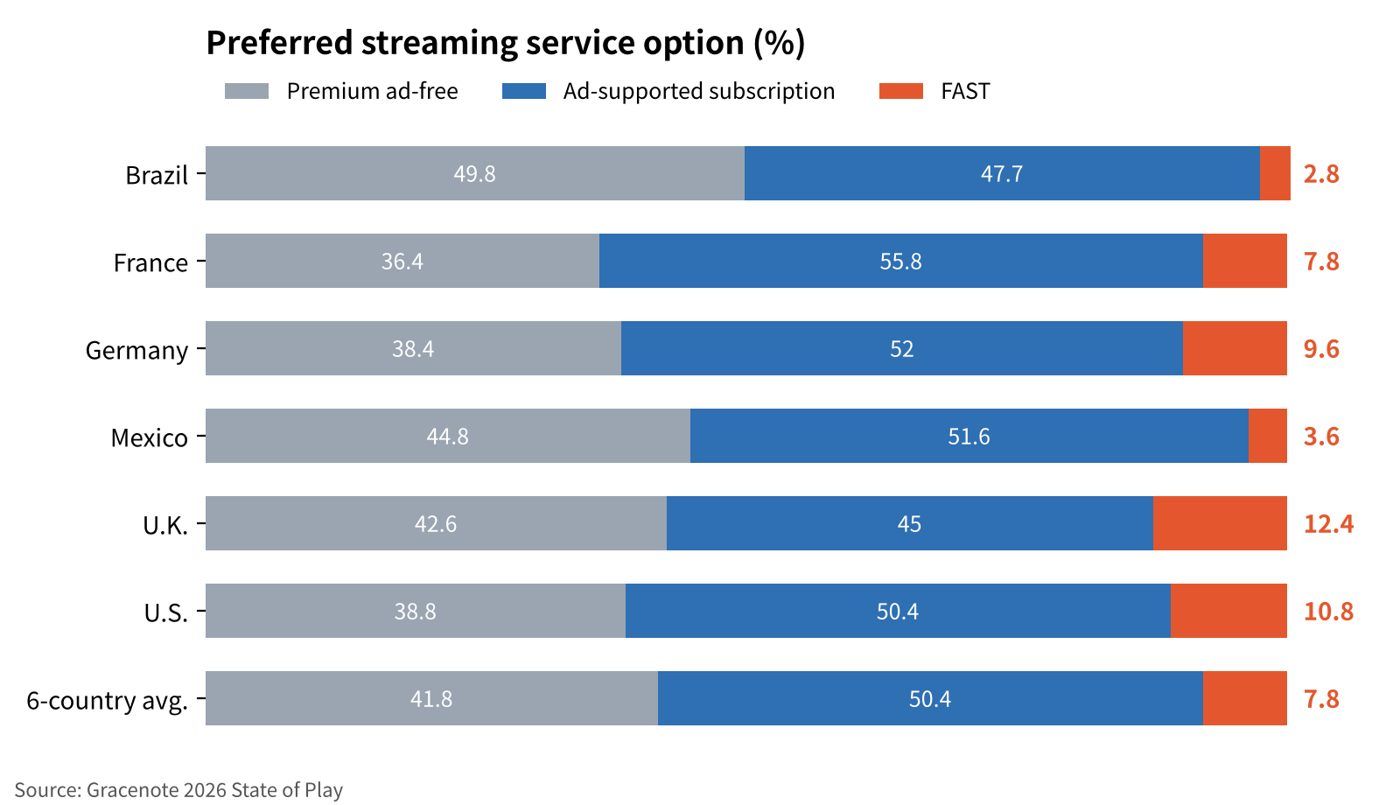
Asked which type of service they prefer, 50.4% picked ad-supported subscriptions, 41.8% ad-free subscriptions and 7.8% FAST. Preference for FAST was highest in the U.K. (12.4%) and U.S. (10.8%) and lowest in Mexico (3.6%) and Brazil (2.8%). Viewers who juggle several services and didn't pick FAST may still watch it.
FAST usage overlaps with the regions where K-content consumption is growing.
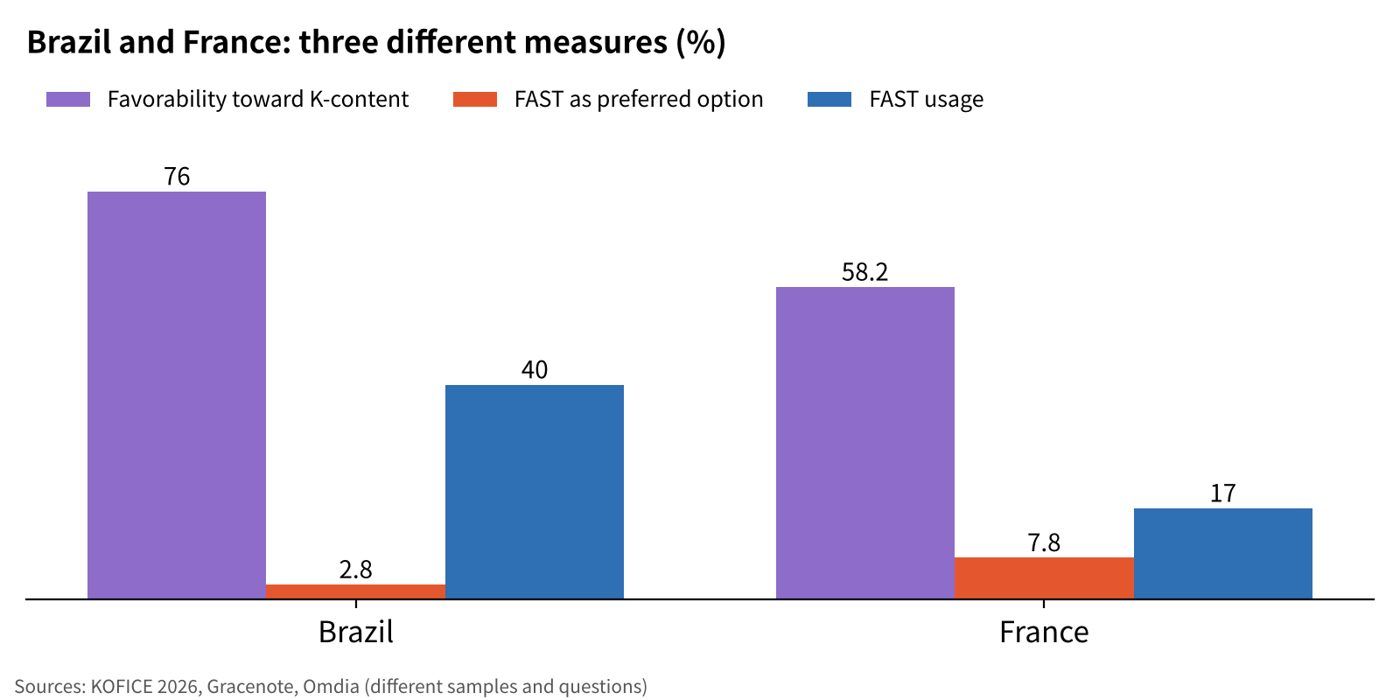
In the 2026 Overseas Hallyu Survey by Korea's culture ministry and the Korea Foundation for International Cultural Exchange (KOFICE), favorability toward Korean cultural content was 76.0% in Brazil and 58.2% in France, against a 30-country average of 69.7%. The survey covered 27,400 people aged 15 to 59 who had consumed Korean content, from Nov. 13 to Dec. 12, 2025. In France, the share who had listened to Korean music rose 11.3 points. The Korea Creative Content Agency (KOCCA) says K-content exports have grown 391% in Latin America and 328% in the Middle East since 2021.
Omdia said on Jan. 21 that Brazil's FAST usage measure stood at 40% and revenue at $152 million, making it the third-largest market after the U.S. and U.K. In France, 17% of online adults used FAST monthly, Omdia said in December 2025. Amagi counted 190% growth in Latin American FAST viewing hours in the second quarter. The samples and questions differ, so these figures can't be set against Gracenote's preference rates. The business question is which Korean titles to put, in Portuguese, into Brazil's existing free-viewing and ad market.
Both countries are already on free TV lineups. Samsung said on Aug. 13 it would stream KCON LA 2026, held Aug. 14–16, free on the CJ ENM K-POP channel on Samsung TV Plus in 17 countries including Brazil and France. FAST platforms program each country separately, so a channel can launch where the fans are.
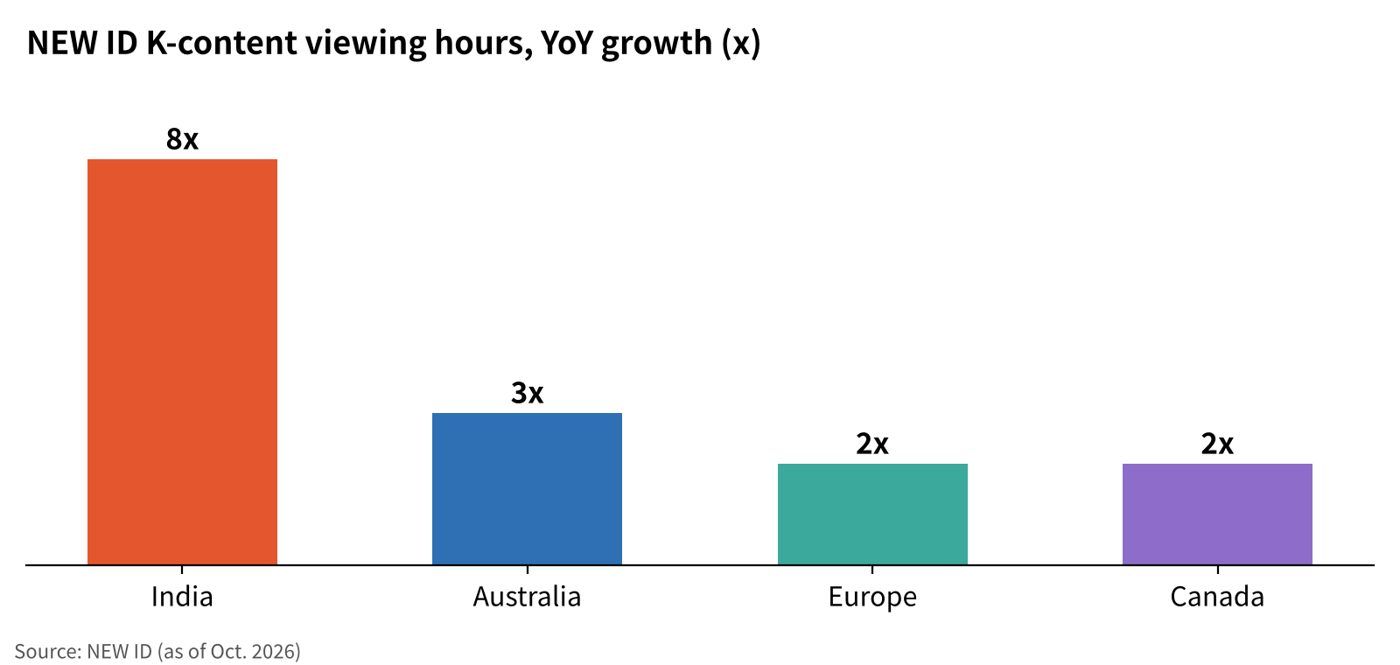
FAST operators are posting results. NEW ID (뉴 아이디), a FAST channel operator, said on Nov. 3 that Korean content on 34 platforms in 96 countries had passed 840 million cumulative viewing hours. Year-on-year viewing grew eightfold in India, threefold in Australia and twofold in Europe and Canada.
News titles 3,100 → 4,500; 40% of viewing on LG Channels India … taking K-news overseas
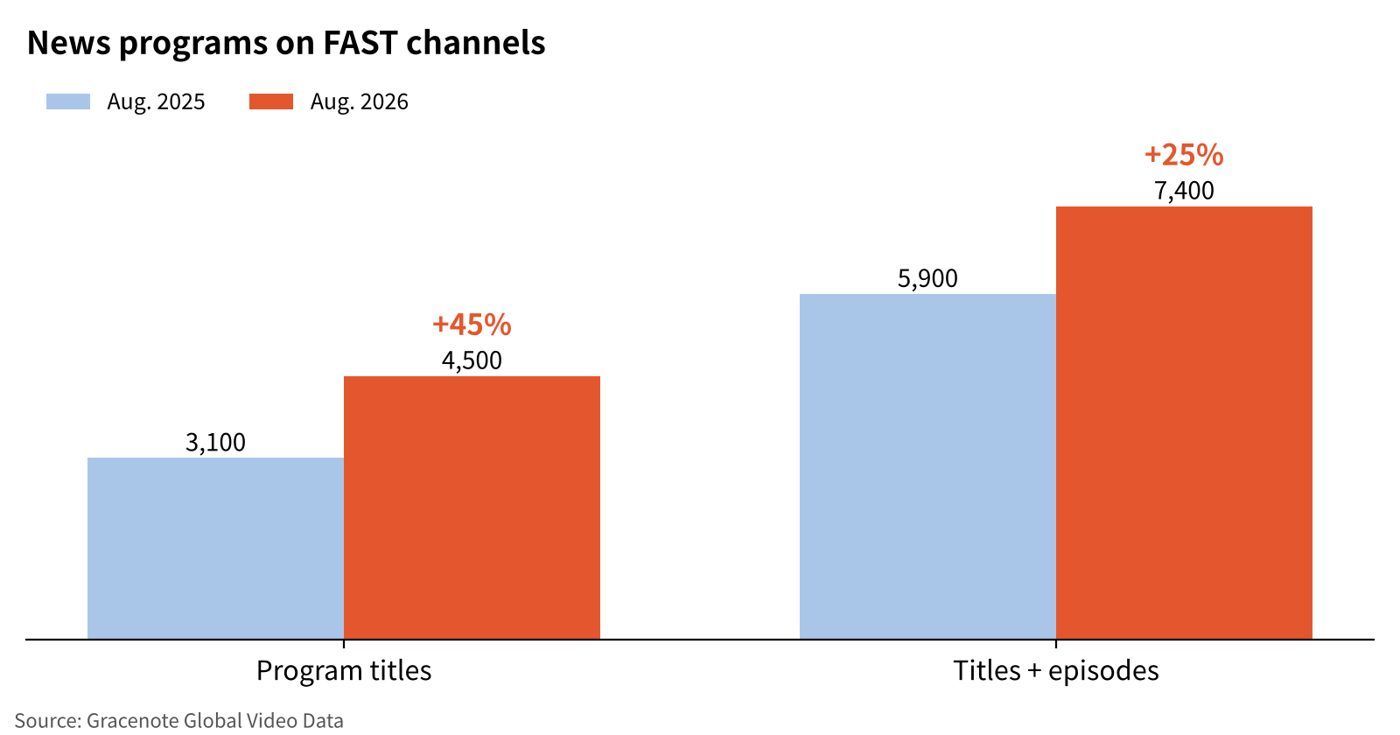
FAST needs a reason to keep the channel on. Live content such as concerts, commerce, news and sports holds viewers on a channel, and news in particular brings them back whenever something happens. In Gracenote's data, FAST news titles rose 45% from about 3,100 in August 2025 to about 4,500 in August 2026; counting episodes, the total rose 25% from about 5,900 to about 7,400. Those are supply figures. In Amagi's count, news took 27% of FAST viewing hours and 33% of ad impressions.
LG Electronics said in August 2025 that news accounted for more than 40% of LG Channels viewing time in India that June, and that TV Chosun, JTBC, MBN, Channel A and YTN ranked near the top on LG Channels in Korea. Samsung added KBS News 24 and SBS No.1 News Live to Samsung TV Plus in Korea on Jan. 29. Korean broadcasters' 24-hour news channels have yet to leave domestic FAST. Global FAST lineups should include news in local languages.

Korean news on overseas FAST could reach a wide audience. The Overseas Koreans Agency (재외동포청) counts 7,006,703 overseas Koreans in 181 countries, led by 2.56 million in the U.S., 1.85 million in China and 960,000 in Japan. For them, local stations' regional news becomes news from home.
It can also inform foreigners drawn to Korea by its content. Korean-language news for the diaspora and international news for local viewers are different products. Travel and food stories also promote Korean tourism and Korean food abroad.
An overseas news channel costs more than translation. It needs updates timed to local hours, background for international viewers, checks for mistranslation and a corrections process, and sponsorship and advertising must be kept apart from editorial. The value is there. If viewers abroad can get Korean news from Korean broadcasters' own reporting rather than recycled wire copy, the channel becomes a tool of public diplomacy. Ads alone are unlikely to sustain such channels, so public funding needs its own discussion. NHK, which is using FAST to widen its reach abroad, names mutual understanding among international viewers as the goal of its international service.
Korea's government has started using FAST for public diplomacy too. The Ministry of Foreign Affairs (외교부) said on July 16 that videos from KOREAZ, its English-language public-diplomacy social channel, would air on the Arirang TV (아리랑TV) FAST channel on LG Channels. "Arirang Special – KOREAZ Collection" ran one video a day, Friday to Sunday, for three weeks from July 17 to Aug. 2, twice daily at 5:30 a.m. and 3:30 p.m. Korea time.
Its nine videos from the first half of the year were grouped by theme: foreign policy, work with provincial governments and development cooperation. The ministry said KOREAZ's audience is concentrated in Asia, the Middle East and Africa, and it wanted to reach North America, where FAST is growing fastest. It was the first time KOREAZ content, previously posted only on YouTube, Instagram, Facebook and X, appeared on a TV schedule. A second special run with second-half content is planned for December.


BBC's 160 feeds and NHK WORLD-JAPAN … how public broadcasters use FAST
Major public broadcasters abroad are investing in FAST. BBC Studios packages its catalog into channels tailored by country and language. As of Aug. 17 it ran more than 160 FAST feeds with over 15 partners in 42 countries across Europe, the Middle East and Africa. A feed is a delivery unit by country, language and platform, not a channel brand. On Germany's Joyn it expanded to four channels, adding BBC Earth and lifestyle to BBC Series and History.
News and single franchises work as channels too. BBC Studios and AMC Networks launched a 24-hour BBC News FAST channel in the U.S. in March 2024. UKTV, owned by BBC Studios, announced eight single-IP FAST channels on Oct. 21 and said they would start on LG Channels and Freely before year-end. NHK's international service NHK WORLD-JAPAN joined U.S. free streaming platform FreeCast on Jan. 12. NHK didn't build a channel for FAST; it found more outlets for an existing one.
| Broadcaster | FAST expansion | Date |
|---|---|---|
| BBC Studios | 160+ feeds, 42 EMEA countries, 15+ partners | Aug. 2026 |
| BBC News | 24-hour U.S. FAST channel with AMC Networks | Mar. 2024 |
| UKTV | 8 new single-IP channels; LG Channels and Freely in the U.K. | Announced Oct. 2026 |
| NHK WORLD-JAPAN | Existing 24-hour English channel added to FreeCast | Jan. 2026 |
| KBS World | Wider free overseas supply via LG Channels in Europe, Latin America and elsewhere | Announced Nov. 2026 |
| MOFA KOREAZ × Arirang TV | Nine public-diplomacy videos in a three-week special on Arirang TV's FAST channel on LG Channels; second run in December | July 2026 |
How broadcasters are expanding through FAST. Feed counts differ from channel brand counts. Sources: company announcements
K-dance, vertical dramas and regional shows … the opening for Korean broadcasters

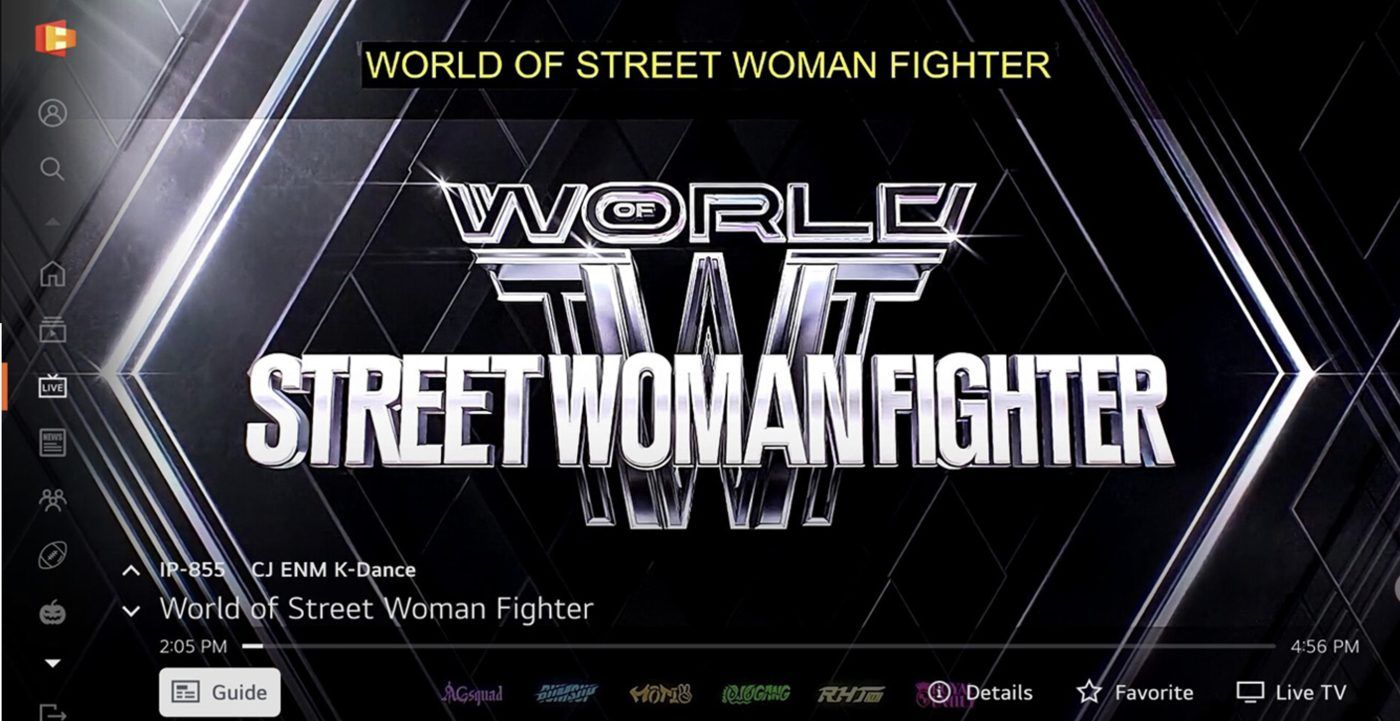
FAST is becoming a new distribution outlet for Korean culture. CJ ENM launched the 24-hour CJ ENM K-Dance channel on LG Channels in the U.S. and Canada on Oct. 27. It bundles Street Woman Fighter, Street Man Fighter, Somebody, idol fancams and MAMA performances, repackaging competition and concert shows as a genre channel. "FAST and AVOD serve as an important hub in strengthening CJ ENM's competitiveness in global K-content distribution," said Kim Do-hyun (김도현), head of CJ ENM's content distribution unit.
KT Studio Genie said its FAST revenue in the first quarter exceeded its revenue for all of last year and that the business turned an operating profit. Its vertical-drama channel Genie Shorts launched with 73 titles and sells the empty space on either side of the vertical picture as ad inventory.
The popularity of Korean culture is drawing Korea's regional broadcasters abroad. Busan-based KNN signed a deal in April with Vietnam's Ho Chi Minh City Television (HTV) to air Korean tourism, education and medical content in HTV slots, and plans to expand to up to 10 countries including Thailand, Indonesia and Uzbekistan. Regional content on FAST is the next step. NEW ID CEO Park Jun-kyung (박준경) told Aju Business Daily (아주경제) that food, travel and nature content with strong local character and few language barriers could travel well on overseas FAST. For regional broadcasters, going abroad is a matter of survival: advertising has fallen to about 30% of revenue at Korea's regional commercial broadcasters, the Journalists Association of Korea (한국기자협회) reported.
Regional content can be tied to commerce. Samsung Ads named its first advertisers using Amazon's ad technology on Samsung TV Plus on June 22: viewers can add Amazon-sold products to a cart with the remote or send other product details to their phone. South Jeolla–Gwangju (전남광주통합특별시) sold 79 local products, including laver and yuja tea, to Europe through TikTok Shop in May and June, earning €97,000. Adding a purchase path to a regional station's food and travel shows could pair channel expansion with product exports, though local sellers, shipping, payment and settlement have to be built separately.
Online content is moving onto FAST as well. Samsung TV Plus carries creator channels such as Mark Rober's, and LG Channels supplies NEW ID's @K-MUSIC and NEW K FOOD in Poland.
AI dubbing cuts costs by up to 90%, viewing data guides launches … a cheaper way in
Language is the biggest cost and obstacle in launching a channel on overseas FAST. That is why the science ministry and the Korea Association for ICT Promotion (KAIT, 한국정보통신진흥협회) have put their effort into spreading K-content and K-FAST channels with AI dubbing, and it has paid off. At a Global K-FAST Alliance meeting on July 9, the ministry said 20 AI-dubbed K-FAST channels, carried since December 2025 on Samsung TV Plus and LG Channels in 22 countries including the U.S., Canada and Mexico, drew about 100 million cumulative viewers in five months through the end of April. Through the program the government has localized about 1,200 titles, or 1,400 hours, into English, Spanish and Portuguese. Alliance membership grew from 22 companies at its April 2025 launch to 82.
Hudson AI says its AI dubbing costs 90% less than voice-actor dubbing. "FAST earns less per title than subscription services, so it's hard to absorb traditional dubbing costs," Hudson AI CEO Shin Hyun-jin (신현진) told Digital Today. "To supply many countries, AI has to bring localization costs down."
Spreading K-FAST worldwide will take more AI and entertainment tech. Discovery of K-content in particular depends on metadata. Amagi's June report found that "poor metadata is hurting discovery and ad revenue on FAST." Gracenote partnered with ad platform The Trade Desk on Aug. 27 to link program-level data to ad buying. Channel operators can use AI to produce local-language titles, synopses and schedules, and use country-level viewing data to decide which genres to program where.
MIPCOM, the world's largest TV content market, heard the same message. At the session of European and U.S. FAST specialists K-EnterTech Hub held in Cannes on Oct. 11, participants proposed winning first-time viewers through FAST, then producing local-language versions and expanding into telco and pay-TV lineups. They said entertainment-tech tools such as Hudson AI could keep localization costs down in Europe, and that FAST launches should be used to gather local viewing data.
With demand for K-content rising, the market has to be met now. At the roundtable, Karina Rompa, founder of Media Hansa, described the K-pop dance craze in Warsaw and the Czech Republic, and Latvian media and streaming strategist Inga Alika picked K-dance as a genre to reach young viewers. The Korea Creative Content Agency (KOCCA) said the Korea pavilion at MIPCOM logged 872 export meetings worth $267.75 million.
| Indicator | Figure | Source |
|---|---|---|
| Netflix viewing of Korean productions | 12.1bn hours; 2nd after U.S. | Omdia/Digital i, Apr. 2025–Mar. 2026 |
| Want one guide for all services | 72.3% | Gracenote six-market survey |
| K-content export growth vs. 2021 | Latin America 391%, Middle East 328% | KOCCA |
| AI-dubbed K-FAST | 20 channels, 22 countries, ~100m cumulative viewers | Science ministry/KAIT, July 2026 |
| New channels funded in 2026 | 4; ₩230m each | Science ministry, July 2026 |
| NEW ID cumulative viewing | 96 countries, 34 platforms, 840m+ hours | Company data, Oct. 2026 |
| CJ ENM K-Dance | 24-hour channel, U.S. and Canada | CJ ENM, Oct. 2026 |
Key indicators for K-content demand and K-FAST. Survey shares, cumulative hours and cumulative viewers are different measures. Sources: as listed
Rights, revenue reporting, channel glut … viewing is not revenue
K-FAST still has problems to solve.
Rights come first. Even Netflix hits often can't go on free channels because of territorial exclusivity and contract terms. Music and performer rights, and permission to re-edit and dub, also need checking. Broadcasters have to sort their IP by territory, language and release window and set aside titles for FAST once paid deals expire. A show the broadcaster can't program is no use to a channel, however well known it is abroad.
Korean rights holders signing with platforms need to know whether ad revenue is split on gross or net, what is deducted and how much country-level reporting they get.
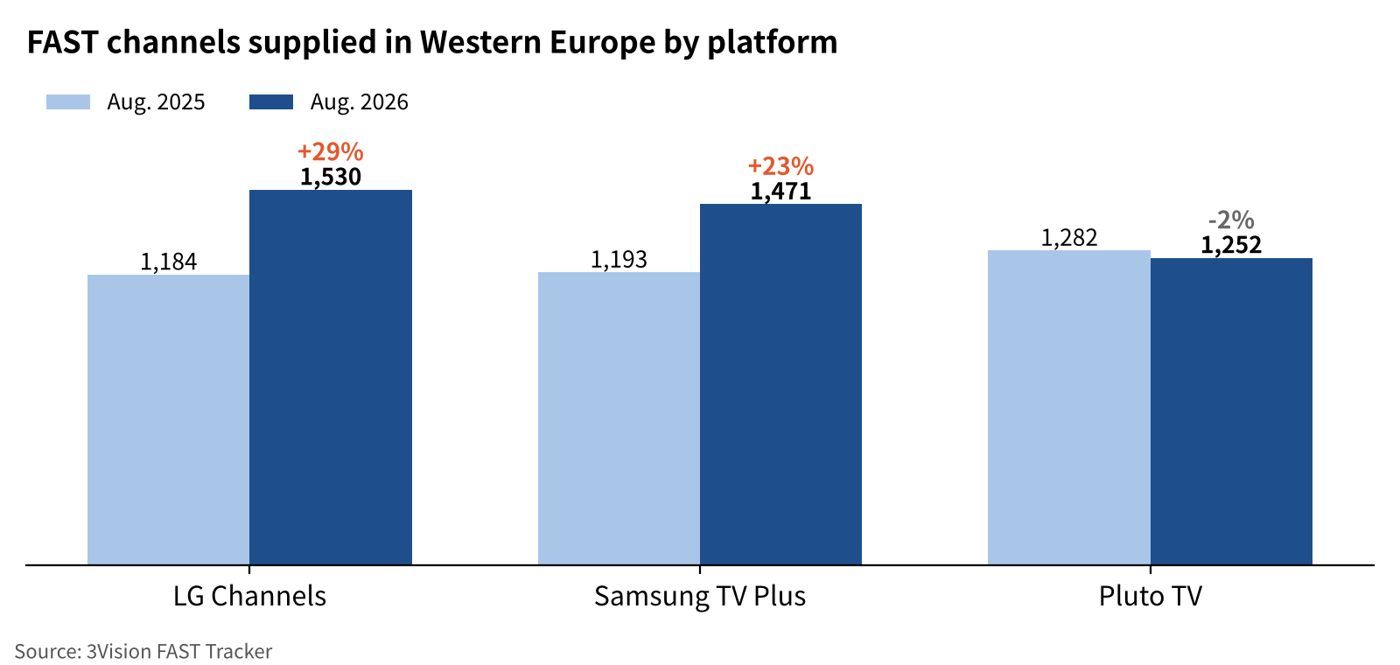
Competition for slots is growing. In 3Vision's Aug. 28 analysis, LG Channels in Western Europe went from 1,184 to 1,530 channels in a year and Samsung TV Plus from 1,193 to 1,471, while Pluto TV fell from 1,282 to 1,252. The counts add up supply across countries and don't equal unique IP. Korean channels are entering a bigger network and fighting more rivals for placement.
Marketing is expensive. "Even people who use the many FAST platforms in the U.S. don't know there is K-content on them," Kim Jung-eun, CEO of K20, told MTN in April. "It's hard enough to bear the cost of running and transmitting a FAST channel, and promoting it in the U.S. takes too much money and time." FAST is still a small part of CJ ENM's results. Regional broadcasters losing ad revenue may lack the means to open a first channel at all.
From ₩8 billion to ₩920 million for new channels … the case for more funding
The science ministry launched the AI-dubbed K-FAST program with ₩8 billion ($6 million) from the 2025 supplementary budget. In 2026, three consortia led by Hudson AI, ESTsoft and UN AI are building four channels in vertical drama, K-beauty and K-dance. Each gets ₩230 million ($170,000), or ₩920 million in total. That figure covers new channels only, not all public support for FAST in Korea.
The government has pledged to back Korean broadcasters' global expansion through FAST. "With the domestic broadcast media industry struggling as rising production costs and falling ratings cut into ad revenue, a strategy that actively uses global distribution platforms such as FAST is needed," Kim Jong-cheol (김종철), chairman of the Korea Media and Communications Commission (방송미디어통신위원회), said at a FAST meeting on June 4. He cited "the 600 million smart TVs supplied worldwide by Korean electronics companies" and pledged to build a K-FAST ecosystem with other ministries. At its International OTT Forum on Nov. 5, the commission invited speakers from Korean and global companies including Tubi to discuss FAST and streaming strategy.
If the budget grows, there is plenty to spend it on.
First, rights clearance and local-language versions: confirming free overseas rights for broadcasters' IP and adding AI dubbing and subtitles. Second, local promotion and metadata, because a channel viewers don't know about won't be discovered. Third, global news and public-information FAST channels. A K-news channel with translation, corrections and round-the-clock operations is unlikely to survive on ads alone, so it needs a separate case for public funding.
Fourth, first launches by regional broadcasters and links to commerce.
The yardsticks need to change. Current disclosures make it impossible to compare cost-effectiveness across funded channels. Agencies need not force companies to reveal trade secrets, but they should collect localization, rights, transmission and ad-payout figures on a consistent basis. News channels should be judged by reach, trust and corrections; commercial channels such as K-dance and drama by ads sold and actual payouts as well as hours. When regional shows are tied to commerce, broadcast results and product sales should be counted separately. Funding market validation rather than channel counts would show which languages and genres can pay back.
72.3% want one guide … the next contest is discovery and payout
FAST matters to K-content because of the long tail: a show doesn't have to be a hit to find viewers once it is on a schedule. In Gracenote's survey, seven in 10 respondents (72.3%) wanted a single programming guide across services, and nearly 70% wanted to be told where a show is even if it sits on another service. 87.4% said user experience weighs on whether they keep a service. Korean shows on FAST will be noticed only if local-language titles, episode data and availability by country and platform are attached.
Subscription streaming is piling up cancellation intent and search fatigue, and Netflix's original viewing has slipped. FAST has become the place where viewers who don't want to choose meet K-content first. Korea has proven demand on Netflix, 600 million smart TVs in the field and AI dubbing. Outside the U.S., it is hard to find a connected-TV ecosystem that combines content, TV makers and AI localization in one country.
Korea can open channels in markets such as Brazil, France and India where fans and free viewing are both growing, and move beyond drama and K-dance to 24-hour news and regional content. What remains is turning channel supply and cumulative viewing into revenue. FAST will become a new income stream for Korean broadcasters once ad payouts by Korean IP come into view and rights, promotion and data get funded.