
Court stops the FCC's early renewal review of eight ABC-owned stations, looking past the stated rationale to purpose and effect. In the U.S. the issue is retaliation; in Korea, voting procedure. Both cases ask about the legality of licensing and the stability of investment in broadcasting
A U.S. federal court halted the FCC's early renewal review of ABC's station licences, finding the review itself can chill programming before any licence is revoked. Korean regulators' decisions are also in court, but there the issue is the legality of voting procedure, not retaliation.
A U.S. federal court has stopped the Federal Communications Commission from bringing forward the renewal review of ABC's station licences by several years. What the court questioned was not the power to review licences but the purpose and manner of its use. Contrary to the FCC's account that the review served an inquiry into Disney's hiring practices, the court found strong indications of retaliation against programming that criticised the president. Even before any licence is revoked, it held, a broadcaster that changes its programming for fear of losing its licence has already suffered harm the court must protect against.
Judge Loren AliKhan of the U.S. District Court in Washington on Wednesday granted Disney and ABC a preliminary injunction halting the FCC's early renewal review of ABC's eight owned-and-operated stations, and denied the agency's motion to dismiss. It is an interim measure ahead of a ruling on the merits, but it is notable because the court drew a line between the administrative power to manage broadcast licences and a broadcaster's freedom of expression and programming.
The decision does not mean ABC is finally clear of the risk of losing its licences. It is a measure to prevent, first, the infringement of free expression that could occur while the review runs. Industrially it lowers the immediate regulatory risk; legally it should be read as an intermediate step that leaves jurisdiction and the merits undecided.
The questions the case raises are not confined to the United States. Broadcast licensing is both a means of securing public responsibility and a powerful administrative tool that decides whether a business can continue. By what standards and procedures that power should be exercised, and how much of the resulting uncertainty a company should bear, are questions Korean broadcasting faces too. In Korea, board appointments at the Foundation for Broadcast Culture (방송문화진흥회) and KBS (한국방송공사) and the approval of Eugene Group's takeover of YTN have all come before the courts. An appeals ruling on the cancellation of YTN's change-of-largest-shareholder approval is due on Dec. 18.
The focus of the comparison must be clear, however. The U.S. court looked at the regulator's public statements and the timing of its actions to examine retaliatory purpose and the chilling effect on programming. Korea's main administrative suits centre on how the regulator was constituted and how it reached decisions, such as whether two commissioners alone could decide major matters. This does not mean the same kind of pressure on broadcasters has been established in both countries. What should be compared is the standard by which courts control regulatory powers that bear on a broadcaster's survival and management, and what the outcome means for companies' autonomy and investment stability.
The distinction matters for readers outside Korea as well. The ABC case challenges an early renewal order for station licences, while the YTN case challenges the legality of the approval given to a company that became the largest shareholder after an acquisition. The public broadcasters' board appointments are a separate question of governance. The regulatory tools differ, but the cases meet where administrative decisions shape a broadcaster's programming and its ownership and management.
An early review launched the day after the Kimmel attack: the court looks past the rationale to the sequence of events
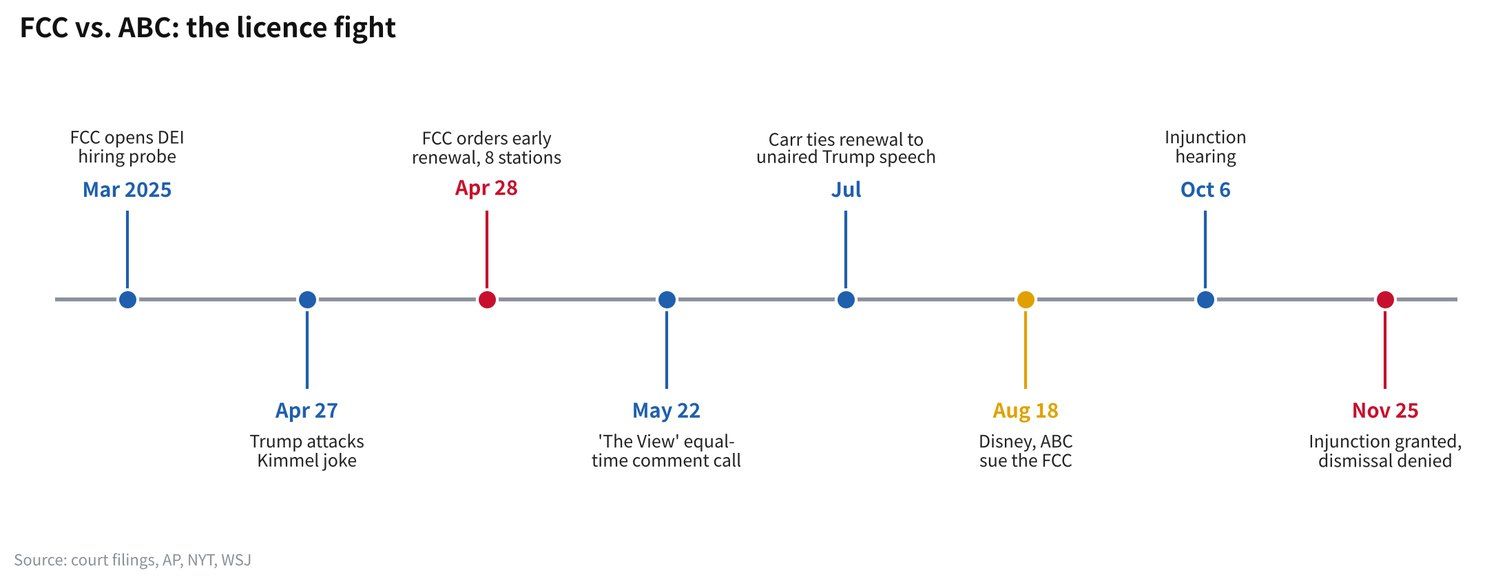
Mr. Trump has attacked "Jimmy Kimmel Live!" for years. On April 27 he lashed out again over a monologue joke; on April 28 the FCC ordered ABC's eight stations to file for renewal early. Asked at an April 30 press conference whether the joke would weigh on the review, Carr said Disney would have to demonstrate it had operated in the public interest. In July, Variety reported, he said the review would also consider ABC's decision not to air the president's election-security speech live.
The sequence of events alone does not automatically prove retaliation. What mattered here was that the adjacent dates came together with the chairman's public remarks and the link between the existing inquiry and the early renewal. The court did not judge the agency's official explanation in isolation from the context in which it was given.
Throughout the case the FCC said it reached for the licences because Disney had failed to cooperate with document requests in a DEI inquiry opened in March 2025. Government lawyers also argued that the Communications Act routes challenges to FCC decisions exclusively to the D.C. Circuit, leaving the district court without jurisdiction. At an Oct. 6 hearing Judge AliKhan said the comments of the president and the chairman made it hard to see the case as a mere discovery dispute (Courthouse News). In her ruling she wrote: "This is not a close case."
Late-night comedy and daytime talk in the crosshairs; a renewal tool unused for nearly 60 years
The U.S. broadcast industry is watching closely because the regulatory effect reaches directly into the content of individual programmes and scheduling decisions. Alongside Mr. Kimmel's late-night comedy, ABC's daytime talk show "The View" has become an FCC target. The agency is examining whether the show must give rival candidates equal airtime when politicians appear. ABC has asked the FCC to confirm that it is a bona fide news interview program, which is exempt, and the Media Bureau opened that request for comment on May 22 (ABC court filing).
Carr's regulatory case rests on spectrum as a public resource. Broadcasters, he told Fox Business on July 31, struck a public-interest bargain with the American people in exchange for free use of airwaves worth billions (AP). When he used that bargain to bring talk and entertainment programming into the review, ABC's lawyer Beth Wilkinson told the court the early-renewal procedure had not been used in nearly 60 years. Disney and the eight stations sued the FCC and Carr on Aug. 18 (CBS News), and several former FCC chairs from both parties sided with Disney, arguing the agency had overstepped.

Two principles collide here: that broadcasters using public airwaves must accept oversight under the law, and that oversight must not become a means of suppressing speech the government finds inconvenient. The issue is not whether public-interest obligations exist, but whether the specific action taken in the name of checking them was justified.
'Already curtailed': the court treats the chill as present harm
"This is a big win for Disney," Andrew Jay Schwartzman, a veteran public-interest lawyer, told The New York Times. "Rarely does a court intercede in an ongoing federal agency proceeding." Judge AliKhan crossed that threshold because of the weight of the penalty. Losing a licence threatens a broadcaster's very existence, she reasoned, so an early renewal proceeding alone risks chilling an ordinary broadcaster, and ABC's changed editorial decisions showed protected activity had already been curtailed.
Regulatory risk does not enter management decisions only after a sanction is final. Once the possibility of losing a licence is raised, a broadcaster weighs that risk in later programming decisions. The chilling effect the court identified is this: a company narrowing its own choices, apart from anything a formal order prohibits. Which programming changes occurred, and to what degree, must be assessed on the court record, however, and the ruling cannot be stretched to mean that every regulatory inquiry infringes free expression.
The conflict is far from over. The injunction covers only the early review. The judge declined ABC's broader request to bar the FCC from threatening it over editorial choices, so the merits case goes on, and the Disney hiring inquiry and the "View" equal-time inquiry remain open.
No one doubts the commission may enforce the law as it sees fit, the judge wrote, but it may not retaliate against licensees for disfavored speech. The FCC called the decision "wrong on the facts and wrong on the law" and said it "looks forward to prevailing in full." Anna Gomez, the commission's lone Democrat, said the ruling showed the FCC to be a "paper tiger" whose threats crumble when challenged.
The administration's clash with broadcasters runs beyond licences. Last month the Justice Department opened an antitrust inquiry into ABC, CBS, CNN, NBC and Fox News over their brief suspension of pooled White House coverage, and another federal judge extended an order blocking the exclusion of CNN, MS NOW and Politico from the White House, according to The New York Times.
Each of these cases must be decided on its own law and facts. For a broadcaster, though, uncertainty across licences, investigations and access to newsgathering together makes up the operating environment. That is why, apart from who wins any single suit, how predictably the relationship between regulators and the press is run has become an industry concern.
Korea's judicial check runs a different route: the legality of two-member votes
If purpose and effect were at issue in the U.S., in Korea the main question has been whether the body exercising regulatory power was lawfully constituted and voted lawfully. This is more than a difference of form. It concerns who may take decisions that affect a broadcaster's governance and survival, and by what procedure.
The abbreviations and types of broadcaster in the Korean system also need to be kept apart. Bangmunjin is the Foundation for Broadcast Culture, MBC's controlling shareholder. The KBS case concerns appointments to a public broadcaster's board; the YTN case concerns approval of a change in a news channel's largest shareholder. These differ in legal subject from the re-approval of general-programming channels such as TV Chosun, MBN and JTBC. Only with these differences in mind can one avoid forcing Korea's several cases into a single political story.
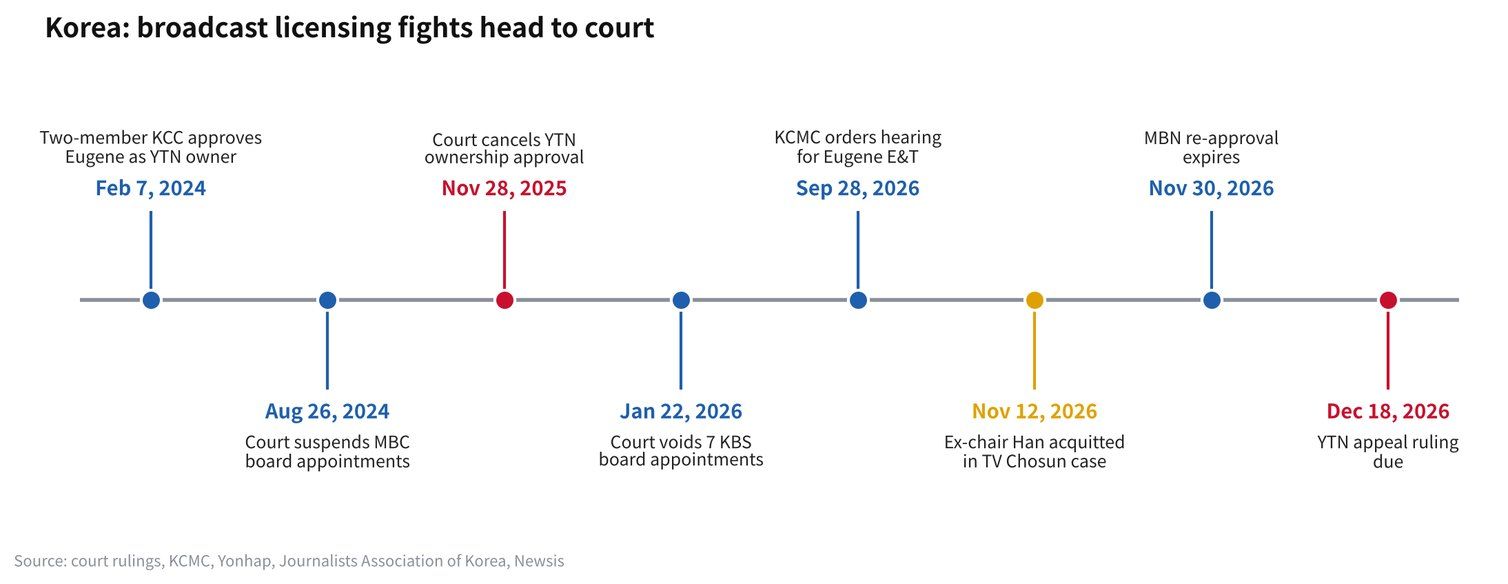
Over the past two years Korean courts have repeatedly suspended or cancelled broadcast regulators' decisions. The common issue in the Bangmunjin and KBS board cases and the YTN approval examined here was voting by a two-member commission. In July 2024 a Korea Communications Commission (방송통신위원회) reduced to two members, Chairwoman Lee Jin-sook and Vice Chairman Kim Tae-kyu, named six new directors to the Foundation for Broadcast Culture. The Seoul Administrative Court suspended the appointments on Aug. 26, and the Supreme Court upheld that in March 2025 (Journalists Association of Korea). On Jan. 22, 2026 the same court cancelled seven KBS board appointments made the same day, ruling that two commissioners could not form a majority (Law Times).
YTN turns on the same question. On Feb. 7, 2024 the two-member commission approved Eugene E&T (유진이엔티), a Eugene Group vehicle, as YTN's largest shareholder. On Nov. 28, 2025 the Seoul Administrative Court voided the approval in a suit by YTN's employee stock ownership association, ruling that a two-member vote with three of five seats vacant lacked a quorum (Newsis). The government declined to appeal (Segye Ilbo), but Eugene E&T appealed, noting that the Seoul High Court had found two-member votes lawful in an MBC "PD Diary" (PD수첩) sanctions case the same day (New Daily).
The Korea Communications and Media Commission (방송미디어통신위원회) voted on Sept. 28 to hold a hearing with a view to revoking the approval (Dailian). The hearing was postponed after Eugene E&T successfully challenged a presiding officer, and on Oct. 30 the company asked the commission to wait for the appeal. The Seoul High Court closed arguments that day and set Dec. 18 for its ruling (Journalists Association of Korea). In the Bangmunjin, KBS and YTN rulings the deciding factor was the quorum. Whether the government had pressured a broadcaster over its coverage did not enter the reasoning.
A court ruling cancelling an approval should also be kept apart from any follow-up action the regulator considers separately. Which administrative decision a ruling addresses, how the decision's effect is handled while an appeal is pending, and what procedure the regulator is running are each matters to be checked. However important the appeal, no single ruling should be assumed to settle every follow-up step automatically.
TV Chosun re-approval case ends in acquittal after three and a half years: the fight over the score sheet
The Korean case in which a re-approval review itself became the subject of a criminal investigation is TV Chosun (TV조선). Prosecutors charged Han Sang-hyuk (한상혁), then chairman of the commission, in 2023 with seating a civic-group figure critical of the channel on its 2020 review panel and with condoning reduced scores to secure a conditional approval. On Nov. 12 the Seoul Northern District Court acquitted him and five others, including commission officials and the panel chair (ZDNet Korea). The court allowed that panelists may have revised scores but found no proof of conspiracy (Financial News).
The prosecution shook Korean broadcasting. The Journalists Association of Korea noted in an editorial that the commission chairman was dismissed, boards and chief executives at KBS and other public broadcasters were replaced, and current-affairs programmes were cancelled and hosts changed (editorial). In Washington the issue was a regulator aiming at a programme critical of the president; in Seoul, how the regulator picked its judges and tallied their scores became the subject of investigation and trial.
An acquittal is, first, a judgment on whether the charges were proved to the standard required for criminal liability. It should not be read as a declaration that the re-approval system has no problems, nor, conversely, as a ruling that every later change in broadcasting was part of one unlawful act. Industry analysis should separate what the court found from wider political and institutional assessments.
Content sanctions tied to re-approval: 650 out of 1,000 to pass
An FCC renewal review looks at matters such as public-interest service and serious violations. In this dispute the problem was not that programming was graded on a Korean-style score sheet, but the act of bringing a normal renewal schedule forward. The FCC cited its inquiry and public-interest obligations; ABC countered that the tool was used to pressure particular speech and programming. The court weighed the timing, the public remarks and the effect on programming in deciding an injunction was needed.
In Korea, several mechanisms for checking broadcasters' public responsibility are tied to company-level licences and approvals. Terrestrial re-licensing, re-approval of general-programming and news channels, and approval of a change in largest shareholder are different systems, but each has a major effect on a broadcaster's operations and governance. They should not all be lumped together as one kind of licence. What matters for the industry is whether each system's purpose and standards are clear, and whether companies can reasonably predict regulatory outcomes and timetables.
Korean broadcasters generally need more than 650 of 1,000 points in a re-approval or re-licensing review. Public responsibility and fairness are scored items, and the 2020 re-approvals of the four general-programming channels carried a common condition to keep formal sanctions for broadcast-standards violations to five a year or fewer (Journalists Association of Korea). Sanctions from the Korea Communications Standards Commission flow into re-approval conditions and scores.
In this structure, content rulings on individual programmes are not fully separate from licensing risk at company level. A broadcaster weighs not only the direct effect of a single sanction but its effect on future evaluations and condition compliance. The structure can give public responsibility concrete form, but if standards are vague or applied inconsistently it can also reduce the predictability of management and programming, and both sides need examining.
The Korea Communications and Media Commission, successor to the Korea Communications Commission, split programming-code and programming-committee compliance into a separate 50-point item for the second-half 2026 renewal of 103 terrestrial stations (Newsis), and on Nov. 18 added a fact-checking measure to its annual evaluation, applying from 2027 performance (Korea.kr).
MBN (매일방송), whose re-approval expires on Nov. 30, received a corrective order on Oct. 28 for failing to keep three business-plan promises made at its last re-approval, including fact-check reporting on its main newscast and an election-pledge verification segment (Yonhap). JTBC's approval lapsed in November 2025, but it has yet to be reviewed after delays in launching the new commission and its rehabilitation filing.
In re-licensing and re-approval, the strictness of review is not all that matters. When a review takes place, what material and standards are used, and what chance to correct and what appeal route exist when shortcomings are found are also part of the business environment. The longer the review schedule and legal status remain unclear, the more a company must treat regulatory outcomes as a major variable in its medium- and long-term plans.
Next turning points: a jurisdiction fight in the U.S., the YTN appeal in Korea
The U.S. decision is a preliminary injunction issued before a ruling on the merits. It does not establish that the FCC acted unlawfully. The immediate next question is jurisdiction. The FCC and the Justice Department argue that Congress assigned licensing challenges to the D.C. Circuit; if a higher court agrees, the district court's injunction could lose its force. As of Nov. 27 the FCC had not said whether or when it would appeal, though an appeal appears likely.
If a higher court instead upholds the finding that a threat alone can chill programming, the FCC will have less room to use renewal schedules as leverage. Even without revoking a licence or imposing a sanction, conduct that pushes a broadcaster to change its own programming for fear of reprisal would face a legal brake. The injunction does not end the wider conflict between the FCC and ABC, however. With the DEI and equal-time inquiries still open, the regulatory fight over ABC's talk and entertainment programming may continue, and tension over broadcast regulation is unlikely to ease over the holidays.
A ruling on jurisdiction is also different from a ruling on the substance of free expression. If a higher court denies the district court's jurisdiction, that does not amount to a substantive finding that the FCC's action was justified. Conversely, even if the injunction holds, ABC is not assured of winning every issue on the merits. Future coverage needs to explain separately which court may decide and which conduct is unlawful.
Korea also has rulings ahead that will settle the legality of broadcast regulation and the standing of the companies involved. The Seoul High Court rules on the YTN case on Dec. 18. If it upholds the first-instance finding that the two-member vote was unlawful, the commission's revocation effort gains force. If it reverses, Eugene Group's management uncertainty eases, and litigation over other decisions made by the two-member commission could be affected.
Two things need to be kept apart: defects in the administrative procedure at the time of approval, and the responsibility of a company that has invested and managed YTN for two years on the strength of that approval. Whether the approval was lawful must be examined rigorously, but how far an investor should bear the consequences of problems in a procedure run by a government agency is a separate question.
That Eugene Group's investment and management rested on a government approval should weigh in any follow-up. Correcting the procedure and protecting trust in government decisions need not be a choice of one or the other. In deciding how to remedy the defect and who bears the cost, the commission should consider investors' ability to plan as well as the effect on YTN's management and broadcasting.
Taking account of reliance on a government approval does not mean excusing every management decision a company makes. The point is not to mix the responsibility of the agency that designed and ran the procedure with that of an investor who acted on the approval. If follow-up action is needed, it should be explained what means are required to achieve its aim and what burden those means place on broadcasting and investment. Only then can a consistent standard be offered, beyond any one company's interests, to investors who will enter the Korean media market in future.
The issue running through the U.S. and Korean cases is not whether to regulate. The U.S. must settle the line between retaliation against programming and legitimate enforcement; Korea, the relationship between a lawful voting structure and reliance on administrative decisions. With different legal starting points, the solutions cannot be the same. But the industrial task of reducing the uncertainty created by regulators' use of power is shared.
Competition outside the courtroom: viewers are not waiting for a verdict
Legal stability does not mean a regulator can never change an earlier decision. It means that when a decision must change, the reasons and legal basis should be clear, and the procedure and timetable should be predictable enough for those affected to respond. The more strongly a system demands public responsibility, the higher the duty of explanation on the government that runs it.
Meanwhile the market is moving without waiting for the courts. In Nielsen's August 2026 count, streaming accounted for 49.6% of U.S. TV viewing time. YouTube's share hit a record 15.8%, close to broadcast's combined 17.5%. Total TV usage fell 4.4% from the previous month, yet YouTube viewing rose 6%, so its gain came from more viewing, not just a smaller total. YouTube viewing among adults 50 and older rose 9%. The competitors broadcasters must hold off, and the range over which viewers move, have widened accordingly.
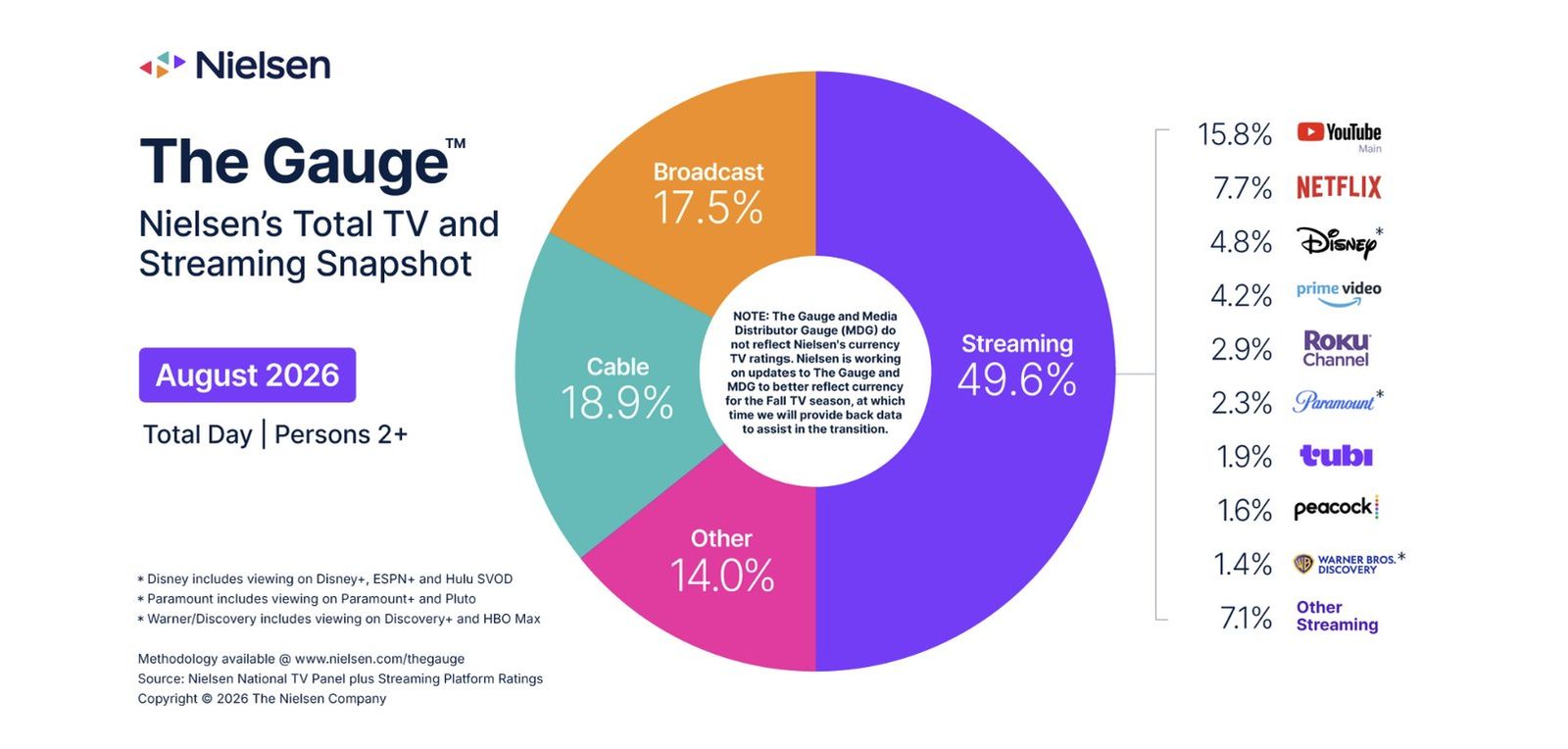
Nielsen's figures should be read as a measure of how viewing time on U.S. TV screens is divided. They cannot be restated directly as shares of all video use, advertising revenue or profitability. Still, the fact that broadcasters and streaming services compete for viewers' time on the same TV screen, and that the competition is spreading to older viewers, is hard to ignore in regulatory debate.
These figures cannot be applied directly to Korea. But they suggest that debates on broadcast regulation cannot stop at competition among incumbent broadcasters or control over ownership and programming. The screens and services viewers choose have already crossed the boundaries of broadcast licences, and policy confined to exercising power over incumbents will struggle to keep up. That is why securing broadcasting's public responsibilities and protecting its ability to keep supplying content have to be considered together.
The policy task is not to abandon public-interest standards but to design an environment in which broadcasters that meet them can keep making content. Alongside deciding what responsibilities to place on broadcasters, policymakers should check whether the system is making the investment and operations needed to meet those responsibilities needlessly unstable. Regulatory legality and industrial sustainability are not opposing goals but conditions to be secured together.
What both countries need is not the abolition of regulation. It is regulation exercised by clear standards and lawful procedure, which also respects the investment and management decisions companies make in reliance on it. The longer pressure on programming and open-ended legal uncertainty last, the more broadcasters focus on immediate defence rather than the future. The question now is not only who holds the power to control broadcasting, but how broadcasters can invest, compete and sustain a public role in a market where viewers are on the move. The power to oversee broadcasting carries a responsibility to support that future.