
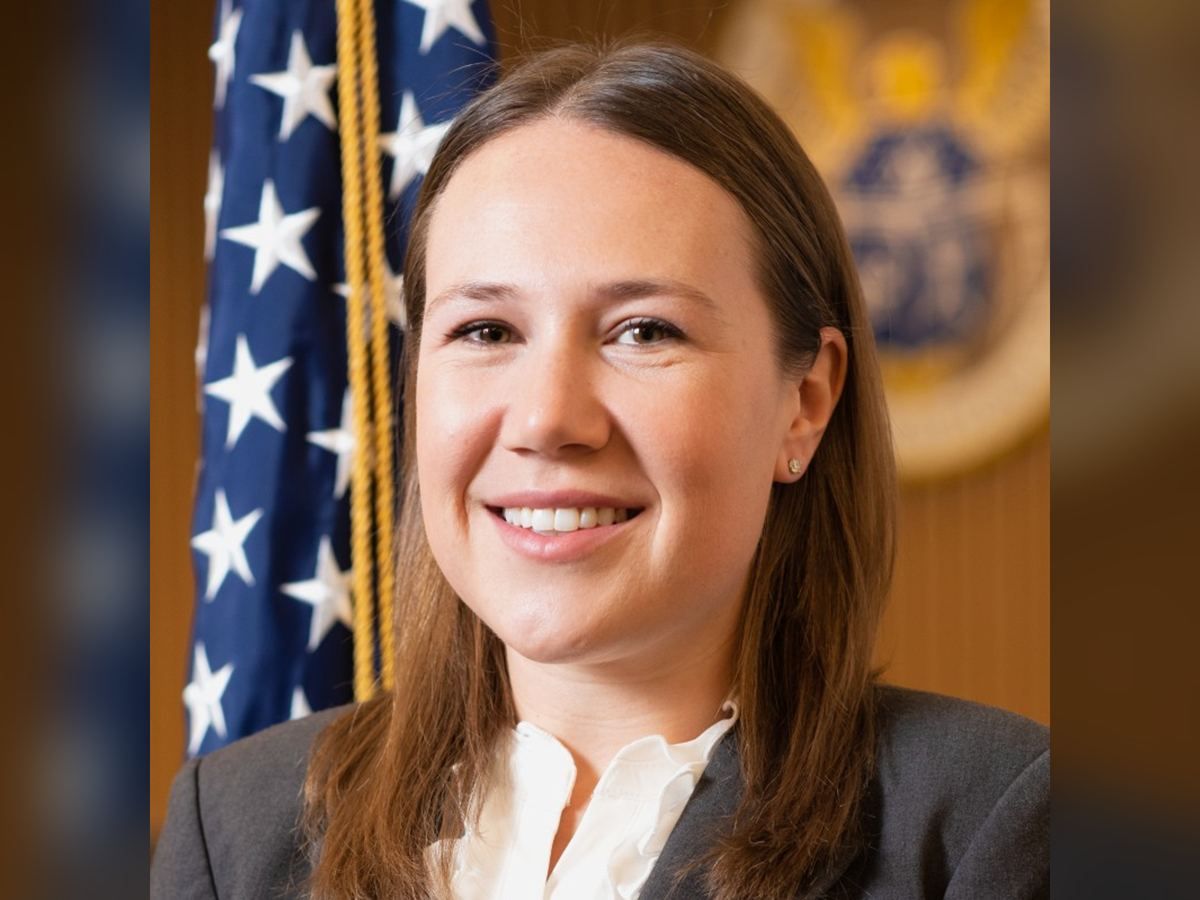
Carr aide Danielle Thumann Severs pledges to follow "the law and the record" on ABC's stations; her confirmation would let three Republicans form a quorum on their own
Carr aide Danielle Thumann Severs told senators on Nov. 10 she would rule on ABC's licenses by "the law and the record" but would not judge Carr's Kimmel warning. Her confirmation would let three Republicans form an FCC quorum. In Korea, a court voided a two-member regulator's YTN approval.
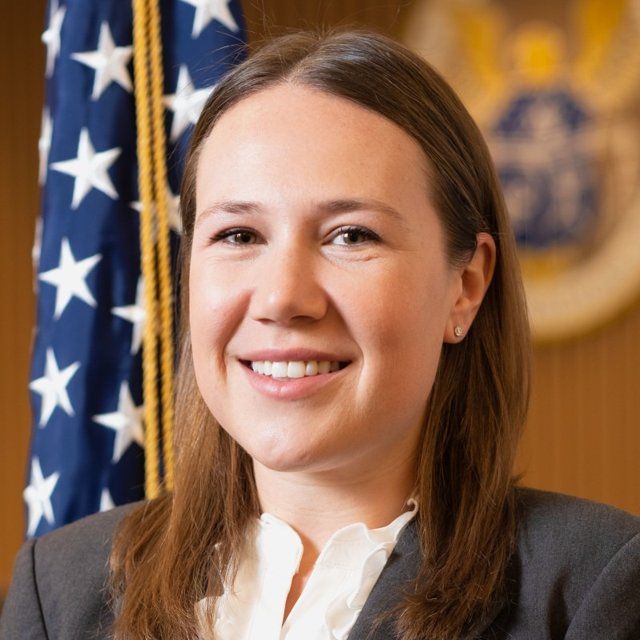
A top aide to Federal Communications Commission Chairman Brendan Carr faced questions about broadcast licensing at her confirmation hearing on Tuesday. Danielle Thumann Severs, President Donald Trump's nominee to the FCC, told the Senate Commerce Committee she would decide the early license review of Disney's eight ABC-owned stations on "the law and the record." Asked about Carr's warning to broadcasters during the Jimmy Kimmel episode, she said, "Those were his words. They were not my words."
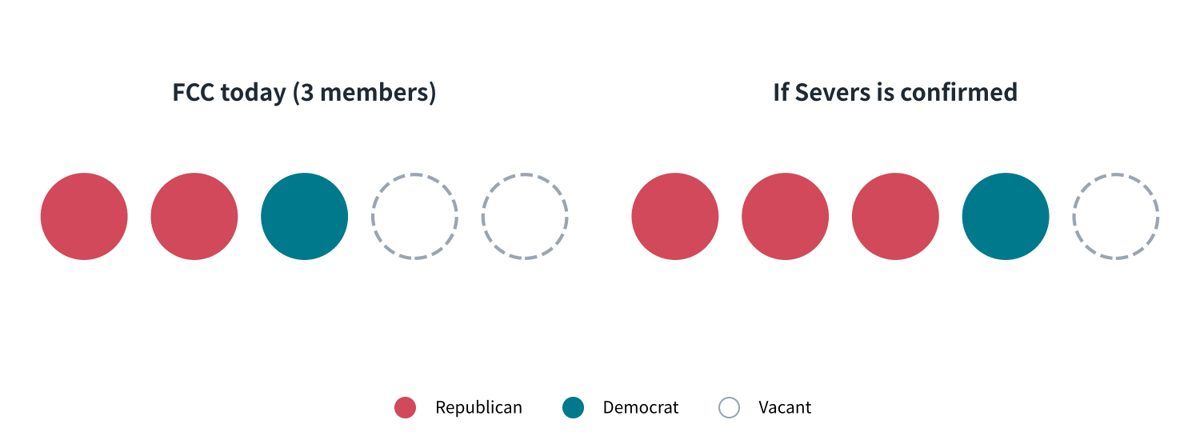
Severs was Carr's legal adviser from 2021 to 2023, worked at tower company Crown Castle and has served as his senior counsel since August 2024. Trump nominated her on Aug. 7. The five-seat commission now has two Republicans and one Democrat, and the Communications Act sets a quorum of three, so her confirmation would let Republicans form a quorum on their own. Axios noted at the time of the nomination that it would make it much easier for the Republican-led FCC to hold and pass votes without Democratic friction.
The law caps any one party at three commissioners, and presidents have long paired nominees across parties. Trump himself nominated two Democrats in his first term, Jessica Rosenworcel and Geoffrey Starks. This time no Democrat was nominated alongside Severs.
Under Carr, the FCC has made a string of major broadcast decisions this year. In April it ordered ABC's eight stations into an early renewal for the first time in more than 50 years, and on Aug. 6 it voted 2-1 to repeal the rule capping any company's national station reach at 39% of TV households. Disney has sued over the early review. With Democrats having won control of the Senate on Nov. 3, the question now is whether Severs is confirmed before the new Congress convenes in January.
In South Korea, the Seoul Administrative Court (서울행정법원) on Nov. 28, 2025 canceled the former Korea Communications Commission's (방송통신위원회) approval of a new largest shareholder for news channel YTN. The court found that the vote, taken by just two commissioners to approve a Eugene Group (유진그룹) affiliate, violated procedure. The Seoul High Court rules on the appeal on Dec. 18. The successor Korea Media and Communications Commission (방송미디어통신위원회) will resume its hearing on revoking the approval on Dec. 22, and it is also reviewing licenses for 103 terrestrial stations that expire at year-end. In the U.S. the FCC's quorum is at issue; in Korea it is the validity of a two-member vote.
"Yes" to Cruz; no verdict on Carr
Committee Chairman Ted Cruz (R-Texas) raised the ABC dispute directly, asking whether Severs would rely on the law and the record rather than use FCC authority to "pressure or punish a broadcaster for protected speech." She said yes. Cruz also criticized Carr's remarks, saying "the First Amendment places important limits on the government's ability to regulate speech," Roll Call reported.
Sen. Ed Markey (D-Mass.) asked whether Carr had been right to warn that broadcasters could face regulatory consequences over Kimmel's commentary. Severs declined to judge, saying she had not advised Carr on the matter or worked with him on media issues. Her portfolio covers the Wireline Competition, Public Safety and Homeland Security, and Consumer and Governmental Affairs bureaus, not the Media Bureau.
Asked by Sen. Tammy Duckworth (D-Ill.) whether editorial choices should factor into renewals, Severs acknowledged broadcasters' First Amendment protections but said the FCC may consider content when weighing public-interest obligations. "I don't think that a decision should be made purely based on someone's discontent with the content that's being aired," she said, according to TheWrap.
Sen. Ben Ray Luján (D-N.M.) asked her to name an issue on which she had disagreed with Carr or Trump; she offered none. Sen. John Hickenlooper (D-Colo.) said her nomination should have moved together with the renomination of Democratic Commissioner Anna Gomez. An FCC spokesperson told TheWrap that Severs is "an exceptionally talented and well qualified nominee."
Fourteen months after Kimmel, ABC's licenses are in court
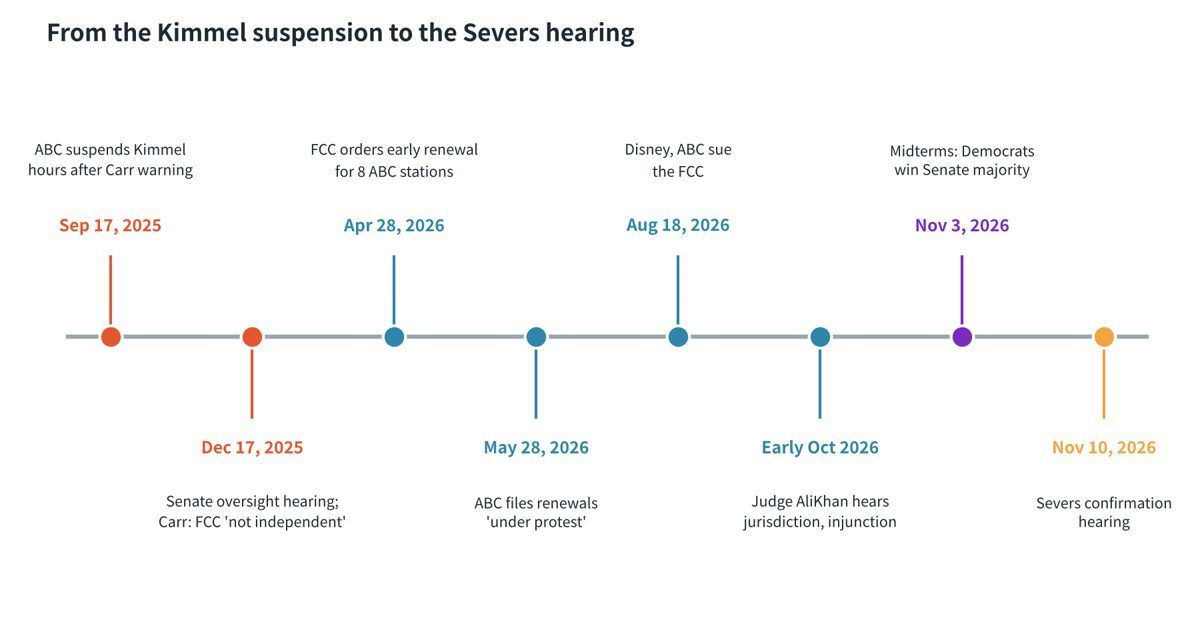
The dispute began on Sept. 17, 2025, when Carr, on Benny Johnson's podcast, criticized Kimmel's monologue about the killing of conservative activist Charlie Kirk: "These companies can find ways to take action on Kimmel, or there's going to be additional work for the FCC ahead." ABC suspended Kimmel within hours, and Sinclair and Nexstar, which own 66 of ABC's 230 affiliates, pulled the show. Kimmel returned less than a week later. Cruz called Carr's remarks "dangerous as hell" at the time.
On April 28, 2026 — a day after President Trump and First Lady Melania Trump criticized a Kimmel joke and the president called for his firing — the FCC's Media Bureau ordered ABC's stations in New York, Los Angeles, Chicago, Philadelphia, Houston, San Francisco, Raleigh-Durham and Fresno to file renewal applications within 30 days. Their licenses were not due for review until 2028 to 2031. The FCC says the order grew out of an investigation into Disney's diversity, equity and inclusion practices that began in early 2025.
ABC filed "under protest" on May 28 and sued the FCC on Aug. 18. The agency moved to dismiss, arguing the case belongs in the D.C. Circuit and is premature. Judge Loren AliKhan heard arguments on jurisdiction and preliminary relief in early October. Disney's complaint says ABC's "The View" has not invited political candidates since February because of the FCC's "pressure campaign."
Three Republicans would make a quorum, and Democrats fear for Gomez's seat
The FCC's three sitting members are Carr, Commissioner Olivia Trusty and Gomez. Removing Gomez today would leave the agency without a quorum; with Severs seated, three Republicans could keep acting. Axios noted that this would take away Gomez's ability to slow or stall votes and make it easier for the administration to replace her without paralyzing the agency.
On June 29, the Supreme Court ruled 6-3 in Trump v. Slaughter that for-cause removal protection for Federal Trade Commission members violates the separation of powers. The ruling concerned the FTC; how it applies to the FCC has not been decided. Gomez's term ended in July, but she can remain until January 2028 unless a successor is confirmed.
Sen. Ron Wyden (D-Ore.) has argued that the 1982 party-balance clause limits a party to two of three sitting commissioners and that actions by an all-Republican panel would be void; the common reading counts the five authorized seats. Republicans including Cruz, Sen. Ron Johnson of Wisconsin and Sen. John Kennedy of Louisiana have also voiced concern that using licenses to pressure broadcasters could run afoul of the First Amendment.
A 2-1 vote ended the 39% ownership cap
On Aug. 6, the FCC voted 2-1 to repeal the rule barring any company from owning stations that reach more than 39% of U.S. TV households, replacing it with case-by-case public-interest review. Gomez dissented, arguing that only Congress, which set the cap in 2004, can change it.
The repeal is tied to Nexstar's purchase of Tegna. Nexstar owns more than 200 stations and Tegna 64; combined, they reach about 80% of U.S. TV households. Nexstar closed the deal in March after Media Bureau approval, but a federal court in California halted the combination with a preliminary injunction in April. With Severs on board, ownership matters like these would be decided by a commission with three Republican votes.
Korea: a two-member regulator's YTN vote was ruled unlawful
Whether a depleted commission can make binding decisions is also before Korean courts. In February 2024, the Korea Communications Commission (방송통신위원회), then operating with only two members — Chairman Kim Hong-il (김홍일) and Vice Chairman Lee Sang-in (이상인) — approved Eugene ENT (유진이엔티), part of Eugene Group (유진그룹), as the largest shareholder of news channel YTN. On Nov. 28, 2025, the Seoul Administrative Court (서울행정법원) canceled the approval, ruling that a five-member collegial body acting with two members had violated procedure.
Eugene ENT appealed as an intervening party, and the Seoul High Court (서울고등법원) will rule on Dec. 18. The successor Korea Media and Communications Commission (방송미디어통신위원회, KMCC) opened a hearing on Nov. 3 on whether to revoke the approval itself, but its presiding officers halted it and moved it to Dec. 22.
In the U.S., quorum and party balance are at issue in the Severs confirmation; in Korea, a vote by an incomplete commission has become grounds to reverse a broadcaster's ownership decision. In both cases, the makeup of the regulator determines whether its license and ownership decisions hold. For Korean broadcasters, whether a KMCC decision was made with a properly constituted commission now bears directly on business planning.
Korea re-licenses 103 stations on a fixed schedule
The ABC case turns on a regulator's power to move up a license review. Korea ties review to expiration dates. On May 29, the KMCC approved a review plan for 103 terrestrial stations at 28 operators — including 13 regional MBC affiliates (지역MBC), seven commercial broadcasters and eight radio operators — whose licenses expire this year. It scores programming committees and editorial charters (편성위원회·방송편성규약) as a separate 50-point item and said it kept the existing structure for "consistency and predictability."
JTBC's re-approval lapsed last November and stalled amid the regulator's reorganization. On Oct. 7, the KMCC voted to give JTBC six months to file a revised plan and to rule within two months after that. In Korea, editorial-independence safeguards sit on the scoring sheet; in the U.S., programming and guest-booking decisions have become entangled with license review in court.
U.S. station consolidation changes who Korean suppliers negotiate with
U.S. local stations are also a distribution route for Korean content. With the cap gone, large groups such as Nexstar and Sinclair can grow further, concentrating the counterparties Korean companies deal with for channel leases and program supply. During the Kimmel episode, Sinclair and Nexstar pulled the show from their ABC affiliates shortly after the FCC chairman spoke, showing how quickly station-group programming responds to regulatory signals.
Korean broadcasters and content companies contracting with U.S. stations need to check those stations' renewal dates and any pending FCC proceedings alongside commercial terms. At home, re-licensing scoring and commission-composition rules set the baseline for planning. Both countries make public-interest review a condition of a broadcast license, and who conducts that review — and how many of them — has become a shared variable for the two industries.
What comes next: a committee vote and December court rulings
Cruz did not say when the committee would vote, and no markup has been scheduled. If the Senate confirms Severs this session, the FCC will have a 3-1 Republican majority before January. Under Senate practice, nominations not acted on by the end of a session are returned to the president, which would send the process to a Democratic-controlled chamber.
In ABC's case, Judge AliKhan's ruling and whether the FCC designates the licenses for hearing are next; the FCC has told the court the stations may keep operating while renewals are pending. In Korea, the YTN appeals ruling on Dec. 18, the resumed hearing on Dec. 22 and year-end decisions on 103 terrestrial licenses follow. Regulators in both countries face decisions on their makeup and on broadcast licenses between year-end and early next year.