

Tubi revenue up 35%, view time up 23%, about $50 million in midterm political ads
Summary Fox's fiscal Q1 revenue rose 22% to a record $4.57 billion as advertising jumped 47%. Tubi led the digital side: revenue up 35%, view time up 23%, and about $50 million in midterm political ads. The pending Roku deal would extend that model.

Tubi, the free ad-supported streaming (FAST) service owned by Fox Corporation, grew revenue 35% in the quarter ended Sept. 30, and total view time rose 23%. Fox reported fiscal 2027 first-quarter results before the market opened on Nov. 2. Revenue rose 22% to $4.57 billion. Both revenue and adjusted EBITDA set first-quarter records.
Advertising drove the quarter. Ad revenue rose 47% as the FIFA World Cup, political spending ahead of the Nov. 3 midterms and Tubi's growth came together. Big live events, sports and an election, combined with an expanding streaming ad business.
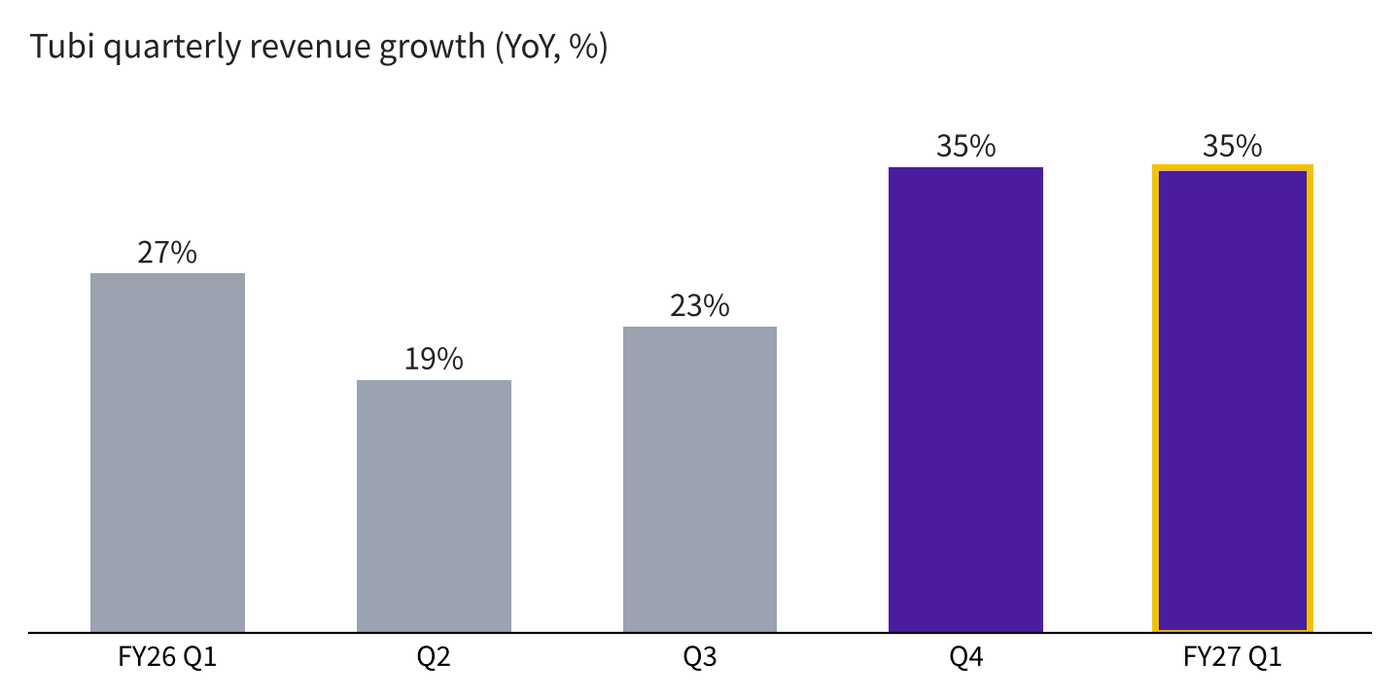
Tubi was the point where all three met. It simulcast World Cup matches from the Fox broadcast network and took about $50 million of Fox's $350 million-plus in midterm political ads. Its revenue has grown by double digits for five straight quarters and by 35% in each of the last two. Viewers who arrive for live events are steered into the library, and the added viewing is turned into ad revenue.
The exodus from pay TV sits behind that. As U.S. households drop cable and satellite, more homes fall outside the reach of traditional channels, and Tubi has become the outlet that connects them with advertisers. About 70% of Tubi's users have cut the cord or never subscribed. As advertisers shift budgets to connected TV to find those viewers, a service that charges no subscription gives them a new point of contact.
Fox was reorganized around news, sports and local stations after selling its film and TV studios to Disney in 2019. Live events run on broadcast and cable, while viewers outside pay TV are reached through Tubi. Variety noted that the mix behind the quarter is one other legacy media groups would struggle to replicate. Korean broadcasters and IPTV operators can take a lesson from it: competitiveness depends not only on how much content a company owns but on how it links live events, its library and ad sales.
Fox aims to extend the model through Roku. The roughly $22 billion acquisition has shareholder approval and awaits a Justice Department review. Closing would give Fox an ad business that links Tubi's 110 million monthly active users with Roku's more than 100 million streaming households. In Nielsen's August data, Tubi and The Roku Channel together held 4.8% of U.S. TV viewing, the same as Disney. Users and households are different measures, however, and cannot simply be added together.
"FOX has had an outstanding start to fiscal 2027 with first-quarter records for revenue and Adjusted EBITDA," Executive Chair and CEO Lachlan Murdoch said in the earnings release. JTBC, which carried the same World Cup in Korea, entered court-led rehabilitation in the same period. The two companies' fortunes cannot be explained by broadcast strategy alone, but the value of turning live-event demand into viewing on one's own platform and into ad revenue is plain. For K-FAST, which has widened Korea's overseas distribution, the next step is monetization. Beyond channel counts and cumulative viewers, whether Korean content companies can secure ad revenue and viewing data is likely to decide whether the business lasts.
Tubi Has Posted Double-Digit Growth in Each of the Last Five Quarters
Tubi's revenue growth went from 27% in fiscal Q1 2026, its first profitable quarter, to 19%, 23% and 35% over the following three quarters, and held at 35% this quarter. Tubi was EBITDA-positive in every quarter of fiscal 2026 and ended the year with 110 million monthly active users.
Viewing was driven by library titles, World Cup programming, Tubi originals and content from more than 600 creators, TheWrap reported. Tubi's EBITDA also grew year over year. On the call, Murdoch said Tubi should mature into a "20% sort of range margin business," according to Investing.com.
Tubi and Roku Channel Together Match Disney's Share of TV Viewing
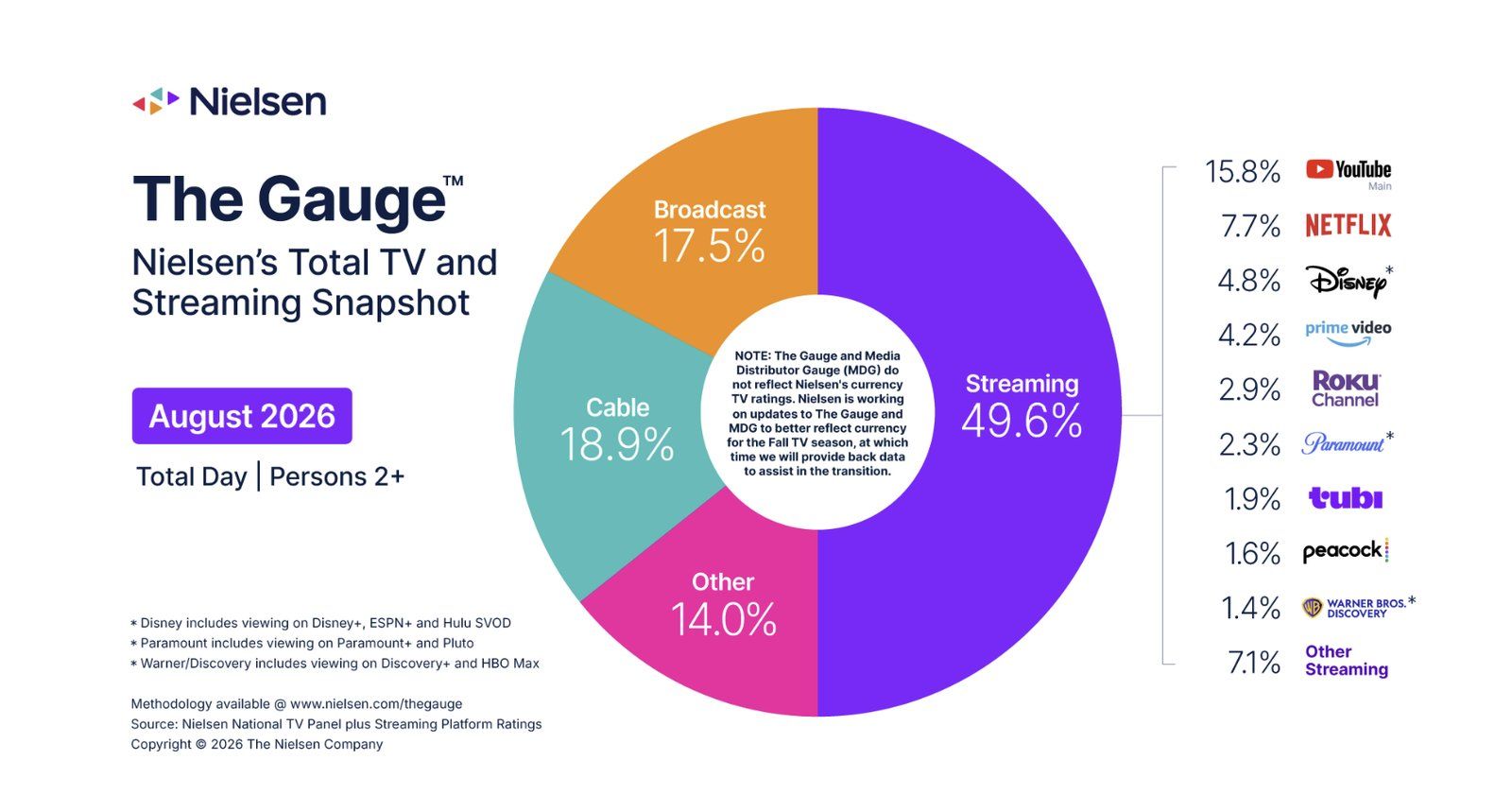
The rise of FAST shows in the data. Streaming accounted for 49.6% of U.S. TV viewing in August, according to Nielsen's Gauge released Oct. 22. Cable took 18.9% and broadcast 17.5%. YouTube led all platforms with 15.8%, followed by Netflix at 7.7%.
Adding up the two FAST services changes the ranking. Tubi drew 1.9% and The Roku Channel 2.9%. Their combined 4.8% equals Disney's total across Disney+, ESPN+ and Hulu, and tops Prime Video at 4.2%, Paramount's Paramount+ and Pluto TV at 2.3%, and Peacock at 1.6%. If the Roku deal closes, Fox would own two free services with viewing behind only YouTube and Netflix.
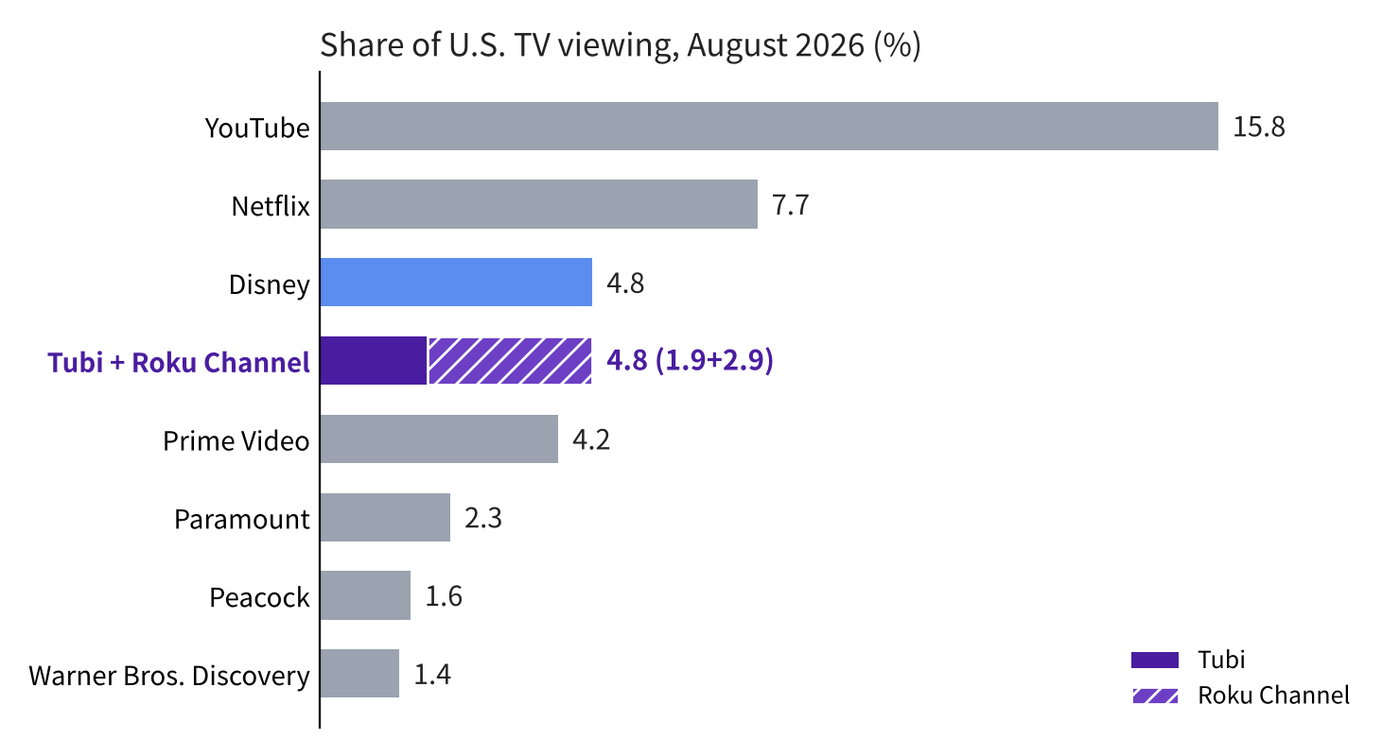
August was a post-World Cup lull. Nielsen said total TV usage fell 4.4% from July and broadcast viewing dropped 14%, with sports falling from 30% of broadcast viewing in July to under 9%. Tubi's 1.9% was below its fiscal 2026 average of about 2.2%. In Nielsen's Media Distributor Gauge, Fox ranked sixth in August with 5.6%. Adding The Roku Channel's 2.9% would bring it to 8.5%, behind Disney's 9.3% and ahead of Netflix's 7.7%.
Midterm Political Ads Top $350 Million, About $50 Million on Tubi
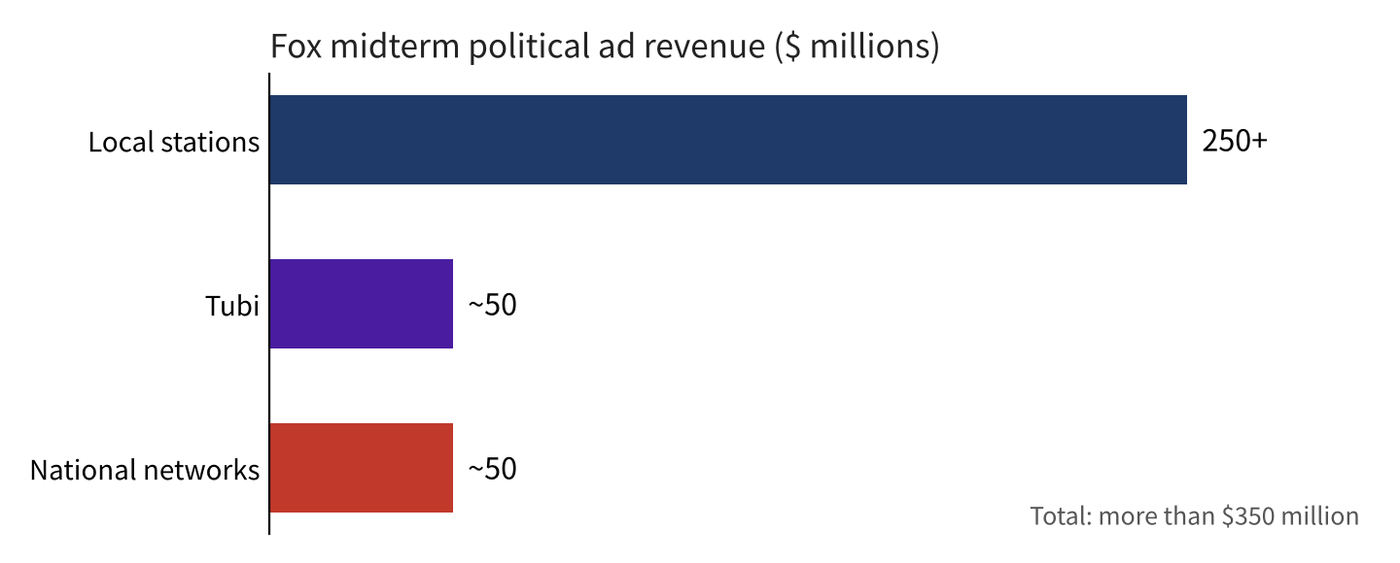
"Political advertising has passed $350 million, a record for a midterm cycle," Murdoch told analysts, The Hollywood Reporter reported. More than $250 million came through Fox's local stations, with about $50 million each at Tubi and the national networks. Fox took in a little over $260 million in the previous midterm cycle.
Tubi's political ads are targeted at the local level, reaching cord-cutting and cord-never households that broadcast stations miss. Murdoch said in February that 70% of Tubi's users have cut the cord or never had pay TV. On Monday's call he pitched Tubi as a political-ad sales channel built on its targeting capabilities, according to The Hollywood Reporter.
TV Segment Ad Revenue Up 60%; Segment EBITDA More Than Doubles
Revenue in the Television segment, where Tubi is reported, rose 32% to $2.71 billion. Advertising climbed 60%, or $641 million, to more than $1.7 billion. Distribution revenue rose 4% to $850 million from $821 million. Segment EBITDA more than doubled to $934 million, Cord Cutters News tallied.
Segment expenses rose 8% on World Cup rights amortization and production costs and higher Tubi content spending, partly offset by lower NFL costs. Total company expenses rose 10%.
World Cup Final Draws 38.9 Million as Fox, FS1 and Tubi Carry 104 Matches
Fox carried all 104 matches of the 2026 FIFA World Cup, played June 11 to July 19, across the Fox network, FS1 and Tubi. Spain's 1-0 extra-time win over Argentina in the July 19 final averaged 38.9 million viewers on Fox, the most-watched soccer telecast in U.S. history. The tournament averaged 7.74 million viewers per match, up 116% from Qatar 2022, TV Technology reported.
Tubi simulcast opening matches and ran a dedicated World Cup hub. In August, Murdoch said the hub drew more than 20 million viewers and that World Cup revenue was meaningful but small relative to Tubi's overall growth, MarketBeat reported. On Monday he said Fox would weigh rights to the 2030 and 2034 tournaments "in a disciplined manner."
Cable Revenue Reaches $1.8 Billion as Digital News Ads Slip
Revenue in Cable Network Programming, home to Fox News and FS1, rose 8%, or $141 million, to $1.8 billion. Distribution revenue grew 10% on contractual rate increases and a higher average subscriber count. Advertising rose 8% on sports including the World Cup, partly offset by lower digital news advertising, a market Murdoch called "hyper-competitive."
About 97% of New Fox One Subscribers Come From Outside Pay TV
Fox One, the subscription streaming service launched in August 2025, targets a different customer from Tubi. Murdoch said about 97% of new subscribers do not have a cable subscription. September sign-ups rose 20% from the start of last year's football season, and Murdoch said Fox has seen "a very healthy engagement balance by subscribers between news and sports consumption," TheWrap reported. He added that Fox One's base will move with the sports calendar.
Roku Deal Awaits Only DOJ Clearance
Fox's roughly $22 billion acquisition of Roku, announced in June, won shareholder approval in mid-October. "We have made significant progress towards closing, including receiving all required Fox and Roku shareholder approvals and foreign regulatory approvals," Murdoch said, adding that Fox is working with the Justice Department to obtain Hart-Scott-Rodino clearance. Fox expects to close in the first half of 2027.
The deal would pair Tubi's 110 million monthly active users with Roku's more than 100 million streaming households. Fox did not take questions on the transaction during the call.
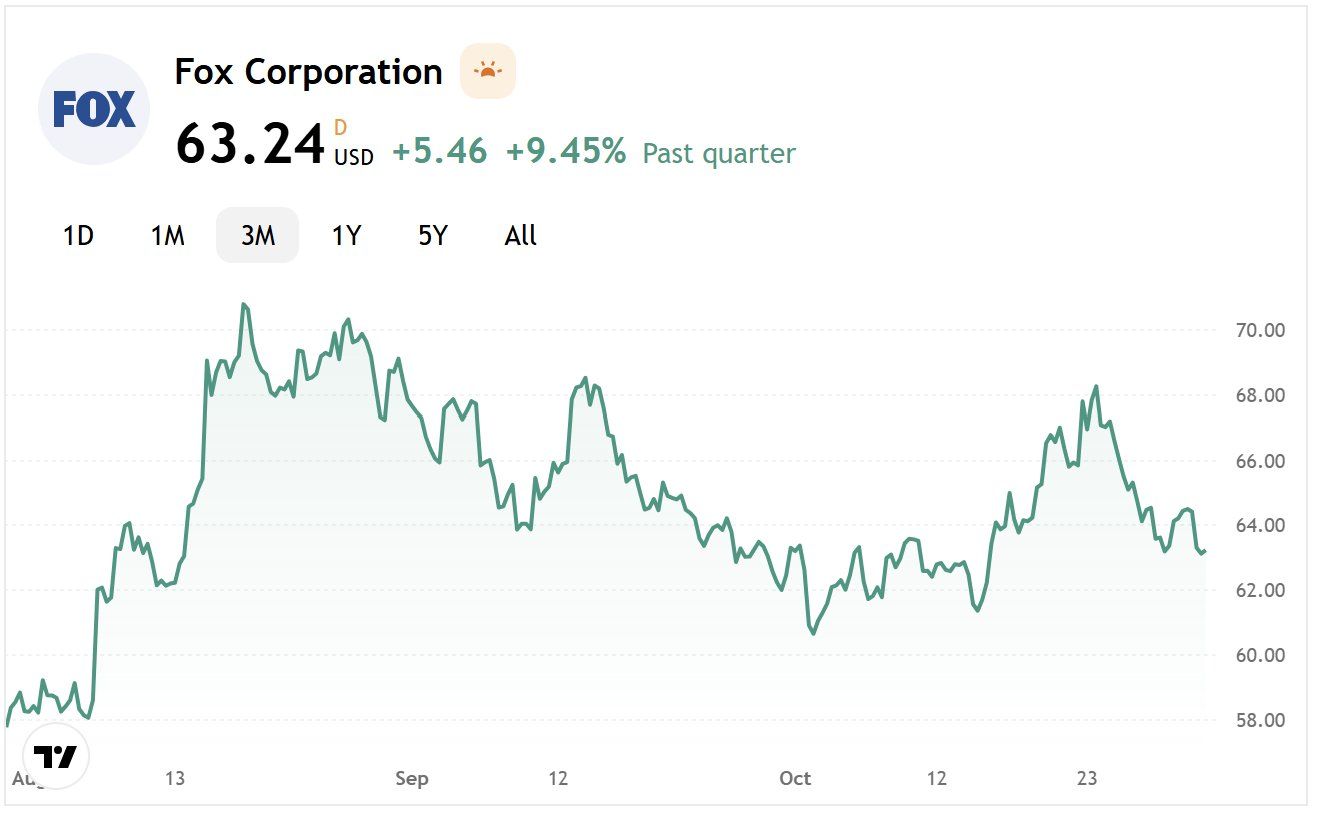
Shares Up 9% Over Three Months; Net Income Reaches $943 Million
Net income attributable to Fox stockholders was $943 million, or $2.20 a share, up from $599 million, or $1.32. Adjusted EPS was $2.54 and adjusted EBITDA rose 54% to $1.64 billion. Revenue and EPS both beat consensus estimates of $4.29 billion and $2.02, TheWrap reported. Fox paused buybacks during the quarter and plans to resume them in the current quarter.
JTBC Paid $125 Million for World Cup Rights… Digital Rights Went to Naver
Korean broadcasters, lacking a FAST outlet that feeds back into their linear channels, came out differently. JTBC, which held exclusive Korean rights to the same World Cup, said in March it paid $125 million. It resold broadcast rights only to KBS (Korean Broadcasting System, 한국방송공사) for 14 billion won ($10.4 million); talks with MBC and SBS failed. It reportedly sold digital rights to Naver (네이버) for 35 billion to 50 billion won ($26 million to $37 million), Edaily (이데일리) reported. JTBC sold 18.5 billion won ($13.8 million) in ads for Korea's three group matches, according to Media Today (미디어오늘), and KBS sold about 6 billion won for the Czech Republic match.
On June 15, four days into the tournament, JTBC filed for court-led rehabilitation at the Seoul Bankruptcy Court after missing payment on 20.6 billion won in securitized loans. Korea's broadcast advertising revenue fell 12.3% in 2025 to 2.01 trillion won ($1.5 billion), the Korea Communications and Media Commission (방송미디어통신위원회) reported in June. Broadcast ad revenue shrank an average 10.6% a year from 2021 to 2025, while mobile advertising grew 7.5%.
The two companies carried the same tournament. Fox sold ads across broadcast, cable and its own FAST service, and the added digital viewing showed up as Tubi ad revenue. JTBC split TV and digital rights and handed digital viewing to a portal.
JTBC's troubles cannot be blamed on the absence of FAST alone. Korean broadcast channels operate under unusually strict regulation, and political advertising works differently too: the Public Official Election Act (공직선거법) permits broadcast ads only for presidential, proportional National Assembly and metropolitan-governor races, with limits on frequency. Korean broadcasters have few paths to collect the kind of locally targeted election ads Fox split between its stations and Tubi. How much streaming ad revenue they capture may depend on whether they own a digital outlet and a targeted ad-sales system.
Samsung TV Plus Tops 100 Million Viewers; Korean Broadcasters Supply the Channels
Tubi could expect about $50 million in political ad revenue this quarter because Fox owns the platform. Many Tubi users live in households without pay TV. Fox reaches them through Tubi and uses viewing data to sell ads by region. Content supply, platform operation and ad sales all sit inside one company. That is also why Fox could put broadcast World Cup matches on Tubi at the same time and turn the added viewing into ad revenue.
Korean FAST is built differently. TV makers run the main platforms, Samsung TV Plus and LG Channels, while broadcasters and channel operators supply content. Samsung TV Plus offers about 4,300 channels in 30 countries and LG Channels about 4,500 in 37, ZDNet Korea (지디넷코리아) reported. Samsung said in June that Samsung TV Plus had passed 100 million viewers. Comparing that figure directly with Tubi's 110 million monthly active users would require confirming that both are counted the same way.
Korean broadcasters and channel operators enter overseas markets by supplying content to platforms that already have global audiences. New ID (뉴 아이디) runs about 400 FAST channels built around Korean content on some 30 platforms, including Samsung TV Plus, LG Channels, Amazon Prime Video, Pluto TV and Tubi, Venture Square (벤처스퀘어) reported. It secures content, programs channels by country and platform, attaches local advertising and shares the revenue.
The deciding factor is control of advertising.
Suppliers split ad inventory or ad revenue with platforms under contract, but supplying a channel does not give them the platform's user data or ad-sales capability. Some suppliers, such as New ID, run their own ad operations and monetization technology and use viewing data, so they cannot be dismissed as simple content vendors.
Still, in ad businesses that target specific regions and households, as political advertising does, what counts is direct access to viewers and the ability to sell ads with data, not just content. For Korean broadcasters going into FAST, the central task is how much authority they secure over ad sales and data, beyond channel counts and overseas reach.
Beyond the Home Market… FAST Emerges as an Alternative to Netflix-Centered Distribution
FAST is growing more slowly in Korea than in North America. In the U.S., expensive pay TV and rising streaming subscriptions fed demand for free services. Korea has relatively cheap pay TV, so there is less reason to switch, Money Today (머니투데이) reported. Domestic demand alone, however, is a poor guide to FAST's potential, because it can give Korean content companies overseas audiences and more distribution routes.
In that sense FAST is less a replacement for Netflix than a way to widen overseas distribution for Korean content now concentrated on Netflix and other global streaming services. Korean programs reach local viewers through the smart TVs Samsung and LG have sold worldwide, earning money from ads instead of subscriptions. For Korean broadcasters and producers, it is a chance to add overseas outlets and ad revenue at the same time.
The government has taken notice. In April 2025 the Ministry of Science and ICT (과학기술정보통신부) and the Korea Association for ICT Promotion (KAIT, 한국정보통신진흥협회) launched the Global K-FAST Alliance with platform companies, broadcasters and channel operators. The AI-dubbed K-FAST expansion program, which uses AI dubbing to take Korean content abroad, secured 8 billion won ($6 million) from a supplementary budget. The approach pairs the overseas reach of Korean platforms with Korean content and localization technology.
The Korea Communications and Media Commission (방송미디어통신위원회), the broadcast regulator, met Samsung, LG, channel operators including New ID and CJ ENM, and broadcasters including KBS, MBC and SBS at Samsung's Suwon campus on June 4 to discuss the global FAST market. A forecast presented there put the world FAST market at 18 trillion won in 2025, rising to 47 trillion won ($35 billion) by 2030. Participants agreed on linking the 600 million smart TVs Korean electronics makers have shipped worldwide with Korea's broadcast production capacity.
Turning that opportunity into results will take more than re-airing existing programs abroad. Industry voices point to planning and scheduling tuned to local viewers, content strategy tied to viewing data and ad sales, and investment in FAST-only content. Combining Korean content, global TV platforms and localization technology is what would carry the business past audience reach and into the ad market.
The program's purpose is not to help Samsung's and LG's platform businesses. The aim is to use the global distribution networks the two companies built to widen overseas opportunities for Korean broadcasters and producers and diversify their revenue. Calling it a Samsung-LG subsidy because the platforms also benefit is the same logic as calling content support a Netflix subsidy because Netflix distributes Korean shows.
What matters is not which platform carries the content but how much of the benefit returns to Korean content companies. Policy results should therefore be judged by real returns, such as the ad revenue, revenue-share terms and access to viewing data that Korean broadcasters and producers secure, rather than by channel counts or audience size.
AI-Dubbed K-FAST Channels Reach 100 Million Viewers; This Year's Support Covers Four New Channels
Government support has delivered overseas audiences. Through last year's AI-dubbed K-FAST program, the ministry and KAIT dubbed about 1,200 Korean titles, some 1,400 hours, into English, Spanish and Portuguese and built 20 FAST channels, Digital Daily (디지털데일리) reported. The channels launched in December on Samsung TV Plus and LG Channels in 22 countries including the U.S., Canada and Mexico, and reached a cumulative 100 million viewers by the end of April, Digital Daily reported in July. AI dubbing lowered the language barrier, and Korean TV makers' global platforms widened contact with overseas viewers.
This year the program adds new channels and diversifies genres and business models. The ministry selected three consortia led by Hudson AI, ESTsoft and UnAI to build four new K-FAST channels, with about 230 million won ($170,000) per channel. Fewer new channels are being built than last year, but support now covers vertical dramas, K-beauty and K-dance. The channels will adapt vertical short-form video for TV viewing, link K-beauty original content to commerce and offer content co-produced with partners in Latin America.
The effort recasts FAST from a re-distribution outlet for existing broadcasts into a place to test new revenue models. It complements overseas distribution centered on paid global streaming and shows how content companies could add advertising and commerce income.
Cumulative viewers, however, measure overseas reach; they do not prove profitability. Turning those viewers into sustained viewing and revenue is the next task.
That is why support after channel building is essential.
Tubi shows why that next stage matters. Its data-driven ad sales and live-event strategy offer a reference for Korean companies. Beyond localization support, platforms, channel operators and ad-tech firms need to work together and put overseas viewing data to work for advertising and commerce. When the Global K-FAST Alliance launched, the ministry listed projects that link overseas viewing data to advertising and commerce among its support goals, Financial News (파이낸셜뉴스) reported. Widening overseas distribution and revenue will, for now, depend on cooperation between Korean content and Korean platforms.
More companies are joining in. The Global K-FAST Alliance grew from 22 member companies and institutions at its April 2025 launch to 82 by July, and was reorganized into five working groups: content and channels, technology, advertising and platforms, global, and coordination. If AI dubbing opened the door to overseas viewers, the next stage is to use this network to connect localization, scheduling, ad sales and commerce. Whether support can grow into a sustainable business model, beyond channel counts and reach, now matters most.
Libraries Go to Overseas FAST, Live Rights to a Portal… Revenue Channels Split
Korean broadcasters' entertainment and drama libraries already reach viewers through overseas FAST channels, and library titles also drove Tubi's viewing growth this quarter. The difference lies in how live content is used. Fox offered its library and live World Cup matches on the same Tubi platform, and viewers who came for the matches went on to watch the library.
JTBC, by contrast, sold its World Cup digital rights to Naver and resold broadcast rights only to KBS. Digital demand created by the live matches was consumed on an outside platform rather than the broadcaster's own. With library distribution and live events running through separate outlets, Korean broadcasters also differ from Tubi in turning live-event traffic into viewing of other content and ad revenue.
That division of rights could become an issue in future negotiations. JTBC holds Korean rights to the 2028 Los Angeles Olympics and the 2030 World Cup and is in court-led rehabilitation. Resale talks could cover not only TV rights but also who secures digital and FAST rights and how ads are sold.
Whether Korean broadcasters build the means to sell FAST ads directly and accumulate viewing data is another key variable. With those capabilities, revenue from overseas FAST need not stop at channel-supply fees or revenue shares and could extend to direct ad sales. Tubi's role in Fox's quarter shows the difference between supplying content and running the viewer relationship and ad business as well.
Outlook: More Political Ads and an NFL Thanksgiving Game on Tubi
Murdoch described advertising trends as "incredibly healthy" across the company. Tubi's growth has continued into the second fiscal quarter, which will also book political spending through Election Day on Nov. 3. Tubi will stream the NFL Thanksgiving Day game live.
The World Cup and midterm boosts will not recur in the same quarter next year. The question for next year's first quarter is how much growth Fox can sustain once the big events are gone, and the answer rests on the NFL and Tubi. Fox said Tubi's growth has continued after the World Cup. The test is whether viewers drawn in by live sports can be steered to the library and their viewing turned into lasting ad revenue.
If the Roku deal closes, Fox's streaming ad inventory could extend from the Tubi app across the Roku platform. The outcome of the Justice Department review and how quickly Tubi's margin approaches 20% are the measures to watch. What matters more than closing the deal is whether the larger ad-sales base turns into actual profit.
Fox's next test is profitability, not audience size. It has to hold on to the viewers the World Cup brought in and generate repeat ad revenue by pairing live NFL games with its library. Whether this quarter was a one-off record built on big events or the start of sustainable growth centered on Tubi will depend on that conversion.
K-FAST, too, has to go beyond adding overseas channels and viewers and turn its audience into lasting ad revenue and income for Korean content companies. Yet the Ministry of Science and ICT's briefing on its 2027 budget did not list FAST or AI-dubbing support as a separate item, leaving the continuity of follow-up support an open question. If the overseas results are promoted while support to turn them into a business remains unclear, channel building and audience gains could prove a one-time achievement.