Toho's 'Godzilla Minus Zero' opens to $31.6 million, 74% from premium screens; holding audiences after 'Hunger Games' arrives Nov. 20 is the test
Toho's 'Godzilla Minus Zero' opened to $31.6 million on 3,254 North American screens, a record for a foreign-language live-action film. IMAX took 40% of the gross and premium formats 74%. Toho released it through its own GKIDS three days after Japan.
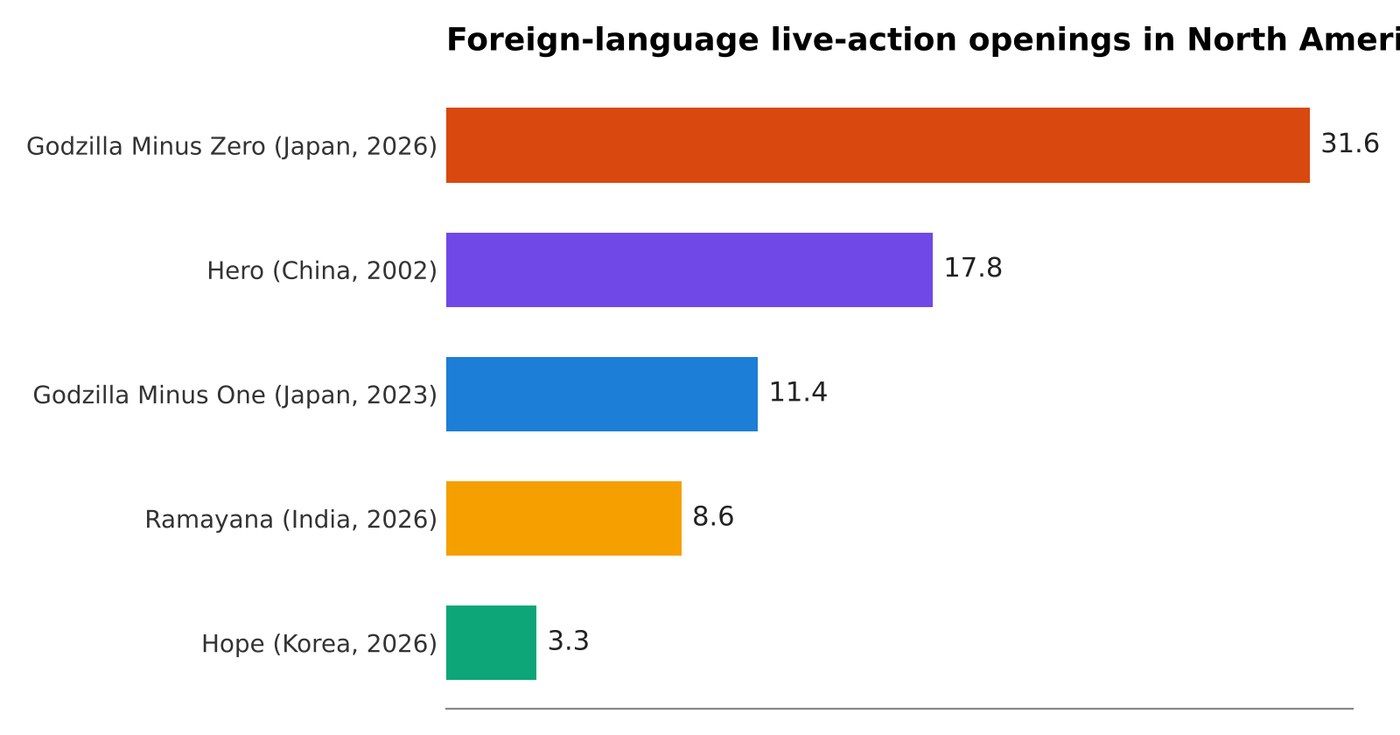
"Godzilla Minus Zero," produced by Japan's Toho Co. (東宝), took first place at the North American box office, grossing $31.6 million from 3,254 U.S. and Canadian theaters over the Nov. 6-8 weekend, Bloomberg reported on Sunday, citing Rentrak estimates. Its global start stands at $63 million. It is the largest opening for a foreign-language live-action film in North America, beating the $17.8 million that China's "Hero" set in 2002.
Set in 1949, two years after the first film, the sequel again has Takashi Yamazaki (山崎貴) as writer, director and visual-effects supervisor, with VFX by Shirogumi. "Godzilla Minus One" opened to $11.4 million in third place in 2023, reached $57 million in North America and $114 million worldwide, and became the first Godzilla film to win an Oscar, for visual effects.
That beat pre-release expectations. Boxoffice Pro's long-range forecast had pegged the opening at $25 million to $35 million. GKIDS' previous record debut was Studio Ghibli's "The Boy and the Heron" at $13 million in 2023 (ComicBasics). Chance Huskey, GKIDS' vice president of distribution, told Variety that audiences embraced the film at an unprecedented scale for an international release, crediting a campaign with Toho built around the must-see intensity of the theatrical experience.
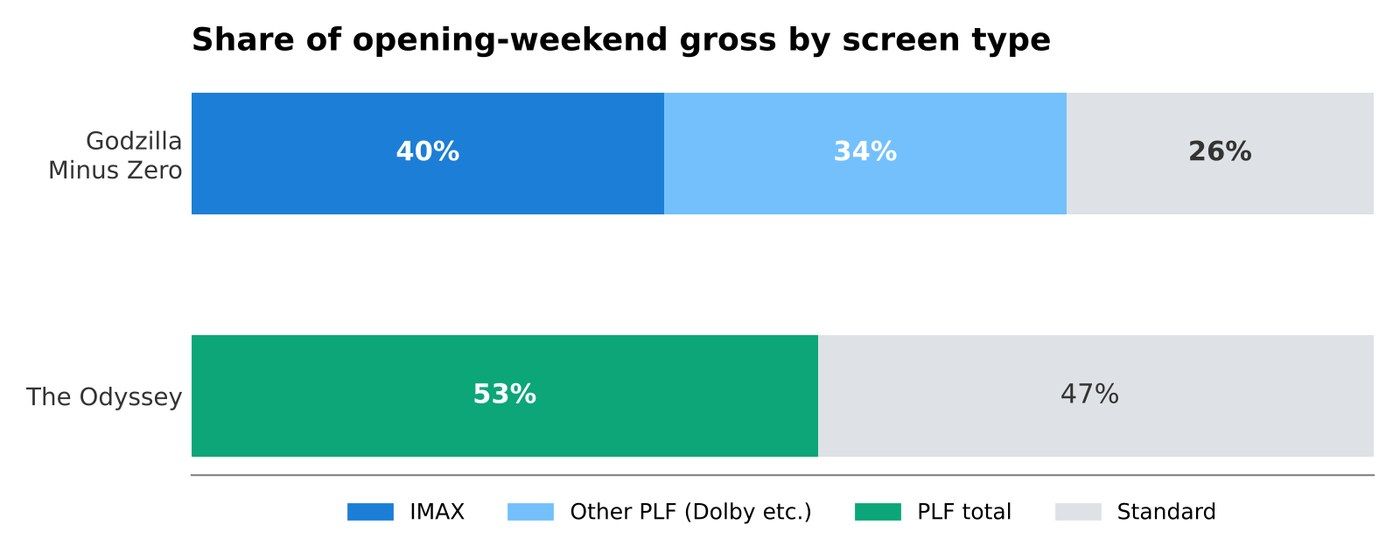
The screens decided the race. IMAX delivered $12.7 million, or 40% of the weekend, and premium large formats (PLF) including Dolby Cinema accounted for 74% of ticket sales, according to Variety. That compares with 53% for Christopher Nolan's "The Odyssey" in its July opening. "Minus Zero" is the first Japanese production filmed for IMAX.
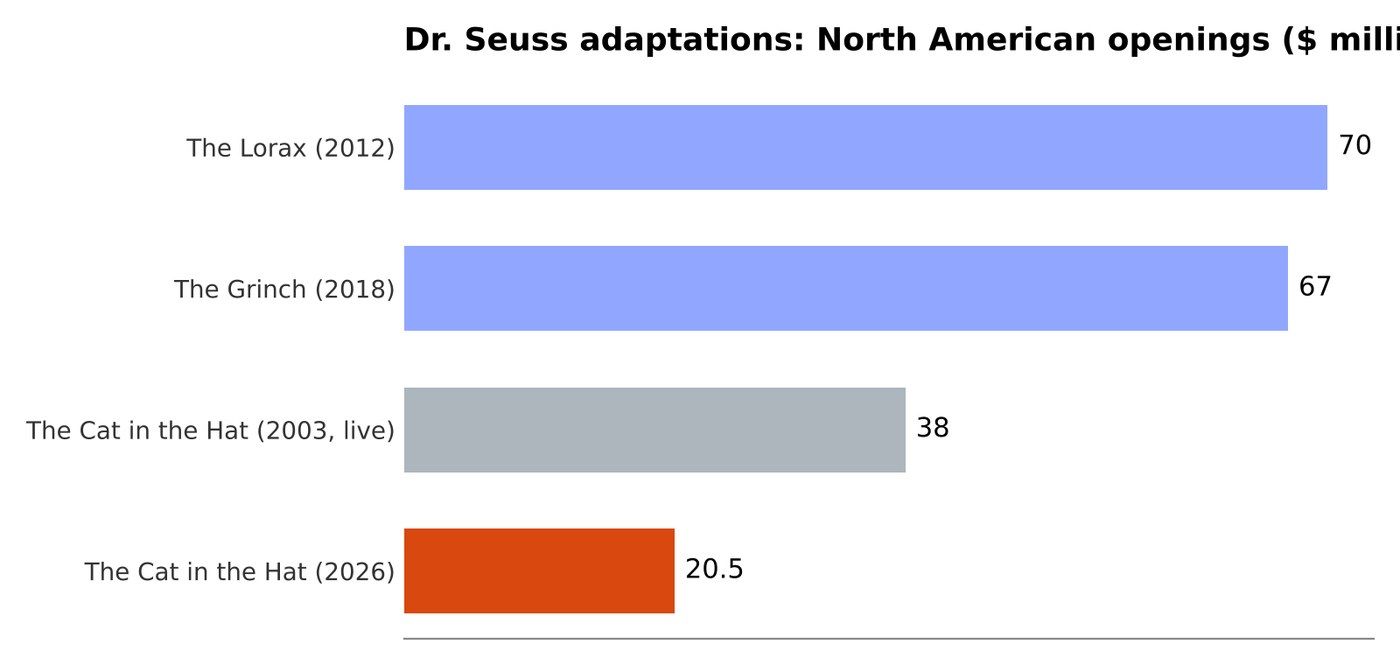
Warner Bros.' animated "The Cat in the Hat" placed second with $20.5 million from 4,003 locations — 749 more theaters than Godzilla, and $11.1 million less in sales. The film cost $92 million to make.
The result lines up with Toho's overseas push. The company bought North American distributor GKIDS in 2024, released the film through it, and scheduled the U.S. opening three days after Japan's. Its long-term plan, TOHO VISION 2032, aims to lift overseas revenue from 10% of the total to 30% by 2032. For comparison, Korean director Na Hong-jin's "Hope" (호프) opened on 1,560 North American screens in September and took $3.3 million in its first weekend.

40% from IMAX, 74% from PLF: the first Japanese film shot for IMAX
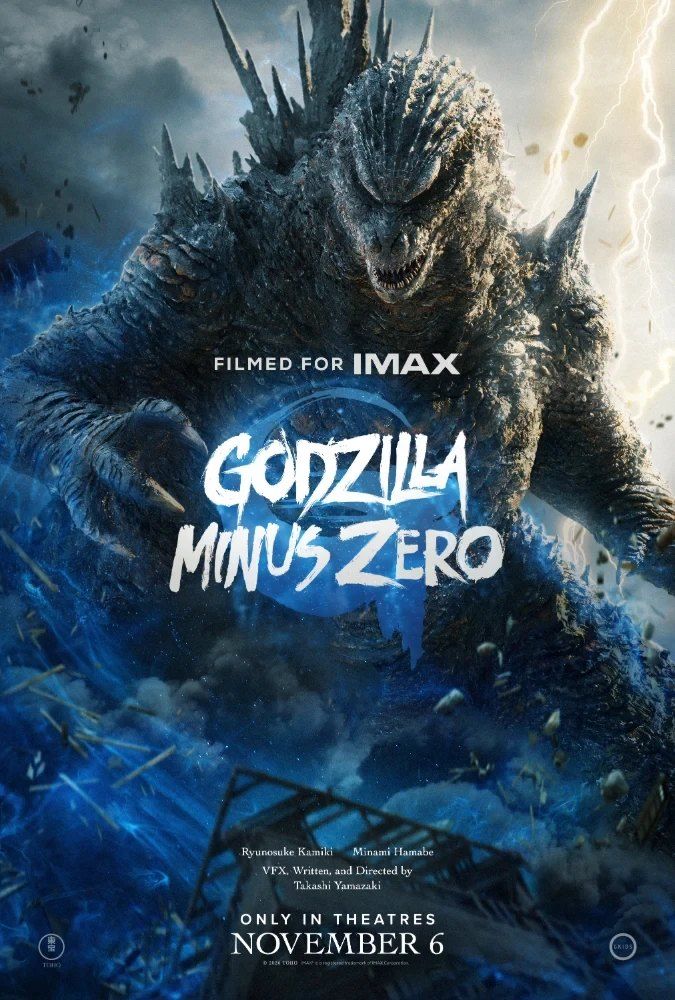
Toho shot the film on IMAX-certified high-resolution digital cameras, it said on the official Godzilla site, framing for IMAX's expanded 1.43:1 aspect ratio. Toho and GKIDS secured a worldwide IMAX release, and the film opened the same day in IMAX across the U.K. and Ireland.
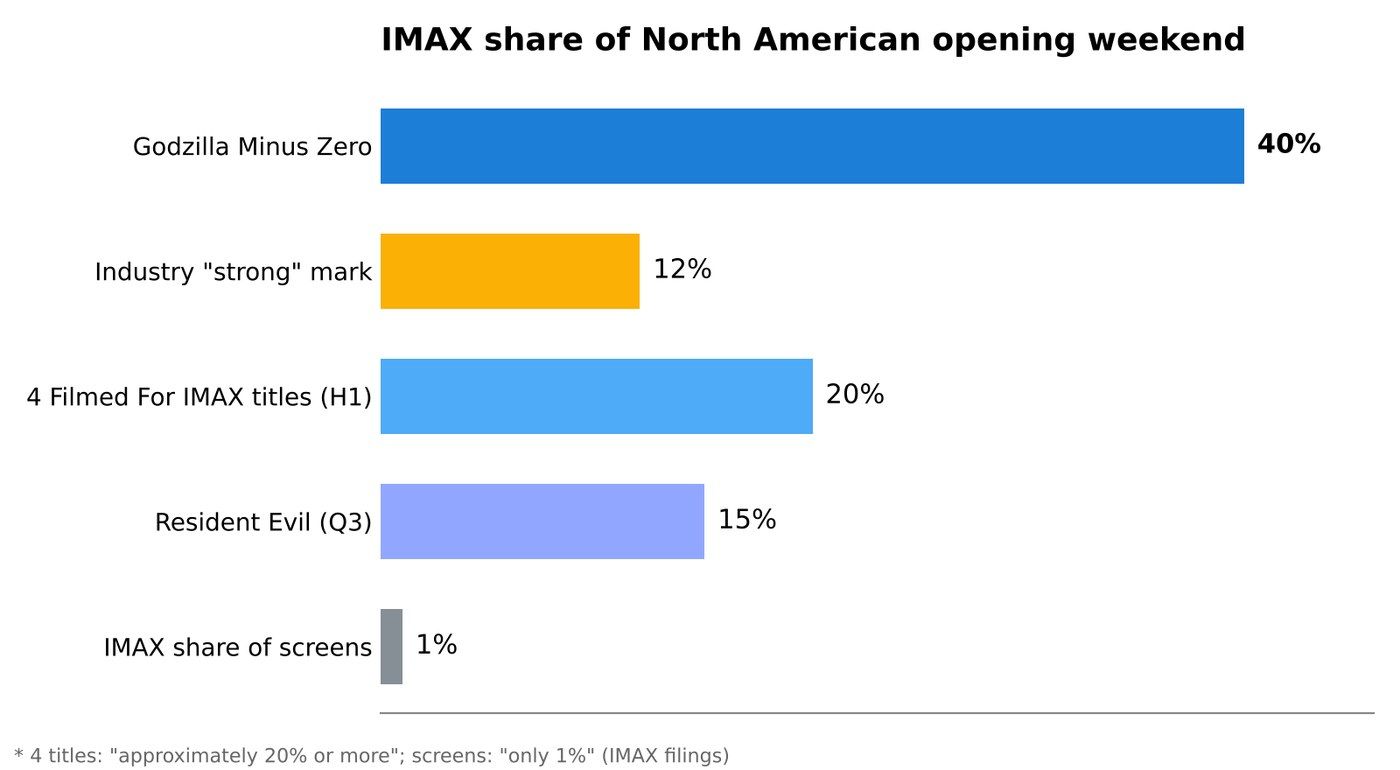
A 40% IMAX share is roughly double the norm for the format's own titles. In its second-quarter filing, IMAX said four Filmed For IMAX releases took approximately 20% or more of their domestic opening weekends while IMAX accounts for only about 1% of screens. Its third-quarter filing put "Resident Evil" at about 15%.
Around 12% is generally considered a strong IMAX share for an opening, so 40% is more than three times that mark. The IMAX gross alone, $12.7 million, exceeds the entire $11.4 million that "Godzilla Minus One" opened to in North America in 2023.
Premium screens carry higher ticket prices, so the same audience yields more revenue. The reviews held up: 90% on Rotten Tomatoes and an "A" CinemaScore. At 135 minutes, it is the longest Japanese Godzilla film (Dark Horizons).
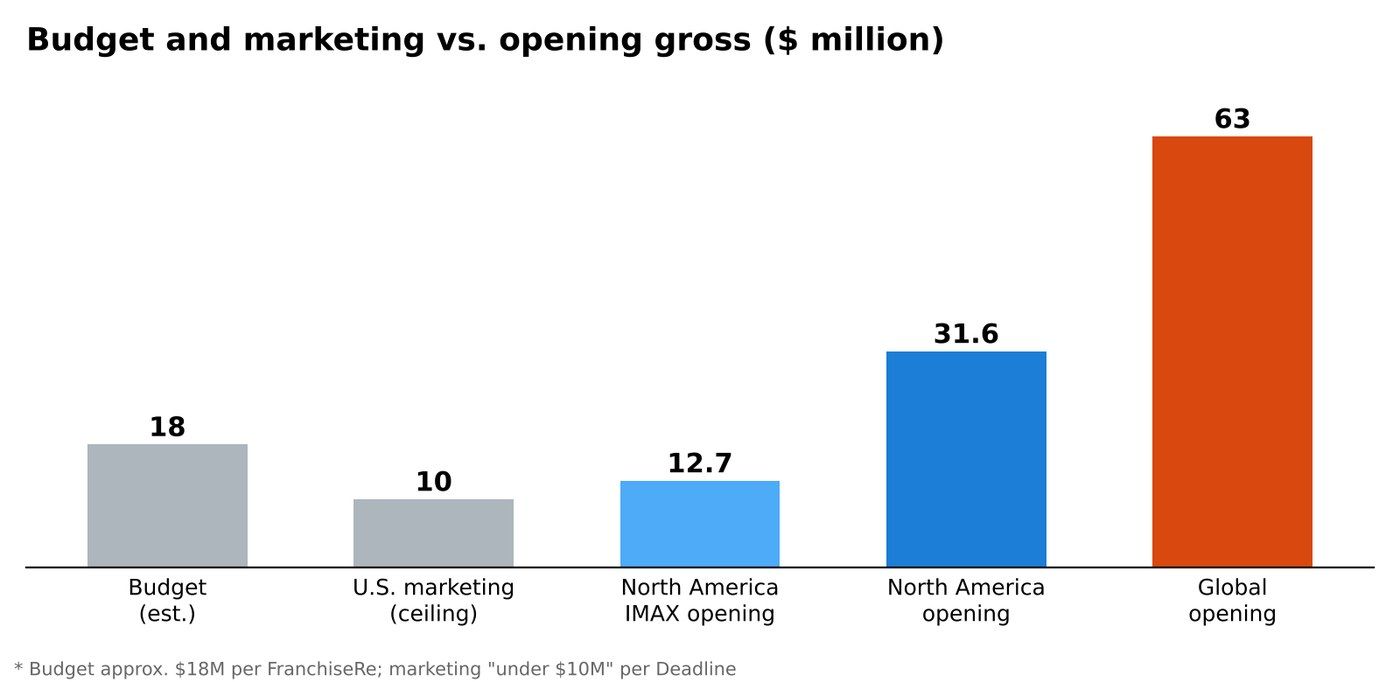
A roughly $18 million budget, under $10 million in U.S. marketing, $63 million worldwide
The economics are lopsided in Toho's favor. FranchiseRe estimates the budget at about $18 million, and Deadline reported GKIDS spent under $10 million marketing it in the U.S. The $31.6 million domestic opening alone exceeds the two combined. Including Japan, the global start is $63 million. "The Cat in the Hat" cost $92 million — about five times as much.
Audiences backed it: an "A" CinemaScore from opening-day viewers and an 85% definite recommend on PostTrak, Deadline reported — the word-of-mouth signal that matters from the second weekend on.
Opening night: 76% male, 63% aged 18-34, 32% Latino, 13% Asian
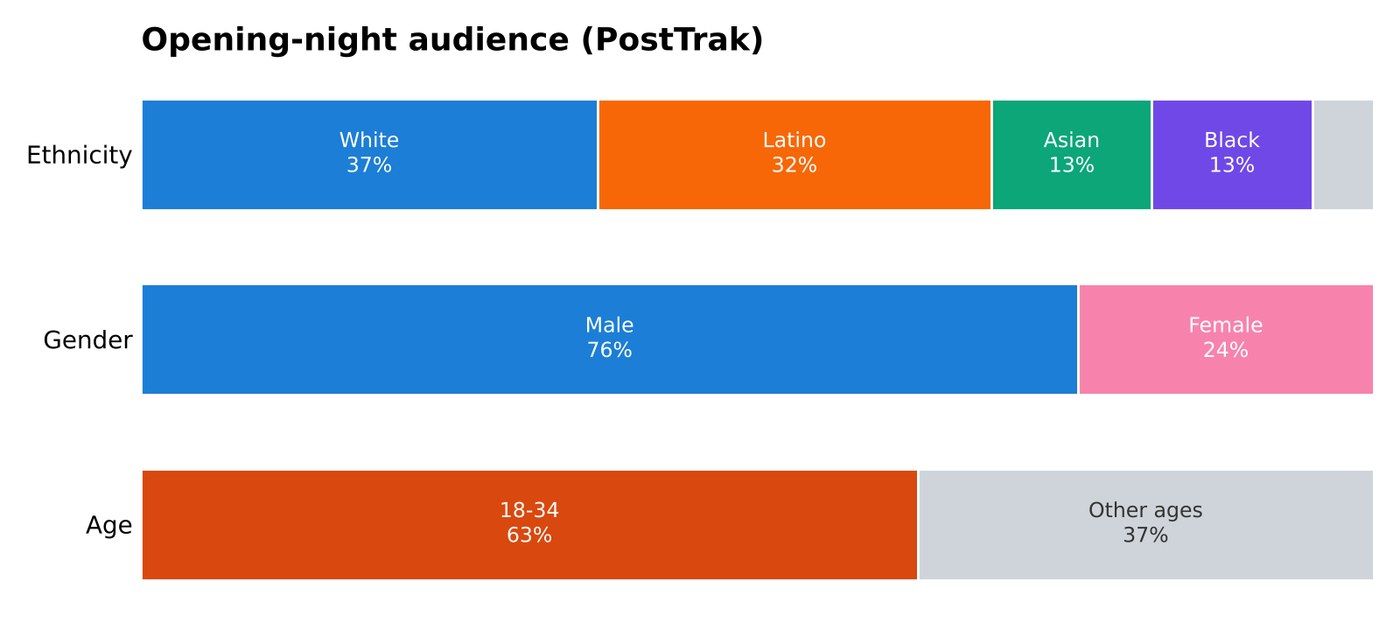
PostTrak's opening-night breakdown, per Deadline: 37% white, 32% Latino, 13% Asian and 13% Black; 76% male and 24% female; 63% aged 18 to 34. For a subtitled Japanese film, Asian moviegoers were 13% of the crowd while white and Latino viewers made up 69%. The R rating removed families; young male genre fans filled the gap.
That profile ties back to the IMAX share: 18-to-34-year-old men seeking monster and action spectacle are the most PLF-inclined audience. For Korean films aiming beyond diaspora and Asian American viewers, the composition is a useful reference for matching genre and screen format to that audience.
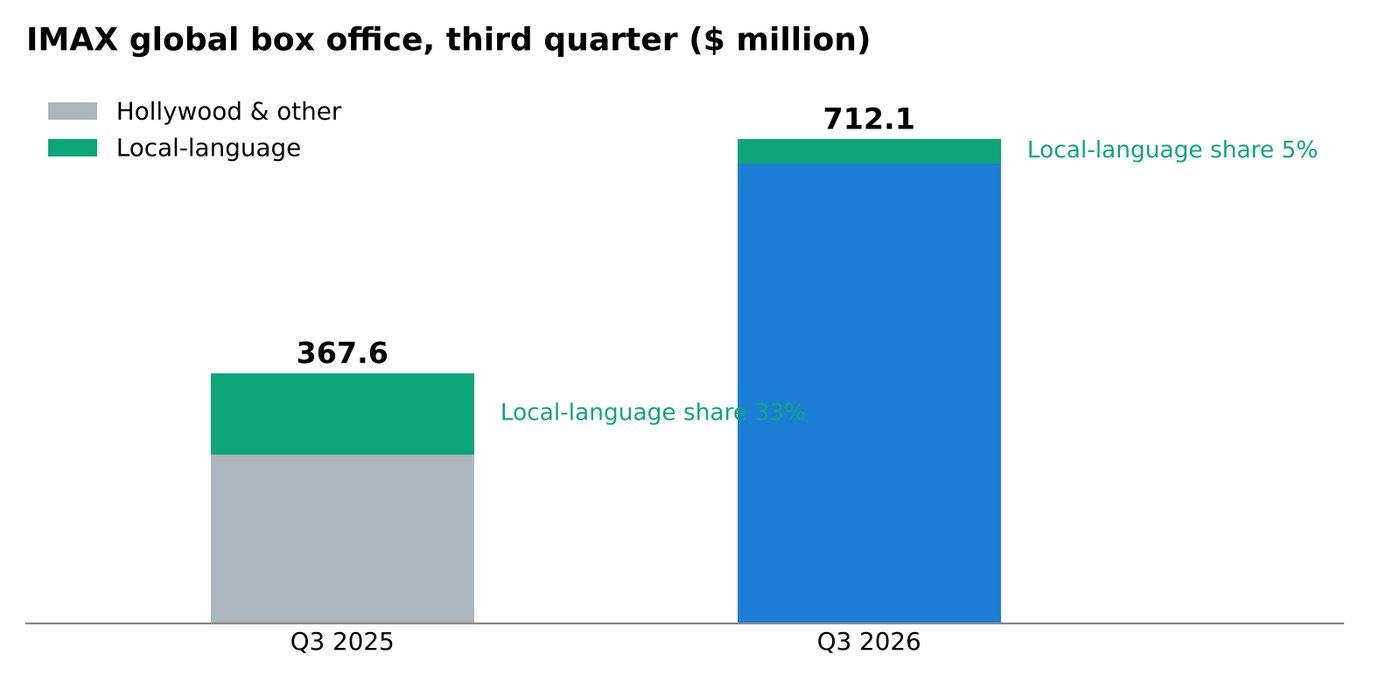
IMAX posts a record $712 million quarter as local-language share falls to 5%
IMAX said on Nov. 5 that third-quarter global box office reached $712.1 million, up 94% from $367.6 million a year earlier and the highest in company history. "The Odyssey" earned $538 million in IMAX alone. The company said it generated 6.7% of the industry's global box office in the quarter on less than 1% of screens.

Local-language films — mostly Chinese titles — generated $36.5 million, or 5% of IMAX's global box office, down from $120.2 million and 33% a year earlier; the first-half share was 15%. IMAX describes local-language films as a higher-margin mix. "Minus Zero" added $12.7 million in North American IMAX alone in the first weekend of the fourth quarter. IMAX had 1,820 systems in operation at Sept. 30 and a backlog of 409.
Rated G in Japan, R in the U.S.: ¥910 million on Japan's opening day
The film opened in Japan on Nov. 3, "Godzilla Day," the anniversary of the 1954 original. Toho said 590,000 people bought tickets on day one for ¥910 million (about $5.7 million), a record opening day for a live-action film in Japan and double its predecessor's (Final Weapon). It is the first time a Japan-produced Godzilla film has opened in Japan and North America in the same week (Godzilla.com).
The ratings diverged. Japan rated it G, suitable for all ages; the Motion Picture Association gave it an R for violence and bloody images, Bloomberg reported. In North America, it won the weekend without the family audience.

Toho's strategy of working the fan economy also paid off. The studio has been building the fan base beyond cinemas: Godzilla appears in Apple TV's "Monarch: Legacy of Monsters" and in games and merchandise, including collaborations with Bandai Namco Entertainment, Bloomberg noted.
David A. Gross, who publishes the FranchiseRe newsletter, said reviews and audience scores were outstanding again and that the opening takes Japanese production to a new level.
TOHO VISION 2032 targets 30% overseas revenue, backed by acquisitions
Toho's long-term strategy names "planning & IP," "overseas" and "animation" as its growth pillars (gamebiz). It plans to raise the overseas share of operating revenue from 10% to 30% by 2032, the company's centenary, and to invest ¥70 billion in content over three years (ContentAsia).
In October 2024 it acquired 100% of GKIDS, placing it under Los Angeles-based Toho International alongside its Godzilla licensing and merchandise business. It set up Toho Entertainment Asia in Singapore that November, later bought U.K. distributor Anime Limited (SciFi Japan), which is releasing "Minus Zero" in Britain, and in March 2026 spun its overseas business into TOHO Global.
Toho is pushing into global markets because it needs steadier revenue to fund long-term investment.
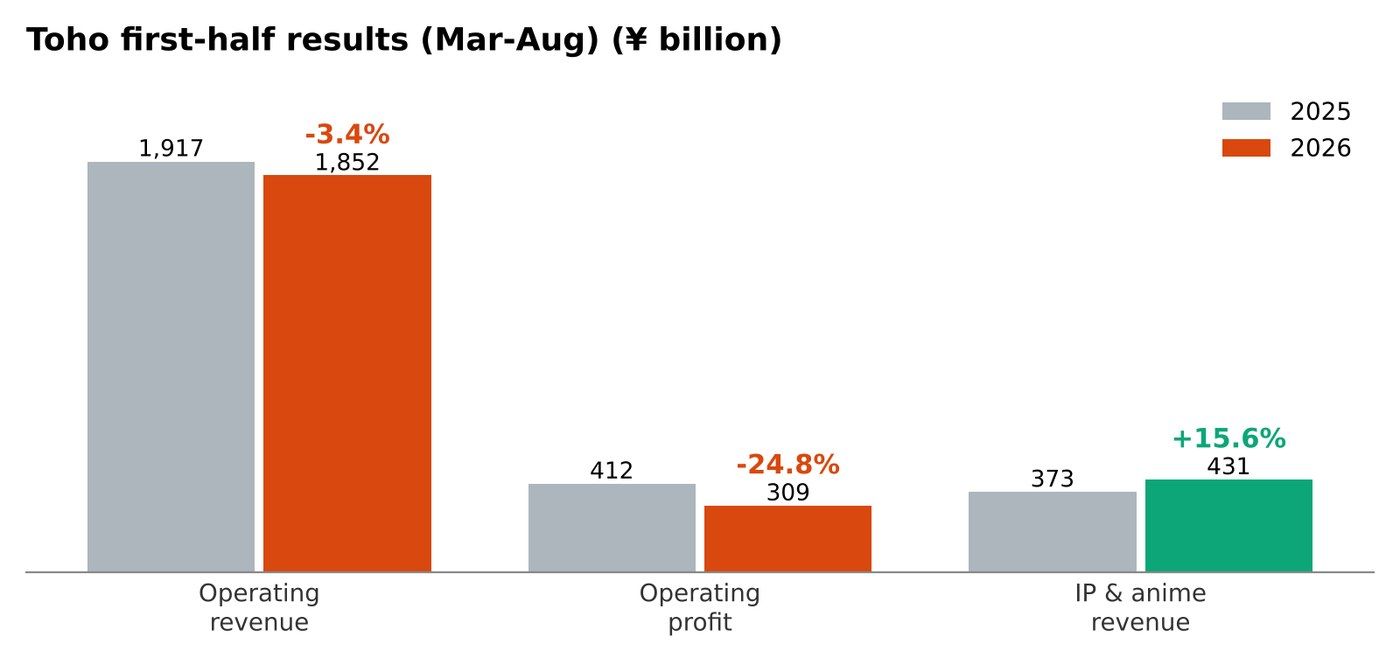
Earnings still swing with domestic hits. On the back of "Kokuho" (国宝) and "Demon Slayer," Toho posted record operating revenue of ¥360.6 billion and operating profit of ¥67.9 billion for the year to February 2026 (Reuters via SBbit). In the six months to August, operating revenue fell 3.4% to ¥185.2 billion and operating profit 24.8% to ¥30.9 billion (gamebiz), while the IP and anime segment grew revenue 15.6% to ¥43.1 billion on titles such as "Jujutsu Kaisen" (GameBusiness).
India's 'Ramayana' on 1,300 screens, Korea's 'Hope' on 1,560: Asian films go wide
Asian films keep gaining ground in North America; since Netflix's rise, North American audiences have grown more open to diverse content.
India's "Ramayana: Rise of a Legend" finished fifth with $8.6 million for the weekend and $12.1 million over four days from 1,300 theaters, the widest North American release for an Indian film. Sony Pictures handled international distribution; the film was shot for IMAX and enlisted Hans Zimmer, Bloomberg said. Its two parts cost a combined $500 million, the most expensive Indian films ever, and it opened to $55.7 million worldwide.
Korea's most recent wide release was "Hope," which NEON — the U.S. distributor of "Parasite" — opened on Sept. 9 across 1,560 screens. It made $1.1 million on day one, $3.3 million over the weekend and $4.92 million in its first week (The Korea Herald). At home it drew 4.54 million admissions after opening July 15 (Sports Kyunghyang).
$114 million weekend, $8.6 billion year to date
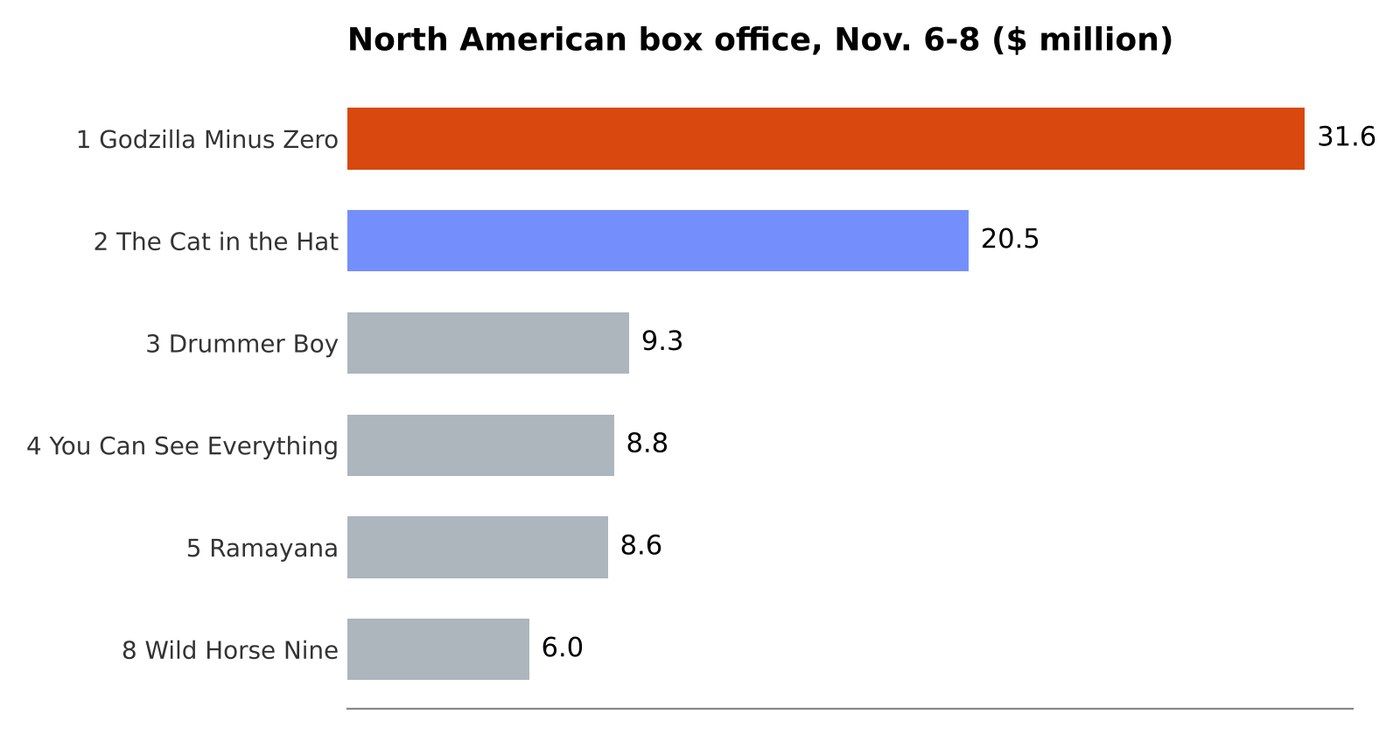
The overall weekend reached $114 million, and year-to-date revenue hit $8.6 billion, 20% ahead of 2025, according to Rentrak. Its head of marketplace trends, Paul Dergarabedian, called it an encouraging sign heading into the holiday season.
A24's Elizabeth Holmes documentary "You Can See Everything" added $8.8 million in its fourth weekend for $79.8 million domestic on a $7 million budget. Angel Studios' "Drummer Boy" was third with $9.3 million from 2,850 theaters; Searchlight's "Wild Horse Nine," from Martin McDonagh, opened eighth with $6 million from 1,100. In limited release, A24's "Club Kid" averaged $65,097 on six screens and Amazon MGM's "I Play Rocky" $49,200 across seven.
Own distribution, same-week release, IMAX capture: what it means for Korea
"Minus Zero" and "Hope" are both Asian live-action films that went wide in North America this year. The Japanese film had 2.1 times the screens (3,254 vs. 1,560) and 9.6 times the opening weekend ($31.6 million vs. $3.3 million). Distribution and timing differed: Toho's own subsidiary released "Minus Zero" three days after Japan, while "Hope" reached North America through a third-party distributor eight weeks after its Korean opening. A short gap lets home-market buzz and reviews feed directly into U.S. marketing.
The IMAX booking was settled at the production stage, when Toho chose IMAX-certified cameras. It arrives as IMAX's local-language share fell to 5% in the third quarter, and two non-English films shot for IMAX — one Japanese, one Indian — opened in North America on the same weekend. IMAX calls local-language titles a higher-margin product, which leaves room for Korean films in that supply.

Korea already has a premium-format supplier. CJ 4DPLEX, a CJ CGV subsidiary, generated $70 million in North America from ScreenX and 4DX in the first half of 2026, up 26%, with ScreenX up 55% (Boxoffice Pro). It runs about 1,270 premium screens in 75 countries, including roughly 490 ScreenX auditoriums (CJ Newsroom). Korean films planning a North American release could use that network if capture format, premium-screen booking and local release dates are set together.
The same sequence applies to Korean broadcasters and streaming services. "Minus One" reached Netflix in June 2024 after its theatrical run; theatrical performance sets the price for later digital, streaming and TV rights — the recoupment path Gross described for "The Cat in the Hat." Ratings matter too: a film rated for all ages at home can land as an R in the U.S. and meet a different audience.
The core of Toho's model is owning distribution: the producer sets dates, screens and marketing, and theatrical results flow into licensing, merchandise and games.
IMAX screens shift to 'Hunger Games' on Nov. 20; holding audiences from week three is next
"Minus Zero" has about two weeks in IMAX before Lionsgate's "The Hunger Games: Sunrise on the Reaping" opens on Nov. 20 (JoBlo). With 74% of the opening from IMAX and other premium large formats, how well it holds audiences in standard auditoriums from its third week will decide the final tally. Box Office Watch projected a domestic total of $70 million to $110 million before release; even the low end would top the predecessor's $57 million.
Competition keeps coming. Paramount's "Ebenezer" opens on Nov. 13, followed on Nov. 25, over the Thanksgiving holiday, by Universal's "Focker-in-Law" and Disney's animated "Hexed" on the same day. "The Cat in the Hat," which opened alongside Godzilla on Nov. 6, needs to lock in family audiences before "Hexed" arrives. November in North American cinemas is a week-by-week fight over screens and audiences.
For Toho, the result means more than box office. Released through its own North American distributor, this run is the first test of whether the 30% overseas target is realistic.
What Korean content companies should take from Godzilla is the structure, not the numbers. The film moved premium-screen demand and a long-built fandom at the same time, and broke through the ceiling on non-English films. That was possible because release timing, the premium-screen window and the local ratings response were lined up in advance.
If Korean films and IP are to become a steady revenue source in North America rather than one-off hits, release scheduling, premium-screen booking and ratings strategy have to be designed together from the planning and production stage. Securing the local distribution capability to execute that plan needs to be weighed alongside it.
Video | 'Godzilla Minus Zero' Official Trailer 2
'The Cat in the Hat' at $20.5 million, down from a $40-50 million forecast
Meanwhile, the much-anticipated "The Cat in the Hat" fell short. Boxoffice Pro's long-range forecast had it at $40 million to $50 million; its week-of forecast cut that to $15 million to $20 million. Audiences gave it an "A" CinemaScore, critics 45% on Rotten Tomatoes. Bill Hader voices the Cat. Overseas it took $10 million from 60 markets for a $30.5 million global start, per Variety.
With theaters keeping roughly half of ticket sales, a $92 million budget is hard to recoup at the box office. Warner Bros., which has merged with Paramount Skydance, has absorbed hundreds of millions in theatrical losses this year on "Digger," "The Bride!" and "Supergirl." The 2003 live-action version opened to $38 million; Universal and Illumination's "The Grinch" (2018) and "The Lorax" (2012) opened to $67 million and $70 million. Pixar's original "Hoppers" debuted to $45 million this spring.
"This is a soft opening," Gross said, adding that family animation earns more from digital sales and rental, streaming and TV licensing than from theaters, which is where the film should recover its costs.