
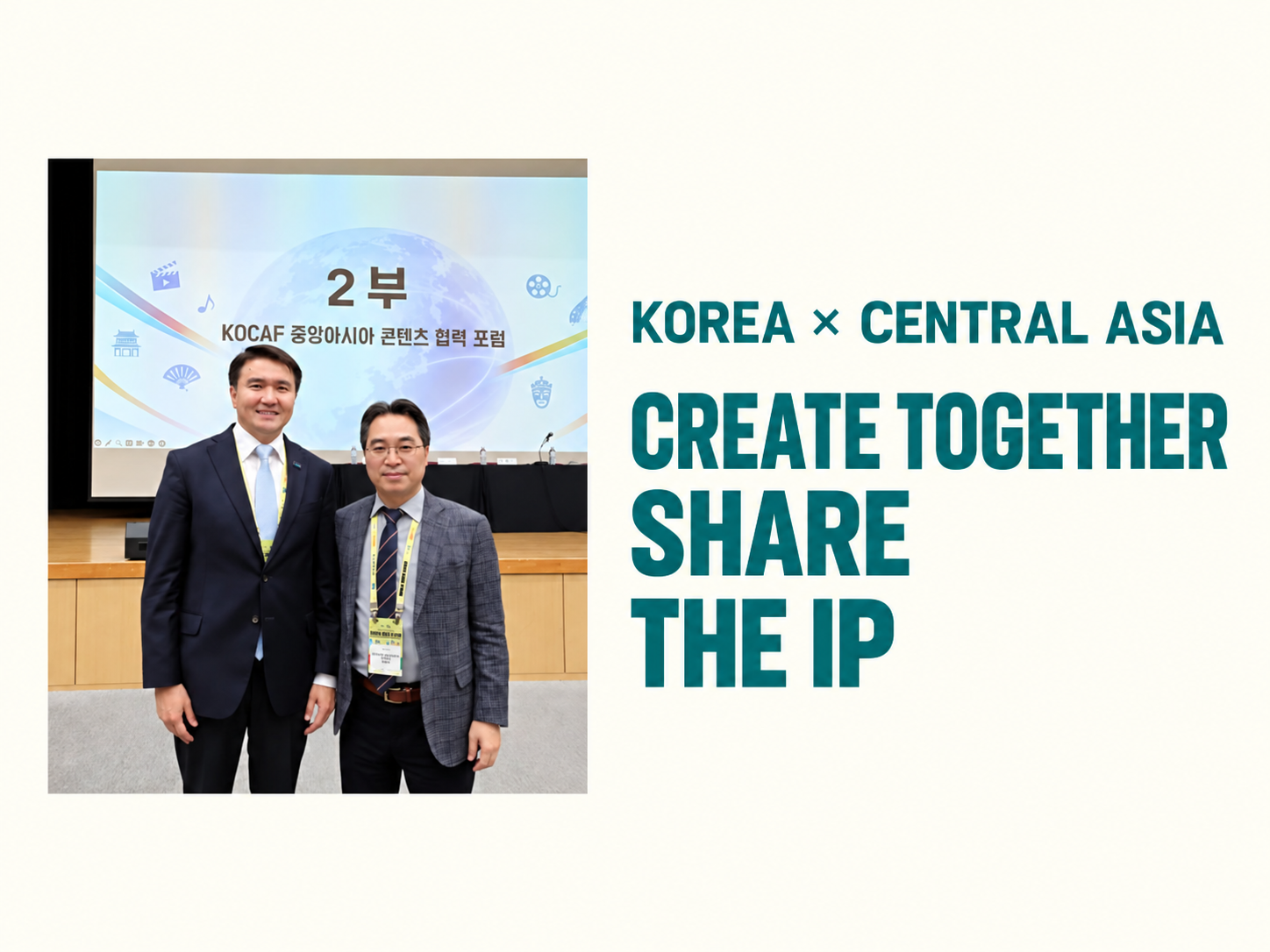
By Samseog Ko (고삼석) — Distinguished Chair Professor, College of Advanced Convergence, Dongguk University; Member, committee, Presidential National AI Strategy Committee; Advisor to the Speaker of the National Assembly (Culture, Broadcasting & ICT); Former Commissioner, Korea Communications Commission
Translated by K-EnterTech Hub(케이엔터테크허브) from the Korean original published in ZDNet Korea(지디넷코리아) on Sept. 14, 2026
SOURCE
A translation of the full column. Its text, order and section headings follow the Korean original; nothing has been added to the author’s writing. The two photo captions carried by the original are reproduced in place.
▶ Korean original — “[고삼석 칼럼] K-콘텐츠의 다음 파트너, 중앙아시아와 ‘공진화’해야,” ZDNet Korea, Sept. 14, 2026

It is time for a change in K-content’s global strategy. Until now, the word we have mainly used in talking about the globalization of K-content has been “export” — making good content in Korea and selling it into world markets through overseas platforms and distribution networks. That K-pop, drama, film and webtoons have achieved remarkable results through this model is something everyone knows well.
But for K-content to make one more leap on the global stage, into a sustainable industry, the question now has to change. Rather than “where else can we sell it,” we have to consider “who do we make what with.” From that perspective, the region I am paying attention to is Central Asia.
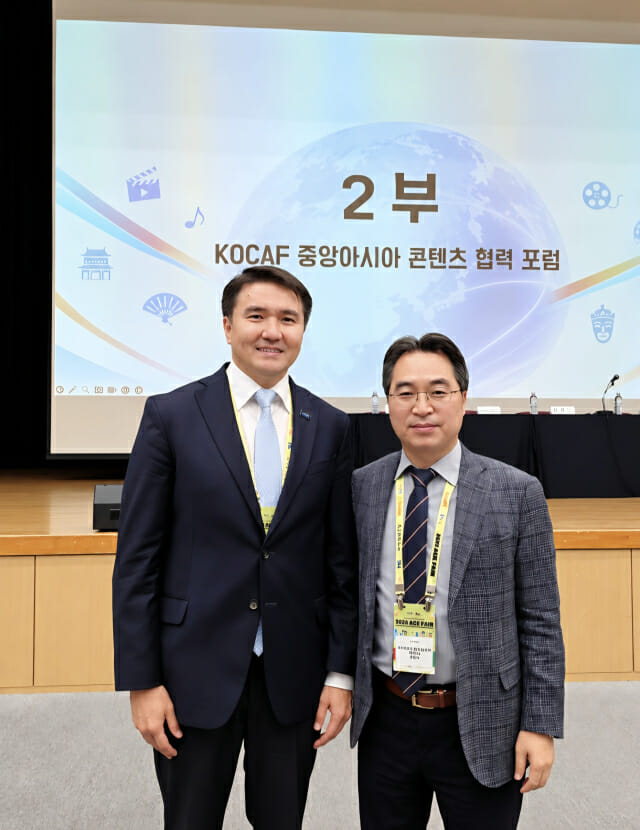
At the “K-Content Academy Forum (KOCAF, K-콘텐츠 아카데미 포럼) Central Asia Content Cooperation Forum,” held as an official event of the Gwangju ACE Fair(광주에이스페어), media and content specialists from Korea, Kazakhstan and Kyrgyzstan gathered to discuss ways of working together. What I confirmed while moderating the forum is that Central Asia is no longer a peripheral market for K-content. It has a young population, digital- and mobile-friendly users, its own history and cultural assets, and a high level of interest in Korean culture. It is a partner with great potential to make content together with Korea and take it back out to world markets.
Central Asia as a “partner,” not a “market”
Our approach to the Central Asian content market still stops at “how much K-content can we export.” With that view alone, however, it is difficult to build a sustainable ecosystem for cooperation. Unlike other goods, content is heavily affected by culture and sentiment. Localization is therefore not completed simply by doing the translation and the dubbing well. It requires understanding and accepting that society’s history and values, its view of family, its humor and even its generational sensibility.
The Kazakhstan cooperation cases introduced at this forum show this well. The country’s first K-pop concert sold out as soon as ticket sales opened, and cooperation between Korean and Kazakh production companies developed into film and remake co-productions. The lessons obtained in that process are clear. The partner country’s culture has to be understood first; a good local partner makes good content; and a sustainable structure of cooperation matters more than one-off projects. It is precisely here that the concept of “coevolution(공진화, Coevolution)” becomes important.
Coevolution is not a relationship in which one side makes something and sells it to the other. It is actors with different strengths changing and growing together in the process of cooperation, and creating new value out of it. Applied to the content industry, it means combining Korea’s planning and production capability, its technology and its global network with Central Asia’s stories, talent and diverse cultural assets. Expressed in a single sentence, it is the transition from “Made in Korea” to “Made with Central Asia.”
Beyond co-production, we have to move to “co-owned IP”
For Korea and the countries of Central Asia to coevolve in the content field, first, the goal of cooperation should be placed on joint IP development rather than on simple co-production. True co-production goes beyond the level of splitting production costs or sharing a shooting location; it is the substantive division of creative authority and IP. In the era of global streaming services in particular, ownership of IP and the right to exploit it determine long-term industrial competitiveness. At this forum as well, the core of international co-production was emphasized as not only the dispersal of resources and risk but also wider market access, strategic IP allocation and creative leadership.
If, for example, a Korean production company jointly develops drama, entertainment programming or animation with creators in Kazakhstan or Kyrgyzstan from the planning stage and owns the IP together with them, both sides become stakeholders. The work can then be distributed through global streaming services, YouTube and FAST, with the results shared as well.
Food, introduced at this forum, is a particularly interesting starting point. Food holds history and culture, tourism and lifestyle all at once, and its language barrier is relatively low. If a “food factual” format combining the food, people and history of Korea and Central Asia were developed as co-owned IP, it could be fully competitive in global markets beyond Asia.
AI and entertech cooperation is another new axis
Second is entertech cooperation combining AI with content technology. Central Asia must not be seen only as a country of technology demand. Kazakh media companies are already making active use of AI in broadcast production processes such as news, voice and design, conducting experiments that shorten the production process and concentrate personnel on more creative work. In Kazakhstan a move is also appearing to newly build an AI ecosystem around the international AI center ALEM.AI. Other Central Asian countries that took part in the forum likewise introduced cases of making active use of AI in content production, including animation.
If the AI, virtual production, XR and immersive content technology Korea possesses is combined with Central Asia’s cultural assets, new forms of cooperation become possible. AI-based multilingual content production and localization, joint virtual production studios, turning cultural heritage into XR content, and AI-based animation co-production are representative fields.
Central Asia’s Silk Road and nomadic culture, its natural environment and its historical narratives are excellent sources for global content. Going beyond a simple division of roles in which Korea provides the technology and Central Asia provides the story, we have to build a co-creation ecosystem in which the technology and the story itself are designed together from the very beginning.
In the end, the core of coevolution is “people”
Third, exchange between creators and talent is as important as cooperation between government and industry. At this forum, while discussing cooperation with Kyrgyzstan, I raised the need for mutual exchange of young content talent — reporters, producers, writers and technical staff. Having people experience each other’s cultures and production sites can be a far more important investment over the long term than buying and selling broadcast programs. The area of human exchange needs to be widened further with Kyrgyzstan and the other Central Asian countries, into new production technologies such as AI, virtual production and XR.
The role of government also has to change. Rather than making content directly or excessively regulating the creativity of the private sector, government should concentrate more on the role of building the institutional foundation on which the private sector can cooperate with confidence — co-production treaties, joint funds, talent exchange, IP protection and settlement systems.
Ultimately, content cooperation between Korea and Central Asia should develop through the stages of content export → localization → co-production → co-owned IP → joint global expansion. Of these, the last stage is especially important. The goal is not to sell more Korean content into Central Asia. It is to take content that Korea and Central Asia have made together into Southeast Asia and the Middle East, Europe, and further into world markets. If the globalization of K-content has until now been “making it in Korea and sending it out to the world,” from now on it has to be “making it with the world and going out into a wider world.”
In Central Asia there are young creators, a distinctive culture, and a great many stories not yet sufficiently uncovered. If Korea’s content planning and production capability, its AI and entertech technology and its global distribution network are combined with these, content and markets that have not existed until now can be created. The next leap for K-content will be possible when we make it together with the overseas countries that love our content, own it together, and go out into the world together. In that respect Central Asia can be an ideal partner with which to pursue a content coevolution strategy together.
Samseog Ko — Distinguished Chair Professor, College of Advanced Convergence, Dongguk University / member, subcommittee of the National AI Strategy Committee (koss21@naver.com)
© ZDNet Korea. All rights reserved. English translation published by K-EnterTech Hub with attribution to the original.
Editor’s note — context added by K-EnterTech Hub, not part of the column
The 2026 Gwangju ACE Fair(Asia Content & Entertainment Fair in Jeonnam-Gwangju) ran Sept. 10–13 at the Kimdaejung Convention Center(김대중컨벤션센터), hosted by the Ministry of Culture, Sports and Tourism(문화체육관광부) and the Gwangju Metropolitan City(광주광역시). The second K-Content Academy Forum was held in Gwangju on Sept. 11. KOCAF was founded in February 2024 as a cooperation platform for Hallyu content specialists.
Two days after this column was published, Seoul hosts the first Korea–Central Asia summit on Sept. 16, lifting to head-of-state level a ministerial cooperation body that began in 2007.
The cooperation areas the presidential office disclosed on Sept. 11 are critical minerals and energy supply chains, future industries, customs, regulation and intellectual property, infrastructure and plants, AI, digital and science and technology, climate and water and disaster response, and counter-terrorism, narcotics and cybercrime; content and culture were not among them (Financial News and Asia Economy, Sept. 11).
References for the editor’s note
1. “제2회 K-콘텐츠 아카데미 포럼, 11일 광주서 개최,” K-Heritage News. https://khf.news/View.aspx?No=4220704
2. 2026 Gwangju ACE Fair, exhibition overview. https://www.acefair.or.kr/fairContents.do?FAIRMENU_IDX=119&hl=KOR
3. “K콘텐츠아카데미포럼 제2대 집행부 출범…,” Eroun. https://www.eroun.net/news/articleView.html?idxno=53153
4. “李대통령, 16일 서울서 ‘한-중앙아 정상회의’ 주재…‘서울선언’ 발표,” Financial News, Sept. 11, 2026. https://www.fnnews.com/news/202609111405242654
5. “李대통령, 14~16일 첫 한-중앙아 정상회의…핵심광물 공급망 넓힌다,” Asia Economy, Sept. 11, 2026. https://view.asiae.co.kr/article/2026091113482567457