
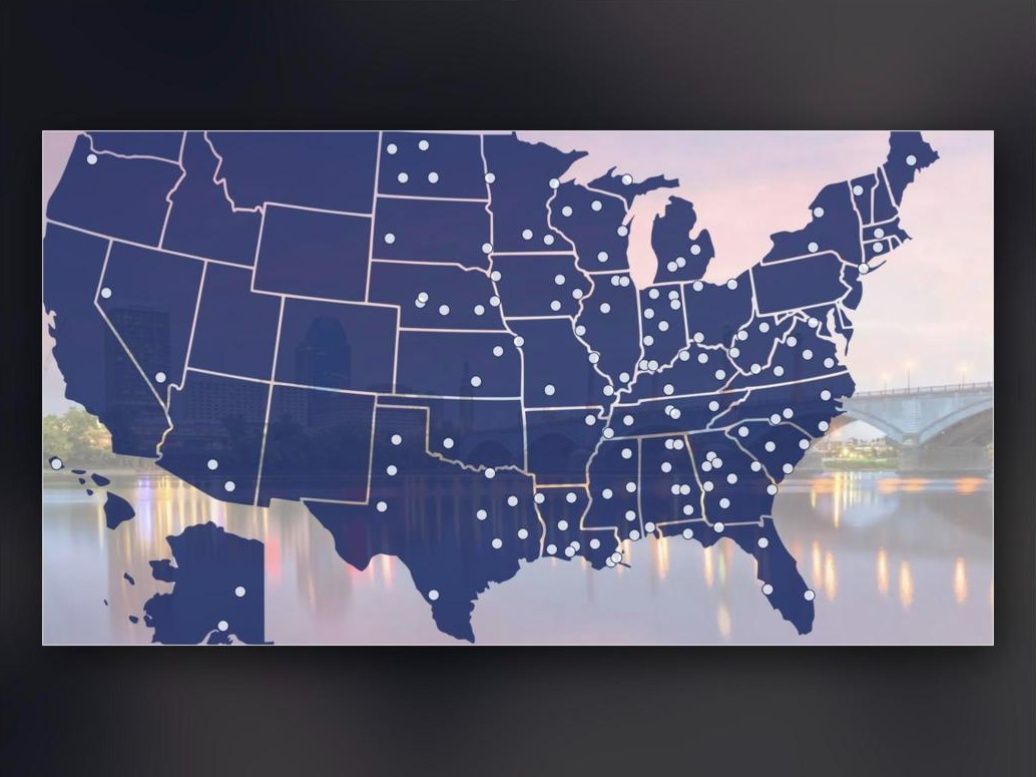
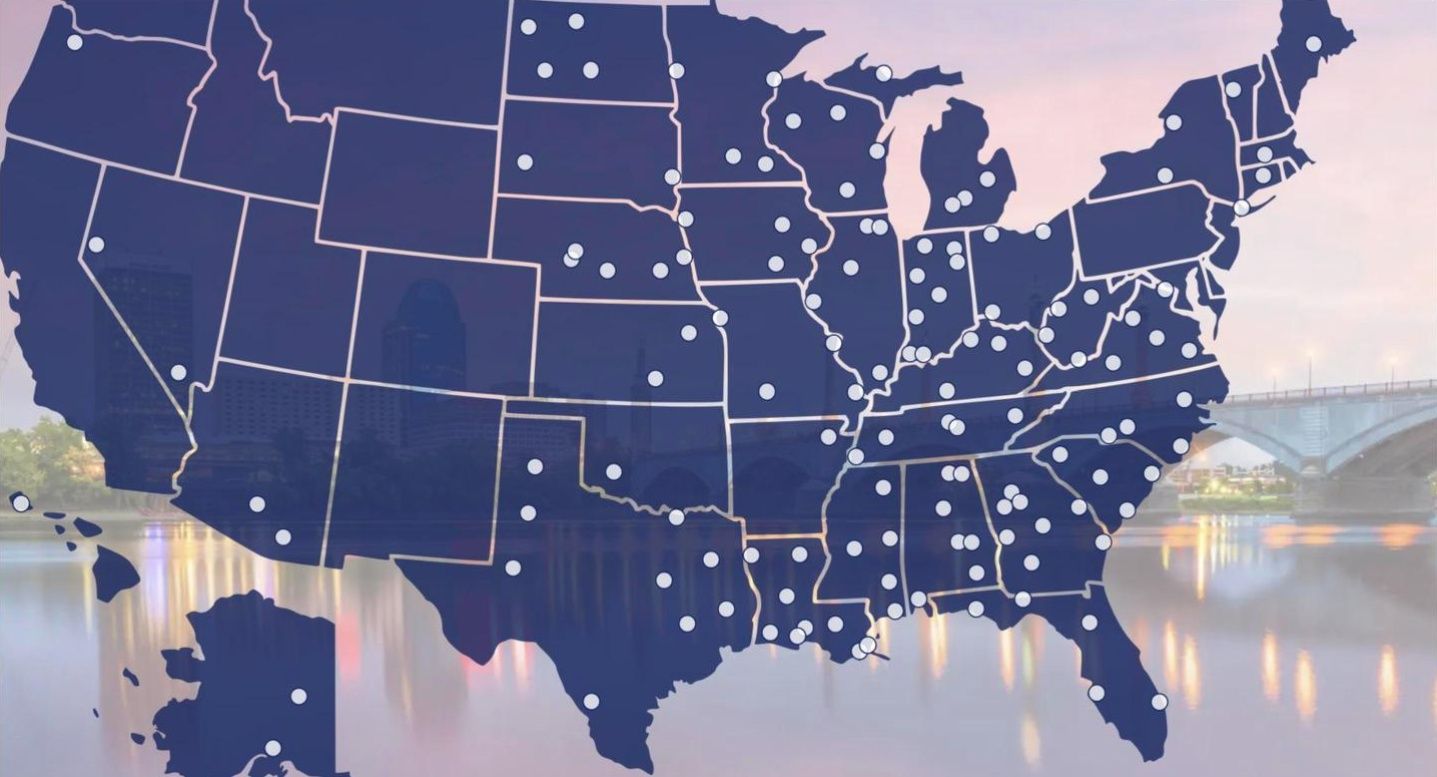
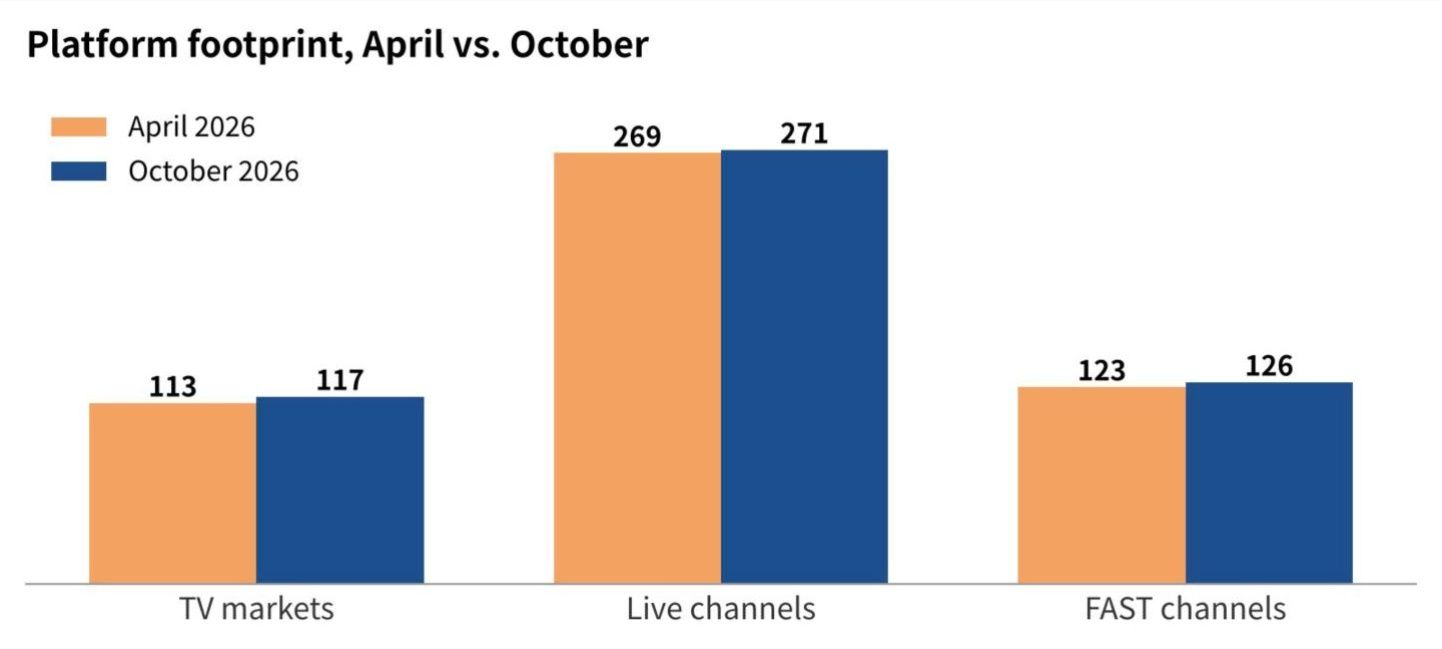
Gray Media runs 1,300 digital touchpoints across 117 markets on one Quickplay platform, with 271 live and 126 FAST channels under a single management layer
“Two years from now, it's not going to replace the human that's out in the local marketplace … giving you play-by-play of what's happening on the streets in that community.”
“Utilize all the tools and resources that are in front of us. Don't run from that, but don't utilize it in ways to sacrifice our audience. The communities count on us.”
— Mike Braun, Senior Operating Officer, Gray Media
Gray Media, the largest owner of top-rated local television stations in the U.S., has put the digital operations of all 117 of its markets onto a single cloud platform. Some 1,300 websites, mobile apps and connected-TV apps now run on one system, alongside 271 live channels and 126 free ad-supported streaming TV (FAST) channels. Quickplay designed the platform; Google Cloud built it.
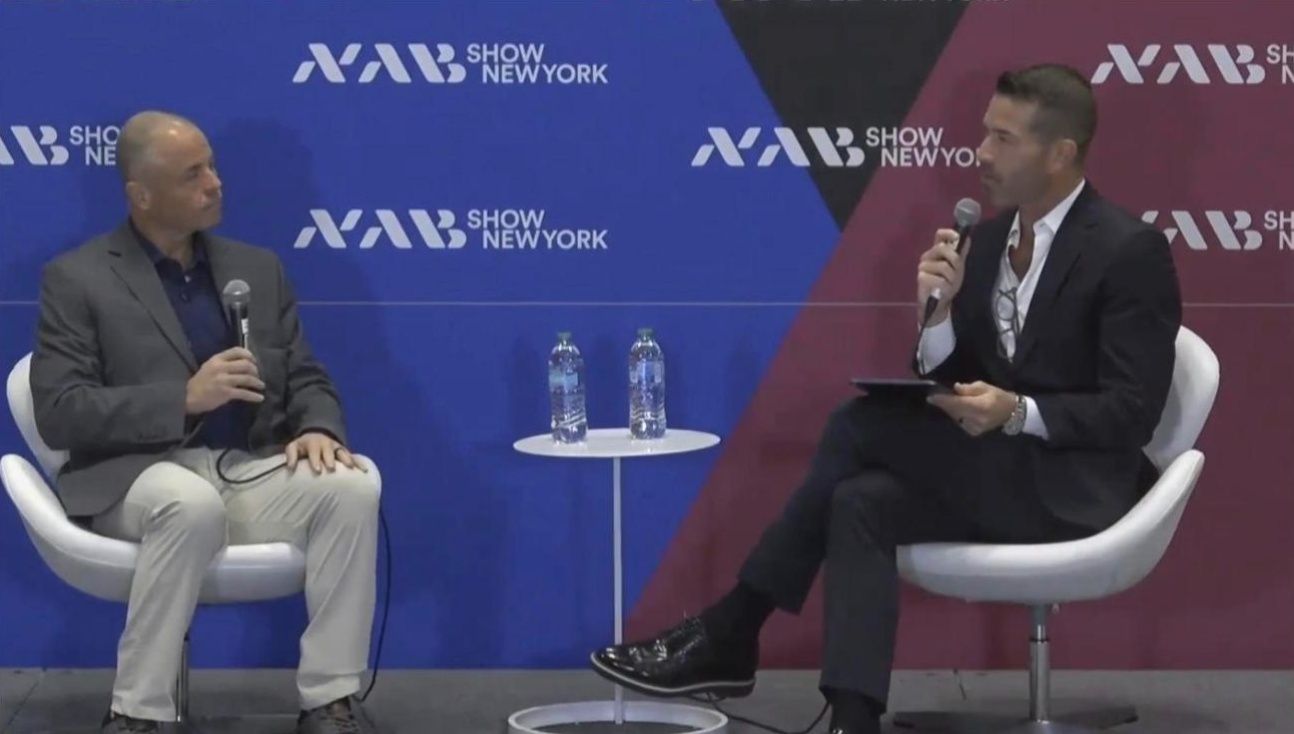
"We were able to pull it off in one year," Mike Braun, Gray's senior operating officer and chief digital officer, said on stage at NAB Show New York 2026, held Oct. 21-22 at the Javits Center. The reason was the spread of Gray's footprint, from Atlanta, a top-10 market, to North Platte, Nebraska. "The staff sizing is different, but something that's similar regardless of market size is content," Braun said. More local journalism, he added, "couldn't happen if we had different technologies in all these different places."
The workload problem has a number attached. In a report released with Caretta Research around NAB Show Las Vegas in April, "The Broadcaster Revolution Will Not Be Televised," Quickplay found that North American broadcasters spend about 75% of their time on technical workflows and about 25% creating content. Parks Associates, wrapping up the April show, noted that vertical video and social-first distribution have moved to the center of mainstream media planning.
Gray's position is that the product has not changed. "There's this misbelief that by having new technology and modern technology, it's going to eliminate people," Braun said in the conversation, moderated by Quickplay co-founder and chief business officer Paul Pastor. "At Gray, we look at it completely the other way."
163 websites, 1,141 apps, one stack in eight months
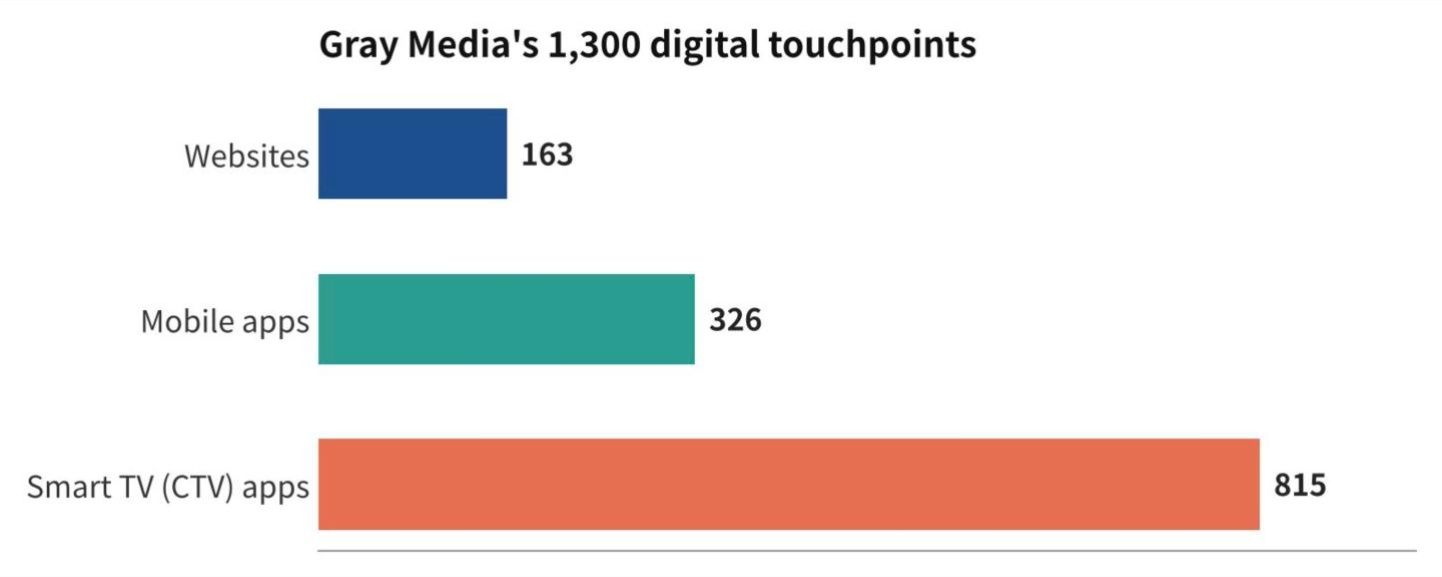
Gray announced the Google Cloud and Quickplay deal on Aug. 21, 2025 and planned to start rolling it out market by market in January. On April 16, Quickplay said the platform was live across 113 markets, consolidating 163 websites, 326 mobile apps and 815 smart-TV apps. It managed 269 live channels and 123 FAST channels on Amazon Prime Video, Roku, Samsung TV Plus, Vizio and Fire TV, with Google's Vertex AI and Gemini models handling personalization.
By the New York session, the footprint had grown to 117 markets, 271 live channels and 126 FAST channels. Gray closed its $171 million purchase of Allen Media Group stations in ten markets in two steps on March 27 and May 1, and Quickplay said in April that four newly acquired markets would be added soon. On July 1, Gray agreed to buy American Spirit Media's six stations for $50 million, with the second closing expected in the fourth quarter.
Gray's own market list shows how wide that footprint is: nine markets in Texas, six in Georgia and five in Mississippi, stretching to KHNL/KGMB in Honolulu, Arizona's Family in Phoenix and Western Mass News in Springfield, Mass. In its hometown Gray runs Atlanta News First, and in Washington it keeps the Gray Washington News Bureau and its streaming news channel, Local News Live. The websites and apps for all of those markets are now managed on one platform.
Gray has cited early results in direction rather than dollars: lower infrastructure spending from retiring overlapping systems, longer viewing driven by personalized recommendations, faster breaking-news delivery and better ad targeting. Frame-accurate switching between programs and commercials keeps the streams paced like broadcast. As of May 15, Gray said its stations reach about 37% of U.S. TV households.
25% reporting, 75% plumbing: 'the same story 10 times'
Braun framed the problem as the number of screens. "We see everything: streaming, streaming, streaming. But what is streaming? What platform is streaming?" he said. Gray needed technology that can "take the same piece of content, repurpose it, redistribute it the way it's needed on that platform," because audiences consume it differently on each. "We don't have the newsrooms to support the same person doing the same story 10 times."
Severe weather is where the model matters most. "Local broadcasters save lives," Braun said, pointing to hurricanes, tornadoes and everyday weather-alert days. The same forecast reaches families on the living-room TV at breakfast, on a phone app, or as a push alert for those without the app. On vertical video, he said viewers "just expect it to work in the environment that they're in at that moment."
Investigations travel across markets; stations pick by drag and drop
One system across 117 markets lets content move between them. "A good investigative piece can be redistributed across multiple markets," Braun said, while the most local stories may stay home. The platform offers an automatic feed to each property and lets local newsrooms choose stories themselves, "as simple as a drag and drop, because we don't have a lot of time in our newsrooms. We need to be producing content, not just reshuffling content."
A 50-year-old logo doesn't buy trust in a feed full of AI slop
Asked by Pastor about AI slop and fake news, Braun turned to trust. "Just because we have a logo and a brand and we've been around in a market for 50 years doesn't just automatically mean we should be trusted," he said. AI-produced content is "easy to debunk," but audiences also have many trusted choices, including independent local journalists on their own YouTube channels. "We can produce as much content as we want, but if the content isn't believed or trusted, it's probably irrelevant."
Next: mobile verticals and AI shorts. 'Not a replacement, not our savior'
Quickplay said in April that the next phase for Gray would include a redesigned app interface, native mobile verticalization, AI-embedded shorts creation, live clipping that preserves ad markers, and cross-platform search. At the same show it introduced Social Signals and Smart Verticalizer in its AI Studio: the first matches trending cultural moments with archive assets to generate social-ready clips; the second reframes horizontal video for vertical formats while keeping faces and on-screen graphics in frame. The session description says Gray can now spot high-value moments, create vertical content at scale and reach viewers beyond its broadcast footprint.
Braun called AI "a tool in our toolbox." "We can't allow AI to dictate or change the way we produce content," he said. "We can't look at it as a replacement. We also can't look at it to be our savior." Two years from now, he said, AI will not replace "the human that's out in the local marketplace" following a tornado street by street. His advice to other broadcasters: "Utilize all the tools and resources that are in front of us. Don't run from that, but don't utilize it in ways to sacrifice our audience."
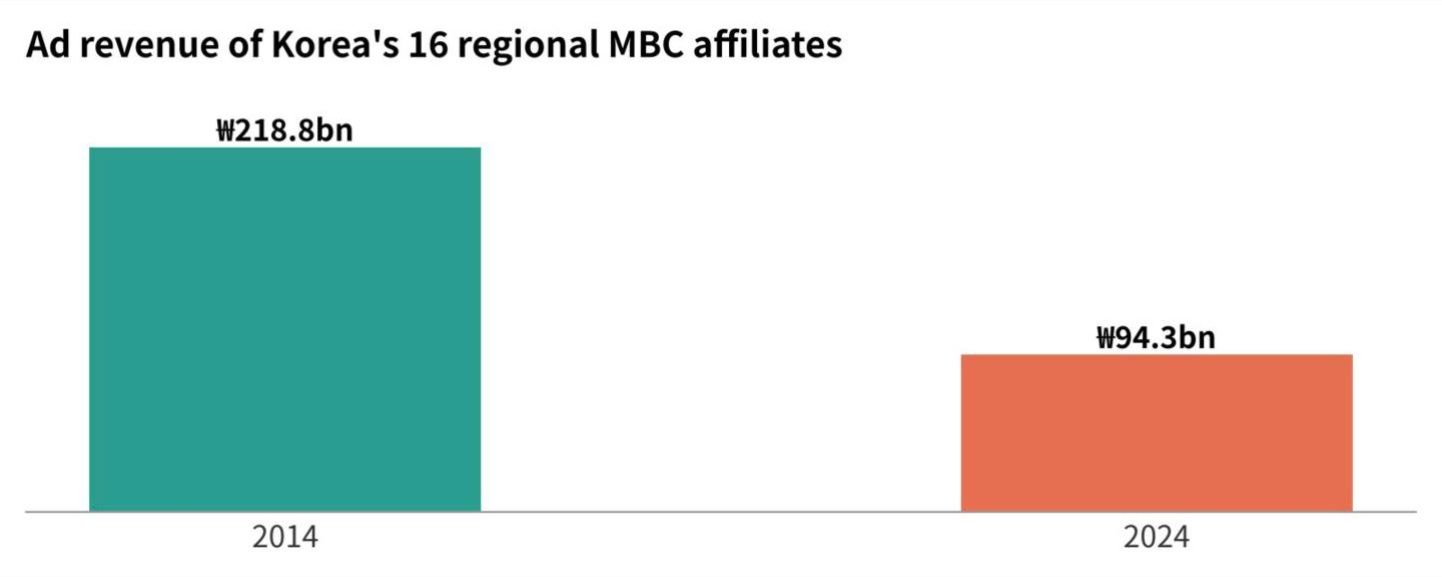
Korea's regional MBC ad revenue halved in a decade, 16 affiliates on separate books
Gray works on two levers: buying stations to consolidate ownership, then running their digital distribution on one system. Korean regional broadcasters face the opposite on both. Citing the broadcasting industry survey of the Korea Communications and Media Commission (방송미디어통신위원회), the Journalists Association of Korea (한국기자협회) reported on April 23 that ad revenue at regional MBC (지역MBC) affiliates fell from ₩218.8 billion ($164 million) in 2014 to ₩94.3 billion ($70.7 million) in 2024. All 16 posted average operating losses over 2023-2025; Jeju MBC (제주MBC) and Pohang MBC (포항MBC) have taken bank loans.
Operations are fragmented as well. In a column for the association's weekly, Han Sun (한선), a media professor at Honam University (호남대), noted that MBC runs 16 regional affiliates as independently accounted companies of equal standing, while KBS directly operates nine regional headquarters and nine local stations, and called for talks on consolidation. Pohang MBC president Lee Seung-yong (이승용) told the association's weekly in April that headquarters leadership has been absent since the "ONE MBC" project was halted. In 2020, MBC proposed merging its 16 affiliates into 10 but said it would proceed only with full consent of local staff.
Government support goes to production. A regional and small-broadcaster content program, planned by the commission and run by the Korea Radio Promotion Association (한국전파진흥협회, RAPA), has distributed about ₩50 billion ($37.5 million) among 39 broadcasters over 12 years, Kim Woo-rim (김우림) of the MBC union's North Chungcheong chapter said in an association report on March 5, a little over ₩100 million per broadcaster a year. The 2026 budget is ₩5.5 billion ($4.1 million), up ₩1 billion.
Korea's next regional broadcasting plan: shared distribution, cross-market sharing, disaster alerts
In Gray's case, the savings came from distribution infrastructure, not production: it retired the separate upkeep of 163 websites and 1,141 apps. Korean regional affiliates and local stations each run their own websites, apps and YouTube channels, so the cost of pushing a local story to multiple screens is repeated once per broadcaster. Merging companies requires staff consent; sharing a digital distribution layer, from content management and apps to FAST playout and ad insertion, could be discussed without changing ownership.
The same layer would allow content to move between markets. Gray feeds investigations to several markets automatically and lets each station choose what fits its audience. On a shared platform, an investigation by one regional MBC could appear on other affiliates' sites and apps the same day, while each affiliate keeps its own editorial calls. With the "ONE MBC" project halted, a shared distribution layer is something affiliates could pursue while keeping their separate books.
Disaster coverage ties directly to regional broadcasters' public duties. Korean law requires broadcasters to deliver prompt and accurate disaster broadcasts. This summer, floods led the government to declare parts of Andong (안동), Uiseong (의성), Geoje (거제) and Tongyeong (통영) special disaster zones. A system that pushes the same alert to TV, apps, push notifications and vertical video would carry that role onto mobile.
FAST is another outlet. Gray runs 126 FAST channels, and Gracenote counts a 40.6% rise in news programming on U.S. FAST since January 2025. Regional news and programs in Korea could be bundled into region-level FAST channels for services such as Samsung TV Plus and LG Channels on top of a shared layer. Gray also says time saved by automation goes back into reporting; Braun argued that even long-established local brands keep trust only through reliable reporting every day.
The policy calendar lines up. Under a 2014 special act, the commission sets a regional broadcasting support plan every three years, and the fourth plan (2024-2026) ends this year. With support so far centered on production budgets, whether shared digital distribution infrastructure becomes eligible in the next plan is likely to be a policy question.
Gray reports Q3 on Nov. 6; the open question is dollars
Gray reports third-quarter results on Nov. 6. Its Sept. 28 guidance update calls for total revenue of $950 million to $965 million and political advertising of $188 million to $195 million. Gray and Quickplay have so far described the platform's benefits in direction only. Whether the earnings release breaks out digital revenue or infrastructure savings is the next data point to watch.
The footprint will keep growing as the American Spirit deal closes and Quickplay's vertical and shorts tools roll out. Asked what he will be proudest of in two years, Braun said it would be using the technology "to empower our people to do more." "It's very easy to step back and say this is a good way to cut costs," he said. "That's just not the way we're looking at it."
Korean regional broadcasters are dealing with shrinking ad sales, tightening liquidity, consolidation talks and calls to redesign state support at the same time. The question Gray's case raises for them is who should run the layer that carries local content to every screen, and at what scale. Whether that becomes a joint project among broadcasters or part of the fifth support plan has not been decided.