

K-EnterTech Hub | AI SEARCH & CONTENT ECONOMICS
A pilot involving roughly 100 publishers puts content valuation, disclosure and control at the center of the next media licensing contest.
The search bargain is acquiring a price tag. Google is testing payments to websites whose content improves its AI-generated answers, opening a revenue channel for publishers while retaining the power to decide what their information is worth. For media companies, the emerging negotiation concerns both compensation and control over the valuation process.
In Korea, Naver’s creator fellowship and Daum’s proposed news citation payments are adding different models to that contest.
Roughly 100 digital publishers reportedly participate in a pilot covering AI Overviews, AI Mode and the Gemini app. The Information’s September 29 report, followed by Search Engine Journal, described substantial variation in payments. The participant count and individual returns are reported figures, rather than a complete roster or rate card published by Google.
The shift matters because the value of a source can survive even when the reader never reaches its website. A payment can recognize that value. An unexplained payment cannot tell the publisher whether the exchange is commercially sound.
Contribution is different from citation
Google’s model rewards a meaningful contribution to an answer, rather than every instance of retrieval or display. The pilot’s published help text distinguishes material used during generation from material linked or used to check facts after the answer exists. Those later uses do not qualify.
The supplied article uses a hypothetical in which a model consults 100 sites but only five improve its response enough to earn money. That is an illustration, not an observed 5% payout rate or an official rule.
Google’s June policy statement describes partnerships with sites that improve the freshness and factual accuracy of AI responses through grounding. Current web material can fill gaps left by a model’s older training information. The contribution pilot attaches an economic value to that process.
Exposure, citation, qualifying contribution and payment are therefore separate events. Publishers need evidence connecting them, especially when the platform also controls the channel through which users discover the original material.
A million-dollar example is not a market rate
Reported returns include less than $1,000 over several months for some small sites, $50,000–$60,000 accumulated by a newer participant, and more than $1 million annually for an early participant. At the conversion rate used in this article, these are approximately KRW 1.35 million, KRW 67.53 million–81.04 million, and KRW 1.35 billion respectively.
These are different publishers over different periods. They do not establish a typical monthly payment. Several small and midsize sites reportedly received less than 0.1% of advertising revenue, while the million-dollar example represented a more meaningful business contribution.
Participants have also described unexplained monthly changes. Some believe anime and gaming perform well because user demand is strong and information is less widely supplied. That observation is not a disclosed weighting formula, and it cannot support a reliable forecast of returns from commissioning more content in those categories.
For a publisher setting budgets, the missing explanation matters alongside the size of the payment. A revenue stream becomes easier to plan around when the producer can understand the evaluation criteria and the reasons for changes.
Publishers face different participation choices
Some larger publishers have held back in pursuit of stronger terms. Others see participation as a chance to learn how AI values their content. Smaller companies with limited negotiating resources may find a platform program more accessible than an independently negotiated licensing agreement.
Digiday’s initial reporting captured both positions. Spur founder David Buttle emphasized the precedent of recognizing valuable content-use events; Madison and Wall’s Luke Stillman saw incremental revenue alongside a reduction in Google’s legal and reputational exposure.
The commercial question extends to access to usage records, explanations for payment changes, rights after withdrawal and a way to challenge an assessment. These are considerations for publishers evaluating the market, rather than claims that the current pilot publicly guarantees those mechanisms.
Lower clicks explain the stakes, not every publisher’s loss
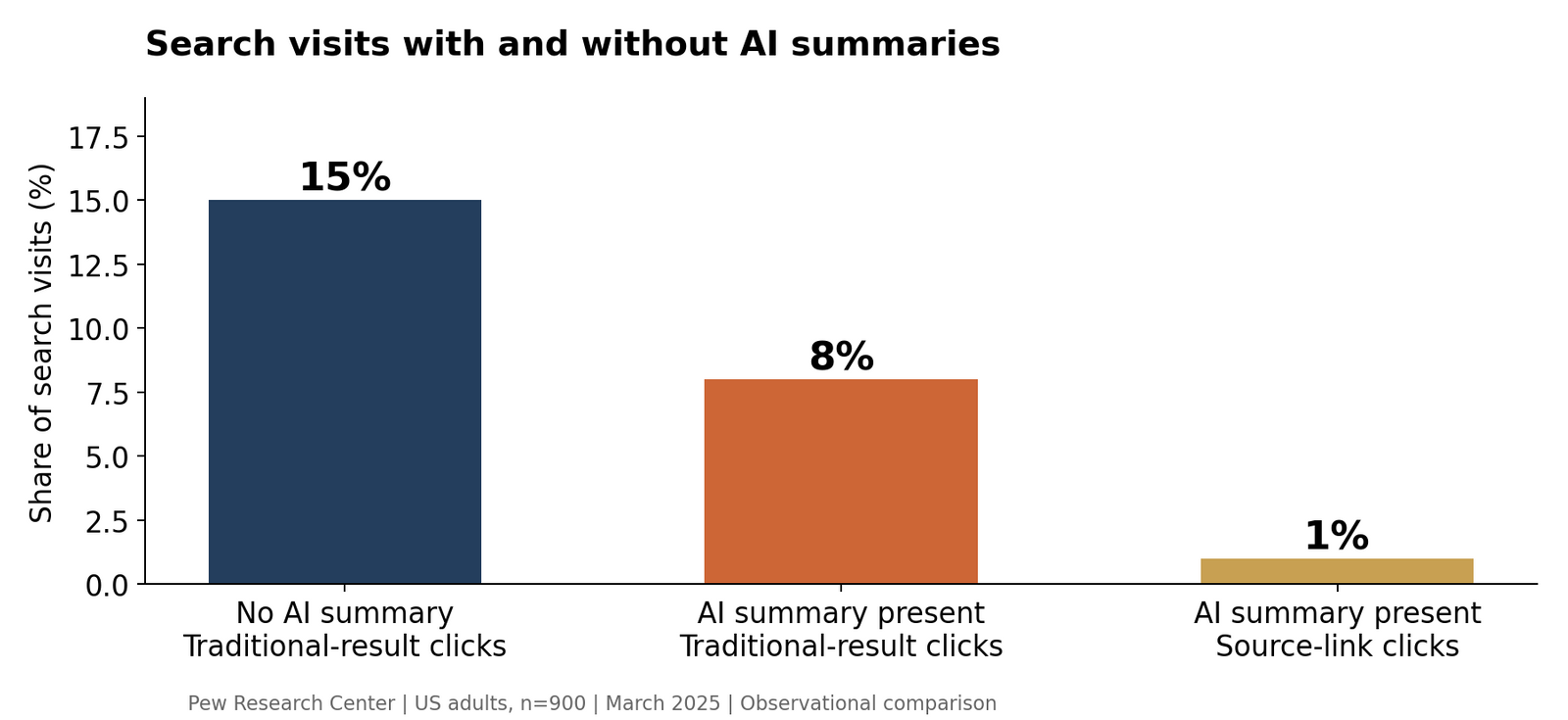
Pew Research Center studied approximately 68,900 Google searches made by 900 US adults in March 2025. Users clicked a traditional result on 15% of visits without an AI summary and 8% with one. Links inside summaries were clicked on 1% of visits. Session endings occurred on 16% and 26% respectively.
The traditional-link gap is seven percentage points, or roughly 46.7% relative to the 15% baseline. It is an observed difference in that sample, not a causal estimate showing that every publisher lost that proportion of traffic.
World History Encyclopedia founder Jan van der Crabben described a 25% monthly traffic decline after AI Overview exposure in a Big Technology interview. The supplied article also cites later reporting of annual declines of 25%–35% and traffic roughly half its 2024 level. These remain site-specific accounts.
In France, APIG cited an Arcom estimate of 33%–38% traffic loss in European markets with AI summaries when bringing its competition complaint, as described by Reuters. That estimate uses a different basis from Pew’s study.
AI can thus retain information value while weakening the visit that generates advertising income. The pilot attempts a new exchange, but the reported payments do not establish that lost referral income has been replaced.
More control, incomplete economics
The UK Competition and Markets Authority imposed publisher protections on June 3, including control over AI search use and fine-tuning, clear attribution and a nine-month implementation period. Compliance reports are required every six months during the first year.
Google says it expanded its controls worldwide on August 31. Exclusion removes a site’s links and content from supported generative AI search features, while leaving other search ranking and inclusion signals unaffected.
The latest official control documentation also describes inheritance and overrides for child properties, including URL-prefix properties. A blanket claim that control is available only for an entire site is therefore outdated. Training is governed separately through Google-Extended; excluding a site does not prevent similar information from being drawn from other sources.
Google’s generative AI performance report provides impression information for AI Overviews and AI Mode, with page, country and device dimensions. It does not list clicks or queries among the provided metrics. It is a visibility report, not an accounting statement explaining each content contribution. Its scope also differs from the payout pilot, which includes the Gemini app.
Publishers still need to connect platform data with their own referrals and subscription conversions to compare the economics of staying in or opting out.
A US legal setback and European scrutiny
Chegg and Penske Media’s AI Overview antitrust cases were dismissed in the US. Reuters’ October 1 report describes Judge Amit Mehta’s distinction between an expectation of traffic and an agreement. The dismissal should not be generalized into a ruling that every AI content use is lawful or that compensation can never be required.
Penske’s separate adtech litigation concerns a different market and should not be presented as a second stage of its AI Overview suit.
The European Commission investigation opened in December 2025 examines AI use of web and YouTube content, including compensation and meaningful refusal options. APIG’s August complaint raises compliance with Google’s earlier negotiation commitments. Neither an investigation nor a complaint establishes a violation.
On October 5, Poland’s UOKiK raised allegations concerning insufficient information and unilateral conditions in press-content payment negotiations. That proceeding is separate from the contribution pilot, but highlights the same practical need to verify a proposed valuation.
Licensing, regulation and litigation timeline
Negotiated contracts coexist with platform assessments
Google’s Reddit data deal dates to 2024. Reuters reported a value of roughly $60 million annually, or approximately KRW 81.04 billion. That figure is a reported contract value, not an official unit price for content.
The AP agreement announced in January 2025 supplies real-time information for Gemini. A separate Google News pilot announced that December includes The Guardian, The Washington Post, Der Spiegel and El País, with experiments in article overviews and audio briefings.
Negotiated licensing and platform-assessed contribution payments now coexist. Size alone does not determine which route a publisher takes. Exclusive material, delivery capabilities, recognized brands and bargaining resources can nevertheless shape access to better terms.
Comparing content payment mechanisms
Naver’s fellowship offers a different Korean comparison
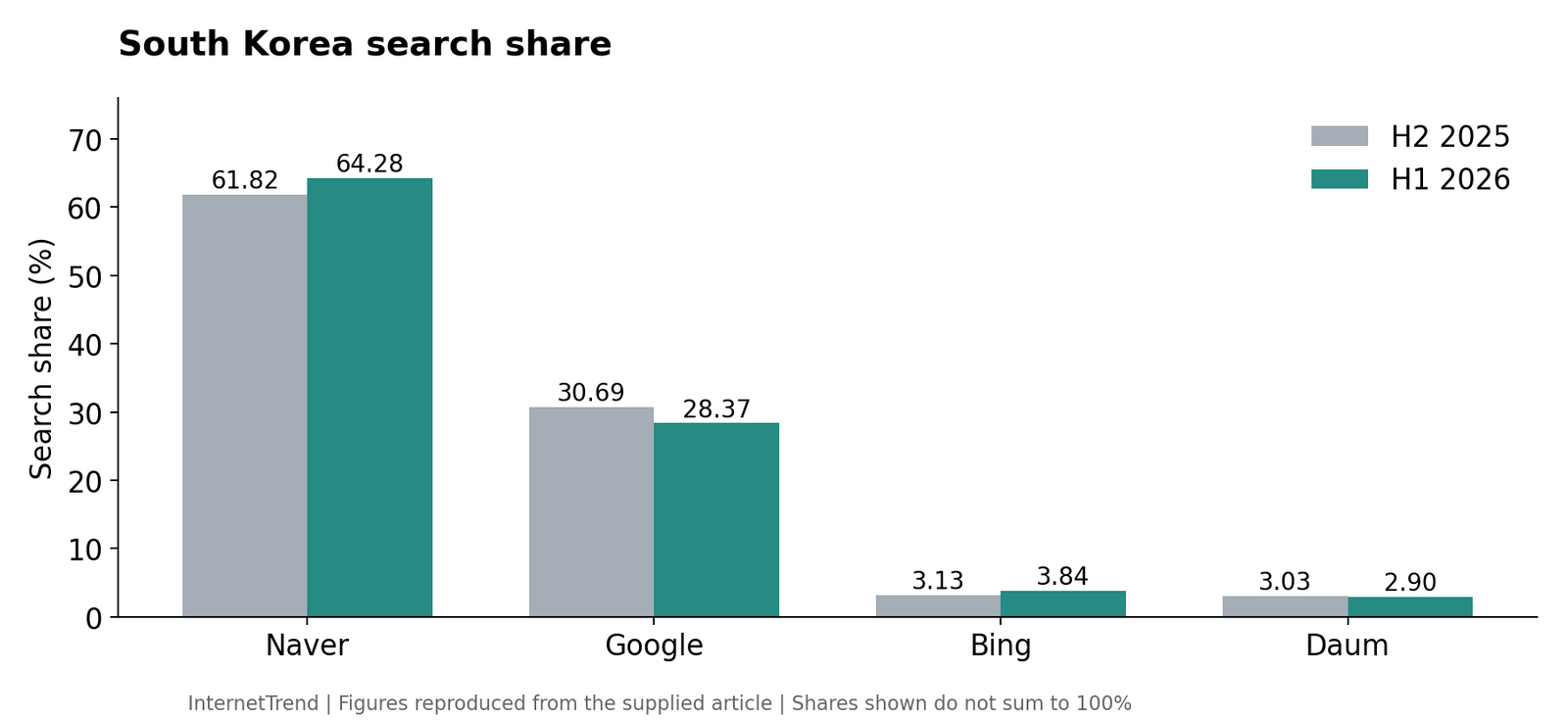
In South Korea, InternetTrend figures reported by Yonhap put Naver’s first-half 2026 search share at 64.28% and Google’s at 28.37%, changes of plus 2.46 and minus 2.32 percentage points from the previous half. These are search-share measurements, not app-user counts. Google launched Korean-language AI Mode in September 2025.
Naver’s May announcement committed KRW 1 trillion, approximately $740.41 million, to its content ecosystem over five years. It also cited 30 million monthly AI Briefing users and a 70% UGC share of content used in search.
The Naver Mate fellowship launched June 4 selects roughly 3,000 creators monthly using AI Briefing citation counts. Annual support is approximately KRW 20 billion, or $14.81 million. Its official release distinguishes a KRW 300,000 monthly base allowance, approximately $222, from additional KRW 3 million and KRW 10 million support for top creators, approximately $2,221 and $7,404.
The distinction matters: citing a total maximum of KRW 10 million can obscure the stated base-plus-additional structure. A creator fellowship based on citation counts is also different from Google’s answer-contribution assessment and from a general news-licensing rate.
The Korea Newspaper Association’s 2025 competition complaint, Korean journalism-sector discussion of use before compensation, and the Korea Press Foundation report coverage show that control, measurement and payment remain distinct issues for news organizations.
Daum adds a consent-based news citation payment proposal
Daum belongs in the Korean comparison. According to the Journalists Association of Korea’s September 22 report, the portal announced at its September 21 media day a separate KRW 2 billion annual budget for news cited in AI summaries. Its proposal would distribute payments quarterly, according to contribution, to publishers consenting to participation and data use.
Daum also proposed moving mixed republication-fee and revenue-sharing arrangements to fixed fees, with contracts extended from one year to two. A separate AI data API business would seek publisher consent to refine and sell news data. Citation payments, republication fees and data products involve distinct uses and rights.
An October 1 follow-up reported that publishers welcomed the direction but wanted to examine the contracts. The announced budget and allocation framework should therefore be treated as a proposal, rather than completed payouts or a settled per-citation rate. Google’s answer-contribution assessment, Naver’s creator fellowship and Daum’s consent-based news proposal differ in eligibility and calculation. The comparison turns on measurable use, contractual scope and verifiable settlement records, alongside headline funding.
K-content companies need information they can negotiate over
Broadcasters’ online reporting, episode guides, cast details, clip descriptions and subtitles can all serve as information inputs for AI search. Accurate English-language information about Korean drama and entertainment connects international discovery with rights management.
When official material is missing, systems may rely on fan sites or wikis. Publishing an official English page does not guarantee a contribution payment, nor does its absence prove a fan site receives one. The defensible opportunity is to maintain accurate, current material with clear ownership and a way to measure its use.
Content inventories, language-specific visibility, referrals and viewing, purchasing or subscription conversions can become negotiating evidence. Joint industry analysis could help smaller companies overcome limited samples and uneven access to platform information.
Google’s pilot opens a route to compensation. A durable market will also require producers to understand the use, assessment and calculation behind the payment. The next contest is over who must explain the price of an AI answer.