
First-anniversary report — 99 action items reviewed, 5.8tn won for the 3 Mega Projects in 2027, culture strategy due from the society subcommittee in the third quarter
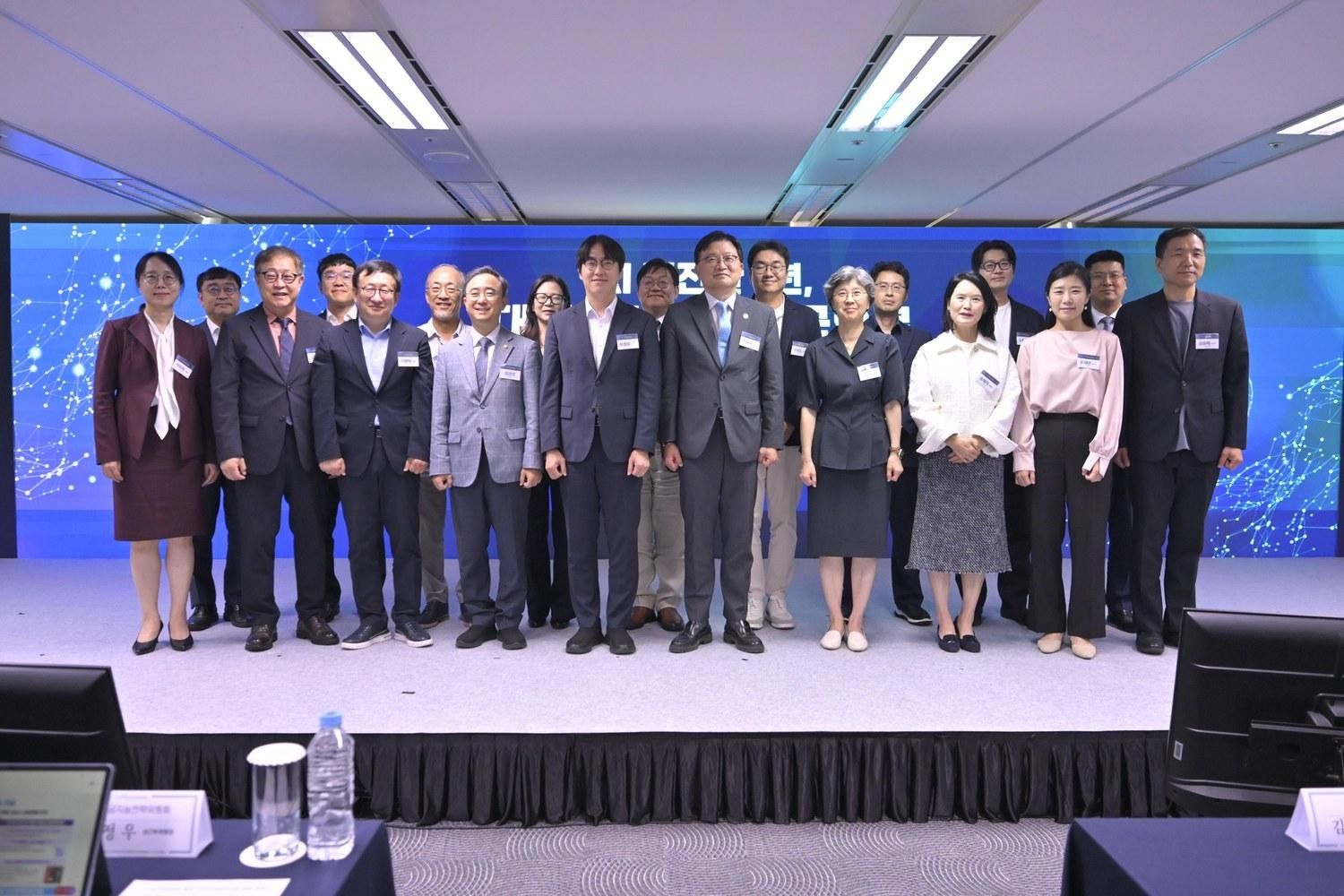
Standing vice chair Ha Jung-woo, lawmaker Lim Moon-young, subcommittee chairs, special committee chairs, task force leaders and members at the National AI Strategy Committee's first-anniversary report meeting. Photo: National AI Strategy Committee
The National AI Strategy Committee (국가인공지능전략위원회), chaired by the president, held its first-anniversary report meeting at Seoul Square on September 8. Ten subcommittees, two special committees and the legislation task force presented a year of results and their forward roadmaps. About 150 people attended, among them standing vice chair Ha Jung-woo (하정우), senior presidential secretary for AI future planning Lee Hae-min (이해민) and lawmaker Lim Moon-young (임문영).
In his keynote Ha said global AI competition "has spread beyond technology development into a whole-of-nation contest that decides industry, security and growth," and assessed that Korea "has the potential to build a full-stack AI ecosystem on the strength of its AI technology and infrastructure and its manufacturing competitiveness" (Yonhap News, September 8). The committee confirmed the Korea AI Action Plan in February — 99 action items and 326 policy recommendations under three policy pillars and twelve strategic fields — and reviewed progress by subcommittee at this week's meeting.
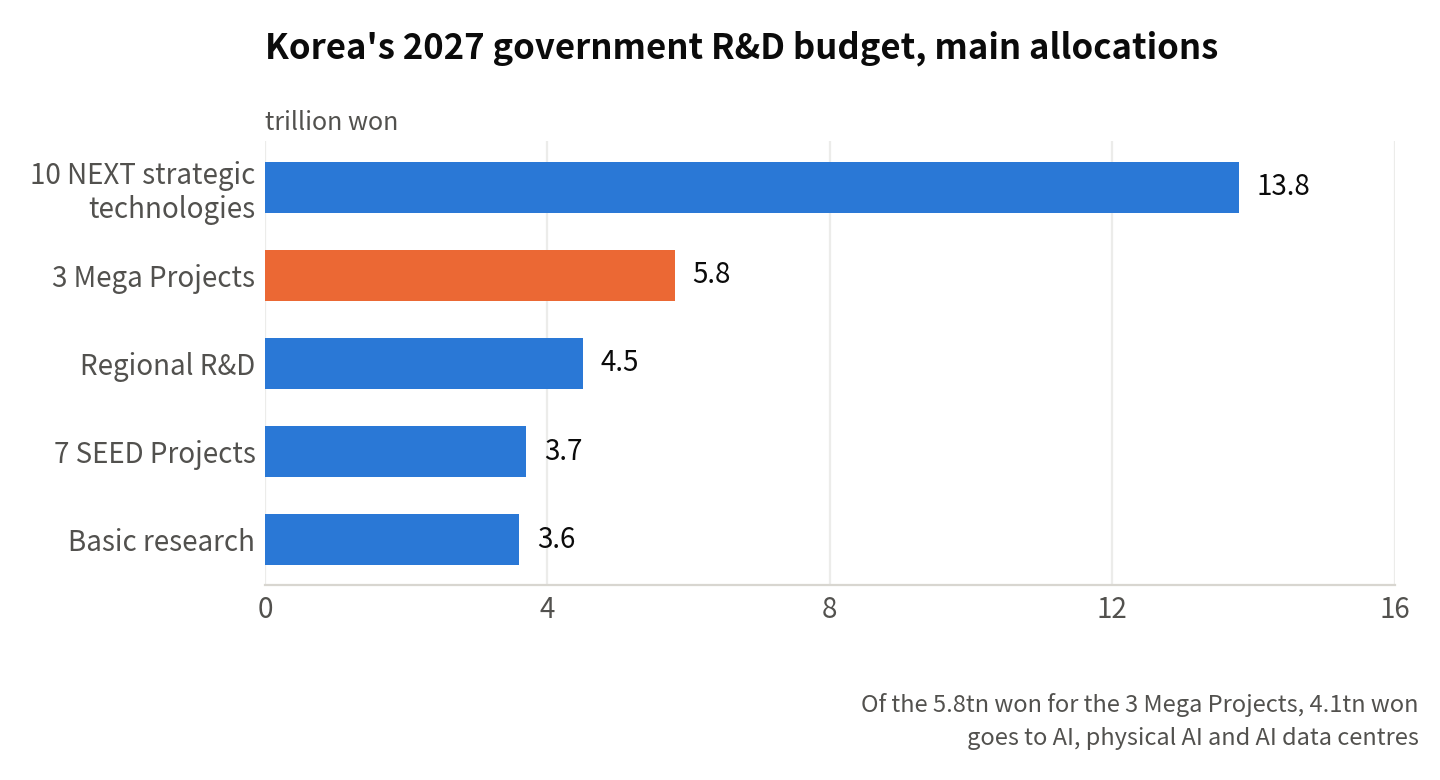
The 2027 national R&D budget confirmed on September 1 comes to 39.5tn won (about $29.4bn), up 11.2% on this year. The 3 Mega Projects take 5.8tn won and the 7 SEED Projects 3.7tn won; within the Mega Project allocation, 4.1tn won goes to AI, physical AI and AI data centres, or AIDC (Money Today, September 1). Ha said the committee will strengthen coordination between policy and programmes so the two do not fragment across ministries, and will run the committee around projects and measurable results.
Content and culture fall to the society subcommittee, led by Yoo Jae-yeon (유재연). The AI-era culture strategy (AI 시대 문화 미래전략) is targeted for the third quarter and the basic-society plan for AI (모두를 위한 AI 기본사회 추진계획) within the year. Over the same period the Ministry of Culture, Sports and Tourism (문화체육관광부) budgeted 240.6bn won (about $178.8m) for culture technology next year and said it will open five sets of AI-ready public cultural data in December. Ha took office on August 31, four months after leaving the presidential office's AI future planning post, a seat vacant since May (ZDNet Korea, August 31).
39.5tn won of 2027 R&D — 5.8tn won to the 3 Mega Projects, 3.7tn won to the 7 SEED Projects
The double-digit rise in 2027 R&D comes from the new large programmes. The 3 Mega Projects — semiconductors, physical AI and AI data centres — take 5.8tn won (about $4.3bn). The 7 SEED Projects, covering small modular reactors, nuclear fusion and perovskite tandem solar cells among others, take 3.7tn won (about $2.7bn). A further 13.8tn won goes to ten NEXT strategic technologies, 4.5tn won to regional R&D and 3.6tn won to basic research (Money Today, September 1).
Ha listed continued refinement of the action plan, wider AI growth opportunities for regions and young people, and stronger global cooperation as the tasks ahead. Among the past year's results he put GPU procurement first, saying startups felt the benefit most directly (Asia Economy, September 8).
Subcommittee roadmaps set out — five defence AX hubs open from this month
The technology innovation and infrastructure subcommittee, led by Shin Jin-woo (신진우), will build the AIDC review and approval machinery and run simulations before the AIDC special act takes effect in March 2027, and will upgrade real-time monitoring of GPUs and other computing resources. The government began purchase orders for 9,704 NVIDIA (엔비디아) GPUs in June (ZDNet Korea, June 8). Incentives for hosting AIDC outside the capital region are written into the same act.
The science subcommittee, led by Seok Chaok (석차옥), will review domain foundation models in bio, materials and healthcare and push a one-stop AI platform for emergency golden-hour care along with a wider public healthcare AI highway. The industry AX and ecosystem subcommittee, led by Cho Jun-hee (조준희), supports a 2030 global AI decacorn plan and an AI transformation plan for transport and logistics in the second half.
The public AX subcommittee, led by Park Tae-woong (박태웅), will produce a rapid-development framework and guidelines for public AX and standardise public APIs, Model Context Protocol (MCP) connections and data. The defence and security subcommittee, led by Sim Seung-bae (심승배), opens five defence AX hubs in sequence from this month to widen data sharing and field pilots, and supports defence-specific AI built on a domestic foundation model along with a defence AI data centre (Yonhap News, September 8).
Results and next steps by subcommittee and special committee. Sources: National AI Strategy Committee press release (September 8) and Yonhap News, September 8
Training rules come first — a workable opt-out and after-the-fact compensation
For a domestic foundation model to train on Korean-language data and on K-content, the legal uncertainty around using copyrighted works has to clear first, and that is what the data subcommittee, led by Paik Eun-ok (백은옥), wrote into the action plan alongside the principles for a special provision on personal data. The direction the government has settled on is to make the opt-out workable — creators mark a work as off-limits for training — and to pair it with after-the-fact compensation for works whose creators have not objected or whose rights holders are unclear. Sectors with an established trading market, such as news, books and music, get separate treatment aimed at supporting reasonable transactions (Money Today, March 11). The culture ministry has already issued fair-use guidance on training generative AI on copyrighted works.
The same subcommittee is running a May-to-October push to limit HWP attachments across the On-nara system, On-mail and the civil service integrated mail service. Unless documents stop arriving in a format machines read poorly, government records cannot be used for training or retrieval. It supported March guidelines on AI-friendly management of public data and has flagged data valuation and its link to accounting as the next step.
Five cultural datasets open in December — MCP applied to public data for the first time
The culture ministry will put five sets of high-value, AI-ready cultural data on the public data portal in December. Digital audio and images of Korean traditional music from the National Gugak Center (국립국악원) carry genre, instrument, rhythmic-cycle and technique metadata; the National Library of Korea, Sejong (국립세종도서관) contributes a policy-information question-and-answer dataset; the Korea Tourism Organization (한국관광공사) multilingual tourism information and regional and thematic video; and the Korea Culture Information Service Agency (한국문화정보원) three-dimensional cultural assets, Korean dress and traditional pattern data. Seven more sets follow in 2027, for twelve in all.
The release is the first to use MCP connections. Rather than downloading and reshaping files, an AI agent queries the data directly, which lowers the cost of tasks such as finding references or generating subtitles and commentary in production workflows (Asia Economy, September 3). It runs in the same direction as the public AX subcommittee's work on public API, MCP and data standardisation.
Culture-technology budget of 240.6bn won — 25bn won of new money for AI immersive performance
Abroad, Cosm (코즘) runs domed venues in Los Angeles and Dallas that show live sport and concerts as shared-viewing events, and Sphere (스피어) operates its large LED sphere in Las Vegas. The 25bn won (about $18.6m) the culture ministry has newly budgeted for AI immersive performance technology is aimed at meeting the same demand with domestic technology: reproducing venue and stadium events inside theatres using generative AI direction and ultra-low-latency transmission, targeted at 2030. The ministry describes it as the first large-scale culture-technology R&D programme in 24 years.
The remaining items are 6.2bn won for digitising museums and galleries, 5bn won for on-site solutions and 3.1bn won for AI copyright verification. The culture-technology fund carries a 60bn won government contribution, to which the ministry plans to add 40bn won of private money for a fund of 100bn won (about $74.3m). Commercialisation support of 3.2bn won is new (Financial News, September 8).
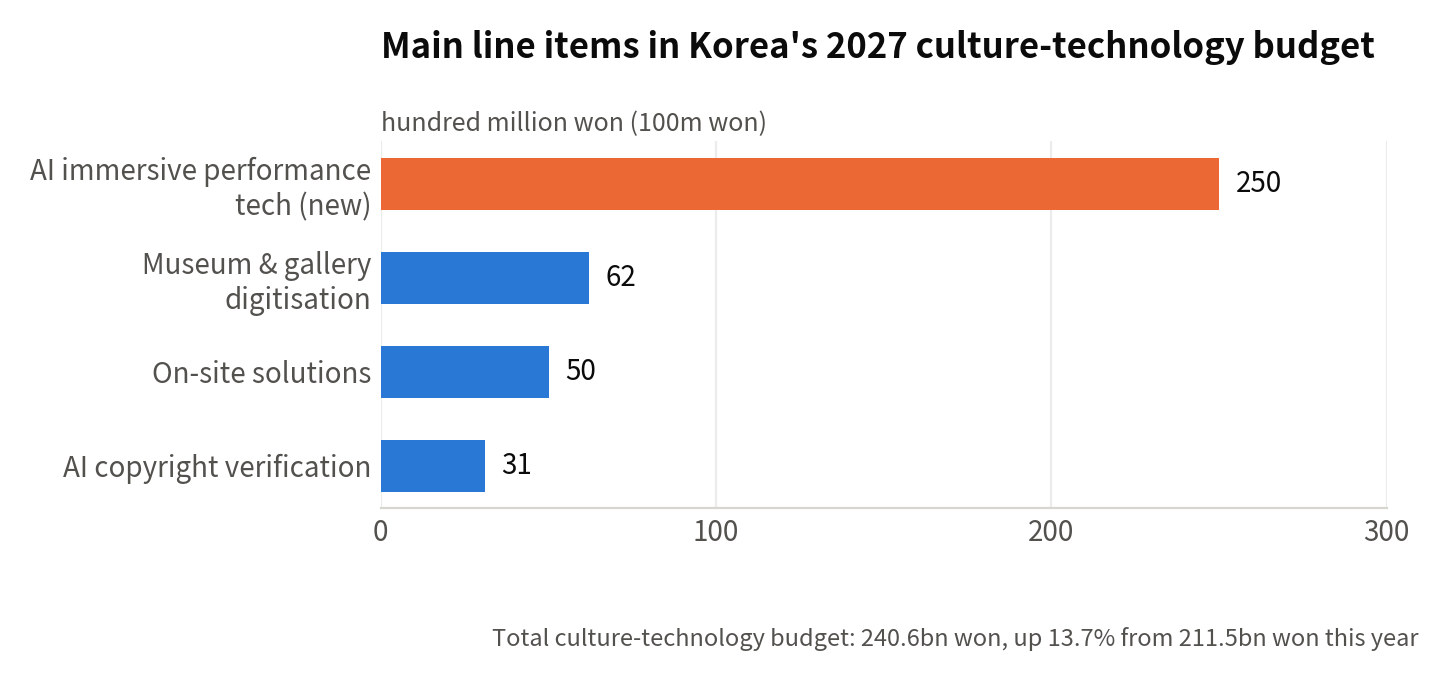
Main line items in Korea's 2027 culture-technology budget. Source: Financial News, September 8
Composition of the 2027 culture-technology budget. Source: Financial News, September 8
All-stage AI security after Mythos — task force comments land in the manufacturing AI bill
The special committee on security, chaired by Lee Won-tae (이원태), drew up a February roadmap for a standing scheme under which white-hat hackers continuously find and report vulnerabilities in live networks for the operating institution to fix. After the release in April of the frontier model Mythos (미토스), it supported sector-by-sector responses across private, public and financial systems. Next come all-stage AI security — security as a default principle from model development through adoption, procurement and operation — and a K-AI cybersecurity framework linking the separate ISMS, N2SF and CSAP regimes.
The legislation task force, led by Noh Han-dong (노한동), built an AI legislative framework around AI development, promotion of AI transformation, AI safety and trust, and prevention of misuse. Working from it, the task force reviewed the defence AI bill (April), a bio-AI bill (May) and a manufacturing AI bill (July); in the manufacturing case its comments on excessive regulation and penalties and on overlap with existing law were reflected in the amendment. After consultation with ministries the framework will be formalised and used to support further sector legislation.
Standardisation governance due in Q3 — APEC and G20 AI agendas handled across government
The global cooperation subcommittee, led by Oh Hye-yeon (오혜연), launched a cross-ministry body on global AI governance in June with the foreign, science and ICT, industry, interior and defence ministries. A national AI standardisation governance structure is targeted for the third quarter, and the government will respond as a whole to the AI agendas of the APEC summit in November and the G20 summit in December. The education and talent subcommittee, led by Lee Min-seok (이민석), is working with the National Education Commission on an AI-native education system and on embedding AI across higher education.
The AI democracy subcommittee, led by Kim Eui-young (김의영), will finalise "K-Democracy in the AI Era: Vision and Action Plan" by March 2027 and pilot AI public forums on five themes including labour and education. The special committee on regions, chaired by Song Hye-ja (송혜자), reviewed AX projects in South Gyeongsang, Gwangju, Daegu and North Jeolla, held ten site visits and roundtables, and will link the Mega and SEED projects to regional AX programmes.
"Turning the groundwork into change that citizens and companies can feel"
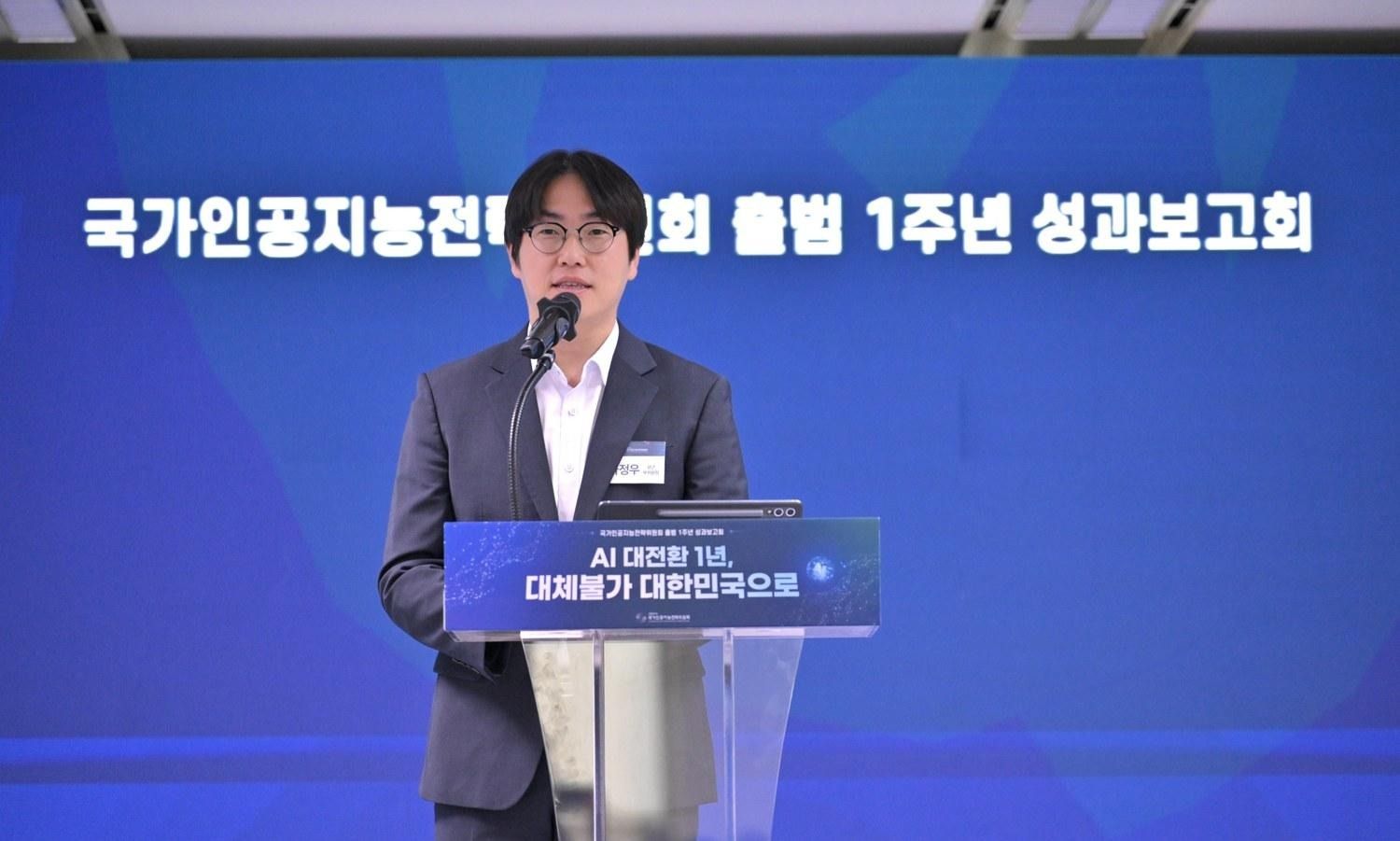
"Over the past year the committee brought together private-sector expertise and the government's policy capacity to set the direction of national AI strategy and to support change in each field," Ha said. "What matters most now is turning the groundwork of the past year into change that citizens and companies can feel." On taking office he had put it in similar terms: "In the first year we concentrated on setting the big strategy and direction; now we will concentrate on producing visible results that citizens can feel in their daily lives" (Weekly Hankooki, September 6).
"The second-term committee will connect the capabilities needed across ministries and fields and work harder to clear obstacles on the ground," he added. "We will support Korea in becoming an irreplaceable node in the global AI supply chain, and in realising an 'AI for all' in which every citizen shares in the opportunities and benefits of AI."
Sources
· National AI Strategy Committee (국가인공지능전략위원회), press release, "One year since launch: Korea's AI transformation moves into delivery," September 8, 2026
· Yonhap News (연합뉴스), "[AI Prism] One year of the National AI Strategy Committee — 'towards an irreplaceable AI supply-chain nation'" (by Kwon Ha-young), September 8, 2026
· Money Today (머니투데이), "Three Mega Projects lead, seven SEED projects follow — 39.5tn won national R&D next year," September 1, 2026
· Money Today (머니투데이), "What the presidential National AI Strategy Committee did in its first year," September 8, 2026
· Money Today (머니투데이), "Balancing AI training and copyright protection — government builds a K-content AI ecosystem," March 11, 2026
· Asia Economy (아시아경제), "AI Strategy Committee to lead results-driven AX execution," September 8, 2026
· Asia Economy (아시아경제), "Culture ministry opens five sets of AI and high-value public cultural data for the first time," September 3, 2026
· Financial News (파이낸셜뉴스), "Culture ministry budgets a record 240.6bn won for culture technology," September 8, 2026
· ZDNet Korea (지디넷코리아), "Ha Jung-woo takes office as vice chair of the National AI Strategy Committee," August 31, 2026
· ZDNet Korea (지디넷코리아), "Government secures 9,704 NVIDIA GPUs; purchase orders this month," June 8, 2026
· Weekly Hankooki (주간한국), "[Person of the week] AI policy hand Ha Jung-woo returns after four months," September 6, 2026
· Edaily (이데일리), "One year on, the National AI Strategy Committee turns policy into execution," September 8, 2026
· Seoul Money Brokerage Services (서울외국환중개), USD/KRW reference rate, September 8, 2026