
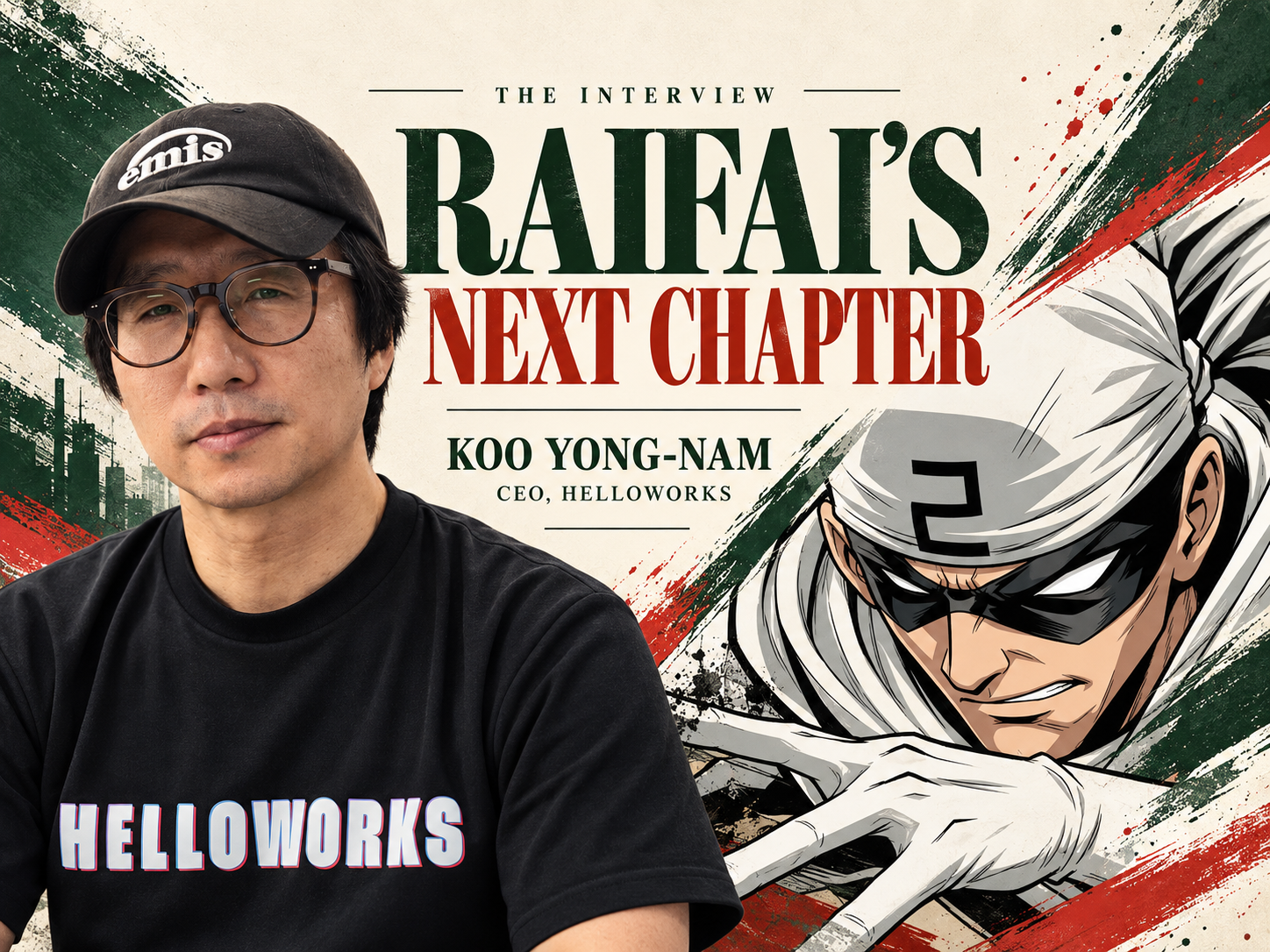
INTERVIEW
CEO Koo Yong-nam on moving from screenplay development into production, combining AI tools with original stories and finding a new audience for a classic Korean hero
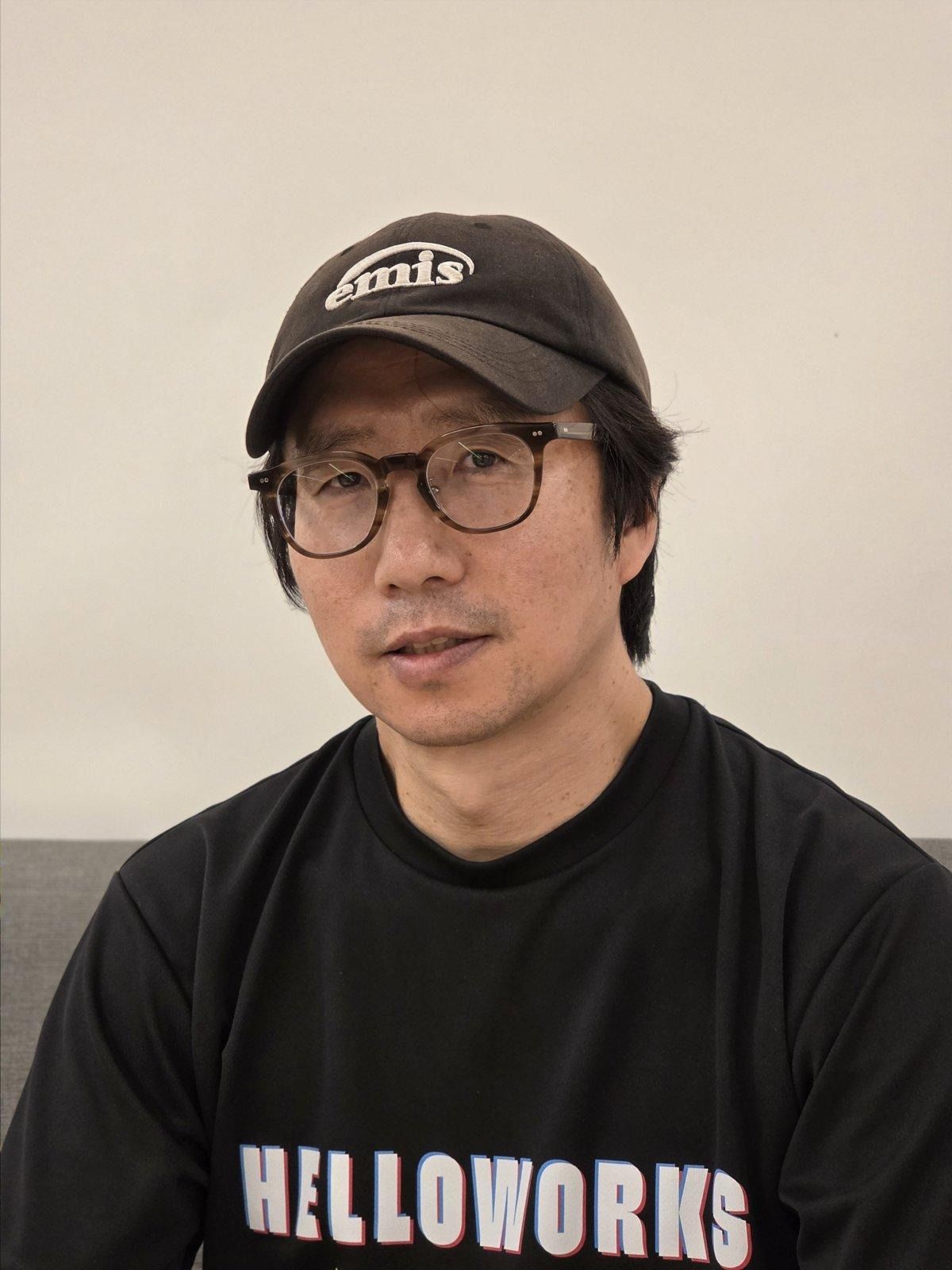
HelloWorks is an entertainment-technology-based creative studio that develops intellectual property and produces short dramas, AI-assisted video and immersive content. It has expanded from film screenplay development into production and overseas distribution.
HelloWorks is in the final stages of negotiating a copyright licensing agreement and a production agreement with Raifai creator Kim San-ho.
The agreements have not yet been signed, and the company has not completed its acquisition of the relevant rights. CEO Koo Yong-nam’s proposed revival of the Korean science-fiction comic Raifai illustrates that transition: introduce its creator, Kim San-ho, to American viewers through a documentary, then explore animation, webtoons and other adaptations.
“Kim San-ho has had an unusually eventful life. We want to approach the US market with a documentary about that first, then develop a feature animation as interest and awareness grow,” CEO Koo Yong-nam said in an August 29 interview.
The company’s proposal targets principal photography in the fourth quarter of 2026 and a broadcast in the second quarter of 2027. It also envisages announcing the wider reboot business around the broadcast; neither a broadcast slot nor subsequent releases have been confirmed. HelloWorks is scheduled to introduce its plans at the Korean session of Global Stage Hollywood, or GSH, at the TCL Chinese Theatre in Los Angeles on October 3.
Two production rhythms coexist at HelloWorks. Short dramas offer opportunities to deliver finished work and build localization experience; Raifai requires longer development and agreement on the underlying rights. AI supports source-material review, production, translation and dubbing across that work. The central business question is which stories the company can develop and which markets it can reach.
At the GAMFF 2026 AI and metaverse film festival’s B2B exhibition on September 3–5, the company presented K-Short Drama AI. HelloWorks says the solution can reduce source-material review time by up to 90% and bring production costs and schedules down to one-third of conventional levels. While seeking greater efficiency in short dramas, it plans to introduce longer-term properties such as Raifai in stages, beginning with a documentary.
From Screenplay Development to Production
HelloWorks began by developing film scripts. “When CJ ENM needed screenplays in new genres, we put together a team of writers and worked steadily on development for more than four or five years,” Koo said. The business involved assembling writers around the genres and stories a distributor needed.
A contracting theatrical market prompted a change. “With short-form dramas, and more recently VR and XR, we decided we needed to become a studio that could produce across genres,” he said. The company expanded into AI production, filming and postproduction so it could turn the stories it developed into finished work.
“There are so many companies coming out as AI production studios,” Koo said. His comment points to the difficulty of distinguishing a company by its tools alone. HelloWorks emphasizes the ability to carry a script through production and localization. Its profile on KOCCA’s WelCon directory likewise combines original-story development and directing with AI summarization, multilingual translation and dubbing. A content studio combining IP development with production is a more specific description of its current business.
Combining Short Dramas With Artist Management
HelloWorks has its headquarters in Mapo, Seoul, and an office at Pangyo Startup Square. Its August 17 company presentation divides the business between content production and artist management. Production covers original IP, AI tools and overseas distribution; management encompasses K-pop dance teams, a girl group and an actors’ agency, with activities extending into performances and VR content. YouTube channel operations and overseas festival booking are also part of the business.
The company’s website describes short dramas, YouTube production and artist management as core activities. Its interview and presentation set out plans to connect those operations with original IP, AI tools and overseas distribution. Writers develop stories, production teams turn them into video, and performers and international partners join individual projects. AI software sales and an XR platform remain expansion plans rather than evidence of an established software revenue stream.
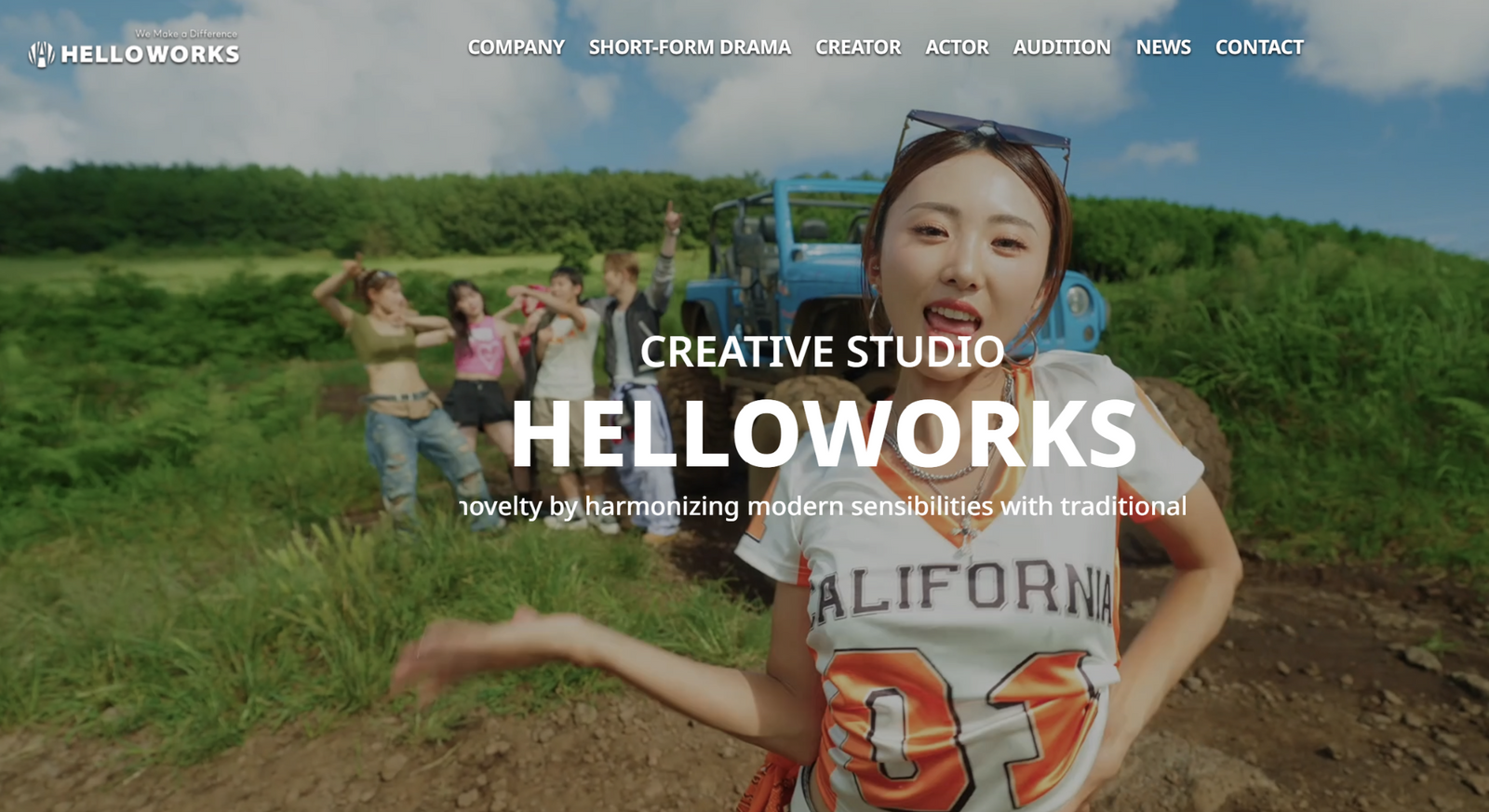
HelloWorks presents itself as a creative studio on its website. Image supplied by the company.
According to company materials, HelloWorks produced four short dramas in 2024 and plans more than 10 in 2026. Wife’s Letter of Resignation debuted on Daum Kakao in June 2025 before reaching ReelShort in November, where it ranked 11th among new releases. The company supplied Time to Hunt You and The Divorced Princess & Her Sweet Billionaire to Japan’s Kanta, and The Seductive Client to K-Short.
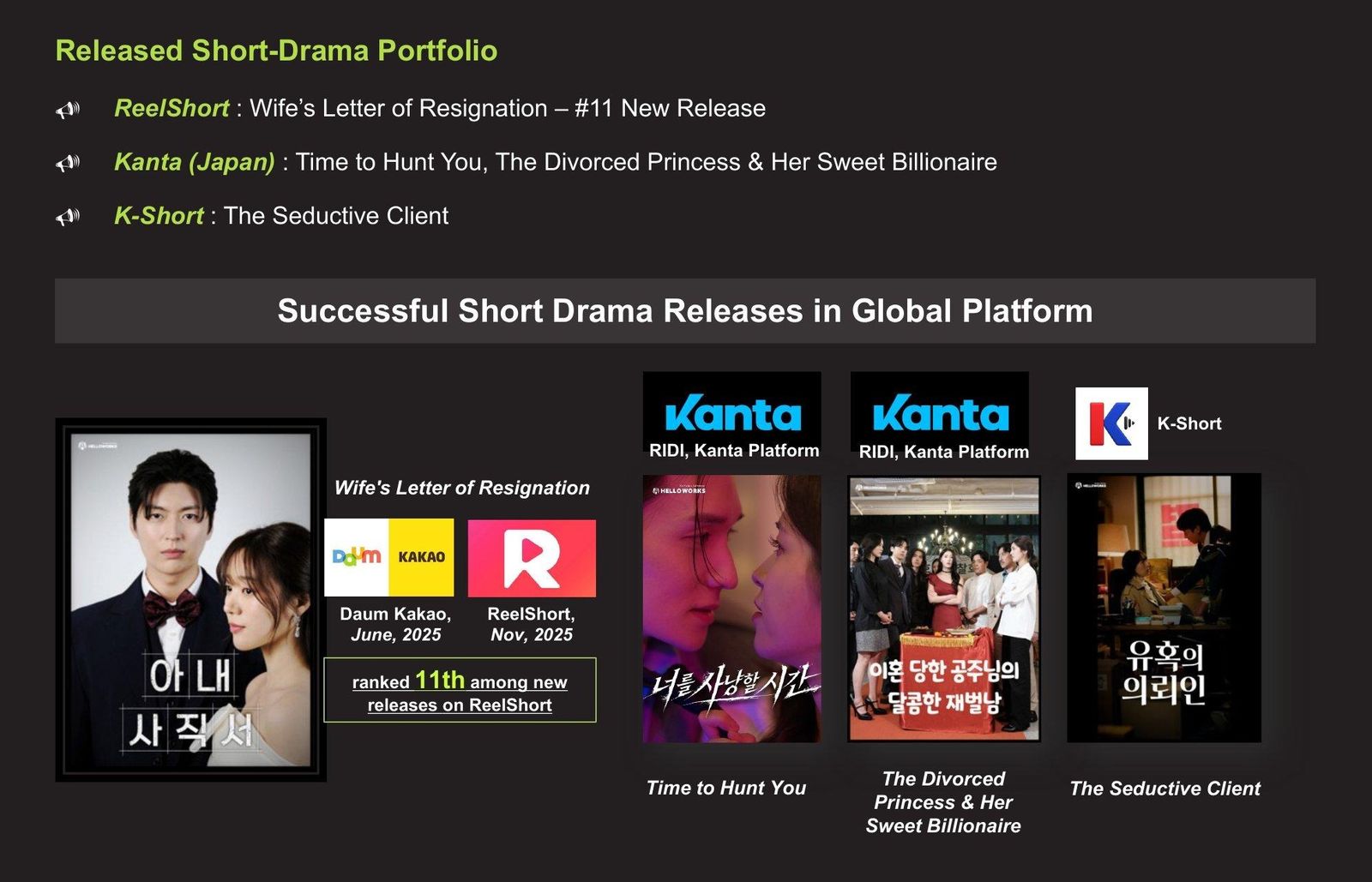
Short dramas supplied to Daum Kakao, ReelShort, Kanta and K-Short. The company reports that Wife’s Letter of Resignation ranked 11th among ReelShort’s new releases. Source: HelloWorks company presentation, August 2026.
HelloWorks is also building a development portfolio across genres. Its presentation lists 42 original properties: 22 romances, four comedies or human dramas, four action or thriller titles, two occult stories and 10 science-fiction or fantasy projects.
They include Trouble Maker, The River, a story about returning to 100 days before a housing-related marriage, and a thriller about an obsessive chef’s spy, alongside AIDOL, Surviving in Space and Pangaea. The company intends to develop individual properties as short dramas, films, series, animation or XR experiences.
Calculated from the company’s list, romance represents 52.4% and science fiction/fantasy 23.8%, or 76.2% combined. The slate spans stories suited to short dramas and genres requiring longer development.
The 42 entries are a company-reported development portfolio, not 42 completed or sold productions, nor proof of ownership across every territory and medium. Its target of more than 10 short dramas in 2026 implies at least 2.5 times the four productions reported for 2024; that is a planned scale of output, not achieved growth.
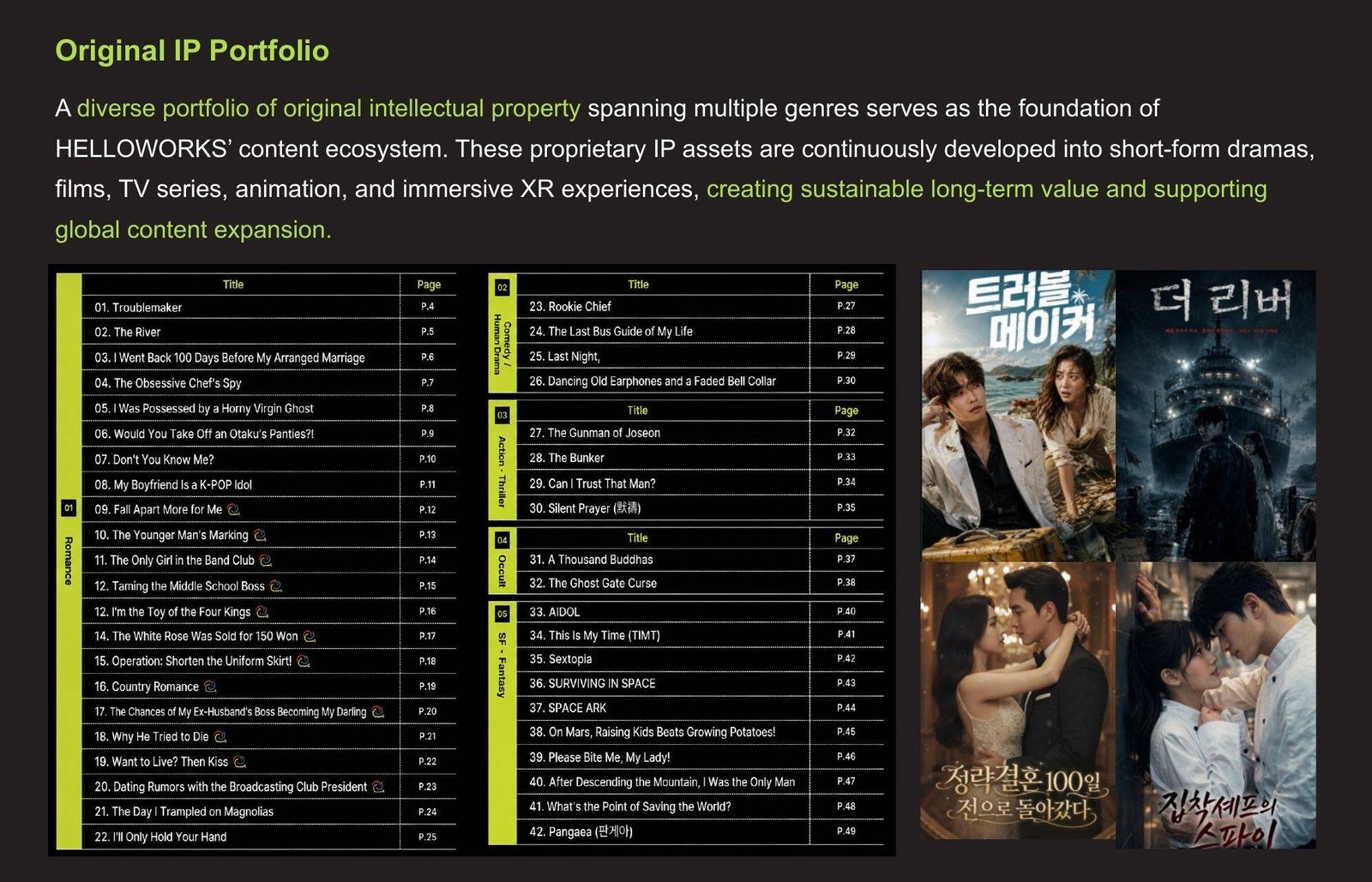
The company presentation lists 42 original IP development projects, including 22 romances and 10 science-fiction/fantasy titles. These are distinct from completed or sold productions. Source: HelloWorks presentation, August 2026.
The six-member dance crew TIMT, formed in April 2022, is a principal act in the management business. Its members are Kanel, Eunbyeol, Aoi, Sien, Taejun and Hwanwoo.
The company presentation lists 770,000 YouTube followers, 600,000 on TikTok and 200,000 on Instagram, a combined total of roughly 1.57 million that does not exclude people following on multiple platforms.
The company describes TIMT’s YouTube channel as being in the top 1% in Korea and worldwide and says the group has released two digital singles. Its materials also list girl group KANDIS, actors’ agency ARA ENT and LA Dance Studio in Incheon, which provides dance and vocal training and cultural exchange programs.
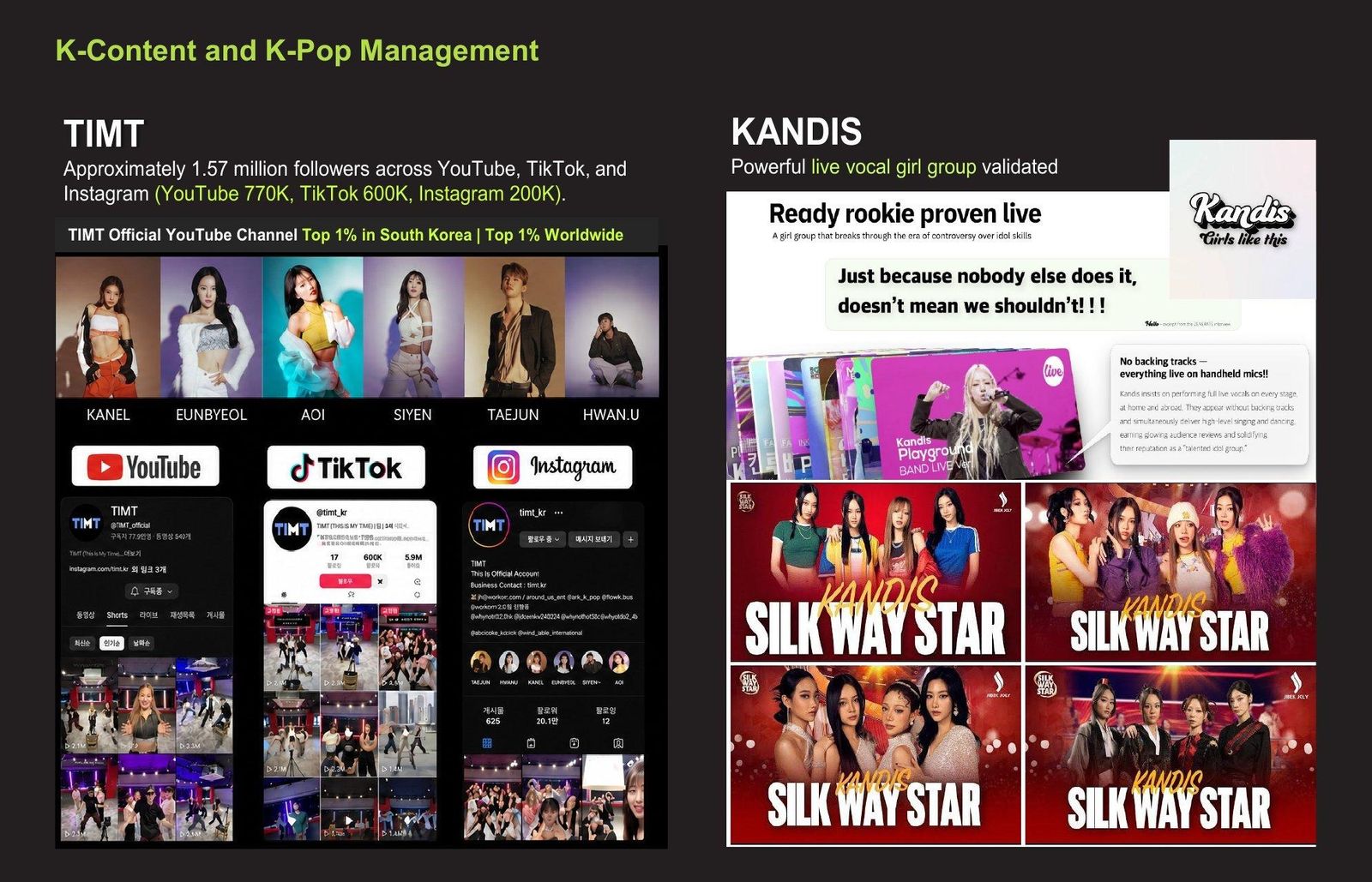
TIMT’s combined YouTube, TikTok and Instagram following is approximately 1.57 million, according to the company; KANDIS is presented as a vocal-focused girl group. Source: HelloWorks company presentation, August 2026.
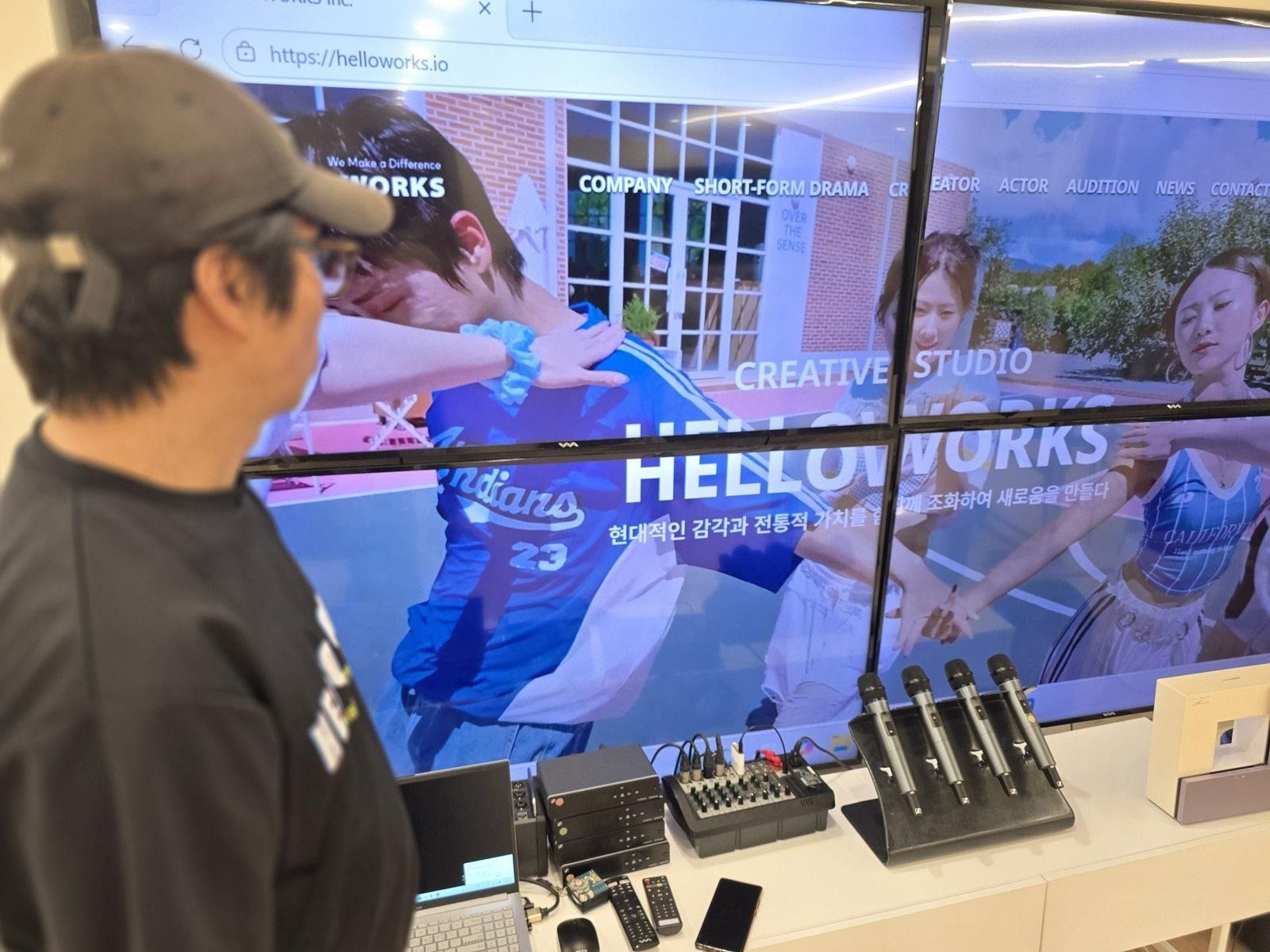
Koo introduces the company in front of a video wall displaying the HelloWorks website and its short-drama, creator, actor and audition sections. Photo: K-EnterTech Hub.
The artist roster supports HelloWorks’ immersive-content plans. It uses real-time rendering, game engines, virtual production, LED walls and motion capture to develop K-pop performances, XR musicals and tourism experiences.
Proposed uses include VR concerts offering a front-row or near-stage perspective, digital performances for overseas fans and branded videos. HelloWorks is also preparing XRAVIO, an XR platform intended to connect creators and fans. By combining artist management with production, it aims to match performers to individual projects.
Two Teams Connect Story Development and AI Production
The operating structure follows that division. An IP development team works on webtoons, web novels, drama concepts and scripts, while an AI content production team turns them into video using generative AI and automation. “Some content moves quickly into short-form projects, while stories that need more time become feature animation, films or drama series,” Koo said. He added that scripts for one drama and three potential films had been completed, with preparations under way involving actors, directors and distribution.
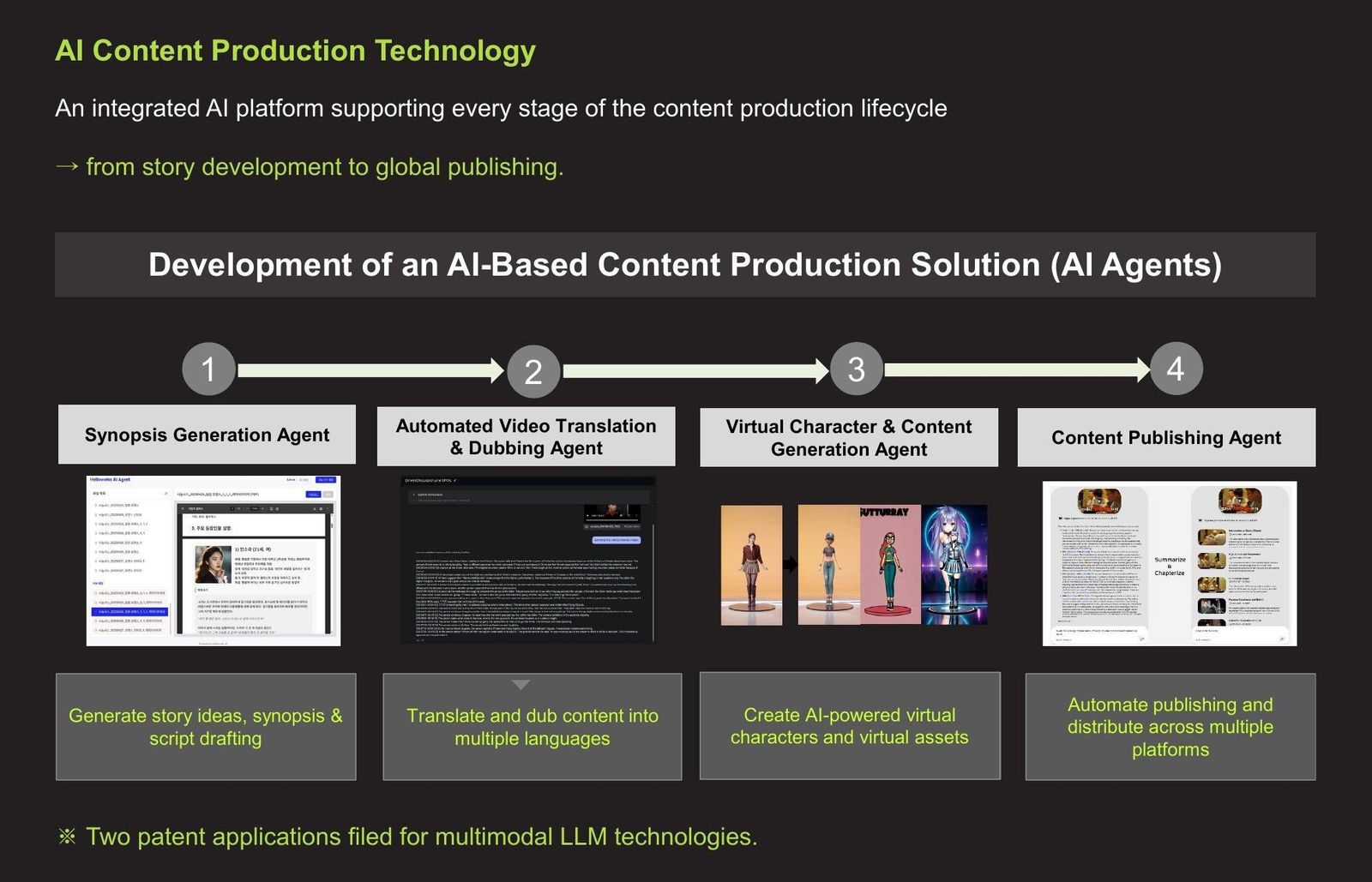
K-Short Drama AI is designed to connect the teams’ work. According to HelloWorks, it combines generative AI and retrieval-augmented generation to produce a synopsis in about three minutes, and uses speech recognition, machine translation and speech synthesis to automate translation and dubbing.
AI motion capture and 3D modeling support virtual characters. The company groups the system into four agents: synopsis generation, translation and dubbing, virtual character and content generation, and publishing. It also lists IP trading and distribution across platforms among the intended functions, and says it has filed two patent applications involving multimodal large language models.
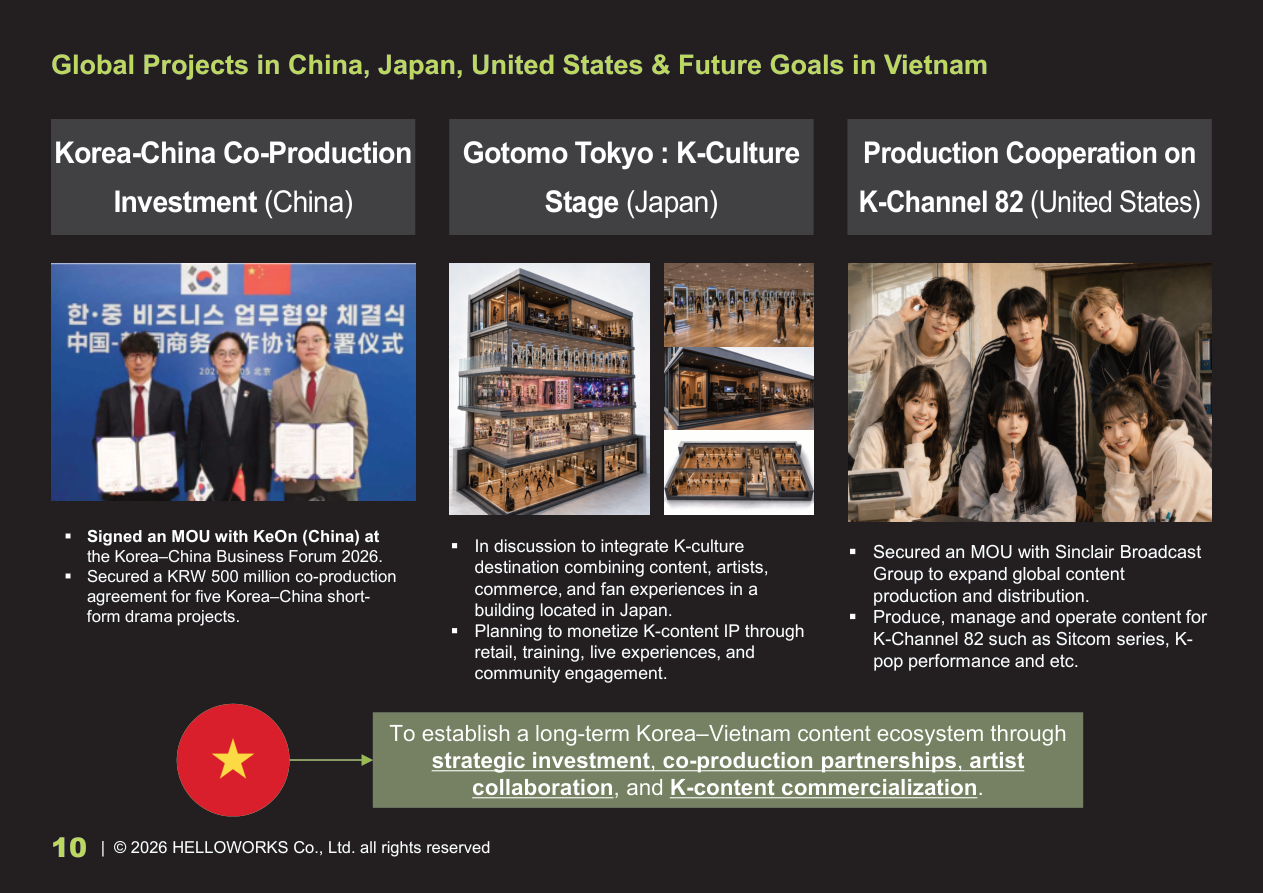
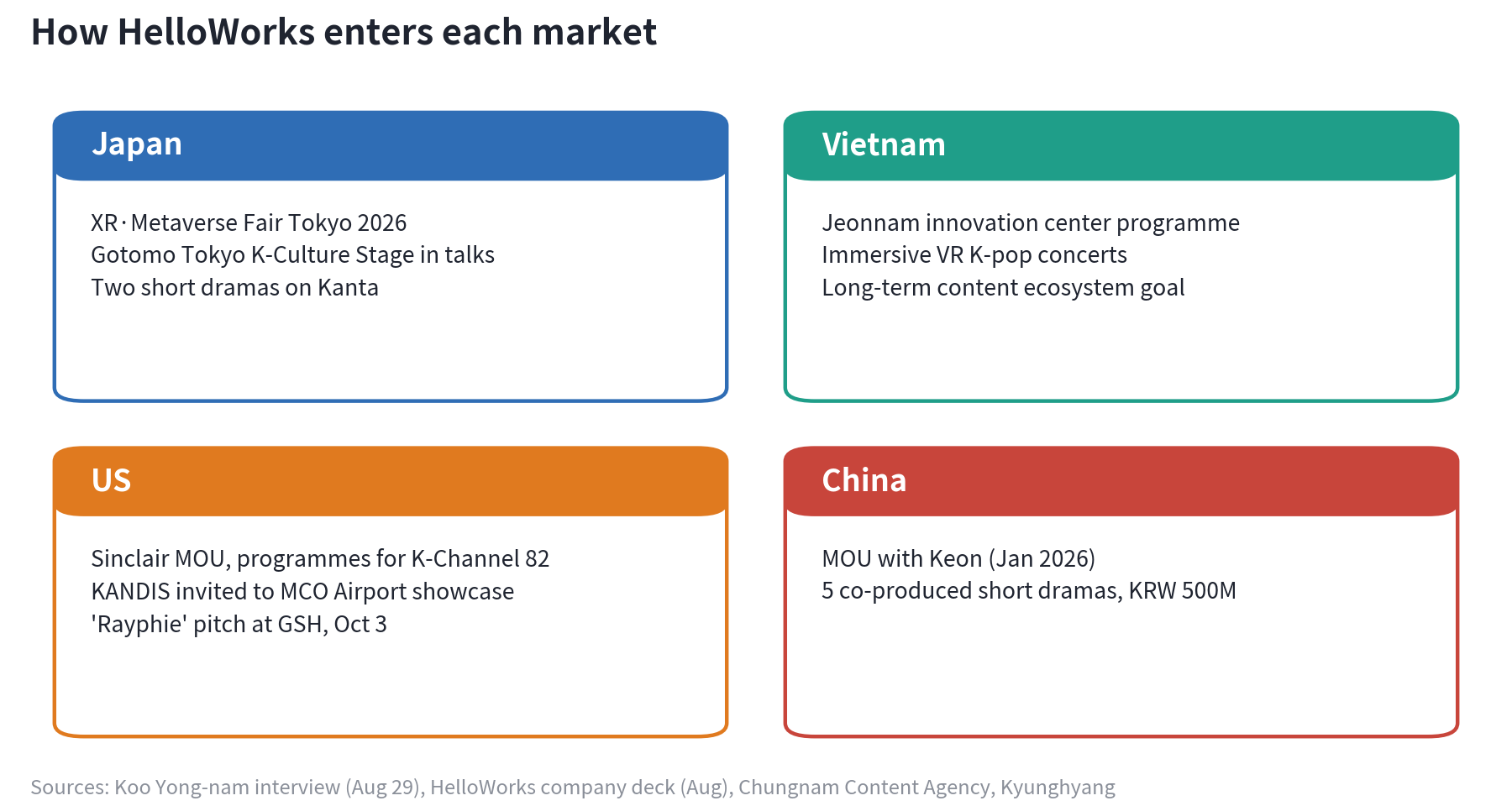
In China, HelloWorks is building a co-production base. It signed a memorandum of understanding with Chinese company Keon at the Korea–China business forum in Beijing in January. The agreement covers Chinese rights distribution, co-production and joint IP development for short-form content, entertainment shows, films and dramas. The company presentation says it subsequently led to a five-title short-drama co-production contract worth KRW 500 million, approximately $369,000.
The KRW 500 million figure covers the five-project co-production agreement; it is neither total company revenue nor an established per-title production budget. The international strategy differs by market: a co-production contract in China, discussions around a cultural venue in Japan, and programme and performance supply in the US. Each route has different counterparties and commercial terms.
A Growing Market Raises the Stakes for Costs and Stories
Sensor Tower’s State of Short Drama Apps 2025 put global in-app revenue at about $700 million (KRW 949.2 billion) in Q1 2025, versus $178 million (KRW 241.4 billion) a year earlier—roughly 3.9 times as much. Quarterly downloads exceeded 370 million, up 6.2 times. The US generated about $350 million (KRW 474.6 billion), or 49% of revenue. These are app receipts, not the revenues earned by production companies.
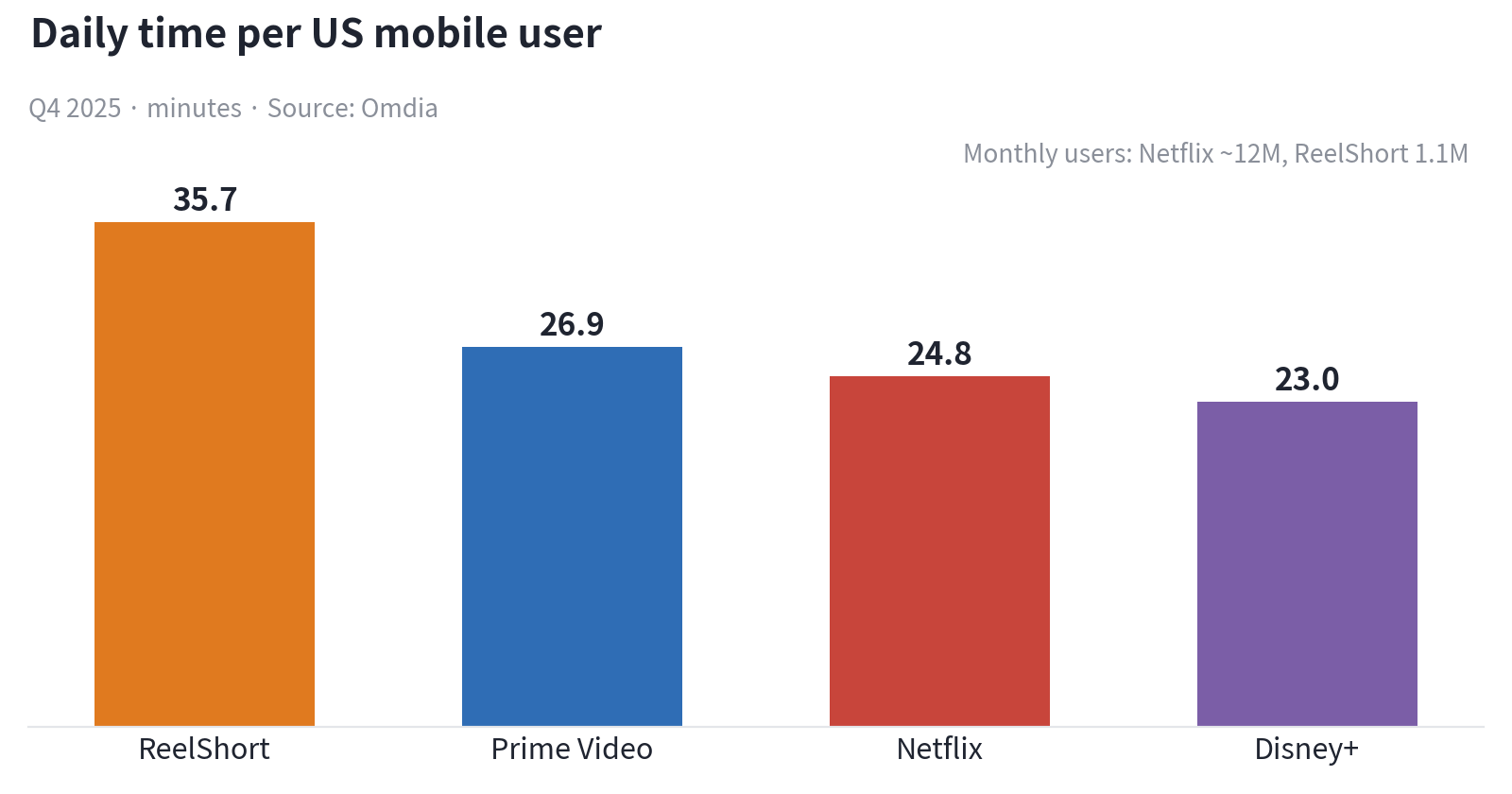
Omdia’s Q4 2025 US mobile data put daily usage at 35.7 minutes for ReelShort, 26.9 for Prime Video, 24.8 for Netflix and 23.0 for Disney+. ReelShort’s figure was 10.9 minutes, or approximately 44%, above Netflix’s. Monthly mobile audiences were very different: about 1.1 million for ReelShort and 12 million for Netflix. The comparison concerns mobile usage intensity, not total viewing across devices or subscriber scale.
US studio participation is increasing competition for supply. Fox Entertainment’s October 2025 investment announcement for Holywater identified original vertical productions, advertising, brand partnerships and possible extensions or remakes of Fox IP as areas of collaboration.
The deal combines a technology platform with stories and production capabilities. For HelloWorks, the corresponding challenge is to secure both work for overseas platforms and properties that can support subsequent productions.
Production and support programs are also expanding in Korea, which Sensor Tower ranks as the fourth-largest short-drama app revenue market. KT Studio Genie said it had delivered chart-topping titles on both DramaBox and ReelShort in January and was pursuing an annual slate of 56 with partners. The Korea Creative Content Agency added short-form production to its streaming-platform support program this year, offering up to KRW 100 million, approximately $74,000, per project for around three DramaBox-linked titles. The format calls for 50–80 episodes of no more than five minutes each.
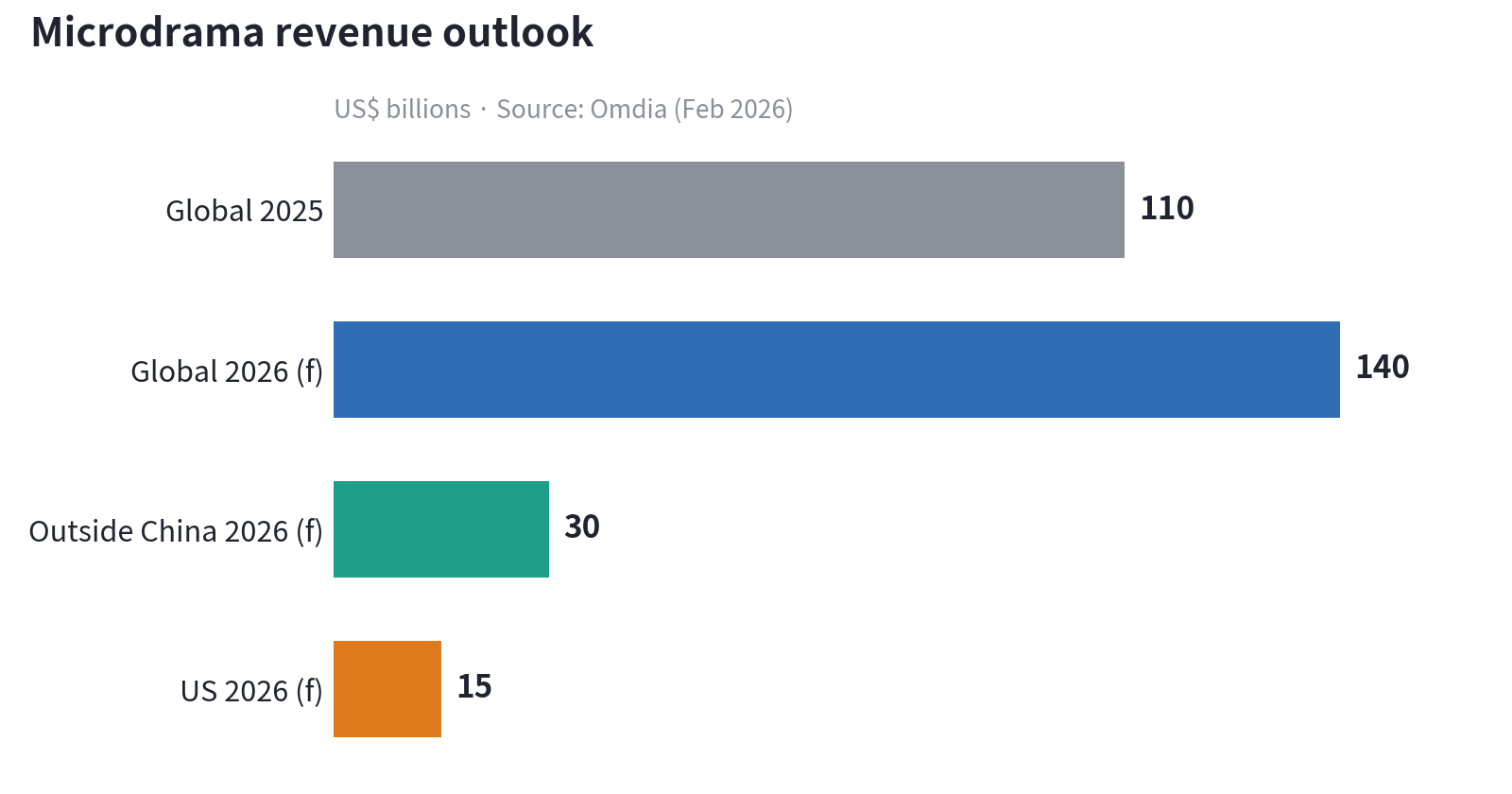
Omdia estimated global microdrama revenue at $11 billion (KRW 14.916 trillion) in 2025 and forecast $14 billion (KRW 18.984 trillion) for 2026, implying approximately 27.3% growth. It forecast $3 billion outside China, including $1.5 billion in the US. These market estimates and Sensor Tower’s in-app receipts differ in scope and period and cannot be added or treated as directly comparable.
For HelloWorks, the figures establish a growing market to consider, not a forecast of its own sales or a guarantee of successful titles. A producer’s economics depend on recoupment terms, distribution deductions, localization costs and its participation in later uses. The relevant question is how an individual production generates income and who receives it.
The Value of IP Depends on the Rights
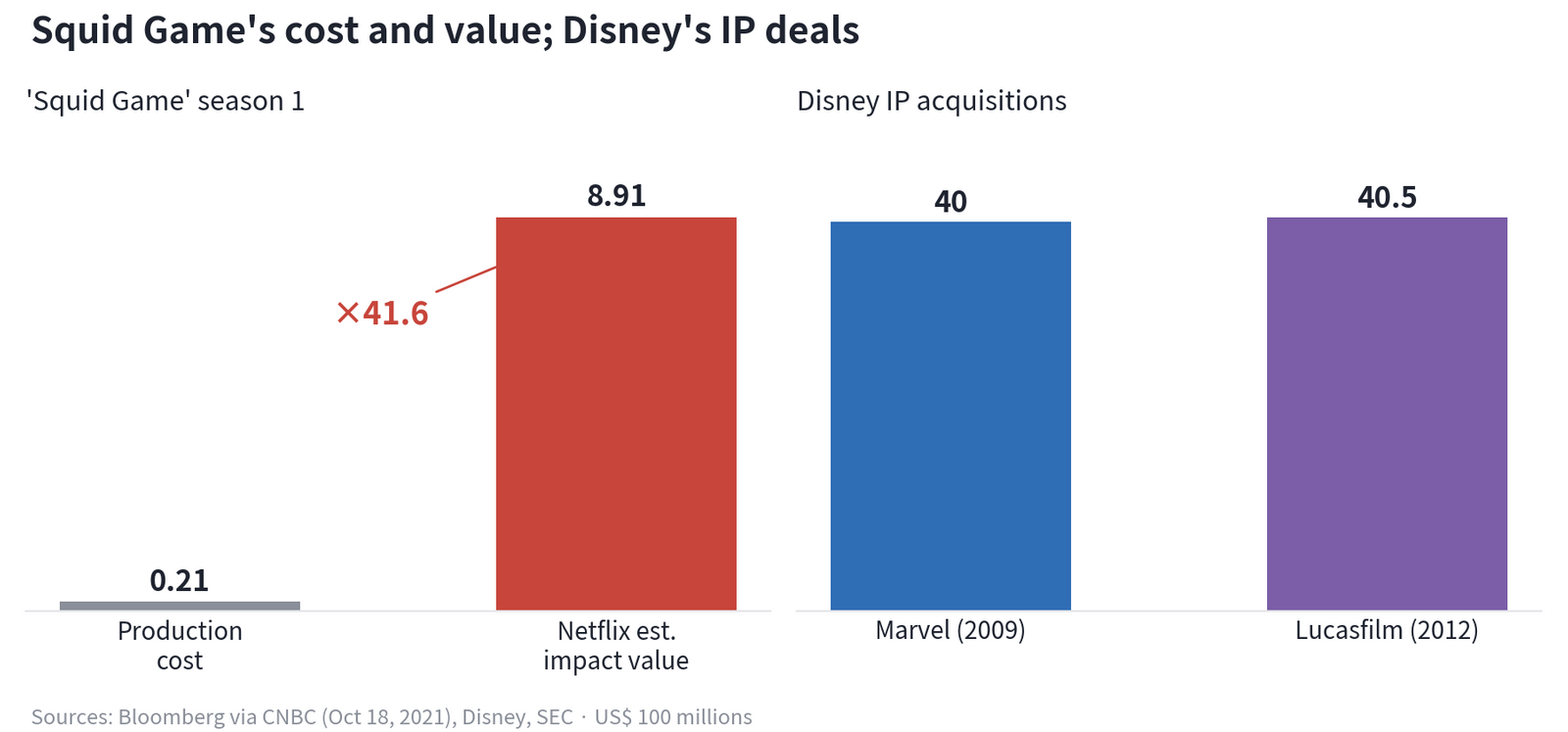
The v12 source article adds a useful comparison: Bloomberg’s 2021 reporting on internal Netflix documents put Squid Game season-one production costs at $21.4 million (KRW 29.0 billion) and its estimated impact value at $891 million (KRW 1.208 trillion). That internal value estimate is not cash revenue, profit or a realized investment return. The figures illustrate why a successful production and ownership of its underlying rights are separate business questions.
Disney acquired Marvel for approximately $4 billion (KRW 5.424 trillion) in 2009 and Lucasfilm for $4.05 billion (KRW 5.492 trillion) in 2012. These are corporate acquisition prices, not directly comparable measures of a single title’s performance. WEBTOON Entertainment raised $315 million (KRW 427.1 billion) in its 2024 IPO; the supplied article cites 191 screen adaptations of Naver Webtoon properties over 12 years.
South Korea’s January 2026 policy-fund announcement set a KRW 731.8 billion (about $539.7 million) formation target, including KRW 200 billion (about $147.5 million) for an IP-focused fund. These are planned fund sizes, not amounts already paid to producers. For HelloWorks, the practical question is which adaptation, territory and distribution rights its own agreements will grant.
A Lezhin Adaptation With American Actors and a Chinese Studio
Koo described a short drama intended for the US market as the year’s most demanding production. Based on a Lezhin Comics property, it was filmed at a Chinese studio with American actors. At the time of the interview, the target was a release in the second half of 2026. The company’s earlier goals of launching one feature animation and one live-action film remained in progress.
“We have achieved less than 50% of our goals, and there is still a lot to do,” he said. HelloWorks was also still going through the selection process for TIPS, Korea’s private investment-led technology startup support program. Koo said the company was being assessed as an AI content business in a new-industry category, with a final stage expected in the first week of October.
The source article cites a general-track R&D ceiling of KRW 800 million, about $590,000, over two years. That ceiling does not represent funding awarded to HelloWorks.
Different Routes Into Japan Vietnam and the United States
HelloWorks participated in the Tokyo XR and Metaverse Fair at Tokyo Big Sight on June 17–19 with support from the Chungnam Content Agency. It was one of two Chungnam companies in a joint regional pavilion involving agencies from Daejeon and North Chungcheong.
Koo said the company presented an immersive VR business model built around K-pop. It is also discussing Gotomo Tokyo K-Culture Stage, a venue combining content, artists, commerce and fan experiences. In Vietnam, a program supported by the Jeonnam Center for Creative Economy and Innovation is helping it develop K-pop and concert VR content while exploring investment, co-production and artist collaboration.
The supplied English presentation describes the Japanese venue as under discussion and the Vietnam initiative as a long-term goal involving investment, co-production and artists. It does not establish that a venue has opened or that all proposed partnerships have been contracted.
K-pop VR concerts are also attracting international distribution efforts from other producers. AmazeVR worked with BigHit Music and HYBE 360 on TXT’s third VR concert, ENDLESS RIDE, which began theatrical screenings in Korea and Japan on July 31, with plans to expand to North America and Europe. CEO Steve Lee described the operation as a music concert business in an interview with the Korea JoongAng Daily.
In the United States, HelloWorks is preparing content for television schedules. Company materials say it signed a cooperation MOU with Sinclair and is pursuing sitcom and entertainment programming, along with K-pop performance cooperation, for K-Channel 82, a Korean culture channel intended to use ATSC 3.0 distribution.
The materials describe a year-end launch target, with the schedule still being adjusted. “We are looking for opportunities in sitcoms, entertainment shows and K-pop content suited to the US market,” Koo said.
The company presentation also lists an invitation for KANDIS to perform at a Korean-content pop-up showcase at Orlando International Airport. California-based US branch head Sam Woo leads local activities. K-EnterTech Hub, this publication’s publisher, is involved in developing K-Channel 82.

HelloWorks’ US plans include a KANDIS showcase invitation at Orlando International Airport and programming and K-pop performance cooperation for K-Channel 82. Source: HelloWorks company presentation, August 2026.
A Korean Science Fiction Hero First Published in 1959
Kim San-ho published Raifai through Bueongi Mungo in four parts and 32 volumes between 1959 and 1962. Set in 2110, it follows a hero who loses his parents and mentor before confronting a succession of villains. Rocket belts and wireless pagers were among its futuristic devices.
The Encyclopedia of Korean Culture describes the work as helping establish a Korean superhero model. Bucheon’s comics information center reissued it in its Korean comics classics collection in 2003. HelloWorks’ proposal focuses on the science-fiction imagination the comic offered children in postwar Korea.
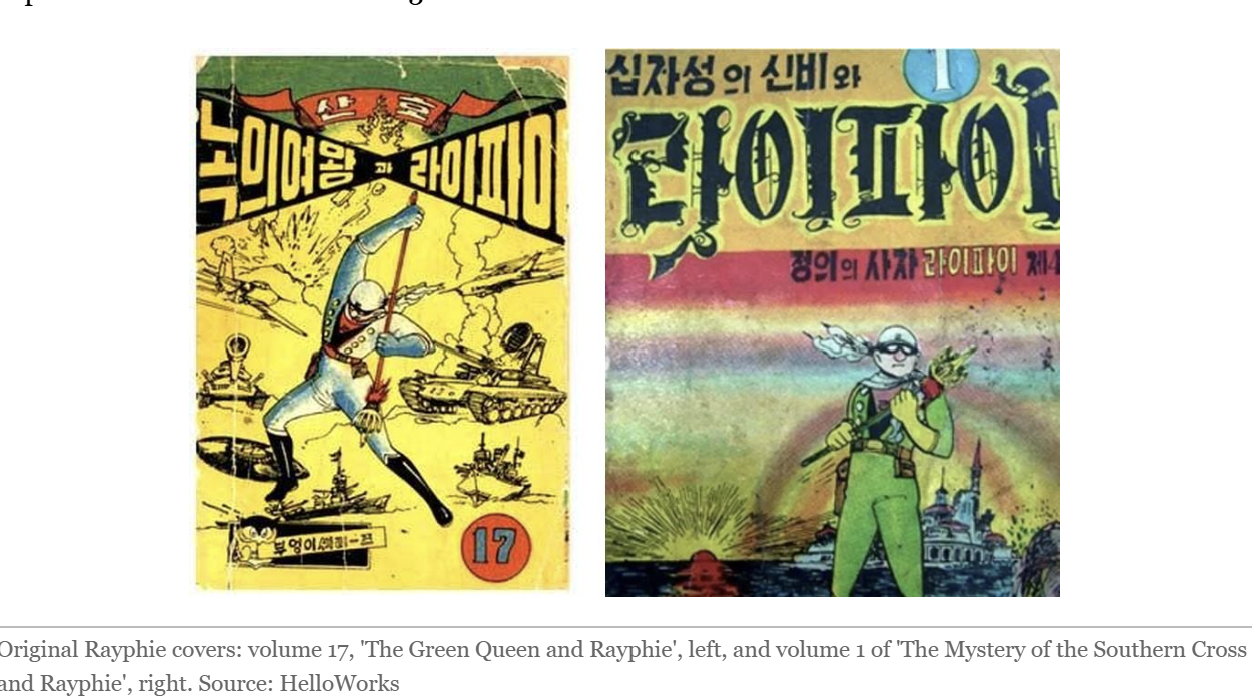
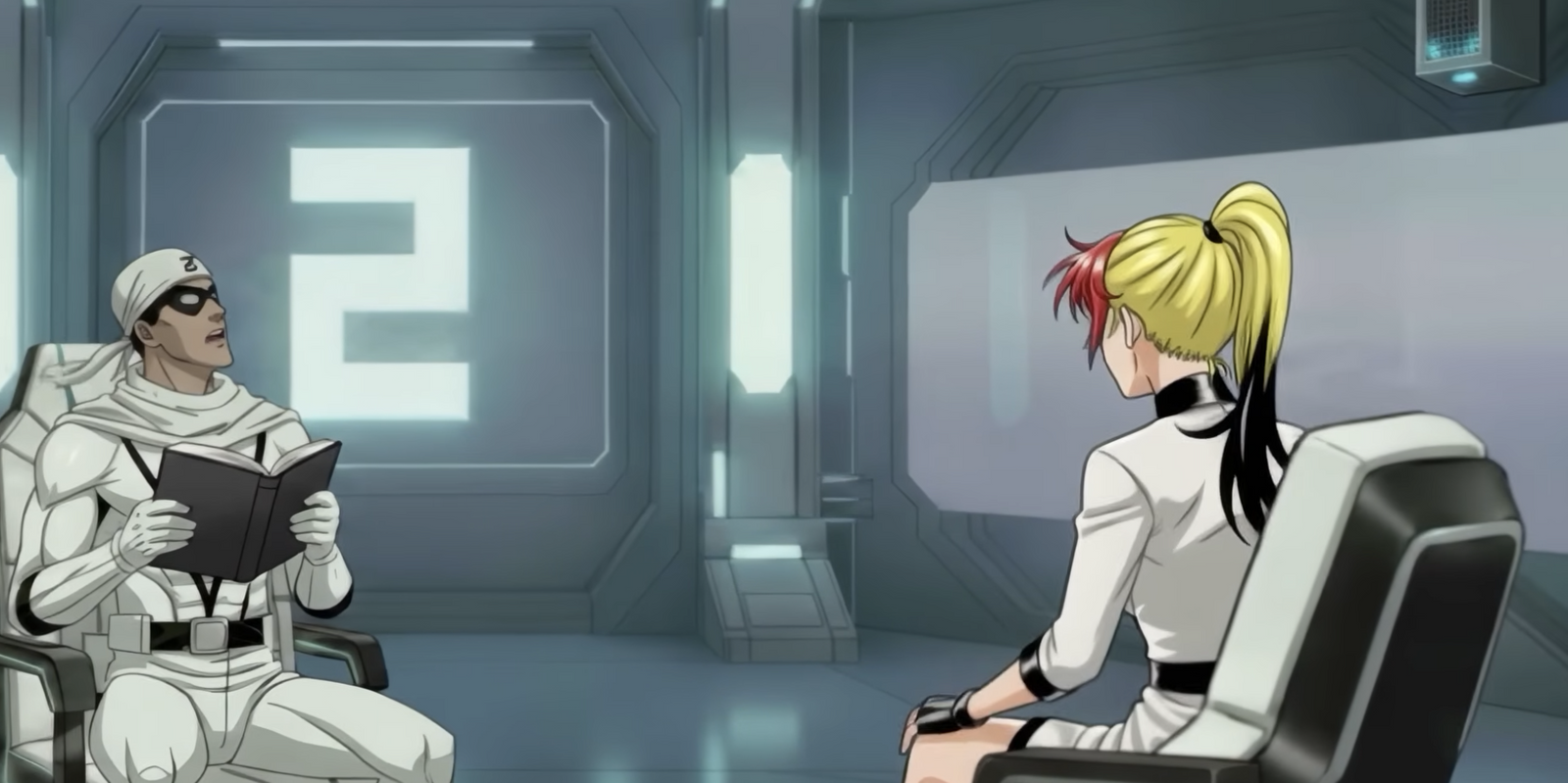
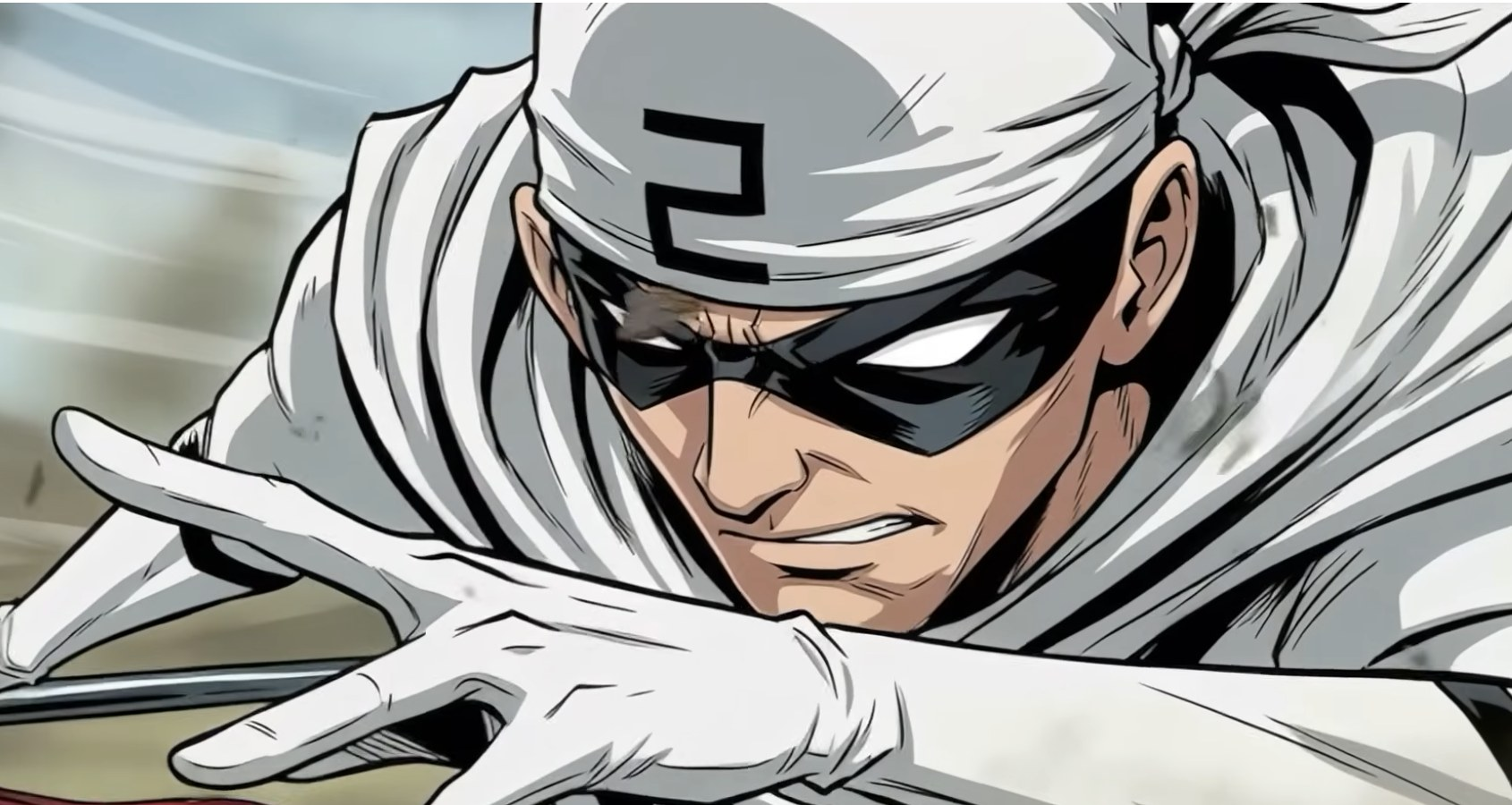
Raifai artwork. Image supplied.
Born in Manchuria in 1939, Kim moved to the United States in 1966. His credits include Charlton Comics’ Fightin’ Marines, Ghost Manor and House of Yang, as well as Marvel’s Deadly Hands of Kung Fu. Lambiek Comiclopedia lists more than 300 credits for 1969–1976 and describes him as the first Korean comics artist to publish regularly in the United States. After returning to Korea, he received the Okgwan Order of Cultural Merit in 2008 and the SICAF Comic Award in 2011.
A VikingLab and Grae consortium produced the short-form animation Raifai: The Green Queen under Korea’s 2025 AI content production support program. The project used text-to-image and image-to-video generation to reinterpret the original artwork in a contemporary style, according to Global Epic’s November 28, 2025 report.
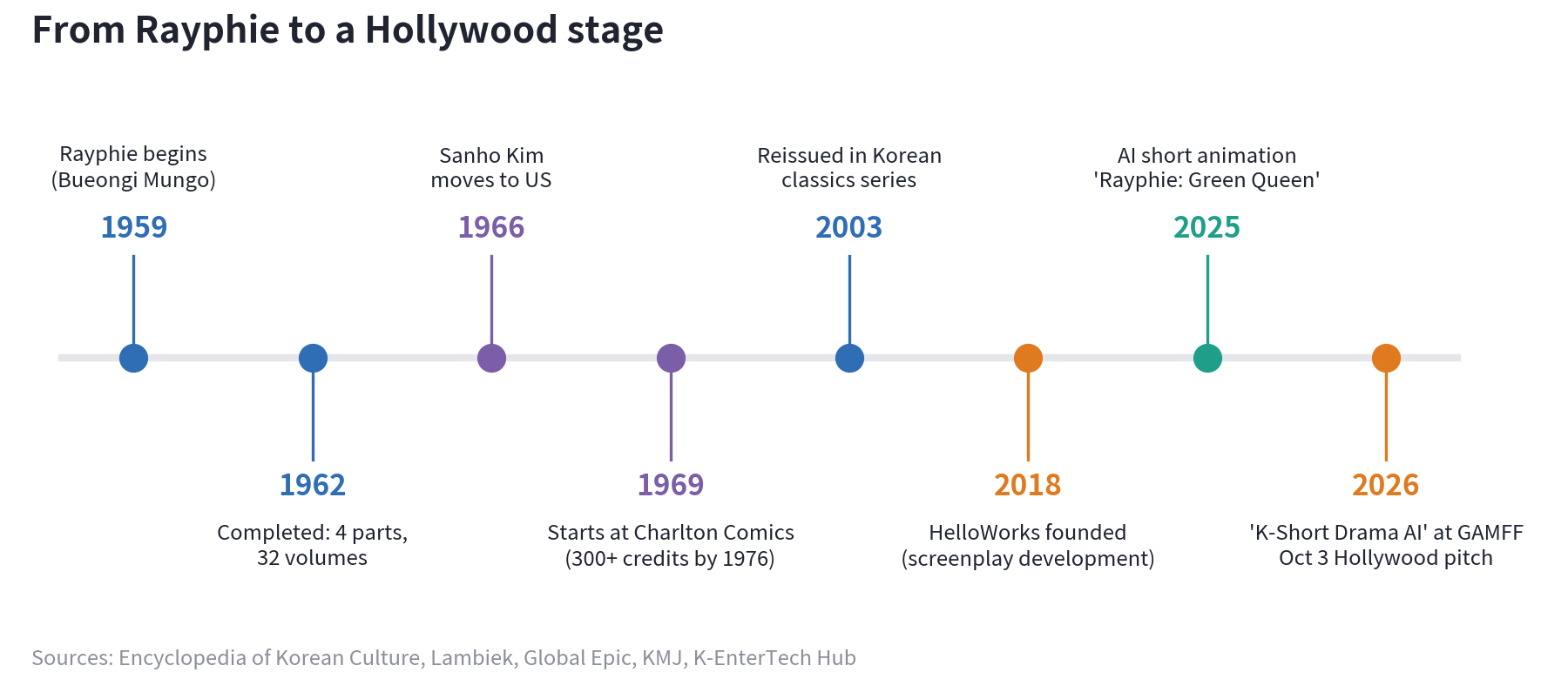
Raifai’s publication history and later adaptations: original publication began in 1959 and ended in 1962; Kim moved to the US in 1966 and began Charlton work in 1969; the comic was reissued in 2003 and adapted as AI animation in 2025. HelloWorks, founded in 2018, is now developing a documentary. Sources: Encyclopedia of Korean Culture, Lambiek, Global Epic, KMJ and company materials.
Copyright and Production Agreements Remain Under Negotiation
Koo’s introduction to Raifai came during a trip to Japan. He was developing a story bringing together heroes from Korea’s Joseon period when he met the head of a Korean–Japanese cultural exchange organization. That contact knew Kim, and their discussion of hero stories led to the possibility of redeveloping Raifai. Koo did not grow up reading the comic. Alongside older readers’ nostalgia, he saw possibilities in the story and in its creator’s American career.
His proposed direction combines taekwondo and K-pop in a Korean superhero animation. “I hope an animated Korean hero story combining taekwondo, Korean culture and K-pop could find a new response in the market,” he said.
The story and characters are being reworked. “We are at the planning stage with the original creator’s consent,” Koo said. The development ideas he described include a series of worlds and stories built around the Green Queen. His reference to a villain from a green planet should be read as part of the current development discussion: the Encyclopedia of Korean Culture describes the original Green Queen as a descendant of the Inca civilization. The original comic and the proposed new version need to be distinguished.
The creator’s consent to preliminary development is separate from a signed copyright licensing agreement. HelloWorks and Kim are still finalizing the copyright and production agreements; the scope of permitted uses and production terms will depend on the signed agreements. Koo said an IP agreement must come before overseas pitching. “We do not pitch without a contract,” he said. Defining those rights will shape which formats the company can develop next.
Underlying IP matters because it determines which subsequent businesses a producer can pursue. WIPO’s filmmaking guidance links commercial outcomes to assembling talent, securing relevant rights and using those rights to attract financing and distribution. Permission for one screen adaptation does not automatically confer publishing, game or character rights; the scope depends on the agreement.
Raifai’s documentary and any subsequent animation therefore require their own development arrangements. A portrait of Kim could give unfamiliar viewers a way into the work. Moving from that introduction to a broader character business would also require the relevant rights and production and distribution partners. Koo’s contract-first approach addresses the step between an attractive revival concept and a viable project.
Following the Artist at Work Today
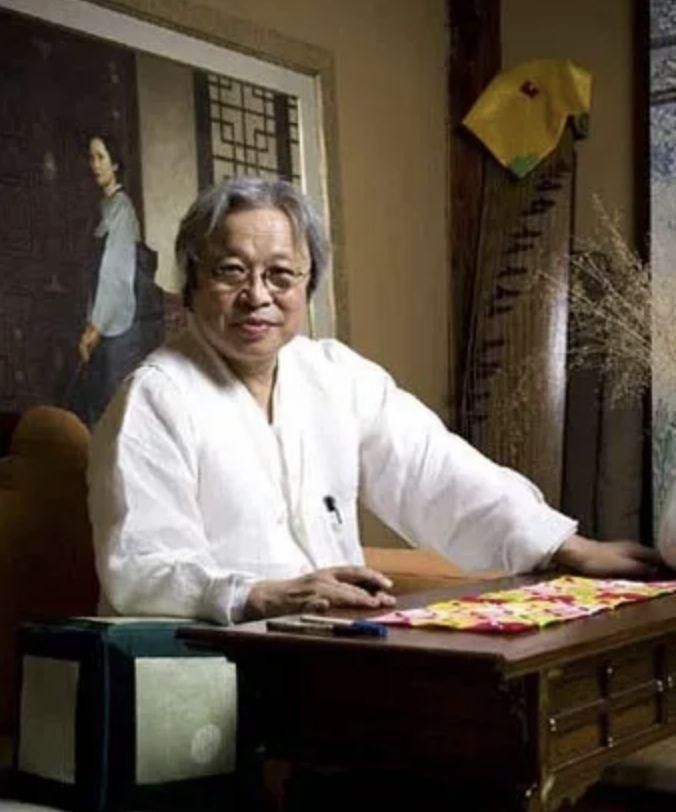
Kim San-ho. HelloWorks plans to make observation of his studio work a central part of documentary filming. Source: HelloWorks documentary proposal.
The documentary’s working title translates as Korea’s First Science-Fiction Comics Artist Kim San-ho and the Return of Raifai. The proposal combines the artist’s life with the process of developing the reboot, using the broadcast to introduce related IP projects. Its central subject is the artist, now in his 80s, exploring and experimenting with 3D modeling and AI production tools.
The proposal presents Kim as an artist who handled a wide range of drawing and directing work within the American comics industry’s division of labor, and experimented with panel layouts and sound-effect lettering. The filmmakers want to show him continuing to test production technologies while considering their cost and quality.
The planned story opens with Kim preparing work for American auctions, then returns to Raifai’s popularity, his Charlton years and Promised, a comic introducing Korean culture. It subsequently returns to the present, including motion capture of a taekwondo poomsae champion and discussions of AI production. The proposed closing sequence transforms an old comics panel into an image from the reboot.
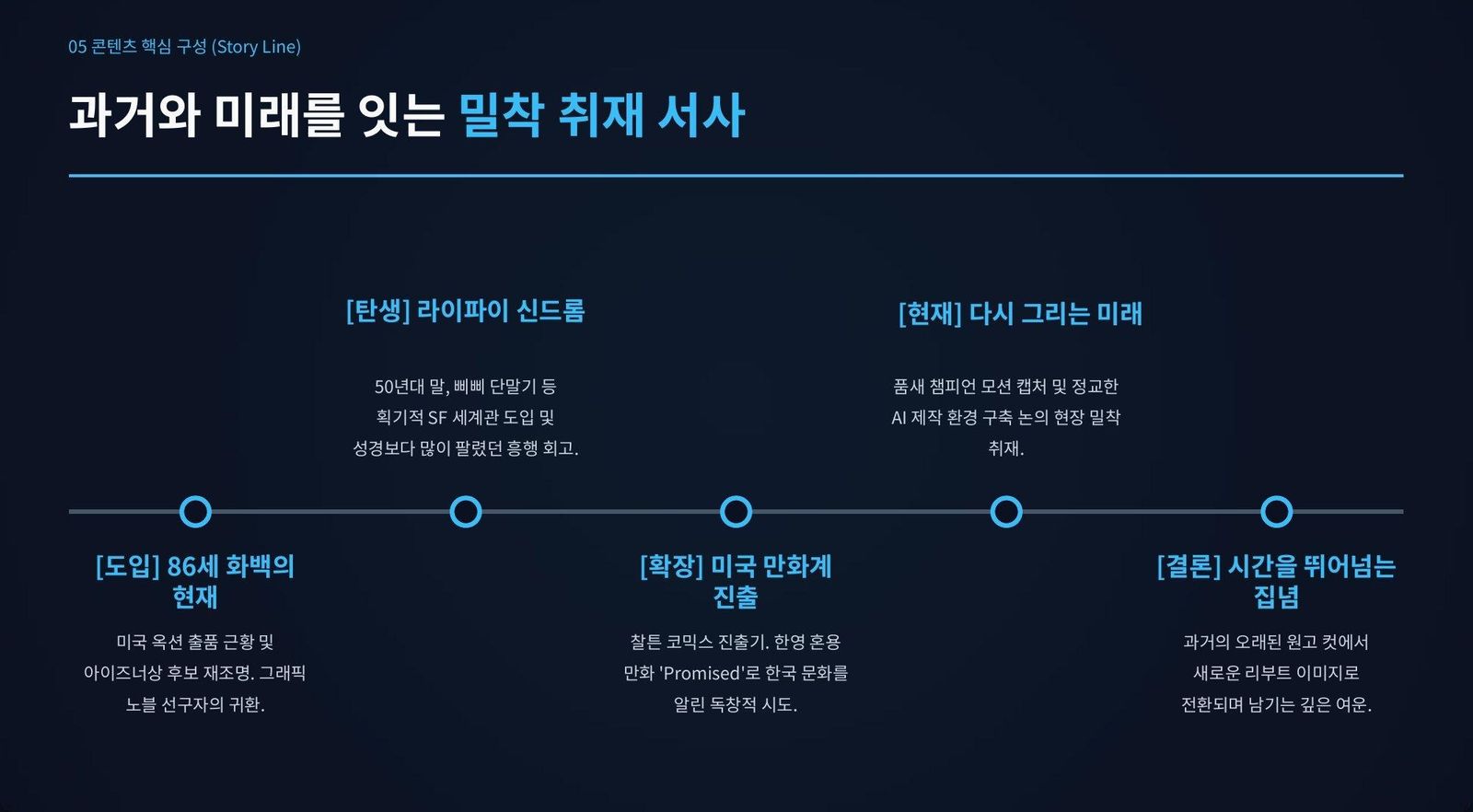
The proposed documentary moves from Kim’s present-day work through Raifai’s popularity and his American comics career, then returns to the reboot process. Source: HelloWorks documentary proposal. The original Korean storyboard is retained.
For subsequent adaptations, the proposal favors authentic taekwondo movements and limited graphic violence, using the phrase “bloodless action.” It envisages capturing a world poomsae champion’s movements for 3D models, with possible uses in animation, webtoon visual development, games and metaverse content. The intention is to address a broad age range; no viewing classification has been established.
The target audience mix is 50% viewers in their 20s and 30s, 30% in their 40s and 50s, and 20% in their 60s and 70s. Those are planning assumptions, not audience research results. The company wants viewers interested in AI production and reboots to form the principal audience, rather than relying entirely on people who remember the original.
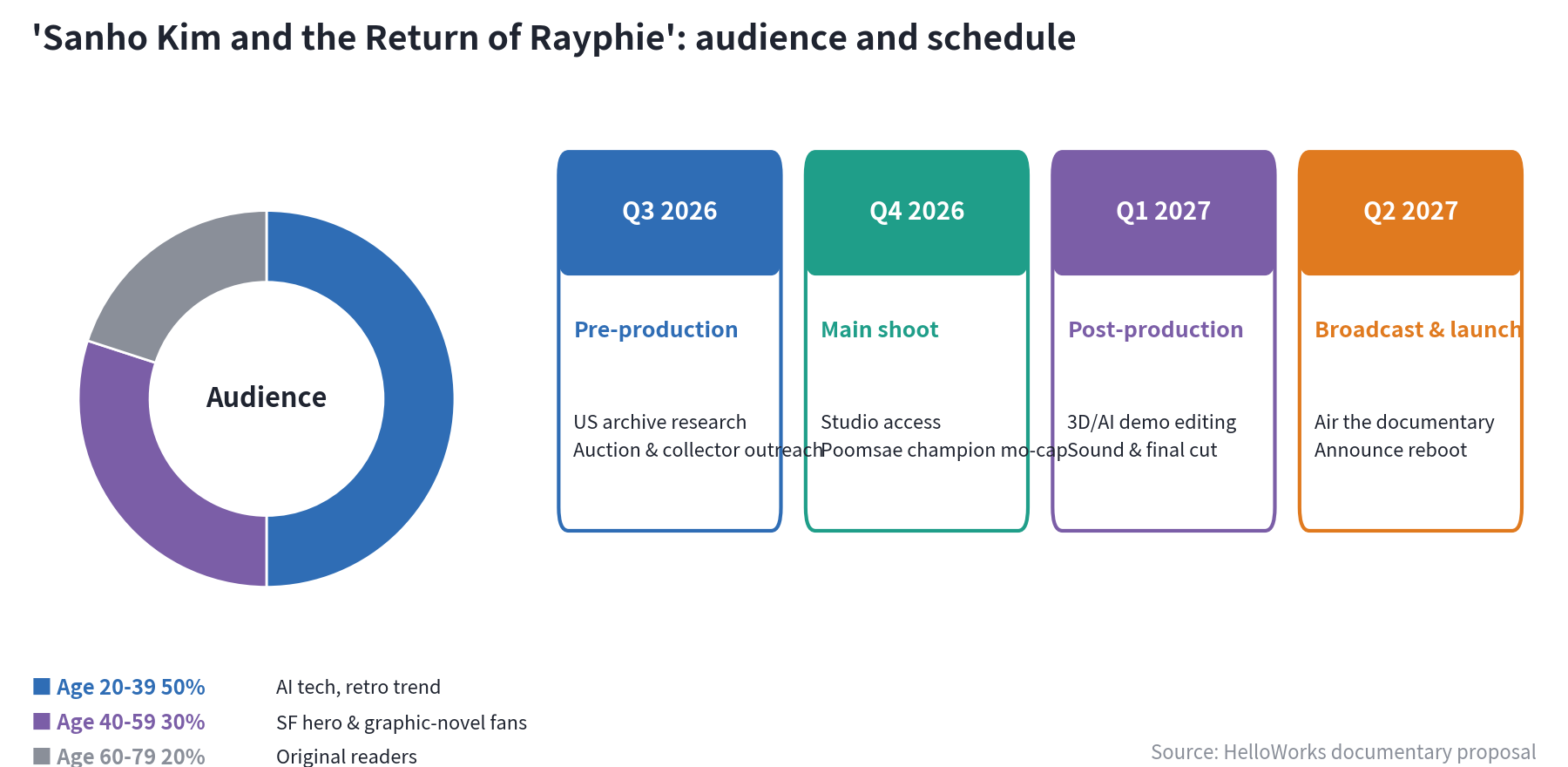
Proposed audience mix and production schedule: preproduction in Q3 2026, principal photography in Q4, postproduction in Q1 2027, and a target broadcast in Q2. The audience percentages are targets, and the broadcast is not a confirmed booking. Source: HelloWorks documentary proposal.
The schedule has four stages. In Q3 2026, the company plans to assemble American publishing materials and prepare interviews with auction and collecting sources. Q4 is allocated to filming in Kim’s studio and recording taekwondo motion capture. In Q1 2027, the team aims to complete 3D and AI demonstration footage and sound, ahead of a target broadcast in Q2. It also intends to announce the next stage of the reboot around that time. The proposal calls for UHD production, cooperation with a Korean 3D motion-capture studio, and a budget focused on archive licensing and specialized filming.
For international sales, HelloWorks plans to emphasize Kim’s American comics career and the taekwondo action concept. The documentary would introduce the creator and property, with webtoons and AI shorts intended to sustain interest afterward. Actual release dates for those projects will depend on rights agreements and production progress.
Introducing an Older Property to New Viewers
Raifai has returned through reprints and AI shorts, but familiarity differs considerably by generation. “People in their 60s tend to know it,” Koo said. Asked whether the old property could work today, he acknowledged that this remained a concern and said the script would need to change while awareness was built.
Longstanding readers and newcomers need different reasons to engage. Existing fans may focus on what survives from the original; unfamiliar viewers need a compelling reason to watch now. The documentary would seek to bridge that gap through Kim’s American career and present-day work. Exploring both broadcast and YouTube distribution would widen access, although attention to a documentary would not in itself establish paying demand for a later adaptation.
Presenting the Development Plans in Hollywood
The supplied GSH 2026 presentation and Korean-session plan place the festival at Hollywood’s TCL Chinese Theatre on October 2–4. K-EnterTech Hub’s session, focused on Korean entertainment-technology companies entering global markets, is planned for October 3, 1–3 p.m. Pacific time. The organizers describe screenings, industry panels and networking designed to connect Asian filmmakers with Hollywood distribution and business partners.
The latest supplied v12 running order schedules HelloWorks LA branch head Sam Woo at 1:05 p.m. on October 3 for a 20-minute presentation on Raifai’s revival and global IP business, followed by five minutes of questions. CopySight AI co-founder and CEO Artem “Tommy” Petrov is listed as a respondent on rights checks for AI content based on existing IP. Millennial Works then presents its overseas expansion in AI theme parks and IP experiences, with HumaAI’s Anisa Abeytia responding on US AI policy and governance. These are planned arrangements and supersede the earlier supplied running order.
From 2:05 p.m., the proposed fireside discussion has two parts. The first examines AI and rights with Petrov, Abeytia, Millennial Works and Dongguk University chair professor Samseog Ko. The second addresses global expansion with Ko, Douglas Montgomery, former Wavve Americas CEO Kunhee Park and Sam Woo. Jung Han moderates the Korean-English session, scheduled to finish at 3 p.m. with questions and a group photograph. Participant details and timing remain subject to change.
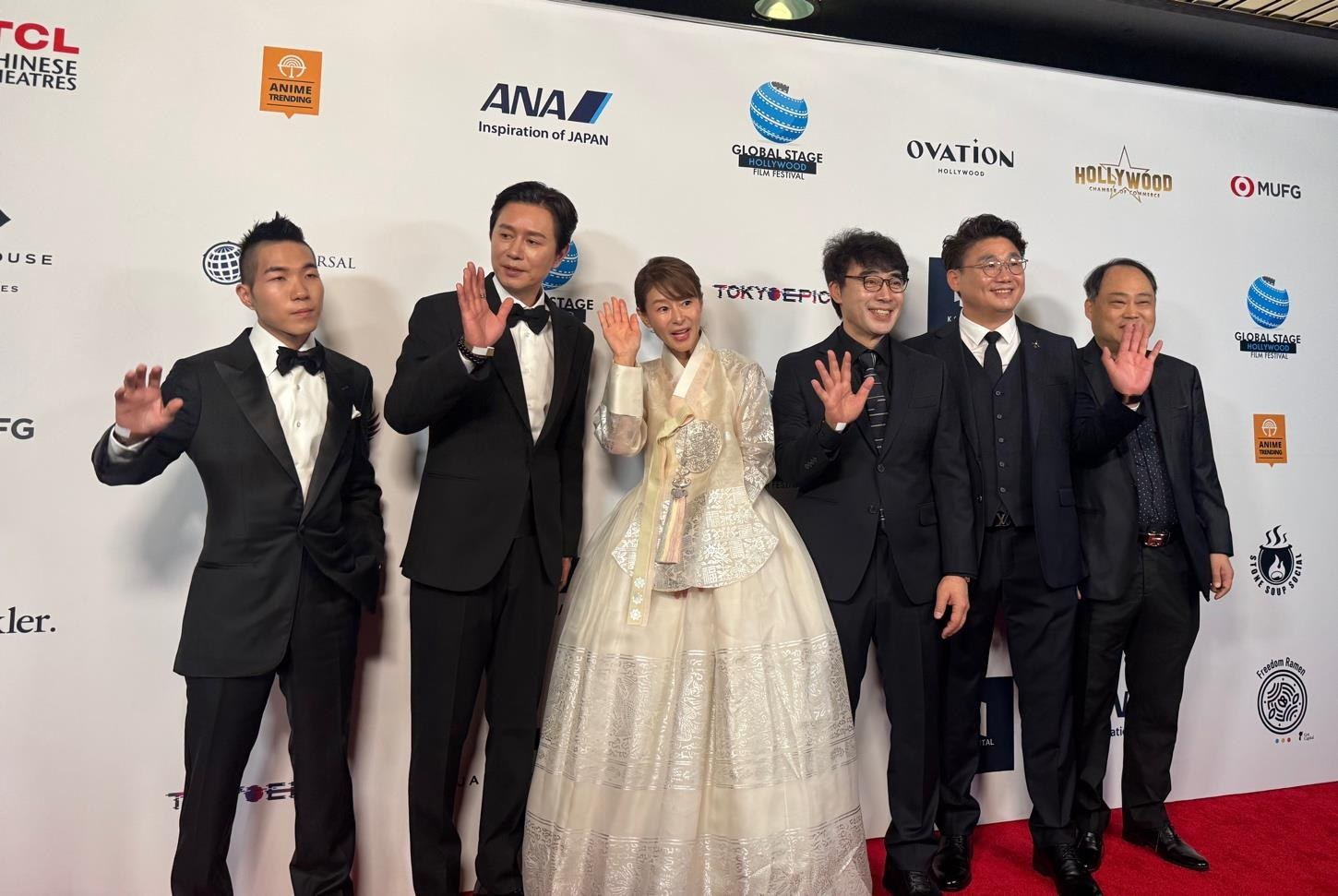
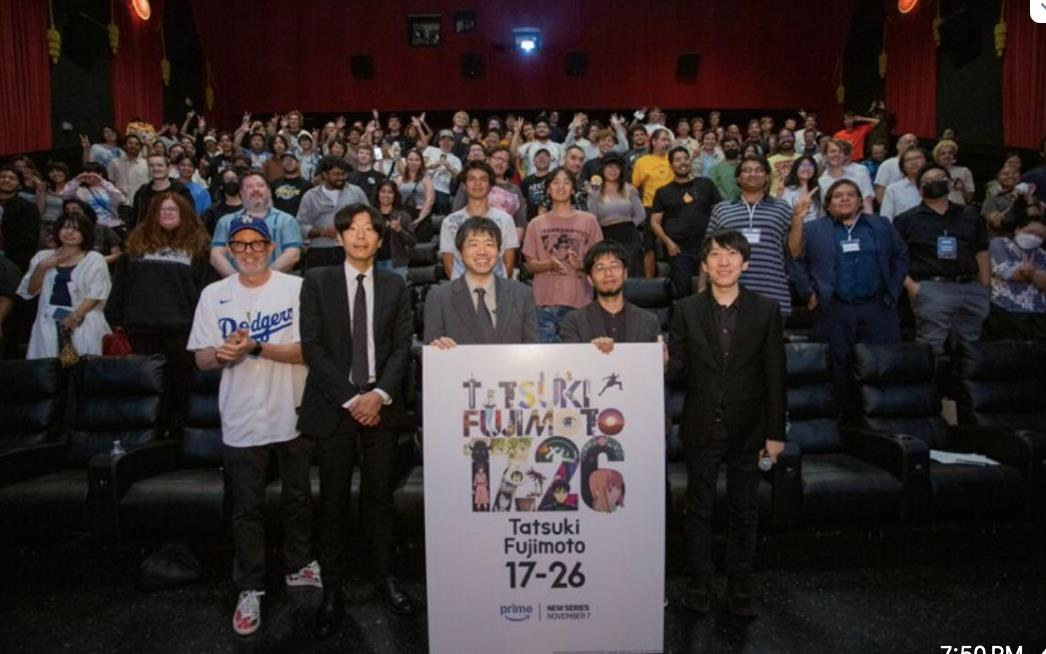
GSH’s presentation describes Montgomery’s 17 years in international distribution at Warner Bros. and his role as Parrot Analytics’ Asia market adviser. Discussion topics include platforms, broadcast channels, performances and festivals as entry routes, alongside distribution terms, revenue sharing, rights and AI-assisted localization.
For HelloWorks, the session offers a setting to present a development proposition and discuss the partners needed to advance it; a presentation is not evidence of a US distribution or financing deal.
The Korean-session plan also describes HelloWorks as jointly operating a short-drama studio with KT Studio Genie. It adds context to the company’s production base but does not specify ownership, contract duration or a joint production record.
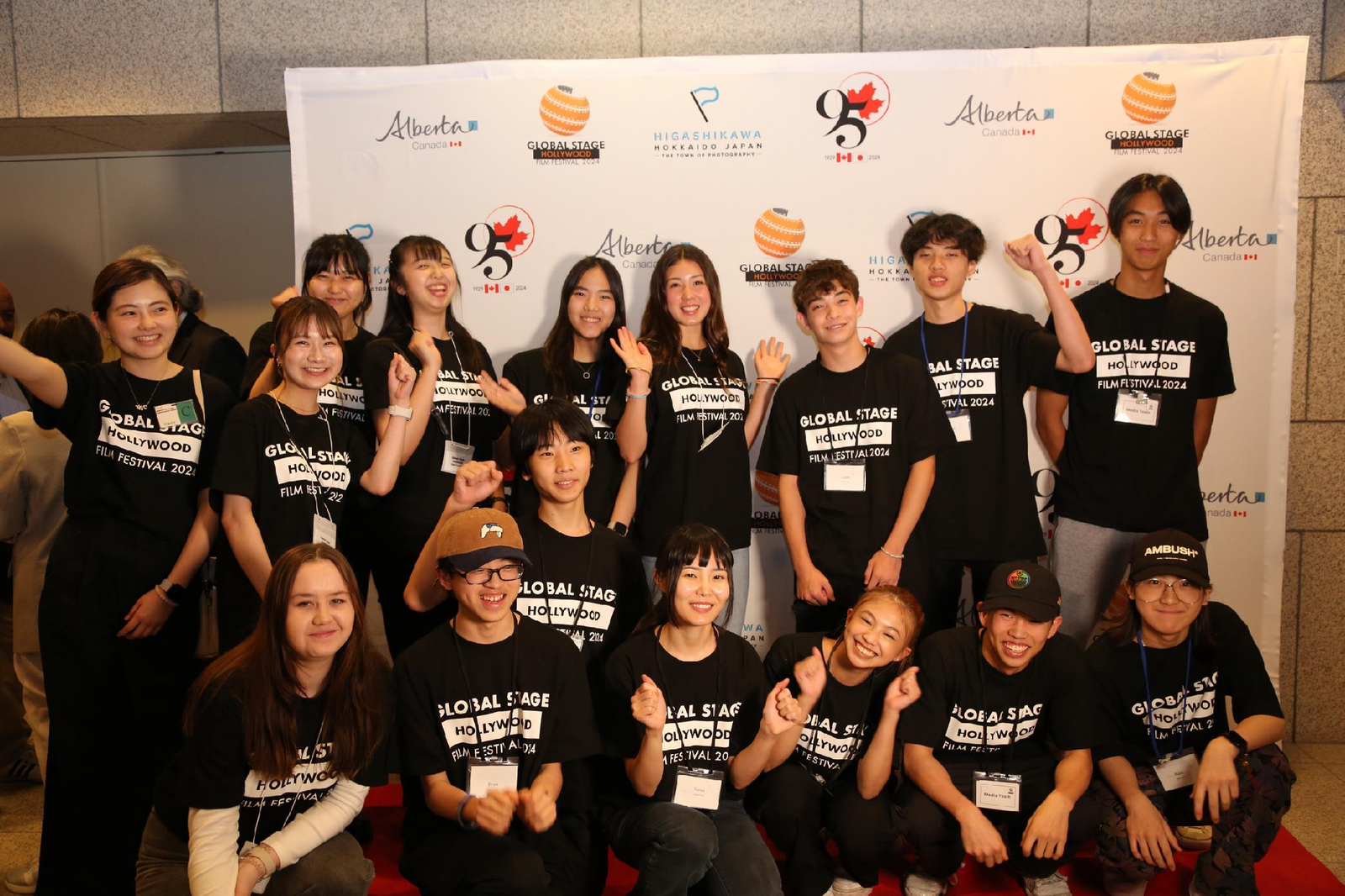
An existing event photograph reproduced in GSH’s 2026 presentation. The planned Korean session includes HelloWorks’ Raifai presentation and a discussion on international expansion. This is not a photograph of the forthcoming Korean session. Source: GSH presentation, p. 8.
HelloWorks is also discussing participation in a Local Tech Conference planned for January 7, 2027, at Caesars Palace in Las Vegas during CES. K-EnterTech Hub and Mega Exhibition are jointly organizing the event to connect local-government technology presentations with US business contacts. HelloWorks’ participation has not been confirmed.
Turning Production Experience Into Finished Work and an Audience
The company presentation describes 2025 as a year for building AI production capabilities, with goals including four short-drama deliveries, five platform partnerships, AI agent development and original-story development with webtoon and web-novel partners. Its 2026 plan calls for at least two productions per quarter and wider distribution in Korea, China and Asia. Supply to North America, Europe and Latin America is planned for 2027. From 2028 onward, the company intends to sell AI production solutions and increase upfront investment under revenue-sharing arrangements. Japan, the United States, Vietnam and Singapore are priority expansion markets. These are roadmap targets, rather than a record of completed results.
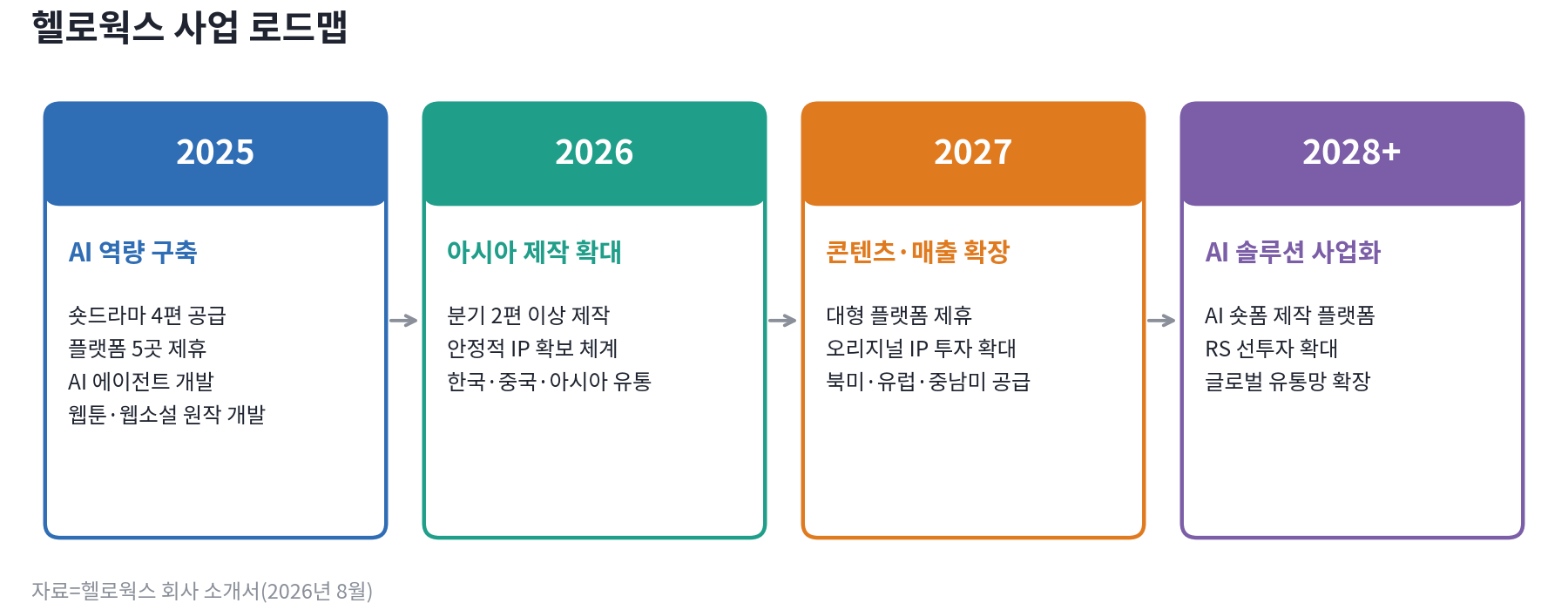
The company roadmap moves from AI capability building in 2025 to Asian production expansion in 2026, wider international supply in 2027, and AI solution commercialization from 2028. Source: HelloWorks company presentation, August 2026.
For Raifai, the first task is to define development and commercial rights with the creator. The next is to reach American viewers who do not know the property. Kim’s US career may create interest, but it does not guarantee an audience. Hollywood presentations, YouTube distribution and K-Channel 82 are possible routes that still have to become distribution agreements and actual viewing.
At the interview, Koo put progress against his annual goals at less than halfway. The US-oriented short drama, TIPS selection process and documentary shoot remained ahead. The next measures of progress will be finished releases, distribution agreements and rights available for subsequent exploitation, rather than the size of a development list alone. HelloWorks must keep delivering productions while finding a new audience for Raifai. Koo was clear about one prerequisite: “We do not pitch without a contract.”
About HelloWorks
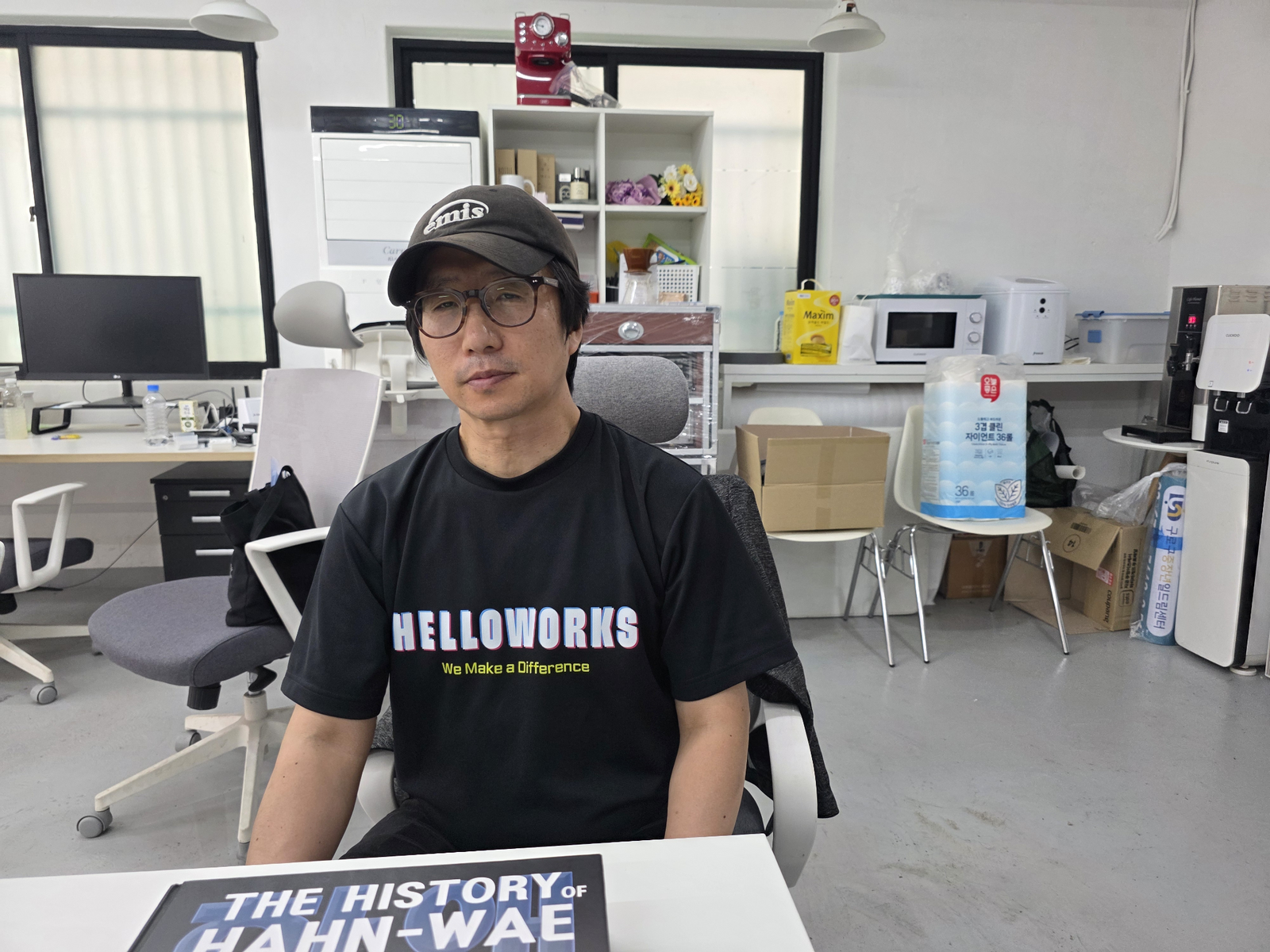
HelloWorks is an entertainment-technology-based creative studio combining IP development with video production. Founded in August 2018 and led by CEO Koo Yong-nam, HelloWorks has offices in Mapo, Seoul, and Pangyo, with a US branch in California. Its principal businesses are short-drama production and artist and content management.
Company materials list 42 original IP development projects, four AI production agents and two patent applications involving multimodal LLMs. Its management and training activities include TIMT, KANDIS, ARA ENT and LA Dance Studio in Incheon. It has supplied Daum Kakao, ReelShort, Kanta and K-Short, and is pursuing cooperation with Sinclair and China’s Keon. XRAVIO, an XR platform, is in preparation. Sources: company presentation, website and interview.
This reported interview is based on the August 29 conversation, the supplied v12 Korean article and company and event materials. Company targets and future plans are distinguished from completed results.
Interview quotations are translated from the supplied Korean article and edited for readability. Summaries of remarks and company materials, and the reporter’s analysis, appear outside quotation marks.
Disclosure: K-EnterTech Hub organized the GSH Korean session and is involved in K-Channel 82 and the Local Tech Conference, the latter co-organized with Mega Exhibition.
Company figures, including review-time reductions, production savings, IP counts, followers and rankings, are company-reported. Production, release, broadcast, funding and event schedules are identified as plans where applicable, based on the dates of the underlying materials and interview.
Sources
1. Interview with HelloWorks CEO Koo Yong-nam, Seoul, August 29, 2026.
2. HELLOWORKS Company Information, August 17, 2026. Company-supplied presentation.
3. HelloWorks documentary proposal, Korea’s First Science-Fiction Comics Artist Kim San-ho and the Return of Raifai. Company-supplied material.
4. HelloWorks company page (English) — https://helloworks.io/en/company
5. HelloWorks short-form drama and creator pages — https://helloworks.io/en/short-form-drama , https://helloworks.io/en/creator
6. VentureSquare, GAMFF 2026 AI innovation and investment presentation participants, August 30, 2026 — https://www.venturesquare.net/1109522
7. KMJ, HelloWorks presents K-Short Drama AI at GAMFF 2026, Shin Ju-baek, September 1, 2026 — https://www.kmjournal.net/news/articleView.html?idxno=13313
8. KMJ, GAMFF AI innovation and investment presentations, Shin Ju-baek, September 4, 2026 — https://www.kmjournal.net/news/articleView.html?idxno=13348
9. Chungnam Content Agency, Tokyo XR and Metaverse Fair participation, June 25, 2026 — https://ccon.kr/bbs/board.php?bo_table=news&wr_id=326
10. Kyunghyang Shinmun, Korea–China business forum MOU, January 5, 2026 — https://www.khan.co.kr/article/202601051543001
11. M Economy News, HelloWorks–Keon MOU, January 5, 2026 — https://www.m-economynews.com/news/article.html?no=63354
12. Omdia, Microdramas overtake streamers on mobile engagement, February 23, 2026 — https://omdia.tech.informa.com/pr/2026/feb/microdramas-overtake-streamers-on-mobile-engagement-says-omdia
13. Marketing Dive, coverage of Sensor Tower’s State of Mobile 2026, February 20, 2026 — https://www.marketingdive.com/news/microdrama-apps-stand-out-on-mobile-heres-what-the-numbers-say/812610/
14. Sensor Tower, State of Short Drama Apps 2025, July 2025 — https://sensortower.com/blog/state-of-short-drama-apps-2025
15. Sensor Tower, Korean short-drama app market, February 2026 — https://sensortower.com/ko/blog/the-state-of-korea-short-form-drama-app-market
16. Fox Corporation, strategic investment in Holywater, October 9, 2025 — https://www.foxcorporation.com/news/business/2025/fox-entertainment-deepens-creative-content-portfolio-and-audience-reach-with-strategic-investment-in-vertical-video-technology-platform-holywater/
17. Holywater, $22 million funding announcement, January 15, 2026 — https://www.holywater.tech/blog/holywater-raises-record-22-million-to-turn-microdramas-into-mainstream-entertainment-in-the-u-s
18. IBTimes UK, four Hollywood vertical-microdrama launches, July 22, 2026 — https://www.ibtimes.co.uk/hollywood-embraces-vertical-microdrama-four-major-launches-1810121
19. Dailian, KT Studio Genie short dramas, February 9, 2026 — https://www.dailian.co.kr/news/view/1608224/
20. KT Studio Genie press release, February 9, 2026 — https://studiogenie.co.kr/news/press/66
21. MTN, KOCCA streaming-platform short-form production support, April 6, 2026 — https://news.mtn.co.kr/news-detail/2026040616532243146
22. GTT Korea, expansion of TIPS R&D support, January 2026 — https://www.gttkorea.com/news/articleView.html?idxno=24068
23. Korea JoongAng Daily, AmazeVR and K-pop VR concerts, September 2026 — https://www.koreajoongangdaily.com/entertainment/after-metaverse-bust-kpop-is-still-betting-on-vrs-iphone-moment/12860123
24. Otakukart, TXT ENDLESS RIDE VR concert, July 17, 2026 — https://otakukart.com/tomorrow-x-together-launching-third-vr-concert-endless-ride/
25. Encyclopedia of Korean Culture, Raifai — https://encykorea.aks.ac.kr/Article/E0081432
26. Korea Manhwa Contents Agency archive, Korean Comics Classics 3: Raifai, Messenger of Justice (2003) — https://www.kmas.or.kr/archive/comics/2003018741
27. Lambiek Comiclopedia, Kim San-ho — https://www.lambiek.net/artists/k/kim_san-ho.htm
28. Electronic Times, Kim San-ho, July 10, 2009 — https://m.etnews.com/200907090105
29. The Liverary, Kim San-ho, August 16, 2024 — https://theliverary.kr/article?id=976
30. Global Epic, VikingLab and Grae’s Raifai: The Green Queen, November 28, 2025 — https://www.globalepic.co.kr/view.php?ud=2025112810154091786cf2d78c68_29
31. Lucas Museum of Narrative Art press release, September 2, 2026 — https://lucasmuseum.org/press/lucas-museum-of-narrative-art-opens-to-the-public-on-september-22-2026
32. History.com, Star Wars opens on May 25, 1977 — https://www.history.com/this-day-in-history/may-25/star-wars-opens
33. Global Stage Hollywood official website — https://www.globalstagehollywood.com/
34. Currency conversions use the source article’s reference rate of KRW 1,356 per US dollar and are approximate. Its cited exchange-rate source is Investing.com USD/KRW historical data — https://kr.investing.com/currencies/usd-krw-historical-data
35. KOCCA WelCon, HelloWorks company profile — https://welcon.kocca.kr/en/directory/company/helloworks-inc--4048
36. WIPO, How to Make a Living from Movie Copyright — https://www.wipo.int/en/web/copyright/creative-industries/how-to-make-a-living-from-movie-copyright
37. WIPO, From Script to Screen: What Role for Intellectual Property? — https://www.wipo.int/pressroom/en/stories/ip_and_film.html
38. Editorial calculations: genre shares 22/42, 10/42 and 32/42; target output multiple 10/4; quarterly revenue multiple 700/178; mobile usage gap (35.7−24.8)/24.8; forecast growth (14−11)/11. Each uses its stated company, Sensor Tower or Omdia scope and period.
39. GSH 2026 Festival presentation (supplied PDF), schedule, industry programme and executive producer profile.
40. GSH2026 Korean entertainment-technology session plan (supplied DOCX), running order, participants and company profiles.
6. CNBC, 'Netflix's Squid Game is reportedly worth almost $900 million', 2021.10.18 — https://www.cnbc.com/2021/10/18/netflixs-squid-game-is-reportedly-worth-almost-900-million.html
8. 디즈니 루카스필름 인수 발표(SEC 제출), 2012.10.30 — https://www.sec.gov/Archives/edgar/data/1001039/000119312512441509/d429302dex991.htm
9. 디즈니 마블 인수 완료 발표, 2009.12.31 — https://thewaltdisneycompany.com/press-releases/disney-completes-marvel-acquisition/
10. 르네상스캐피털, WEBTOON Entertainment IPO, 2024.6 — https://www.renaissancecapital.com/IPO-Center/News/105419/
12. 대한민국 정책브리핑, 2026년 콘텐츠 정책펀드 7318억원, 2026.1.23 — https://www.korea.kr/news/policyNewsView.do?newsId=148958466