

Hollywood's deal market has changed what it pays for. The premium no longer goes to companies that added channels and libraries, but to those holding IP, live events and audience data that generative AI cannot easily imitate. Axios reached that conclusion on Nov. 14 after mapping the businesses of more than 100 media, tech and entertainment companies.
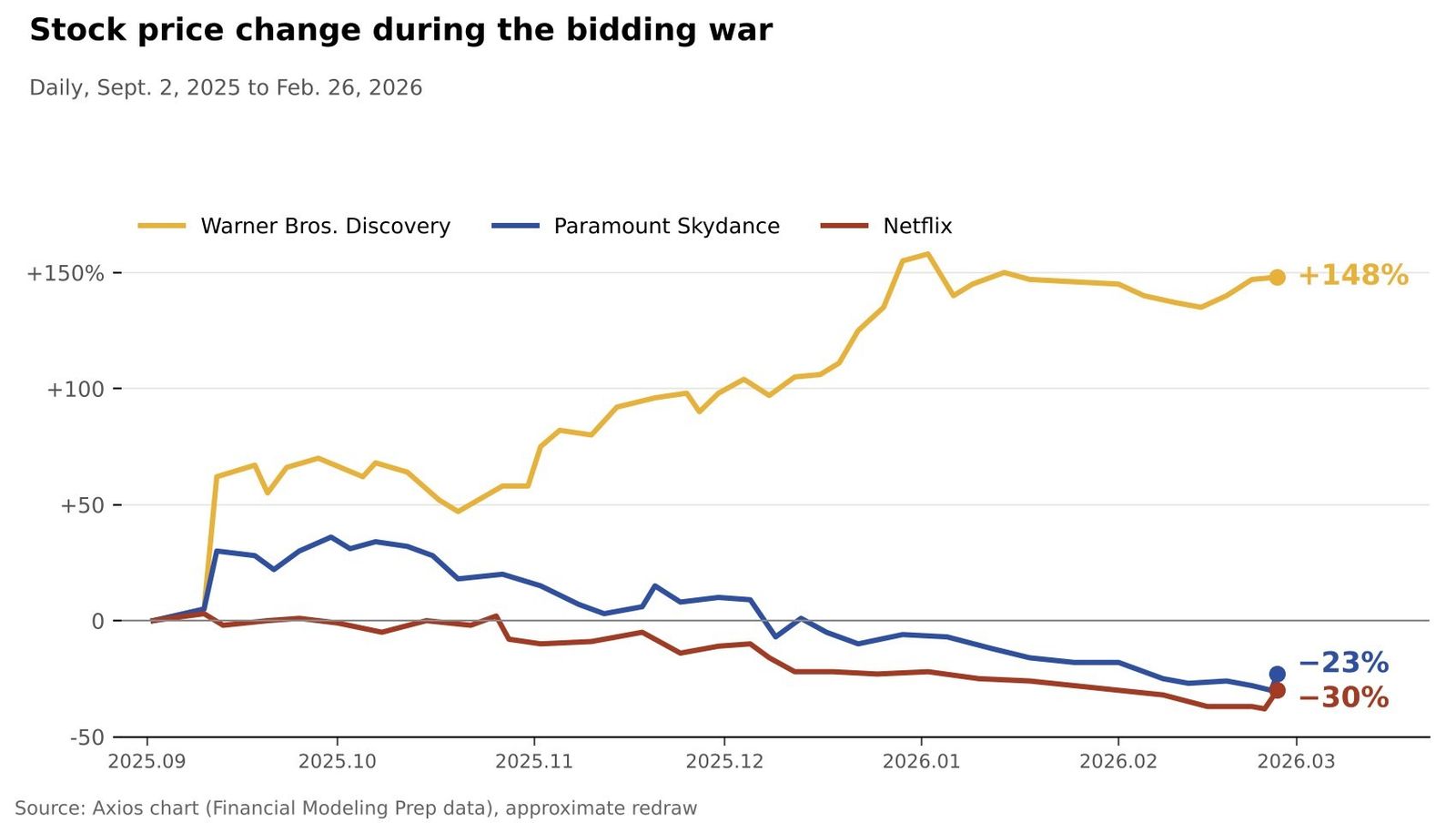
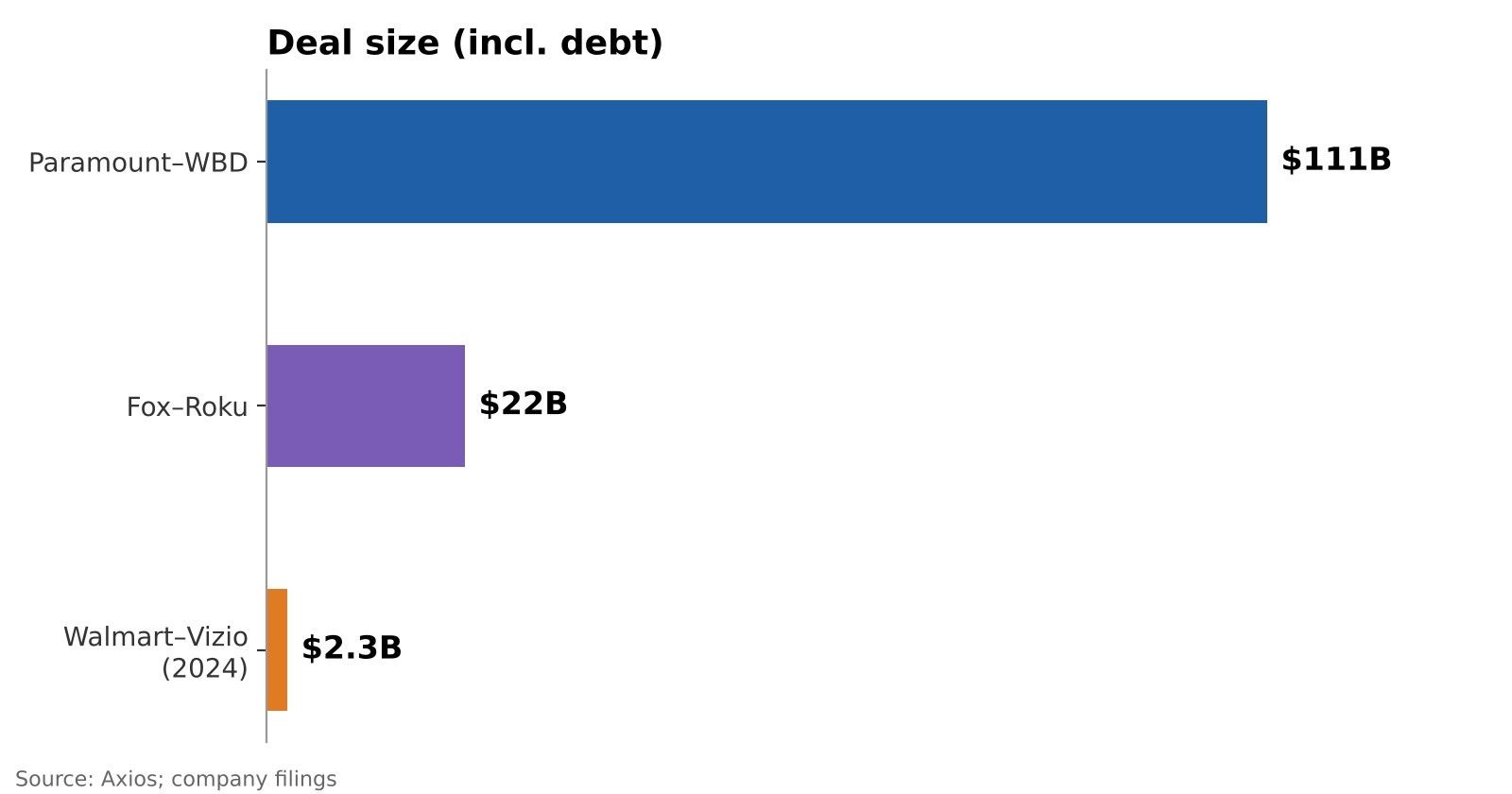
The money confirms it. Paramount Skydance completed its takeover of Warner Bros. Discovery on Oct. 6, a deal worth nearly $111 billion including debt. During the five-month bidding war, WBD's stock rose 148% while Paramount fell 23% and Netflix 30%. Fox, meanwhile, agreed to pay $22 billion not for content but for Roku's TV operating system and viewing data.
Two forces sit behind the new price logic: generative AI and the limits of viewing time. As AI lowers the cost of making video, the ability to produce a lot of content becomes common, while the hours viewers can spend do not grow. Assets whose supply cannot expand, such as franchises that have drawn audiences for decades, games and concerts that must be seen live, and the pipes and data that reach viewers, gain relative value.
For Korean media companies, this comes back to deal structure. Fifth Season, the U.S. studio CJ ENM bought in 2022 for about ₩934.8 billion, lost money for four straight years before a single Netflix hit expanded its distribution deals. Holding IP rights creates more value than buying a company. The buyers and sellers of these assets will meet at the entertainment sessions of CES 2027, which opens Jan. 6.
WBD shares up 148% in five months as Paramount's offer climbs from $19 to $31
WBD's board rejected Paramount's $19-a-share offer last September. Once Netflix entered the race for the streaming and studio assets, Paramount raised its bid several times, reaching $31 a share in cash in February, 63% above its first offer. Netflix said on Feb. 26 it would not go higher. By Axios's count, WBD added $23 billion in market value over five months.
Closing slipped once because of a lawsuit by 12 states. A federal judge approved a settlement on Sept. 30, under which Paramount committed to a five-year film production plan, $1.5 billion of investment in U.S. films and a $25 million fund to buy independent movies. The new Skydance Corp. is led by chairman and CEO David Ellison and co-CEO Ynon Kreiz, and combines three major film studios, the Paramount+ and HBO Max streaming services, and the CNN and CBS news networks.
Share prices moved in opposite directions for seller and buyers. The assets in contention were the IP of Warner Bros. Pictures and HBO, and WBD shareholders collected the premium. Axios noted that by walking away, Netflix left one competitor saddled with debt and two burdened by long regulatory reviews. WBD had also prepared to spin off its cable networks if the sale failed, as Comcast did with Versant. Mergers and splits alike are being used to separate IP that commands a premium from channels that do not.
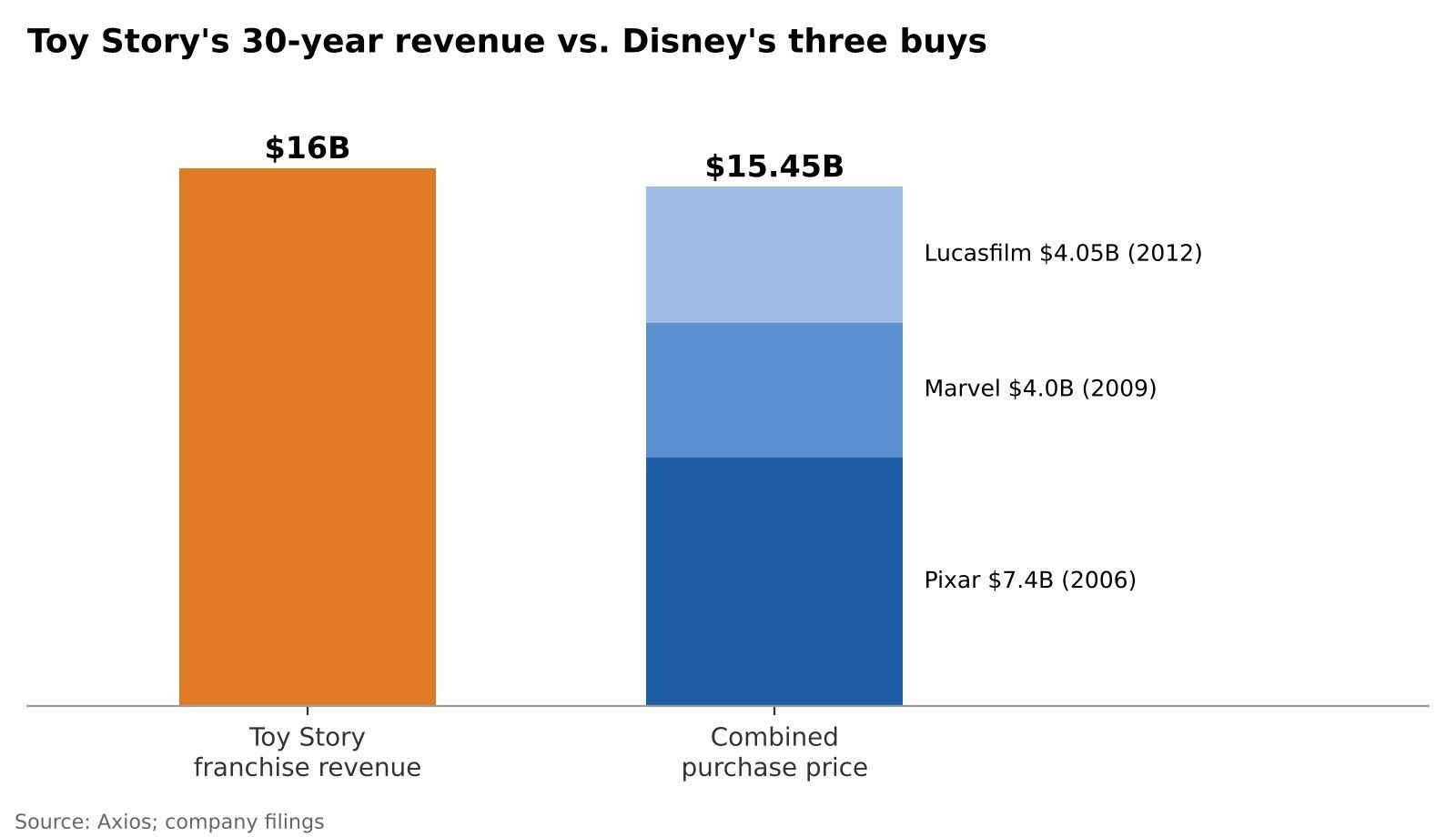
Toy Story's $16 billion in 30 years tops Disney's price for Pixar, Marvel and Lucasfilm
Between 2006 and 2012 Disney paid a combined $15.45 billion for Pixar ($7.4 billion), Marvel ($4 billion) and Lucasfilm ($4.05 billion). Axios reported in June that the Toy Story franchise alone has generated $16 billion in 30 years. After the theatrical run, the same IP keeps producing streaming, licensing, merchandise and theme-park revenue.
"Uncertainty is a value destroyer," Drew Marcus, senior adviser at Guggenheim Securities, told Axios. "How do you get comfortable investing in something where you don't know if it'll exist in five years from now?" asked Mark Boidman, head of media and entertainment at Solomon Partners. AI may make new content cheaper, but it cannot tell whether that content will draw an audience. The cheaper production gets, the more a franchise with proven demand is worth.
Big libraries are sold out, so Netflix and Disney sign proven creators
20th Century Studios, Searchlight Pictures and MGM have all been bought in recent years. Rich Greenfield of LightShed Partners said the remaining Lionsgate and Imagine are "small enough where they don't really move the needle." Specialized producers such as ITV Studios and Mediawan come up mainly as targets for studios expanding abroad.
On Nov. 2 Netflix signed comedian Druski to a multiyear exclusive development deal. His 4LIFERS Entertainment will make original series for Netflix, starting Dec. 1 with the semi-scripted comedy "Collect & Praise," based on a megachurch-pastor character from his internet sketches. Druski's YouTube videos have more than 1 billion views, and on Nov. 7 he became the first social media creator to host SNL.
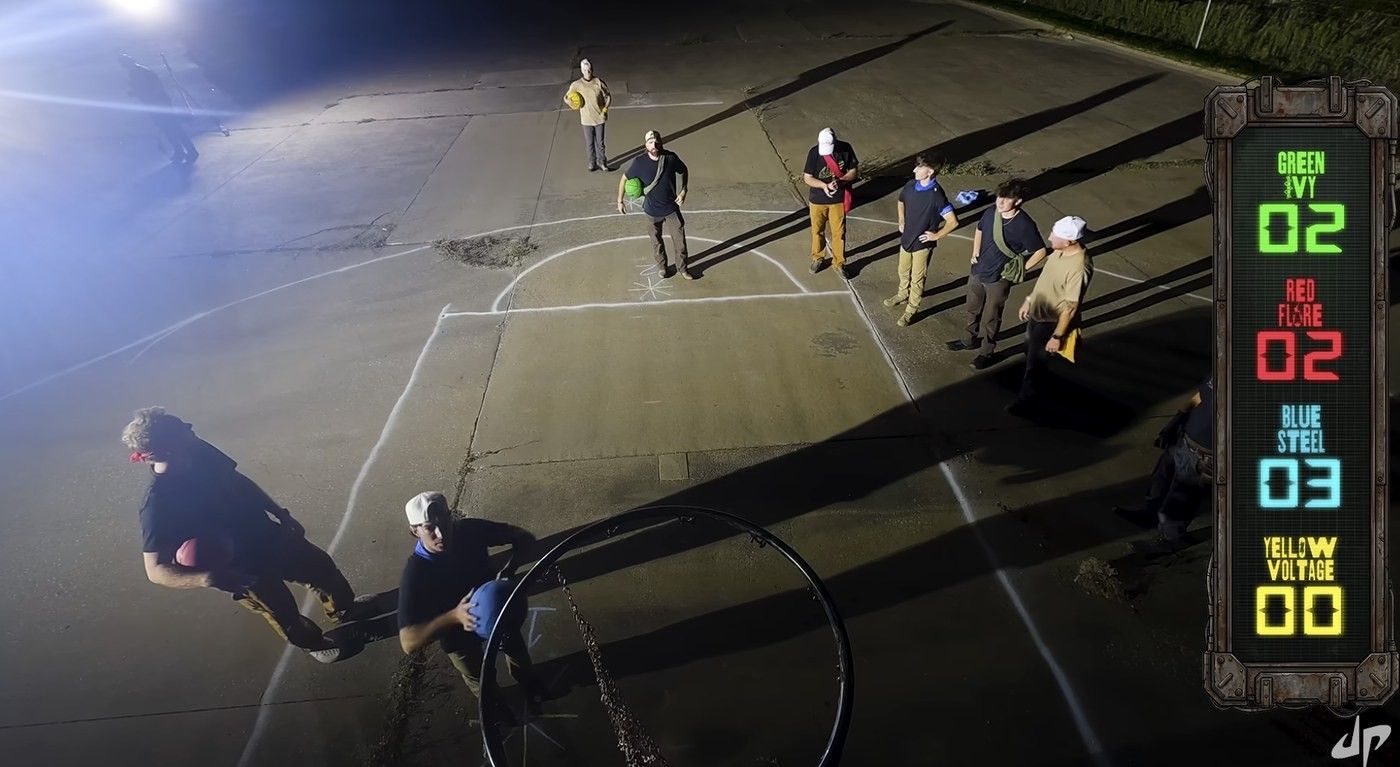
On Oct. 15 Disney announced a company-wide creative partnership with Dude Perfect. The group will make content tied to Super Bowl LXI, the 50th anniversary of Star Wars and Marvel's "Avengers: Doomsday" for its own channels, while Disney distributes some of its short-form videos on Disney+ and ESPN. Dude Perfect's video touring 12 Disney parks drew 13 million views in its first 24 hours. "I'm not saying Disney's buying MrBeast," Greenfield said, but creators "seems like the rising content category."
Both deals follow the same math as buying IP. Netflix and Disney bring in characters and formats whose audience response has already been tested on YouTube and TikTok, cutting the risk of failed originals. Disney also attaches its own franchises, turning creator channels into promotion for its IP. For streamers that can no longer buy big libraries, creators are the cheapest source of demand-tested IP.
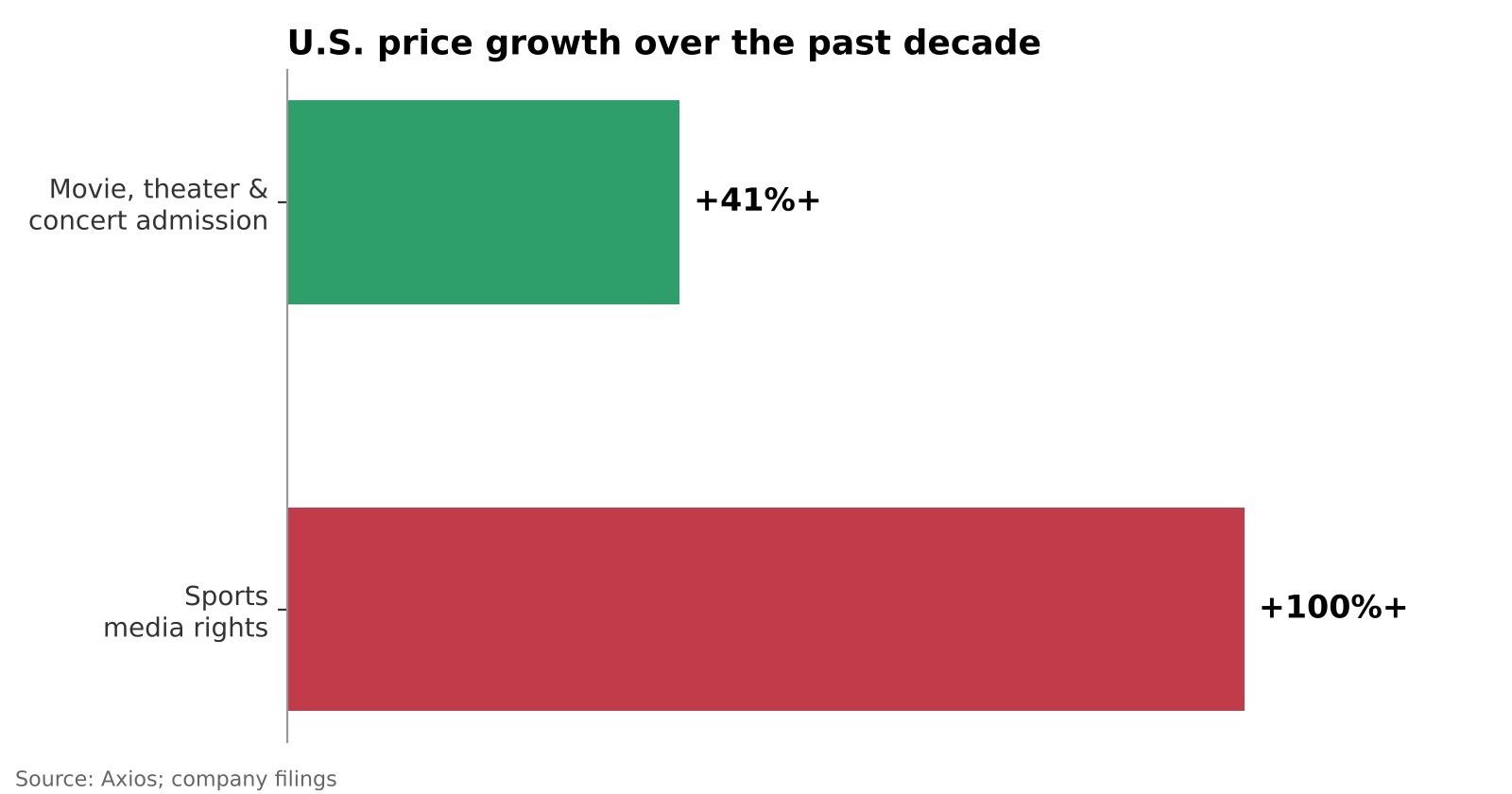
Admission prices up 41% in a decade, sports rights more than doubled
Per Axios, U.S. admission prices for movies, theaters and concerts have risen more than 41% over the past decade, and U.S. sports media rights have more than doubled over the same period.
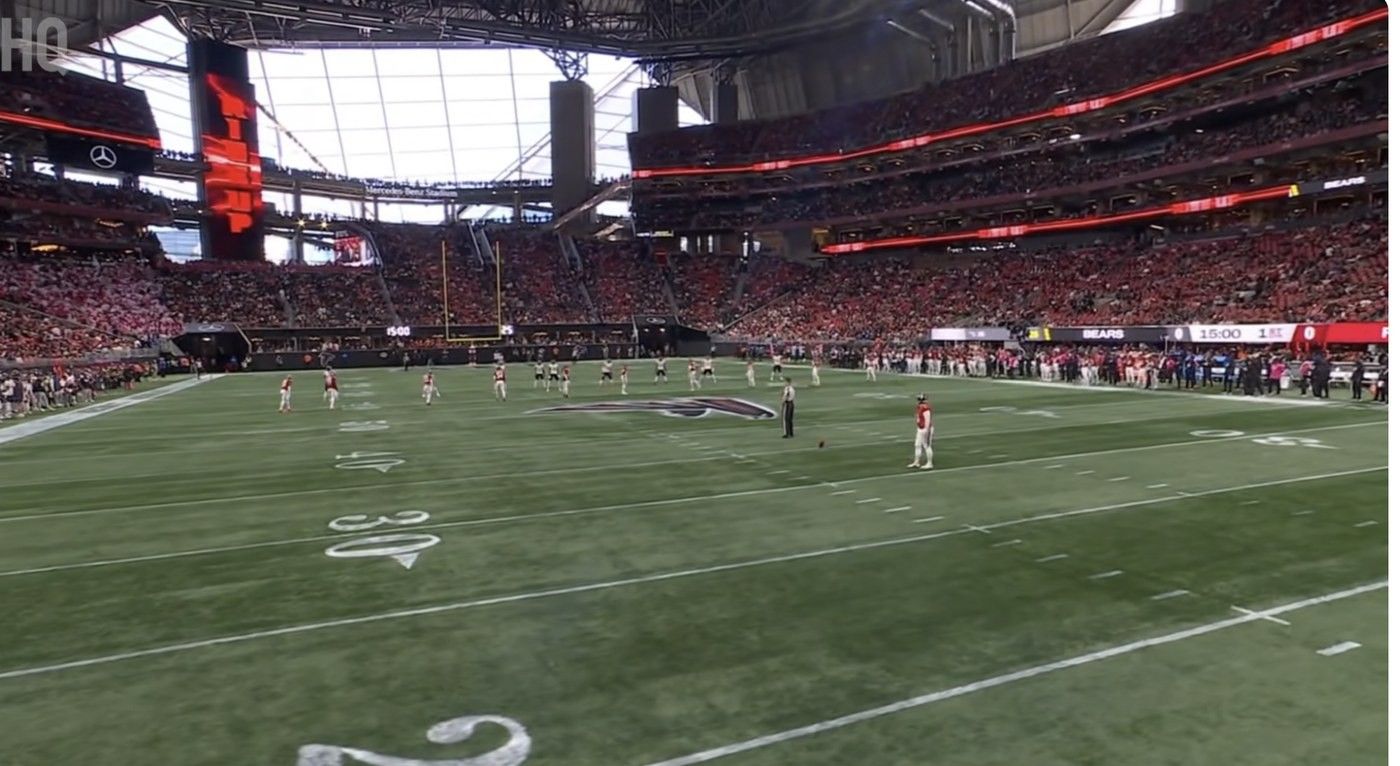
Live games and concerts cannot be produced by AI and lose value when watched later. Because their supply does not grow, every new streaming service adds a bidder and prices rise. That is why Netflix keeps adding live sports and events, and why Live Nation, TKO and Sphere are adding streaming and advertising to their venues.
Fox pays $22 billion for Roku as a content company buys the pipe and the data
On June 15 Fox agreed to acquire Roku for $160 a share, about $22 billion in enterprise value. Roku's TV operating system is installed in about 100 million households worldwide. Pairing its Tubi service with The Roku Channel makes Fox one of the largest free ad-supported streaming businesses and, by share of viewing, the third-largest player in U.S. television. Closing is expected in the first half of 2027.
Roku booked about $2.5 billion in ad revenue over the past 12 months, against $6.5 billion for Fox's linear and digital businesses. Emarketer analyst Ross Benes said the deal would more than double Fox's annual connected-TV ad revenue. Walmart's $2.3 billion purchase of TV maker Vizio in December 2024 was likewise about SmartCast's 19 million active accounts and its ad data.
Fox owns news and live sports such as the NFL and the World Cup. But in connected-TV advertising, the company that knows which screen a viewer uses and what they watch is the operating-system owner. Ad rates come from reach and data, so a company with content alone pays fees to whoever owns the pipe. Buying Roku turns that cost into an asset.
AI crawlers visit 10 times as often as search engines, squeezing outlets without direct readers
Axios argued on Oct. 17 that websites are shifting from human destinations to information hubs for AI agents. Anna Patterson, CEO of AI infrastructure firm Ceramic.ai, said AI crawlers hit websites roughly 10 times as often as traditional search crawlers, driving up publishers' costs. Axios expects companies without distinctive IP or loyal audiences to be squeezed first, speeding consolidation.
At Time, human visitors get articles with imagery and storytelling while AI agents receive structured information, COO Mark Howard told Axios, and Time's Agent Ads extends that to advertising with machine-readable sponsor information. "There's a risk that you could lobotomize all the LLMs because there's just tons of synthetic data that no human is ever going to read," said investor Joe Marchese.
In the search era, ads sold when people clicked. When AI agents read articles on their behalf, clicks fall and only the crawler costs remain. Outlets with direct readers and distinctive IP can sell experiences to people and data to machines. The logic that has Hollywood buying IP and pipes is working the same way in news and on the web.
Even Google and Amazon cover only 11 of 14 categories; live events belong to specialists
On Axios's map as of Nov. 12, Google and Amazon each operate in 11 of 14 categories, from books to telecom. Tencent has 10, and Disney, Skydance, Comcast and Fox nine each. None of them is in sports and live events.
That category is held by Live Nation, TKO, Sphere and MSG Entertainment, by Netflix with its live push, and by The New York Times, Bloomberg and The Economist through their events. Further down are EA and Take-Two (games), Reddit and Discord (social), Universal Music and Warner Music (music), book-only Abrams and W.W. Norton, and film-only Neon. Private equity firm KKR appears in books, audio and live events.
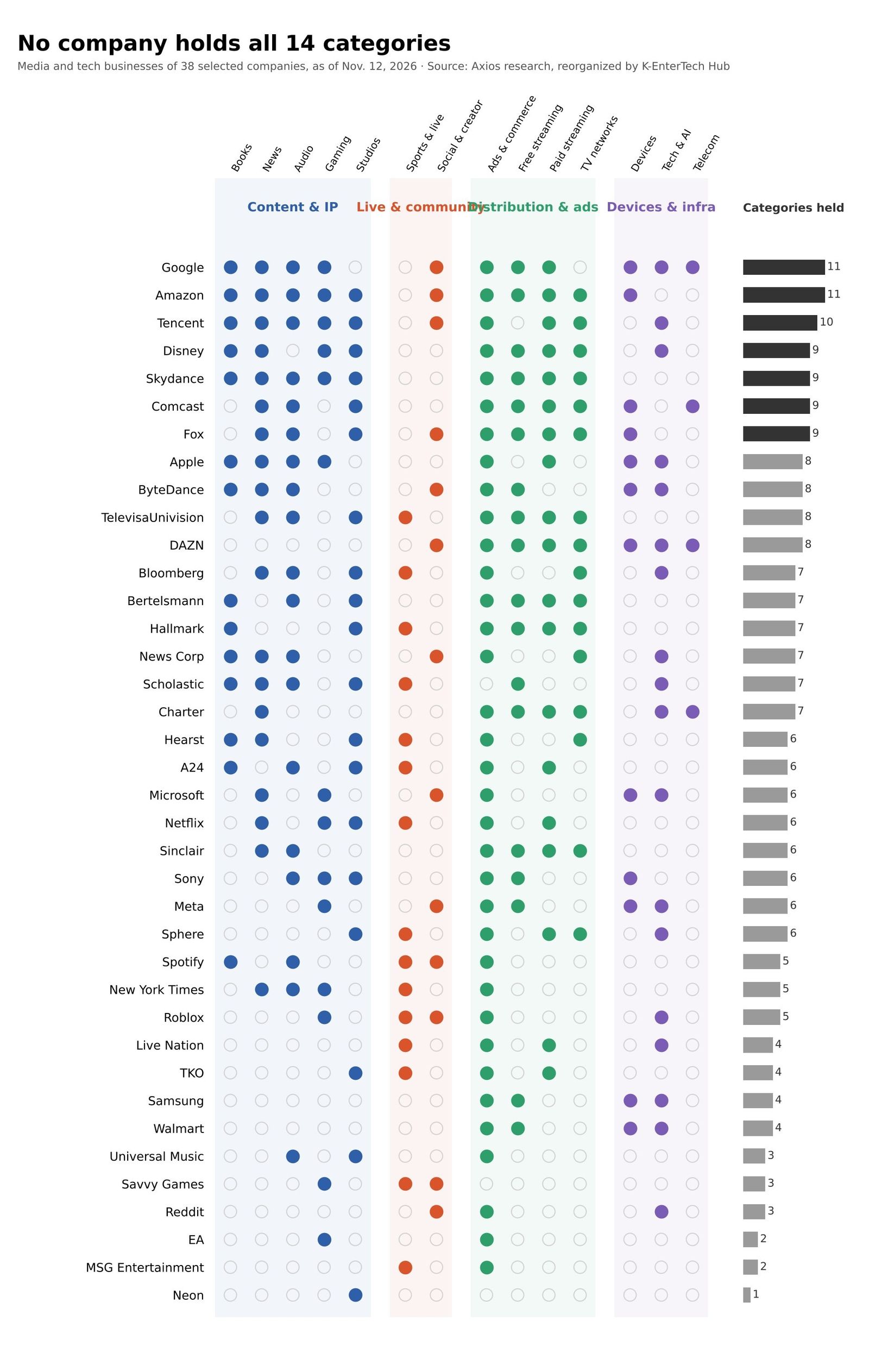
The broadest companies have left the live column empty. Specialists that hold that column, or a single deep asset in music or games, line the bottom of the map. When the giants try to fill their gaps, these are the companies they can buy, and future prices are likely to be set by how scarce the asset is rather than how many categories a company spans.
Netflix's closed game studios and Fifth Season's four years of losses: buying a company did not bring the IP
On Aug. 13 Netflix closed Oxenfree developer Night School Studio and Helsinki-based Moonloot. Night School, Netflix's first studio purchase in 2021, shut six weeks after releasing "Unhinged." After selling Spry Fox back to its founders in December 2025, Netflix owns only one studio, Next Games. Axios also notes that James Patterson's novels have been runaway successes, but their screen adaptations have not.
CJ ENM bought 80% of Endeavor Content in 2022 for $785.4 million and renamed it Fifth Season. Fifth Season has posted losses for four years, with cumulative operating losses of ₩168.4 billion and goodwill impairment of ₩146.8 billion, Korea's Dealsite (딜사이트) reported. Its series "His & Hers" then ranked first among all series in Netflix's first-half 2026 report with 104 million views, and Fifth Season went on to sign an original-content distribution deal with Roku.
In both cases, buying the company did not mean buying the IP it would produce. Netflix hired game makers but did not create game IP tied to its series; Fifth Season lost money for four years before its hit arrived. Buying production capacity buys the chance of IP, with no set date for when that chance turns into cash.
Kakao Entertainment pools 16,000 IPs while the TVING–Wavve merger stalls
On Aug. 12 Kakao Entertainment (카카오엔터테인먼트) voted to merge its story subsidiaries Samyang C&C, Intime and Pilyeon Management. After North American webcomic platform Tapas, it is liquidating its translation unit and pooling some 16,000 IPs at home. HYBE (하이브) is prioritizing localized groups in North America and elsewhere over buying outside IP.
The TVING (티빙)–Wavve (웨이브) merger, meant to pool subscribers to take on Netflix, was conditionally approved by the Korea Fair Trade Commission in 2025 but had not closed as of February because shareholders including KT Studio Genie had not consented. The regulator's price freeze runs through year-end. While Kakao Entertainment has turned from buying platforms to IP, Korea's largest streaming deal is still about getting bigger.
What it means for Korean media companies: IP rights, live assets, direct relationships
Korean broadcasters and producers have typically made Netflix originals on cost-plus terms, receiving production costs plus a margin and handing over the IP. Box-office upside, later seasons and derivative rights stay with the platform. With global buyers paying premiums for proven IP, how much of the IP stake, secondary rights and overseas remake rights a Korean company keeps at signing now shapes its valuation.
Live content belongs in the same calculation. Pro baseball rights and K-pop concerts cannot be made by AI and are limited in supply in Korea. If broadcasters secured co-production and stakes in live businesses rather than trading rights for short-term programming, they could build at Korean scale the position Fox and Live Nation hold in the U.S.
Creators and reader relationships can be secured for relatively little money. Signing co-production and distribution deals early with YouTube creators whose audiences are proven would reduce the risk of failed originals. As AI agents read the news for people, member data and direct visitors become what protects ad rates. Fifth Season's four years of losses and Kakao Entertainment's restructuring are Korean evidence that holding these three kinds of rights comes before buying companies.
Samseog Ko (고삼석), a distinguished professor at Dongguk University and a member of the Presidential Council on National AI Strategy, made the same point in a keynote at ICNX 2026 in Incheon on Nov. 4. "It is difficult to imagine the future of content without AI, or the global competitiveness of the AI industry without content," he said, according to SBS. In the lecture, he described the shift in stages: "Just as CG was once used in films, dramas and music videos, we're moving past using AI as a tool to combining AI with IP," he said, adding that using AI with IP to create new content and added value "is becoming a way to transform the industry's value chain." "What matters now is not why we should combine K-content and AI, but what and how we should combine them." Ko argued that the coevolution of content and AI creates new IP, business models and global markets, and that Korea should move beyond exporting content to an open ecosystem in which overseas companies and creators plan, produce and share results together.
CES 2027 opens with Digital Hollywood on Jan. 5, where the dealmakers for scarce assets gather
CES 2027 runs Jan. 6–9 in Las Vegas. C Space spans ARIA, Vdara, The Cosmopolitan and Park MGM, which the organizer calls the central hub for the marketing, advertising, content and entertainment industries. The Creator Space in the Las Vegas Convention Center's Central Hall runs three days of sessions on the creator economy and brand partnerships.
On Jan. 5, CES conference partner Digital Hollywood returns to ARIA for its 28th year with a program on cinematic AI, the creator economy, streaming, microdramas and Hollywood IP. Its session "Super Creativity Studios: The Future of Hollywood Brands" argues that the definition of a studio has changed, from MrBeast to reimagined film and TV studios to indies. The parties to the IP, creator, live and distribution deals in this story gather in these sessions more than on the gadget floor.
The "CES 2027 Entertainment Tech Insight Tour," run by K-EnterTech Hub and smartcms, follows that route: pre-show site visits and Digital Hollywood sessions on Jan. 5, and a Jan. 7 CES tour centered on C Space and the LVCC Central Hall Creator Space. That afternoon's UNLV EnterTech Summit brings experts from Adobe, Microsoft, NVIDIA and Hollywood studios, with pitches from Korean entertainment tech companies and a K-Culture Zone. Participants receive the "CES 2027 Entertainment Tech Report," analyzing Digital Hollywood and other key sessions. Early registration closes Dec. 15. Details are in the K-EnterTech Hub shop; inquiries go to Emilia Nam (남현정), CEO of smartcms.
Fox–Roku review and Skydance integration are the first tests in early 2027
The first test next year is the review of Fox–Roku, where U.S. authorities are expected to examine effects on connected-TV advertising and content distribution. Skydance has pledged at least 30 theatrical releases a year and must honor its five-year production plan with the states. With few large libraries left, creator deals are likely to spread from Netflix and Disney to other streaming services.
In Korea, merger talks between TVING and Wavve are expected to resume when the price freeze ends early next year. As AI lowers production costs, deal markets are likely to put an even higher price on IP, live events and direct audience relationships that are hard to copy. What Korean companies should check in Las Vegas in January is how much global players are spending on these three assets, and on what terms.