
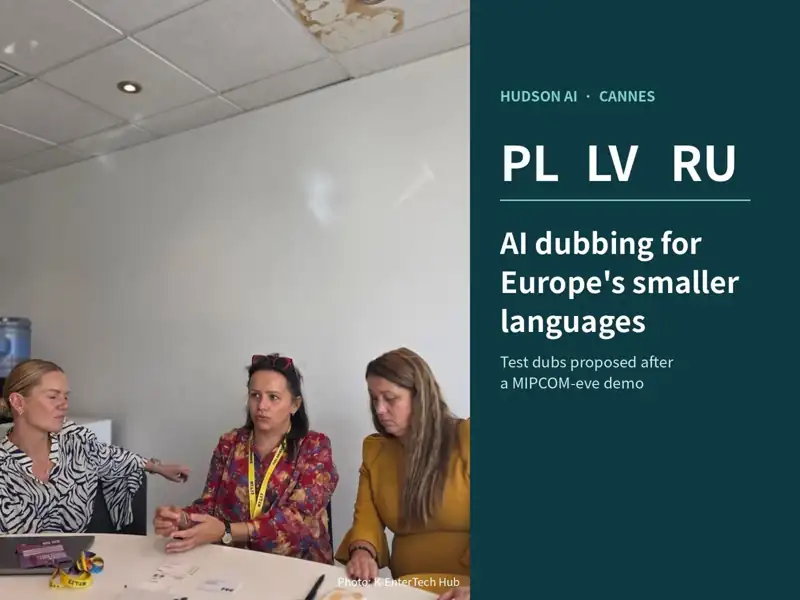
In brief Korean AI dubbing firm Hudson AI demoed drama, animation and live baseball dubbing to European and US distributors in Cannes on October 11, the eve of MIPCOM. The Europeans called it "really very high quality," and Hudson proposed ten-minute Latvian and Polish test dubs.
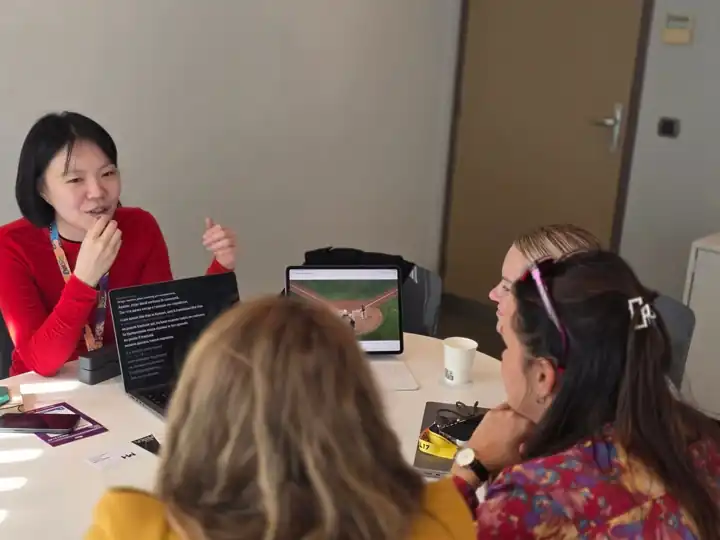
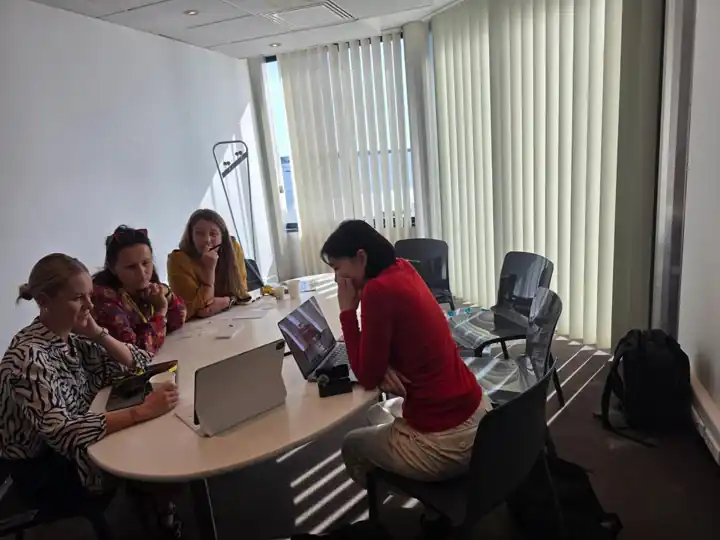
CANNES — Hudson AI (허드슨에이아이), a Korean AI dubbing company, put its technology in front of European and US content distributors at the Palais des Festivals on October 11, the day before MIPCOM 2026 opened. The demonstration was the centrepiece of a closed-door Korean Content & Entertainment Tech roundtable hosted by K-EnterTech Hub (케이엔터테크허브).
Chief executive Shin Hyun-jin (신현진) ran through an English dub of a CJ ENM drama, the animated series Pororo (뽀로로) in Japanese, an Italian version of the English-language film Charade and a live AI dub of a Korean pro baseball (KBO) broadcast. She finished with live interpretation for meetings, her Korean coming out in Russian and Polish as she spoke.
Around the table were Karina Rompa, a former Rakuten TV executive who founded Warsaw consultancy Media Hansa; Inga Alika, a media and streaming strategy consultant who runs Alika Media and Tech in Riga; Martyna Dobrzańska, head of partnerships at Warsaw TV agency Media Spurs; and Young Jin Park (박영진), co-founder of Los Angeles studio Park Star Media. All three Europeans buy content and place channels with telcos and pay-TV operators for a living.
The Europe they described is a map of languages. Poland has about 300 pay-TV operators and Latvia about 70, and in Latvia a Russian dub cannot go out without a Latvian version alongside it. After hearing the tool render sobbing and other non-verbal sounds, Alika said: "It's really very high quality. Now we only need to check if you have our own languages."
Tears, Pororo and live baseball: Hudson Studio in more than 80 languages
Hudson Studio, the company's dubbing tool, uses in-house audio AI to separate dialogue, transcribe it, translate it in context, synthesise speech and match lip movement in one workflow, across more than 80 languages. Each line can carry an emotional direction such as "lovely" or "annoyed, shouting", so the original performance survives the dub. The company is also building "agentic localisation", in which the AI grades its own acting and translation and flags lines to fix; in the demo, lines the AI judged acceptable turned green.
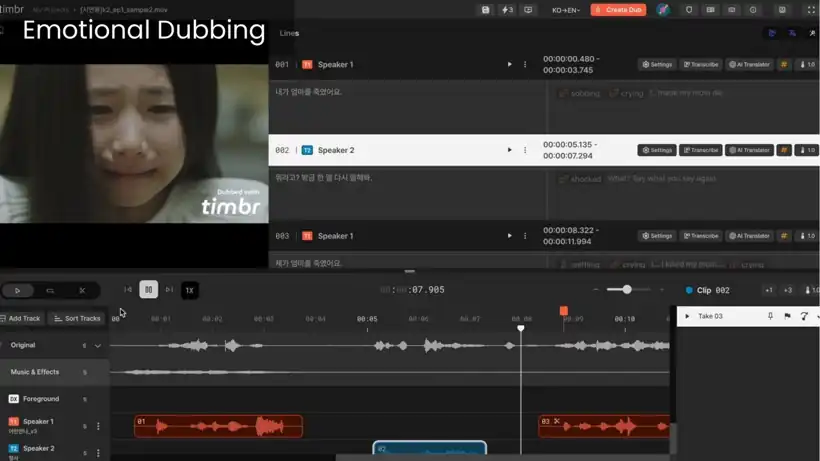
Hudson has made international versions with Korean media groups including CJ ENM, SBS and KOCOWA (코코와). It processed 30 dramas, or 500 hours of broadcast dubbing, in about three months, Byline Network reported in February. With LG Electronics it produced English, Spanish and French AI dubs of the drama The Tale of Lady Ok (옥씨부인전) for LG Channels viewers in Europe; LG Electronics president Park Hyung-se (박형세) told Newsis the work took more than 60 percent less time than conventional dubbing.
"A really good Polish": Latvian-plus-Russian dubbing a potential "game changer"
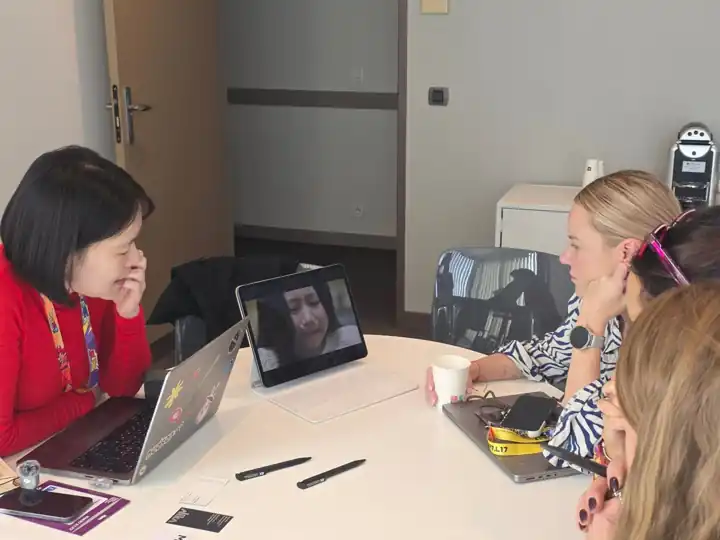
The reactions came as the demo went on. Alika called the Japanese Pororo "very amazing" and the emotion-matched drama dub "impressive". When the Polish interpretation came through, Dobrzańska said: "It's a really good Polish."
The strongest response came where the technology met a local business problem. If Hudson could produce original, Latvian and Russian versions at once, Alika said, it would be a "game changer" for many local channels. Newcomers to the Latvian market will not pay for localisation, she explained, and when a dominant operator localises a title itself, the rest of the market gets nothing. Demand is not the issue: in 2019 Korean content was the most pirated content in Latvia.
Smaller languages were the test. "It's always a problem with AI dubbing companies that they are not able to support the smaller languages," Alika said. "Polish is not so small. Every language is not small," Dobrzańska added, saying Polish partners need a Polish version. Shin said Hudson technically supports more than 80 languages but quality varies by language; its strongest are Korean, Japanese, Chinese, English, Latin American Spanish, Portuguese, German and French. The company sells a subscription tool without human review and a managed service in which a native speaker checks every title.
The American view pointed the same way. Park said dubbing is where Korean animation stumbles in the US: studios make high-quality animation but sometimes skimp on English dubbing, and the right tools and proper-quality voices are what parents and buyers look for first.
300 operators in Poland, 70 in Latvia, and Western European FAST revenue up 76% by 2031
The Europeans named free ad-supported streaming (FAST) as the first route in. For viewers who have never seen Korean content, Rompa said, a free channel has "no blocker". Research firm 3Vision expects Western European FAST revenue to grow 76% from $1.9 billion in 2026 to $3.4 billion in 2031, Señal News reported in August.
The catch is language and plumbing on the receiving end. Italy and Spain expect local-language versions; the Netherlands and the Nordics accept English. Many telcos lack server-side ad insertion and so cannot carry FAST channels at all. Dobrzańska's agency places international channels with Polish and Central European operators and has just started selling microdrama and five unlocalised sports channels. When Shin mentioned Hudson's work with Japanese broadcasters on minor sports, Dobrzańska said she would raise the idea with the people she was meeting the next day.
Double the watch time, triple the clicks: Hudson Studio and Hudson Live
Hudson opened its MIPCOM showcase with the line "You don't need more content. You need more languages." The audience scanned a QR code, picked a language and heard the talk in it. By the company's own measures, AI-dubbed versions get twice the watch time of subtitled ones, AI-dubbed thumbnails and titles get three times the click-through rate, and total viewing hours across a catalogue grew 180-fold. It did not disclose the period or platforms measured.
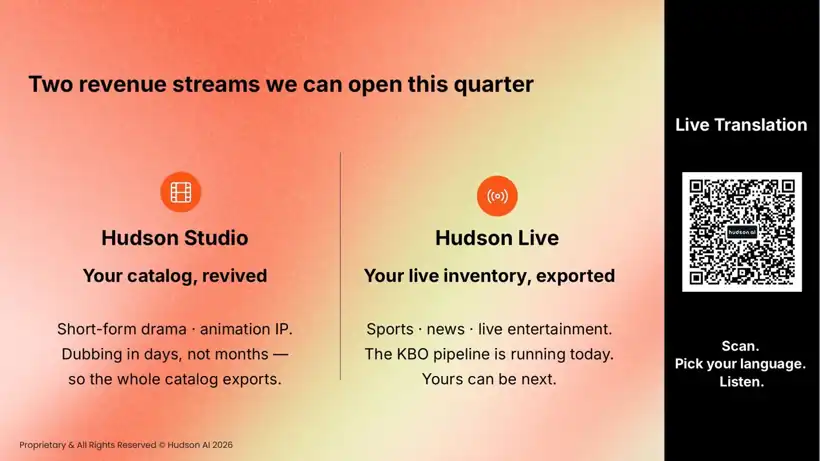
The pitch has two parts. Hudson Studio dubs short-form drama and animation catalogues in days rather than months. Hudson Live sends sports, news and live entertainment out in several languages in real time — the deck called live TV "the most-watched hours on television, sold in one language at a time." Hudson has already dubbed KBO games live for viewers in the US, New Zealand and Australia.
Leading a K-Dance channel for K-FAST, as Europeans flag "great potential for K-dance"
Hudson leads the consortium building CJ ENM's K-Dance flagship channel this year under the Global K-FAST Alliance, run by Korea's Ministry of Science and ICT (과학기술정보통신부) and the Korea Association for ICT Promotion (KAIT, 한국정보통신진흥협회). Last year alliance members AI-dubbed about 1,200 Korean titles into English, Spanish and Portuguese to create 20 K-FAST channels, which run on Samsung TV Plus and LG Channels in 22 countries and had reached about 100 million cumulative viewers by the end of April, Newsis reported. This year three consortia are building four flagship channels at about 230 million won ($172,000) each. Localisation is "the key task" for taking K-FAST into wider markets, Shin told Money Today in July.
The genre came up again in Cannes. "Everybody wants to win a younger audience, so it's a great potential for K-dance," Alika said, noting how hard it is for European telcos and pay-TV operators to reach young viewers. Rompa recalled K-pop dance crews crowding a Korean brand event in Warsaw and said K-pop concerts sell out every time.
Korean broadcasters face the same arithmetic. Korea's broadcast and video exports were $1.257 billion in 2024, Herald Economy reported, while domestic TV advertising fell 5% that year to 3.2191 trillion won ($2.4 billion). CJ ENM Studios chief executive Ken Oh said in the MIPCOM opening keynote that per-episode drama budgets in Korea have tripled in five or six years, ContentAsia reported. When a show has to sell in more countries and languages to earn back its cost, Polish and Latvian become the next stop for dubbing that has so far been aimed at the Americas.
Ten-minute Latvian and Polish test dubs proposed; NEM in Dubrovnik in June also on the table
Shin proposed a test of about ten minutes in Latvian and Polish, using a vertical drama, an animation or a drama, and the Europeans said they would check the translation quality once there was something to see. Dobrzańska said she plans to pitch Korean content and microdrama to Polish telcos and TV platforms and would visit Hudson's stand, R8.C7. During MIPCOM Hudson continued buyer meetings there and at the AI dubbing wall of the K-FAST Alliance stand.
Rompa pointed to NEM, the market held each June in Dubrovnik, Croatia, as the door into Central and Eastern Europe; Alika called it "the MIPCOM of Central and Eastern Europe". Rompa said KOCCA (한국콘텐츠진흥원) has been discussing a Korean pavilion there with the organisers and has recently opened an office in Warsaw. In Cannes, the route for Korean AI dubbing beyond the Americas came with specific languages and a specific market attached.
Exchange rate: $1 = 1,337 won. Quotations are remarks from the roundtable (K-EnterTech Hub recording) or reported remarks; unquoted text summarises them. The 2x, 3x and 180x figures are Hudson AI's own measures.
Sources
· Byline Network, Hudson AI updates Hudson Studio (Feb 25, 2026)
· Newsis, LG Electronics and Hudson AI dub The Tale of Lady Ok (Mar 27, 2026)
· Newsis, Global K-FAST Alliance results (Jul 9, 2026)
· Money Today, Science ministry expands K-FAST Alliance (Jul 9, 2026)
· Señal News, Western Europe streaming forecast (3Vision, Aug 17, 2026)
· Herald Economy, 2024 content exports (Feb 26, 2026)
· ContentAsia, Ken Oh MIPCOM keynote
· Hudson AI MIPCOM 2026 showcase deck; K-EnterTech Hub roundtable recording, Cannes (Oct 11, 2026)