
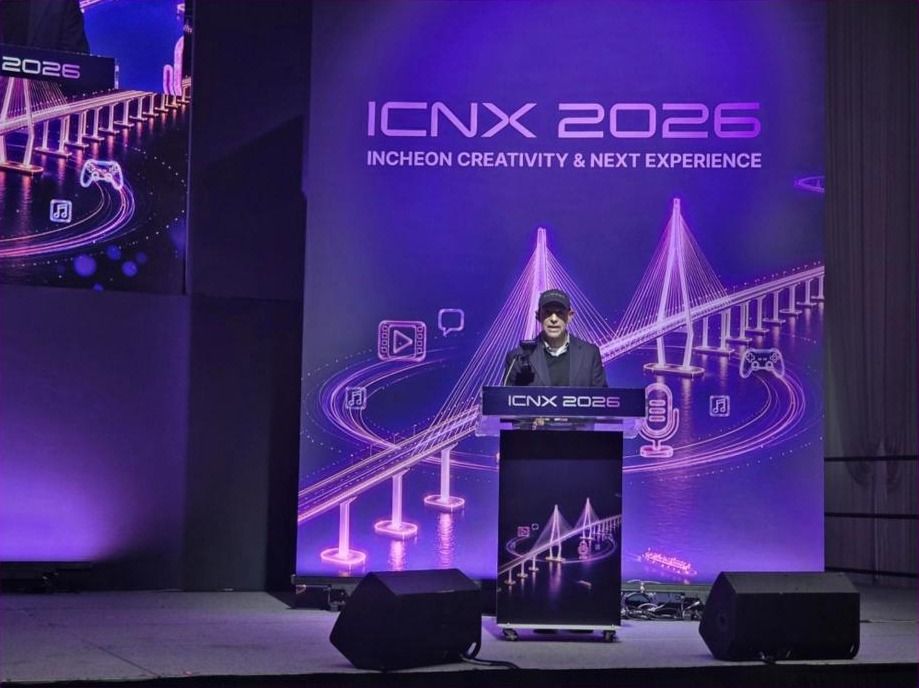
Adobe's Darren Frankel at ICNX 2026: "It is not AI versus not AI. It's ethical versus unregulated"
Adobe's Darren Frankel told ICNX 2026 on Nov. 3 that AI in post moves at the speed of trust, not technology. He set ethical AI, which owns or licenses its training data, against unregulated AI, and called localization AI a big opportunity for Korean content if humans check nuance and honorifics.
Darren Frankel, Head of Film & Television at Adobe, put one word at the center of his keynote at ICNX 2026: trust. "AI adoption in post will move at the speed of trust, not the speed of technology," he told the opening day of the conference (Incheon Creativity & Next Experience) at Songdo Convensia (송도컨벤시아) in Incheon, Korea, on Nov. 3.
The talk, titled "AI in the Edit Bay: Building Trust and Why it Matters," drew on a career spent in the cutting room. Before joining Adobe, Frankel was head of post-production and visual effects at Marvel Television, and he helped build the episodic division of Framestore. He told the audience he had worked on "literally hundreds of shows."
His starting point was the handoff. A director gives an editor months of footage, performances captured once and a vision for the story. "AI enters the room as a new collaborator, and the first question every editor asks is: can I trust it?" he said.
Six days later, on Nov. 9 at Adobe MAX in Miami Beach, Adobe and The Walt Disney Company announced a multi-year strategic alliance naming Adobe an Official AI Innovation Partner of Disney. Adobe also joins StudioLAB, the Walt Disney Studios' innovation hub, to explore internal creative workflows — the kind of relationship where the trust Frankel described becomes a condition of doing business.
Good at interpolation, weak at interpretation
Frankel began by questioning whether today's AI is intelligent at all. "It's why no one says a library is intelligent," he said: a repository of information is not comprehension. AI can create frame B from frames A and C, but it struggles when an editor has A, B and C and wants D. "Cutting is about rhythm, emotion and subtext," he said. "These are judgment calls, not pattern-matching problems."
He also gave a case where AI earned its place. A VFX supervisor working with an A-list director was asked to make static trees in a practical shot look as if they were whipping in the wind, with no budget to roto the actors and build CG trees. A vendor did it with AI, the team upscaled the result with Topaz, and the shot was improved where "the alternative would have just been not to do it." Even so, Frankel said most AI use in VFX is still in previs, animatics and storyboarding rather than final pixel, because models struggle with resolution, duration, color space and, above all, consistency.
AI paralysis or AI aggression… draw the line at ethics
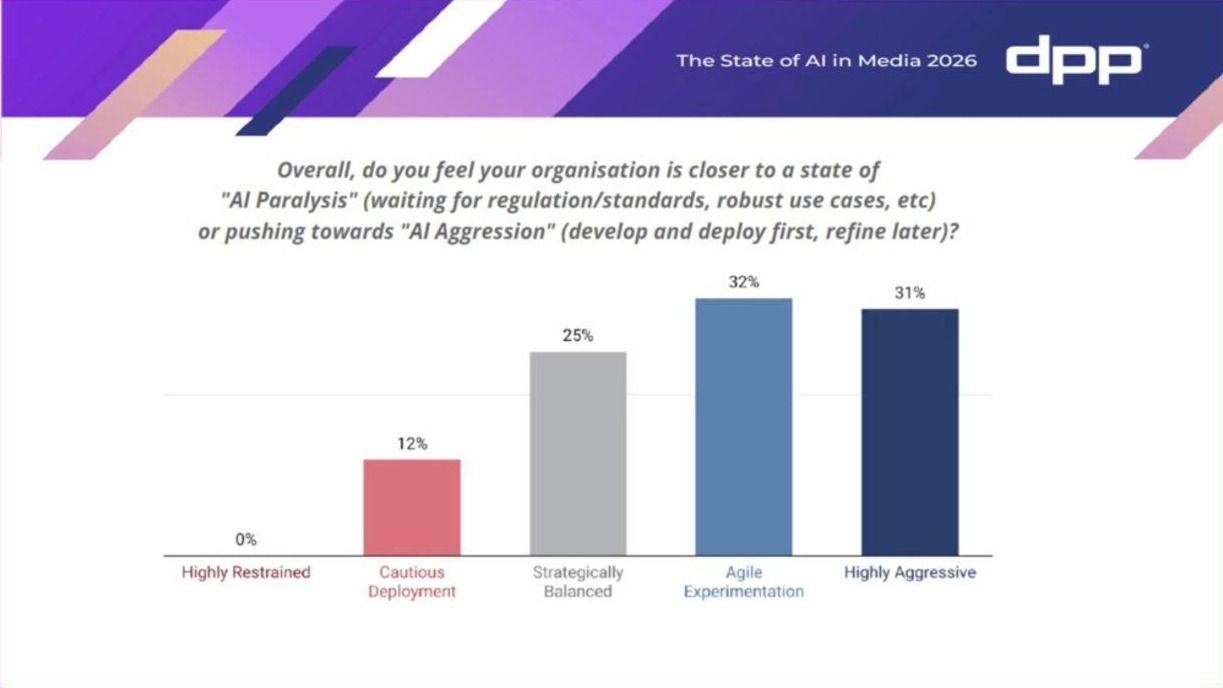
Frankel said the industry is splitting into those who treat AI as the solution and those who call it the enemy. In a DPP survey he showed, asked whether they were closer to "AI paralysis" or "AI aggression," 32% of media companies chose agile experimentation, 31% highly aggressive, 25% strategically balanced and 12% cautious deployment. None said highly restrained.
"Most people draw the line on AI in the wrong place," he said. "It is not AI versus not AI. It's ethical versus unregulated." Unregulated AI, in his words, "is the smash-and-grab thief who comes in, takes everything they want and doesn't pay the bill," while ethical AI owns the asset or a license to use it for training. "If we don't protect IP, there's no industry left."
Trust is contractual… legal, security and E&O
Frankel stressed that trust is not only a creative matter. Studios and streaming services carry legal, security and errors-and-omissions requirements, along with delivery specifications and distributor obligations. "Trust isn't just a creative question, it's a contractual one," he said. Editorial teams ask whether their judgment will still be valued; legal teams ask what a model was trained on and who owns the output; security teams ask where the footage goes.
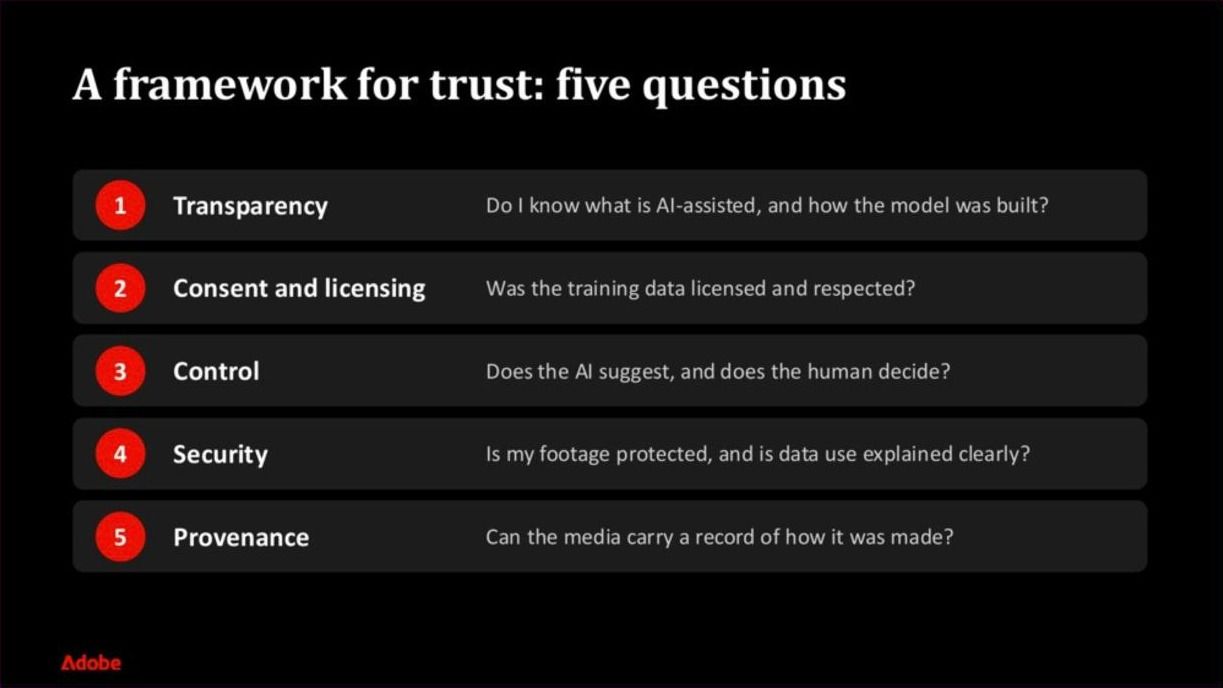
He proposed five questions: transparency (do I know what is AI-assisted and how the model was built?), consent and licensing, control (does the AI suggest and the human decide?), security, and provenance (can the media carry a record of how it was made?). "Ask vendors hard questions about training data, data use and controls," he said.
Assistive AI takes 50–75% of the drudgery
The biggest misunderstanding he encounters, Frankel said, is conflating assistive and generative AI. "Much of the most useful AI in editorial is unglamorous," he said, listing transcription, scene detection, audio cleanup, conforming, organization and database building. His favorite target is "the 50 to 75% of many people's jobs that never should have had a human in the first place." Time saved on repetitive work, he said, "becomes time returned to the creative work."
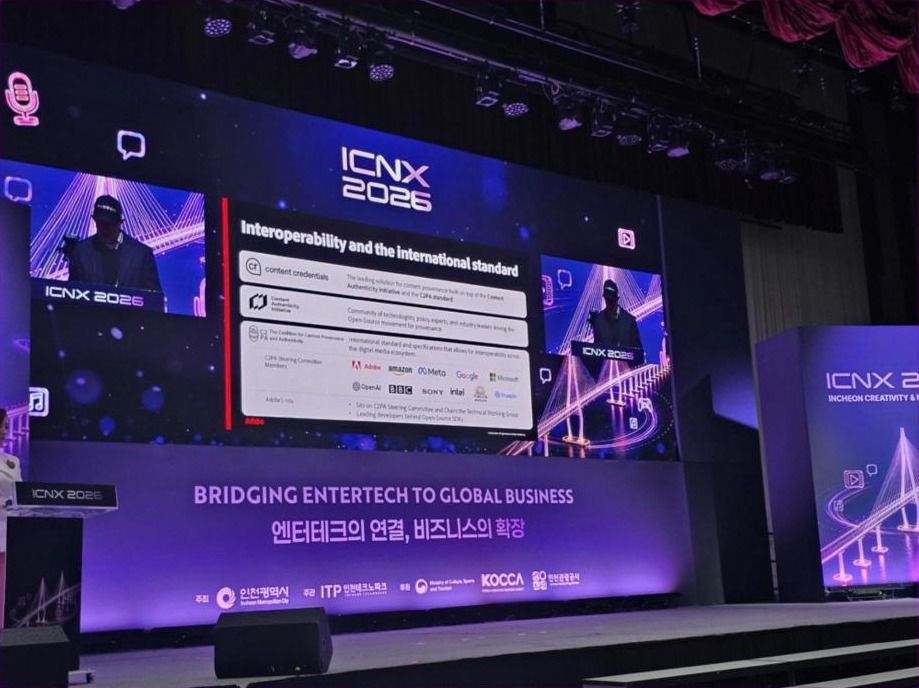
On generative tools, he urged producers to use open standards such as the Content Authenticity Initiative and the C2PA to keep content credentials "front and center." Adobe sits on the C2PA steering committee and chairs its technical working group. He cited recent studies in which more than 75% of people said AI-generated content should be disclosed, and called agentic workflows, which let users stay model-agnostic and work in natural language, the most useful part of the AI revolution.
Korean content exports hit $14.9 billion… localization needs human review
Late in the talk, Frankel turned to Korea. "There is an incredible opportunity in territories like Korea," he said. "Korean productions travel to every market, so localization AI is a huge opportunity." Better translation, subtitling and dubbing, he said, have helped good content earn regardless of where it was made or what language it was shot in. Korea's Ministry of Culture, Sports and Tourism (문화체육관광부) said on June 2 that the country's content exports reached a record $14.9 billion in 2025, a provisional figure.
He attached a condition. "Achieving that kind of success with the original content comes down to trust," he said. "Accuracy in Korean transcription and translation matters. Nuance, honorifics and tone can be lost. Human review is essential." Pointing to The Great British Bake Off, remade in 40 territories, he added that exported IP can create "a financial flywheel of success."
For Korean broadcasters and producers, the message is about sequence: adopting subtitling and dubbing AI comes with a review step for honorifics and tone, and with contract language on training data and data use. Frankel also described Hollywood as "the new Detroit" — an industry that took its position for granted while filmmaking hubs outside Hollywood grew quickly.
Outlook: with Disney, trust becomes a contract term
Adobe's alliance with Disney shows how the trust Frankel described is moving into deal terms. Adobe will give Disney early access to Firefly, Firefly Foundry, Premiere and Photoshop, along with dedicated engineering support, and co-innovation projects with StudioLAB and ESPN Edge are already under way.
In Korea, too, the criteria for choosing AI tools are likely to shift from raw performance to training-data licenses, ownership of outputs and how AI use is disclosed. Once those items enter the delivery requirements of global distributors and streaming services, content credentials and review records become part of the export paperwork. Frankel closed with a question and an answer: "How do you build trust? By being trustworthy."