

DEAR.AI co-founder Jayce Tham at ICNX 2026: "every creative decision is based on data," ReelShort spends 55% of revenue on marketing, and free ad-supported apps now hold over half of China's market
DEAR.AI co-founder Jayce Tham told ICNX 2026 that short-drama apps sell the moment viewers can't wait. ReelShort's US users stay 35.7 minutes a day, but it spends about 55% of revenue to win them. Broadcasters hold the reach and IP apps lack, she said, and should test with vertical prequels.

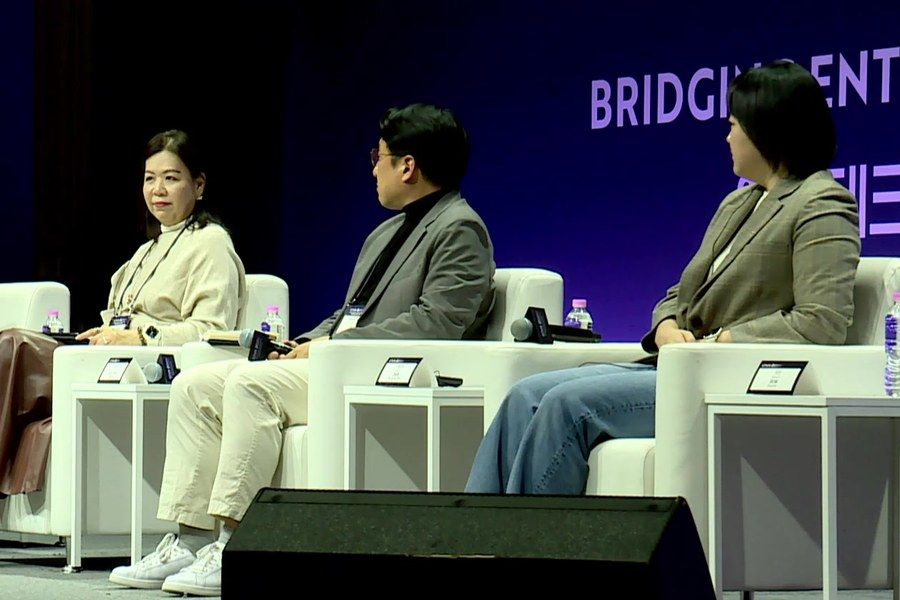
What vertical short dramas actually sell was the subject of the first talk at ICNX 2026 Session 4. Jayce Tham, co-founder of CreativesAtWork and DEAR.AI, broke down the economics of pay-per-episode short drama on Nov. 4 at Songdo Convensia (송도컨벤시아) in Incheon and laid out what broadcasters can take from it.
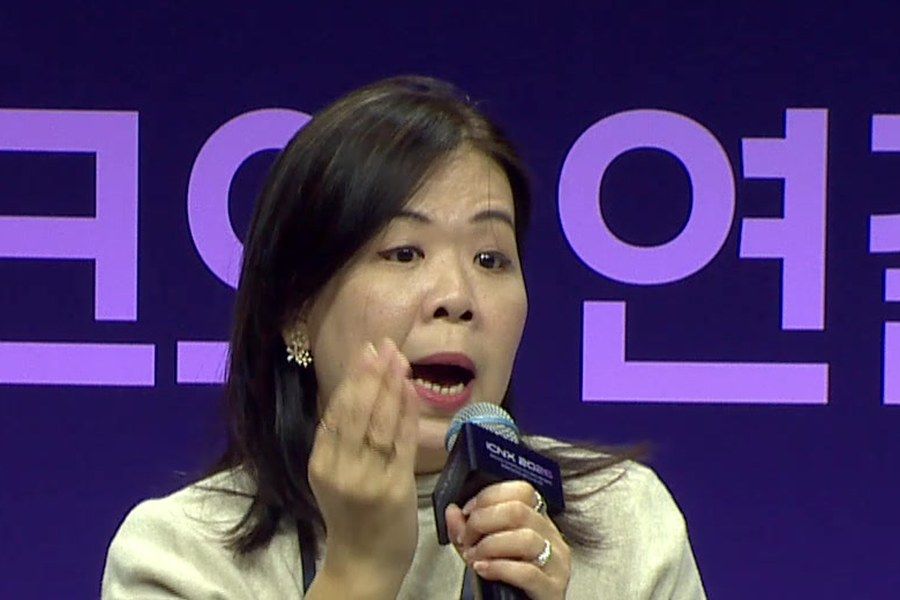
CreativesAtWork, founded in Singapore in 2012, is a freelance-based production company with offices in Indonesia, Malaysia and Vietnam. In 2024 Tham started DEAR.AI, Singapore's first full AI content production studio, with freelance directors, producers and writers. "We are a group of filmmakers that believe in leveraging the technology," she said, adding that humans always decide what gets made and what reaches audiences.
AI vertical dramas for DramaBox: 78 minutes in three weeks, 90 minutes in five
DEAR.AI has delivered two AI vertical dramas to DramaBox. "The Dragon King's Succubus Bride" ran 78 minutes and took three weeks; "Pearls from a Broken Heart" ran 90 minutes and took five. Tham said DramaBox, ReelShort and DramaWave are the top three vertical short-drama platforms in the US.
Brands are a new source of demand. DEAR.AI made a 15-episode series of roughly two minutes each for a major Thai gaming company to drive downloads. Broadcasters across Southeast Asia, she added, are turning past IP into bite-size vertical formats sold directly to consumers.
Seven free episodes, then $0.18 each: "they sell the moment you can't wait"
Tham described the engine in four steps. The first seven episodes are free. Each one- to two-minute episode ends on a twist. To unlock the next, viewers pay coins, watch an ad or wait, and the cycle repeats. A ReelShort episode costs about $0.18 (about 240 won), or about $18 for 100. "They don't sell episodes. They sell the moment you can't wait," her slide read.
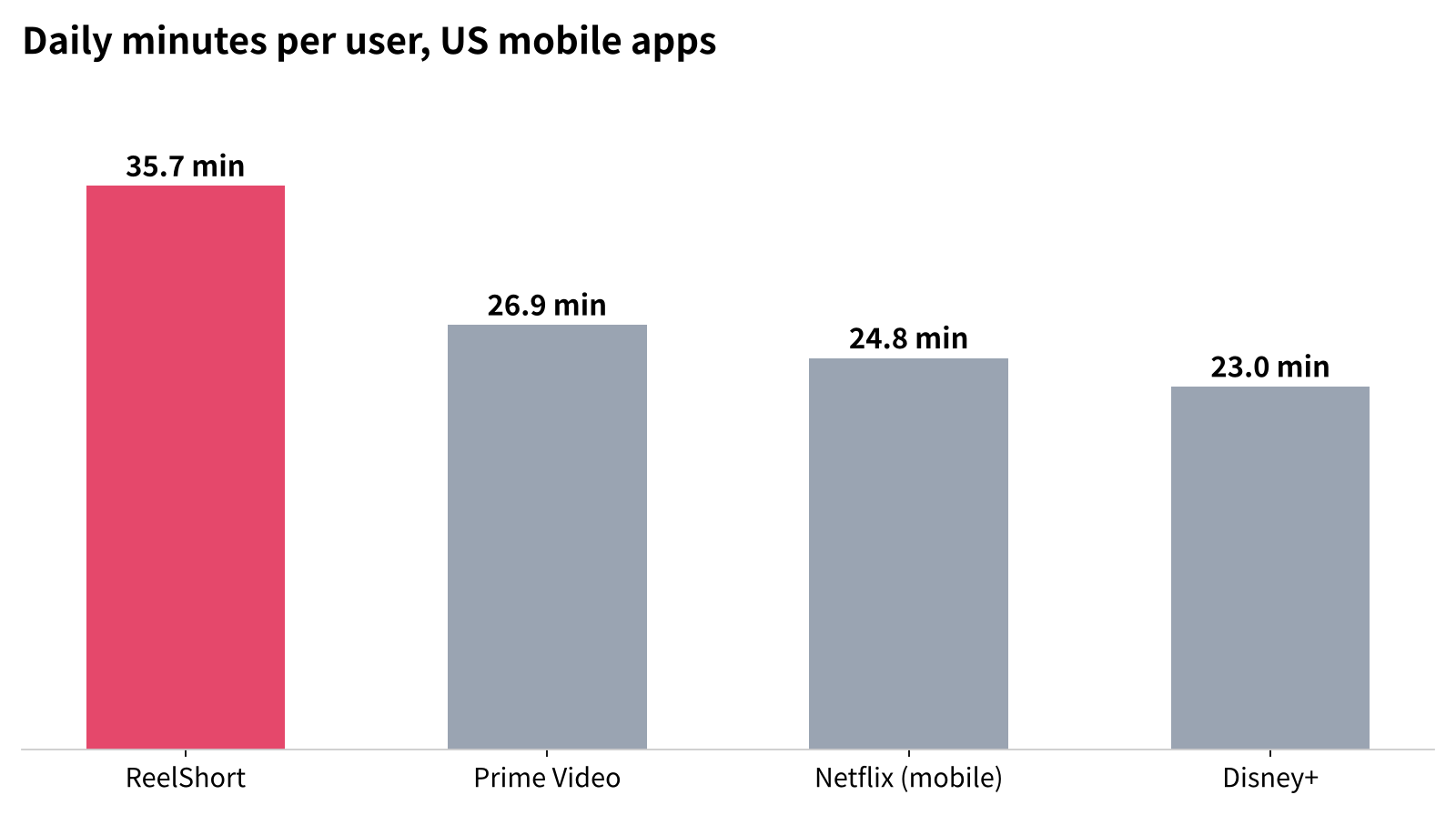
Engagement runs deeper than on the big streaming services. In an Omdia analysis of Sensor Tower data, US users spent 35.7 minutes a day on ReelShort, against 26.9 on Prime Video, 24.8 on Netflix mobile and 23 on Disney+.
"Whether you slap from the left or from the right" is a data decision
Tham sees the apps as data companies, not content companies. "Every creative decision that they make is based on the data point, whether it is about werewolf, time travel or mermaid," she said. "Even when you have a scene, whether you slap the person from the left or from the right actually makes a difference in terms of the audience reaction." TV and film have time to make viewers love a character; a mobile vertical drama does not, so every episode needs a cliffhanger.
ReelShort spends 55% on marketing; in China, free ad-supported apps pass half the market
Tham summed up the weakness: payment is excellent, finding viewers is expensive. Media Partners Asia estimates ReelShort's 2025 revenue at about $785 million, about 55% of which went to marketing and user acquisition, as growth comes from markets with lower spending power. DramaBox, by comparison, earned about $10 million on revenue of about $323 million in 2024.
In China, the most mature market, the paywall has given way. Short drama there was worth 50.5 billion yuan in 2024, more than the box office, and free ad-supported apps passed half the market in December 2024, led by ByteDance's Hongguo. Tham calls it "microdrama 2.0."
"If people don't want to watch, 100 hours won't amount to anything"
Asked by moderator Kim Kyung-oe (김경외) of Yonsei University where AI cuts costs, Tham pointed to pre-production. "AI is a tool based on probability," she said, so the output is not guaranteed and "the more we produce, the more credit we need." DEAR.AI concentrates AI on visualization before production. "The question should be about what is the content that your audiences want," she said. "If people don't want to watch, even if you can produce 100 hours, it's not going to amount to anything."
Because Singapore is expensive, much of the production happens in Indonesia and Vietnam with Southeast Asian creators. Asked about Korean animation in Singapore, she advised treating the city as a gateway to the region rather than a market on its own, and suggested Comic Con in Singapore each December as a first stop.
One character, five payers
Apps and broadcasters each have what the other lacks, Tham said. Apps have moment-level pricing, fast testing and swipe-level data but must buy their audiences. Broadcasters have reach, trust, IP libraries and advertiser relationships. She sketched how one character could earn from five payers.
| Step | Format | Payer | What it is |
|---|---|---|---|
| 1 | Vertical prequel | Viewers, advertisers | Free with ads, or pay to binge: a cheap test |
| 2 | Main series | Subscribers, advertisers | Broadcast or streaming release |
| 3 | Branded episode | Sponsor | A special set in the same world |
| 4 | Global version | Overseas platforms | Subtitled, dubbed and locally edited cuts |
| 5 | Rights | Licensees | Format sales, remakes and adaptations |
Five ways to earn from one character. Source: Jayce Tham presentation (illustrative)
Outlook: broadcasters hold the reach and IP; vertical prequels are the test
Not every story will travel all five steps, Tham said; the reaction to the prequel shows which ones might. Broadcasters and apps are already pairing up. Fox took a stake in Holywater and is making about 200 vertical series with it. In Korea, Spoon Labs' short-drama app Vigloo, backed by Krafton, earns about half its revenue in the US.
Korean broadcasters hold the audience reach that apps pay heavily for, and proven IP. Tham's advice was to price the moment, not just the library; to use reach, the one cost the apps cannot escape; and to test cheaply, then scale what audiences actually pay for. For the next three years she named branded storytelling and "phygital" content. "Instead of just telling people how good your product is, brands now want to use stories to convey the benefit," she said.