
At ICNX 2026, Ko points to the speed gap between AI and policy and urges a shift toward new K-culture industries and overseas co-production; the National Assembly’s December budget review is the first test
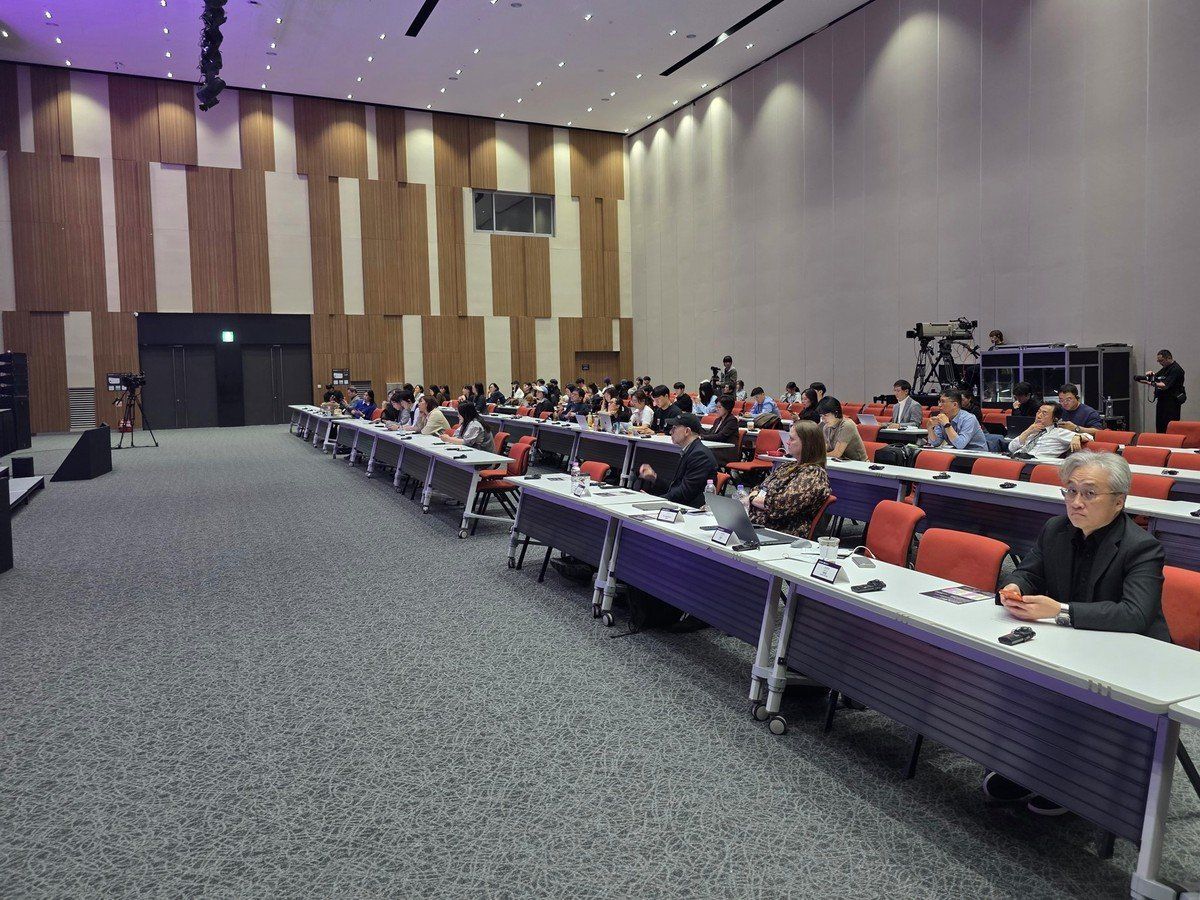
Samseog Ko (고삼석), Distinguished Professor at the College of Advanced Convergence, Dongguk University (동국대학교), called on Korea to run K-content promotion and its AI industry as a single national strategy in the keynote that opened the second day of ICNX 2026, the Incheon advanced-media global conference, at Songdo Convensia (송도컨벤시아) on Nov. 4. With the government proposing an 84.3% increase in its 2027 AI budget and the National Assembly reviewing it through early December, his message was that content belongs inside the same blueprint as AI policy, not on its margins.
“It is hard to imagine a future for content without AI, or a globally competitive AI industry without content,” Ko said. “K-content promotion and AI industry development must be pursued as one national strategy, not as two separate policies.” His talk was titled ‘Why K-Content and AI Must Be One National Strategy — Where Content Promotion Meets AI Governance.’
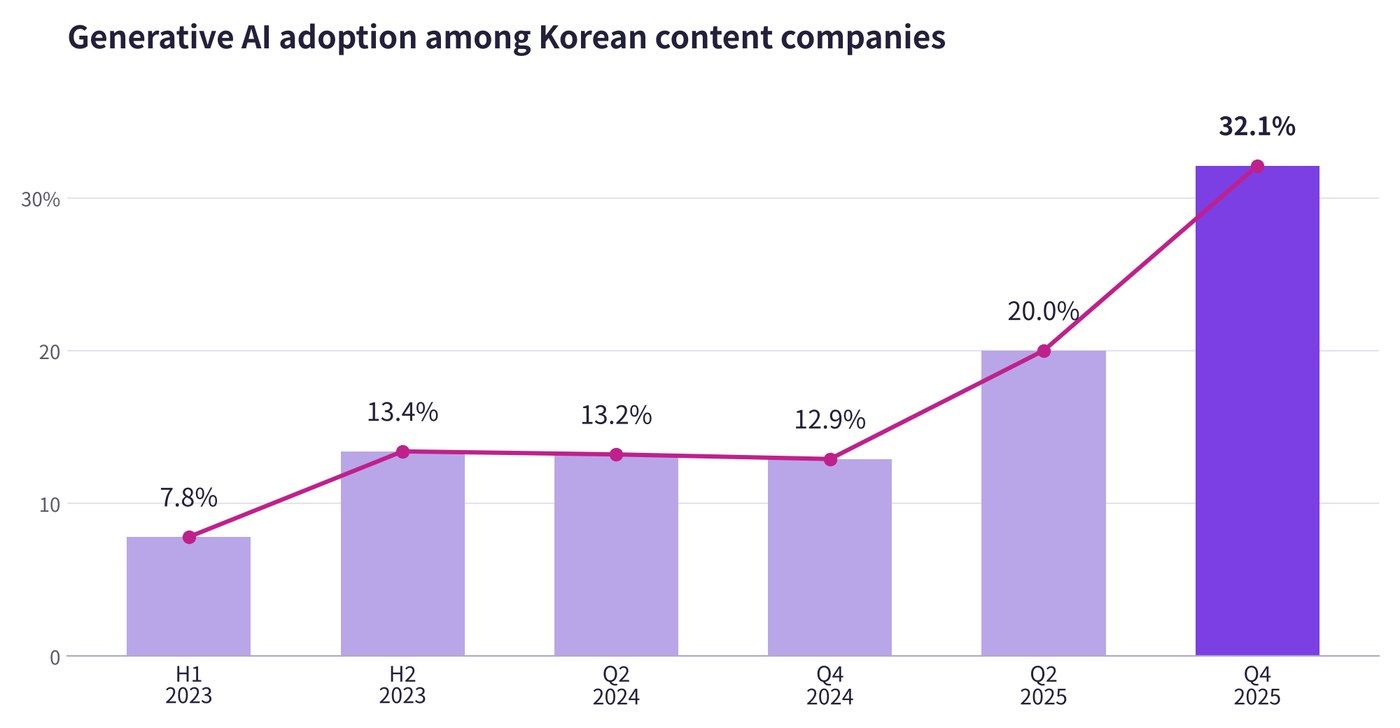
His case rests on a gap in speed. The share of Korean content companies using generative AI reached 32.1% in the fourth quarter of 2025, four times the level two and a half years earlier, and companies named funding for AI-based production as their top need (57.1%). Government policy and budgets, Ko noted, move in one-year cycles; AI changes every six months.
Competitors have already joined the two. The United States is combining AI with content IP on the back of $285.9 billion in private AI investment in 2025; China has grown its microdrama industry past 100 billion yuan and released 490,000 new titles in the first nine months of this year; Britain has written Createch into its industrial strategy. Korea assigned items 70 to 73 of the 99 in its February 2026 AI Action Plan to culture, and the science ministry’s 2027 AI budget proposal stands at 9.42 trillion won (about $6.9 billion).
The proposal translates the ‘coevolution’ agenda Ko has carried this year — from an EnterTech Alliance at CES 2026 in January to Malaysia, Qingdao and Orlando — into the language of Korea’s action plan and budget. He called for shifting policy from converting production and distribution to AI toward new AI-based K-culture industries and joint planning and production with foreign partners. Ko will continue the discussion with Seoul National University professor emeritus Kim Nan-do at the AI Content Festival 2026 at COEX on Nov. 12.
His was the only session at ICNX devoted to policy and national strategy, a 40-minute talk with simultaneous Korean–English interpretation. Ko moderated a roundtable at ICNX 2025.
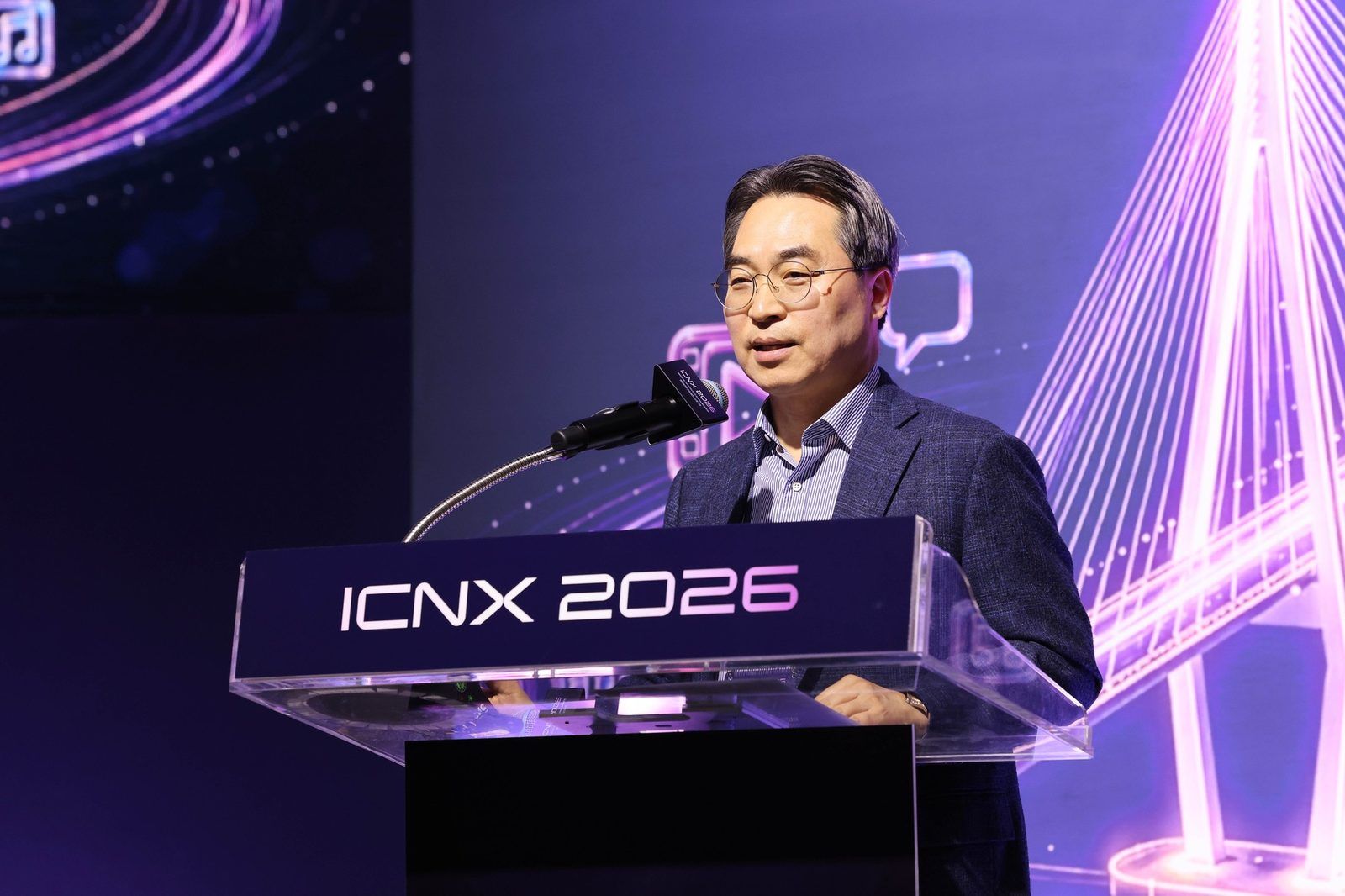
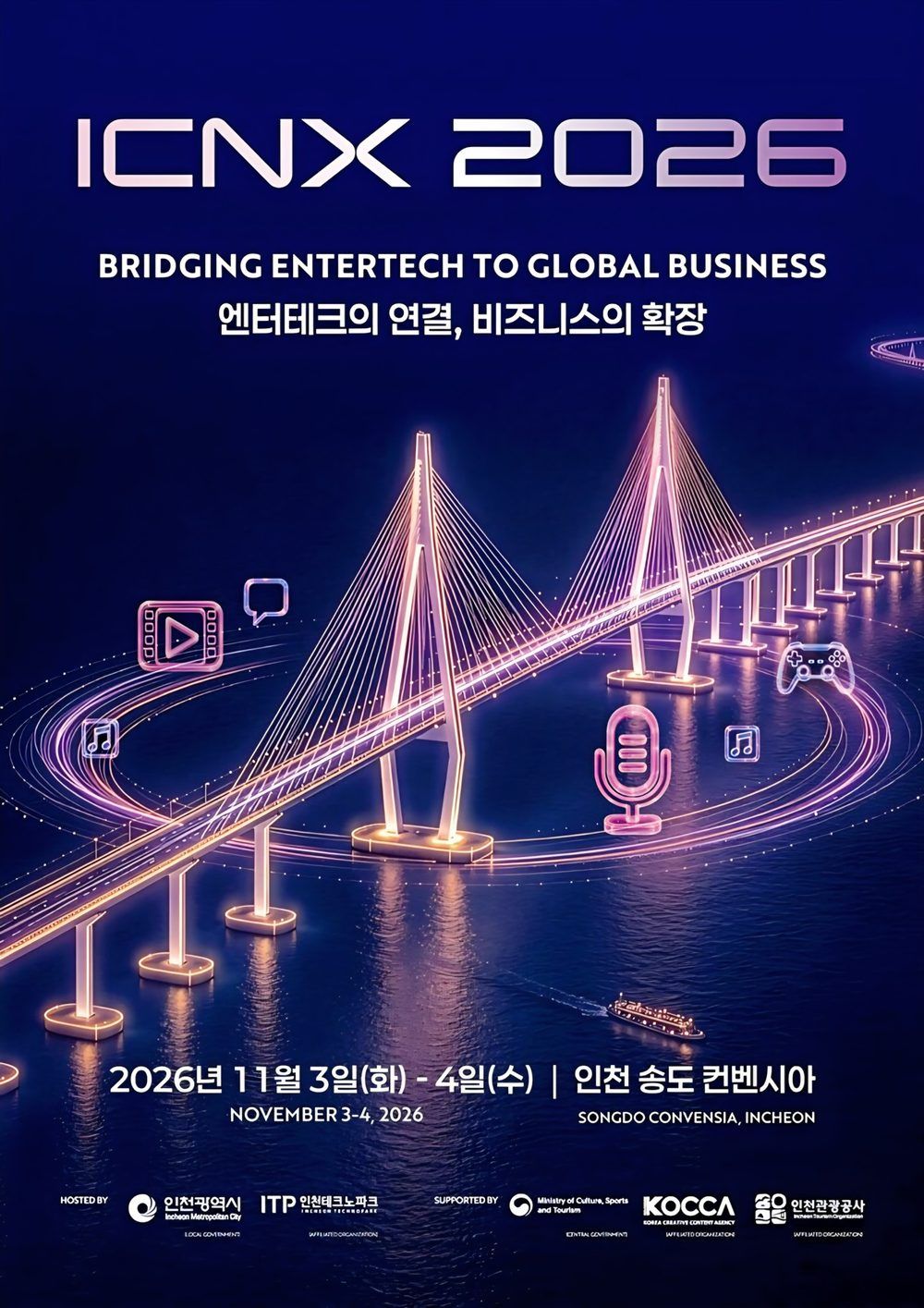
ICNX 2026 ran Nov. 3–4 under the theme “Bridging EnterTech to Global Business.” It was hosted by the Incheon Metropolitan City (인천광역시) and Incheon Technopark (인천테크노파크, ITP), with support from the Ministry of Culture, Sports and Tourism (문화체육관광부), the Korea Creative Content Agency (한국콘텐츠진흥원, KOCCA) and the Incheon Tourism Organization (인천관광공사).
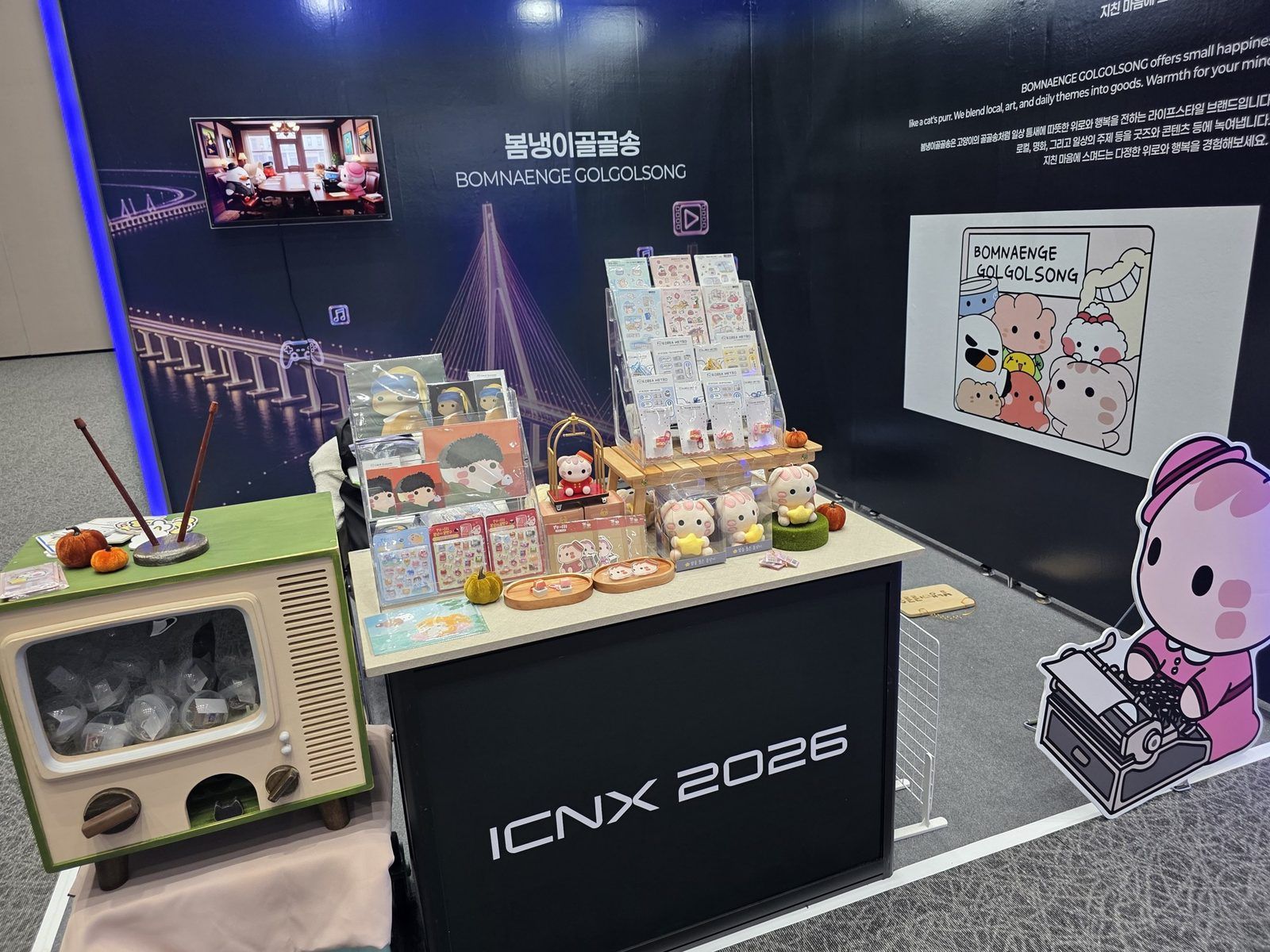
Ko sits on the social affairs subcommittee of the Presidential Council on National AI Strategy (국가인공지능전략위원회), advises the Speaker of the National Assembly on culture, broadcasting and ICT, and is a former standing commissioner of the Korea Communications Commission (방송통신위원회).
Lessons of the Red Flag Act: policy moves yearly, AI every six months
Ko opened by noting that the United States, China and the United Kingdom all now treat content and AI together as national strategy. K-culture’s global success, he said, did not come from government policy alone but from creators’ originality and creativity — and combining that with public and private capabilities can produce far larger results.
He framed the link between technology and policy through history. When cars arrived in 19th-century Britain, he noted, the Red Flag Act was introduced to protect the horse-drawn carriage trade, and that over-regulation cost Britain leadership of the automobile industry. By contrast, the U.S. internet and semiconductor industries grew out of government defense-technology policy, and Korea’s informatization drive around 2000 helped lift it from a middle-income to an advanced economy.
He also flagged the speed problem: government policy and budgets move in one-year cycles, while AI changes every six months. Citing Daron Acemoglu and James Robinson’s Why Nations Fail, he argued that inclusive economic institutions that protect property rights and encourage investment in new technology favor growth — and that in the AI era, too, the institutions and policies behind a technology decide the outcome.
AI adoption among content companies hits 32.1%, four times the 2023 level
Ko described the two sectors as reinforcing each other. “AI raises the productivity and scalability of content, and content strengthens the commercial value and cultural influence of AI,” he said. “The coevolution of the two industries is creating new intellectual property, business models and global markets.”
His slides break the relationship into three stages: using AI tools for production efficiency, combining AI with IP to rework the industry value chain, and building AI ecosystems that create new markets and businesses. Competition, in this view, shifts from tools to IP and data, then to platforms and ecosystems. Ko described the move from digital transformation (DX) to AI transformation (AX) as changing industry, markets and policy at once.
Three stages of AI–content convergence, and the DX-to-AX shift
| Stage 1: AI tools | Stage 2: AI × IP | Stage 3: AI ecosystems | |
|---|---|---|---|
| Main effect | Production efficiency | Value-chain innovation | New markets and businesses |
| Basis of competition | Tools | IP and data | Platforms and ecosystems |
| DX → AX change | Industry: productivity, value-chain restructuring, convergence → new creation and production structures | Market: new markets, diversified revenue, new competitive order → new added value | Policy: converged industrial policy, infrastructure and IP, new governance → reset of national growth strategy |
Source: Ko’s keynote slides
He put numbers on the pace of adoption: ChatGPT reached 1 million users in five days and 100 million in two months, and his slides cite roughly 800 million weekly users today. AI, he said, is already applied across the content value chain, from planning and production to distribution, marketing and ad targeting.
He grounded the argument in industry data. In KOCCA’s annual content industry report for 2025, the share of content companies using generative AI rose from 7.8% in the first half of 2023, hovered around 13% through 2024, then jumped to 20.0% in the second quarter of 2025 and 32.1% in the fourth — a gain of more than 12 percentage points in six months.
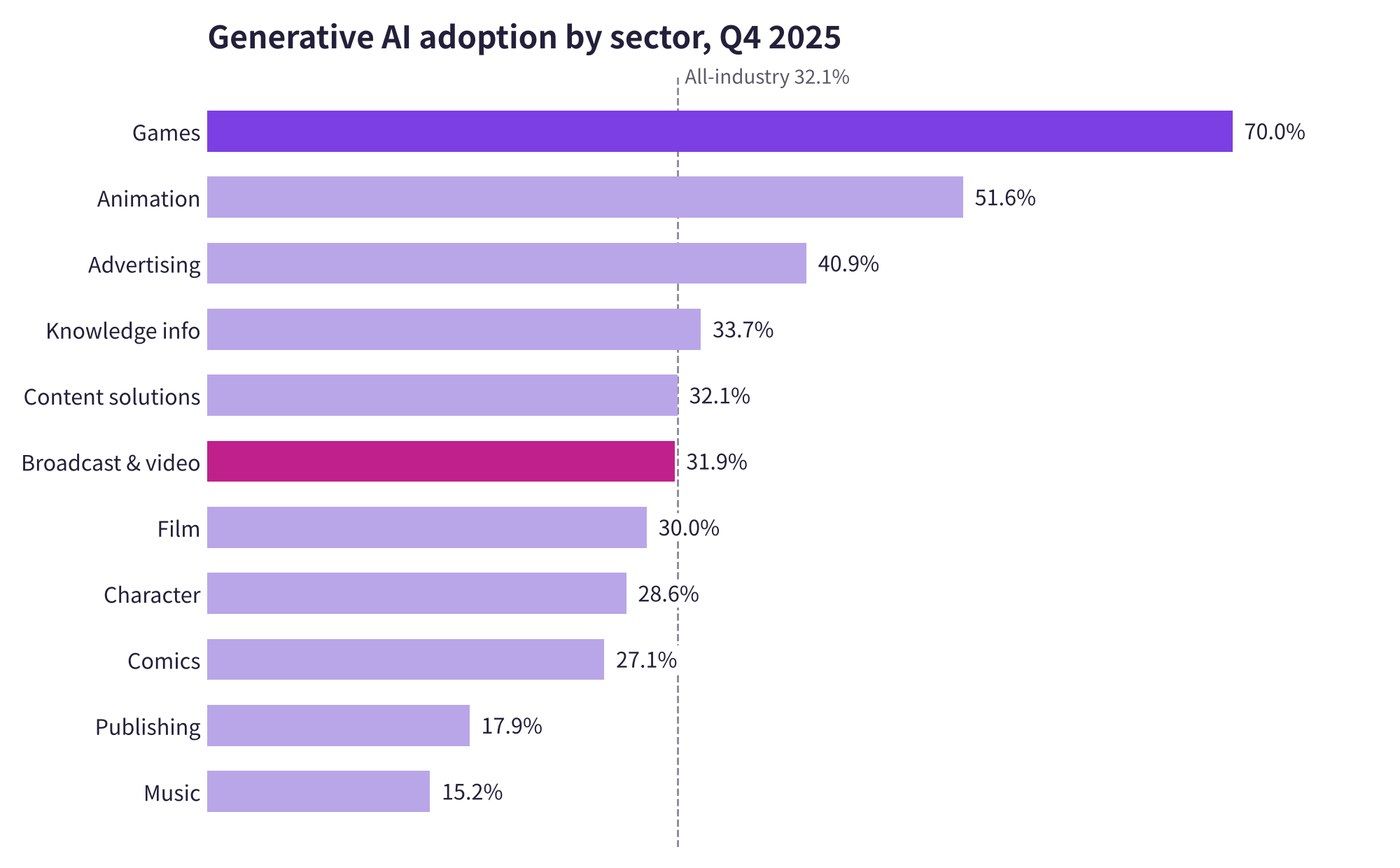
The spread across sectors was wide. Games stood at 70.0%, more than double the average, followed by animation (51.6%) and advertising (40.9%). Broadcasting and video sat near the average at 31.9%; publishing (17.9%) and music (15.2%) were lowest. Of the 810 companies using AI, 33.8% had rolled it out company-wide and 66.2% in some departments.
Among non-adopters (67.9%), the top reason was difficulty getting satisfactory output (56.1%), followed by a lack of infrastructure or funding (33.1%) and poor return on cost (31.9%). The same report put 2025 content industry revenue at 161.48 trillion won and exports at a record $14.91 billion.
Korea’s content industry in 2025
| Indicator | Figure | Note |
|---|---|---|
| Revenue | 161.48 trillion won (about $119 billion) | Up 2.6% year on year |
| Exports | $14.91 billion (about 20.2 trillion won) | Up 5.9%; record high |
| Top export sector | Games: $8.60 billion (about 11.7 trillion won) | 57.7% of all exports |
| Generative AI adoption | 32.1% (810 companies) | Company-wide 33.8%; some departments 66.2% |
| Main AI use | Content production 62.7% | Business planning 43.7%; content creation 32.8% |
| Top reason for not adopting | Unsatisfactory output 56.1% | Lack of infrastructure/funding 33.1%; poor return 31.9% |
Source: KOCCA, 2025 Q4 and Annual Content Industry Trend Analysis Report
Production funding tops the industry’s wish list at 57.1%
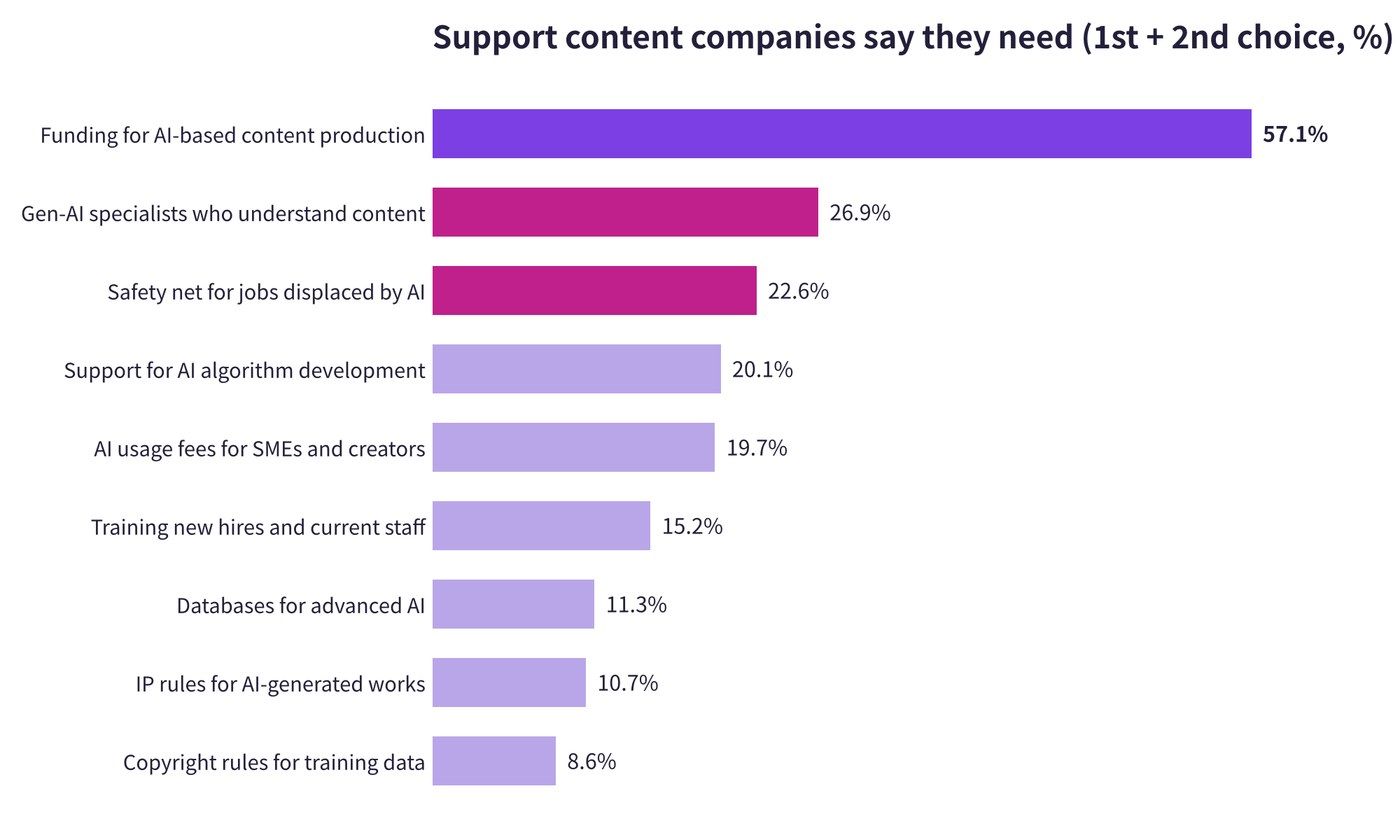
Asked what support they need in the generative-AI era, 57.1% of companies named funding for AI-based content production. Next came training generative-AI specialists who understand the content business (26.9%), a safety net for jobs displaced by AI (22.6%) and help with AI algorithm development (20.1%). Ko presented those answers as the starting point for policy design.
U.S. private AI investment reaches $285.9 billion as models diverge
Ko set the major economies side by side. The United States is combining AI technology with content IP, China is industrializing AI content at scale, and the United Kingdom is building an AI-driven creative-technology, or Createch, industry, he said.
On the United States, Ko pointed to a private-sector-led strategy anchored in core technology and infrastructure, with initiatives such as the Genesis Mission launched by executive order in November 2025 tying together government, national laboratories and universities, while content companies secure IP through large acquisitions and build their own AI capabilities. Britain adopted the ‘creative industries’ as a national strategy in 1997 and again named them a priority sector in its 2025 industrial strategy, growing Createch around content and data infrastructure and protection of creators’ rights.
The capital gap is large. Stanford HAI’s AI Index 2026 put U.S. private AI investment in 2025 at $285.9 billion (about 388 trillion won) — 23 times China’s $12.4 billion and 48 times the U.K.’s $5.9 billion — while noting that state-directed capital likely leaves China’s figure understated. Korea’s Ministry of Science and ICT (과학기술정보통신부) has proposed an AI budget of 9.42 trillion won (about $6.9 billion) for 2027, up 84.3%.
AI and content strategies: U.S., China, U.K., Korea
| United States | China | United Kingdom | Korea | |
|---|---|---|---|---|
| How AI meets content | AI technology × global IP | AI technology × content at industrial scale | AI technology × creative industries (Createch) | Entertainment Tech ecosystem built on K-culture originality and global fandom |
| Policy vision | Innovation leadership, infrastructure, deregulation, national security | ‘AI+’ rollout, advanced manufacturing, open cooperation, security | National AI strategy combined with creative-industries strategy | Top-three AI power, industrial AX, chips, data, talent |
| Flagship investment/budget | Stargate, up to $500 billion (private) | National AI industry fund, 60 billion yuan | Createch company growth; AI and immersive R&D | 2027 AI budget proposal 9.42 trillion won (about $6.9 billion) |
| Private AI investment, 2025 | $285.9 billion | $12.4 billion* | $5.9 billion | — |
Sources: Ko’s keynote slides; Stanford HAI AI Index 2026; Ministry of Science and ICT. *Excludes state-directed capital
Media M&A reaches $110 billion as AI strategy moves from licensing out to building in
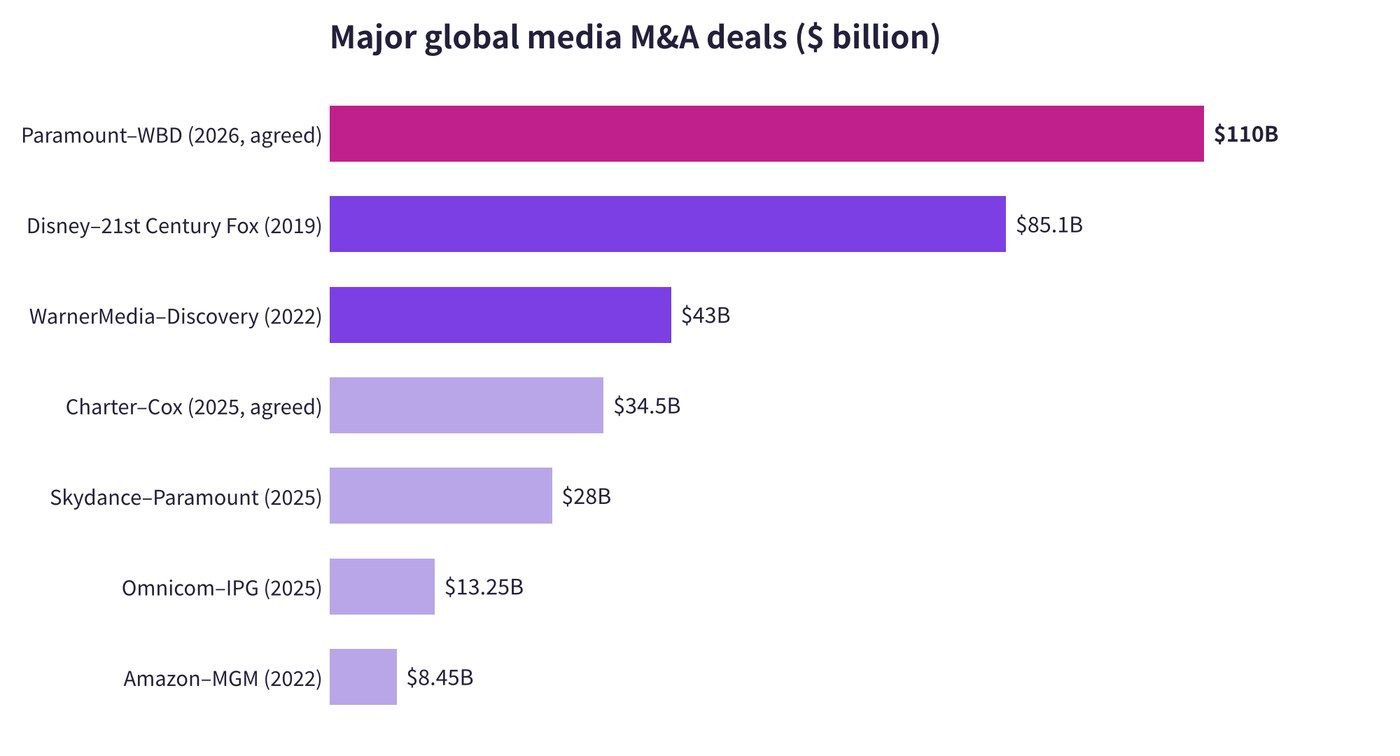
Ko also laid out the scale of industry consolidation. Paramount Skydance agreed on Feb. 27, 2026, to acquire Warner Bros. Discovery at an enterprise value of $110 billion (about 149 trillion won), larger than Disney’s purchase of 21st Century Fox ($85.1 billion) and the WarnerMedia–Discovery merger ($43 billion).
On AI, he contrasted licensing IP out with bringing technology in. In December 2025 Disney signed a three-year deal letting OpenAI’s Sora video app use more than 200 Marvel, Pixar and Star Wars characters, with a planned $1 billion equity investment; the deal ended when OpenAI shut Sora down in March 2026.
That same month Netflix acquired InterPositive, the post-production AI company founded by Ben Affleck, for an undisclosed sum. Ko’s slides summed up the two cases: when you license out, the partner’s product sets the life of the deal; when you bring tools into production, they stay with the company as an advantage.
How global media companies approach AI
| Approach | Examples | Outcome / features |
|---|---|---|
| Licensing IP out | Disney × OpenAI (Dec. 2025): 200+ characters for Sora; $1 billion equity investment planned | Ended with Sora’s March 2026 shutdown; dependent on the partner’s service |
| Bringing technology in | Netflix buys post-production AI firm InterPositive (Mar. 2026); Lionsgate × Runway library-training deal (2024) | Capabilities built in-house; efficiency and quality gains |
| Industry-wide AI shift | WBD ‘Blueprint for AI’; Comcast AI ad platform; Paramount AI search and recommendation; Amazon Prime Video AI recommendations, dubbing and ads | Applied within labor agreements; mostly post-production for now; ethics, copyright and security governance required |
Sources: Ko’s keynote slides; Variety, MediaPost and others
China’s microdrama industry tops 100 billion yuan, with 490,000 new titles this year
China drew the most numbers in Ko’s talk. According to Chinese research firm DataEye, the country’s microdrama and animated-drama industry passed 100 billion yuan in 2025, close to double that year’s box office, with 696 million viewers as of June 2025. Ko’s slides cite 850 million users as of an October 2026 announcement and 490,000 new titles released in the first nine months of 2026, and project the overseas market outside China at more than $6 billion in 2026, up about 67%.
China’s AI content and microdrama market
| Indicator | Figure | Source |
|---|---|---|
| Microdrama and animated-drama industry, 2025 | Over 100 billion yuan | DataEye; keynote slides |
| Microdrama viewers, June 2025 | 696 million | Chinese industry data |
| Users, October 2026 announcement | 850 million (600 million+ monthly active) | Keynote slides |
| New titles released, Jan.–Sept. 2026 | 490,000 | Keynote slides |
| Overseas market outside China, 2026 forecast | Over $6 billion (about 8.1 trillion won), up about 67% | Keynote slides |
Sources: Ko’s keynote slides (citing China’s NRTA and others); DataEye
The slides also cited an Aug. 18 Reuters report that Hollywood’s production ecosystem is being reshaped by TikTok-generation viewing habits and the microdrama model that began in China. The core U.S. audience is women aged 25 to 55, and the market is expected to grow from $1.5 billion to $2 billion by 2027.
Policy has been layered step by step. Ko’s slides trace a sequence from the National Radio and Television Administration’s ‘Microdrama+’ action plan in January 2025, through the State Council’s ‘AI+’ guidelines in August 2025 and the 15th Five-Year Plan (2026–2030) in March 2026, to microdrama management rules taking effect in September 2026 that require AI-content labeling and protect copyright and likeness rights.
China’s AI and content industry policies
| Date | Policy | Main points |
|---|---|---|
| Jan. 2025 | NRTA ‘Microdrama+’ action plan | Links microdramas with tourism, brands, classics and science; 300 priority titles |
| Aug. 2025 | State Council guidelines on deepening ‘AI+’ | AI integration in culture and consumption; AI across industries |
| Mar. 2026 | 15th Five-Year Plan (2026–2030) | Culture-technology convergence; microdrama growth; digital content exports |
| May 2026 | Plan for quality microdrama creation and distribution | Support for strong titles; quality and industry environment |
| Sept. 2026 | Microdrama development management rules take effect | AI-content labeling; copyright and likeness protection; platform duties and ratings |
Source: Ko’s keynote slides
Ko described China’s approach as a whole-of-government policy. Content–AI integration is written into the 15th Five-Year Plan, decided by the Communist Party Central Committee in October 2025 and finalized in March 2026, and content is used as a platform for growth in tourism, brands and the arts. In some respects, he said, the approach benchmarks Korea’s own content-promotion policy. On that base, China is pushing into Southeast Asia, the United States and Korea.
Korea, Ko argued, should answer with a distinct Entertainment Tech ecosystem built on the originality of K-culture and its global fandom.
Action plan items 70–73: from AI-assisted production to new K-culture industries
Ko referred to the AI-based cultural-powerhouse strategy in the government’s Korea AI Action Plan. The plan, approved by the presidential council in February 2026, contains 99 action items and 326 policy recommendations under three pillars. Culture is covered by items 70 to 73.
Korea AI Action Plan: ‘AI-based cultural powerhouse’ items
| Item | Description |
|---|---|
| 70 | Build an AI-based content creation support system and energize the creator ecosystem |
| 71 | Grow content businesses by supporting AI transformation of the K-culture industry |
| 72 | Secure sustainable growth of K-culture content through early AI adoption |
| 73 | Expand global markets by taking K-content and Korean AI overseas together |
Source: Presidential Council on National AI Strategy, Korea AI Action Plan (as cited in Ko’s slides)
The action plan is organized into three policy pillars, 12 strategic areas and 99 action items. Ko said that as a member of the presidential council he has worked through advisory roles to get culture items reflected in actual policy. He added that content companies are pressing for clearer copyright rules, deregulation and infrastructure.
He proposed moving the plan’s center of gravity: from converting existing production and distribution to AI, toward creating new AI-based K-culture industries, building the ecosystem around them, and expanding abroad.
‘Next Korean Wave’: from exporting content to co-planning and co-producing it
Ko also outlined the coevolution strategy from his book Next Korean Wave (넥스트 한류), published in June 2025. Coevolution, a term from evolutionary biology, describes species that evolve by influencing one another; Ko has long argued for applying it to industry to turn zero-sum relationships into plus-sum ones. “For Hallyu to develop sustainably, we must go beyond exporting content to an open global ecosystem in which we plan and produce jointly with foreign companies and creators and share the results,” he said.
The book began with a question: is K-content sustainable? With broadcasters such as KBS, MBC and SBS, which led the Korean Wave, and production companies increasingly talking about crisis, Ko offered two answers — Entertainment Tech innovation using AI, and coevolution with overseas partners. Coevolution, in his usage, extends beyond content to K-brands in beauty and fashion and to regional arts and cities. An English edition of Next Korean Wave is due to be published.
His slides organized the response of Korean media companies along three lines.
Three tracks for Korean media companies
| Strategic direction: open ecosystem | Entertainment Tech strategy for the AI era | Coevolution: bigger markets through partnership |
|---|---|---|
| Stronger content IP, expanded into global franchises | AI-based production and personalization across creation, recommendation and operations | Partnership networks linking platforms, tech firms and creators |
| Platform diversification and bundling; distribution through alliances | Integrated data and technology infrastructure | Integrated value chains; shared content, technology and data |
| Direct-to-consumer and community-led relationships | New formats: interactive, short-form, live, games | Industry, regional and cultural partnerships for shared growth |
| Taking content and brands abroad | Revenue diversified across advertising, commerce and subscriptions | User-centered growth that also delivers social value |
Source: Ko’s keynote slides
Samseog Ko’s coevolution framework
| Area | Elements |
|---|---|
| K-culture expansion | Lifestyle as a public good; open platforms; wider access |
| K-brand evolution | Fair consumption; sustainability; K-food, beauty and fashion |
| K-tech and inclusion | AI and data; digital inclusion; democratized creation |
| Global cooperation order | Co-production; talent development; shared platforms; joint funding |
| City and regional links | Entertainment Tech hubs; regional innovation; global ecosystems |
| Core principles | Connection, cooperation, inclusion, mutual benefit: from content exports to ecosystem building, from competition to coevolution, from Korea’s growth to growth with the world |
Source: Ko’s keynote slides
From a CES alliance to Qingdao and Orlando: a year of ‘coevolution’ proposals
The starting point was Next Korean Wave, published in June 2025. That October, at AICON 2025 in Singapore, Ko presented a ‘Next Korean Wave Initiative’ built on making Hallyu together with Asia.
On Jan. 7, in his keynote at the Next K-Wave EnterTech Forum @ CES 2026 at Caesars Palace in Las Vegas, he called for an ‘EnterTech Alliance’ linking Korean and American streaming services, AI platforms, studios and startups. “K-content must now move from being an object of export to a domain of cultural partners who create together,” he said. His four agenda items were a Hallyu-specialized AI model, multinational virtual idol groups, K-pop concerts in immersive venues such as Sphere and Cosm, and immersive content for autonomous vehicles.
From Jan. 26 to 28 in Kuala Lumpur, he met Malaysia’s Deputy Minister of Investment, Trade and Industry, Sim Tze Tzin, and proposed a three-way model in which Korean and Malaysian companies enter Nevada together. “The next stage of Hallyu is not one-way expansion but coevolution that grows together with local partners,” he said.
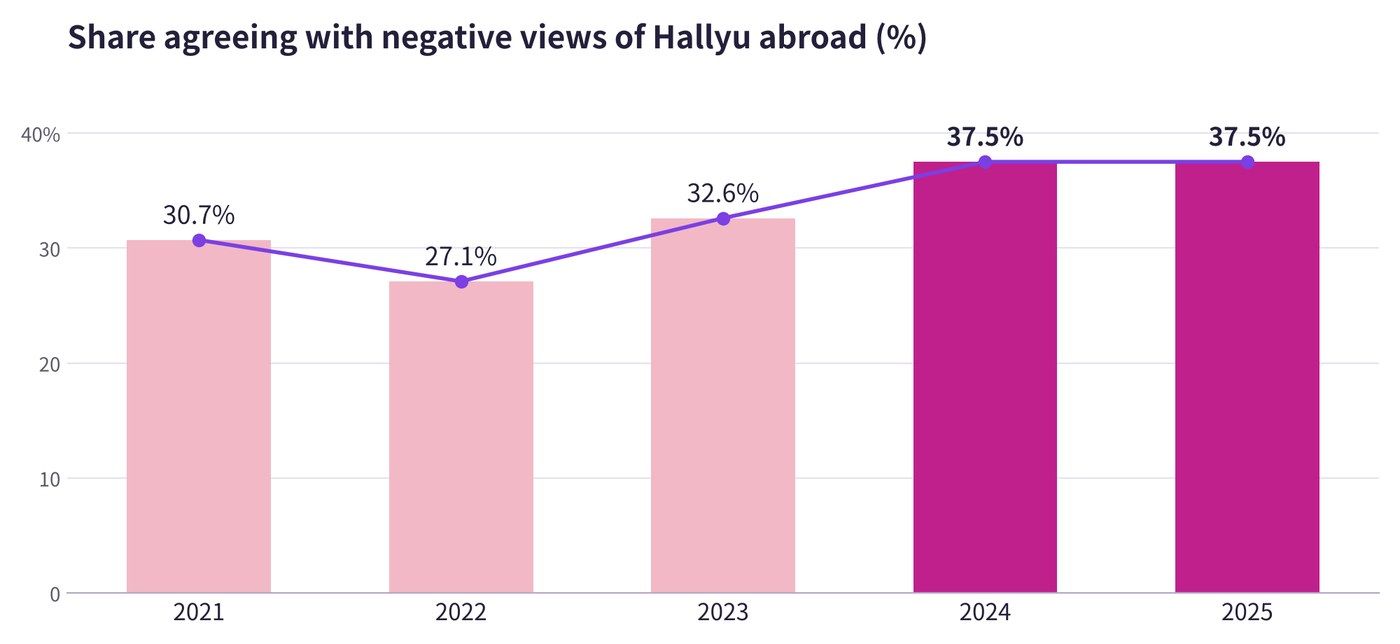
On April 24, at the K-EnterTech Global Summit @ WIS 2026 at COEX, he said the content industry “must move beyond quantitative expansion to qualitative maturity,” and pointed to Hallyu’s shadow. In surveys by the Korea Foundation for International Cultural Exchange (KOFICE), the share of overseas respondents agreeing with negative views of Hallyu rose from 30.7% in 2021 to 37.5% in 2024 and 2025. After a K-pop concert in Kuala Lumpur in February, a ‘#SEAbling’ boycott spread among Southeast Asian users online. That is why Ko frames coevolution as designing relationships with local partners rather than expanding exports.
In June, at a Korea roundtable of the 7th Qingdao Multinationals Summit in Shandong, he said “the era when one side supplies technology and products while the other simply opens its market is over,” calling for “a genuine ecosystem of coevolution in which both countries develop technology, build markets and share risk together.” In August he presented Korea’s AI policy and the coevolution strategy at the US-Korea Conference (UKC 2026) in Orlando, and on Aug. 27 he was appointed adviser to the National Assembly Speaker on culture, broadcasting and ICT.
In a Sept. 14 column for ZDNet Korea, he named Central Asia as K-content’s next coevolution partner, setting as the condition “genuinely sharing creative authority and IP.” The ICNX keynote brought these ideas home to Korea’s policy debate.
Samseog Ko’s coevolution proposals
| Date | Venue | Proposal |
|---|---|---|
| June 2025 | Book Next Korean Wave published | Entertainment Tech and coevolution as the path to sustainable Hallyu |
| Oct. 2025 | AICON 2025 (Singapore) | ‘Next Korean Wave Initiative’: Hallyu made with Asia |
| Jan. 7, 2026 | Keynote, Next K-Wave EnterTech Forum @ CES 2026 (Las Vegas) | Korea–U.S. EnterTech Alliance; four agenda items |
| Jan. 26–28, 2026 | Kuala Lumpur; meeting with Malaysia’s deputy trade minister | Korean and Malaysian firms entering Nevada together |
| Apr. 24, 2026 | Keynote, K-EnterTech Global Summit @ WIS 2026 (COEX, Seoul) | From quantity to maturity; responding to negative views of Hallyu |
| June 2026 | Korea roundtable, 7th Qingdao Multinationals Summit (China) | Korea–China ‘coevolution partners’; joint AI and content development |
| Aug. 2026 | US-Korea Conference UKC 2026 (Orlando) | Korea’s AI policy and coevolution strategy |
| Aug. 27, 2026 | Appointed adviser to the National Assembly Speaker | Advice on content promotion and AI governance |
| Sept. 14, 2026 | ZDNet Korea column | Coevolution with Central Asia; sharing creative authority and IP |
| Nov. 4, 2026 | Keynote, ICNX 2026 (Incheon) | K-content and AI as one strategy; new K-culture industries and co-production |
| Nov. 12, 2026 | Special talk, AI Content Festival 2026 (COEX, Seoul) | ‘AI Is Changing the Business Game,’ with Kim Nan-do |
Sources: Herald Corp. (Jan. 15 and 28, 2026); Qingdao Multinationals Summit; ZDNet Korea; K-EnterTech Hub; event listings
Next stage: a talk on how AI is changing the business game, Nov. 12
Ko will join Kim Nan-do, professor emeritus at Seoul National University, for a one-hour special talk titled ‘AI Is Changing the Business Game’ at 1 p.m. on Nov. 12 on the main stage of The Platz, on the second floor of COEX in Seoul. The session covers how AI is reshaping the content ecosystem — from how work is created to distribution and consumer behavior — and what sustainable business models look like.
The AI Content Festival 2026 runs Nov. 12–14 at The Platz with free admission; advance registration closes Nov. 11. The Ministry of Culture, Sports and Tourism and KOCCA have allocated 19.8 billion won (about $14.6 million) to AI content production support this year and said they would hold a festival in the second half to share the results with industry and the public. Eight days after setting out a policy direction at ICNX, Ko will be discussing business models on the stage built to showcase that government support.

‘Not why, but what and how’ — with the budget review as the first test
“What matters now is not why K-content and AI should be combined, but what to combine and how,” Ko said. “Only when government policy innovation and private-sector Entertainment Tech innovation move together can Korea shape and lead a new global content industry order.”
The presidential council said in September, marking its first year, that its second term would shift to a results-driven footing. The National Assembly is reviewing the 2027 budget through early December. With the culture items moving from planning to execution, the next question is how the production funding, talent and job-protection measures the industry asked for will show up in the budget and the action items.
Closing the talk, Ko said events hosted by local governments such as Incheon can serve as a model for K-content, K-culture and regions growing together. He urged the companies in the audience to think together about how to use AI in combination across a vast global ecosystem.
Analysis: What it means for Korea — from budget silos to a strategy of making things together
Ko’s proposal takes aim at a long-standing divide in Korean content policy. Content promotion has sat with the Ministry of Culture, Sports and Tourism and KOCCA, and AI industry policy with the Ministry of Science and ICT, each with its own budget and programs. The science ministry’s 2027 AI budget proposal is 9.42 trillion won, while the culture ministry and KOCCA set aside 19.8 billion won for AI content production support this year. The years and program scopes differ, so the figures are not directly comparable, but they show that content is not designed in as a core user of national AI investment. Seven in ten game companies already use generative AI, and AI-based production funding is what content companies want most — the two policies serve the same companies.
The first task is speed. When AI changes every six months, a one-year cycle of calls and disbursement means the technology has often moved on by the time funding reaches the field. Multi-year programs, half-yearly reviews and flexible execution that lets projects adjust to technical change are the conditions for making a ‘single national strategy’ work.
The second is the relationship between IP and technology. Disney’s deal with OpenAI ended when Sora shut down, while the post-production AI Netflix acquired stayed inside the company. Licensing IP to overseas AI platforms brings near-term revenue, but unless AI is built into production and data is accumulated in-house, the advantage accrues to the partner platform. That is why Korean broadcasters and studios need their own production-tool and data strategies alongside licensing talks.
The third is how to compete. Korea cannot match U.S. private AI investment ($285.9 billion) or China’s microdrama output (490,000 new titles in nine months) on their terms. Its assets are the originality of K-culture and its global fandom. Yet with 37.5% of overseas respondents agreeing with negative views of Hallyu and a ‘#SEAbling’ boycott spreading in Southeast Asia, one-way export growth alone will not protect those assets. The sharing of creative authority and IP and the sharing of risk that Ko stressed in Qingdao and in his Central Asia proposal should be the design standard for co-production policy.
The first answer to ‘what and how’ will come from the National Assembly’s budget review, which runs through early December. Whether culture items 70 to 73 of the action plan turn into the production funding, specialist training and job-protection budgets the industry asked for — and whether local-government-run venues like ICNX lead to joint planning and production with overseas partners — will be the yardstick for whether binding K-content and AI into one strategy works in practice.