
Q4 ad revenue guided down as much as 10%; £25mn of the £30mn in savings comes from content as smaller commissions slip to 2027
ITV expects Q4 ad revenue to fall 5-10% and is cutting £30mn of costs, £25mn from content, delaying smaller outside commissions to 2027. It blamed the economy, global streamers and the 9pm food ad rule. Korean broadcasters, whose ad sales have halved in a decade, are cutting dramas outright.
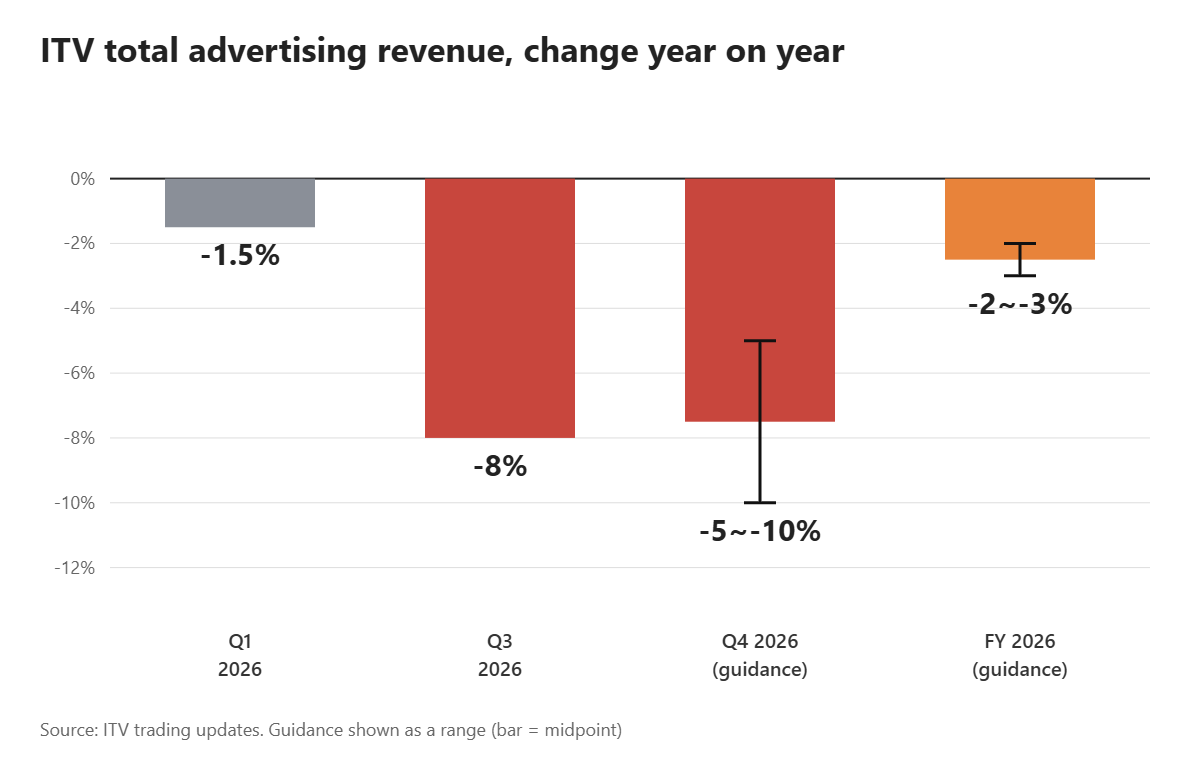
ITV, Britain's largest commercial broadcaster, is taking £25mn (about 44.5 billion won) out of its fourth-quarter programme budget. In its third-quarter trading update on November 11, ITV said total advertising revenue at its media and entertainment business would fall 5-10% year on year in the final quarter and 2-3% over the full year.
The trigger was a sharp slowdown in second-half demand. Total advertising revenue fell 8% in the third quarter. Analysts had pencilled in anything from flat to a 5% decline for the fourth quarter; ITV's guidance came in below the bottom of that range, and the shares fell almost 5% in early trading in London.
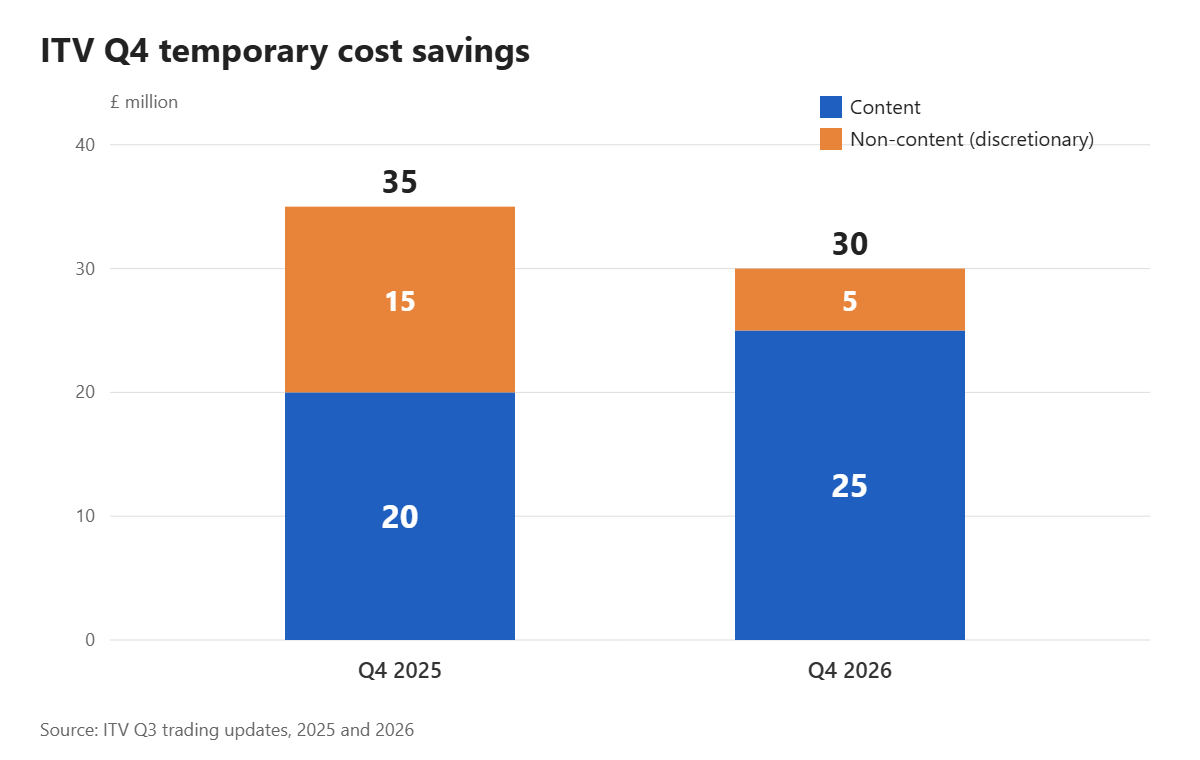
ITV will make £30mn of temporary savings in the quarter: £25mn in content and £5mn in discretionary non-content spending. Chief executive Carolyn McCall said the company was "aligning our investment with advertiser demand". The total content budget for 2026 is expected to stay at about £1.2bn.
The cuts come as ITV prepares to hand its channels, the ITVX streaming service and its advertising sales operation to Comcast-owned Sky in a deal worth up to £1.6bn. Culture secretary Lisa Nandy issued a public interest intervention notice on the deal on November 4, and the Competition and Markets Authority and Ofcom must report back by January 27.
Ad revenue down 8% in Q3; Q4 guidance below forecasts
ITV's advertising year has swung quarter by quarter. Total advertising revenue fell 1.5% in the first quarter before the men's Football World Cup lifted demand in the second quarter and July. Once the tournament ended, third-quarter revenue dropped 8%. Over nine months, total advertising revenue was £1,238mn, 1% below the £1,247mn of a year earlier.
"Demand for advertising in H2 has weakened," McCall said. Group revenue for the nine months fell 1.4% to £2.76bn, according to AJ Bell; media and entertainment revenue slipped 1.4% to £1.43bn and ITV Studios revenue 1.5% to £1.33bn.
£25mn of the £30mn comes from content as smaller commissions slip to 2027
More than four-fifths of the savings come from programming. Citing the Guardian, TheWrap reported that the cuts will mainly hit smaller productions commissioned from outside companies, with some projects pushed back to 2027. ITV does not expect the savings to lead to job losses. The FT expects fewer new shows over the period and more repeats.
This is the second year running that ITV has covered a weak fourth quarter out of its programme budget. Last November it forecast a 9% fall in fourth-quarter advertising and announced £35mn of temporary savings, including £20mn in content achieved by moving programmes into 2026 and funding them from the 2026 budget (C21Media). This year non-content savings have shrunk from £15mn to £5mn while content savings have risen from £20mn to £25mn, a sign that much of the room in marketing and discretionary spending was used up last year.
| Q4 2025 | Q4 2026 | |
|---|---|---|
| Q4 total ad revenue guidance | down about 9% | down 5-10% |
| Full-year total ad revenue guidance | down about 6% | down 2-3% |
| Temporary savings | £35mn | £30mn |
| Content savings | £20mn | £25mn |
| Non-content savings | £15mn | £5mn |
| Annual content budget | about £1.21bn | about £1.2bn |
Source: ITV Q3 trading updates, November 6, 2025 and November 11, 2026
ITVX streaming hours up 29%; digital revenue reaches £461mn
The streaming numbers moved the other way. Total streaming hours rose 29% to 2,153mn over nine months, and digital revenue grew 7% to £461mn. Digital advertising was up 6%. ITVX passed 1bn streams for a third consecutive quarter, Advanced Television reported, and by the end of October had already beaten its 2025 total with 3.6bn streams. ITV's share of commercial viewing on its linear channels also rose, to 32.7% from 31.8%.
Viewing and share went up while advertising went down because digital is still too small to offset the decline in linear. Nine-month digital revenue of £461mn equals about 37% of total advertising revenue of £1,238mn, and digital revenue growth has slowed from 13% in the first half to 7% over nine months.
Three causes: the economy, global streamers and the 9pm food ad rule
ITV pointed to macroeconomic uncertainty, more digital advertising on global streaming platforms and rules on less healthy food. Since January 5, the UK has banned TV advertising for identifiable less healthy food and drink between 5.30am and 9pm, and paid-for online advertising for such products at any time (UK government). Everything ITV schedules before 9pm falls under the rule. Brand advertising in which the product cannot be identified is exempt.
The FT noted that more UK ad spending is moving to digital and streaming rivals such as Netflix and YouTube, while consumers reining in their budgets have made brands more cautious. In its update ITV said advertisers' budgets were being squeezed by macro factors and their attention was shifting to digital platforms, creating a hard environment for linear TV.
Sky deal under a public interest review; regulators report on January 27
ITV agreed in July to sell its channels, ITVX and advertising sales to Sky, leaving ITV plc as a pure production company built around ITV Studios. On November 4 Nandy issued a public interest intervention notice, asking the CMA to report on competition and Ofcom on media public interest questions including plurality and the quality of broadcasting. After reading both reports she can refer the deal for an in-depth investigation. Nandy has also said public interest provisions should extend beyond traditional broadcasting to streaming and on-demand content. According to TheWrap, the inquiry covers the deal's effects on media competition, editorial independence and the diversity of news coverage.
Sky told ITV News it had already made commitments to protect ITV's identity, its public service obligations and the editorial voices of Sky News and ITV News. The FT expects regulators to focus on the combined group's share of advertising. ITV still expects the deal to complete in the second half of 2027, and the weaker the ad market, the more the division's profitability before completion matters to the transaction.
The production side has held up better. ITV Studios made five of the UK's ten most-watched dramas in the third quarter, including The Gentlemen for Netflix, the third series of Vigil for the BBC and The Blame for ITV. ITV expects Studios to grow revenue ahead of the market this year, with a margin at the lower end of its 13-15% range. After the sale, TheWrap notes, ITV Studios will be a supplier to US networks and streamers, with Love Island US: Beyond the Villa for Peacock, Hell's Kitchen for Fox and SuburraMaxima for Netflix among its upcoming deliveries. Studios revenue fell 1% over nine months, but ITV still expects full-year growth because major productions and licensing deals land in the fourth quarter.
In Korea, July terrestrial ad sales of 54 billion won and 30% fewer dramas
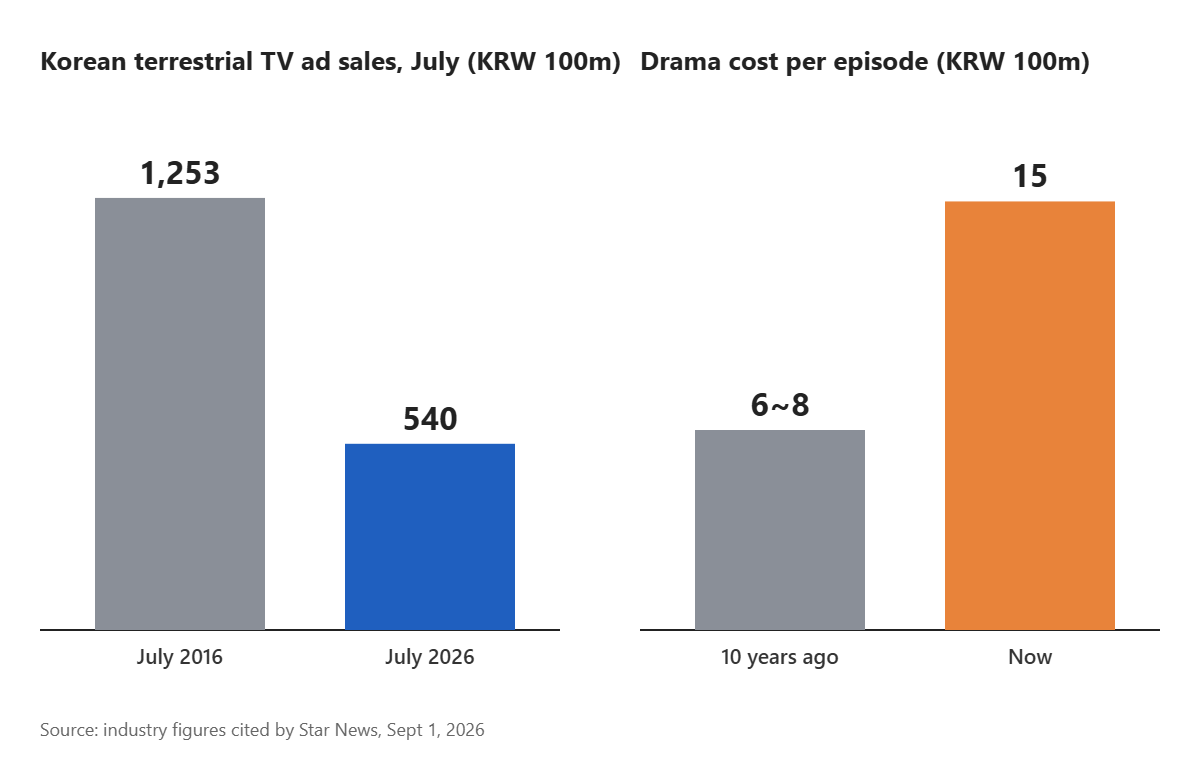
Korean broadcasters have been under the same pressure for longer and on a bigger scale. Industry figures cited by Star News put terrestrial TV advertising (지상파 광고) at 310.4 billion won (about $230mn) in the first half of 2026, against a full-year 1.12 trillion won in 2011 and 793 billion won in 2016. Terrestrial ad sales for July fell from 125.3 billion won in 2016 to 54 billion won in 2026. Over the same period the cost per episode of a drama miniseries rose from 600-800 million won to about 1.5 billion won. KBS (한국방송공사) expects a loss of more than 10 billion won this year and has moved into company-wide crisis management.
Where ITV defers programmes by a quarter, Korean broadcasters are cutting dramas from the schedule. At a press conference at the Korea Press Center on November 4, twelve associations of drama producers, PDs, writers, crews and actors said the number of Korean dramas made had fallen about 30% in two years from 141 in 2022 (JoongAng Ilbo/Korea Daily). Terrestrial broadcasters aired 91 dramas in 2012 and 32 in 2023. The groups called for a 1 trillion won (about $750mn) drama investment and support system tied to joint scheduling by broadcasters and streaming services. The government's 2027 budget plan trims the Ministry of Culture, Sports and Tourism (문화체육관광부) broadcasting and video budget from 91.8 billion won to 87.3 billion won, and the Korea Media and Communications Commission's (방송미디어통신위원회) content promotion budget from 16.8 billion won to 12.4 billion won.
ITV's response to falling advertising runs on several tracks. It is holding its overall programme budget at around £1.2bn while timing spending to advertiser demand, it has grown digital revenue to more than a third of total advertising, and it is preparing ITV Studios to stand alone as a supplier to outside platforms. Korean terrestrial broadcasters do not publish digital revenue each quarter the way ITV does, which makes a like-for-like comparison hard. The twelve associations' call to tie support to joint scheduling with streaming services reflects the view that rising production costs can no longer be recovered from broadcast advertising alone. The UK food rule is also a reminder that restrictions on advertising categories land directly on broadcasters' revenue, a point for Korea's own debates on ad regulation.
Outlook: rolled-over savings and a January regulatory milestone
ITV calls its fourth-quarter savings temporary, but they have now recurred for two years. Programmes deferred last year landed on this year's budget, and the commissions deferred this year move into 2027. If advertising does not recover in the first half of next year, the deferred programme costs will add to the pressure.
The first milestone is January 27, when the CMA and Ofcom report to the culture secretary. A referral for an in-depth investigation could push back completion beyond the second half of 2027. ITV's full-year results early next year will show how far fourth-quarter advertising fell and how large the 2027 programme budget will be. Once the sale closes, ITV's channels and ITVX will belong to Sky, and ITV Studios will remain an independent producer supplying clients such as Netflix and the BBC.
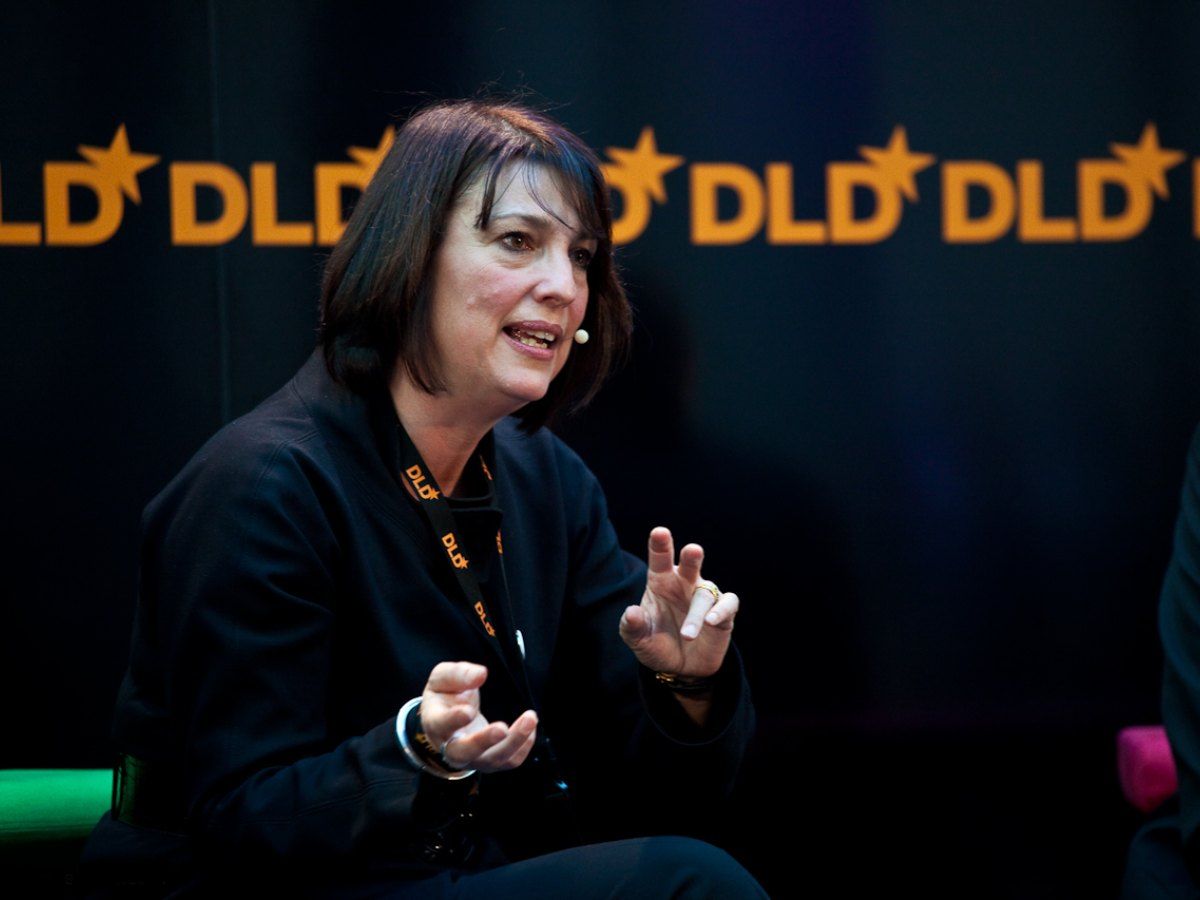
Top photo: ITV chief executive Carolyn McCall. Photo: nrkbeta, Wikimedia Commons (CC BY-SA 2.0)