
From Airwaves to Floor Space — Japan's IP-into-space shift and Korea's task

As Japan's terrestrial broadcasters pivot from shrinking ad revenue to "IP-into-space" monetization — exemplified by TV Asahi's nine-story Tokyo Dream Park anchoring Doraemon and immersive Lumières art —Korea's media industry faces

From Airwaves to Floor Space — Japan's IP-into-space shift and Korea's task

On the ground at Tokyo Dream Park — the ‘non-broadcast revenue’ TV Asahi built into a nine-story building, and the homework for K-content

Midsummer Tokyo, a rooftop with the bay in view. As Doraemon steps onto the stage, hundreds of people raise their phones at once. It looks like a one-off crowd-pleaser, but the scene signals where the weight of Japan's broadcast industry is shifting.

Japan's terrestrial broadcasters are moving the axis of their business off the airwaves. As broadcast advertising declines structurally, they are turning their own IP into floor-space revenue. The clearest example is Tokyo Dream Park (TOKYO DREAM PARK), the nine-story complex TV Asahi brought to full operation on 12 June in Ariake.
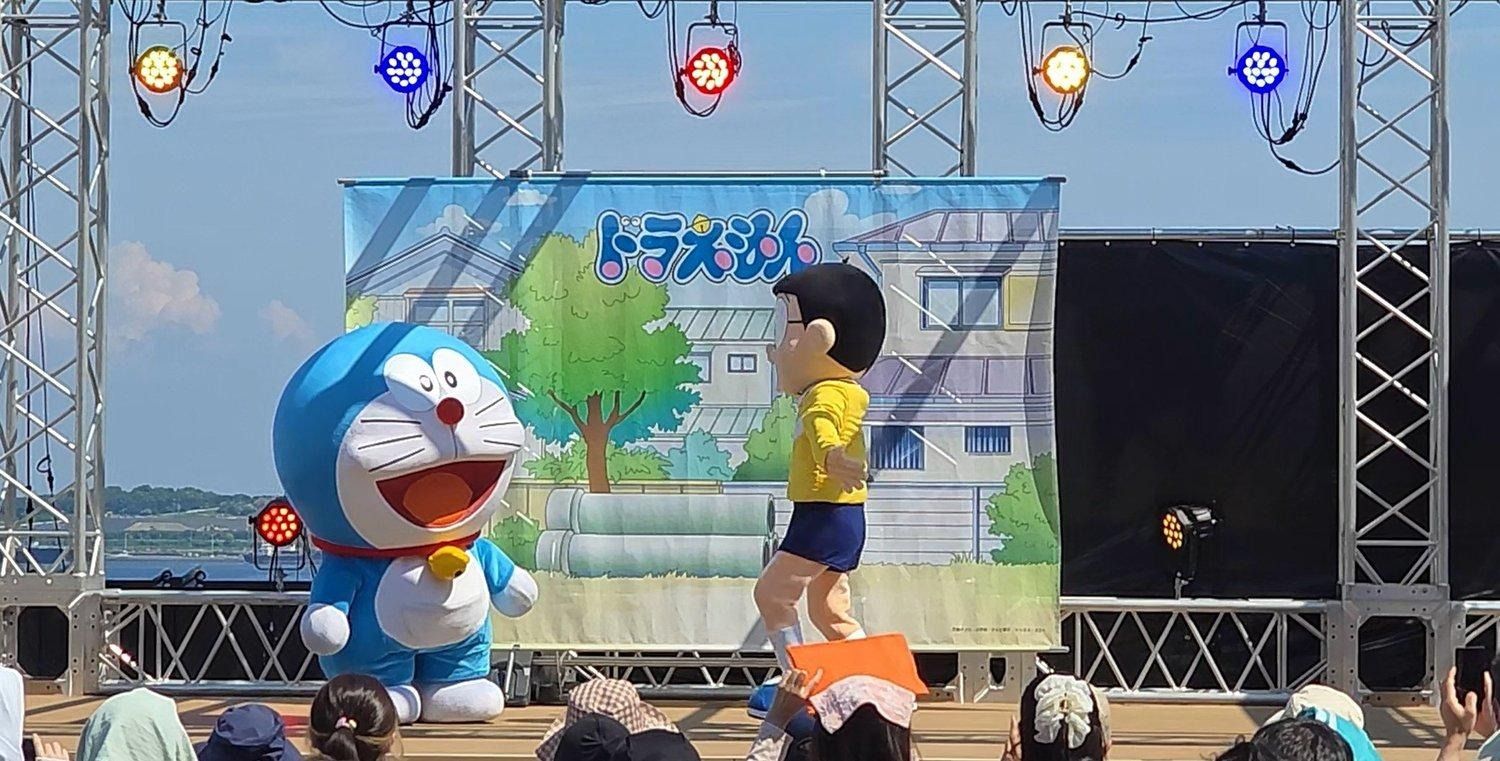
The Doraemon show on the sixth-floor Dream Terrace, Tokyo Bay behind the stage. (Photo by the author)

A nine-story building, built by a broadcaster

Tokyo Dream Park, newly opened in Ariake: one basement level, nine floors above, about 46,500 square meters. A concert hall, a 1,500-seat theater, exhibition halls and restaurants gathered in one building. And the company behind it is not a developer but a broadcaster — TV Asahi. It says it has pooled more than 65 years of know-how, billing itself as a ‘composite business linking city and media’. The building is the product of its 2023 mid-term plan ‘BREAKOUT STATION!’: under the premise that ‘all value originates in content’, it set a ‘360-degree’ strategy spreading content across broadcast, streaming, live and retail, and a ‘Media City’ strategy planting venues in the city, with a large share of ¥50 billion in strategic investment flowing into this building and into IP.

Table 1. Tokyo Dream Park at a glance

Item

Detail

Name

TOKYO DREAM PARK (東京ドリームパーク)

Opening

Phase 1: 27 Mar 2026 → Grand opening (full): 12 Jun 2026, incl. RÊVE DES LUMIÈRES

Location

3-3-8 Ariake, Koto-ku, Tokyo

Scale

B1 + 9 floors / ~46,500 ㎡ / designed & built by Shimizu Corporation

Access

~5-min walk from Tokyo Big Sight Stn (Yurikamome) / ~9-min from Kokusai-tenjijo Stn (Rinkai)

Partners

EPSON (digital-art projection) · TV Asahi

Early results

~300,000 visitors in the first month (~1.5× target) · annual target 2 million

Fact check: official address 3-3-8 Ariake (TV Asahi release, Impress Watch). Opening was phased — 27 March (phase 1) and 12 June (full).

Early turnout beat plan. Per Nikkan Sports, about 300,000 people came in the first month after the 27 March opening — roughly 1.5 times the initial target. TV Asahi is aiming for two million a year.
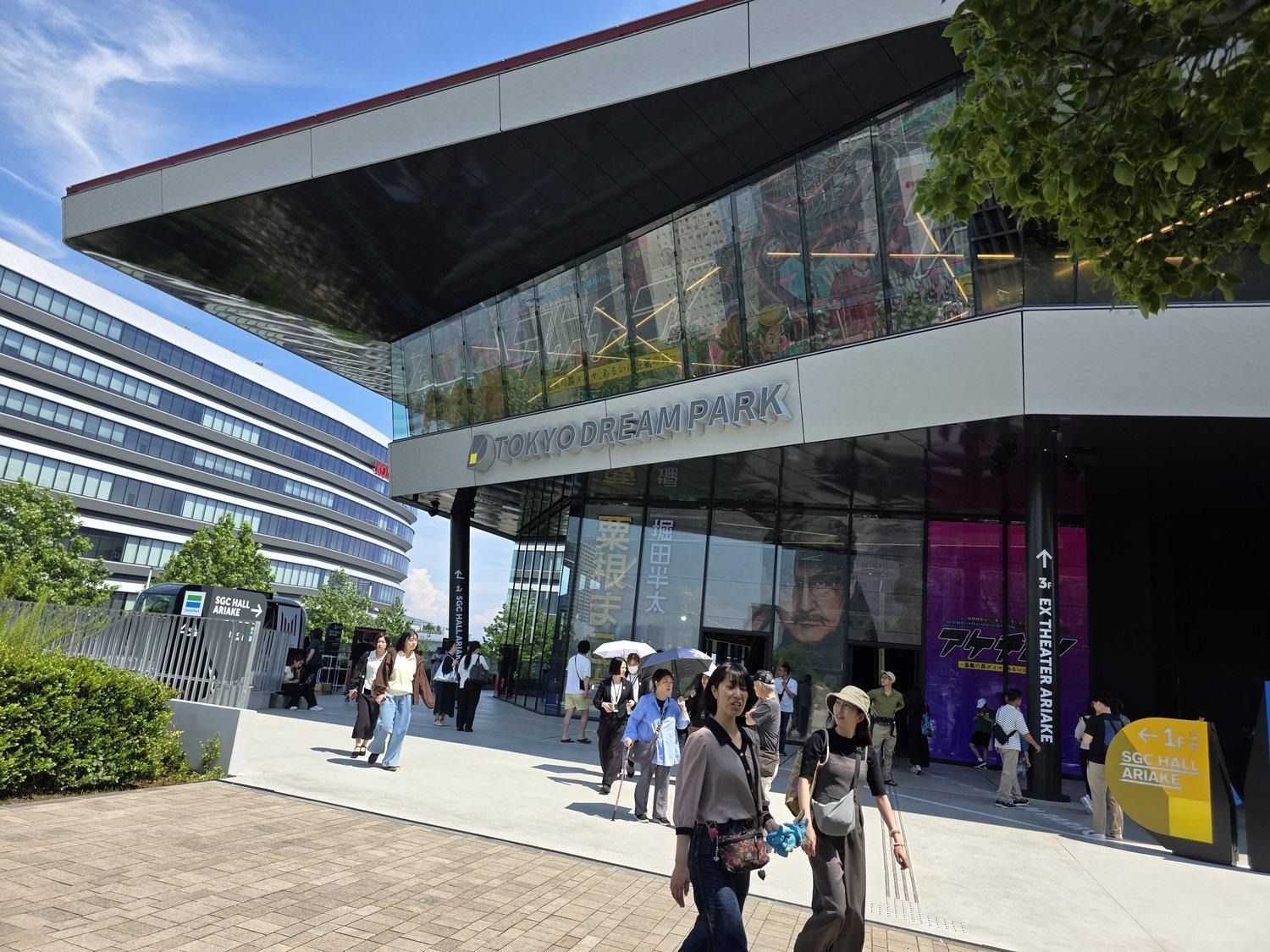
The front of Tokyo Dream Park; routes split toward SGC Hall (1F) and EX Theater (3F). (Photo by the author)

A wedding hall, Anniversaire Tokyo Bay, once stood on the plot; after it closed in 2021, TV Asahi was named operator, broke ground in November 2023 and completed the building, built by Shimizu Corporation, in February 2026. At the 27 March phase-one ceremony, the comedy duo Sandwichman, the singer-author Kato Shigeaki and Doraemon held up an ‘OPEN’ sign; the full building opened on 12 June with the eighth-floor immersive-art space. In October the roughly 10,000-capacity Toyota Arena Tokyo opens nearby, and the whole bayfront is being knit into an entertainment district.

The 27 March opening ceremony, with Sandwichman, Kato Shigeaki and Doraemon. (Photo: Tokyo Dream Park)

Inside — from a gold Ohtani to Van Gogh

A life-size gold Ohtani statue at the second-floor entrance — ¥55 million each. (Photo by the author)

From the second-floor entrance, the mood is different: two life-size gold statues of Ohtani, ¥55 million each, with the British-style pub HUB beside them. The seventh floor belongs entirely to Doraemon — more than 100 life-size figures scattered about, with new designs (Shiba-inu, sumo, sakura, onigiri) made just for the show. ‘100% Doraemon & Friends in Tokyo’ runs through 30 September, the largest such exhibition yet, capped by a recreation of creator Fujiko F. Fujio's desk and a merchandise shop.

And on the eighth floor, the last space to open: RÊVE DES LUMIÈRES — France's Culturespaces immersive-art series ‘Lumières’, its first site in Japan. More than 100 Epson projectors throw Van Gogh's ‘The Starry Night’ across the walls and floor. Van Gogh was a painter immersed in ukiyo-e; a French operator has brought a lover of Japanese art back before Japanese audiences.

The second-floor atrium: a Starry Night stamp rally and sponsor booths hold visitors' paths. (Photo by the author)

Down in the atrium, visitors follow a ‘Starry Night’ stamp rally to three spots around the building, and at each turn a sponsor booth and a ‘Making of Tokyo Dream Park’ display catch the eye. Watching, eating, buying, lingering — the time a visitor spends is stretched out inside one building.

Tokyo Dream Park schematic layout. (Graphic: reconstructed from the floor plan)

Table 2. Tokyo Dream Park layout (①–⑥)

No.

Facility

Position

Notes

SGC HALL ARIAKE

top-left

Large concert hall, premium sound (~5,000)

EX THEATER ARIAKE

center-right

~1,500-seat theater (musicals/plays)

EX STUDIO 8

bottom-right

Digital art — RÊVE DES LUMIÈRES powered by EPSON

DREAM TERRACE

top-right

Rooftop green terrace (Doraemon show · sculpture parks)

CAFE & RESTAURANT

center-left

Umikaze Kitchen, Horiguchi Coffee, etc.

CENTER PROMENADE

bottom-left

Main entrance plaza

EX Theater's official capacity is ~1,500 (the schematic shows 1,000). This plan is an orientation schematic; the actual building is a 9-story vertical structure.

Table 3. Tokyo Dream Park, floor by floor

Floor

Space

What's there

8F

RÊVE DES LUMIÈRES

Immersive digital art (Lumières series, Japan debut · Van Gogh)

7F

EX Studio 7

Events & exhibitions (100% Doraemon & Friends in Tokyo)

6F

Umikaze Kitchen · Dream Terrace · EX Studio 6

Restaurant & rooftop (Doraemon show · sculpture parks)

3F

EX Theater Ariake · Atrium

1,500-seat theater (musicals/plays), linked to main entrance

2F

Main Entrance

Life-size gold Ohtani statues; HUB, donuts, salad, coffee

1F

SGC Hall Ariake

Live hall for ~5,000; hall entrance · FamilyMart

B1

Parking

Source: on-site directory and press materials.

Turning space into a spending route

Why would a broadcaster go this far? The answer is in the flow of money. Japan's terrestrial ad revenue has been sliding over the long run, and attention has scattered to social media. Where it is hard to hold people in front of a screen, a broadcaster's most durable assets are content and IP. Pull that IP out into real space, and you can sell dwell time in a place instead of view time on a screen. The longer people stay, the more each spends — and the videos they post become an ad that draws the next visitor.

The equation the five key stations are solving

This is not TV Asahi alone. For the fiscal year ended March 2025, terrestrial revenue (parent basis) at Japan's five commercial key stations ran ¥236.8 billion at TV Asahi, ¥221.9 billion at Nippon TV, ¥214.1 billion at Fuji TV, ¥212.0 billion at TBS and ¥115.8 billion at TV Tokyo. With terrestrial growth blocked, all five have widened into film, anime, games and events.

The lead cards are IP acquisition and real estate. Nippon TV bought Studio Ghibli in 2023, becoming top shareholder with 42.3% of voting rights, and under ‘open up — Gear up, go global’ targets ¥540 billion in consolidated revenue. TBS, with Mitsubishi Estate, is redeveloping ‘Akasaka Entertainment City’ for completion in autumn 2028; it has turned the Akasaka ACT Theater into the dedicated house for ‘Harry Potter and the Cursed Child’, and its media-content and real-estate arms together generate about 85% of consolidated operating profit. TV Tokyo, building from content and IP under a ‘CaaS’ banner, grew overseas game royalties from NARUTO and BORUTO into record results. The labels differ; the direction is the same — content and IP at the starting point, broadcasting as one route to distribute them.

Table 4. The five Japanese key stations and their IP / experiential strategies

Network

Terrestrial revenue (FYE Mar 2025, parent)

Key IP / experiential moves

TV Asahi

¥236.8 bn

Tokyo Dream Park (real events on own IP); 360° & Media City strategy

Nippon TV

¥221.9 bn

Made Studio Ghibli a subsidiary (2023); pivot to global content company

Fuji TV

¥214.1 bn

Diversifying into content & events to grow non-broadcast revenue

TBS

¥212.0 bn

Akasaka Entertainment City redevelopment; ACT Theater (Harry Potter)

TV Tokyo

¥115.8 bn

Global IP incl. NARUTO/BORUTO overseas game royalties (CaaS)

Source: company IR and mid-term plans, Japanese press. Revenue is terrestrial broadcasting (parent), FY ended March 2025.

Slowing ads, sports rights on the move

Two forces push broadcasters to move IP into buildings: advertising and sports. As viewing shifts to mobile and new media, the broadcast ad market has contracted structurally, and Korea Investors Service judges a meaningful near-term recovery unlikely. At the same time, the live events and one-off rights that propped up ratings are migrating to deep-pocketed streamers.

Deal sizes mark the move. The NBA's new 11-year, $76 billion deal — starting 2025–26 — adds Amazon Prime Video, triple the prior $24 billion package. Netflix locked in NFL Christmas games, the Paul–Tyson bout (its most-streamed sporting event) and US rights to the FIFA Women's World Cup (2027, 2031), cementing an ‘event’ live strategy. S&P Global expects US TV and streaming sports-rights fees to climb from $29.2 billion in 2025 to $37.1 billion by 2030. The center of gravity for rights is shifting from free over-the-air to subscription streaming.

Korea is no different. Coupang Play has piled up the EPL, La Liga, Bundesliga, NBA, F1 and, from autumn 2026, the NFL, using sports as a subscriber lock-in. Tving climbed out of losses on KBO digital rights (₩135 billion / ~$89M, 2024–26). With Netflix, Wavve and Disney+ all leaning into sports, terrestrial broadcasters' footing wobbles. A network can pay a fortune for one-off rights, and a streamer with more capital can take them at the next auction.

Table 5. Sports / event rights migrating to streaming (cases)

Scope

Case

Note

Global

NBA's 11-year, $76bn deal adds Amazon Prime Video

3× the prior $24bn deal

Global

Netflix: NFL Christmas, Paul–Tyson boxing, FIFA Women's WC (2027/2031)

‘event’ live strategy

Global

US sports rights fees to reach $37.1bn by 2030 (from $29.2bn in 2025)

S&P Global

Korea

Coupang Play: EPL, La Liga, Bundesliga, NBA, F1, NFL, K League

sports as subscriber lock-in

Korea

Tving: KBO digital rights (2024–26, ₩135bn / ~$89M)

turned losses around

KRW≈$1/₩1,518 (13 Jun 2026). Sources: Netflix filings, S&P Global, The Current, sisajournal-e.

Why now — the swelling immersive and AI markets

The growth markets broadcasters are heading into are not small. The global immersive-entertainment market is forecast to grow from about $144 billion in 2025 to about $413 billion by 2030 — roughly 23% CAGR (Mordor Intelligence) — with teamLab and Culturespaces as its leaders. The AI market that lowers production cost runs as steeply: from about $244 billion in 2025 to about $827 billion by 2030, of which generative AI (~$70 billion) counts media and entertainment among its core buyers. APAC immersive-art exhibitions are the fastest-growing slice (~15% CAGR), centered on Japan. As advertising thins and sports rights drift to streaming, immersive experience and AI are swelling at once — and broadcasters are stepping in with IP in hand.

Table 6. Immersive and AI-related market sizes

Segment

2025 size

Outlook

Notes

Global immersive entertainment

~$144 bn

$413 bn (2030)

~23% CAGR / teamLab, Culturespaces

Global AI market

~$244 bn

$827 bn (2030)

~28% CAGR

Global generative AI

~$70 bn

high growth (30–40% CAGR)

media & entertainment a top buyer

APAC immersive art exhibitions

fastest-growing

~15% CAGR / Japan most mature

Estimates vary widely by research firm. The above are representative 2025 figures (Mordor Intelligence, Statista, Grand View Research, Dataintelo).

Lessons for Korea

Korea's media sits at the start of the same pressure. Broadcast advertising is slowing and sports rights are moving to streaming. Recently JTBC failed to repay maturing short-term bonds, and its parent JoongAng Holdings, with Contentree JoongAng and Megabox JoongAng, filed for court rehabilitation; a soft cinema market and the burden of content investment are cited as the background. When advertising and the box office both wobble, the question is what a media company keeps as an asset.

The starting line is not bad. K-pop, drama and variety IP already travel globally, and the inbound demand Netflix has lifted keeps rising. The ‘IP-into-space’ approach Japan's networks are testing fits the IP Korea already holds. The question is whether to spend that IP as one-off screen consumption or tie it down as an asset audiences come to and stay in. The lessons from Japan are clear enough.

The most direct path is to fix one's own IP into a permanent experiential asset. As TV Asahi anchored Doraemon and Lumières inside a nine-story building, K-pop and drama IP moved into permanent immersive exhibitions or themed spaces can turn view time into dwell time and spend per head. Once built, it does not slip away at the next rights auction.

Packaging with real estate and local government, rather than a broadcaster going it alone, is another route. As TBS grows Akasaka into an entertainment city with Mitsubishi Estate, binding content, property and tourism into one axis spreads the upfront cost and pulls in local footfall — with room to link to municipal tourism and urban-renewal projects.

Language-free visual and immersive content turns inbound tourism straight into revenue. Experiences that work without subtitles — Culturespaces' Lumières, teamLab — pay off most when paired with the ‘K-content pilgrimage’ demand Netflix has created.

Last is the balance of capital allocation. Expensive one-off rights can pass to a deeper-pocketed bidder at the next auction, but a space built on a company's own IP stays. The point is not the building but the IP that fills it. Will K-pop, drama and variety stay on a screen, or move into spaces audiences walk into and stay in? What kind of building Korea's broadcasters and K-content put up will shape the next bottom line.

The Doraemon show ran over the three opening days on the sixth-floor Dream Terrace; ‘100% Doraemon & Friends in Tokyo’ runs through 30 September. RÊVE DES LUMIÈRES opened 12 June. Tokyo Dream Park is about a 5-minute walk from Tokyo Big Sight Station (Yurikamome).

Sources

Tokyo Dream Park · TV Asahi

– TV Asahi press release (PR TIMES), ‘TOKYO DREAM PARK opens 27 March’ (27 Mar 2026); Impress Watch (28 Mar 2026)

– Nikkei (25 Sep 2025); Kenbiya; Wikipedia (JA); animationbusiness.info (¥50bn investment)

– Nikkan Sports, ‘Tokyo Dream Park draws ~300,000 in first month, ~1.5× target’ (28 Apr 2026) · TV Asahi briefing

– TV Asahi ‘RÊVE DES LUMIÈRES’ opening notice (11 Jun 2026)

Japan's key stations · strategies

– World Rule Creators (Dec 2025) — key-station revenue; ORICON / Studio Ghibli official (Ghibli subsidiary, 42.3%, 2023)

– Sogo Unicom Monthly Property Management (May 2024) — Akasaka ACT Theater; TV Tokyo Holdings IR (NARUTO/BORUTO)

Advertising · sports rights · OTT · Korean media

– Dong-A Ilbo, ‘Defaulting JTBC downgraded; JoongAng Ilbo cut too’ (14 Jun 2026)

– Dealsite, ‘JoongAng Holdings, Contentree, Megabox JoongAng file for rehabilitation’ (15 Jun 2026)

– Netflix filings · S&P Global / The Current — NBA $76bn deal, sports-rights fee outlook

– sisajournal-e (OTT sports push weakens terrestrial, Apr 2026); Coupang Play / Tving rights coverage

Immersive · AI markets · on site

– Mordor Intelligence (immersive) · Statista / Grand View Research (AI) · Dataintelo (immersive art)

– Tokyo Cheapo; GO TOKYO — gold statues, Doraemon, 8F Lumières / On-site photos by the author; ceremony photo: Tokyo Dream Park (2026)