RETAIL / K-CULTURE / CONSUMER INDUSTRY
“Mandu” and “Yangnyeom” Are Becoming Product Names in U.S. Retail
A walk through one Northbrook shopping center reveals a connected consumer ecosystem spanning K-food, K-beauty and Korean content
KEY ANALYSIS
Korean products in mainstream U.S. retail no longer depend solely on labels such as “Korean-style.” MANDU, KIMCHI, GOCHUJANG and YANGNYEOM now remain visible in product names and category language. At the same time, K-beauty, K-pop and Korean webtoon IP are creating a connected retail ecosystem in which exposure to one part of Korean culture can stimulate demand for another.
In Village Square of Northbrook, a suburban shopping center north of Chicago, a short walk through Trader Joe’s, TJ Maxx and Barnes & Noble offers a compact view of the Korean cultural industries’ expanding reach. At the grocery store, shoppers encounter mandu, kimchi, gochujang and yangnyeom. At the off-price retailer, “Korean Beauty” is presented as a dedicated discovery category. At the bookstore, K-pop publications and Korean webtoon-based intellectual property create additional reasons to browse and buy.
The industrial significance lies in more than a growing number of Korean products. Korean words are becoming search terms, memory cues and brand assets for American consumers. Meanwhile, the path from content exposure to food and cosmetics purchases—a cross-category consumption pattern long visible online—is now taking physical form on mainstream retail shelves.

From Translation to Proper Noun
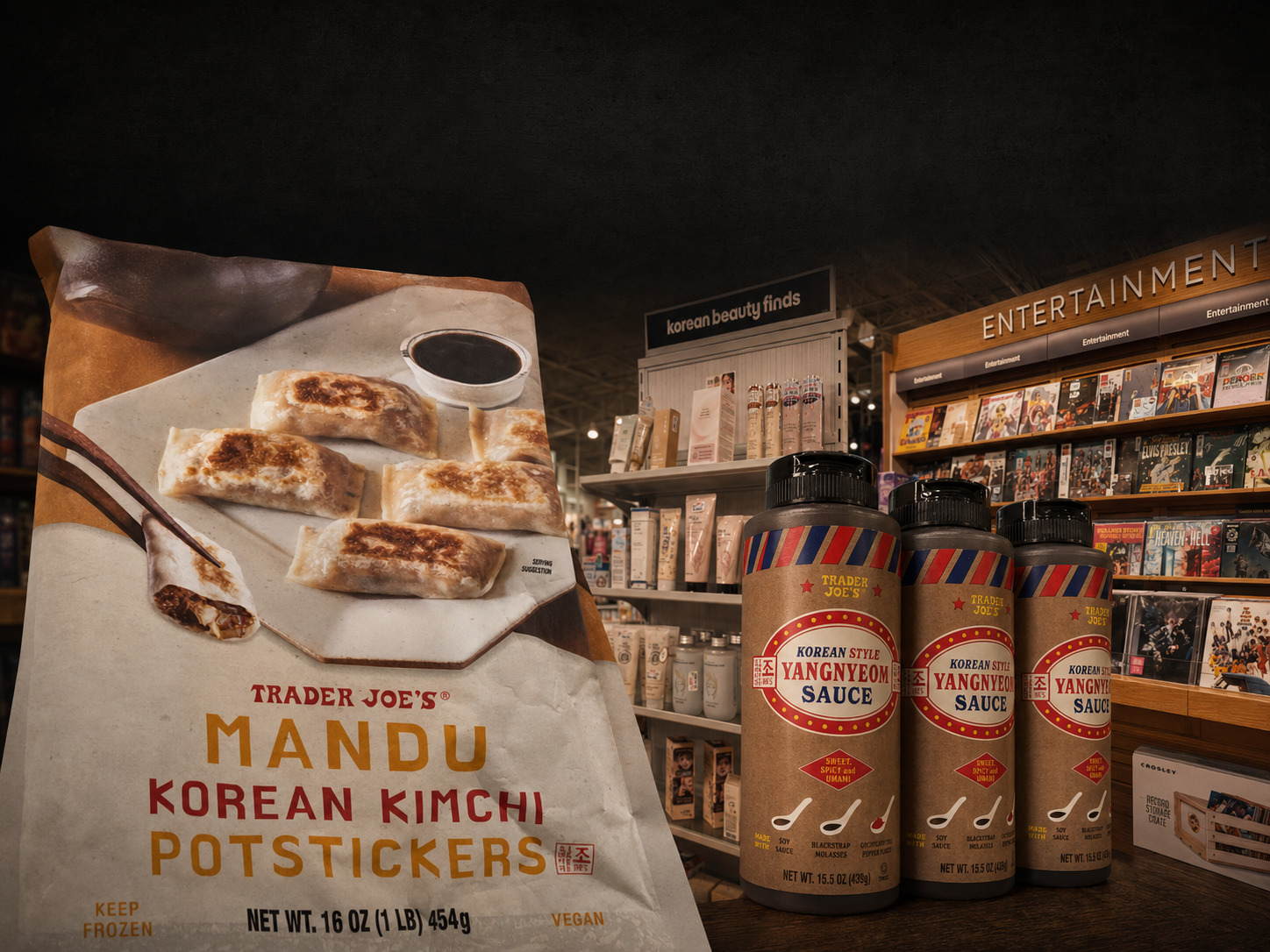
The front of Trader Joe’s “MANDU Korean Kimchi Potstickers” package illustrates a change in linguistic hierarchy. “Potstickers,” the familiar American retail term, remains as an explanatory descriptor, but MANDU is the first and largest product identifier. KIMCHI is not translated either.
The package reflects a shift away from fitting Korean food entirely into an established American category. Instead, the Korean name itself supplies distinction, authenticity and brand value.
The change is even clearer in the sauce aisle. “Gochujang” is followed by the explanation “Korean fermented red pepper paste,” while “Korean Style Yangnyeom Sauce” preserves yangnyeom instead of replacing it with a generic phrase such as “seasoned sauce.”
Gochujang has also entered Merriam-Webster as a standalone dictionary headword. Retailers increasingly treat Korean pronunciation not as an obstacle to consumer education, but as a marketing asset that helps differentiate the product.

In Trader Joe’s frozen section, “MANDU” is the lead product name; “Korean Kimchi Potstickers” appears as the supporting explanation. © K-EnterTech Hub

Trader Joe’s packages put the Korean words gochujang and yangnyeom ahead of generic English translations. © K-EnterTech Hub
Market Data: Mainstream U.S. Retail Penetration Matters as Much as Export Value
The K-culture economy should not be reduced to one aggregate “market size.” Food, cosmetics and content statistics use different scopes, definitions and base years. Adding them together would be misleading. Still, official indicators across the three industries show that the Northbrook displays are not an isolated fad.
Note: The figures above should not be combined because each industry uses a different statistical scope and reference year. Sources: Republic of Korea Ministry of Agriculture, Food and Rural Affairs; Ministry of Food and Drug Safety and Korea.net; Ministry of Culture, Sports and Tourism.
K-food’s U.S. growth is especially relevant to the products observed in Northbrook. According to the Ministry of Agriculture, Food and Rural Affairs, Korean agricultural and food exports to the United States reached $1.8035 billion in 2025, up 13.2%. Sauce exports to the United States totaled $92.2 million. The ministry linked the growth of gochujang, tteokbokki and barbecue sauces to rising demand for flavor profiles that combine heat and sweetness.
The numbers measure export flows; the shelves reveal what happens after those products enter the market. When a mainstream retailer gives MANDU or GOCHUJANG priority on the label, distribution is doing more than moving inventory. It is teaching vocabulary, creating search behavior and increasing the likelihood that Korean names will retain value across brands and product lines.
K-Beauty: From a Collection of Brands to a Retail Category
At TJ Maxx, a shelf marker reading “korean beauty finds” shows that K-beauty has moved beyond being a loose collection of individual imported brands. Toners, masks, creams and cleansers are grouped under a common expectation associated with Korean beauty.
Packaging that retains Hangul can function as a visual signal of provenance, formulation expertise and authenticity rather than as a failure to localize. The category label reduces the consumer’s search cost: shoppers do not need to know every brand in advance because “Korean Beauty” itself becomes the reason to explore the shelf.
Export performance supports that interpretation. Korean cosmetics exports reached a record $11.4 billion in 2025, a 12.2% increase from the previous year. A dedicated display at a major off-price retailer suggests that demand first built through e-commerce, specialty beauty channels and social media has expanded into routine suburban shopping.

The “korean beauty finds” display at TJ Maxx shows that Korean Beauty itself has become a shopping category, not simply a collection of individual brand placements. © K-EnterTech Hub
From K-Pop to Webtoons and Publishing: Expanding Fan Spending Through IP
At Barnes & Noble, K-pop fan guides and related publications occupy prominent space in the entertainment section. The store also carries print editions of “THE STAR SEEKERS,” a title created with the involvement of HYBE and WEBTOON.
The shelf illustrates how fandom can move from music and albums into books, webtoons and character-based merchandise. A single intellectual property franchise can generate several revenue windows while keeping fans inside the same narrative and commercial universe.
This expansion matters because content companies are no longer monetizing attention only through a single format. Music can introduce characters and stories; webtoons can deepen engagement; print editions can convert digital familiarity into a physical purchase. The result is a broader customer lifetime value and a more diversified revenue structure.

K-pop-related publications and merchandise in the entertainment section at Barnes & Noble. © K-EnterTech Hub

HYBE and WEBTOON’s “THE STAR SEEKERS” demonstrates how music fandom can extend into webtoon and publishing consumption. © K-EnterTech Hub
The Cross-Conversion of Korean-Wave Demand
The 2025 Overseas Hallyu Survey covered 26,400 people abroad who had experience with Korean cultural content. Among respondents, 70.3% said they liked Korean cultural content.
When asked whether categories were widely known among the general public and whether related products were being sold, food ranked highest at 53.7%, followed by music at 51.2% and beauty at 50.8%. Willingness to pay for Korean products and services was also strong, reaching 66.2% for food and 57.1% for beauty.
Most importantly for retailers and consumer brands, 22.1% cited an appearance in a movie or television program as a reason for purchasing a Korean product or service, an increase of five percentage points from the previous year.
The finding suggests that K-pop, drama, film and animation do more than generate direct content revenue. They also function as marketing infrastructure for adjacent industries—including sauces, frozen food, cosmetics and tourism—by lowering the cost of consumer discovery and customer acquisition.
The Northbrook retail route makes that cross-conversion visible. A consumer who first encounters Korean culture through music or a webtoon may already recognize kimchi, gochujang or Korean skin-care routines. Conversely, a shopper who begins with food or beauty can become more receptive to Korean entertainment and publishing. Each category helps reduce the unfamiliarity of the others.
Three Implications for the Retail Industry
First, Korean proper nouns are search and branding assets—not translation costs.
English explanations still play an important supporting role, but placing MANDU, GOCHUJANG and YANGNYEOM at the front of the label creates differentiation and preserves the product’s cultural identity.
Second, the “K” category is evolving from shelf organization into a merchandising tool for discovery and experience.
Retailers can use the category to curate products, educate shoppers and design cross-promotions among food, beauty, publishing and entertainment.
Third, content companies and consumer-product companies need to connect fandom data with retail data.
The Korean Wave’s spillover effect becomes an actionable sales strategy only when companies can identify which titles, artists or characters lead consumers toward particular foods, cosmetics or destinations.
These implications also point to a measurement opportunity. Retailers and Korean exporters should track not only unit sales but also branded search terms, first-time category purchases, repeat rates and cross-category baskets. Such data would reveal whether exposure to Korean content is producing measurable incremental demand—and which Korean words are becoming durable consumer language.
Conclusion: Korea Is Exporting Language and Consumer Habits, Not Only Products
Barnes & Noble’s official store announcement lists its Northbrook location at 45 Skokie Boulevard, with Trader Joe’s and TJ Maxx immediately nearby in the same retail area. That proximity is central to the story. K-food, K-beauty and Korean content are being encountered together not at a Korean grocery store or a cultural festival, but along an ordinary American suburban shopping route.
The Northbrook scene suggests that the Korean Wave’s next phase is not simply about putting more products labeled “Korean” on the shelf. It is about consumers saying mandu instead of “Korean dumpling,” gochujang instead of “red pepper paste,” and recognizing Korean Beauty as a shopping category in its own right.
Products and content are being exported, but so are Korean names, discovery patterns and consumer habits. Once a foreign-language term becomes useful to shoppers—something they can search, remember, recommend and repurchase—it begins to function as durable commercial infrastructure.

Barnes & Noble at Village Square of Northbrook. Trader Joe’s and TJ Maxx are located in the same retail area. © K-EnterTech Hub
Sources
- Republic of Korea Ministry of Agriculture, Food and Rural Affairs, 2025 K-Food Plus export release
- Republic of Korea Ministry of Food and Drug Safety and Korea.net, 2025 cosmetics export data
- Republic of Korea Ministry of Culture, Sports and Tourism, 2025 Overseas Hallyu Survey
- Republic of Korea Ministry of Culture, Sports and Tourism, Korean content-industry export indicators
- Barnes & Noble, announcement of the Northbrook store opening
- Merriam-Webster, “gochujang” dictionary entry