AI STUDIOS / CAPITAL MARKETS / GLOBAL
Studio Meta K names Eugene Investment & Securities as lead IPO underwriter, planning to license the engine built on 15.3 billion won of state R&D as SaaS, with a generative AI Sopyonje aimed at global release
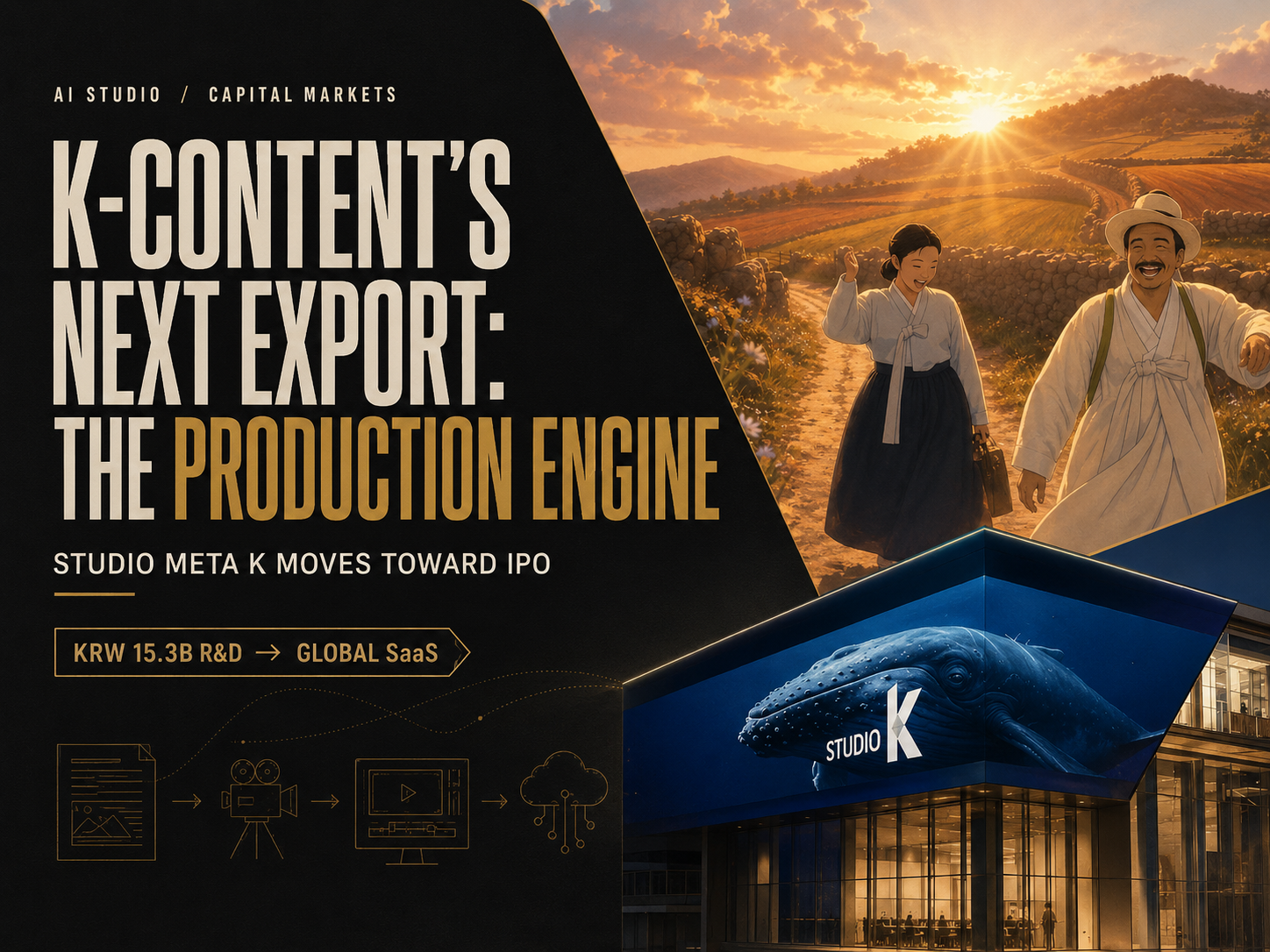
Studio Meta K (스튜디오메타케이), led by chief executive Kwang-Jib Kim(김광집), has selected Eugene Investment & Securities (유진투자증권) as lead underwriter for its initial public offering. The company disclosed the mandate on Aug. 25 and said it would work through listing procedures in stages. No listing timetable or offering size has been set.

What the company presents at the mandate stage are two state research and development projects awarded in July, its own production slate, and theatrical AI animation IP. Founded in February 2022 and based in Pangyo (판교), Seongnam, Studio Meta K builds content and intellectual property using generative AI and virtual human technology. Company records on THE VC show national R&D work in generative AI and virtual humans, and selection for NVIDIA (엔비디아) Inception, Google for Startups Cloud and KOCCA’s investment-linked program.

Eugene resumes lead-underwriting work after a five-year gap
Eugene Investment & Securities had no conventional lead-underwriting record after the September 2021 listing of S&D (에스앤디), setting aside SPAC mergers. According to inews24 (아이뉴스24) on May 7, the firm took the lead mandate for Cosmo Robotics (코스모로보틱스) ahead of its KOSDAQ listing; the company offered 4.17 million shares for roughly 22.1 billion won (about 15.9 million dollars). With Big Wave Robotics (빅웨이브로보틱스) added, Eugene was projected to book three track records in the first half alone.
The rebuild began in 2023. As real estate project financing contracted and the firm needed to diversify its revenue base, it recruited Yoo Jang-hoon (유장훈), formerly head of IPO at Samsung Securities (삼성증권), and reorganized its corporate finance division. As of The Bell’s (더벨) March 9 report, IPO headcount had reached 34 against an initial target of 30, with the biotech desk filled by people from pharmaceutical companies and pharmacists rather than rival brokerages. Studio Meta K is an early case of that desk, built out on robotics and biotech, taking on content and AI.
The two companies have crossed once before. Guide Runner (가이드러너), the short-form drama Studio Meta K released in January, was produced as a selected entry in a spin-off drama competition hosted by the Broadcasting Content Promotion Foundation (방송콘텐츠진흥재단) and sponsored by Eugene ENT (유진이엔티), an affiliate of Eugene Group, per ZDNet Korea on Jan. 21. No connection between the two matters has been disclosed.
What the AI studio looks like: one pipeline from planning to post
The production structure the company describes runs from automated content planning through storyboard and previsualization generation, video and 3D production, digital human creation, automated post-production and personalized content generation, as an integrated pipeline, per Wowtale (와우테일) on July 30. The design binds the whole process into one flow rather than bolting individual tools together, and the platform name attached to it is MetaK AI Studio OS (메타케이 AI 스튜디오 OS).
Broadcast references attach to that as validation data. The company lists Netflix’s (넷플릭스) Monthly Boyfriend (월간남친), MBC’s Rookie Coach Kim Yeon-koung (신인감독 김연경), SBS Plus’s (SBS플러스) A Real Man’s Way to Travel (상남자의 여행법), MBN’s Dolsing Fourmen 7 (돌싱글즈7), KBS’s History Special (역사스페셜-시간여행자), ENA’s My Star Like Gold (금쪽같은 내스타) and media art at Inspire Resort (인스파이어 리조트). ZDNet Korea (지디넷코리아) reported on June 23 that the company has delivered more than 100 commercial projects. The SBS Plus title was announced as a co-production on March 31.
Two state projects worth 15.3 billion won, split between an engine and long-form generation
Studio Meta K was named lead institution on two projects under the 2026 Culture, Sports and Tourism R&D program run by the Ministry of Culture, Sports and Tourism (문화체육관광부) and the Korea Creative Content Agency (한국콘텐츠진흥원, KOCCA). The announcement came on July 30, and total budget across the two over three years is 15.3 billion won (about 11 million dollars).
The first project, an integrated AI-based broadcast video production engine and validation platform embedding directing, shooting and editing grammar, carries a total budget of 10.3 billion won (about 7.4 million dollars) with 7.7 billion won (about 5.5 million dollars) in government funding, per Money Today (머니투데이) on July 30.
Omotion (오모션), Studio Lennon (스튜디오레논), Ofim Digital (오핌디지털), Space Rabbit (스페이스래빗), MBC Plus (MBC플러스), the Korean Broadcasting System (한국방송공사, KBS) and Kwangwoon University (광운대학교) participate. The aim is to connect planning, previsualization, shooting, video generation, editing and post into one platform and validate it on actual broadcast productions, per Venture Square (벤처스퀘어) on July 30.
The second project, a long-form video generation and editing solution reflecting real-world shooting conditions, carries a total budget of 5 billion won (about 3.6 million dollars) with 4.1 billion won (about 2.95 million dollars) in government funding, with Omotion, Kwangwoon University, Sungkyunkwan University (성균관대학교) and KBS Media (KBS미디어) participating. It feeds camera movement, framing, lighting, spatial information and actor movement from real footage into the generation process so that characters, backgrounds and narrative flow stay consistent across long running times, and builds tools to join generated scenes to shot footage and revise them to the producer’s intent, per Wowtale on July 30.
At the time of the awards, Kim said the company would develop AI as a tool that understands the producer’s directorial intent and creative grammar to raise efficiency and quality, rather than as a technology that replaces the producer, per Money Today on July 30. The long-form project is designed along that line, since it takes the camera, lighting and blocking of human-shot footage as the structure for generation.
The in-house slate has grown: a theatrical release and a 20-part short-form drama
Alongside commissioned work, the company has released its own titles. The film To the Name (이름에게) opened in theaters on Oct. 30 last year with a simultaneous IPTV and VOD release, following a journey to find a mother the protagonist was separated from as a child. It won 12 awards at the Paris Film Awards, London Movie Awards and Hollywood Gold Awards among others. Guide Runner, released in January, runs 20 episodes and follows a runner who fails to make a corporate team and becomes a guide runner for a blind athlete. It went out on the short-form platforms Shortime (쇼타임) and Everyreels (에브리릴스) and reached the top five most-watched list on Shortime, per ZDNet Korea on Jan. 21.
Virtual artists as variety show hosts: iaaa and Suvi of SEASON
The IP the company builds in-house is not only titles. iaaa (이아), the first member of its AI virtual artist group SEASON (시즌), debuted as a special host on JTBC’s special program Real Live (리얼라이브); the second member, Suvi (수비), appeared as a special host on MBC’s The PD Has Disappeared (PD가 사라졌다), per Yonhap News (연합뉴스). Suvi has also released a digital single, SUNCREAM, with music produced by Hwang Sung-jin (황성진) of RBW and choreography by Mina Myoung (미나명). She appeared as an AI virtual artist on MBN’s Dolsing Fourmen 7 (돌싱글즈7), which premiered July 20.

Suvi, the AI virtual artist, on MBN’s Dolsing Fourmen 7. Image: MBN broadcast
The work extends past broadcast. AI video and virtual artists have been applied to JTBC’s Dog Days Out (집 나가면 개호강), media wall visuals for Baby DONT Cry (베이비돈크라이) of Psy’s label P NATION (피네이션), a music video for Kim Yong-bin (김용빈) of Mr. Trot 3, and exhibition video for Kia (기아자동차), per a Wowtale interview.
Kim told Yonhap that in this period the content made with virtual artist technology matters as much as the technology itself, and told Wowtale that the company works to hold a six-month training lead while competitors catch up to its current output.

Music videos are where the company has tested the animated idiom. A cyberpunk street, a mech and character animation assembled through generative models produce the kind of scene live-action budgets do not reach. Kim has said in a broadcast interview that replacing scenes that once required large budgets makes it possible to build large-scale shots outside the capital and still compete globally. The direction lines up with K-pop labels and music distributors looking to bring music video costs down.
Virtual artists sit in the most sensitive band of the classification set out above. The HGW document places figures and performances generated from prompts in the machine generative category it treats as uncopyrightable, and US viewers rated entirely synthetic actors lowest, at -19 points. SEASON’s approach, though, is not to substitute for a working actor but to foreground and label the figure as an AI virtual artist. A disclosed character and a replaced performer draw different audience reactions, and a character IP the company owns outright also stays clear of likeness and voice consent questions.
Three MOUs in July alone, reaching live performance, games and a Chinese studio
On July 10, Studio Meta K signed an agreement with MetaRocket (메타로켓), a real-time performance production technology company, on AI-based K-pop concert content, per Money Today. On July 20 it signed separate agreements with the Korea Game Policy Association (한국게임정책학회) and the Chinese AI studio STUDIO TOZ (스튜디오 토즈); ZDNet Korea reported that day that the terms cover joint seminars and forums on AI game content, AI animation and virtual humans, and joint research on copyright, data use, ethics and policy. On July 23 it announced cooperation with Studio Gale (스튜디오게일) on developing and commercializing AI-based animation.
Earlier ties run alongside. A physical AI content agreement with Lumida (루미다) was signed on May 13, and the digital twin company SmartCube (스마트큐브) agreed to pursue overseas expansion, including Japan, together. AI remastered content co-produced with the AI advertising company Gemstone (젬스톤) screened at Samsung’s The First Look event during CES 2026. On April 8 the company was selected for the Ministry of SMEs and Startups (중소벤처기업부) DIPS deep-tech startup program.
The export item is the engine, not the title, and SaaS supply is the next step
The endpoint the company sets for its state R&D work is a platform rather than a picture. Results from the two projects are to be developed into the core technology of MetaK AI Studio OS, then taken out as a SaaS-based AI production service and supplied as a platform to global content companies, per Venture Square on July 30. Revenue built on commissioned production and revenue built on licensing a production tool are assessed differently at listing: the first is a project backlog, the second is recurring.

The overseas contact points run in several directions. In its production announcement materials the company said it is pursuing collaboration with US broadcast networks and global media companies. With STUDIO TOZ it has joint work on AI animation and virtual humans plus joint research on copyright and data use; with SmartCube it agreed to pursue overseas expansion including Japan. The AI remastered content made with Gemstone screened at a Samsung event during CES 2026. Its own titles have travelled too: To the Name took 12 awards at the Paris, London and Hollywood Gold festivals, and Guide Runner went out on Shortime and Everyreels.
Sopyonje is not aimed only at domestic screens either. The announcement materials set the goal as new K-content that keeps the original’s feeling and philosophy while competing in global markets. Pansori and han carry a heavy explanatory load in overseas distribution, but animation costs less to dub and localize than live action, and audience resistance to AI dubbing is comparatively low.
The US approach: a distribution path, technical credibility, a new format
Three contact points attach to the US market. Each is different in character, and each secures something different for the company.
The first is over-the-air television. Sinclair Broadcast Group (싱클레어) launches K-Channel 82 (K-채널 82), a national K-content channel, later this year, beginning in Washington D.C. and Baltimore. The name joins the K of K-content with Korea’s country code, 82. Sinclair operates 185 stations across 86 markets and reaches roughly 40 percent of US households. Channel operations, advertising and scheduling sit with its subsidiary CAST.ERA (캐스트에라), and KBS, SBS, YTN, MBN and Arirang TV (아리랑TV) supply the content, per ZDNet Korea on March 20 and Digital Daily on April 20.

The K-Channel 82 trailer produced by Studio Meta K, credited on screen as "Produced by STUDIO META-K." Image: K-Channel 82 trailer
Studio Meta K produced the channel’s trailer and signed an agreement with Sinclair at the KOBA exhibition in May. The early schedule leans on library content for revenue stability: K-pop and drama at 70 to 80 percent, travel, fashion and industry content at 20 to 30. What meets the company’s cost structure is not that library, but what sits between it.
The promos, interstitials and localization assets a channel has to make new run to high volume at low unit prices, which is the band where AI production carries an economic case.

A variety programming segment from the K-Channel 82 trailer. Image: K-Channel 82 trailer
Transmission runs on ATSC 3.0, the next-generation over-the-air standard, supporting targeted advertising, search, shopping and voting, with AI English dubbing layered on. Del Parks (델 파크스), Sinclair’s chief technology officer, told a Seoul press briefing on March 19 that the goal is to bring a Korean channel into American homes.
The second is the US campus, where demand among younger audiences can be read directly. Kim presented on Aug. 7 at the FutureTech Forum of UKC 2026, the Korea-America conference run by the Korean-American Scientists and Engineers Association (KSEA), in Orlando. At the session, organized by K-EnterTech Hub, the company set out its business in three areas: AI Virtual Artists, Generative AI Contents, and K-Drama and Film. Wangbi Yeosinga (왕비여신가), Grand Master HAN PARK and Wave of Fate (파동) were among the works cited.


The third is Nevada. Since Sphere opened in Las Vegas, venues such as Cosm, IMAX and Inspire have multiplied and a market has formed for content made for those spaces.
Studio Meta K is preparing to enter Nevada against that demand. K-Nevada Gateway 2026, running Sept. 28 to Oct. 1 in Reno, lists AI, content and media alongside entertainment technology and fandom among its target sectors and builds a CES 2027 link into the program.

What the three routes deliver is, in order, a distribution path, technical credibility, and a format distinct from theaters and broadcast. What they share is that none of them sells a finished title. They sit on the same level as the engine export plan described above.
The IP anchor is Sopyonje, with Im Kwon-taek directly involved
On the IP side, the axis is remaking an old Korean film with AI.
Studio Meta K and Dongseo University (동서대학교, president Chang Je-kuk (장제국)) held a production announcement for a generative AI animated Sopyonje (서편제) with director Im Kwon-taek (임권택) at the university’s Centum campus in Busan on June 10, disclosing the production direction and the AI-based process. The company’s announcement materials state that Im, who directed the original, takes part in the project directly to carry its philosophy and sensibility forward. Released in 1993, Sopyonje was the first Korean film to pass one million admissions in Seoul, carrying a Korean aesthetic built on pansori and the sentiment of han (한).

The Sopyonje generative AI animation production announcement at Dongseo University’s Centum campus in Busan on June 10. Photo: Studio Meta K
The teaser shown that day made the idiom explicit. In the footage carried by Busan Ilbo TV (부산일보TV), figures in hanbok walking a stone-walled path appear as hand-drawn 2D animation rather than photoreal reconstruction. The original’s live-action images are carried into animation rather than replicated.
That choice bears on the classification question above. Not reproducing a real performer’s likeness reduces the consent burden, and training models on concept art the team drew itself makes the human-authored contribution easier to describe. What looks like an aesthetic decision also works in favor of the rights structure.

Part of the AI animated Sopyonje teaser shown at the production announcement. Image: Busan Ilbo TV
The setting of the announcement says something about the project. The same day, on the Centum campus, Dongseo launched its Stella College of Arts (스텔라예술대학), presented Im Kwon-taek with a service award and announced Sopyonje alongside it. President Chang Je-kuk said the college would be built into an arts education platform representing Asia in the AX era, per Busan Ilbo on June 11. The local talent base is thickening too: the Busan Film Commission (부산영상위원회) ran a five-week AI filmmaking course for 12 selected residents, who completed 12 AI short films, per Busan Ilbo on July 28.
The roles are split. Studio Meta K takes the whole production system on AI video and content orchestration; Dongseo University’s Institute of Virtual Convergence Technology (가상융합기술연구원) supplies AI, video and animation research capacity and production infrastructure. It is an industry-academia arrangement.
In the announcement materials Kim described Sopyonje as a work holding Korean sentiment and cultural memory, and set the core goal as carrying the original’s feeling and philosophy to a new generation and to audiences abroad. Institute director Cho Seung-woo (조승우) said the project would combine Busan’s film and video industry infrastructure with AI education capacity into a new global production model. Busan Ilbo (부산일보) reported on June 14 that release is expected next year.
Cutting a 5 to 10 billion won animation budget to 500 million, funded through security tokens
Kim presented an IP creation strategy for the generative AI production era at the 5th Korea Blockchain Web3 Game Conference at the Gyeonggi Center for Creative Economy and Innovation in Pangyo on June 23. ZDNet Korea reported that day that Kim said a domestic theatrical animation typically costs 5 to 10 billion won (about 3.6 to 7.2 million dollars) and that financing has become difficult as the investment market contracted.
The alternative he set out has two layers. AI brings unit cost down to around 500 million won (about 360,000 dollars), and ten titles are made at once rather than betting on one. The capital for that comes through security token offerings (STO). A figure of up to 90 percent production cost reduction was presented in the same session.
Funding to date has run through conventional channels. The company raised an additional 3 billion won (about 2.2 million dollars) Series A round from Korea Investment Partners (한국투자파트너스) and Timeworks Investment (타임웍스인베스트먼트) in June last year, and was selected for Scale-up TIPS by the Ministry of SMEs and Startups that October, per Wowtale on July 30.
The security token law takes effect in February 2027, leaving a gap in the funding plan
Amendments to the Electronic Securities Act and the Financial Investment Services and Capital Markets Act passed the National Assembly on Jan. 15, 2026. They recognize distributed ledgers as legally effective securities account books, introduce an issuer account management institution regime, and allow brokerages to distribute investment contract securities, per law firm newsletters carried by Lawtimes (법률신문) on Jan. 16. A column in Electronic Times (전자신문) on July 7 noted that the Financial Services Commission (금융위원회) has set the effective date at Feb. 4, 2027, and that 2026 is closer to a preparation year for subordinate rules, supervisory regulations, and issuance, distribution and settlement infrastructure.
Financing production budgets with security tokens sits on that timetable. Attorney Cha Sang-jin (차상진) told ZDNet Korea on June 28 that detailed work is still needed on licensing-unit inclusion, venture investment eligibility, the issuance basis for investment contract securities, disclosure and investor protection standards, and settlement and accounting rules.
A gap remains. Funding ten simultaneous animated features through security tokens means designing the regulatory clock and the production start on separate tracks.
The technology-track listing bar is rising too, to 10 billion won in revenue by 2029
The Korea Exchange (한국거래소) has widened sector-specific review standards for technology-track listings from bio, AI, space and renewables to advanced robotics and cybersecurity, and has signaled the addition of six more fields during 2026, including advanced robotics, K-content and cybersecurity. One more door opens for a company like this one.
Maintenance requirements tighten at the same time. KOSDAQ delisting standards on market capitalization rise to 15 billion won in 2026, 20 billion won in 2027 and 30 billion won from 2028; revenue standards rise from 3 billion won through 2026 to 5 billion won in 2027, 7.5 billion won in 2028 and 10 billion won from 2029, according to a March 23 column by Pinepat (파인패트) citing Korea Exchange and Financial Services Commission materials.
Technology-growth and pre-profit companies get a grace period: exemption from revenue-shortfall designation for five fiscal years including the year of listing. The Financial Services Commission has also signaled adding a delisting review trigger where a company shifts its main business away from the technology that was assessed. For a company assessed on a production engine, the question is how revenue arriving later from IP distribution or other lines connects back to that assessment.
Overseas capital is shifting from models to studios, and rights-cleared data is now a selling point
PitchBook’s tally published June 26 put investment into AI video and media technology startups at 5.6 billion dollars (about 7.78 trillion won) this year, already more than 43 percent above the full-year 2025 total, with investment in the segment more than tripling over five years.
Most of that money still sits with video generation model companies such as Runway (런웨이) and Luma AI (루마 AI). The same report noted capital broadening from models toward studios, citing Google DeepMind’s (구글 딥마인드) 75 million dollar (about 104.3 billion won) investment in indie studio A24 and London-based Wonder’s (원더) 12 million dollar (about 16.7 billion won) round with Atomico (아토미코) and LocalGlobe (로컬글로브).
Variety VIP+ on Feb. 19 grouped the new studios built around generative AI pipelines as Promise (프로미스), Asteria Film (애스테리아 필름), TCL Studios (TCL 스튜디오), Pigeon Shrine (피전 슈라인), Toonstar (툰스타) and Invisible Universe (인비저블 유니버스).
Promise is backed by Peter Chernin’s (피터 처닌) The North Road Company (노스로드) and Andreessen Horowitz (앤드리슨 호로위츠); Asteria Film was acquired by Moonvalley AI (문밸리 AI). Asteria founder Bryn Mooser (브린 무저) told IndieWire (인디와이어) that the goal is to let a filmmaker make for 20 million dollars (about 27.8 billion won) what would have cost 120 million dollars (about 166.8 billion won). The direction matches Studio Meta K’s 5 billion to 500 million won plan, and the multiple is close as well.
Rights handling on training data has already moved into the commercial terms. Variety reported this month that Asteria’s partnership with virtual production studio ZeroSpace (제로스페이스) gives it access to ZeroGen (제로젠), a generative platform built to keep enterprise output inside legal boundaries on copyright.
Asteria co-founder Benjamin Michel (벤저민 미셸) described the aim in that report as hybrid production, with the latest generative technology working alongside actors, cinematographers, production designers and VFX artists. The competitive condition is not model performance but access to data whose rights are clean.
An AI studio opens in Culver City, and Netflix says AI touched 300 of its 1,000 titles
The Guardian (가디언) reported from the Promise shoot on Aug. 16, in modest premises near the Sony Pictures (소니 픽처스) lot in Culver City (컬버시티). Promise is backed by Google (구글), Silicon Valley venture capital and Disney (디즈니).
The set is small. On a stage that was little more than an office corner hung with white sheets, actor Tori Thomas (토리 토머스) played a chase scene while a small camera followed her and the AI superimposed her movement in real time onto a swaying field generated by Seedance 2.5 (시댄스 2.5), a Chinese video model released this month. Actor and backdrop appeared together on the director’s handheld monitor, and the next take swapped the meadow for an underground cavern. The film is the horror title Touch Grass (터치 그래스), budgeted in the low millions of dollars and directed by Dave Clark (데이브 클라크).
Adoption has already moved to studio scale. Netflix said last week that it had used the technology on 300 of its 1,000 titles in 2026. Director Ron Howard (론 하워드) is preparing The Code (더 코드), an AI-enabled animated documentary based on drawings made by US prisoners of war in Vietnamese captivity, with Obsidian (옵시디언), an AI studio operating from Imagine’s (이매진) Beverly Hills headquarters. Brad Pitt (브래드 피트) said this month that despite the pushback, AI used as a tool would help mid-budget films of 40 to 90 million dollars (about 55.6 to 125.1 billion won) get made, per the same report.
Cost figures came from the floor as well. George Strompolos (조지 스트롬폴로스), co-founder and chief executive of Promise, estimated that hybrid films combining human actors with AI would run 20 to 50 percent cheaper than conventional production. D Ryan Reeb (라이언 리브), an executive producer at Obsidian, put the saving the technology delivers at 30 to 40 percent. Those are a different order from Asteria’s sixfold and Studio Meta K’s tenfold: the more a production keeps live actors and a camera crew, the lower the reduction.

Production cost reductions each AI studio has stated publicly. The light segment runs to the low end of the range, the dark segment to the high end. Source: The Guardian, Aug. 16 (Promise, Obsidian); IndieWire (Asteria); ZDNet Korea, June 23 (Studio Meta K)
The AI studio landscape. Source: The Guardian, Variety, IndieWire, ZDNet Korea and Wowtale reporting
Hollywood stops asking whether AI was used and starts asking who controlled what
The Ankler (앵클러) published the first public document of a Hollywood AI working group on Aug. 20, titled Human Generative Workflows (HGW). The group began in November 2023 under producer Kathleen Kennedy (캐슬린 케네디) and Susan Ruskin (수전 러스킨), dean of the American Film Institute (AFI), with Oscar-winning directors, actors, studio executives and Silicon Valley figures taking part off the record. The document was released after the group widened the room to about 120 participants at AFI last weekend.
The problem was vocabulary. Richard Rushfield (리처드 러시필드), who wrote the accompanying article, described a single word covering everything from a post-production tool to a synthetic performance replacing an actor, leaving contract talks, credits and guild discussions stuck together.
The document sorts AI used in final footage into three categories. Utility techniques and embedded AI cover work with a defined correct answer, such as denoising, upscaling, audio separation, rotoscoping and markerless motion capture. Human Generative Workflows cover pipelines where the artist sets parameters, supplies inputs and evaluates output at each step, working inside professional tools such as Nuke, Unreal, Blender and ComfyUI with tightly trained LoRA models, control nets and structured inputs. Machine Generative (MG) covers likenesses, voices, performances or stories produced from prompts alone as a substitute for human creative work. The first two are treated as copyrightable; MG is not. The framework is offered as a map rather than a switch, and its authors call it an argument, not yet an industry standard.
The legal anchor is the U.S. Copyright Office report Copyright and Artificial Intelligence, Part 2: Copyrightability, issued Jan. 29, 2025. It holds that copyright does not extend to purely AI-generated material or to output where human control over expressive elements is insufficient, that sufficiency is assessed case by case, and that with current generally available technology prompts alone do not provide sufficient control. Protection reaches the human contribution, not the machine-generated remainder.
The worked example in the document is Dear Upstairs Neighbors (디어 업스테어스 네이버스), a six-minute animated short directed by Connie He (코니 허) and produced by Márcia Mayer (마르시아 마이어), which premiered at the Tribeca Festival in June 2026. Roughly 45 people worked on it, including animation veterans from Pixar (픽사) and DreamWorks (드림웍스) alongside Google DeepMind researchers and engineers. The team hand-painted concept art, fine-tuned small custom models on that artwork, built video-to-video workflows with rough animation as the structural backbone, and painted over and retrained when results missed their intent. Every frame passed through generative models; not one was hand-drawn.
The route Sopyonje has taken overlaps with that standard. Training on the team’s own concept art and declining to reproduce a real performer’s likeness places it on the HGW side.
Labeling practice is already moving on its own. A24’s Heretic closed its 2024 credits by stating no generative AI was used; Vince Gilligan’s (빈스 길리건) Pluribus ended in 2025 with a line saying humans made it; DreamWorks’ The Bad Guys 2 used its credits to bar AI training on the work. The document notes that such notices are inconsistent in both policy and wording, and that sales companies and rights advocates have begun pushing for industry-wide certification.
The point is that the question has changed. Not whether AI was used, but at which stage and under whose control, is what separates copyright and credit.
Audiences answer differently by stage: sound effects +12%, synthetic actors -19%
Luminate Intelligence’s July special report, AI & Media: Audience Attitudes, drew on wave 17 of its U.S. Entertainment 365 survey, fielded May 5-26 among 2,000 U.S. respondents aged 13 and over.
Reactions split by stage. Asked how comfortable they were with AI at specific stages of film and TV production, viewers came out net positive on three: sound effects (+12 points), high-quality special and visual effects (+9) and illustrations used in animation (+8). Scripts and screenplays sat at -10; digital replicas of deceased actors and entirely synthetic actors at -19 each; and digital replicas of living actors lowest at -20. Resistance rises not at the technology itself but at the point where it substitutes for a human performance.

Net comfort with AI use in film and TV production among US viewers. Source: Luminate Intelligence, AI & Media: Audience Attitudes (July 2026), U.S. Entertainment 365 wave 17
Other surveys run at the same gradient. In YouGov polling cited in the report, 75 percent of US adults called replacing all actors with AI-generated characters unacceptable and 57 percent said the same of writing the script, while 64 percent found translating subtitles acceptable and 61 percent said so of generating visual effects. Bain found 55 percent less interested in watching video where AI generated an entire show, against 23 percent when AI was used to brainstorm ideas.
Disclosure runs stronger still. In HUB Entertainment Research polling of 2,500 people aged 16 to 74 in November 2025, 72 percent said companies should always disclose AI use when making a TV show or movie. Twenty-one percent said disclosure was needed only where AI was used in a major way, and 7 percent said it was unnecessary (carried in the Luminate report).
The age split runs against expectation. On AI-scripted movies and TV, net interest among 13 to 17 year-olds ran +32 points against -26 among 18 to 24 year-olds. The gap between those two bands reaches 58 points. Those aged 55 to 64 sat at -32 and those 65 and over at -43. The line falls inside Gen Z before it falls between generations.
Where the copyright line and the audience line diverge
The two lines largely coincide. The utility and embedded AI category the HGW document treats as copyrightable is the same band where viewers are net positive, and the machine generative category it treats as uncopyrightable is the band where they are most negative.
Scripts are where they diverge. Even under an artist-controlled workflow, audience reaction sits at -10. Process design does not resolve it; disclosure has to be prepared separately.
The working group’s three categories and where Studio Meta K’s work falls. Source: the Human Generative Workflows document published by The Ankler, and the U.S. Copyright Office Part 2 report
The state project design addresses the same problem as this classification. The long-form project takes camera movement, lighting and actor blocking from real footage as the input to generation and returns output the producer can revise to intent, which overlaps with what the HGW document describes as artist control and structured inputs.
A tension follows. If the path to a 500 million won unit cost raises the share of prompt-generated footage, the copyright in the output weakens; keeping control narrows the saving. For IP built for U.S. distribution, that distinction can enter the contract terms.
Capital, technology and rights structure, overseas AI studios and Studio Meta K. Source: PitchBook, Variety, IndieWire, Money Today and Wowtale reporting
The sharpest difference is where the money comes from. Abroad, the savings from lower unit cost have mostly been absorbed by private capital and parent balance sheets. Studio Meta K is taking the same cost logic to the public offering market. The 500 million won unit cost and the 90 percent reduction are targets presented from a conference stage; no completed title has yet been disclosed with profit and loss demonstrating them.
The tests cluster in 2027
Listing procedure, regulatory effect and first release fall in the same window. One item already applies: the AI Framework Act took effect on Jan. 22, 2026, so the labeling duty for generated output is in force, with corrective orders and fines up to 30 million won (about 22,000 dollars) for breach. The rest are points still to be checked.
Checkpoints overlapping Studio Meta K’s listing preparation. Source: Financial Services Commission and Korea Exchange materials, Electronic Times, Pinepat, Venture Square and Busan Ilbo reporting
Korean cinema shrank at the title count first: 22 releases scheduled for 2026
Major distributors including CJ ENM, Lotte Entertainment, Showbox, NEW and Plus M Entertainment have 22 Korean commercial films scheduled for release in 2026, per Hankyung (한국경제) on Jan. 2, half the roughly 40 a year before the pandemic. Releases of commercial films with net production budgets above 3 billion won (about 2.2 million dollars) rose from 37 in 2017 to 40 in 2018 and 45 in 2019, then fell to 30 in 2025, per Segye Ilbo (세계일보) on April 12.

Korean commercial film releases (net production budget above 3 billion won). The 2026 figure is distributors’ announced slate. Source: Segye Ilbo, April 12; Hankyung, Jan. 2
Recovery of capital narrowed alongside. Of the 30 commercial films released in 2025, six passed break-even; in 2024 it was eight of 37, per the same Segye Ilbo report. Dailian (데일리안) reported on Jan. 8 that the backlog of films shot during the pandemic and held back from release has effectively run out, leaving 2026 to be filled by titles financed under current conditions. First-half 2026 box office came to 579 billion won (about 417 million dollars), but a single title accounted for 45 percent of it. Box office reflects past investment; the title count is the coming slate.
That is the setting in which cutting unit cost to raise title count gets proposed. Studio Meta K’s ten-titles-at-once plan treats a volume problem as a cost problem.
The cause of the 22 figure, though, is not only budget. It also sits in the break-even structure. If recovery channels do not widen as costs fall, the same problem returns, which is why an AI animation slate has to be designed across theatrical, OTT, short-form and overseas distribution together.
Where Studio Meta K sits: an AI studio selling the engine
Capital for AI studios abroad has moved outside public markets. Promise draws on Google and Disney, Obsidian on Imagine’s in-house resources, Asteria on the Moonvalley acquisition, A24 on DeepMind’s investment. An AI studio taking its cost structure into a public offering, where disclosure obligations attach, is still rare.
That is what makes Studio Meta K’s attempt consequential domestically: the cost reduction and the pipeline have to be translated into the language of a prospectus, and the figures that emerge become the reference line for valuing Korean AI production companies afterward.
The gap between the cost claims is what gets tested. Promise’s 20 to 50 percent and Obsidian’s 30 to 40 percent describe live-action hybrid production with actors on camera; Studio Meta K’s 90 percent describes theatrical animation. The processes differ, so the numbers do not compare directly. Still, with Asteria’s animation and hybrid figure at roughly 83 percent, the composition of work that produces a 90 percent figure is an item that needs explaining during listing preparation.
Audience tolerance is the third line alongside cost and copyright. The stages where US viewers came out net positive were post-production, visual effects and animation illustration; replacing performers sat at the bottom. That Studio Meta K is preparing theatrical animation places it on the favorable side of this terrain: animation stands apart from the live-action performer replacement fight, and viewer reaction there falls inside the net positive band. A structure like Sopyonje, with the original director attached, also makes the human-authored contribution easier to describe.
The endpoints differ in shape as well. AI studios abroad mostly make and sell work. Promise makes films, Obsidian a documentary, Phantom X a YouTube series. Studio Meta K sets two endpoints: build IP with Sopyonje, and license the engine validated in the process as SaaS. The state projects with broadcasters and universities are the proving ground for that engine, and overseas supply is the revenue structure. Whether a Korean producer can move from exporting content to exporting the tools gets tested here first.
The US contact points are production participation rather than content sales. On K-Channel 82 the work was the trailer; at UKC it was a technical presentation; in Nevada it is venue content in preparation. Contract sizes are small next to selling finished titles. Each, though, connects directly to a US broadcaster, an academic network and venue operators, which reads as a precondition for engine supply deals.
Model sourcing belongs in the same frame. Chinese models are in working use on US AI studio floors, and Washington is weighing restrictions on Chinese open-source models. Studio Meta K is building its own production engine through state projects while holding an agreement with a Chinese studio. For IP aimed at U.S. distribution, which model entered at which stage bears not only on the copyright assessment but on the export-control discussion.
What this says to Korean operators
The basis for valuation is shifting: from order backlog to cost structure. The number Studio Meta K put forward was not title count or revenue but cost per title. For a production company preparing an IPO, the item under examination is not whether AI is in use. It is whether the savings reproduce in finished work, and whether they stay with the producer rather than being clawed back through lower commissioning rates.
A cost saving is priced only when it reaches the copyright ledger. The U.S. Copyright Office assesses human contribution case by case, and the HGW document places the onset of consent, credit and copyright at the moment a tool moves from exploration into the final pipeline. What a producer needs is not a statement about whether AI was used but a production record: which model, trained on which data, entered at which stage, and under whose judgment. That log is both the evidence of human authorship and the basis for explaining the IP asset during listing review.
Applying AI is no longer the exception. Netflix said it used the technology on 300 of its 1,000 titles in 2026, per The Guardian on Aug. 16. The phase where adoption itself was a differentiator has passed. What remains is which category of AI entered which stage, and who holds the rights in what comes out.
State R&D is technology validation and consortium positioning at the same time. The two awards bind broadcasters, a broadcast affiliate, AI companies and universities together. Entering with partners that hold data and live production environments is becoming more favorable, both for selection and for commercialization, than applying as a standalone firm.
The regulatory calendar is a variable in the funding plan. Security tokens take effect in February 2027 and the subordinate rules are still being drafted. A technology-track listing buys five years of revenue exemption, after which the raised thresholds apply. What has to be demonstrated is not the saving itself but the path from a lower cost base to repeatable revenue. The AI Framework Act is also already in force: failure to label generated output can draw a corrective order and a fine of up to 30 million won (about 22,000 dollars). A user applying AI as a simple tool is not covered by the duty under current law, but a producer supplying AI production capability as SaaS moves into a different position as an operator.
A layer is being added to the export mix. K-content has so far shipped finished titles and formats. If licensing a production engine opens as a route, the buyer moves from broadcasters and streamers to producers and studios, and the contract unit shifts from per-title to annual subscription. \
The competition in that market is not other Korean producers but model companies like Runway and Moonvalley and tool companies like Adobe and Blackmagic. Holding the differentiator — an engine built by people who know production grammar — depends on validation data continuing to flow in from actual broadcast work.
What this says to Korean broadcasters
In the two state projects, KBS, KBS Media and MBC Plus are co-development participants rather than commissioning clients. Broadcasters help set the specification of an AI production engine at the design stage, and their production data and archives enter as training and validation resources. KBS’s History Special appearing on Studio Meta K’s list of AI-applied titles is itself an archive use case.
Three contract layers need settling here: the scope of training and generative use of archive masters; where the AI savings land within outsourced production budgets; and consent and compensation when the likeness, voice and creative work of performers, voice actors and art staff enter a generative pipeline. A broadcaster holds three positions at once — commissioning client, counterparty to performer contracts, archive holder. If the R&D agreement records only the technical split and leaves these rights terms blank, the dispute arrives not at settlement but at commercialization after the project closes.
Internal standards are already being written. According to KOCCA’s Broadcast Video and OTT Trends, KBS adopted KBS AI Guidelines in August 2025 and planned to publish a detailed KBS AI Usage Notice in June 2026 setting out transparency and ethics criteria. The notice covers in-house production, outsourced production and digital and public service areas, specifying the scope of AI use, approval procedures, labeling and disclosure methods, and accountability and record-keeping standards.
The demand for disclosure is already coming from viewers: 72 percent of US respondents said AI use in TV and film should always be disclosed. In Korea the AI Framework Act’s labeling duty and broadcasters’ internal standards are moving the same way. Recording use by category during production costs less than attaching notices afterward.
Labeling has to move with a classification scheme. If the disclosure standard stops at whether AI was used, denoising in post and a prompt-generated performance carry the same on-screen line. That is the gap the working group’s three categories are meant to close. Writing permitted categories into the standard outsourcing contract, and matching credit wording to those categories, also splits performer consent negotiations by category — which is what the document proposes when it suggests separating consent on Machine Generative output of actors from the HGW discussion and taking it first.
Last comes implementation rights. If the integrated production engine is commercialized as SaaS, a broadcaster that contributed to its development as a participant could end up paying licensing fees to use it. Specifying implementation rights and usage terms at the agreement stage keeps the broadcaster’s options open in later production budget negotiations.
SOURCES
Lee Do-won, "AI content company Studio Meta K pursues IPO, names Eugene Investment & Securities as lead underwriter," ZDNet Korea, Aug. 25, 2026. https://zdnet.co.kr/
Studio Meta K, production announcement release for the generative AI animated Sopyonje, June 10, 2026 (company-provided).
"Studio Meta K selected as lead institution on state AI R&D projects worth 15.3 billion won," Money Today, July 30, 2026. https://www.mt.co.kr/future/2026/07/30/2026073013144172699
"Studio Meta K wins state AI content production projects worth 15.3 billion won," Wowtale, July 30, 2026 (per-project budgets, participants, pipeline). https://wowtale.net/2026/07/30/262211/
"Generative AI across the full production chain: Studio Meta K lands 15.3 billion won in state projects," Venture Square, July 30, 2026. https://www.venturesquare.net/1102164
"AI content company Studio Meta K drives into film and drama production," ZDNet Korea, Jan. 21, 2026 (To the Name, Guide Runner). https://zdnet.co.kr/view/?no=20260121102702
"Studio Meta K accelerates AI content industry cooperation," ZDNet Korea, July 20, 2026 (Korea Game Policy Association, STUDIO TOZ). https://zdnet.co.kr/view/?no=20260720103000
"Studio Meta K and MetaRocket sign MOU on AI-based K-pop concert content," Money Today, July 10, 2026. https://www.mt.co.kr/future/2026/07/10/2026071013132850159
"Studio Meta K and Dongseo University to remake Sopyonje as an AI film," ZDNet Korea, June 11, 2026. https://zdnet.co.kr/view/?no=20260611175350
"Kim Kwang-jip, Studio Meta K: cutting production cost by 90% with AI, leading a content funding revolution with STO," ZDNet Korea, June 23, 2026. https://zdnet.co.kr/view/?no=20260623190922
"Im Kwon-taek’s Sopyonje reborn as AI animation," Busan Ilbo, June 14, 2026. https://www.busan.com/view/busan/view.php?code=2026061423220592102
"Dongseo University launches Stella College of Arts," Busan Ilbo, June 11, 2026 (service award to Im Kwon-taek; AI animated Sopyonje announced). https://mobile.busan.com/view/busan/view.php?code=2026061114475407569
"Busan Film Commission’s AI artist training program bears fruit," Busan Ilbo, July 28, 2026. https://www.busan.com/view/busan/view.php?code=2026072810131270761
Busan Ilbo TV, teaser footage for the AI animated Sopyonje. https://www.youtube.com/watch?v=5UNoes4mEl8
Studio Meta K company profile (founding, funding, program selections), THE VC. https://thevc.kr/studiometak
Sung Jin-woo, "Eugene Securities restarts IPO engine after five years," inews24, May 7, 2026. https://www.inews24.com/view/1966275
"House analysis: Eugene Investment & Securities builds IPO presence through VC outreach," The Bell, March 9, 2026. https://www.thebell.co.kr/front/newsview.asp?key=202603091438189920105063
"Blockchain column: the legal basis for security tokens is set, the real market starts now (part 1)," Electronic Times, July 7, 2026. https://www.etnews.com/20260707000180
"Electronic Securities Act and Capital Markets Act amendments for security tokens pass the National Assembly," law firm newsletter via Lawtimes, Jan. 16, 2026. https://www.lawtimes.co.kr/LawFirm-NewsLetter/215101
"Attorney Cha Sang-jin: security tokens should be seen as funding infrastructure for innovative companies," ZDNet Korea, June 28, 2026. https://zdnet.co.kr/view/?no=20260628112218
"Technology-track listing in 2026: technology alone is not enough," Pinepat, March 23, 2026 (citing Korea Exchange and FSC materials). https://www.pinepat.com/ko/insights/columns/2026-tech-exemption-listing-technology-alone-not-enough
"AI output labeling: scope, methods and governing law," Beonhwa Law Office, June 17, 2026. https://bh-law.kr/ko/news/column/ai-content-labeling-obligation-guide
KOCCA, Broadcast Video and OTT Trends 2026 Vol.1 (KBS AI Guidelines and AI Usage Notice). https://www.kocca.kr/trendott/2026/vol01/spotlight_2.html
Kim Ji-sun, "Now variety hosts too: Studio Meta K’s AI virtual artists," Yonhap News (SEASON, iaaa and Suvi).
"Studio Meta K leads with AI video and virtual human technology," Wowtale interview. https://wowtale.net/2025/09/09/246756/
"Korean drama on US over-the-air TV: the blueprint for K-Channel 82," ZDNet Korea, March 20, 2026. https://v.daum.net/v/20260320100123500
Kang So-hyun, "Sinclair launches K-content broadcast channel K82, on air in the US from September," Digital Daily, April 20, 2026. https://www.ddaily.co.kr/page/view/2026042013482948730
Lee Seung-yoon, "YTN on US over-the-air TV: Channel 82 goes on air in September," YTN, April 26, 2026 (ATSC 3.0, AI dubbing, Stanley Park quote). https://www.ytn.co.kr/_ln/0104_202604260224297996
"Sinclair to create K-Channel 82 for Korean content," Broadcasting Technology Journal, March 23, 2026 (Del Parks press briefing). http://journal.kobeta.com/
"K-news goes global: AI-dubbed K-Channel 82 reaches US airwaves in September," ZDNet Korea, May 14, 2026. https://zdnet.co.kr/view/?no=20260514163055
K-Nevada Gateway 2026 program information (target sectors, schedule, CES 2027 link). https://knevada.com/
Luminate Intelligence, "AI & Media: Audience Attitudes," special report, July 2026 (U.S. Entertainment 365 wave 17, fielded May 5-26 among 2,000 respondents aged 13+; carries YouGov, Bain and HUB Entertainment Research polling).
Kim Ye-rang, "Fewer titles, lower expectations: Korean cinema on trial in 2026," Hankyung, Jan. 2, 2026. https://www.hankyung.com/article/2026010283497
"Falling admissions, polarized hits: where does Korean film go?" Segye Ilbo, April 12, 2026. https://v.daum.net/v/20260412102131921
"2026 outlook: Korean cinema at the edge," Dailian, Jan. 8, 2026. https://www.dailian.co.kr/news/view/1596089
"One title took 45%: first-half 2026 box office of 579 billion won," Issue Insight, 2026. https://www.issueinsight.co.kr/news/articleView.html?idxno=2988
Robert Booth, "I see the incredible promise: on set of an AI film shoot as new studios embrace controversial tech," The Guardian, Aug. 16, 2026. https://www.theguardian.com/film/2026/aug/16/on-set-of-an-ai-film-shoot-as-new-studios-embrace-controversial-tech
Richard Rushfield, "First Look: Hollywood’s Secret AI Talks Go Public. Here’s the Plan," The Ankler, Aug. 20, 2026 (carries the full Human Generative Workflows document). https://theankler.com/first-look-hollywoods-secret-ai-talks-go-public-heres-the-plan/
U.S. Copyright Office, "Copyright and Artificial Intelligence, Part 2: Copyrightability," Jan. 29, 2025. https://www.copyright.gov/ai/Copyright-and-Artificial-Intelligence-Part-2-Copyrightability-Report.pdf
"US Copyright Office Publishes Second Part of Report on AI Copyrightability," Mintz, Feb. 7, 2025. https://www.mintz.com/insights-center/viewpoints/54731/2025-02-07-us-copyright-office-publishes-second-part-report-ai
"From models to studios: how AI video investment is evolving," PitchBook, June 26, 2026. https://pitchbook.com/news/articles/from-models-to-studios-how-ai-video-investment-is-evolving
"AI Entertainment Studios: The New Breed of Companies Pioneering Gen AI-Powered Production," Variety VIP+, Feb. 19, 2026. https://variety.com/vip/ai-entertainment-studios-production-promise-tcl-edglrd-asteria-1236245068/
"AI Studio Asteria Strikes Strategic Partnership with Virtual Production Studio ZeroSpace," Variety, 2026. https://variety.com/2026/biz/news/ai-studio-asteria-strikes-strategic-partnership-zerospace-1236825083/
"This AI Animation Studio Believes It Can Convince All the Skeptics," IndieWire (Bryn Mooser interview). https://www.indiewire.com/news/business/ai-animation-film-studio-asteria-bryn-mooser-interview-1235058404/