
ANALYSIS · K-FAST
KOBACO study, 15 industry interviews… global market of USD 16.5bn by 2029, Korea's domestic market at USD 48m by 2030
The Korea Broadcast Advertising Corporation (한국방송광고진흥공사, KOBACO) has published A Study on Promoting the K-FAST (Free Ad-supported Streaming TV) Ecosystem. Written by research fellow Kim Do-kyung (김도경) and Kwon O-ju (권오주) of Korea University's graduate school, the 123-page report covers the structure of the FAST ecosystem, the operator landscape and policy demand. The report states that its findings are the researchers' personal views and not the official position of the corporation.
What the report identifies as the object of policy is not the domestic free-video market but the overseas distribution route itself. Korea's FAST market revenue is forecast to move from USD 23m (approx. KRW 31bn) in 2024 to USD 48m (approx. KRW 65bn) in 2030 (Omdia, 2024). Pay TV penetration above 90% and entrenched bundled tariffs leave little cord-cutting pressure.
The condition that gives Korea an unusual position in FAST sits in the hardware rather than the market size. With more than 89% of global TV sales now smart TVs, device-integrated FAST embedded in the operating system has become a distribution window reachable the moment the set is switched on, with no app install and no sign-up. Samsung TV Plus (삼성 TV 플러스) runs more than 4,300 channels in 30 countries and has passed 100m monthly active users; LG Channels (LG 채널) offers more than 5,000 channels in 37 countries on a webOS distribution base of 260m sets. A hardware share converting into a content distribution route is the starting premise of the study.
Global FAST at USD 16.5bn by 2029… 1.1bn users by 2027
Global FAST revenue is forecast to rise from USD 7.6bn in 2023 to USD 16.5bn (approx. KRW 22.3tn) in 2029 (Digital TV Research, 2024), with users passing 1.1bn by 2027 (Amagi and Omdia, 2024). The market is moving away from a North American concentration that once held more than 70% of global revenue: Europe is forecast to grow at a compound annual rate of 15.7% between 2023 and 2030 (KBV Research, 2025), and CTV households in Asia-Pacific are projected to expand from 160m in 2025 to 260m in 2030 (MPA, 2025).
The spread between research houses is wide. Omdia, presenting at Content London in December 2025, put global FAST revenue at USD 6bn in 2025 and USD 11bn by 2030. Against Digital TV Research's USD 16.5bn for 2029, the two forecasts are a year apart and differ by close to 50%.
Global FAST revenue forecasts, by research house

Blue is Digital TV Research, terracotta is Omdia. Two houses measuring the same market land close to 50% apart. Source: Digital TV Research (2024), Omdia (2025)
US streaming at 44.8% passes broadcast and cable combined… FAST at 5.7%
Through August 2025, US FAST viewing time rose 43% year on year to 1.8bn hours (Comscore, 2025). In May of the same year, total streaming accounted for 44.8% of viewing, exceeding broadcast and cable combined, while the major FAST platforms together held 5.7% — passing a single broadcast network for the first time (Nielsen, 2025). Around 6m US households dropped pay TV in 2024 alone, and cable and satellite usage fell to 36% (Cable Compare, 2025).
US TV viewing share, selected measures

Terracotta marks FAST services, blue all streaming. Streaming and FAST figures are for May 2025; The Roku Channel is December 2025 and Tubi full-year 2025. Source: Nielsen (2025), Direct Media Lab (2026), Fox Corporation (2025)
Regional gap of more than 100 times… USD 6.5bn in North America against USD 48m in Korea
North America is forecast to hold its position as the largest market with approximately USD 6.5bn by 2029. Europe is expected to move from USD 820m in 2025 to above USD 1bn in 2027, with the UK, Germany and France accounting for more than 60% of European revenue (Digital TV Research, 2025). Spain records the highest monthly FAST reach in Europe at 35% (Omdia, 2025).
FAST market size by region and country

Terracotta marks Korea, whose domestic forecast is roughly one one-hundred-and-thirty-fifth of North America. Source: Digital TV Research (2024, 2025), Omdia (2024, 2025), Statista (2025)
FAST markets by region
Source: KOBACO (2026), Table 2-3, reorganized
Samsung TV Plus at 100m MAU… Tubi past USD 1.1bn, platform 87% of Roku
Within North America's dedicated FAST services, Tubi holds 30%, The Roku Channel 25% and Pluto TV 20% (Apprupt, 2026). Fox Corporation's Tubi passed USD 1.1bn (approx. KRW 1.49tn) in fiscal 2025 revenue with 100m monthly active users and a 2.2% share of total US TV viewing time. Roku's total 2025 revenue was USD 4.737bn (approx. KRW 6.39tn), of which USD 4.145bn — 87% — came from the platform segment.
Share of dedicated FAST services in North America

Three operators account for 75% of dedicated FAST services in North America. Source: Apprupt (2026)
Major FAST platforms
Some figures differ between the report's Table 3-1 and its body text: ViX appears as 19 countries in the text and 21 in the table, and Pluto TV as several hundred channels in the text against 100+ in the table. Source: KOBACO (2026)
The largest variable in ownership is Fox's acquisition of Roku. Announced in June 2026 at an enterprise value of approximately USD 22bn (approx. KRW 29.7tn), the transaction is expected to close in the first half of 2027. On completion the combined company would rank third by total US TV viewing time behind YouTube and Disney, with Fox expecting around USD 400m in annual cost synergies (Fox Corporation, 2026).
Pluto TV illustrates the gap between viewing growth and monetization. Global viewing time rose 8% in 2024, but fourth-quarter 2025 non-Paramount+ DTC revenue fell 16% year on year, led by Pluto TV. More channels and more viewing time increased the supply of ad inventory, while ad demand, sell-through and rates did not keep pace.
85–90% of US CTV advertising is programmatic… PMP rates run near three times open market
More than 85–90% of US CTV display advertising is traded programmatically, and the cost per mille in premium private marketplaces stands at around USD 15 against USD 5.54 in the open marketplace (Beet.TV, MNTN Research, Simulmedia, 2025).
US CTV advertising CPM

Inventory tier moves the rate by close to three times. Source: Beet.TV, MNTN Research, Simulmedia (2025)
FAST ad revenue-sharing models
Source: KOBACO (2026), Table 2-2, drawn from Amagi (2025)
Amagi lists in India… FY26 revenue of KRW 230bn and a first annual profit
The report treats the media tech layer between content owners and platforms as a separate object of analysis. Amagi listed on India's NSE and BSE in January 2026 and recorded fiscal 2026 revenue (April 2025 to March 2026) of around KRW 230bn (approx. USD 170m), up about 30% year on year, delivering its first annual net profit. Global viewing hours across the channels Amagi tracks rose 55% year on year as of June 2026, with ad impressions up 53%.
Wurl is a wholly owned subsidiary of the mobile and CTV ad technology company AppLovin. Its BrandDiscovery product, launched in 2024, uses generative AI to analyse dialogue, sound and video in real time, scoring emotion and brand safety scene by scene and aligning ads to the context of the preceding scene. Korea's NEW ID began in channel packaging and brought scheduling and playout (Playout+), ad monetization (Demand+) and AI dubbing (DUBBLE) in house in turn, launching Hyundai TV Plus for Hyundai Motor vehicles in 2025.
Media tech vendors compared
Source: KOBACO (2026), Table 3-2, reorganized
Fifteen expert interviews… “only about 10% goes out through global OTT”
Between February and April 2026 the study conducted semi-structured face-to-face interviews with 15 people working in platforms, multi-channel programming, advertising, policy, AI technology, academia and the press, each lasting one to two hours. Three academic and industry experts were consulted separately in advance to set the sample and the questions. Selection required standing as a FAST stakeholder, understanding of the business and its current issues, and at least five years of relevant experience.
“Only about 10% of content reaches overseas markets through global OTT; the other 90% can go through FAST.”
F, general manager at an MPP, Chapter 4 of the report
“Domestic electronics makers hold about 30% of CTV, so the barrier to entry is lower than global OTT, and having K-channels and platforms inside the FAST ecosystem is also favourable in terms of platform sovereignty.”
I, director-general in policy, Chapter 4 of the report
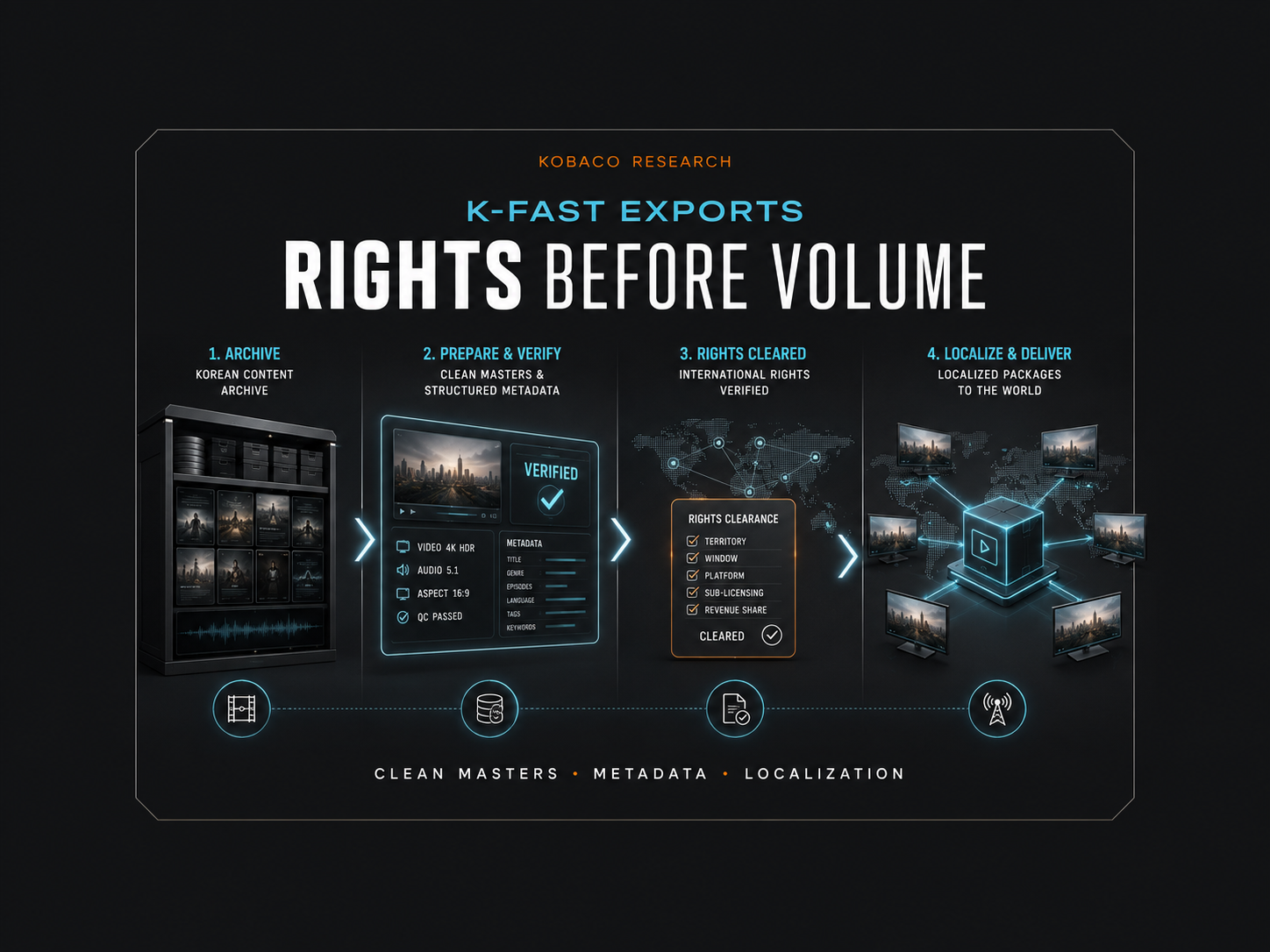
The diagnosis of the bottleneck is the most consistent finding. Older Korean content lacks clean masters with video, music and subtitles separated, and lacks systematic metadata, which adds cost during subtitling, dubbing and re-editing. Music programmes and variety shows face particular constraints from music and ancillary rights. Interviewees also noted that channel saturation and competition for exposure on overseas FAST platforms make a listing alone insufficient.
Principal interview findings
The 15 interviewees comprised 3 from platforms, 3 from MPPs, 2 from advertising, 3 from policy, 1 from AI technology, 2 from academia and 1 from the press. Source: KOBACO (2026), Table 4-3
The objective is an export ecosystem… public overseas promotion as first ad demand
The stated policy objective is a sustainable export-oriented media ecosystem built on K-FAST. Six tasks follow from it.
1.Content supply and rights infrastructure premised on global distribution: separating video, music, dialogue and subtitle files from the production stage, securing global and secondary-use rights, and standardizing programme- and scene-level metadata. For existing libraries, subsidize clean-master restoration, digitization, remastering and rights clearance, prioritized by overseas demand.
2.A public IP trading platform consolidating culture, tourism and performance content held by local governments and public institutions, delegated to a public body with relevant expertise.
3.Package-based localization that distinguishes dubbing-preferring from subtitle-tolerant markets, combines human and AI localization in varying proportions, and bundles local partner introductions, scheduling and marketing.
4.A standing network running from demand surveys through matchmaking and contract support to post-launch performance management, with channel bundling for smaller operators.
5.A pilot connecting government and public-institution overseas promotional advertising to K-FAST inventory, run on a limited scale against open competition, appropriate rates, brand safety, reach, conversion, duplicate exposure and settlement transparency, then verified before wider rollout.
6.Common infrastructure across advertising, data and commerce: aggregated inventory sales, standard performance metrics, data-sharing principles, and open shoppable-ad APIs and SDKs.
Longer-term tasks include inter-ministerial coordination and integrated governance, extension to next-generation devices such as vehicle displays, and financial and tax instruments that help smaller producers retain IP and share in long-term revenue. The report also calls for baseline statistics and a regular survey system, noting the absence of objective data on domestic market size, usage, advertising effect and export performance.
What this means for Korean operators
Translated into a business plan, the order of work changes. What has to be secured is not new content volume but the condition of the library already held. Whether clean masters exist, whether music and ancillary rights are cleared, and whether scene-level metadata is present determine both whether a channel can be opened and what localization will cost. Only an operator that has finished rights due diligence and a materials audit can calculate the economics of a channel-level launch.
The revenue structure deserves a second look. Revenue share removes the ad sales burden but leaves income dependent on the split ratio and settlement transparency; inventory share has no ceiling but demands local ad sales capability. In a market where premium PMP and open-market CPMs differ by close to three times, that choice is a question of who controls the rate.
Pluto TV shows that adding channels does not convert directly into revenue. When viewing time grows without matching ad demand and sell-through, inventory sits unsold. That is why the report proposes viewing time, retention, sell-through and overseas platform renewal rates as the operative performance measures.
What this means for Korean broadcasters
Broadcasters sit differently: they commission production, they are counterparties to performer contracts, and they hold the archives. Two of the bottlenecks the report names fall directly on them. The first is whether secondary-use rights to past productions were secured in the original contracts. The second is the handling of music and ancillary rights in music programmes and variety shows. Libraries where neither is settled incur re-editing costs before they can enter an overseas schedule.
The public IP trading platform proposal also bears directly on broadcasters. The report frames a broadcast content metadata database and the brokerage of publicly owned copyright material as work aligned with broadcasters' own interests, and argues that a credible public body should execute it so that smaller broadcasters benefit alongside large ones. Broadcasters that begin digitizing archives and organizing rights information now will hold the supplier position when such a system comes into operation.
Production contracting practice is also in scope. Requiring separated delivery of video, music, dialogue and subtitle files, along with global distribution rights, is likely to become a condition of future support programmes.
Notes on using this data
Three points bear on citation. Digital TV Research and Omdia diverge by close to 50% on the global forecast, so naming the house and the vintage together is the safer course. Some figures differ between the report's tables and its body text. And Samsung TV Plus, LG Channels, WatchFree+, Pluto TV, Rakuten TV, ViX, Xumo Play, Plex, NEW ID and Wurl all withhold standalone FAST results; the verifiable standalone figures are limited to Tubi and Roku.
The report states its own limit: with no data on domestic platform users, viewing time or channel counts, it had to rely substantially on market forecasts.
Sources
Kim Do-kyung and Kwon O-ju (2026). A Study on Promoting the K-FAST (Free Ad-supported Streaming TV) Ecosystem. Korea Broadcast Advertising Corporation, 123 pp. The report states that its content reflects the researchers' personal views and not the corporation's official position.
Digital TV Research (2024). Global FAST forecasts 2024-2029; Digital TV Research (2025), European and Latin American forecasts.
Omdia (2024, 2025). Regional FAST revenue forecasts. The USD 11bn 2030 figure comes from Content London 2025. https://www.businesswire.com/news/home/20251202073598/en
Amagi and Omdia (2024). Global FAST audience and platform growth analysis. Informa Tech.
Comscore (2025). State of streaming 2025. https://www.comscore.com/Insights/Press-Releases/2025/10/Comscores-2025-State-of-Streaming-Report
Nielsen (2025). US streaming share of viewing (The Gauge).
Apprupt (2026). FAST channel statistics 2026-2027. https://www.apprupt.com/fast-channel-statistics/
Cable Compare (2025). US pay TV cord-cutting and cable rate trends 2024-2025.
Deloitte (2026). 2026 digital media trends. https://www2.deloitte.com/us/en/insights/industry/technology/digital-media-trends.html
Amagi (2026). Indian listing (22 Jan), FY26 results (20 May), June AIRTIME report (1 Jul). https://www.amagi.com/newsroom/
Fox Corporation (15 Jun 2026). Agreement to acquire Roku. https://investor.foxcorporation.com/news/corp-press-releases/2026/fox-corporation-to-acquire-roku-inc/
AppLovin (4 Apr 2022). Completion of the Wurl acquisition. https://investors.applovin.com/news/news-details/2022/
Samsung Electronics (2026), LG Electronics (2026), Paramount (2025, 2026), Roku (2026), Fox Corporation (2025), Rakuten Group (2024), TelevisaUnivision (2026), Xumo (2026), Plex (2026), VIZIO (2024), Walmart (2024), Wurl (2026), NEW ID (2025), MPA (2025), KBV Research (2025), Statista (2025), Beet.TV, MNTN Research and Simulmedia (2025), Mordor Intelligence (2025), Direct Media Lab (2026).
Korea Information Society Development Institute (2024); Korea Creative Content Agency (2025); Kim Jung-sup (2024), FAST: The New Viewer-Friendly Channel of the K-Culture Era, Hanul Academy; Kim Hae-young and Kim Do-kyung (2025), Public Potential and Policy Implications of Ad-supported Streaming (FAST) Platforms, Media and Policy 3(1), 5-18.
Text in quotation marks reproduces interview statements as recorded in the report; unquoted description summarizes the report's content. Interviewees are identified by the anonymized codes used in the report. Won conversions apply KRW 1,350 per dollar, the rate implied where the report renders USD 16.5bn as KRW 22.3tn. Omdia's December 2025 release states Spain's FAST revenue in billions; USD 32m to 65m is the correct magnitude.