
K-EnterTech Hub | Broadcast & Transmission
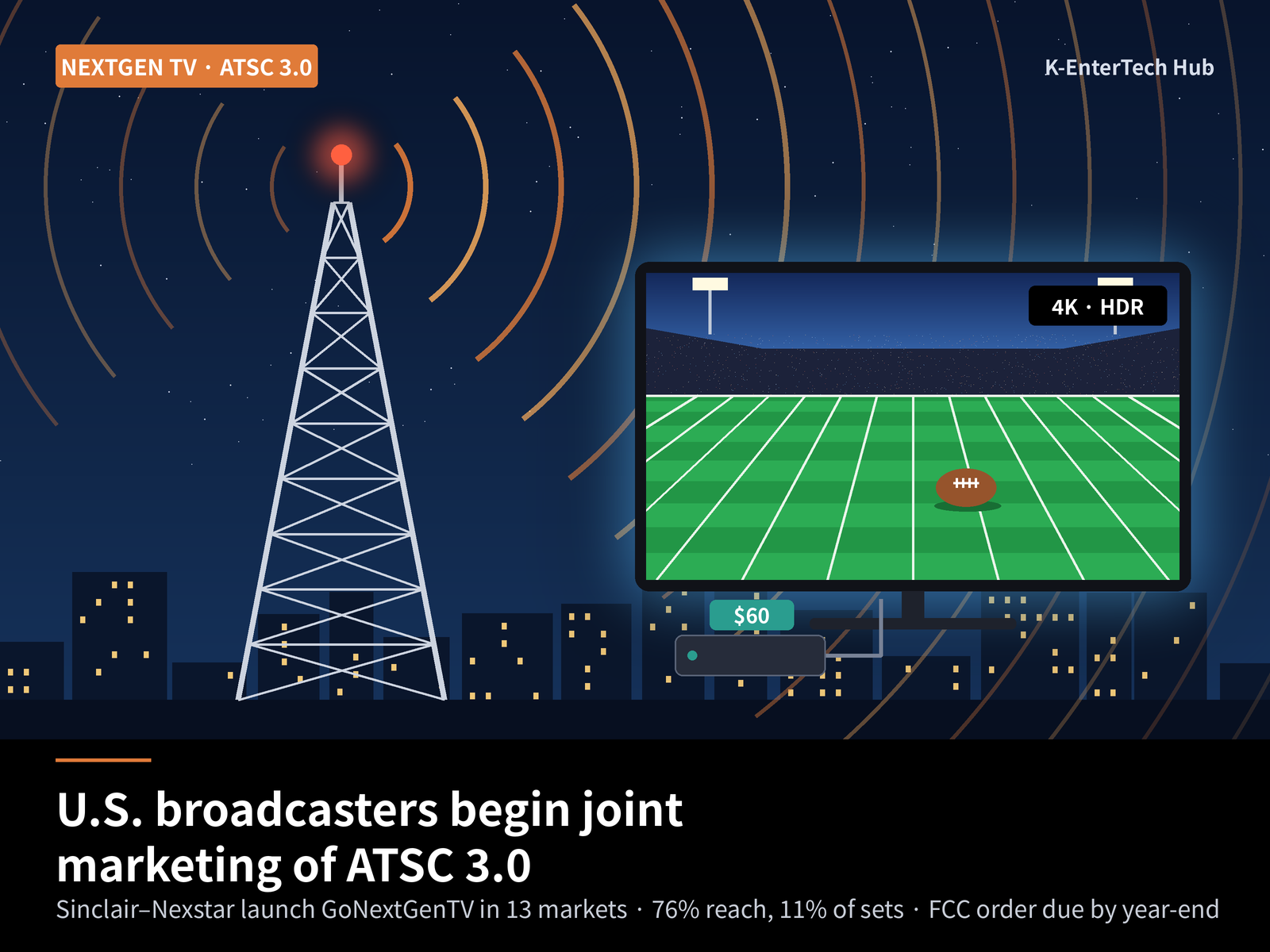
Sinclair and Nexstar launch GoNextGenTV in 13 markets on Sept. 17; signal reach is 76%, capable sets 11% of shipments, and the FCC's final order is expected by year-end
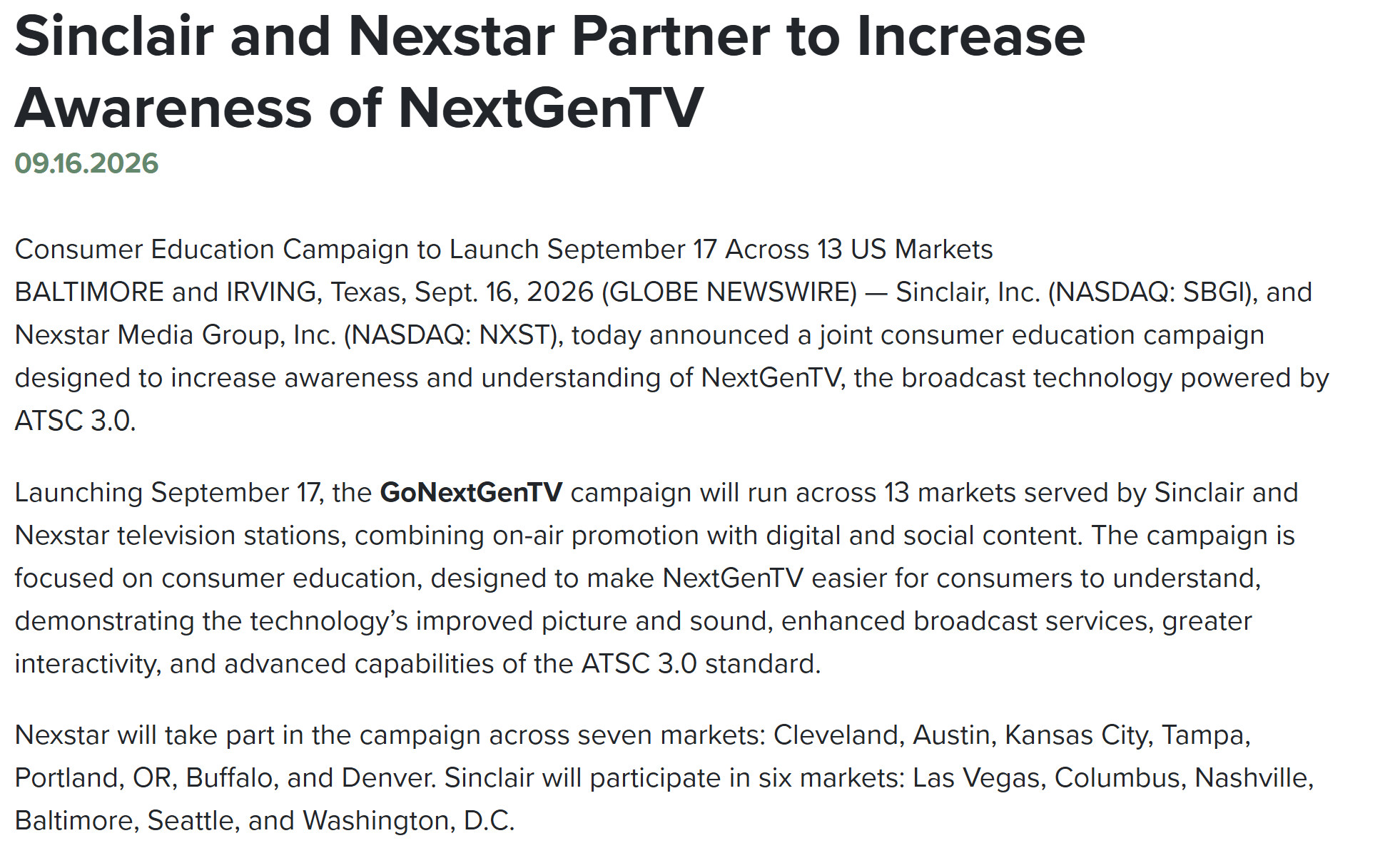
Sinclair and Nexstar Media Group began joint marketing of NextGen TV in 13 U.S. markets on Sept. 17. The campaign is called GoNextGenTV. The two companies announced the plan in a joint release a day earlier. Nexstar is running it in seven markets and Sinclair in six. It combines on-air promotion by local stations with digital and social content, and it sends viewers to a guide site, GoNextGenTV.com.
NextGen TV is the consumer name for ATSC 3.0, the next terrestrial transmission standard. It carries ultra-high-definition and HDR video, immersive audio and interactive services over the air. It is not compatible with today's ATSC 1.0, so a viewer needs a TV with an ATSC 3.0 tuner or a separate receiver. U.S. broadcasters have been adding markets since 2020. ATSC, the standards body, puts 76% of U.S. households within reach of a signal as of July 2026. With Cleveland's launch on July 23, ATSC 3.0 is on the air in all of the top 25 markets.
The Consumer Technology Association (CTA) estimates that NextGen TV sets will be about 11% of the 40.451 million TVs shipped in the U.S. in 2026. The 2025 figure was 10%. That is 65 percentage points below signal reach. The Federal Communications Commission (FCC) proposed in October 2025 to end the simulcast requirement, but it set no shutdown date for ATSC 1.0 and no tuner requirement for new TVs. In a letter to the FCC dated March 27, 2026, 91 House members wrote that manufacturers hold back production because demand is limited, while broadcasters cannot create that demand until they regain their full channel capacity. TV Technology has reported that the FCC's final decision is expected by the end of 2026.
Sinclair tested a consumer-education campaign in Columbus, Ohio, this summer and has now extended it to 13 markets with Nexstar. Pearl TV, a consortium of broadcast groups, opened a converter-box program in April with a suggested retail price of $60 (about ₩83,000) or less. The two companies describe the September launch as the first phase of the joint campaign. Next on the calendar are a target of 50,000 converter boxes at retail by the end of 2026, the FCC's final order expected before year-end, and the July 17, 2027, sunset of the "substantially similar" rule.
The campaign is called GoNextGenTV; seven Nexstar and six Sinclair markets, on air, digital and social
In the Sept. 16 release the two companies said the campaign is focused on consumer education. It is designed to make NextGen TV easier for consumers to understand and to show the technology's improved picture and sound, enhanced broadcast services, greater interactivity and the advanced capabilities of the ATSC 3.0 standard. It pairs on-air promotion with digital and social content. Both companies are listed on Nasdaq.
The joint release issued by Sinclair and Nexstar on Sept. 16. Source: Nexstar
Nexstar is airing the campaign in Cleveland, Austin, Kansas City, Tampa, Portland, Ore., Buffalo and Denver. Sinclair has Las Vegas, Columbus, Nashville, Baltimore, Seattle and Washington, D.C. Sinclair says in the release that it owns, operates or provides services to 178 stations in 79 markets. The 13 markets are a portion of the two companies' footprints.
TV Technology reported on Sept. 16 that the promo was produced as a TV spot and as a social-media post. The line is: "On game days, who's got next? With NextGen TV, you do." The message is that NextGen TV delivers games in UHD with immersive sound, along with local news, weather and popular shows. The copy arrives in September, as the football season gets under way.
GoNextGenTV.com lets a visitor enter a ZIP code to see which NextGen TV broadcasts are available locally. It explains two ways to watch: a set with a built-in ATSC 3.0 tuner, or a converter box connected to an existing TV. It lists converter boxes, NextGen TV sets, antennas and cables, and carries a frequently-asked-questions section. The route that does not require a new TV appears in the guide in the same year Pearl TV opened its converter-box program.
Del Parks, Sinclair's president of technology, pointed to the Columbus test in the release. When consumers understood what NextGen TV is, how to get it and what it offers, engagement rose meaningfully, he said. "Now is the time for all broadcasters to begin promoting the advantages of NextGen TV," he said. Brett Jenkins, Nexstar's executive vice president and chief technology and digital officer, said he expects consumers who understand the benefits to look for TV models with ATSC 3.0 capability.
Columbus pilot ran June 4 to July 3; Cleveland's July 23 launch put ATSC 3.0 in all top-25 markets
TV Technology reported on June 4 that Sinclair's Columbus campaign combined a market-specific microsite, giveaways, on-air promotion and digital outreach, and ran through July 3. The microsite offered ZIP-code availability lookup, equipment-compatibility guidance, step-by-step setup instructions and recommendations for TVs, antennas and converters. Converter boxes and antennas were given away with Channel Master. Parks said at the time that Columbus was chosen for its sports engagement, changing viewing behaviour and Sinclair's local station footprint. The ZIP-code lookup and device guidance on GoNextGenTV.com carry that microsite's structure over to a site shared by 13 markets.
Cleveland, one of the 13 markets, has been on the air for less than two months. Nexstar announced the ATSC 3.0 launch there on July 23. Cleveland had been the largest market still without service because of limits on available spectrum and station participation. Nexstar contributed the spectrum of WBNX-TV, which it acquired in 2024, as the host station, and WJW (Nexstar, Fox), WEWS (Scripps, ABC), WOIO (Gray, CBS) and WKYC (Tegna, NBC) joined. With that launch ATSC 3.0 is transmitting in all of the top 25 U.S. markets.
Jenkins said at the Cleveland launch that NextGen TV service also opens opportunities for EdgeBeam Wireless, Nexstar's joint venture, in high-precision positioning, digital signage and public-safety data delivery. Nexstar described the launch as an example of consolidation accelerating innovation. Nexstar closed its $6.2 billion (about ₩8.57 trillion) acquisition of Tegna on March 19, but a federal court in the Eastern District of California issued a preliminary injunction on April 17 halting integration, and the two companies are operating separately. The FCC eliminated the 39% national ownership cap in a 2-1 vote on Aug. 6, TechTimes reported.
Signal reach at 76% for a second year; capable sets at 11% of 2026 shipments
The 76% reach figure from ATSC matches the number Pearl TV announced in October 2024. TV Technology's tracker, updated Sept. 15, counts more than 75 markets on the air. Madeleine Noland, ATSC's president, told TVNewsCheck in an April 3, 2025, article that the remaining markets lack spare spectrum and an obvious host station for the simulcast. Broadcasters have made the move by having one station transmit ATSC 3.0 while another carries that station's ATSC 1.0 signal.
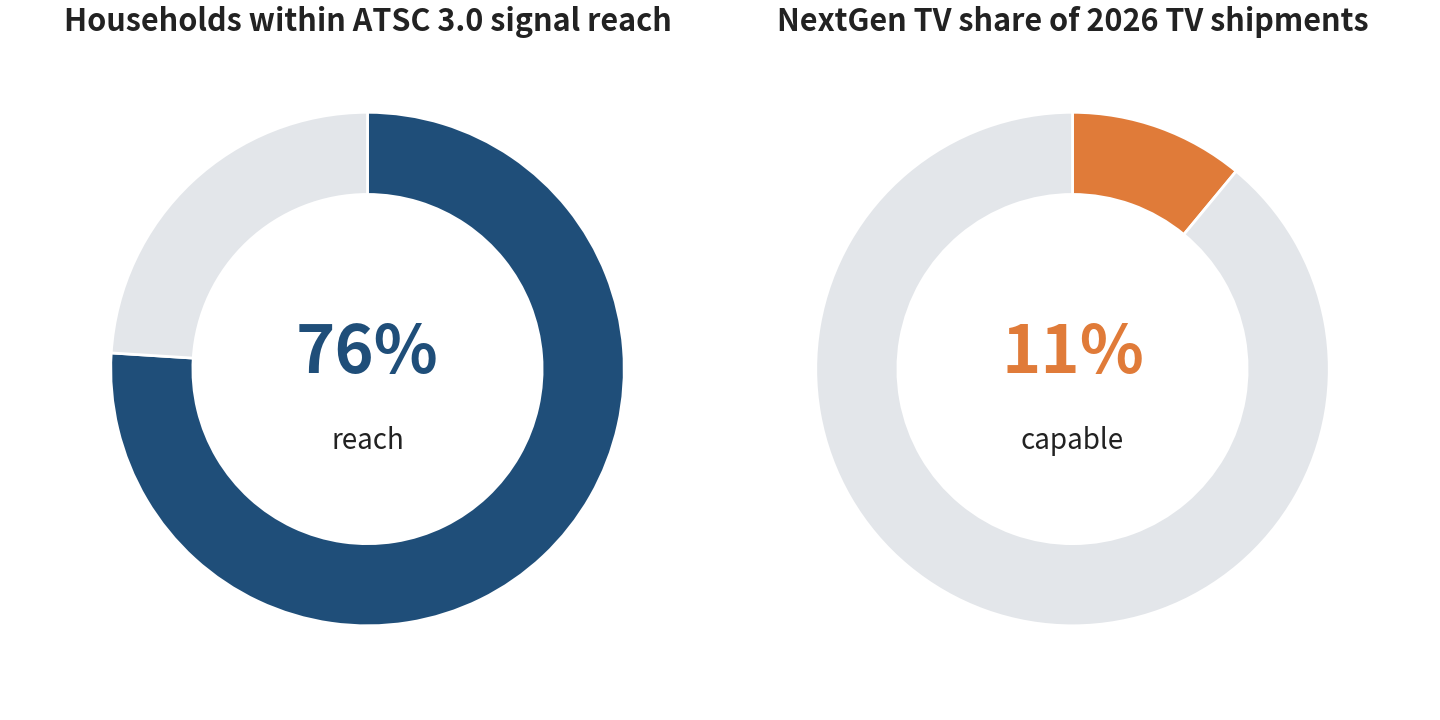
ATSC 3.0 signals reach 76% of U.S. households; capable sets are about 11% of 2026 TV shipments. Source: ATSC (July 2026), CTA
CTA forecasts life-to-date shipments of ATSC 3.0-capable TVs at 19.256 million by the end of 2026. Pearl TV's estimates ran from 10 million at the end of 2023 to 14 million at the end of 2024 and more than 15 million in 2025. A3SA, the ATSC 3.0 security authority, said on April 17 that 18.5 million A3SA-enabled TVs have been sold and that about 40 models from Hisense, Panasonic, Samsung, Sony and TCL account for most of them.
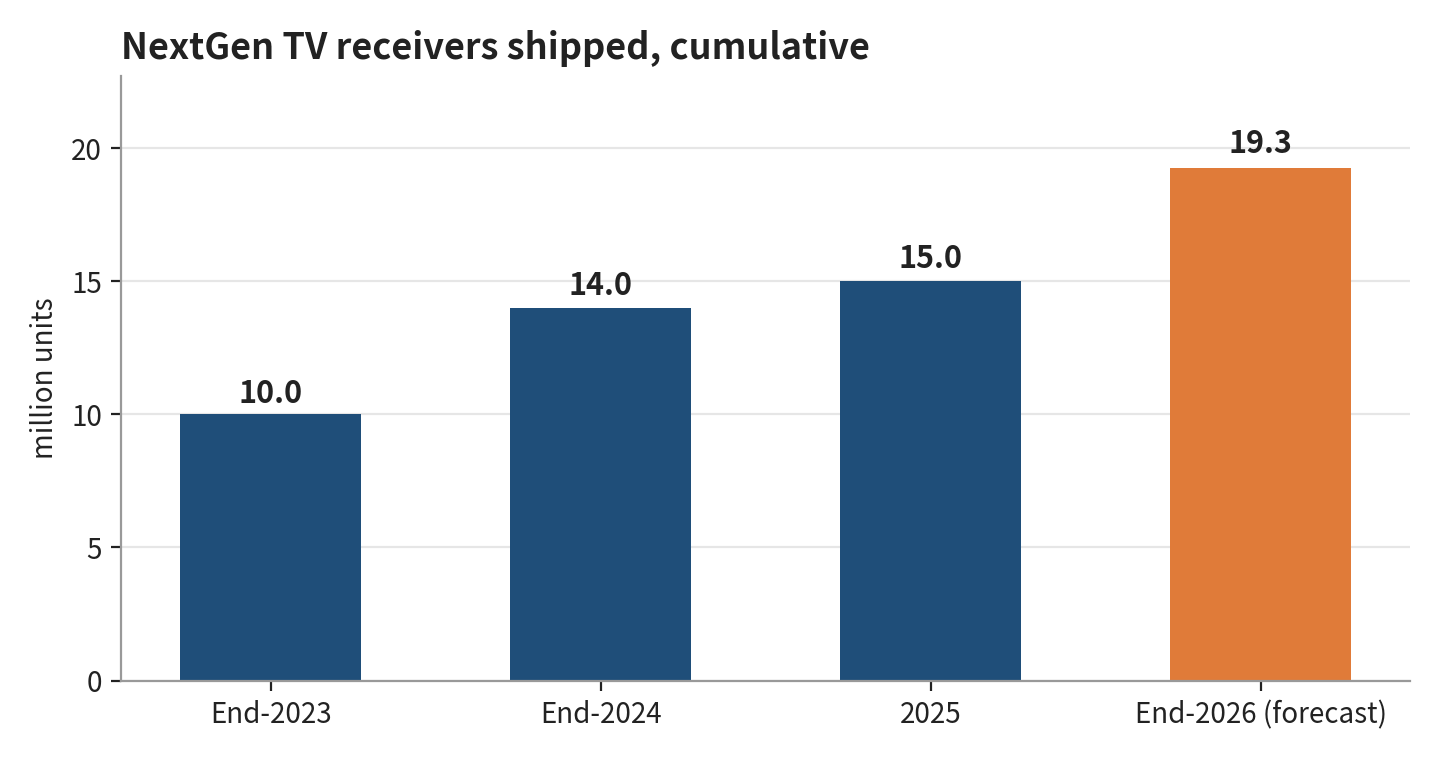
Cumulative receiver shipments are forecast at 19.3 million by the end of 2026. Source: Pearl TV estimates (2023–2025), CTA forecast (2026)
Next TV reported on May 9, 2024, that CTA had put NextGen TV sets at 12% of 2023 shipments and expected 50% by 2025. The 2025 figure came in at 10%. About 75 models are on sale at retail from Sony, Samsung, Hisense, TCL, RCA and Panasonic, with starting prices of $600 to $700 (about ₩830,000 to ₩970,000).
Converter box at $60 or less; 15 million of 23 million antenna homes are the target
Pearl TV showed prototype converter boxes at CES in January and opened the program to manufacturers on April 16, ahead of the NAB Show. Anne Schelle, Pearl TV's managing director, put U.S. over-the-air households at about 23 million and estimated that at least 15 million of them will want this kind of device. The suggested retail price is $60 or less. To hit that price the box has no display, no recorder and a single tuner.
The device sits between the antenna and the TV and connects by HDMI. It must receive both ATSC 3.0 and 1.0, decode 4K HEVC with HDR, and support emergency alerts, captions and an over-the-air program guide. No internet connection is required. ADTH, Skyworth and Zinwell supplied the prototypes. TV Technology reported on Jan. 9 that the target is 50,000 boxes at retail by the end of 2026.
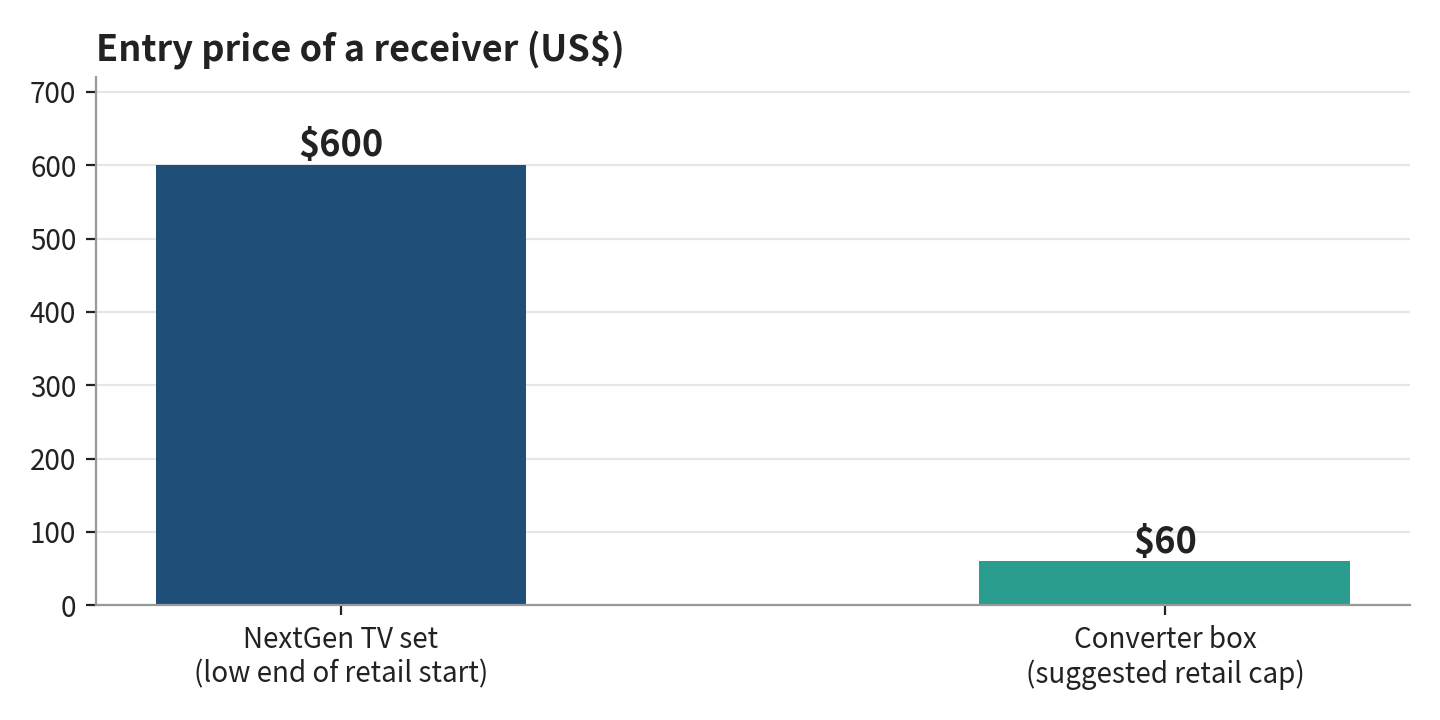
NextGen TV sets start at $600 to $700 at retail; the converter box is capped at a suggested $60. Source: TV Technology, Pearl TV
In a January 2026 survey that Pearl TV commissioned from Magid, 81% of respondents said they would buy a converter box to keep their free local stations. The sample was 600 adults aged 25 to 64 who use an antenna on at least one TV for at least two hours a week. Ninety-two percent said they would miss antenna access if it went away. Nearly two-thirds also subscribe to streaming services. Interest was highest among adults 25 to 44, households with families and higher-income households.
Set-top box maker EKT showed a Linux-based ATSC 3.0 converter box at IBC 2026 in Amsterdam on Sept. 9. According to Pearl TV, it uses less than half the memory of a comparable Android-based box. The software is built on the ATSC 3.0 stack that DTVKit provides royalty-free to its members.
FCC proposes ending the simulcast rule; no ATSC 1.0 sunset date, no tuner mandate
The current rules date from 2017. A station transmitting ATSC 3.0 must also simulcast its primary stream in ATSC 1.0, and the two streams must be "substantially similar." That requirement is scheduled to sunset on July 17, 2027. The National Association of Broadcasters (NAB) petitioned on Feb. 26, 2025, for ATSC 1.0 to end in the top 55 markets, home to about 70% of viewers, in February 2028 and in all remaining markets in February 2030, along with an ATSC 3.0 tuner requirement for new sets.
The FCC adopted its Fifth Further Notice of Proposed Rulemaking unanimously on Oct. 28, 2025. Its tentative conclusion is to eliminate the simulcast requirement and let broadcasters continue ATSC 1.0 on a voluntary basis. The "substantially similar" rule and the 95% coverage threshold are also slated for removal. The notice contains no firm cutoff date and no tuner mandate; it asks for comment on both. Comments closed on Jan. 20, 2026, and reply comments on Feb. 18.
In Current, the public-media trade publication, Franz Joachim, chief executive of New Mexico PBS, said on Nov. 19, 2025: "If you don't mandate it, it's probably not going to happen." On March 27, 2026, 91 House members led by Rep. Mark Alford and the other co-chairs of the Congressional Broadcasters Caucus asked the FCC to set a firm transition timeline. Radio + Television Business Report wrote that CTA and set makers strongly oppose a mandate and that the cable industry is also unenthusiastic. The LPTV Broadcasters Association backed a mandatory schedule for the more than 1,700 full-power stations while asking that low-power stations be left out.
The notice also asks whether the content protection administered by A3SA fits the Communications Act's definition of "broadcasting." A3SA told the FCC in reply comments on Feb. 18 that more than 99% of the 18.5 million receivers in the market can display protected broadcasts. Phil Kurz, a contributing editor at TV Technology, wrote on Aug. 4 that the FCC's final report and order is expected before the end of the year.
FCC decision expected by year-end; ATSC 3.0 won an Emmy on Sept. 9, and a DRM ballot closes Sept. 18
TV Technology reported on July 15 that the FCC is expected to announce a final decision by the end of 2026. NAB argued in comments filed in February that whether to pursue NextGen TV is no longer in question; what remains is whether the transition gets an orderly framework or is left in regulatory uncertainty. In a July 14 blog post NAB said that without content protection, unauthorised businesses could capture local stations' signals and resell them at scale. It is also running a campaign to keep live sports on free over-the-air TV.
TVNewsCheck reported on June 4 that no FCC official appeared at ATSC's annual conference, held at NAB's Washington headquarters, and that most participants conceded the transition has stalled. The National Academy of Television Arts & Sciences is giving a 2026 Technology & Engineering Emmy to the ATSC 3.0 standardisation effort, ATSC announced on Sept. 9. ATSC has put a revision of its DRM recommended practice, A/362, to a membership ballot that closes on Sept. 18.
Mark Aitken, president of ONE Media Technologies, Sinclair's engineering unit, told TV Technology in a Sept. 1 article that the company will test Castanet's platform, which runs 5G Broadcast on ATSC 3.0 transmitters, at WIAV-CD, its low-power station in Washington, D.C. Full-power stations share ATSC 3.0 spectrum among several broadcasters because of the ATSC 1.0 simulcast requirement, which limits the capacity available for 5G multicasting. "We're just waiting for somebody to cut the shackles," he said. The same article says smartphones with Qualcomm chipsets supporting 3GPP Release 19 are projected for 2028, and that India's Prasar Bharati is running direct-to-mobile trials in 19 cities.
Seventeen months to the first sunset in NAB's plan; capable sets gained one percentage point in a year
The two companies call the September launch a first phase and have not disclosed the markets or timing of a second. Parks used the release to urge all broadcasters to start promoting NextGen TV. Whether other groups that took part in the Cleveland launch, such as Scripps, Gray and Tegna, will use the same creative and guide site has not been announced.
By CTA's estimates, NextGen TV sets went from 10% of shipments in 2025 to 11% in 2026, one percentage point in a year. February 2028, the date NAB proposed for ending ATSC 1.0 in the top 55 markets, is 17 months away. The converter-box target is 50,000 units at retail by the end of 2026, against demand that Pearl TV puts at no fewer than 15 million households. That gap is the basis on which the 91 House members and NAB have asked for a firm date and a tuner requirement.
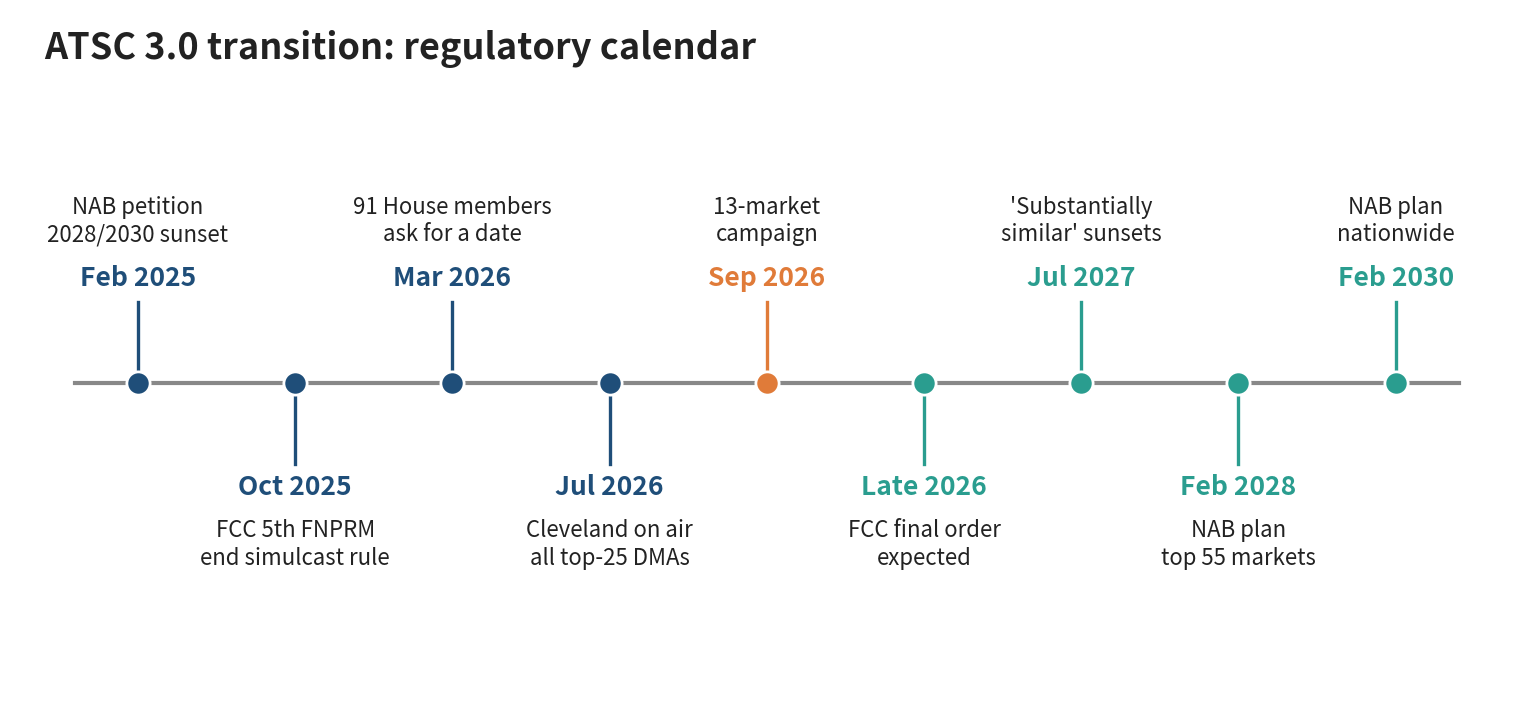
The joint campaign started two months after Cleveland's launch and before the FCC's final order. Source: FCC, NAB, U.S. House, TV Technology
The FCC's final order is expected before year-end. If the tentative conclusion of the Fifth FNPRM is adopted as written, the simulcast requirement goes and there is no sunset date or tuner mandate. In that case each broadcaster decides, market by market, when to switch off ATSC 1.0, and telling viewers about the change and how to receive the new signal also falls to broadcasters. The ZIP-code lookup and device guidance on GoNextGenTV.com are tools that could be used for that as they stand. If a date is written into the order, set makers' tuner plans could move forward; that is the argument in the House letter.
After the transition: data delivery and 5G Broadcast; supporting smartphones projected for 2028
Full-power stations share ATSC 3.0 spectrum among several broadcasters because of the simulcast requirement. Without it, each station could use its whole channel for ATSC 3.0 and put spare capacity into data delivery. Nexstar's EdgeBeam Wireless lists high-precision positioning, digital signage and public-safety data delivery as its lines of business. Sinclair is preparing a 5G Broadcast test in Washington, D.C. Smartphones that support it are projected for 2028, so a mobile-reception business could only scale after that.
The sports-led ad copy also ties to a current issue for broadcasters. The NFL game played in Melbourne on Sept. 11 drew 18.5 million U.S. viewers on Netflix, according to TV Technology. NAB is running a campaign to keep live sports on free over-the-air TV. Broadcasters are presenting UHD picture and immersive sound as features that set over-the-air coverage apart from streaming services.
South Korea's UHD direct reception went from 5.3% to 2.2%; the regulator said on Sept. 8 it is reviewing the policy
GoNextGenTV.com tells a viewer whether the signal is available at home, which device is needed and how to connect it to the TV already in the room. U.S. broadcasters built that guide as a shared site in the seventh year of transmission and paired it with a device at $60 or less. It is the tool they chose in the absence of a shutdown date and a tuner mandate.
South Korea launched the world's first terrestrial UHD service on ATSC 3.0 in May 2017. Figures from the office of lawmaker Park Wan-joo (박완주), reported by Edaily (이데일리) on Oct. 6, 2022, put direct reception of terrestrial UHD at 5.3% in 2017, 4.2% in 2018, 2.6% in 2019, 2.3% in 2020 and 2.2% in 2021. On Dec. 9, 2020, the Korea Communications Commission (방송통신위원회) and the Ministry of Science and ICT (과학기술정보통신부) moved the rollout in cities and counties from 2021 to 2023. They reset the mandatory UHD programming ratio to 20% through 2022, 25% in 2023, 35% in 2024 and 50% in 2026.
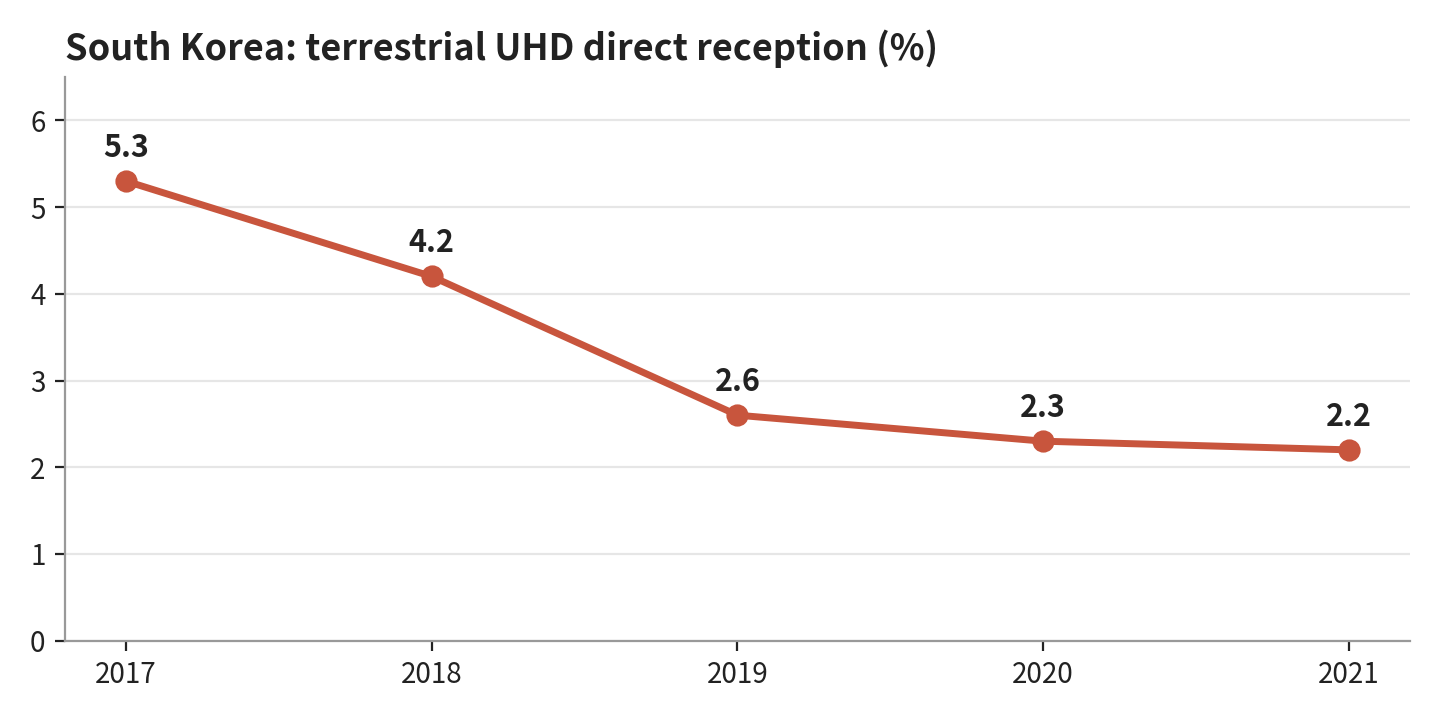
Direct reception of terrestrial UHD in South Korea fell from 5.3% in the launch year to 2.2% in 2021. Source: office of lawmaker Park Wan-joo, as reported by Edaily, Oct. 6, 2022
Mediaus (미디어스) reported on Oct. 31, 2025, that Democratic Party lawmaker Lee Hun-ki (이훈기) told a parliamentary audit on Oct. 30 that ₩2.2 trillion (about $1.59 billion) had gone into terrestrial UHD through 2023. Media Today (미디어오늘) reported on Jan. 8, 2025, that the commission, asked by the lawmaker's office for the number of terrestrial UHD viewers, replied that it does "not track it separately." The same article put terrestrial direct reception at 2.8% in 2023.
Kim Jong-cheol (김종철), chairman of the Korea Communications and Media Commission (방송미디어통신위원회), told the National Assembly's science, ICT and broadcasting committee on Sept. 8 that "the media environment has changed so rapidly that we are reviewing this," according to Yonhap News (연합뉴스).
Lawmaker Han Jun-ho (한준호) asked for a review of EBS's UHD transmission record and of the 2027 target for ending HD broadcasts. In South Korea the government set programming ratios and an HD end date first; in the U.S., with no date, broadcasters took on receiver adoption. Whether the number of direct-reception homes, the price of a receiver and a viewer guide will be part of the commission's review has not been made public.
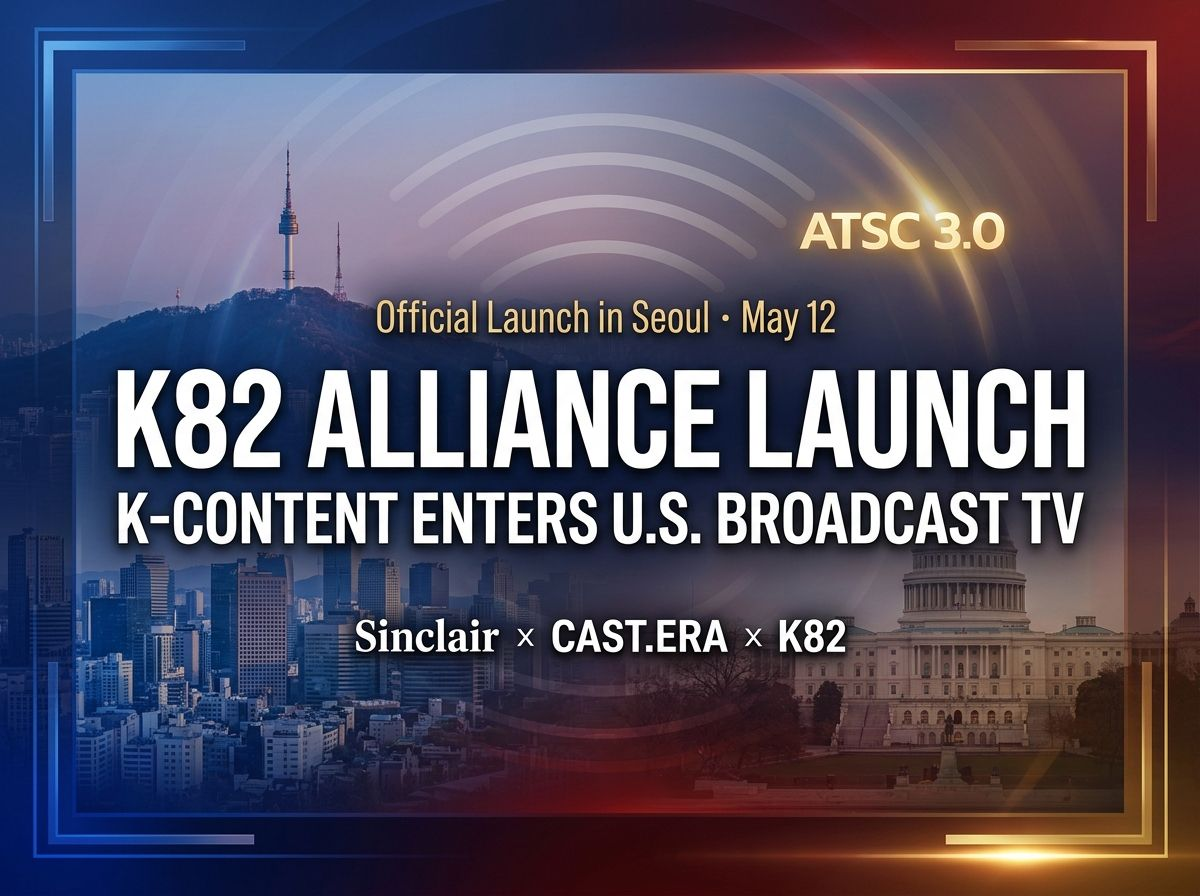
Sinclair is preparing K-Channel 82, a Korean-content channel, in Washington; D.C. and Baltimore are among its six campaign markets
Sinclair is working with Korean broadcasters on K-Channel 82 (K채널 82), a Korean-content channel carried on its ATSC 3.0 signal. At a briefing in Seoul on March 19, Parks said the goal is "to bring a Korean channel to American homes," as reported by ZDNet Korea (지디넷코리아) on March 20. The channel is planned as ATSC 3.0 virtual channel 82, programmed with K-pop, drama, entertainment, news and lifestyle content. Sinclair signed content-supply agreements with SBS, KBS and MBN in March and with YTN and Eugene Group (유진그룹) in April, the Korea Economic Daily (한국경제) reported on April 21. In January it signed a memorandum with Hudson AI (허드슨AI) on AI dubbing into English and Spanish.
KBS and Sinclair signed a strategic collaboration agreement on March 16. The Desk reported that day that K-Channel 82 is expected to reach about 30 million homes on the NextGen TV signals of Sinclair's 185 stations. The two agreed to share advertising revenue generated by KBS content and to jointly develop a mobile app that links viewing to product purchases. KBS will also provide its disaster-broadcasting technology to Sinclair, RBR reported on March 16.
Digital Daily (디지털데일리) reported on April 20 that Sinclair said it would launch K-Channel 82 in Washington, D.C., on Sept. 14. YTN reported on April 26 that broadcasts would start in Washington and Baltimore, with nationwide expansion after 2028. According to ZDNet Korea, the pilot is to collect viewer feedback for at least six months, and the plan is to extend the channel to FAST on Samsung (삼성) and LG smart TVs in 2027. As of Sept. 18, no launch announcement could be confirmed.
Washington, D.C., and Baltimore are among Sinclair's six markets in this campaign. Because K-Channel 82 is carried on the ATSC 3.0 signal, its audience is homes with a capable set or a converter box. The Broadcasting Technology Journal (방송기술저널) reported on March 23 that Sinclair is counting on the mandatory 2028 transition in NAB's petition. On the set side, Samsung is one of the five manufacturers A3SA confirmed. The manufacturers Pearl TV has named in its converter-box program are ADTH, Bitrouter, Skyworth, Zinwell and EKT.
- Nexstar / Sinclair joint release, 'Sinclair and Nexstar Partner to Increase Awareness of NextGenTV' (Sept. 16, 2026) https://www.nexstar.tv/sinclair-and-nexstar-partner-to-increase-awareness-of-nextgentv/
- TV Technology, Phil Kurz, 'Sinclair, Nexstar Launch Campaign to Raise Awareness of NextGen TV' (Sept. 16, 2026) https://www.tvtechnology.com/platform/broadcast/sinclair-nexstar-launch-campaign-to-raise-awareness-of-nextgen-tv
- TV Technology, 'ATSC 3.0 Deployments' (updated Sept. 15, 2026) — 76% reach, CTA shipment forecast, retail models and prices https://www.tvtechnology.com/news/atsc-30-deployments-where-and-when-will-nextgen-tv-be-available
- ATSC, 'Deployments' https://www.atsc.org/nextgen-tv/deployments/
- ATSC (reprinting TV Tech), 'NextGen TV Now Available in 76% of U.S. Homes' (Oct. 9, 2024) https://www.atsc.org/news/tv-tech-nextgen-tv-now-available-in-76-of-u-s-homes/
- TVNewsCheck, 'Road To NAB: Fits And Starts Mark NextGen TV, RF Advances' (April 3, 2025) https://tvnewscheck.com/tech/article/road-to-nab-fits-and-starts-mark-nextgen-tv-rf-advances/
- Next TV, 'ATSC 3.0: Everything You Need to Know About NextGen TV' (May 9, 2024) https://www.nexttv.com/news/atsc-3-0-nextgen-tv
- A3SA release, 'Secure Content Distribution at Heart of New ATSC 3.0 Receivers' (April 17, 2026) https://a3sa.com/news-updates/secure-content-distribution-at-heart-of-new-atsc-3-0-receivers-for-consumers-and-broadcasters/
- Pearl TV release, 'Broadcasting Industry Launches NEXTGEN TV Converter Box Program' (April 16, 2026) https://pearltv.com/news/broadcasting-industry-launches-nextgen-tv-converter-box-program-to-deliver-low-cost-upgrade-option-for-millions-of-over-the-air-tv-viewers/
- TV Technology, 'NextGen TV at CES 2026: Pearl TV Focuses on Low-Cost Vanilla Converter Boxes' (Jan. 9, 2026) https://www.tvtechnology.com/platform/broadcast/nextgen-tv-at-ces2026-pearl-tv-focuses-on-low-cost-vanilla-converter-boxes
- TV Technology, 'Survey Shows Strong Consumer Interest in NextGen TV Converter Boxes' (March 18, 2026) — Pearl TV / Magid survey https://www.tvtechnology.com/platform/broadcast/survey-shows-strong-consumer-interest-in-nextgen-tv-converter-boxes
- Pearl TV release, 'New Low-Cost Platform for ATSC 3.0 Converter Boxes on Display at IBC Amsterdam' (Sept. 10, 2026) https://pearltv.com/news/new-low-cost-platform-for-atsc-3-0-converter-boxes-on-dispay-at-ibc-amsterdam/
- Federal Register, 'Authorizing Permissive Use of the Next Generation Broadcast Television Standard' (Nov. 20, 2025) https://www.federalregister.gov/documents/2025/11/20/2025-20437/authorizing-permissive-use-of-the-next-generation-broadcast-television-standard
- FCC Public Notice DA 25-314 on the NAB petition of Feb. 26, 2025 (April 7, 2025) https://docs.fcc.gov/public/attachments/DA-25-314A1.pdf
- Pillsbury CommLawCenter, 'A Simulcast Sunset on the Horizon as FCC Adopts NextGen TV NPRM' (Oct. 29, 2025) https://www.commlawcenter.com/2025/10/a-simulcast-sunset-on-the-horizon-as-fcc-adopts-nextgen-tv-nprm.html
- TV Technology, 'FCC Approves NextGen TV Proposal…' (Oct. 28, 2025) https://www.tvtechnology.com/news/fcc-approves-notice-of-proposed-rulemaking-on-nextgen-tv
- Current, 'FCC's ATSC 3.0 rules would slow transition to Next Gen TV broadcasting' (Nov. 19, 2025) https://current.org/2025/11/fccs-atsc-3-0-rules-would-slow-transition-to-next-gen-tv-broadcasting/
- Office of Rep. Mark Alford, letter from 91 House members to the FCC (March 27, 2026) https://alford.house.gov/UploadedFiles/3.27.26_Letter_to_FCC_re_ATS_3.0_Transition.pdf
- RBR, 'Route 91: Congress' Fast Track Toward NEXTGEN TV Mandate?' https://rbr.com/route-91-congress-fast-track-toward-nextgen-tv-mandate/
- NewscastStudio, 'LPTV broadcasters back NextGen TV deadline, seek exemption for low-power TV' (April 2, 2026) https://www.newscaststudio.com/2026/04/02/lptv-broadcasters-back-nextgen-tv-deadline-seek-exemption-for-low-power-tv/
- TV Technology, 'FCC Plots a Murky Roadmap for the NextGen TV Transition' (Dec. 1, 2025) https://www.tvtechnology.com/opinion/fcc-plots-a-murky-roadmap-for-the-nextgen-tv-transition
- Antennaland, 'FCC Weighs TV Encryption as Broadcasters Defend ATSC 3.0 DRM' (Feb. 27, 2026) https://www.antennaland.com/fcc-tv-encryption-atsc-3-drm-debate/
- TV Technology, Phil Kurz, 'Will FreeCast Announcement Muddy the ATSC 3.0 R&O Waters?' (Aug. 4, 2026) https://www.tvtechnology.com/insights/opinion/will-freecast-announcement-muddy-the-atsc-3-0-r-and-o-waters
- TV Technology, 'Sinclair Launches NextGen TV Campaign in Columbus, Ohio' (June 4, 2026) https://www.tvtechnology.com/platform/broadcast/sinclair-launches-nextgen-tv-campaign-in-columbus-ohio
- TV Technology, 'NextGen TV Launches in Cleveland' (July 23, 2026) https://www.tvtechnology.com/platform/broadcast/nextgen-tv-launches-in-cleveland
- TV Technology, 'NAB: NextGen TV Represents an Essential Investment in the Future of Free, Local Television' (July 15, 2026) https://www.tvtechnology.com/regulatory-legal/legislation/nab-nextgen-tv-represents-an-essential-investment-in-the-future-of-free-local-television
- TV Technology, 'Broadcasters Gain Flexibility in Pursuit of 5G Multicasting' (Sept. 1, 2026) https://www.tvtechnology.com/platform/broadcast/broadcasters-gain-flexibility-in-pursuit-of-5g-multicasting
- TV Technology, 'NFL Melbourne Game Scores 18.5 Million U.S. Viewers on Netflix' (September 2026) https://www.tvtechnology.com/platform/streaming/nfl-melbourne-game-scores-18-5-million-u-s-viewers-on-netflix
- TVNewsCheck, 'ATSC's NextGen Narrative Stalls In Annual Gathering' (June 4, 2026) https://tvnewscheck.com/tech/article/atscs-nextgen-narrative-stalls-in-annual-gathering/
- ATSC, 'ATSC 3.0 To Be Honored With Technology And Engineering Emmy Award' (Sept. 9, 2026) https://www.atsc.org/news/atsc-3-0-to-be-honored-with-technology-and-engineering-emmy-award-as-significant-advancement-in-television-broadcasting/
- ATSC, 'Standards Update' (September 2026) — A/362 DRM ballot closes Sept. 18 https://www.atsc.org/news/atsc-standards-update-updated-standard-approved-and-published/
- Deadline, 'Nexstar Closes Tegna Merger Following FCC And DOJ Approval' (March 20, 2026) https://deadline.com/2026/03/fcc-approves-nexstar-tegna-merger-1236760998/
- TheWrap, 'FCC Will Vote to End Cap on National Broadcast Ownership…' (July 15, 2026) https://www.thewrap.com/media-platforms/tv/fcc-vote-end-cap-national-broadcast-ownership/
- TechTimes, 'FCC Scraps Broadcast Cap in Party-Line Vote; Nexstar Deal Stays Frozen by Courts' (Aug. 6, 2026) https://www.techtimes.com/articles/323390/20260806/fcc-scraps-broadcast-cap-party-line-vote-nexstar-deal-stays-frozen-courts.htm
- Edaily (이데일리), report on UHD programming ratios and direct reception (Oct. 6, 2022) https://edaily.co.kr/News/Read?mediaCodeNo=257&newsId=03575206632490296
- Edaily (이데일리), report on the two-year delay of nationwide terrestrial UHD (Dec. 10, 2020) https://edaily.co.kr/News/Read?mediaCodeNo=257&newsId=01521926625997208
- Digital Daily (디지털데일리), 'Terrestrial UHD direct reception at a record-low 2.2%' (Sept. 29, 2022) https://m.ddaily.co.kr/page/view/2022092910470674954
- Mediaus (미디어스), report on the parliamentary audit of terrestrial UHD policy (Oct. 31, 2025) https://www.mediaus.co.kr/news/articleView.html?idxno=315066
- Media Today (미디어오늘), feature on terrestrial UHD policy (Jan. 8, 2025) https://www.mediatoday.co.kr/news/articleView.html?idxno=323600
- Yonhap News (연합뉴스), 'KCMC signals review of terrestrial UHD transition policy' (Sept. 8, 2026) https://korean-vibe.com/news/newsview.php?ncode=179569273088642
- The Desk, 'Korean broadcaster to partner with Sinclair on NextGen TV channel' (March 16, 2026) https://thedesk.net/2026/03/kbs-sinclair-tv-channel-pact-korean/
- RBR, 'K-Pop! Sinclair Opens An Avenue For KBS In U.S.' (March 16, 2026) https://rbr.com/k-pop-sinclair-opens-an-avenue-for-kbs-in-u-s/
- ZDNet Korea (지디넷코리아), report on the K-Channel 82 plan (March 20, 2026) https://zdnet.co.kr/view/?no=20260320090858
- ZDNet Korea (지디넷코리아), report on K-Channel 82 news programming and FAST expansion (May 14, 2026) https://zdnet.co.kr/view/?no=20260514163055
- Broadcasting Technology Journal (방송기술저널), report on Sinclair's K-Channel 82 (March 23, 2026) http://journal.kobeta.com/%E7%BE%8E-%EC%8B%B1%ED%81%B4%EB%A0%88%EC%96%B4-%ED%95%9C%EA%B5%AD-%EC%BD%98%ED%85%90%EC%B8%A0-%EC%A0%84%EC%9A%A9-k-%EC%B1%84%EB%84%90-82-%EC%8B%A0%EC%84%A4-%EC%B6%94%EC%A7%84/
- Digital Daily (디지털데일리), report on the Sept. 14 K82 launch plan (April 20, 2026) https://www.ddaily.co.kr/page/view/2026042013482948730
- YTN, report on K-Channel 82 from NAB Show (April 26, 2026) https://www.ytn.co.kr/_cs/_ln_0104_202604260916174605_005.html
- Korea Economic Daily (한국경제), report on Eugene Group and Sinclair (April 21, 2026) https://www.hankyung.com/article/2026042168331
- VentureSquare (벤처스퀘어), Hudson AI–Sinclair MOU (Jan. 22, 2026) https://www.venturesquare.net/1034518
- Money Today (머니투데이), won-dollar close of ₩1,382.2 (Sept. 17, 2026) https://www.mt.co.kr/economy/2026/09/17/2026091715355333750