

A new role would redesign contract review, legal research and compliance workflows
Base salary reaches $260,600 as Disney weighs automation and operating costs
Disney is recruiting a director to redesign legal work around AI as its Legal & Global Affairs organization prepares to shrink. The combination points to a practical test of enterprise AI: whether it can reduce repetitive review and research while changing the cost of providing legal services. The timing alone, however, does not establish that AI is directly replacing particular employees.
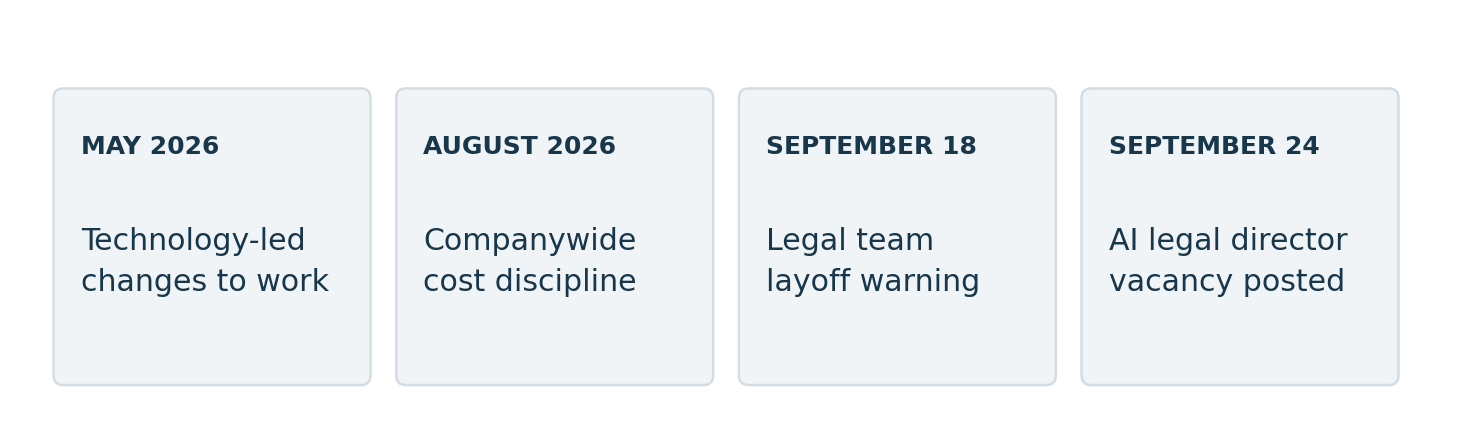
According to Deadline, chief legal and global affairs officer Horacio Gutierrez warned employees of a smaller organization in a September 18 memo. He identified automation, self-service, alternative legal service providers and outsourcing as ways to lower costs. The memo did not explicitly name AI, but it framed technology as part of a wider change in how the department operates.
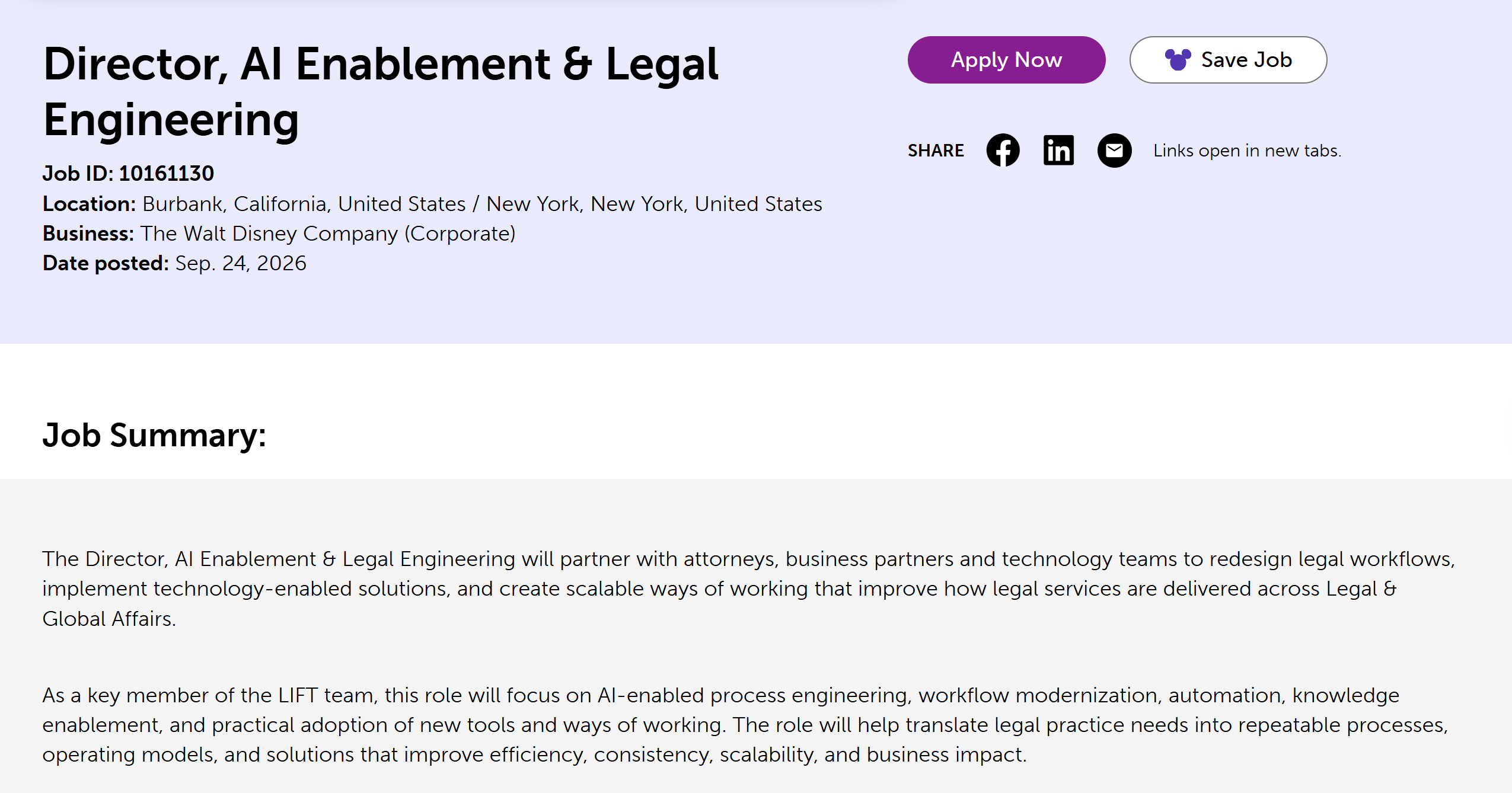
Six days later, on September 24, Disney posted a vacancy for Director, AI Enablement & Legal Engineering. The remit includes AI-assisted contract review, legal research and regulatory analysis, along with decisions about building systems internally or buying outside tools. The Hollywood Reporter connected the hiring effort to the legal organization’s restructuring in its September 25 coverage.
Disney is therefore looking for expertise to change its operating model while considering a smaller workforce. The posting describes the work to be redesigned; it does not disclose the final scale of legal layoffs or identify jobs that AI would eliminate. According to that reporting, Disney declined to comment on the matter.
A lawyer with responsibility for technology and workflow design
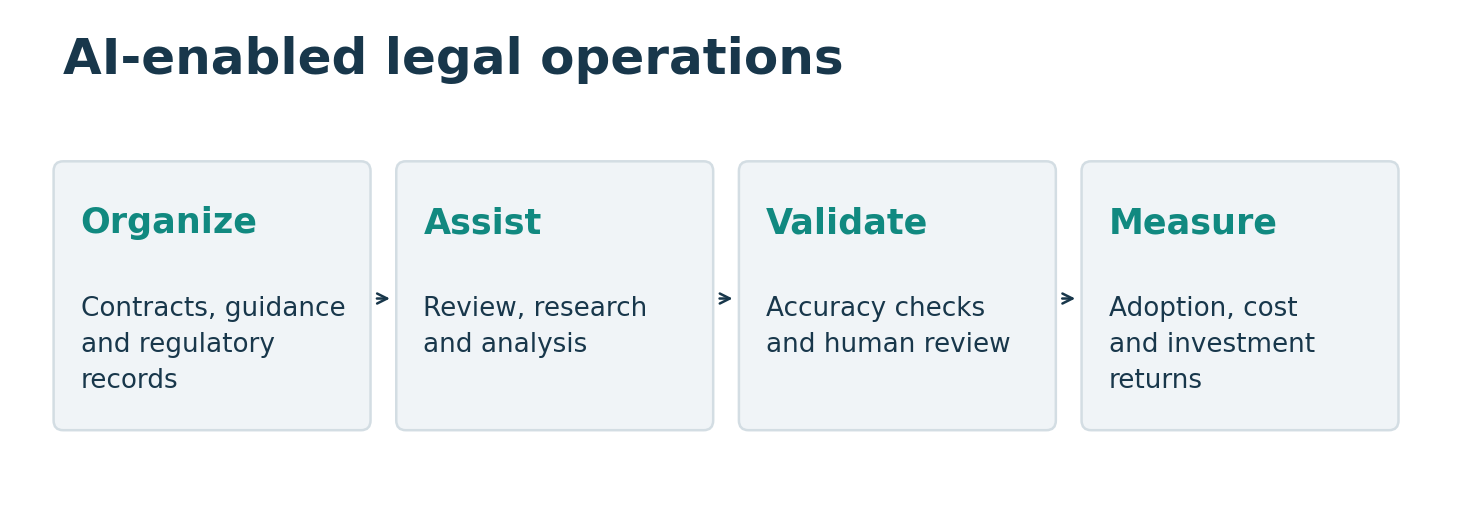
The position is based in Burbank, California, or New York and sits within the legal organization’s LIFT team. Its central task is to translate legal practice into repeatable processes. That includes organizing contracts, internal guidance and regulatory documents so AI tools can retrieve and analyze relevant material.
The remit extends beyond implementation. The director would evaluate legal technology vendors, compare in-house development with external platforms and track investment returns. Training and adoption are also part of the job, alongside collaboration with legal leadership and colleagues in technology, finance and human resources. The posting calls for testing, validation and quality controls to support accuracy and reliability.
Applicants need a Juris Doctor degree, an active law license in good standing and at least 10 years of experience in relevant fields, including legal practice, legal operations, technology, consulting or transformation. Preferred experience includes process engineering, Lean, Six Sigma, design thinking, contract lifecycle management and workflow automation. The advertised annual base-pay range is $185,500–$248,800 in California, or approximately KRW 252 million–337 million, and $196,600–$260,600 in New York, or approximately KRW 267 million–353 million. These are base-pay ranges, not total compensation.
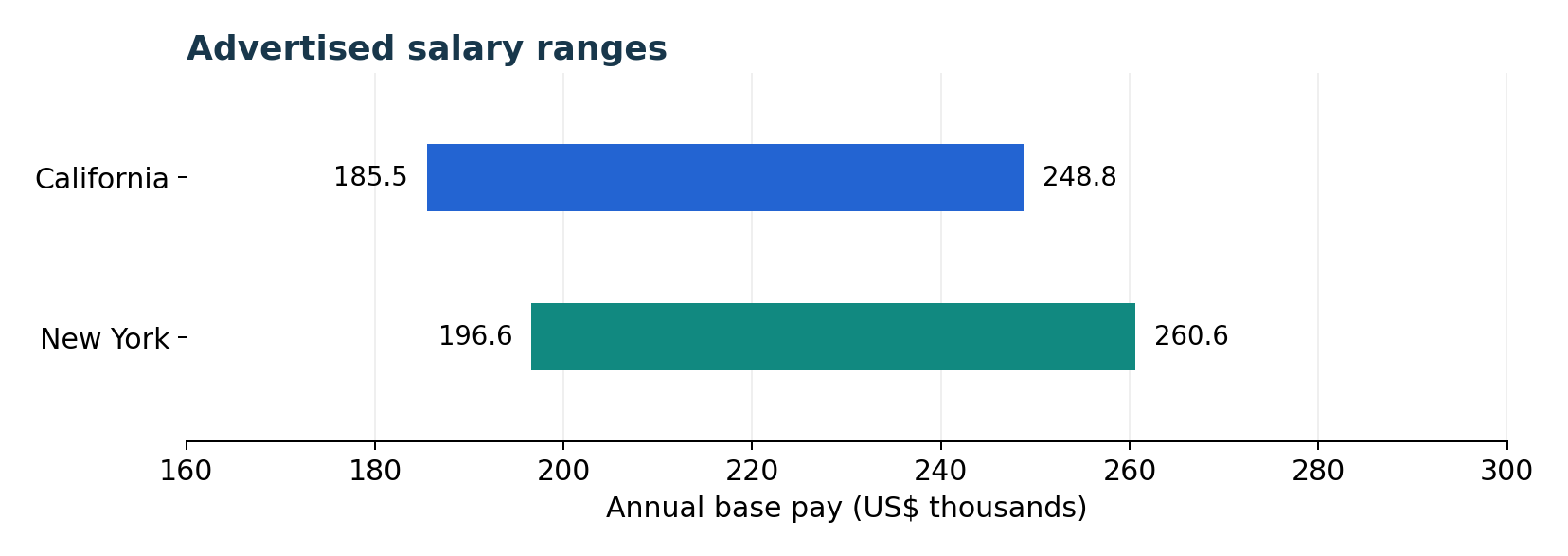
Advertised annual base-pay ranges. Source: Disney Careers, September 24, 2026.
Production and legal work carry different AI risks
The Hollywood Reporter identified copyright and ownership questions as constraints on AI use in production. Rights to training material, the ownership of generated output and commercial-use terms can all affect whether a studio can incorporate material into a finished work. That does not mean AI adoption has stopped across every part of Disney’s production business.
Legal operations contain tasks that are relatively straightforward to define and repeat: extracting contract clauses, searching documents and comparing rules. Turnaround time and review quality can also be measured before and after a tool is introduced. Yet legal work is not free of rights or security constraints. Confidentiality, permission to use documents, access controls and the verification of inaccurate outputs remain part of the operating design.
The significance of the vacancy is the attempt to redesign the information processing that supports legal judgment. How far automation should extend, and which outputs require human review, are operational decisions. Disney’s emphasis on quality controls and the daily experience of legal professionals suggests that successful adoption will depend on more than installing a model.
Sources: The Hollywood Reporter and Disney Careers; comparison and interpretation by K-EnterTech Hub.
Cost discipline under Josh D’Amaro
The legal reorganization sits within a broader efficiency drive under CEO Josh D’Amaro, who previously led Disney’s parks business. Disney named him its next chief executive on February 3, 2026. He succeeded Bob Iger on March 18.
In May earnings commentary, CFO Hugh Johnston described using technology to change working practices and redeploy financial and human capital toward higher-return opportunities. Deadline’s April report put the first round of cuts under D’Amaro at up to about 1,000 positions. The legal department’s plans should be read in that broader context of operating efficiency.
The company’s third-quarter shareholder materials, released in August, also emphasized cost discipline. The figures cited in The Hollywood Reporter’s September 25 report show a share-price decline of about 5% since the start of the year and nearly 40% compared with 2021. Those figures describe the comparison reported at that time; they are neither a current market quote nor a measure of AI’s effect on the business.
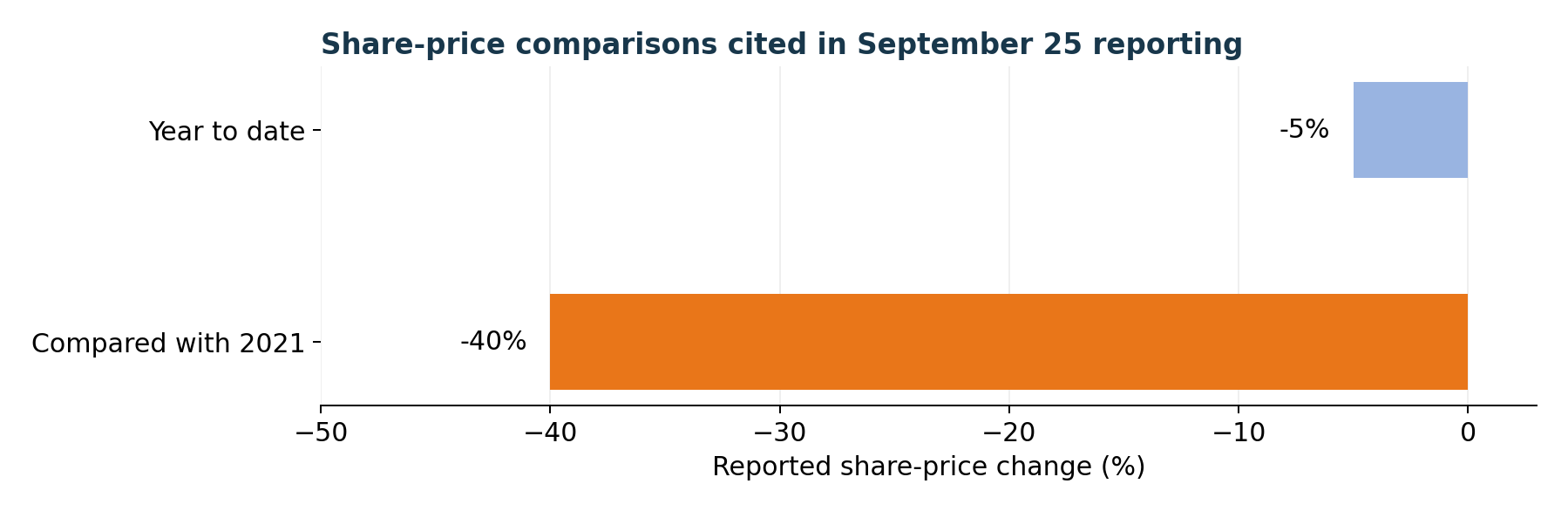
Share-price changes cited in The Hollywood Reporter’s September 25 coverage, as reproduced in this article. Exact comparison dates and prices were not supplied.
Sources: CBS News, Variety, Deadline and The Hollywood Reporter. Figures refer to separate reported rounds and should not be read as an audited cumulative total.
Automation is one part of the operating-model review
Gutierrez’s memo presented technology adoption as part of a change in collaboration and resource allocation. Its message was that Disney should lower internal barriers and use technology to strengthen its capabilities rather than preserve established practices simply because they are familiar. Legal services are now among the functions being reviewed through that lens.
The options include self-service and external providers as well as automation. That matters when assessing any subsequent head-count change: AI would not necessarily be the only cause. Decisions about what to retain in-house, standardize or outsource can change both staffing requirements and the expertise a department needs.
Source: Gutierrez’s September 18 memo as reported by Deadline.
Korean legal teams are moving from trials to operating strategy
In South Korea, discussion of legal AI is also moving beyond isolated tool experiments. Thomson Reuters Korea held Korea Legal Tech Forum 2026 at Conrad Seoul on June 9. Law.asia, an official media partner at the event, reported attendance of about 250 in-house counsel, law-firm lawyers and academics. The discussion focused on incorporating AI into legal strategy and everyday work.
For Korean media and content companies, Disney’s example raises a question about the allocation of work. If routine review takes less time, how much capacity can be redirected to negotiation and rights decisions? What happens to outside-counsel spending and the burden of internal verification? The available evidence does not support a sweeping conclusion about whether Korean companies are ahead of or behind Disney in linking AI to workforce planning.
Measure review quality as well as cost
The requirement to track return on investment makes operating performance part of the new role. Contract-review time, rework and outside legal fees are possible measures for comparing workflows before and after adoption. Faster processing is not enough on its own: the cost of detecting and correcting omissions or errors must also be counted.
The next developments to watch are Disney’s build-versus-buy choices, the eventual scale of legal cuts and whether comparable roles appear at other studios. Similar methods could extend to finance, human resources or procurement, but the vacancy does not establish an expansion timetable or a companywide mandate. Wider hiring would indicate interest; demonstrated operating results would be needed to show that the model is becoming established practice.
Korean broadcasters and producers could begin with a limited scope, such as contract review, rights-usage records or regulatory documentation. Priorities should reflect permission to use the underlying data, the share of repetitive work, the ability to detect errors and total implementation costs. Decisions carrying commercial or legal consequences still need a defined professional review process.
The skills requirement is changing too. Disney’s posting combines a legal qualification and substantial professional experience with technical implementation and process-improvement capabilities. That creates a role for practitioners who can work with engineers to define what should be automated. For Korean companies, the choice is whether to develop those skills internally or recruit people who already bridge law and technology. The operational change lies in how legal services are organized and delivered.
Source note The vacancy’s date, responsibilities, qualifications and salary were checked against Disney’s official listing. Memo details, historical layoffs, earnings commentary and share-price comparisons follow the reporting and materials cited in the supplied Korean article; restricted-access reporting has been paraphrased rather than independently re-quoted. KRW equivalents retain the source article’s illustrative rate of KRW 1,356.18 per US dollar; the date-specific market rate was not independently verified. Forward-looking implications and recommendations are editorial analysis.