
ANALYSIS | AUDIO & WEARABLES
32% of U.S. owners use them for music and podcasts, Kagan finds; Meta’s $349 camera-free audio glasses and Alibaba’s $450 glasses arrive the same day, and Samsung is reported for a November U.S.–Korea launch
Graphic: K-EnterTech Hub
SUMMARY Thirty-two percent of U.S. smart-glasses owners use them for music and podcasts, per S&P Global Market Intelligence Kagan. On Oct. 13, Meta opened preorders for camera-free $349 audio glasses and Alibaba unveiled $450 AI glasses. Glasses remove the phone-app-earbuds routine and can add listening time, but AI assistants that summarize episodes threaten episode-based listening and ad sales. Samsung is reported to launch in the U.S. and Korea in November.
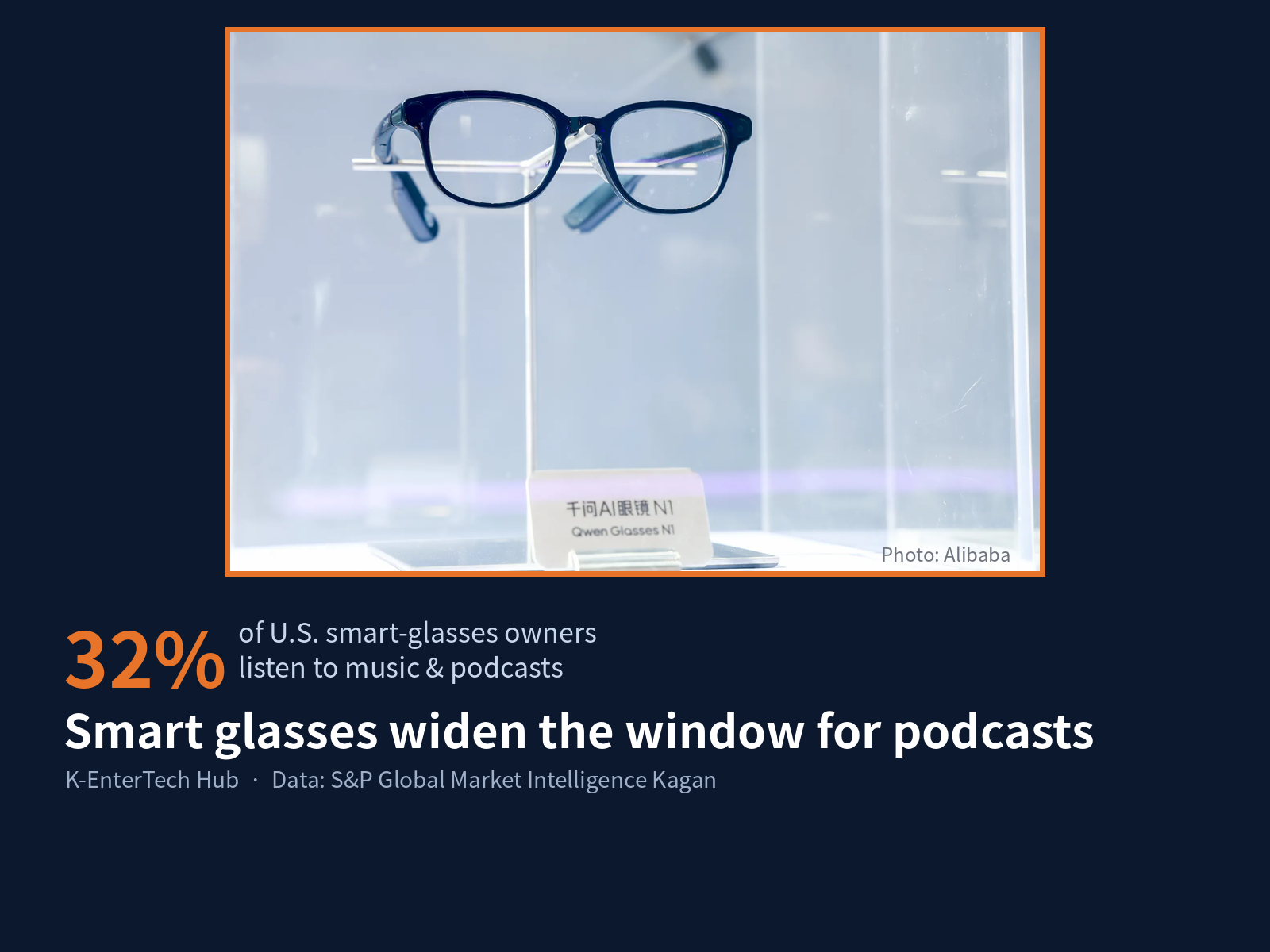
Three in 10 U.S. smart-glasses owners now use the devices to listen to music and podcasts. In a third-quarter 2026 survey of 2,532 U.S. internet-using adults by S&P Global Market Intelligence Kagan, 32% of the 163 respondents who own smart glasses said they use them for “music, podcasts or audio content.”
Luminate, the entertainment data company, reads that figure as a growth signal for podcasting. In an analysis of the survey, Luminate Chief Insights Officer Andrew Wallenstein argued that if the smartphone made podcasts portable, smart glasses could make them ambient. Most of the attention on the category has gone to cameras and AI, he noted, but audio can run alongside dishwashing, commuting or child care because it never asks for the listener’s eyes.
The hardware base is growing quickly. IDC counted 9.6 million smart glasses shipped worldwide in 2025, with Meta taking about 76.1%, according to a Reuters report carried by The Korea Herald, and expects 13.4 million units in 2026. In the U.S. alone, Circana put category sales at roughly $436 million in the 12 months through May 2026, up 233% year on year, according to a market roundup.
Manufacturers are leaning into audio and AI assistants. On Oct. 13, Meta opened preorders for Ray-Ban Meta Audio, a model with no camera at all, starting at $349 and built for music and podcast playback, calls, live translation and conversation with its AI assistant, TechCrunch reported on Sept. 23. The same day, Alibaba unveiled its Qwen Glasses N1 in Hangzhou, starting at 2,999 yuan ($450), Bloomberg reported.
South Korea sits among the first markets in the next round. Meta launched Ray-Ban Meta and Oakley Meta (레이밴 메타·오클리 메타) in Korea on May 25, and Forbes reported on Oct. 13 that Samsung Electronics (삼성전자) will release its Galaxy glasses first in the U.S. and Korea in November. For Korean broadcasters, the question is how their radio and podcast programming will reach a listener whose next audio device sits on the face rather than in the pocket.
Photos and video lead at 61%; audio ranks fourth at 32%
Photo and video capture was the most common use among Kagan’s owners, at 61%. Hands-free calls and messaging (44%), real-time answers from an AI assistant (43%) and audio listening (32%) followed. Personal display and real-time speech translation each drew 26%, navigation 22%, work tasks and text translation 21% each, and memory or cognitive support 20%. Respondents could choose more than one.
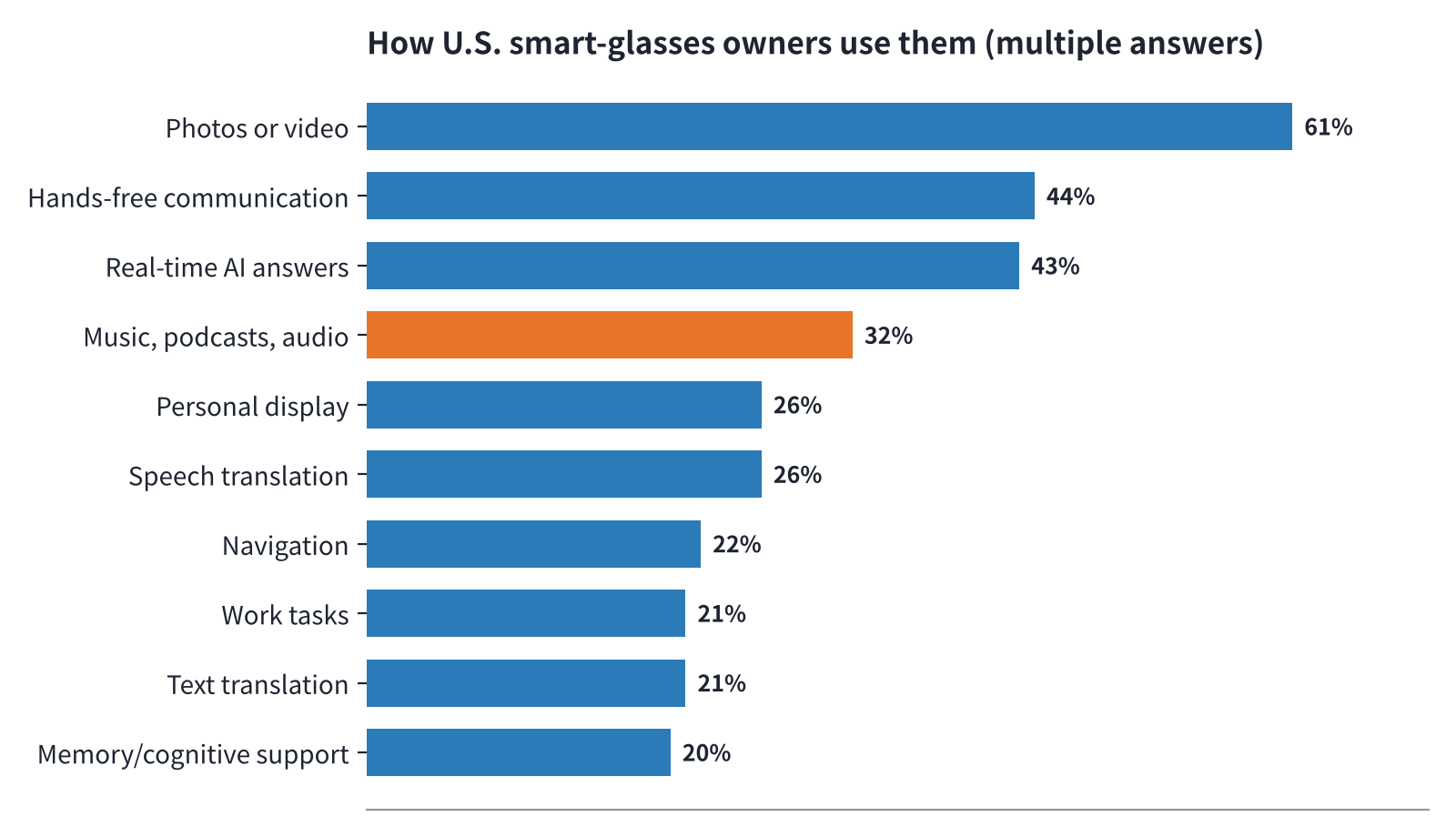
How U.S. smart-glasses owners (n=163) use their devices; multiple answers allowed. Source: S&P Global Market Intelligence Kagan via Luminate
Wallenstein pointed to the spread of uses — calls, search, listening, translation — as evidence that owners fold the glasses into daily routines rather than treat them as dedicated entertainment devices. More than a third of owners in the survey said the glasses help them stay present while using technology, and nearly one in five said they spend less time looking at their phones. Open-ear, eyes-forward audio fits that pattern.
Podcasts at the kitchen sink: the phone, the app and the earbuds drop out
One owner cited by Kagan listens to podcasts through the glasses’ open-ear speakers while washing dishes. Because his ears stay uncovered, he can still hear if his child wakes up or his partner calls from another room.
Listening on a phone usually means finding the device, opening an app and putting in earbuds. Glasses that are already being worn skip those steps, Wallenstein wrote, and could open new listening occasions across the day. The Ray-Ban Meta sold in Korea pairs a 12-megapixel camera with open-ear speakers and up to eight hours of battery life; Samsung’s glasses run up to nine hours, with up to seven more charges from the case, Hankyung reported (한국경제).
58% of Americans hear a podcast monthly; podcasts overtake radio in spoken-word time
The glasses arrive in a U.S. podcast market already at record levels. Edison Research’s Infinite Dial 2026 found that 58% of Americans 12 and older — about 167 million people — listened to or watched a podcast in the past month, the highest on record. Monthly online-audio use among those 55 and older rose from 52% in 2024 to 70% in 2026.
Podcasts have also passed AM/FM radio in spoken-word listening for the first time. In Edison’s Share of Ear study for the fourth quarter of 2025, podcasts took 40% of daily spoken-word listening time against radio’s 39%, Net Influencer reported; in 2015 the split was 75% radio, 10% podcasts. Viewing has grown alongside listening: YouTube said viewers watched 700 million hours of podcasts a month on living-room devices in 2025, up from 400 million. Video podcasts are pulling audiences toward the TV screen; glasses push the other way, toward screen-free listening.
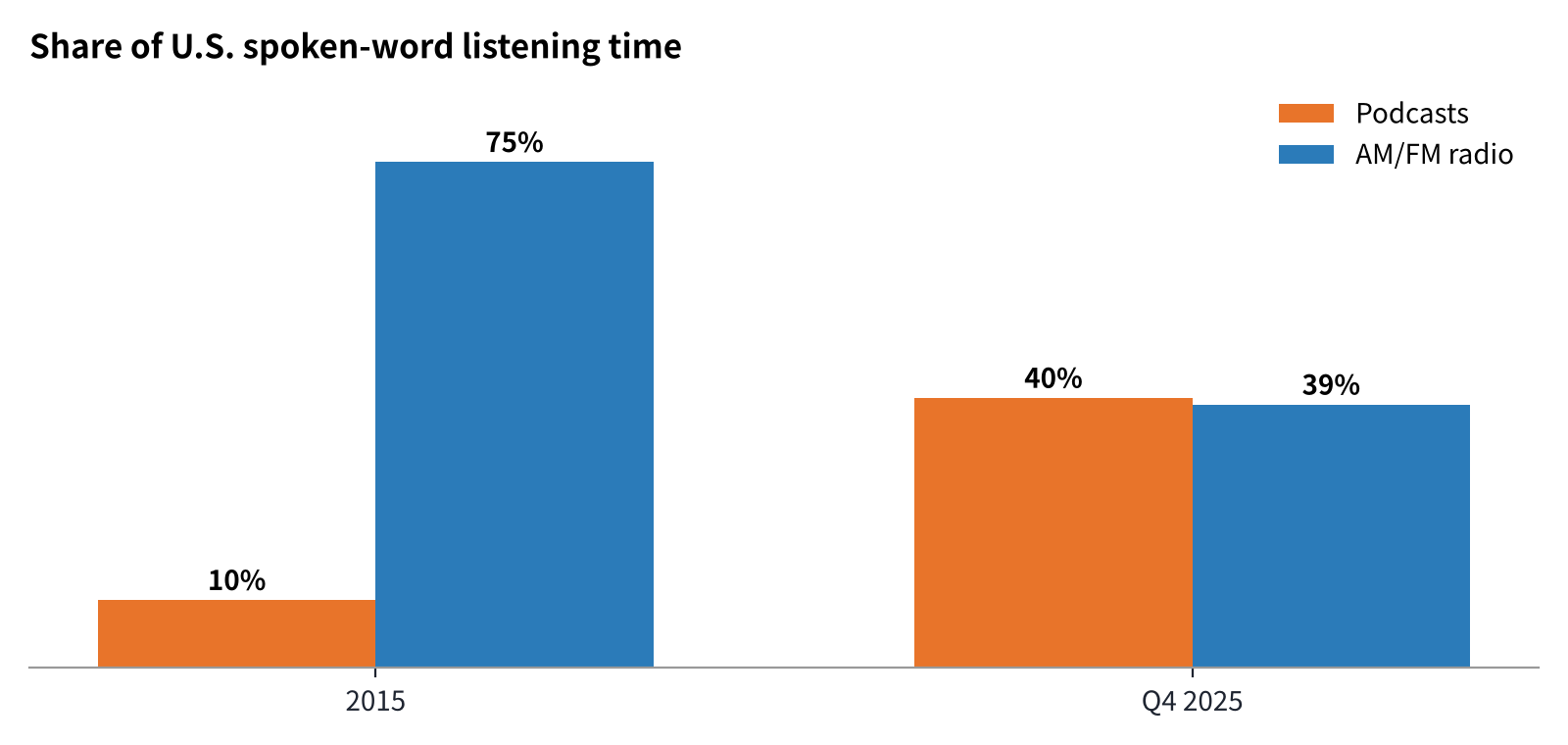
Share of daily spoken-word audio listening time among Americans 13+. Source: Edison Research, Share of Ear
9.6 million units shipped in 2025, Meta holds 76%; 13.4 million forecast this year
Meta dominates the category. IDC research director Ramon Llamas put Meta’s share of 2025 shipments at about 76.1%. Omdia, which defines the market differently, counted 8.7 million AI glasses shipped in 2025, up 322%, with Meta shipping 7.4 million for an 85.2% share. EssilorLuxottica, Meta’s manufacturing partner, said in February that cumulative Meta glasses sales had reached 7 million units.
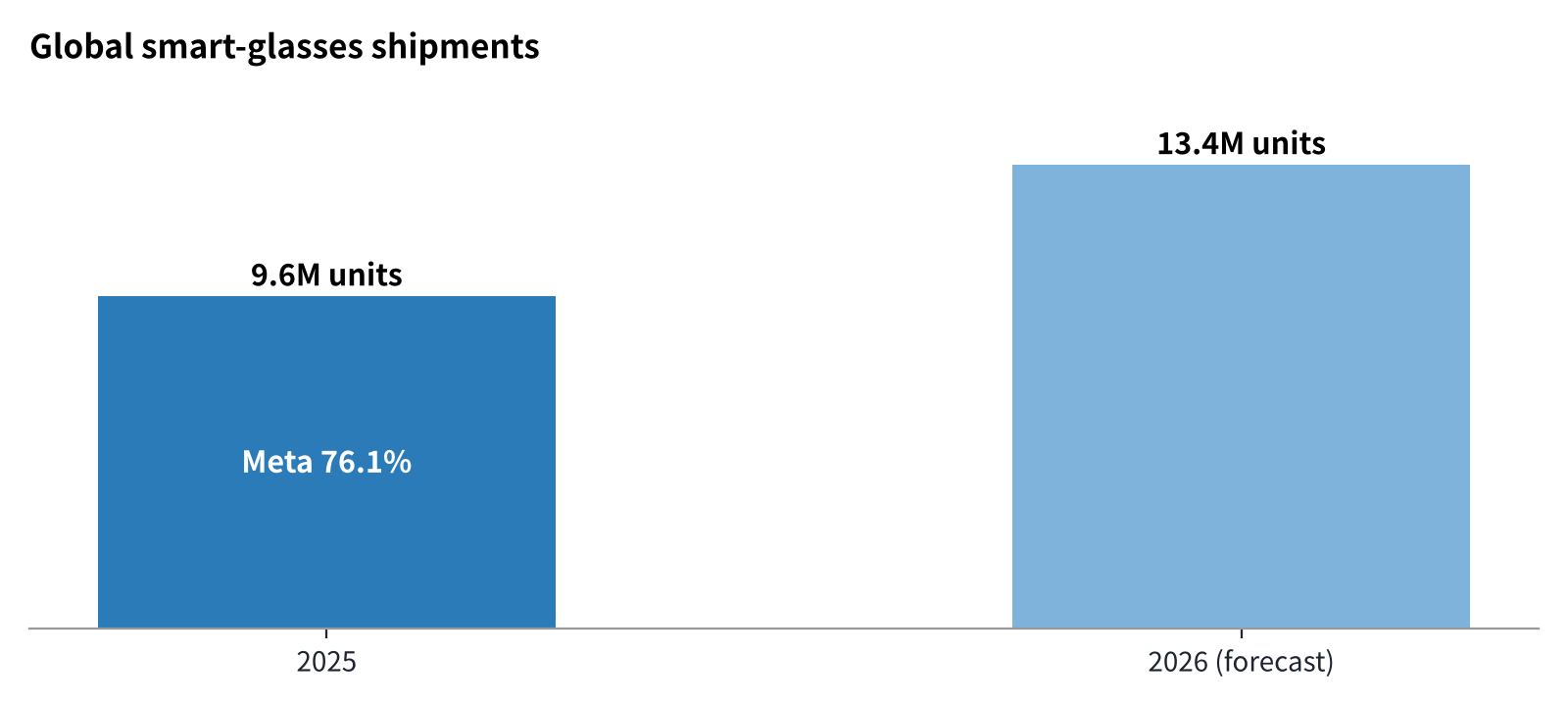
Global smart-glasses shipments; 2026 is a forecast. Source: IDC, via The Korea Herald
Rivals are moving on their own timetables. Meta’s display-equipped Meta Ray-Ban Display, unveiled in 2025, sells for $799. Apple pushed the unveiling of its AI glasses, code-named N50, from late this year to late next year, Bloomberg reported, citing the maturity of its visual-AI features, according to Asia Economy (아시아경제).
Meta drops the camera at $349; Alibaba adds $450 Qwen glasses and Bose-built earbuds
Meta announced Ray-Ban Meta Audio at Connect 2026 on Sept. 23. The camera-free glasses weigh 43 grams and run up to 12 hours on a charge, or 48 hours with the case. Meta designed them around conversations with Muse, its new AI assistant, which will reach all of its AI glasses, according to TechCrunch. Photo and video capture topped Kagan’s list at 61%, yet Meta has now split off a model that keeps only audio and the assistant — one that also sidesteps the U.S. backlash over covert recording.
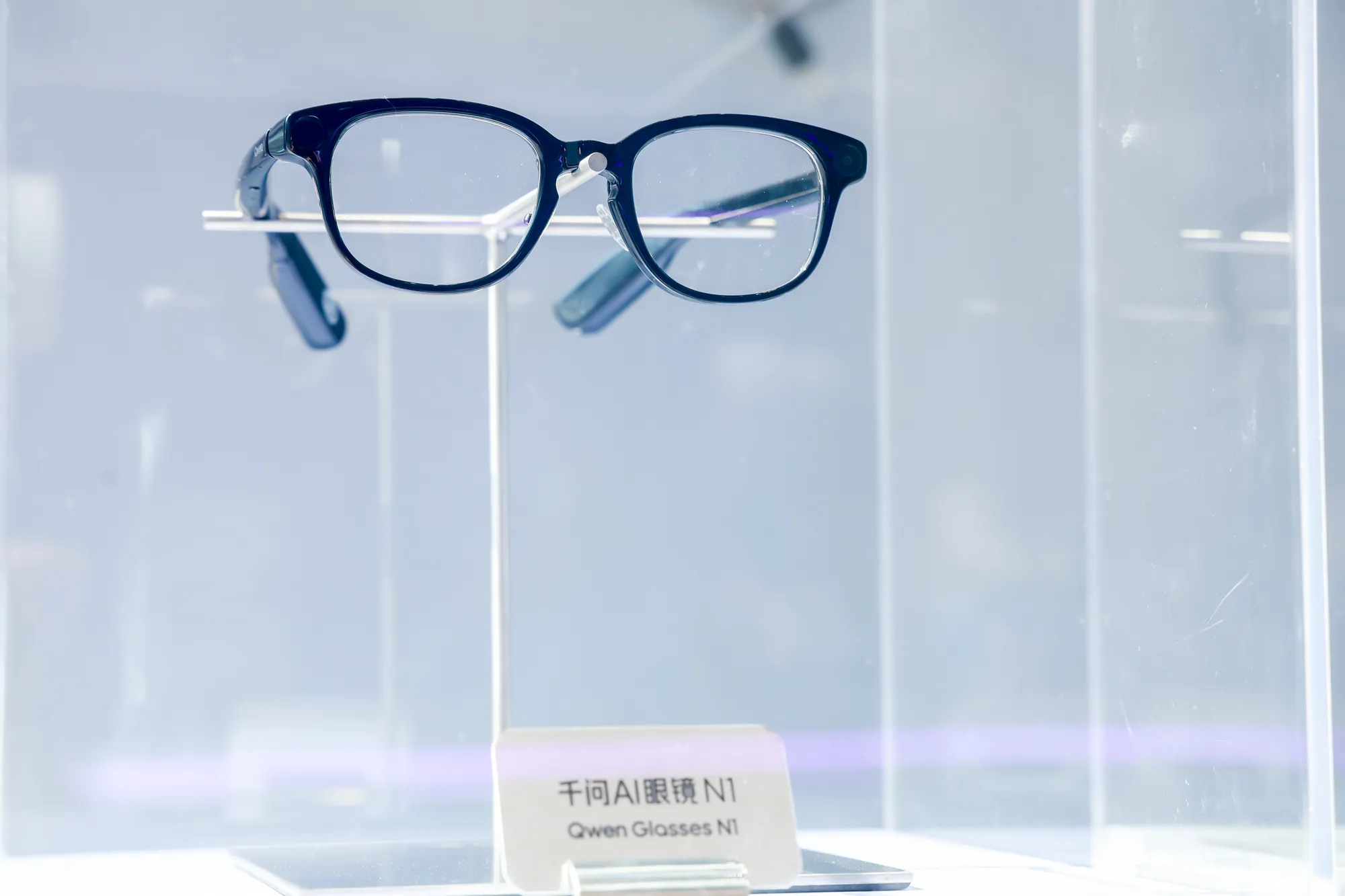
Alibaba’s Qwen Glasses N1, unveiled in Hangzhou on Oct. 13 at 2,999 yuan and up. Photo: Alibaba
Alibaba’s Qwen Glasses N1 series, shown at an event in Hangzhou on Oct. 13, follows its first glasses of November 2025. At 2,999 yuan ($450) before discounts, they are no cheaper than Meta’s Ray-Bans, which Bloomberg read as an effort to compete on quality and features rather than price. The cameras move up to 50 megapixels, and a Pro edition with eye tracking costs 3,499 yuan. A charge gives 25 hours of standby or nine hours of music playback, according to Alibaba. Users talk to the Qwen AI agent through bone-conduction microphones, and the glasses handle shopping, payments and health tracking, said Wu Jianjun, general manager of Qwen AI hardware products.
Alibaba also began selling Qwen Clip, AI earbuds developed with Bose, at 1,299 yuan (about $195), as a cheaper way into Qwen. Like Meta, Bloomberg noted, Alibaba wants glasses to be the entry point for its AI tools and agents; Chief Executive Eddie Wu reiterated in September the goal of building AI across the stack, from large language models and chatbot apps to chips and hardware. Meta’s camera-free glasses and Alibaba’s earbuds both move the assistant’s main touchpoint from the screen to the ear — the same slot podcasts and radio occupy.
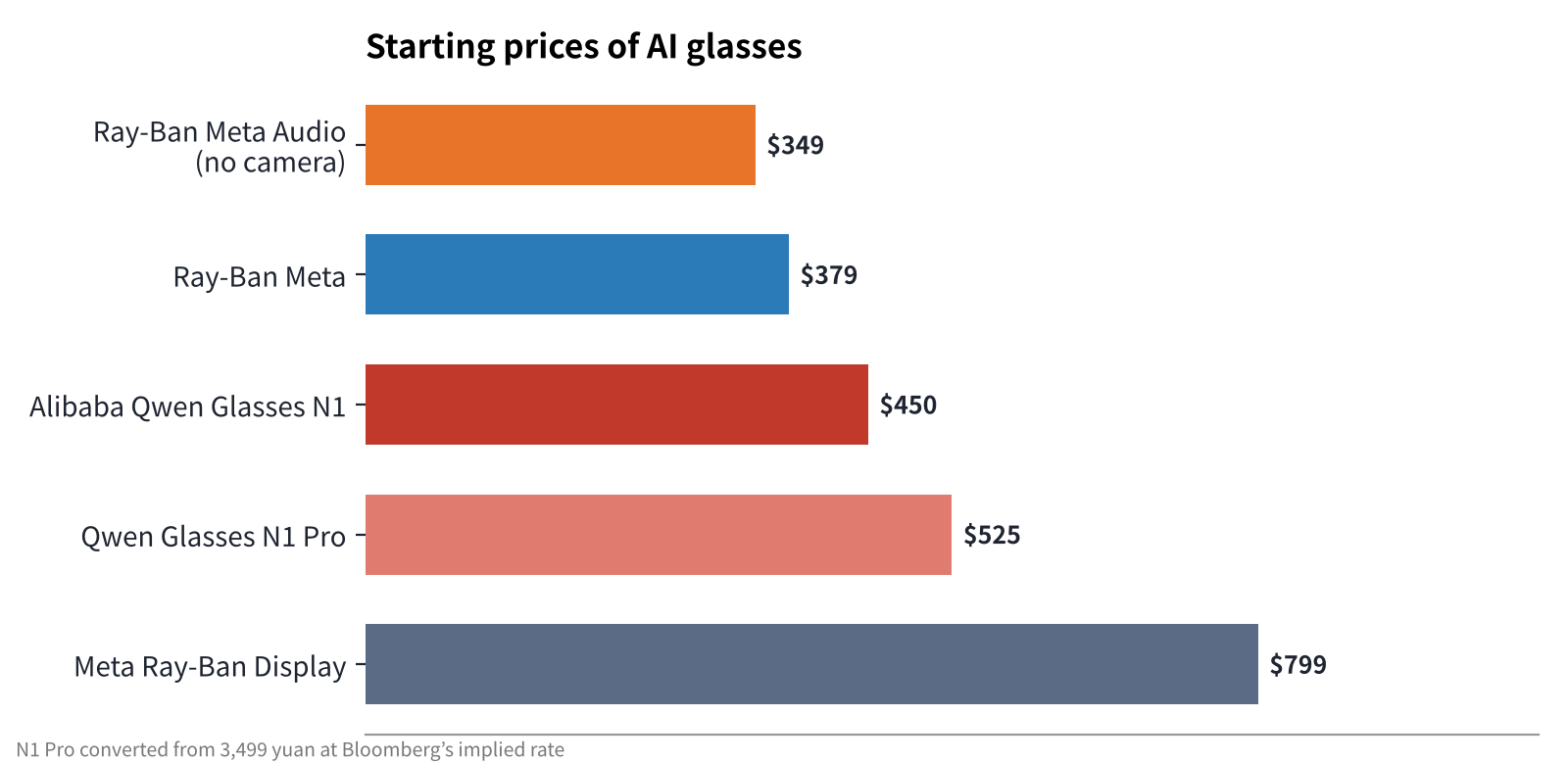
Starting prices of AI glasses. Sources: Meta, Alibaba, Bloomberg, TechCrunch
43% use the AI assistant — and the episode may lose its grip
The AI assistant, used by 43% of owners, is the feature most likely to change how podcasts are consumed. As glasses become conversational, Wallenstein wrote, listeners may ask for a specific discussion inside an episode, request a summary, or pose a follow-up question about something they just heard.
That, he argued, is both an opportunity and a risk for publishers. Glasses could expand time spent with audio while weakening the episode as the basic unit of consumption, if AI extracts the information from spoken-word programming instead of having listeners hear the whole show. For a business that sells ads inserted into episodes, a summarized listen does not register as an ad impression. Listening time may grow even as the episode-based sales model needs rebuilding.
Meta in Korea since May; nine Samsung frames leak ahead of a reported November launch
Meta’s Ray-Ban and Oakley models went on sale in Korea on May 25, starting at 690,000 won (about $518), with BLACKPINK’s Jennie fronting local marketing, Hankyung reported.
Samsung showed its “Intelligent Eyewear” at Galaxy Unpacked in London on July 22. The glasses run on Android XR, the platform built with Google, and Gemini can translate a conversation partner’s speech or a foreign-language menu aloud. They use the same Qualcomm Snapdragon AR1 Gen 1 chip as Ray-Ban Meta. Won-joon Choi (최원준), chief operating officer of Samsung’s MX business, described them as a new touchpoint that reads everyday context to deliver more personalized AI.
The line-up has now surfaced. Forbes contributor Andrew Williams wrote on Oct. 13, citing images published by Sammyguru, that Samsung will offer nine frames: six from Gentle Monster (젠틀몬스터) and three from Warby Parker — Alden, Reid and Wren — with clear, tinted or sunglass lenses. Samsung plans to launch first in the U.S. and South Korea in November, with the Warby Parker designs exclusive to the U.S., Forbes reported. Warby Parker operates in the U.S. and Canada; Gentle Monster is a Korean brand with stores in several countries.
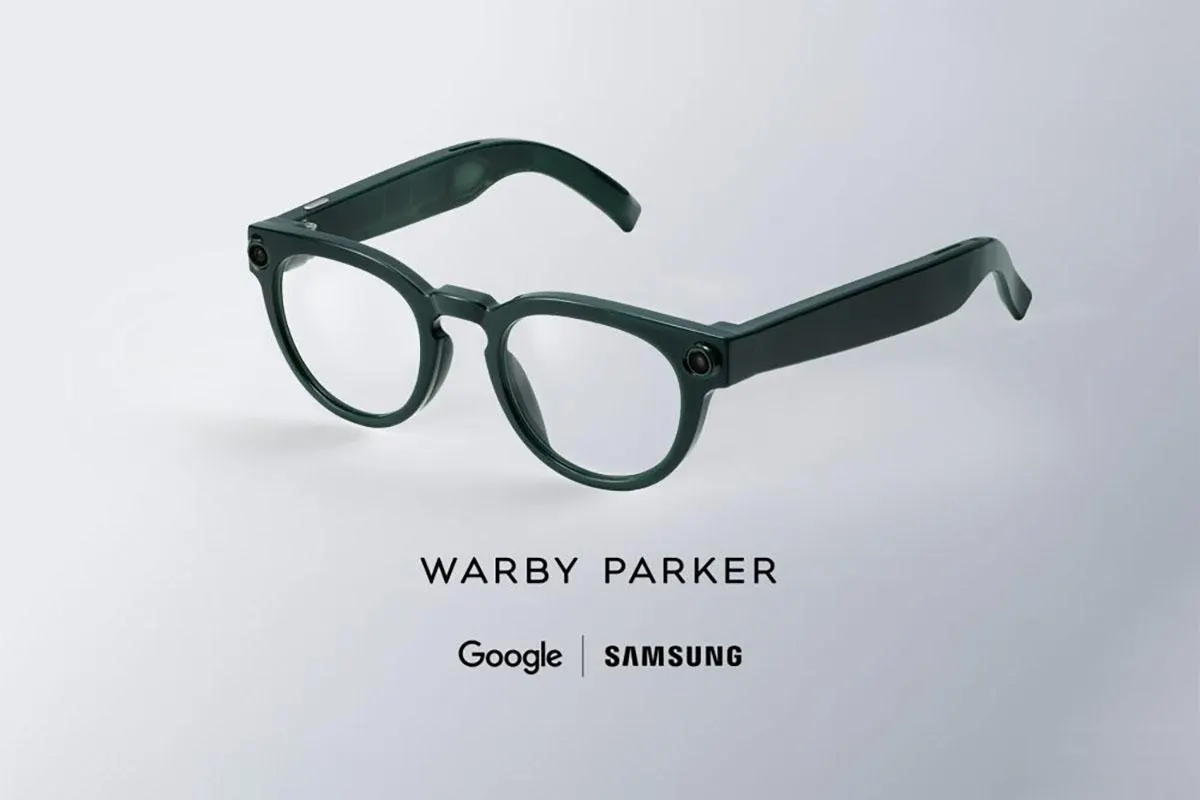
The AI glasses Samsung and Google designed with Warby Parker, with cameras at the hinges. Photo: Samsung
The Galaxy glasses carry no display, relying on a microphone array, speakers and a camera — rumored to be 12 megapixels and capable of 3K video at 30 frames per second, according to Forbes. Pricing has not been announced; Forbes pointed to the $379 Ray-Ban Meta as the benchmark. Google’s Android ecosystem president Sameer Samat has pitched the glasses as delivering “all-day, hands-free help” from Gemini that responds to what the wearer sees. Samsung itself has not announced a date; two models, SM-O200J and SM-O200P, appear in U.S. Federal Communications Commission filings, Wikitree reported (위키트리). Camera-equipped glasses face a privacy backlash in the U.S., making recording indicators a factor in sales.
Terrestrial ad sales fall 7.2% to ₩1.23tn; daypart radio ads get repriced on the glasses
Where U.S. podcasters worry about the episode, Korean broadcasters sell by daypart. Korea’s ad spending rose 3.5% to 17.13 trillion won ($12.87 billion) in 2024, according to the advertising expenditure survey released on Jan. 8 by the Korea Communications and Media Commission (방송미디어통신위원회) and the Korea Broadcast Advertising Corp. (KOBACO, 한국방송광고진흥공사). Online took 10.10 trillion won ($7.59 billion), or 59%, up 7.9%. Broadcast advertising fell 5% to 3.22 trillion won ($2.42 billion), an 18.8% share. Terrestrial advertising across TV, radio and DMB dropped 7.2% to 1.23 trillion won ($925 million), the Journalists Association of Korea reported (기자협회보).
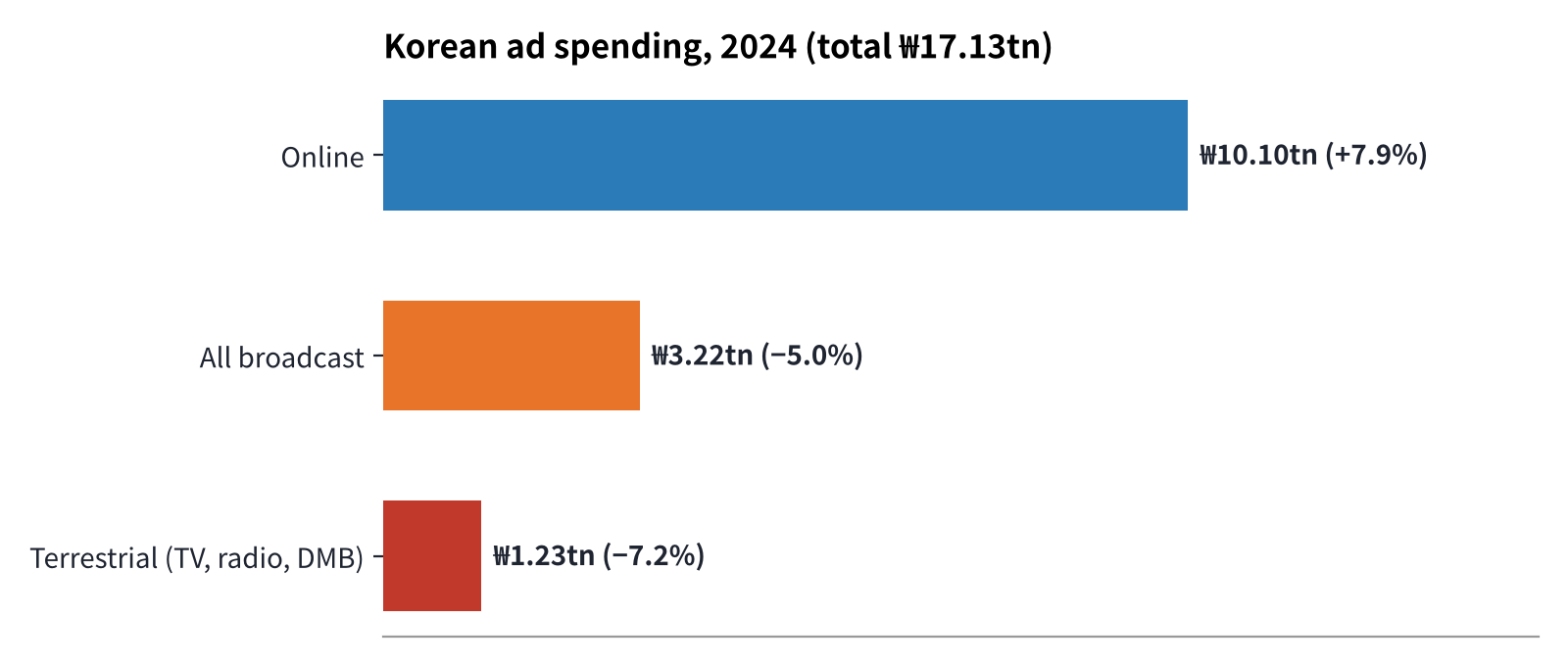
Korean ad spending, 2024; year-on-year change in parentheses. Source: Korea Communications and Media Commission, KOBACO
Radio ads are sold as programs and time slots and priced against ratings surveys. An assistant on the glasses breaks that model. A listener no longer tunes in at a set hour, and can ask instead for “just the exchange-rate segment from this morning’s current-affairs show.” That two-to-three-minute excerpt is consumed outside the daypart and does not show up in current ratings. With broadcast advertising shrinking, radio will need digital audio ad models that count and price exposure by excerpt and summary if it is to earn money on the new device.
Naver Audioclip shuts after nine years; Korea’s voice gateway shifts to foreign assistants
Korea’s audio distribution channels have narrowed. Naver (네이버) closed its Audioclip platform on Dec. 31, 2025, after nine years. Edaily (이데일리) attributed the closure to a stalled AI-speaker market, generative AI overtaking older voice assistants, and listening time lost to YouTube and short-form video. Naver said it would focus on AI and on user content services such as Cafe, Blog, Chzzk and Clip.
That leaves broadcaster radio apps (KBS Kong, MBC mini, SBS Gorealra) and YouTube. In the commission’s 2025 Broadcast Media Usage Survey, eight in 10 Koreans used streaming services, News1 reported (뉴스1) on Dec. 30. In the Digital News Report 2026, 64% of Korean respondents used news creators on YouTube or social media, above the 55% average across 48 markets.
Glasses add one more layer in front of those routes: an AI assistant. Meta’s frames carry Meta AI and Muse, Samsung’s carry Google’s Gemini, Alibaba’s carry Qwen. All three are foreign. When a listener says “play the news,” the assistant decides which broadcaster and which program to play. With Audioclip gone, no Korean platform controls a voice gateway on glasses. Rather than lead with their own apps, Korean broadcasters will have to strike integration deals and technical terms with each foreign assistant. With Meta now selling a $349 audio-only model, how much glasses listening time Korean programming wins will depend on those integrations.
KBS calls AI a “survival strategy,” MBC unit builds NewSide; broadcasters use AI in production, glasses use it at the point of listening
Korean broadcasters are adopting AI. KBS President Park Jang-beom (박장범) called AI an important survival strategy for the broadcaster in his New Year address on Jan. 2 and said AI is already used in radio programs, the Journalists Association of Korea reported. Dost11 (도스트일레븐), MBC’s AI strategy subsidiary, demonstrated NewSide at the World Journalists Conference in March. The tool turns an article link into a radio news script of a chosen length and language, and the company said it could produce radio news every five minutes, according to the association’s paper.
Both cases put AI to work in production. The assistant on the glasses works at the point of listening, summarizing and excerpting broadcasters’ programs. Tools like NewSide, which turn out short audio news fast, fit glasses-length formats. If broadcasters produce their own few-minute briefings and question-and-answer news and supply them to the assistants, they enter in their own format before the assistant starts cutting up their programs.
Audio archives feed the assistants; 26% use live translation, a route abroad for Korean-language audio
Broadcasters’ archives of radio and current-affairs audio become source material for assistant answers. The Korea Press Foundation expects copyright protection and attribution to matter more as news use through AI chatbots grows. Audio faces the same issue: licensing archives to generative AI companies will require contract terms on summarization and excerpting rights, attribution and payment. For terrestrial broadcasters losing ad revenue, archive licensing could become a new income line.
Translation opens a route in the other direction for Korean content companies. In Kagan’s survey, 26% of owners use live speech translation and 21% text translation; Samsung’s glasses have Gemini translate speech aloud. If overseas listeners can hear Korean podcasts, radio or K-pop-related audio translated on their glasses, spoken-word content long held back by subtitling and dubbing costs could find listening time abroad. Who produces the translated voice, and how the revenue is split, will be set in contracts with the platforms that own the assistants.
Korea is a launch market for Samsung’s glasses, and a Korean brand, Gentle Monster, designed most of the frames. From November, Korean broadcasters and audio producers can test glasses-native formats at home first and use the results in integration talks with the foreign assistants.
A 163-owner early-adopter sample; November’s launch is the next data point
Kagan’s owner sample is small — 163 people — and drawn from early adopters, so usage shares may shift as the category reaches a mass audience. With photo and video capture far ahead at 61%, it is too early to call audio a core use.
Wallenstein located the significance of smart glasses for audio less in replacing earbuds than in removing friction. Podcasts grew because they can accompany life rather than interrupt it; glasses could turn audio from something consumers choose to start into something almost always within earshot.
Competition is shifting away from cameras and displays toward audio and the assistant. Meta has a $349 camera-free model; Alibaba launched earbuds alongside its glasses. Both put an assistant in the user’s ear at the center of the pitch, and Kagan’s 32% audio figure could rise as camera-free models spread.
In Korea, November’s Galaxy launch will put Meta and Samsung head to head in the same market for the first time. First-year sales, the share of owners who listen to audio, and whether Korean broadcasters’ programming connects to Meta AI and Gemini will be the measures of how far the device reshapes Korean audio. For broadcasters, the next questions are whether radio ads can be sold by excerpt and summary, and on what terms audio archives open to generative AI companies.