
REGIONAL AX BRIDGE@KOREA | COMPANY INTERVIEW
Six months after selling its consumer app, the Wonju startup built AROS, an operating system that ties entry, payment, camera vision and robots into one platform. It is now in a proof of concept with a semiconductor back-end manufacturer and lining up a U.S. landing in Portland, Oregon.

Hallowa (할로와), an AI startup based in Wonju, Gangwon Province, is putting its spatial operating system into a semiconductor factory. The company is running a proof of concept (PoC) with a chip back-end processing firm, after first proving the system in unstaffed retail stores and a self-service workspace.
Hallowa was one of the exhibitors at the first Regional AX Bridge@KOREA (지역 AX 브릿지@KOREA), hosted by the Ministry of Science and ICT (과학기술정보통신부) and organized by the National IT Industry Promotion Agency (NIPA, 정보통신산업진흥원) at COEX in Seoul on October 13–14.
The 20 participating companies, picked region by region, went through four months of demand surveys, buyer invitations, commercialization consulting and one-on-one buyer matching beforehand, ZDNet Korea reported on October 15.
Hallowa’s company profile for the event pitches AROS as an AI platform that rolls entry, booking, payment, seating, power, CCTV vision and reporting into one. “It isn’t an OS that stops at looking through a camera. It executes all the way to actually running the space,” CEO Hyukjin Kwon (권혁진) told K-EnterTech Hub in a video interview on October 6.
For its first U.S. foothold, Hallowa has picked Portland, Oregon, where it is in talks to join a local soft-landing program.
See, Decide, Act, Verify: four steps to run a room
Kwon says AROS stands for Autonomous Real-world Operation System; the company’s own product graphic also renders it as Autonomous Retail/Space OS. Either way it runs in four stages: See reads the state of the space, Decide works out what needs doing in context, Act hands the task to people, equipment or robots, and Verify checks that the job got done.
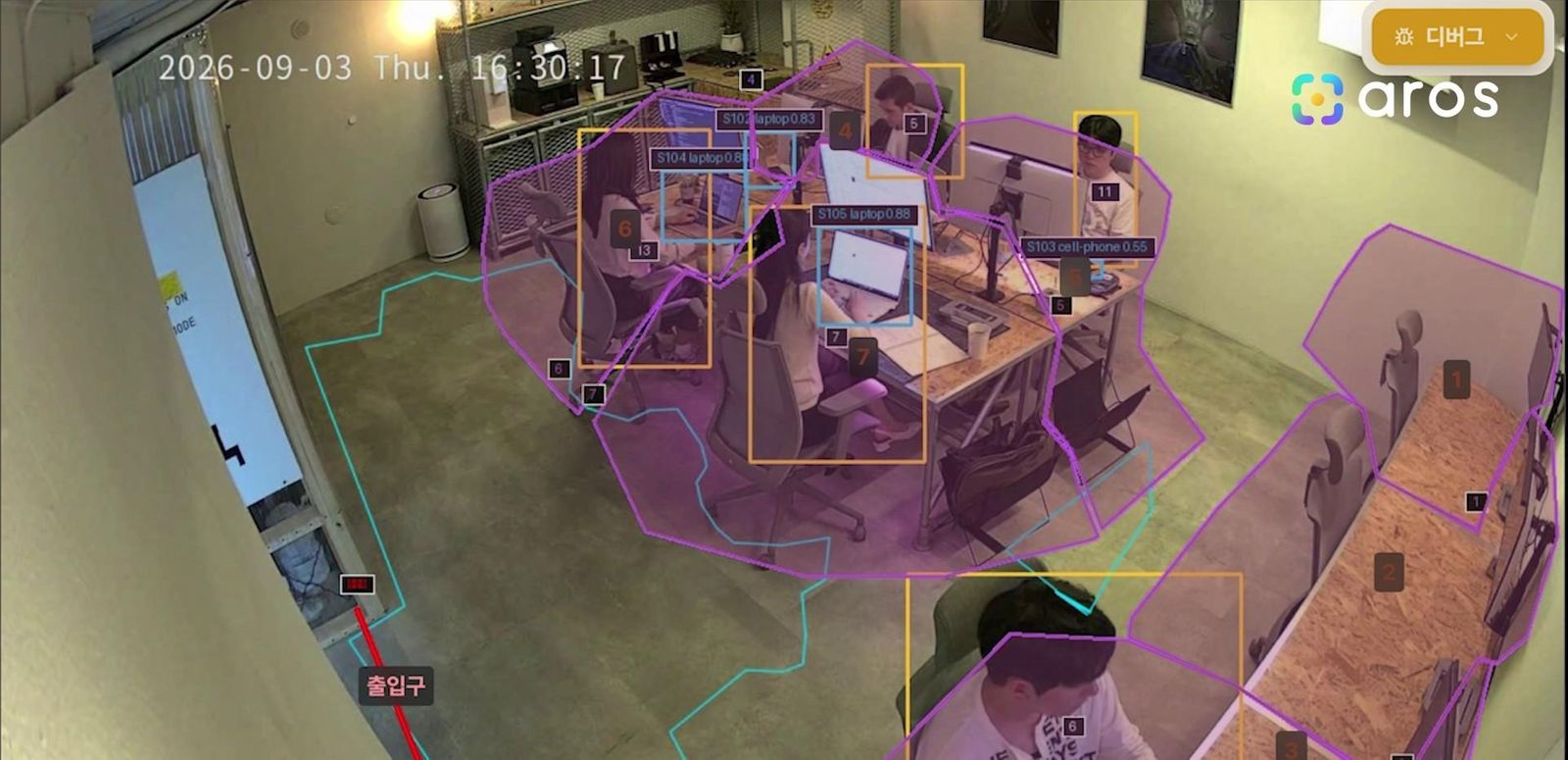
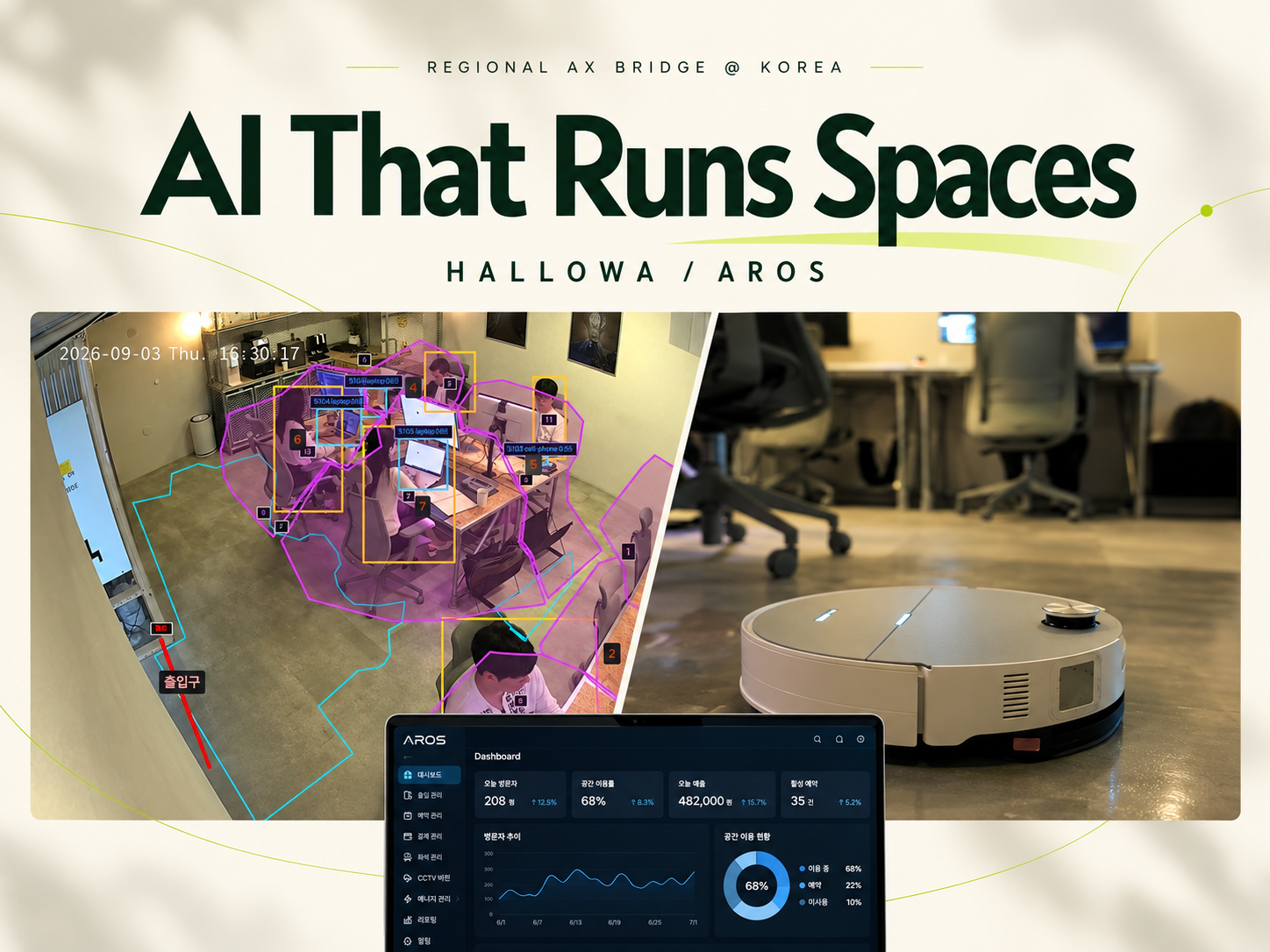
A promotional video Hallowa released in September walks through the loop in an unstaffed workspace. A customer books and pays on a phone, AROS immediately unlocks and controls the space, and ceiling-camera vision AI counts how many people are using it. The site keeps running with no manager on hand. Entry can also be handled by facial recognition.
Kwon’s favorite example is the same scene. “If someone spills coffee, the digital twin and camera vision we installed pick up the coordinates of that area, and a robot vacuum goes there and cleans it up.” In the video, a liquid-detection flag pops up on the camera feed and a robot vacuum heads for the spot. Move that loop onto a factory floor and detecting a problem, dispatching equipment or a robot, and confirming the fix all happen inside one system.
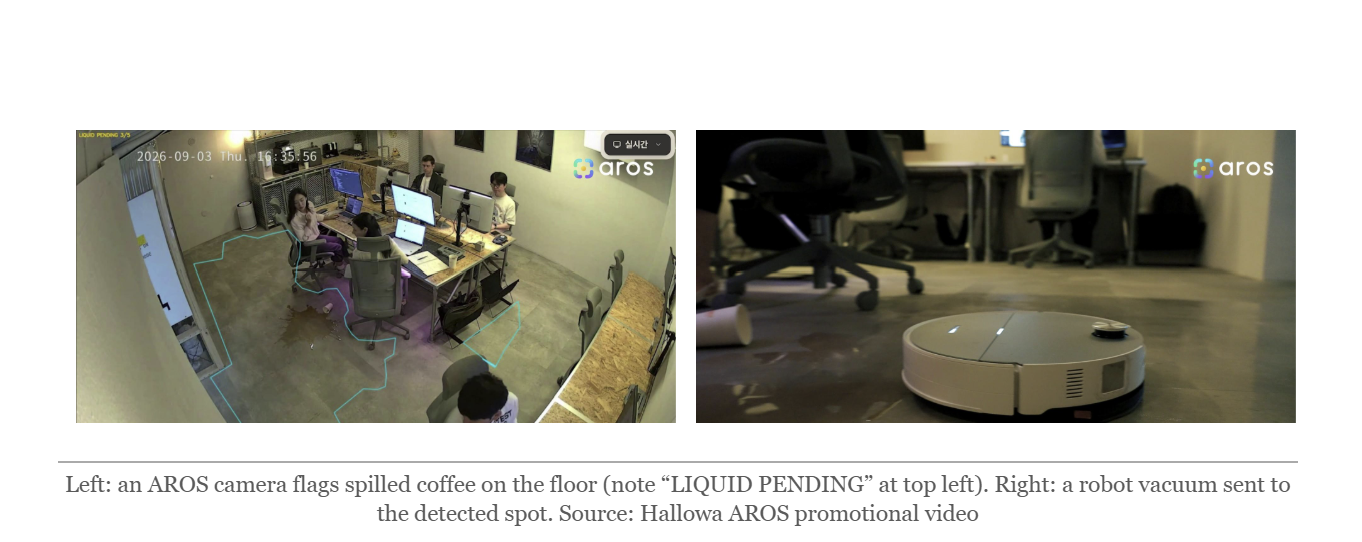
How AROS works, with the showroom example. Source: interview with Hyukjin Kwon and AROS video
Entry, booking, payment, seats, power and CCTV on one screen
The company profile lays AROS out in three layers. At the bottom, an edge and IoT layer connects CCTV cameras, NPU boxes, sensors, smart locks and power and energy devices. In the middle, the AROS platform handles integrated operations, a data hub and an automation engine. On top, an AI and analytics layer runs vision AI, predictive analysis and reporting. Operators see visitors, occupancy, sales and bookings together on a dashboard and a mobile app, and the promotional video says the same data shows when a space is busiest and how much operating cost has come down.
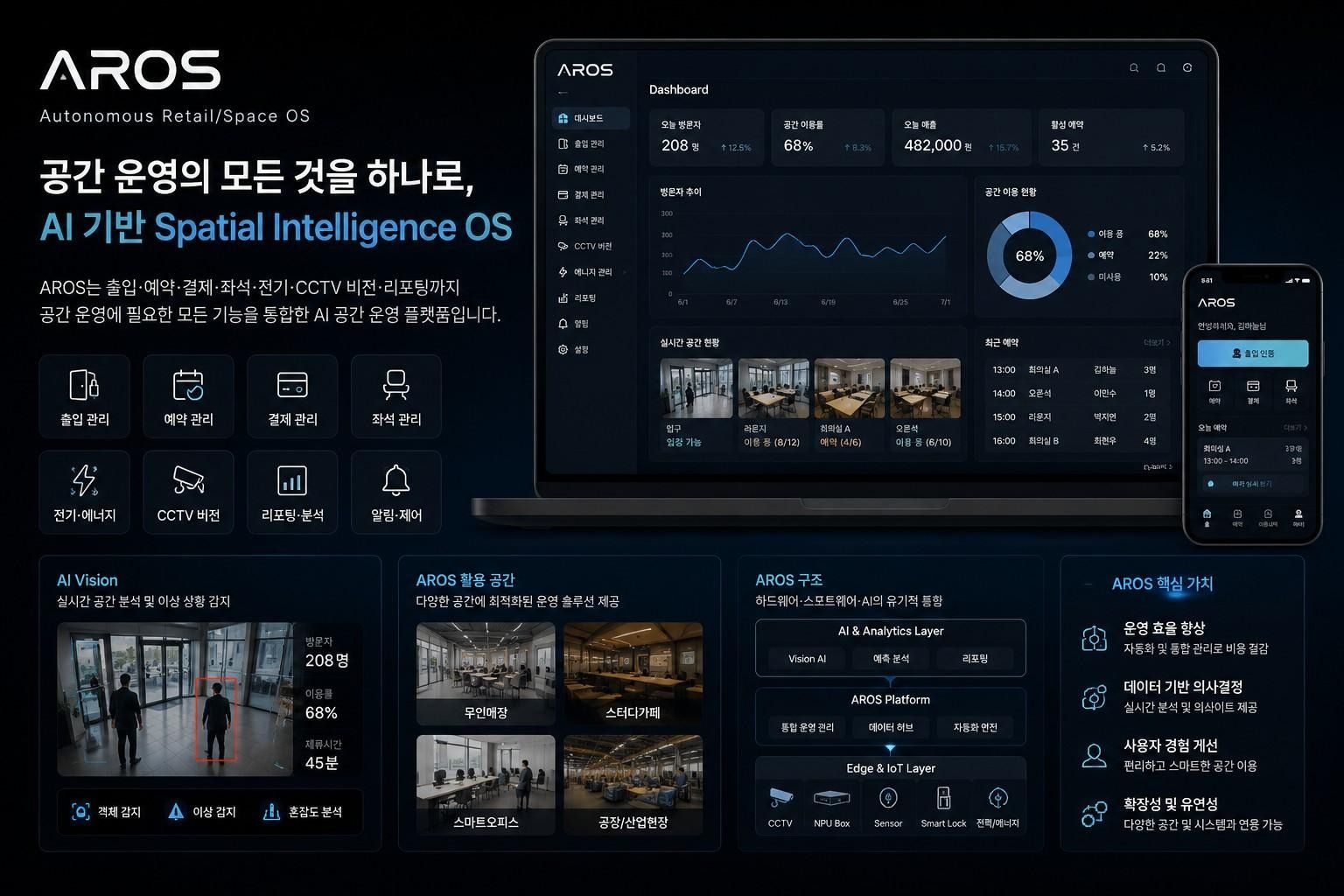
AROS system layout. Source: Hallowa company profile
Not vision AI, not robotics: the layer that tells both what to do
Kwon defines Hallowa by what sits on either side of it. A typical vision-AI company recognizes people and objects and turns them into data, and the process ends there.
A robotics company focuses on how the robot itself moves. AROS sits in between: it reads the whole space, decides what work is needed and passes that instruction to people, equipment and robots as API calls.
“The way people doing vibe coding these days exchange data over MCP, we check the spatial data and pass APIs to the people, things and robots in that space,” Kwon said. He also reached for Tesla. “Tesla drives cars with cameras and sensors around to build FSD. Think of us as the company that makes FSD usable for a space.”
The other difference, he said, is where the system was tested. Rather than a lab, Hallowa built AROS by running its own showroom, a dogfooding approach that gave it live operating data before it walked into a chip back-end plant.
From an end-of-day discount app to deep tech in six months
Hallowa was founded in Wonju in April 2023 and raised a seed round in April 2024, according to its company profile on startup database THE VC. It was also selected for TIPS, Korea’s government-backed tech startup program. Its first product was a location-based app, also called Hallowa, that pointed users to end-of-day discounts at nearby stores. Kwon said the company sold that app business last year. Today it lists its fields as AI, smart retail, smart buildings and facility management.
The spatial AI traces back to an eye-recognition patent Hallowa bought while it still ran the app. “Opening doors and paying was inconvenient, so we bought it to fix the user experience,” Kwon said. The camera-vision and payment work outlived the app. So did the company’s focus on customer behavior data and customer relationship management. Taking the unstaffed-space service from plan to live operation took a little over six months. “Software alone is fun, but I wanted to go into industrial spaces and do deep tech,” Kwon said.
A September U.S. tour, TechCrunch Disrupt in October, CES in January
Hallowa has no overseas revenue yet. “We have focused on the domestic business so far, and we have no real overseas sales track record,” Kwon said. In September he spent a little over two weeks in Seattle, Portland and New York meeting accelerators, prospective customers and potential PoC partners. In Portland, he said, talks about a soft-landing program and a place in an Intel-linked startup hub have gone well.
The choice of Portland follows the PoC.
The Portland area, known as the Silicon Forest, is home to Intel’s major manufacturing and research sites. “Silicon Valley, Seattle and New York are all good, but the competition is too intense,” Kwon said, adding that he wants to build references there first.
The region already courts Korean founders: Greater Portland Inc ran its first soft-landing program for 10 Korean startups in September 2025, together with the Gyeonggi Center for Creative Economy and Innovation (경기창조경제혁신센터).
The partners Hallowa listed for the event’s matchmaking were also overseas: retail, PropTech and SpaceTech companies in the U.S., Japan and Singapore; businesses and operators weighing a space-operations platform; global SI, distribution and facility-management partners; and investors and accelerators. Hallowa is aiming to enter the U.S. market in 2027. It is exhibiting at TechCrunch Disrupt 2026, held October 13–15 at Moscone West in San Francisco, and plans to attend CES in January. Kwon said the core task is to standardize the industrial PoC now running in Korea so it can be reproduced in the U.S. unchanged.

What Hallowa wants from NIPA: U.S. customers and local investors
Kwon named two goals for the program. “Education and consulting on the U.S. market matter, but first, we want chances to find PoCs and customers in the U.S. Second, we want help getting into local VC and accelerator programs and widening our network.” The company’s TechCrunch trip, he added, is getting substantial support through the AX program.
Outlook: turning the chip-plant PoC into a contract comes first
Hallowa’s next test is converting its semiconductor back-end PoC into a paid contract. Kwon conceded that a spatial OS “is not yet a fully established business, not just in Korea but in San Francisco too.” American manufacturers ask for on-site references before anything else, so how quickly Hallowa can carry data from its own workspace and its Korean plant PoC into a Portland pilot is likely to set the pace for its 2027 U.S. entry.
Policy is moving the same way. NIPA set up a physical AI task force for the first time this year, and the budget of its regional AX division is expected to top 400 billion won (about $300 million) next year, according to ZDNet Korea. A system that ties robots, equipment and people together at the level of a whole site speaks directly to the AI conversion that regional factories are being funded to make.
Quotations are from Hyukjin Kwon’s video interview with K-EnterTech Hub on October 6, 2026, translated from Korean; unquoted passages summarize the interview and company materials (event profile, AROS video). Won figures converted at 1,331.4 won to the dollar, the Seoul close on October 16.
Sources
· K-EnterTech Hub, video interview with Hallowa CEO Hyukjin Kwon (Oct. 6, 2026)
· Hallowa, Regional AX Bridge@KOREA company profile (Aug. 2026)
· Hallowa, AROS promotional video (Sept. 2026)
· Hallowa website https://www.hallowa.co.kr
· ZDNet Korea, first Regional AX Bridge@KOREA held (Oct. 15, 2026, in Korean) https://zdnet.co.kr/view/?no=20261015150836
· THE VC, Hallowa company profile (in Korean) https://thevc.kr/hallowa
· Greater Portland Inc, Greater Portland Inc. hosts South Korean startups (Sept. 2025) https://www.greaterportlandinc.com/news-and-events/news/p/item/65373/greater-portland-inc-hosts-south-korean-startups-in-hopes-of-getting-ground-floor-expansions
· Reworked, TechCrunch Disrupt San Francisco 2026 event listing https://www.reworked.co/events/conference/techcrunch-disrupt-san-francisco-2026/
· BetaNews, won closes at 1,331.4 per dollar (Oct. 16, 2026, in Korean) https://www.betanews.net/article/view/beta202610160138