

MEDIAGPT · ANALYSIS
Sinclair's The National Press packages work from about 1,200 local journalists for $5 a month, with Free Press alumni at New Media producing it for a fee and a revenue share
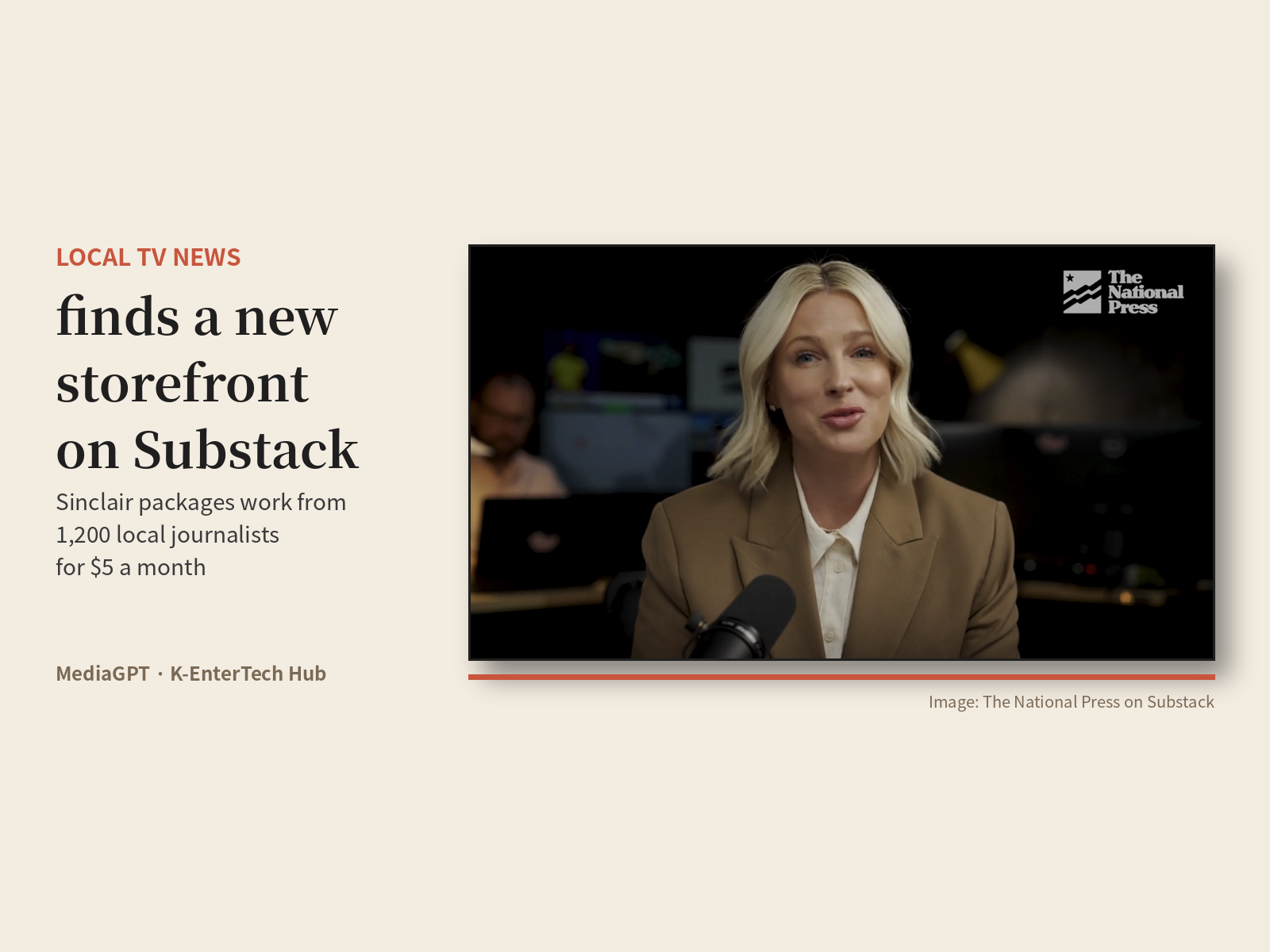
Sinclair, one of the largest local broadcast groups in the U.S., launched a national news brand on Substack on Oct. 6. The National Press, first reported by Axios, offers free and paid tiers and distributes its video and audio shows through YouTube, podcast apps and social platforms.
The raw material is Sinclair's existing local newsrooms. The service picks stories with national weight from roughly 1,200 journalists in more than 60 markets, rebuilds them into a 30-minute weekday morning show, and charges from $5 a month for the paid tier. "Our journalists cover the communities where national stories begin," Scott Livingston, Sinclair's senior vice president of news, said in the announcement. "The National Press will give that reporting national reach without losing the local knowledge that makes it valuable."
The reason is Sinclair's revenue mix.
The company earns from advertising and retransmission fees and, until now, nothing directly from viewers. In the second quarter core advertising fell 3% to $308 million, with $59 million in midterm political spending covering the gap.
The launch, TheWrap's A.J. Katz wrote, tests whether trust in Sinclair's local stations can carry over to a national, direct-to-consumer news product.
Sinclair did not build the operation itself. New Media, a startup founded by veterans of Bari Weiss's The Free Press, produces and runs it for a monthly fee plus a share of revenue. Chief executive Chris Ripley told Axios that revenue growth is the top measure of success, followed by subscriber growth, and declined to give targets. Sinclair bought the digital news brand Circa in 2015 and shut it four years later; this time it has chosen to share the risk with an outside producer.
Three shows, one anchor, $5 a month
Lyndsay Keith, an independent journalist who previously co-hosted a show on Newsmax, leads the service.
According to Sinclair's announcement, the weekday show The National Press has Keith frame each story and bring in the local reporter who broke it. The National Story is a weekly deep dive on a single story; The National Debate pairs two people who disagree.
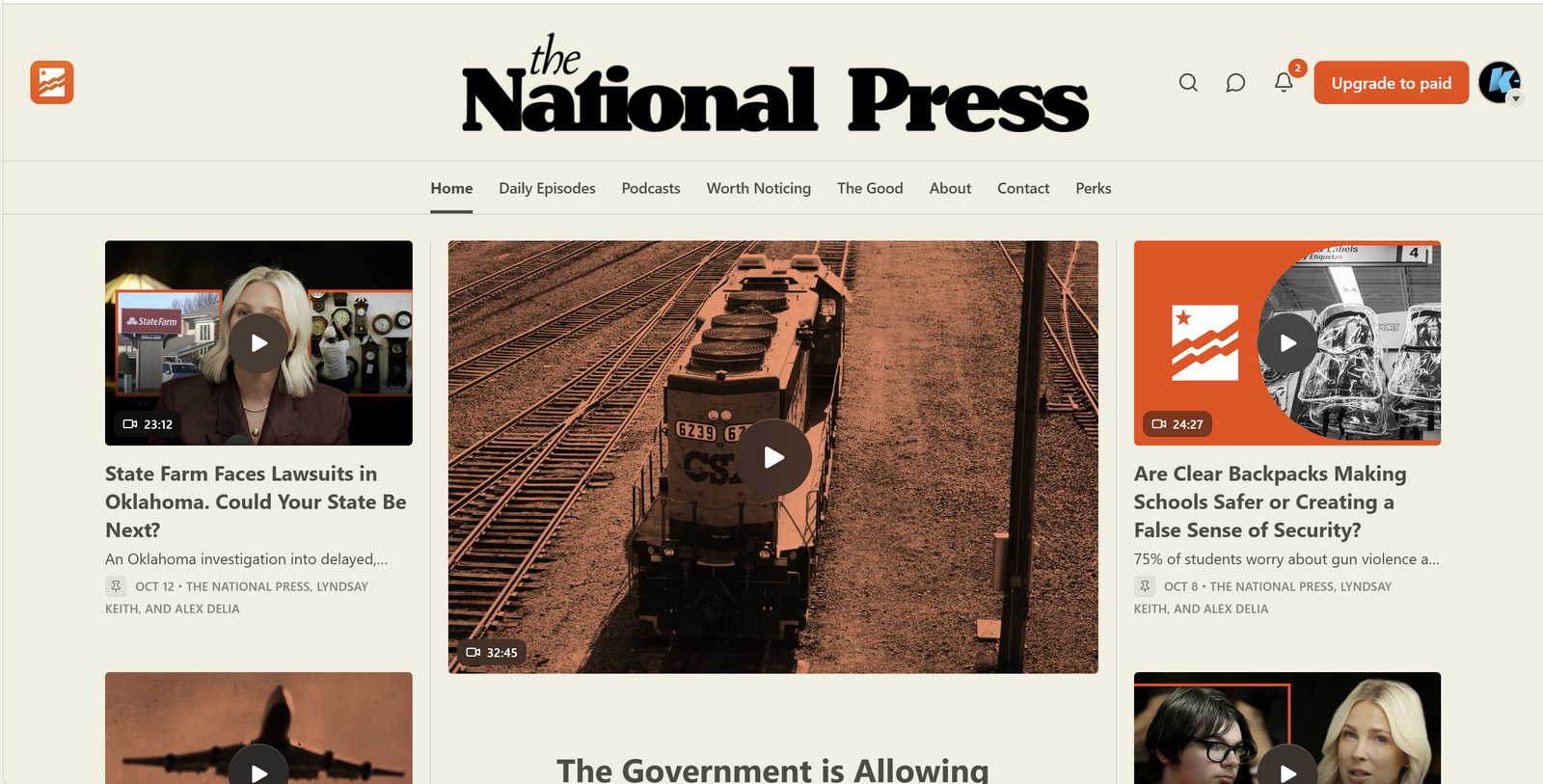
The National Press on Substack: a video hosted by Lyndsay Keith sits at the top of the feed, under an Upgrade button for paid tiers. Image: The National Press on Substack
Paying members get ad-free and extended versions of shows plus subscriber-only content. Nieman Lab reported on Oct. 7 that subscriptions start at $5 a month or $50 a year and include community chat and merchandise. The first episode covered Michigan's review of life sentences for people sentenced at 18 to 20 and congressional fights over AI regulation. The site's first five posts drew seven to 14 likes each.
Kevin Cotlove, Sinclair's chief digital officer, said the venture gives the company's local reporting "a new destination" and a direct audience relationship. NewscastStudio noted that launch photos appear to show the set built for The National News Desk, Sinclair's free national news service, with a new logo. The free service continues, so the same local reporting now feeds both a free broadcast product and a paid subscription.

New Media takes a production fee and a share of revenue
New Media founder Alex Chitty is a former Vice producer whom The Free Press hired as head of video in early 2024.
The company helps legacy newsrooms build subscription businesses. Sinclair pays it monthly, and New Media also takes part of The National Press's revenue, which Chitty said gives his firm a financial stake in the outcome. "We only succeed if the partner succeeds," he told Axios. Advertising and sponsorship are not in the initial plan, though Chitty said they could be added later.
Vice Media co-founder Shane Smith is an investor in New Media and a partner in the venture. Several Free Press journalists have joined New Media, including former executive producer and host Raf Siewert.
The Free Press launched at $8 a month in December 2022. Paramount Skydance bought it in October 2025 in a deal reported at about $150 million and made Weiss editor-in-chief of CBS News. Citing the Financial Times, SAN reported that the outlet then had about 1.5 million subscribers, more than 170,000 of them paying, and over $15 million in annual subscription revenue. The team that grew a Substack outlet to a sale is now applying the same playbook to a broadcaster's reporting. Substack says on its about page that it has passed 5 million paid subscriptions; it keeps 10% of paid revenue.
Revenue of $840 million in the second quarter, and a new race for scale after the FCC lifted the cap
Sinclair's second-quarter revenue rose 7% to $840 million. Adjusted EBITDA climbed 45% to $149 million, while the net loss widened to $76 million from $64 million, NewscastStudio reported. Political advertising drove the growth, rising from $6 million to $59 million, 9% above the second quarter of the 2022 midterm cycle.
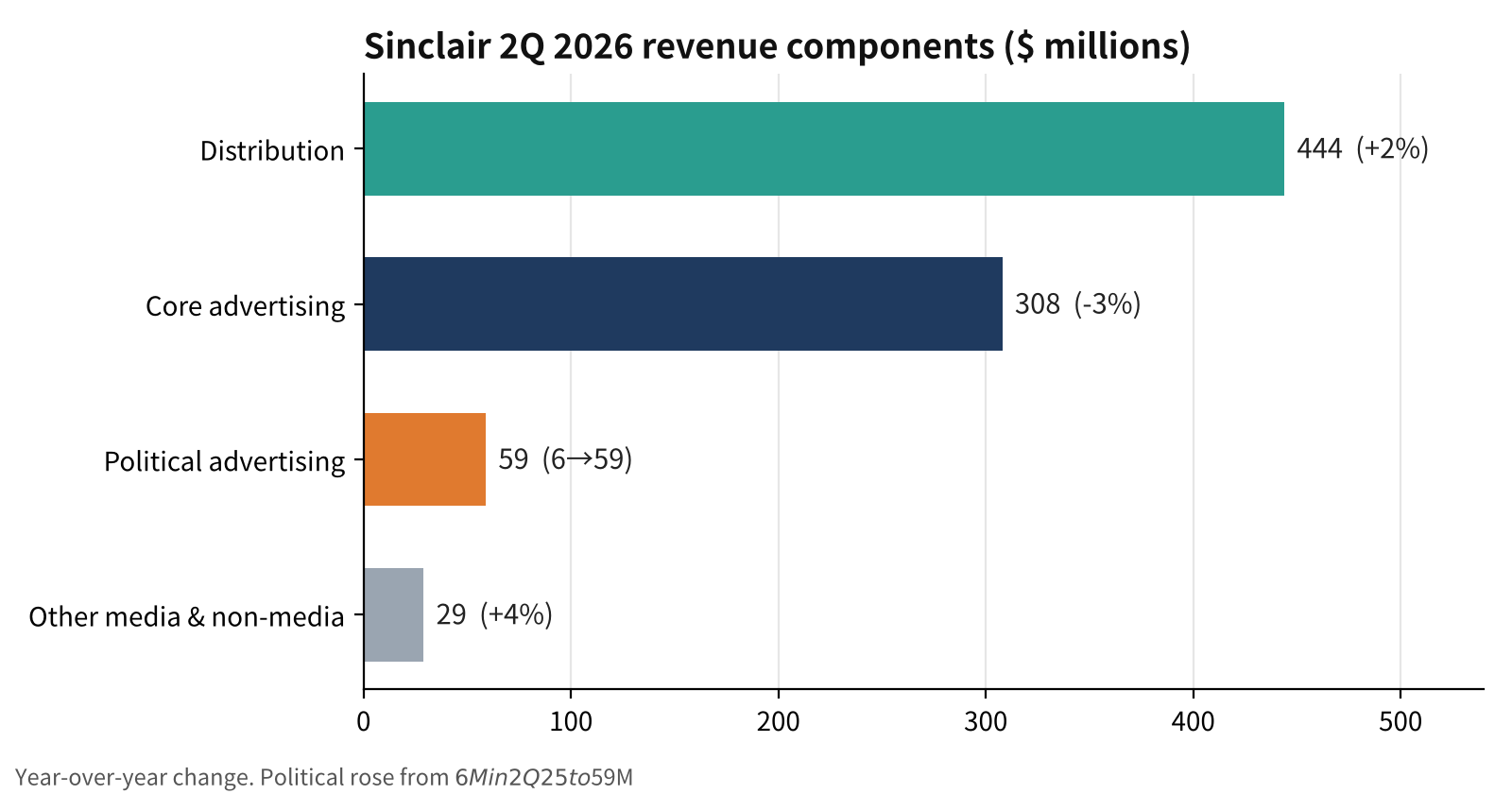
Sinclair's second-quarter 2026 revenue components. Source: Sinclair earnings release
Sinclair second-quarter 2026 results. Sources: Sinclair; NewscastStudio
Distribution revenue, at $444 million, remains the largest line; core advertising slid 3%. Sinclair raised its full-year political forecast to at least $375 million but left total revenue guidance at $3.4 billion to $3.54 billion. Political money disappears in off years.
The rules have changed too. On Aug. 6 the Federal Communications Commission voted 2-1 to eliminate the cap that barred a single owner's stations from reaching more than 39% of U.S. TV households, Axios reported. Ripley said that day the decision "will set the stage for local broadcasters to begin to compete on a more level playing field." Sinclair bought 8.2% of rival E.W. Scripps in November 2025 and proposed a combination; Scripps's board rejected it, and Sinclair said in January that its last offer carried a premium of more than 240%. Nexstar's purchase of Tegna was on hold as of August amid an antitrust suit by DirecTV and several state attorneys general. Alongside the race to own more stations, Sinclair is now trying to earn direct revenue from the newsrooms it already has. The National Press "could very well be a core part of our digital offering, if we hit the targets and the expectations that we have," Ripley said.
Circa closed after four years, and the bias question follows Sinclair
This is Sinclair's second attempt at a national digital news brand. It bought mobile news startup Circa in 2015, relaunched it nationally and shut it down four years later. Ripley told Axios that Circa was a "failure" but that partnering with New Media should "significantly mitigate" the risk. Circa required building an organization; The National Press reuses reporting already being produced and outsources production.
Perceptions of Sinclair are the other hurdle. Viewers mostly deal with its local stations, but the company has long faced criticism over the conservative bent of some nationally distributed programming and editorial decisions, TheWrap noted; PBS NewsHour among others has examined the partisan tilt of its local news. Asked by Axios about critics who see The National Press as another right-leaning outlet, Ripley said, "They should tune in and judge for themselves." Sinclair did not immediately respond to TheWrap's request for further comment.
Anchors go independent, cable news sells memberships
Sinclair is entering a market TV journalists are already testing. Axios reported on Sept. 16 from the Status Summit in New York, where Don Lemon, let go by CNN in 2023, said his audience had grown younger since he launched Lemon Media Network; he has nearly 7 million followers across Instagram, YouTube and TikTok. Mehdi Hasan, who left MSNBC in 2024 to start Zeteo, has more than 700,000 free newsletter subscribers on Substack and reported over 45,000 paid subscribers in April 2025.
Cable networks are selling memberships too. Versant's MS NOW launched one on Sept. 9 at $7.99 a month or $79.99 a year. Semafor reported that it was designed from surveys and interviews with 18,000 viewers and bundles a 24-hour live feed, members-only content and access to on-air talent. Comscore data supplied by the network showed less than 10% overlap between its TV and digital audiences, The Desk reported. MS NOW president Rebecca Kutler is targeting news-heavy viewers in their 20s to 40s who don't have cable.
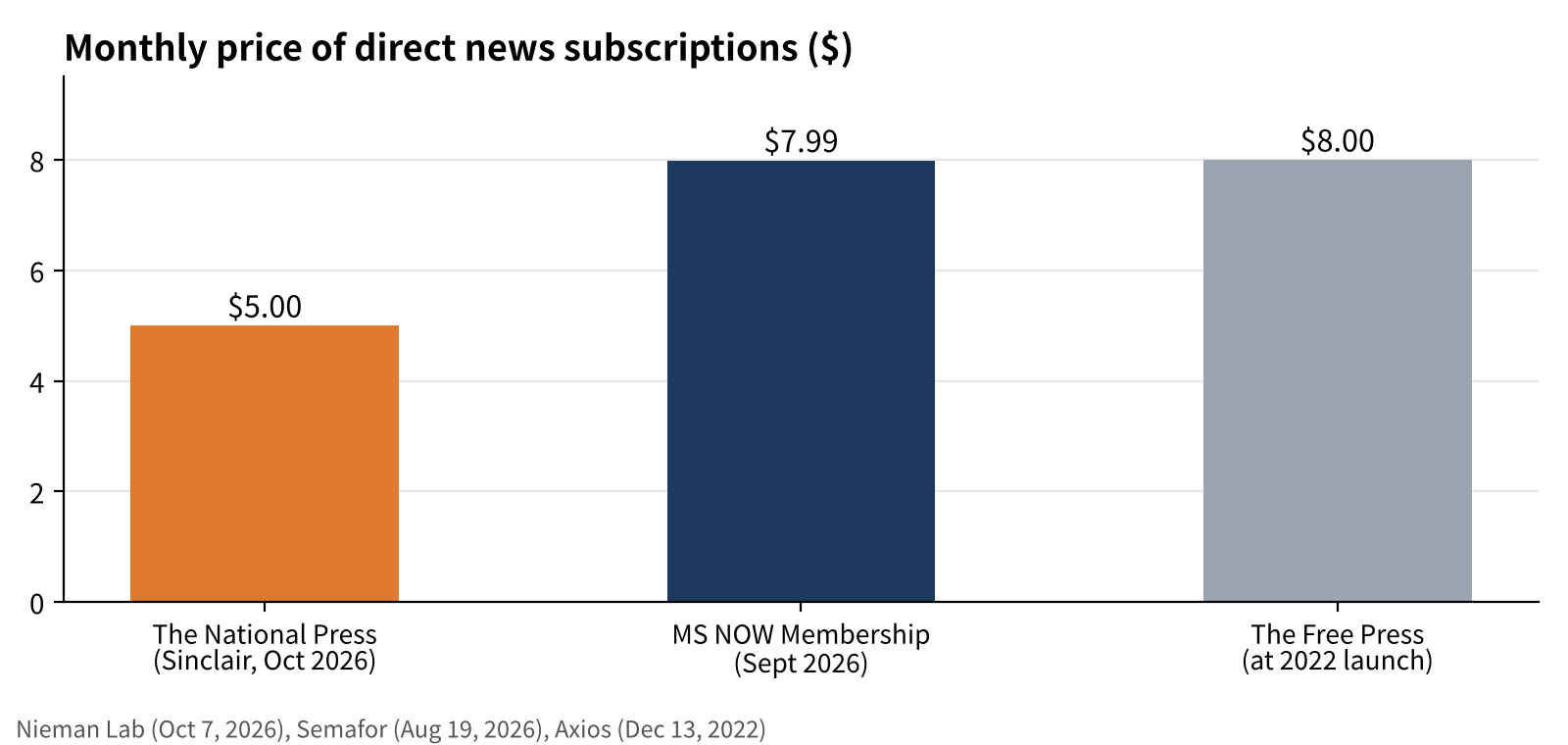
Monthly prices of direct news subscriptions. Sources: Nieman Lab, Semafor, Axios
Direct-to-audience outlets built from U.S. TV news. Sources: Axios, Nieman Lab, Semafor, SAN (citing FT)
Veteran cable producer Jonathan Wald told the summit that the collapse of the network system that raised him had created opportunities nobody could have imagined three or four years ago. The other ventures rest on one anchor's following or a cable channel's audience; Sinclair's rests on a payroll of local reporters.
South Korea (한국): portals are the main gateway for 61%; only 8% go direct
The starting conditions in South Korea are different. In the Reuters Institute Digital News Report 2026, as analysed by the Korea Press Foundation (한국언론진흥재단) on June 16 (CBS Nocut News (노컷뉴스)), 61% of Korean respondents named portals and other search and aggregation services as their main way to news in the past week, nearly double the 48-market average of 31% and second only to Japan (65%). That share has fallen every year from 76% in 2019. Just 8% go directly to news sites or apps, against an average of 22%; only Thailand (7%) is lower.
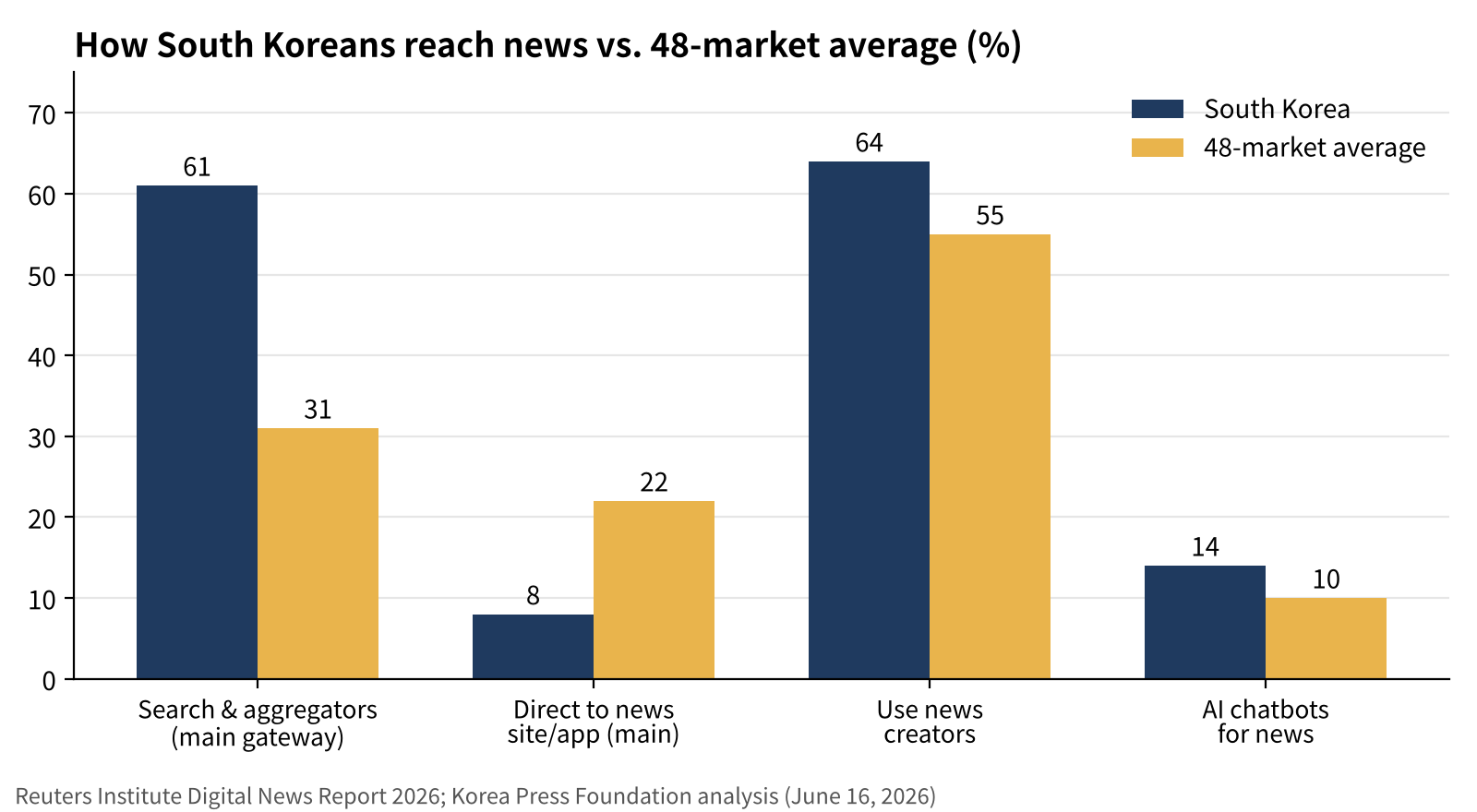
How South Koreans reach news vs. the 48-market average. Sources: Reuters Institute; Korea Press Foundation
Key South Korea figures, Digital News Report 2026. Sources: Reuters Institute; Korea Press Foundation
Attention that left the portals has moved to social platforms and creators. Social media as a main gateway rose from 9% in 2019 to 21%, and news use on KakaoTalk (카카오톡) and Instagram roughly doubled in a year. YouTube news use is above average, particularly among people in their 50s and over. Some 64% use news creators (average 55%), and the share getting news from AI chatbots doubled from 7% to 14%.
Overall trust in news is 30%, below the 37% average, but broadcasters top the brand table: MBC (문화방송) at 60% for a fourth straight year, then JTBC (59%), SBS (56%), YTN (54%) and KBS (한국방송공사, 53%). The habit of paying is weak. In the 2023 report, as reported by the Journalists Association of Korea (한국기자협회), 11% of Koreans had paid for online news in the past year, about half the U.S. rate. The 2025 report found YouTube news use split 63% among conservatives and 43% among progressives, against a 48-market average that barely differed by ideology.
Broadcast ad spend down 20% in two years; JTBC in rehabilitation, all 16 regional MBCs losing money
Broadcast advertising in Korea fell to KRW 3.22 trillion ($2.4 billion) in 2024 from KRW 4.02 trillion in 2022, a 20% drop, according to the survey by the Korea Communications and Media Commission (방송미디어통신위원회) and KOBACO (한국방송광고진흥공사). Terrestrial advertising fell 7.2% in a year to KRW 1.23 trillion, while online took 59% of the total at KRW 10.1 trillion. KOBACO estimated that broadcast advertising fell roughly another 13% in 2025, and in its 2026 media-use survey only 67.5% of respondents had seen a TV ad in the past month, down 10.9 points, against 86.1% for YouTube.
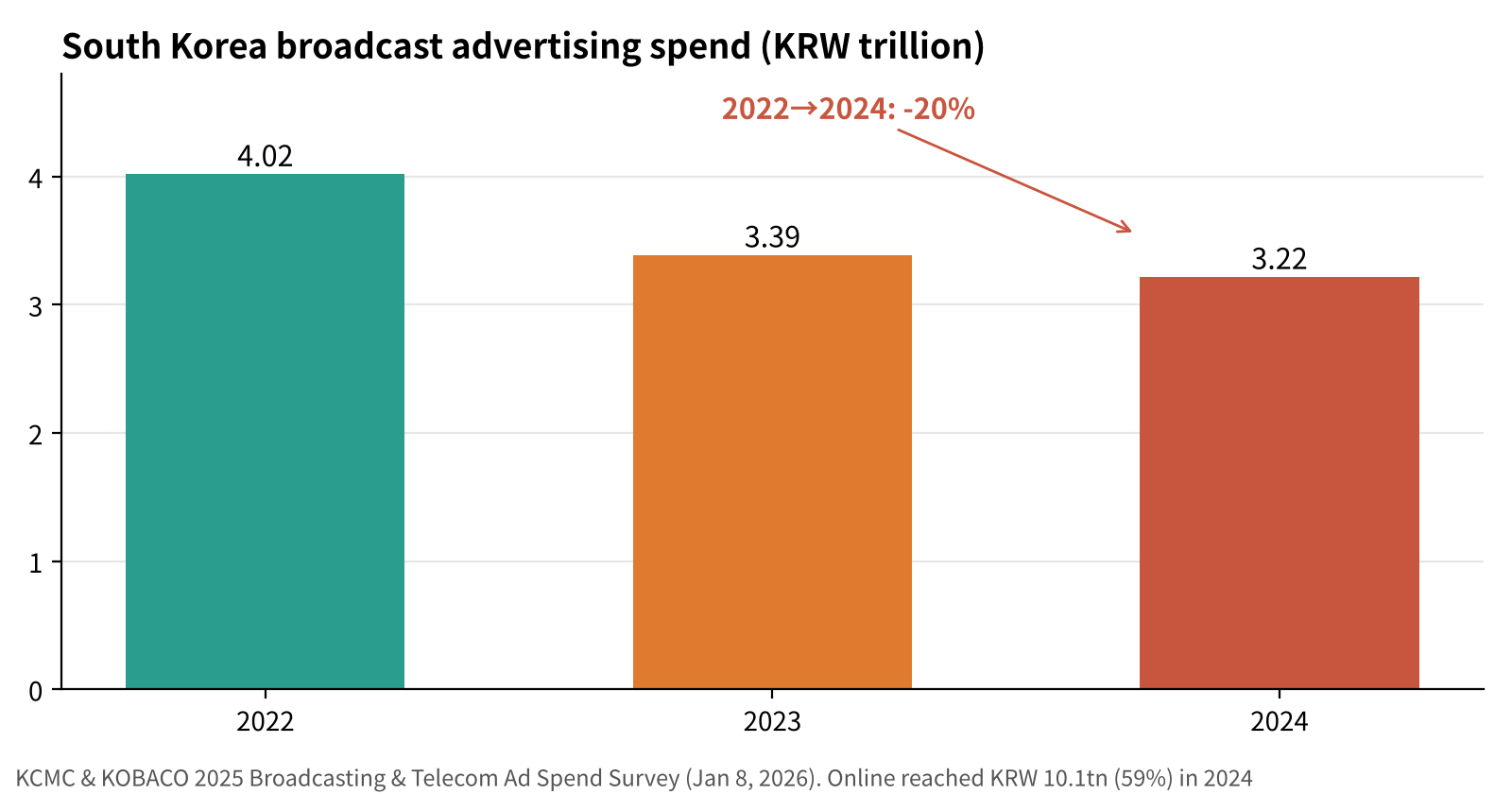
South Korea broadcast advertising spend. Source: KCMC and KOBACO
Shrinking ad revenue and sports-rights bills have reached balance sheets. JTBC defaulted on KRW 20.6 billion ($15.4 million) of asset-backed borrowing on June 12, and on Aug. 28 the Seoul Bankruptcy Court (서울회생법원) opened rehabilitation proceedings, citing the growth of streaming services, rising production costs, a shrinking broadcast ad market, concentrated Olympic rights payments and a liquidity crisis across the JoongAng Group (중앙그룹). JTBC is pursuing a sale; its rehabilitation plan is due by the end of January 2027.
Regional broadcasters are in worse shape. Ad revenue at Korea's 16 regional MBC stations (지역MBC) fell 57%, from KRW 218.8 billion ($163 million) in 2014 to KRW 94.3 billion ($70 million) in 2024, according to government survey data reported by the Journalists Association of Korea in January.
All 16 posted operating losses on average over 2023-2025, the same publication reported in April, ranging from about KRW 90 million a year at Mokpo MBC to KRW 11.3 billion at Busan MBC. Jeju MBC borrowed KRW 2.56 billion from banks in 2025 and Pohang MBC KRW 1 billion, and monthly ad revenue in the first quarter of 2026 was down 10% to 20% year on year.
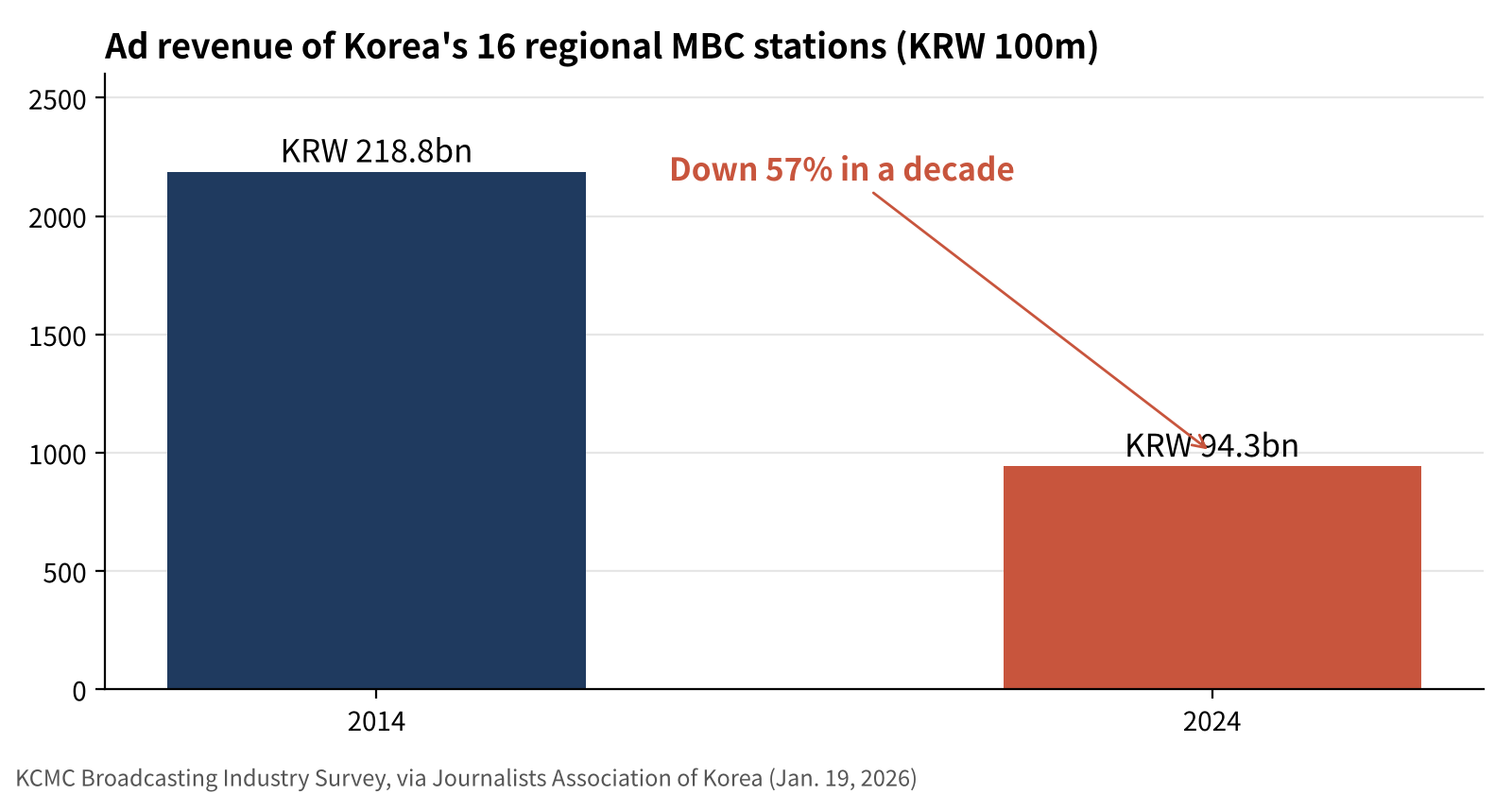
Ad revenue at Korea's 16 regional MBC stations. Source: KCMC Broadcasting Industry Survey, via Journalists Association of Korea
In a joint statement on Jan. 19, ad managers at the 16 stations said regional terrestrial broadcasters faced a threat to their very existence from "a Seoul-centred media structure and an outdated advertising system," and called for a negative-list approach to ad regulation, more virtual, indirect and mid-programme advertising, and separate support for regional broadcasters. Their demands centre on loosening ad rules; none involves charging viewers directly.
Most-trusted Korean news brands (DNR 2026) and broadcast ad indicators. Sources: Reuters Institute; KCMC; KOBACO; Journalists Association of Korea
The message for Korean broadcasters: sell the reporting you already make, directly
What Sinclair built is a wrapper and a storefront, not a newsroom. It selects stories its stations already produce, has an anchor bring in the reporters who wrote them, and hands production to an outside firm that has grown a subscription outlet before, paid partly through revenue share. Korean terrestrial and general-programming broadcasters also produce daily reporting at headquarters and in the regions, and most of it ends its life after broadcast as portal supply or ad-supported YouTube clips.
The storefront has to be where audiences already are.
only 8% of people go directly to news sites, a standalone newsletter product starts from a low base. Koreans are on portals, YouTube and KakaoTalk, and news use on KakaoTalk and Instagram doubled in a year. Sinclair itself distributes the free show on YouTube and podcasts and takes payment on Substack. For Korean broadcasters, the data point toward paid tiers on existing YouTube channels or messaging channels.
Brand trust has to move to people.
five of the most-trusted news brands in Korea are broadcasters, while 64% of people use news creators. Audiences follow individuals; trust sits with broadcast brands. A subscription product fronted by anchors and beat reporters uses both. As Lemon and Hasan show, if networks leave that space empty, journalists leave and build the same product themselves.
Production can be tested with outside partners on revenue share.
Sinclair built Circa in-house and closed it after four years; this time it pays a monthly fee plus a cut of revenue. For Korean broadcasters struggling to add fixed costs as ad revenue falls, sharing results with a studio experienced in digital subscriptions and creators lowers upfront cost and risk.
The value of subscriptions lies in the relationship and the data.
Sinclair booked $308 million in core advertising in one quarter; The National Press is a $5 product, and only about 11% of Koreans pay for online news. With broadcast ad spend down 20% in two years and TV ad reach down 10.9 points in one, direct subscriptions matter less as replacement revenue than as a route to logged-in viewers and usage data, which in turn feed ad sales and programming.
Fairness rules come before the product.
Korean YouTube news use splits 63% among conservatives and 43% among progressives, a far wider gap than the 48-market average. Subscription products lean on loyal users and drift toward partisan bases easily. Broadcasters whose news brands are subject to broadcast review should publish editorial and fairness rules for subscription products before launch. JTBC's news brand ranked second for trust (59%) even as the company seeks a buyer under court supervision; subscribers and subscription revenue could become a measure of what a news brand is worth beyond ratings.
The message for regional broadcasters: local reporting is the raw material for a national product
The National Press starts with local reporters. Sinclair reselects their stories for a national audience and puts them on screen to explain what they found, so local reporting becomes the raw material of a national product rather than staying inside local schedules. Korea's 16 regional MBC stations, regional commercial broadcasters and KBS regional bureaus produce local stories every day. For regional MBCs, whose ad revenue has fallen 57% in a decade, this is a revenue source they can test independently of ad deregulation.
A shared brand works better than single stations.
Sinclair's advantage is the scale to put reporting from 60-plus markets under one brand. A single Korean regional broadcaster lacks the volume of reporting and the audience for a national subscription product. A joint brand pooling the reporting of the 16 regional MBCs or the regional commercial broadcasters under one channel and host could recreate Sinclair's conditions, with shared editing and presenting and revenue split by contributed reporting.
Local stories national outlets miss are the differentiator.
The National Press's first episode dealt with Michigan's review of life sentences, and a recent post covered insurance lawsuits in Oklahoma. Stories that national outlets pick up late, explained by the reporter who covered them first, are what set the product apart. In Korea, regional development, local councils, regional industry and disasters, which regional broadcasters cover first and in depth, would not overlap with Seoul-based outlets.
Support policy can widen its scope.
The regional MBCs' January statement asked for ad deregulation and separate support. Sinclair's case suggests that the start-up cost of repackaging local reporting into digital subscriptions, and partnerships with outside producers, could also qualify for support. Given how quickly the ad market is shrinking, survival plans for regional broadcasters would need to include experiments in direct viewer revenue alongside ad sales.
Outlook: revenue first, subscribers second, and the Nov. 3 midterms as the first test
Ripley's yardstick is revenue growth first and subscriber growth second. Ads and sponsorships are out for now. In its first week The National Press is free to read and engagement is measured in dozens of likes. Demand for political news ahead of the Nov. 3 midterms will be its first real test, and will show how perceptions of Sinclair's politics affect conversion to paid.
The product scales with Sinclair's newsrooms. If the end of the FCC cap lets Sinclair buy more stations, the pool of source reporting grows; if local advertising keeps shrinking and newsrooms are cut, the raw material shrinks with it. The National Press tests whether local reporting can earn national subscription revenue, and whether digital money can help carry the cost of keeping local newsrooms open.
In Korea, broadcast advertising keeps falling, JTBC's rehabilitation plan is due in January 2027, and all 16 regional MBCs are losing money. Portal dependence declines each year and news use is moving to creators and messaging apps. The longer broadcasters, regional ones above all, wait to sell the reporting they already produce directly to viewers, the more of that space goes to individual journalists and outside creators.